
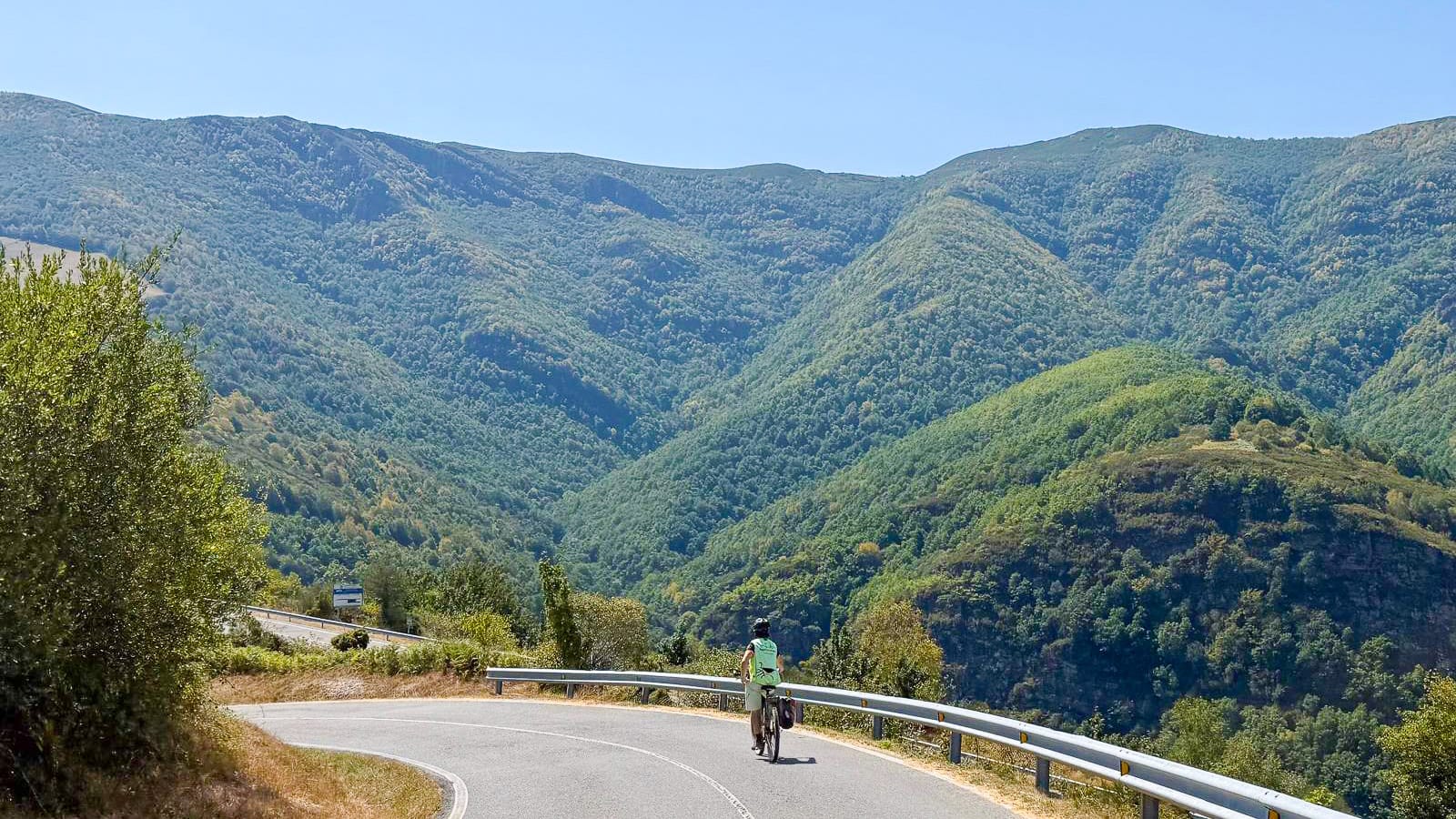

Cycling the Camino Francés takes you from the Pyrenees in France to Santiago de Compostela in Spain. Riding through vineyard country, open plains and the green hills of Galicia, it is a journey with plenty to tempt a travel-loving cyclist.
Choosing the right route and allowing enough time makes a real difference.
Should you ride the whole Camino Francés, or start in León? How demanding are the climbs? And how do you combine a cycling holiday with the slower, experience of the historic pilgrimage route?
To help you plan, we spoke to Sérgio Marques, founder and route designer at Top Bike Tours Portugal. Based in Porto, Sérgio has been cycling the Camino de Santiago for more than 13 years. Over that time, he has ridden different sections of the route, refined cycling itineraries, and helped hundreds of cyclists plan their own journey to Santiago de Compostela. His knowledge comes not only from personal experience on the Camino but also from more than a decade of designing and operating Camino cycling tours.
His company grew from a small bike hire and maintenance shop, inspired by a cycling journey to Santiago. Today, he plans the practical support for guests making that journey themselves.
Below, Sérgio shares what he enjoys about the route, who it suits and the practical details to consider before setting off. His company offers both a full journey from Saint-Jean-Pied-de-Port and a shorter option from León.
Over to you, Sérgio…

Sérgio Marques is the founder of Top Bike Tours Portugal.
He has a background in accounting and a lifelong love of sport, including a particular passion for cycling. The idea for the company came after a life-changing ride with friends to Santiago de Compostela in 2012. From that journey, Top Bike Tours Portugal was born. Sérgio's aim was to share authentic cycling experiences.
Today, Sérgio manages the business and occasionally leads tours himself, especially for larger groups. He speaks Portuguese and English.
We love to introduce our community to cycling businesses, destinations and ideas that we think are genuinely interesting. Top Bike Tours Portugal caught our attention because of its focus on this popular tour and similar routes in France, Spain and Portugal. We were therefore pleased to work with the Top Bike Tours Portugal team on this article.
Top Bike Tours Portugal paid for this advertisement feature. Our decision to collaborate reflects our view that the brand is relevant to our readers; it is not a formal approval, audit or guarantee of its services. Unless we expressly say otherwise, we have not personally taken the trip described or independently verified information supplied by Top Bike Tours Portugal.
As with any travel purchase, please check the latest trip details, terms and customer protections directly with Top Bike Tours Portugal before booking. Any booking is made with Top Bike Tours Portugal, not Epic Road Rides.
Always check current travel information and advice. For visitors from the UK, the UK government travel information pages are here.
Table of contents
This article contains a lot of useful information. To help make it more digestible, we’ve broken it down into several parts:
- Part 1: Route overview
- Part 2: Why ride the Camino Francés?
- Part 3: Choosing your route
- Part 4: Practicalities
- Part 5: Preparation and tips
- Part 6: Top Bike Tours Portugal
Sponsor Message
Take the stress out of planning your Camino Francés trip!
Top Bike Tours Portugal have been helping cyclists enjoy unforgettable bike tours since 2013. Their Camino Francés trips include carefully planned routes, hand-picked accommodation and luggage transfers - all arranged for you.
Choose between guided and self-guided tours to experience the Camino your way.
Head to their website to find out more.
Got a question for Sérgio Marques from Top Bike Tours Portugal?
Fill out this form and we will pass it to Top Bike Tours Portugal who aim to reply (within 24 hours wherever they can!)
Part 1: What should you know about cycling the Camino Francés?
What is the Camino Francés and where does it go?
The Camino Francés, also called the French Way, is a historic pilgrimage route to Santiago de Compostela in north-western Spain. It is one of the best-known routes of the Way of St James. People follow it on foot and by bike, travelling towards the cathedral associated with the tomb of Saint James.
Despite the name, most of the journey is in Spain. The full route starts in Saint-Jean-Pied-de-Port, on the French side of the Pyrenees. It then crosses into Navarre and continues west through La Rioja and Castile and León before entering Galicia.
Historically, a pilgrimage was a journey to a place of religious or spiritual significance. For the French Way, the pilgrimage has shaped the places you pass on the route. Churches, bridges, monasteries and former pilgrim hospitals are part of the route, alongside the cafés and accommodation that welcome travellers today. Some people come for religious reasons; others want a physical challenge, time to reflect or the chance to explore northern Spain slowly.
The Camino Francés also forms part of the UNESCO World Heritage-listed Routes of Santiago de Compostela in Spain.
For a broader introduction to the different routes, see Epic Road Rides’ guide to cycling the Camino de Santiago.
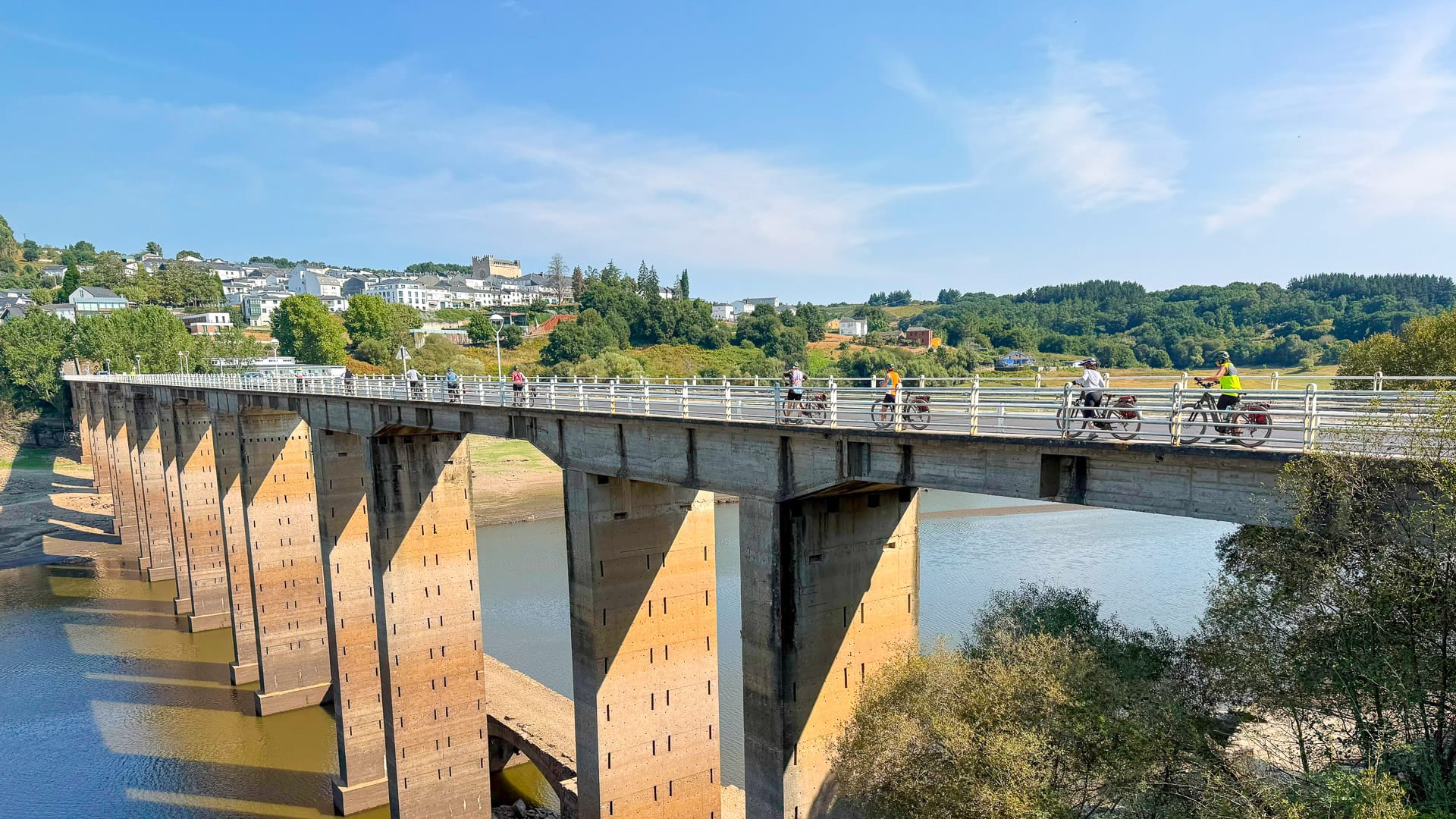
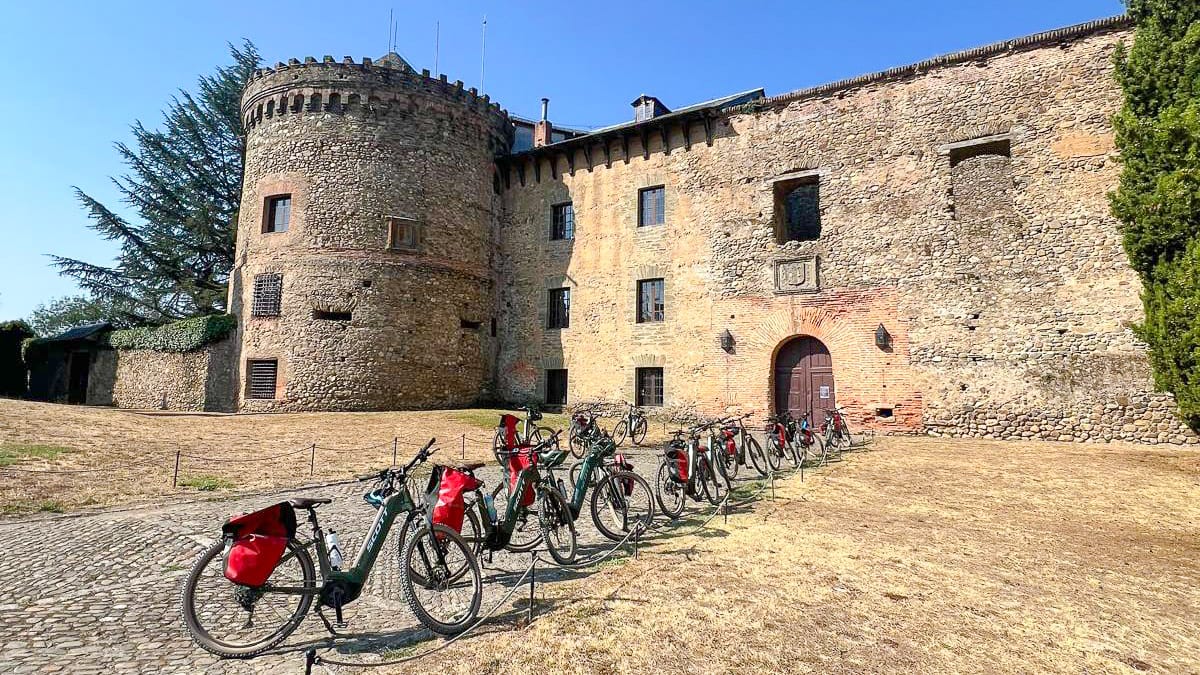
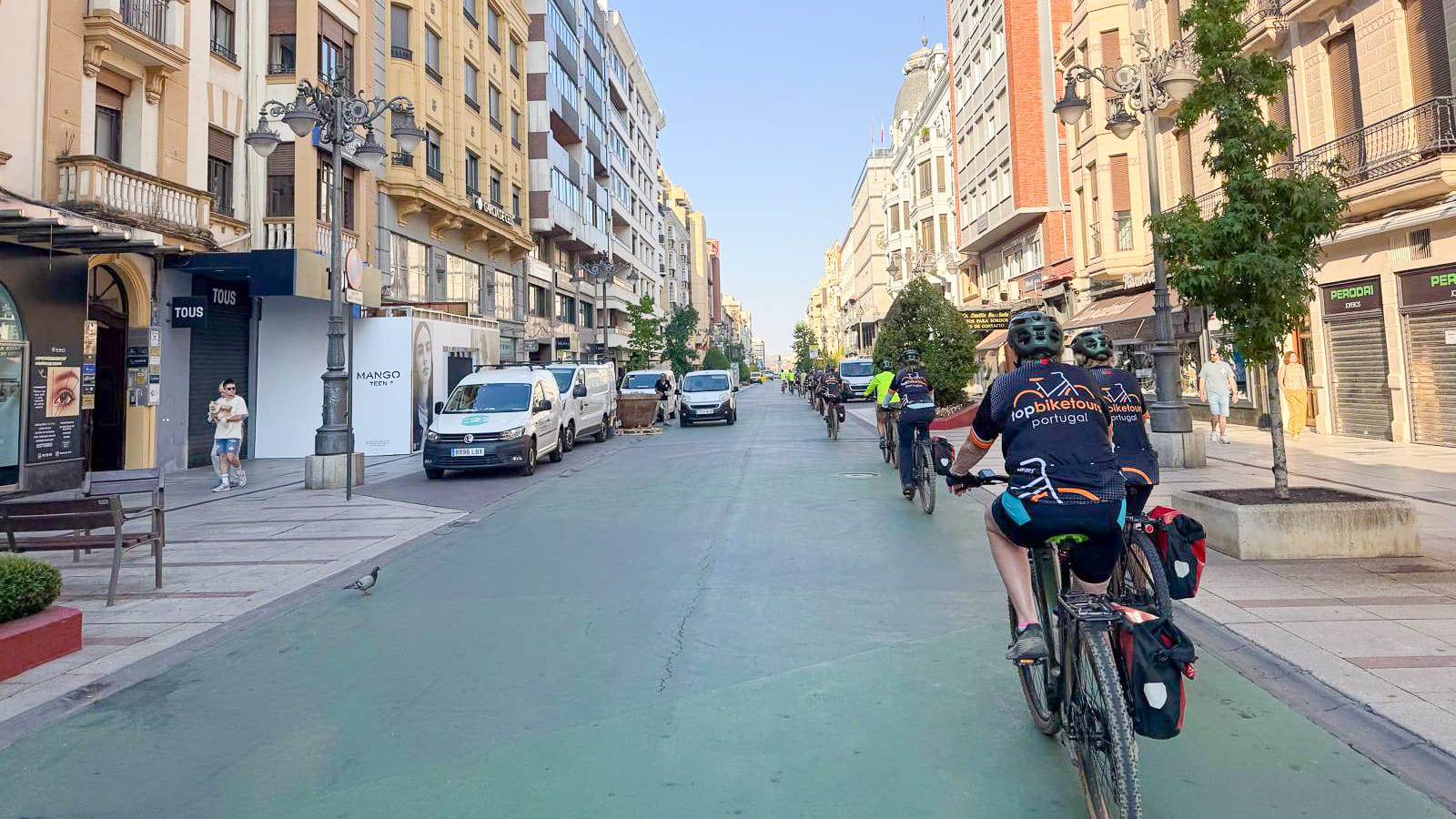
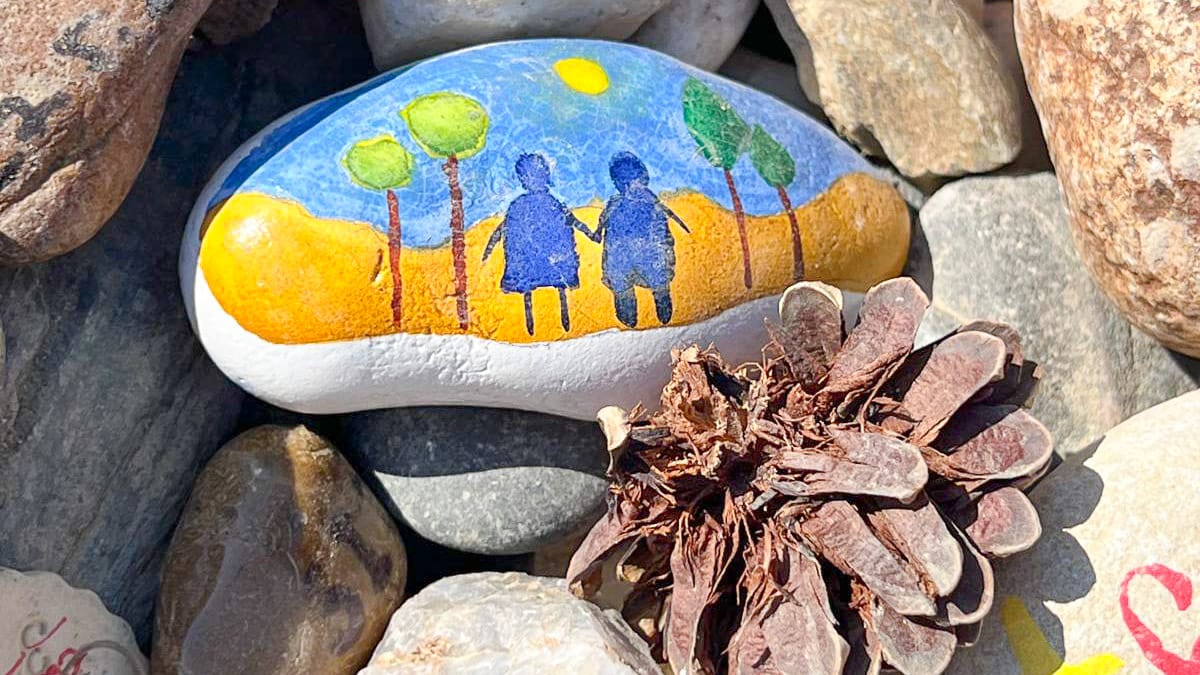
How long is the Camino Francés and how many days do you need?
The complete route from Saint-Jean-Pied-de-Port to Santiago is roughly 780 to 800 kilometres, depending on the route you follow. Our full tour itinerary covers approximately 791 kilometres, over 16 days and 15 nights, with 13 riding days and a rest day in León.
Our shorter León to Santiago cycling tour covers approximately 320 kilometres over eight days and seven nights, with six riding days. It gives you time in the western part of the French Way, including the mountains before Galicia and the approach to Santiago.
Choose an itinerary that suits the riding you enjoy. Allow for arrival, departure and rest days as well as riding days. Distance alone will not tell you how demanding a day will be. Note that what looks like a short mountain stage can still take several hours!
What does the full Camino Francés journey look like?
Your journey begins in Saint-Jean-Pied-de-Port, where you have time to explore before setting off by bike the following day. On day two, the route crosses the Pyrenees from Saint-Jean-Pied-de-Port to Roncesvalles. The climbing begins straight away.
Beyond Roncesvalles, we ride through Navarre’s countryside and villages towards Puente la Reina on day three.
On day five, the route continues from Puente la Reina to Logroño. Day five takes you onwards to Santo Domingo de la Calzada. Vineyards become a familiar part of the view as we travel through the Rioja wine region.
We reach Burgos on day six. From here, the landscape begins to change as the route approaches the Meseta, the high plateau across central Spain.
Day seven takes us from Burgos to Carrión de los Condes. On day eight, the journey continues via Sahagún towards León. These stages feel quite different from the mountainous start of the Camino.
After León, day 10 takes us to Astorga. On day 11, we continue towards Ponferrada and the Bierzo region. There are more mountains ahead before the greener countryside of Galicia.
We reach Santiago de Compostela on day 15, during the stage from Melide. After spending the night in Santiago, there is time to enjoy the city, the cathedral and the atmosphere of this famous pilgrimage destination before departure on day 16.
Do cyclists follow the same Camino as walkers?
We follow the traditional Camino as closely as is practical for cycling, passing through many of the same towns and villages. However, a walking path is not automatically a suitable bike route.
Some sections have loose stones, steep gradients or narrow paths where passing walkers is difficult. Our routes use cycling alternatives where necessary, including roads and other tracks. You still experience the Camino, but the route needs to suit the bicycle and the rider.
One of the best-known examples is the climb from Saint-Jean-Pied-de-Port to Roncesvalles, where some sections of the traditional pilgrim path are very steep, rocky and difficult to ride. Cyclists typically use suitable mountain roads and tracks that cross the Pyrenees while still following the Camino route closely.
Another example is the stretch between Burgos and León, where walkers often follow paths directly across the Meseta. Cyclists may alternate between Camino tracks and quiet local roads, depending on surface conditions, wind and comfort.
Particularly after Sarria, the Camino becomes much busier with pilgrims on foot. Some narrow woodland sections and village trails are not ideal for cycling, so we occasionally use nearby roads or wider tracks before rejoining the Camino.
This is one reason we provide stage-by-stage GPS routes on our tours. Following yellow arrows alone does not tell you whether the next section is appropriate for your bike or handling skills.
Sponsor Message
Take the stress out of planning your Camino Francés trip!
Top Bike Tours Portugal have been helping cyclists enjoy unforgettable bike tours since 2013. Their Camino Francés trips include carefully planned routes, hand-picked accommodation and luggage transfers - all arranged for you.
Choose between guided and self-guided tours to experience the Camino your way.
Head to their website to find out more.
Got a question for Sérgio Marques from Top Bike Tours Portugal?
Fill out this form and we will pass it to Top Bike Tours Portugal who aim to reply (within 24 hours wherever they can!)
Part 2: What makes cycling the Camino Francés special?
What are the highlights along the route?
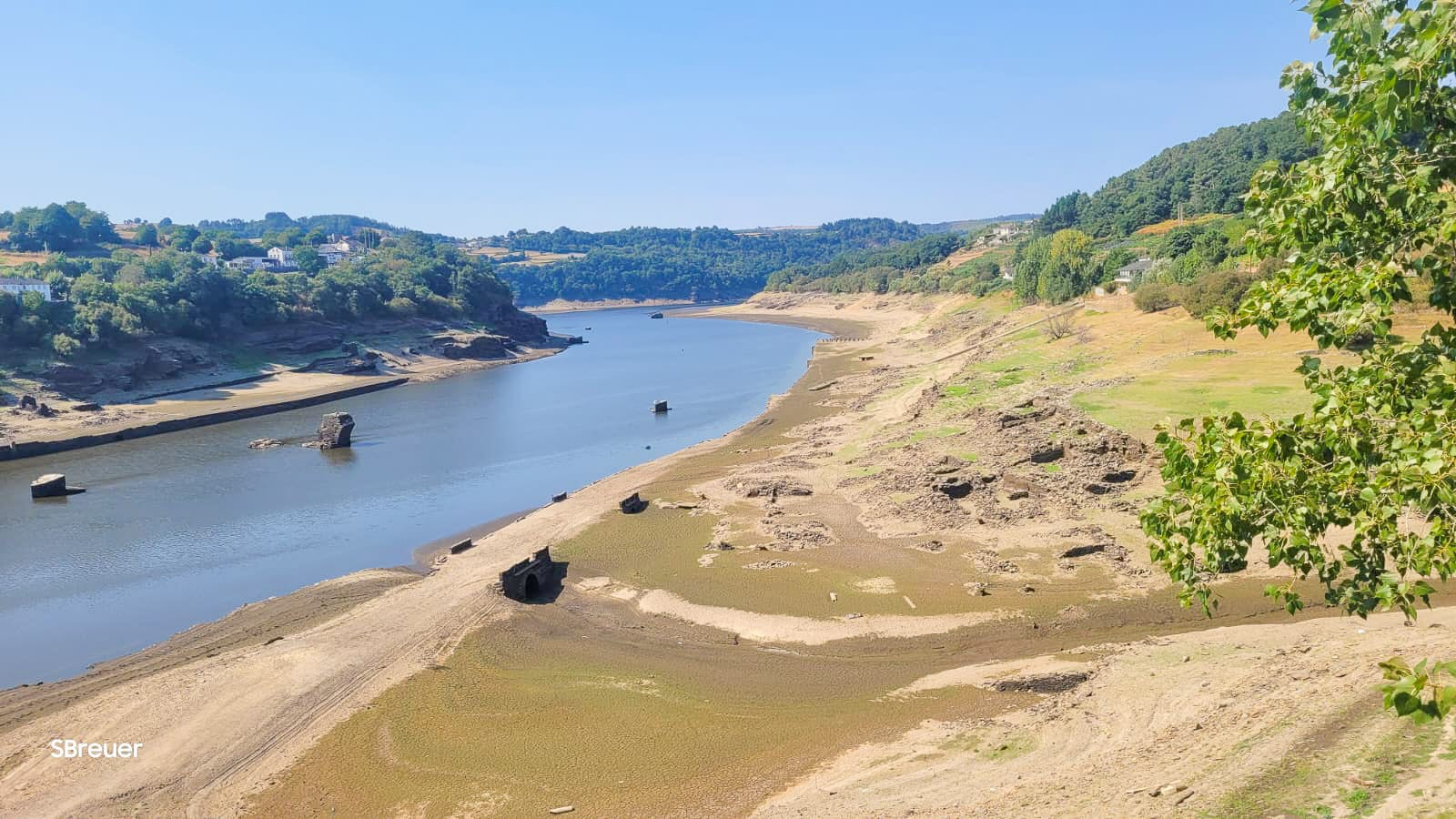
For me, the changing scenery is one of the pleasures of the full journey. You start among mountains, ride through wine-growing country and cross open plains before reaching Galicia. You notice the differences gradually, including the buildings, food and atmosphere of the places where we stop.
The Pyrenees crossing is a memorable start. Our opening ride to Roncesvalles is around 27 kilometres, but the climbing makes it a demanding introduction. Reaching the other side gives you a real sense that the journey has begun.
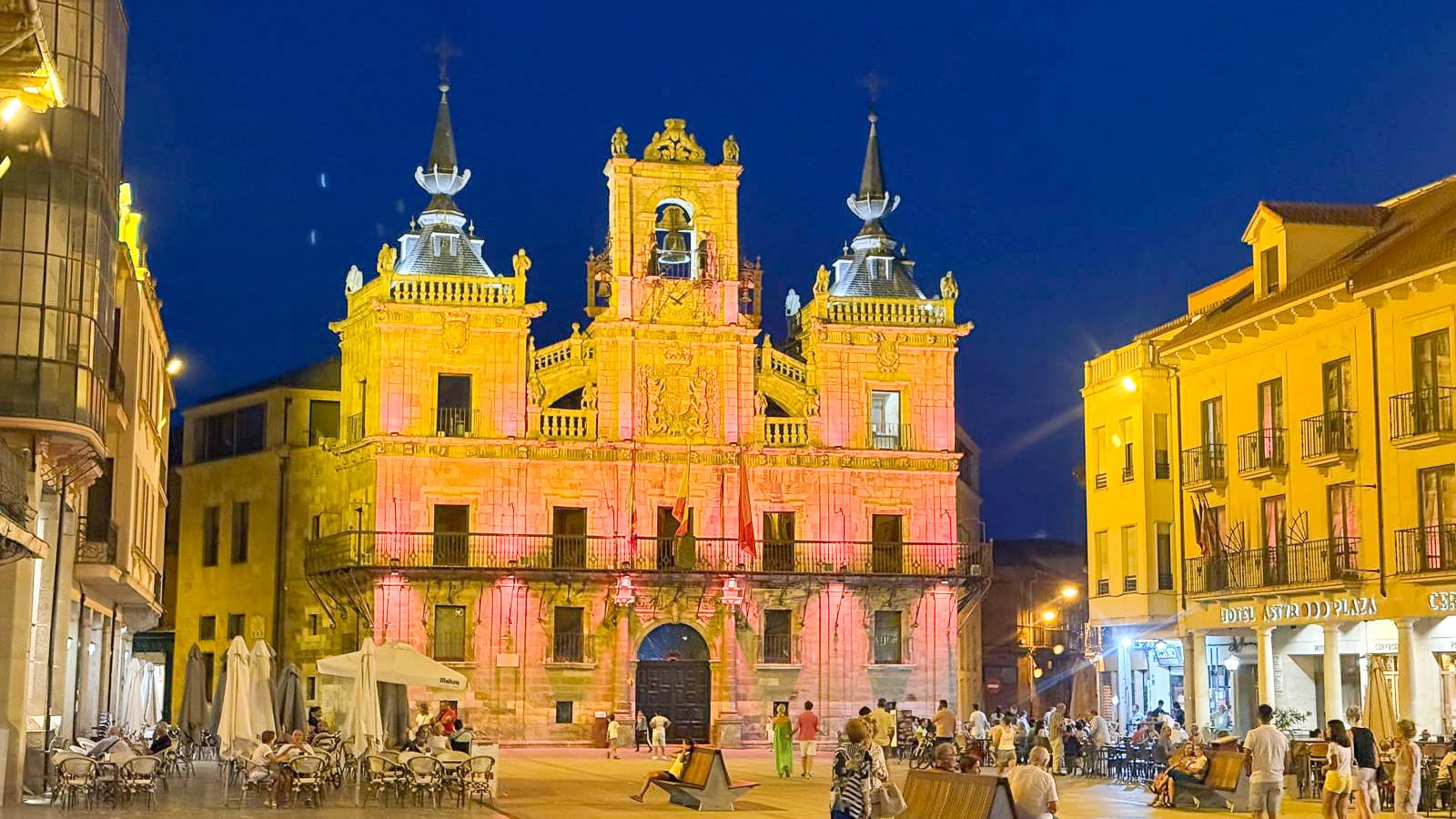
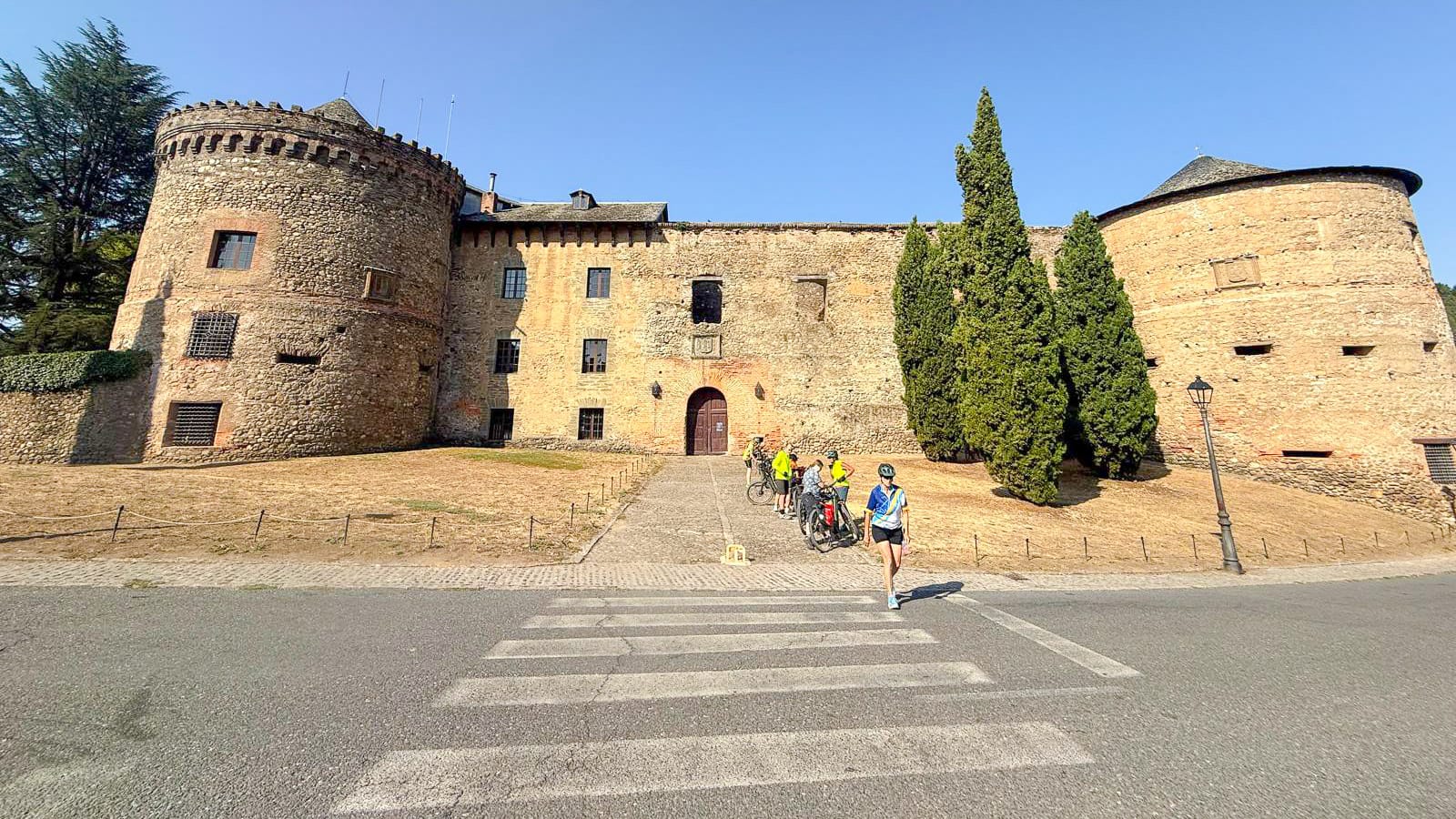
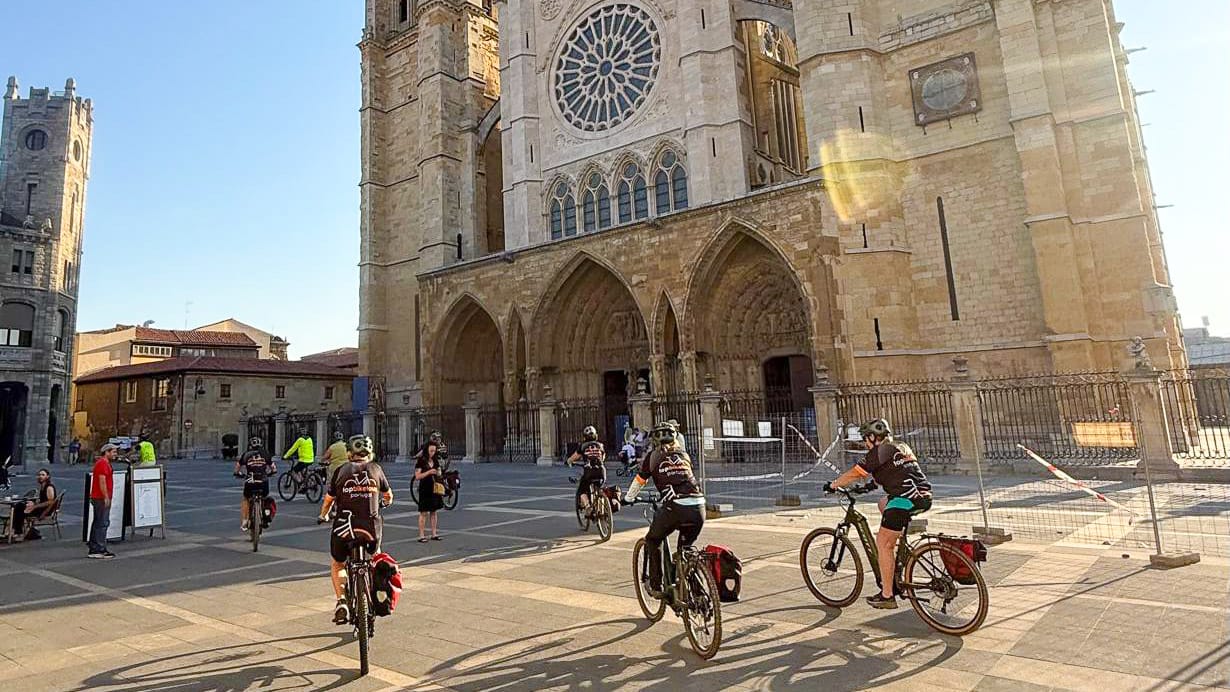
I also enjoy the historic towns. Burgos and León have impressive cathedrals; Astorga has its cathedral and Gaudí’s Episcopal Palace; Ponferrada has its Templar Castle. They give us reasons to stop and spend time off the bike, rather than simply checking into the next hotel.
What does cycling add to the Camino experience?
A bicycle allows you to see more of the route within a typical holiday. You can move between regions and historic towns while still noticing the countryside between them.
There is a trade-off. Because you cover more ground than a walker, it is easy to pass through smaller places too quickly. I think it is worth stopping regularly, even when you feel you could keep riding. A church, village café or conversation can become as memorable as a climb.
Make the most of time off the bike, too. In León, you can explore the cathedral and old streets without watching the kilometres.
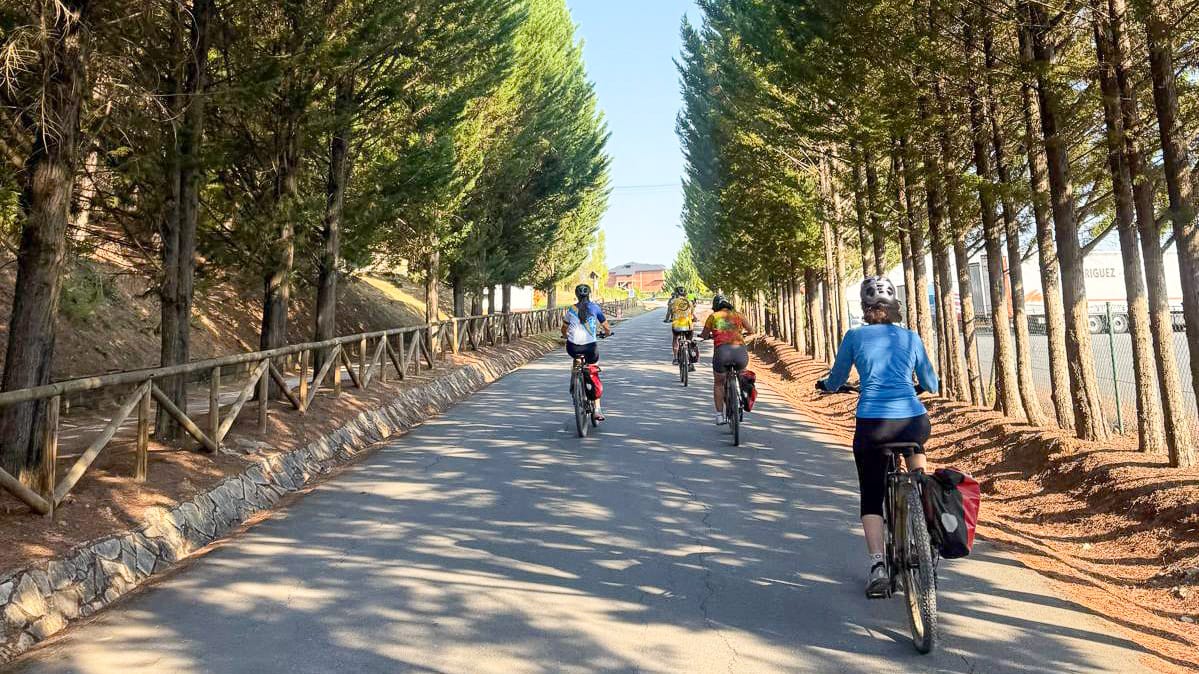
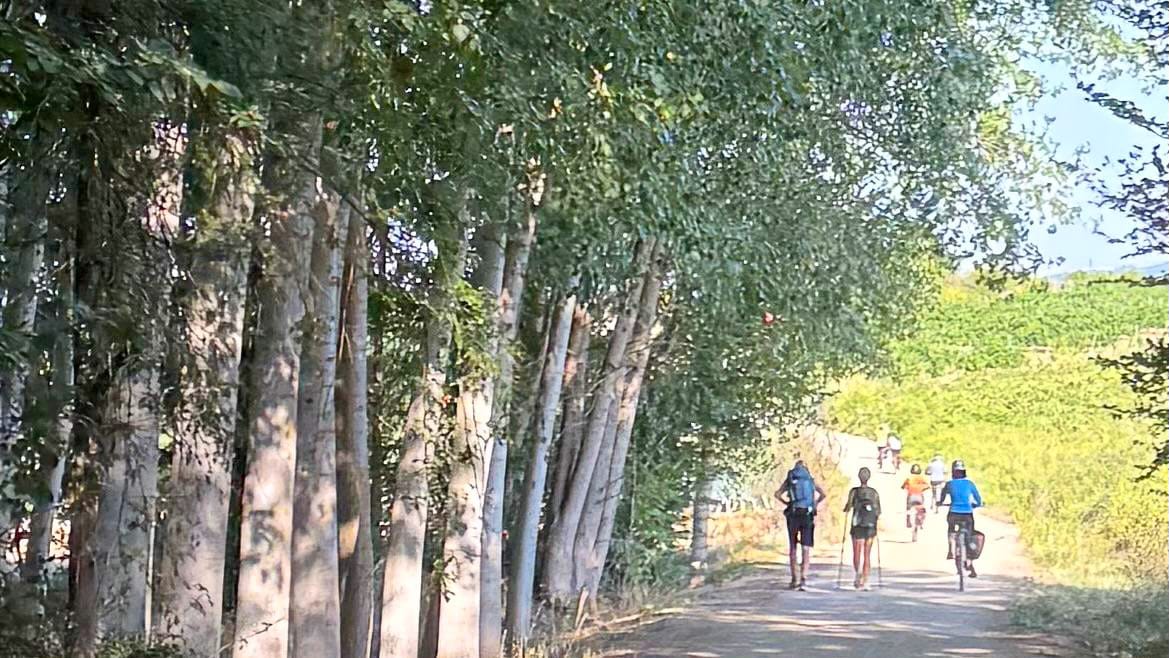
Cycling the tree-lined section of the Camino Francés (photo credit: Top Bike Tours Portugal)
How can cyclists make time for the pilgrimage experience?
The shared destination makes the Camino feel different from another point-to-point ride. We meet people from many countries, each travelling towards Santiago for their own reasons.
You do not need to rush past that side of the journey. Stop in villages, greet other pilgrims and give yourself time in the places where you stay. Collecting stamps in your pilgrim’s passport can also become a record of those encounters.
For me, arriving in Santiago brings the individual days together. The mountains, long rides and conversations become part of the same journey. Seeing guests reach the cathedral is one of the reasons I enjoy organising these trips.
One of the moments I remember most was stopping at a small village café early in the morning and finding it full of pilgrims from different countries. Some were walking, others were cycling. Despite having very different backgrounds, everyone was sharing stories about the previous day’s challenges and the road ahead. It was a simple moment, but it captured what makes the Camino special: the sense of community that develops between people who would never otherwise have met.
Experience the Camino by bike with your accommodation and luggage transfers arranged. Find out more about Camino Francés cycling holidays with Top Bike Tours Portugal.
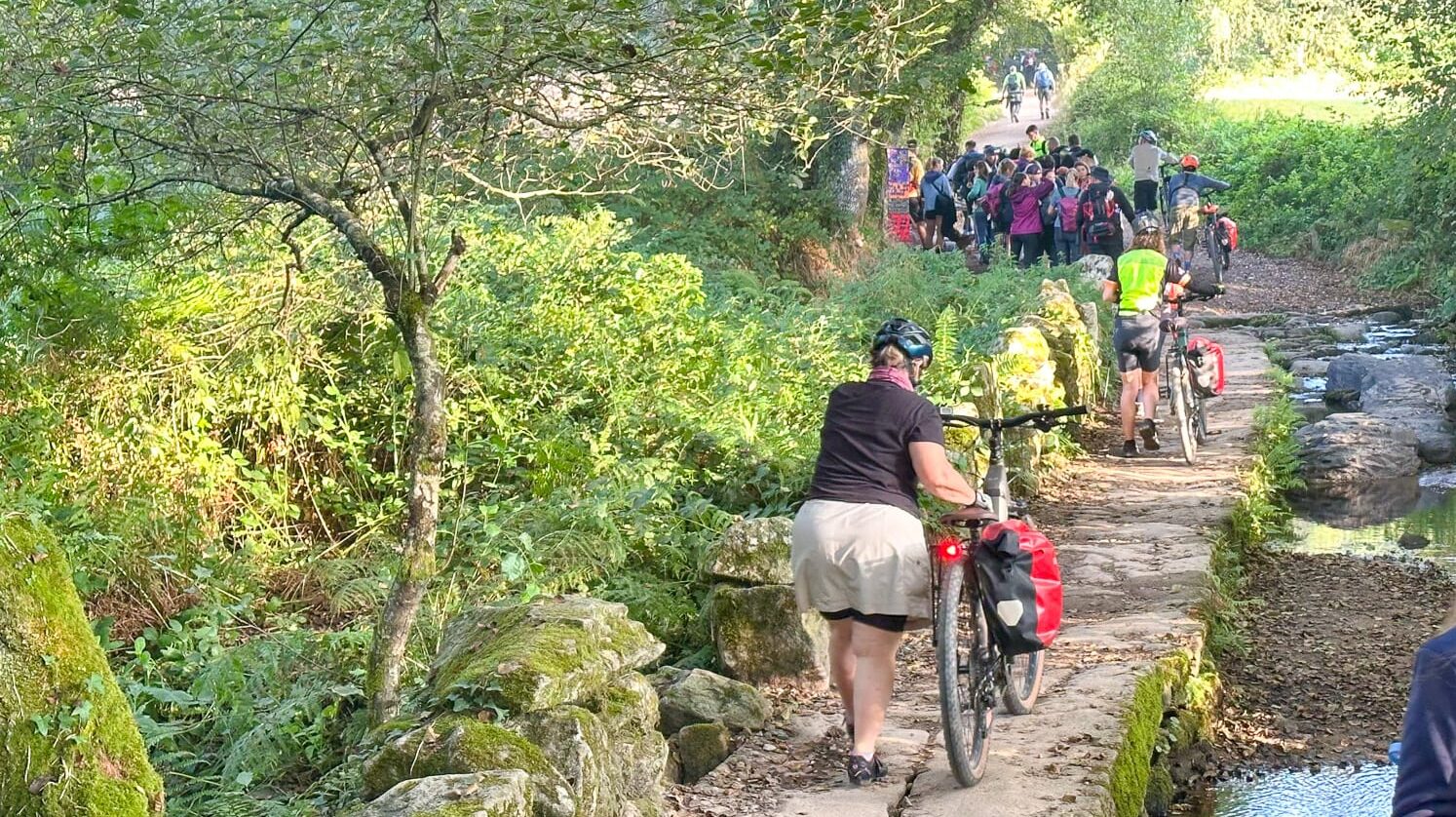
A tree-lined path on the Camino Francés (photo credit: Top Bike Tours Portugal)
Sponsor Message
Take the stress out of planning your Camino Francés trip!
Top Bike Tours Portugal have been helping cyclists enjoy unforgettable bike tours since 2013. Their Camino Francés trips include carefully planned routes, hand-picked accommodation and luggage transfers - all arranged for you.
Choose between guided and self-guided tours to experience the Camino your way.
Head to their website to find out more.
Got a question for Sérgio Marques from Top Bike Tours Portugal?
Fill out this form and we will pass it to Top Bike Tours Portugal who aim to reply (within 24 hours wherever they can!)
Part 3: Should you cycle the full Camino Francés or start in León?
What is it like to cycle from Saint-Jean-Pied-de-Port to Santiago?
Our full tour covers approximately 791 kilometres over 14 riding days, with around 12,000 metres of climbing. We give it a difficulty rating of four out of five.
You see the scenery change from the Pyrenees to vineyards, open plains and the green hills of Galicia. The challenge is getting back on the bike each morning, especially after several days of climbing.
Daily riding: Stages include a short mountain opening and longer days of around 50 to 85 kilometres, depending on the itinerary.
Who it suits: Riders who enjoy a demanding journey and have experience cycling over several days. Some gravel or off-road experience is useful too.
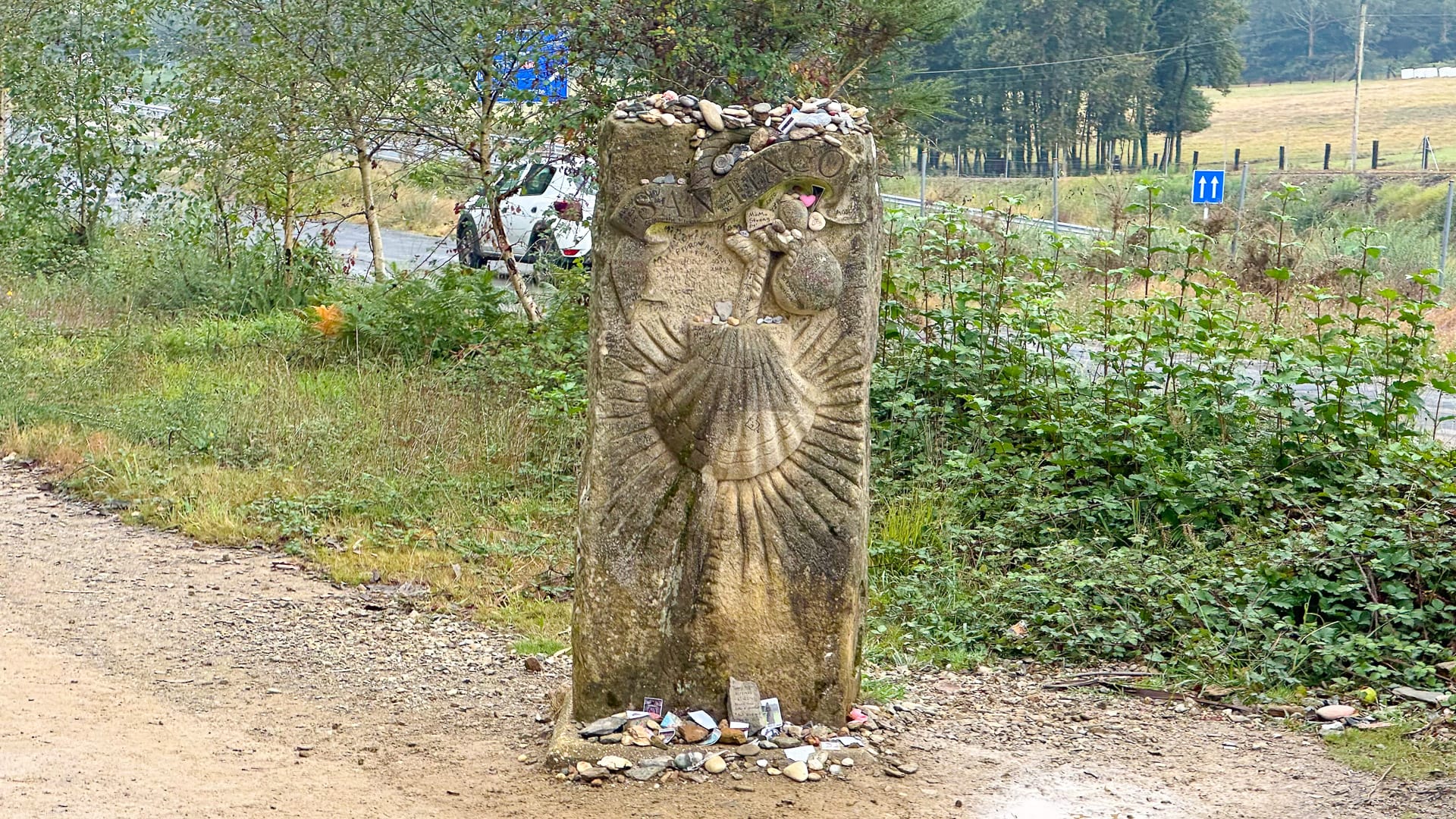
Stone Camino milestone along the pilgrimage route in Galicia (photo credit: Top Bike Tours Portugal)
What is it like to cycle from León to Santiago?
Starting in León suits riders with less time who want to experience the western Camino. We ride through Astorga and the Bierzo region before continuing towards O Cebreiro, rural Galicia and Santiago. The itinerary combines rolling countryside, mountain crossings and the rewarding climb from the Bierzo region into Galicia.
The route includes six riding days. The Standard itinerary covers approximately 328 kilometres, with daily rides ranging from around 25 to 81 kilometres. The Premium itinerary covers approximately 335 kilometres, with daily rides ranging from around 39 to 81 kilometres.
The Premium itinerary includes approximately 5,933 metres of elevation gain, making it one of our more challenging Camino cycling holidays. It is shorter than the full route, but it still includes climbing and rougher sections that deserve preparation.
This option can suit active recreational cyclists who have less time for their holiday. I would still want riders to feel confident on descents and uneven ground. If you are unsure, tell us about the rides you normally do so we can discuss whether the itinerary suits you.
Here’s a stage-by-stage breakdown of the distances for the standard and Premium itineraries:
| Stage | Standard / Premium distance | Elevation gain |
| León to Astorga | 53 kilometres | 420 metres |
| Astorga to Villafranca del Bierzo | 81 kilometres | 1,236 metres |
| Villafranca del Bierzo to Sarria | 69 kilometres | 1,628 metres |
| Sarria to Portomarín | 25 kilometres / 49 kilometres | 933 metres |
| Portomarín to Arzúa | 61 kilometres / 44 kilometres | 780 metres |
| Arzúa to Santiago de Compostela | 39 kilometres | 936 metres |
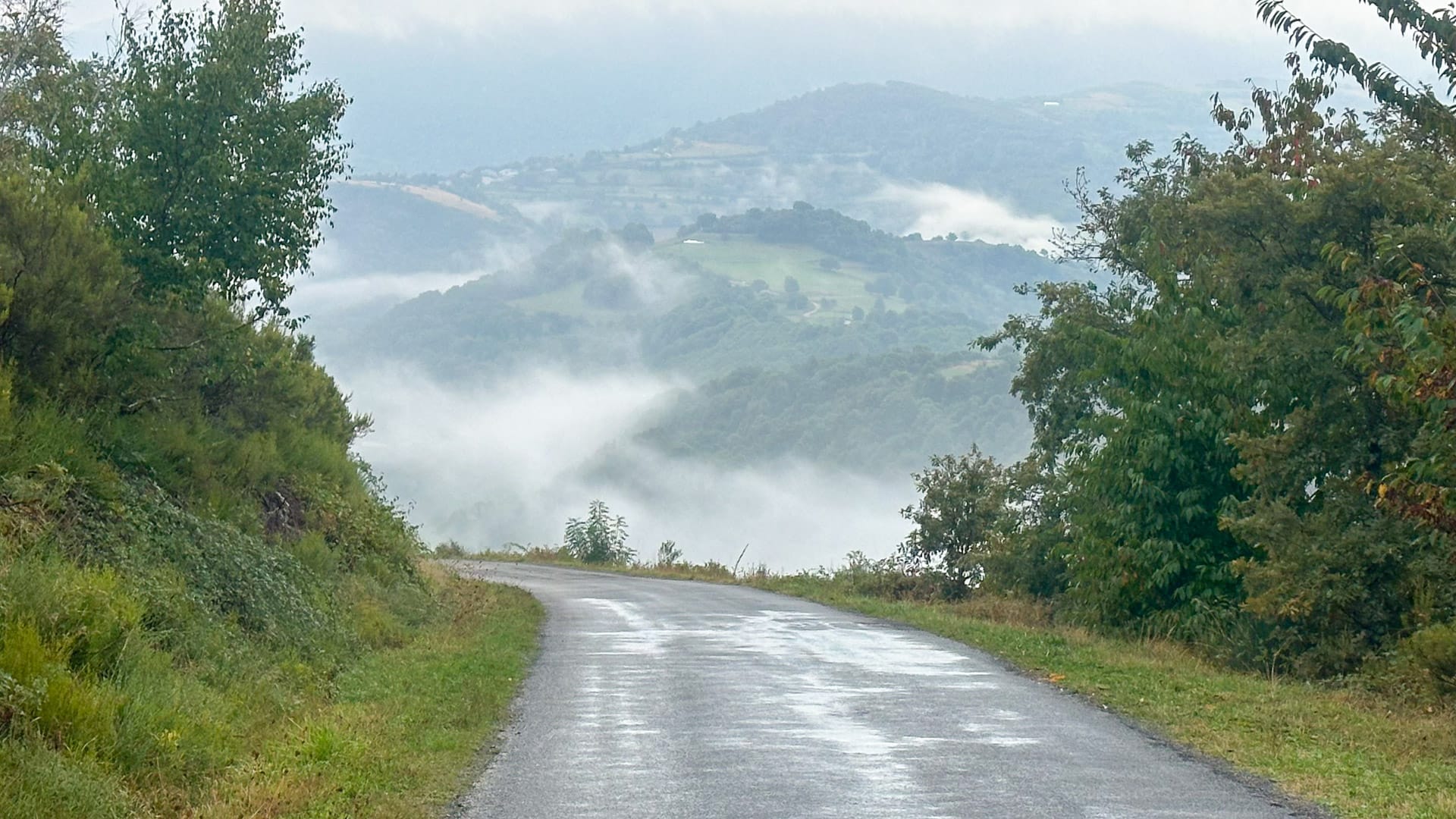
Views from the Camino Francés (photo credit: Top Bike Tours Portugal)
Which sections need particular care by bike?
On the full Camino Francés, the first riding day takes you straight into the Pyrenees, with more challenging climbing. Later, there are mountain sections around Astorga and Ponferrada, before the route continues through Cacabelos and climbs into the Galician mountains towards Las Herrerías. Weather, tiredness and the surface under your wheels all affect how a stage feels.
Climbing is only part of the picture. Loose stones, steep descents and wet tracks can require more concentration than a longer section on asphalt. Slow down where necessary and be prepared to get off the bike if a passage is beyond your confidence or is busy with walkers.
A good example is the route between Villafranca del Bierzo and Sarria. This is one of the most demanding days of the León to Santiago tour, with over 1,600 metres of elevation gain and several steep climbs and descents. Depending on weather conditions, some off-road sections can become rocky, muddy or slippery, requiring extra care and concentration.
Another example is between Sarria and Portomarín, where cyclists share parts of the route with a large number of walkers. On narrower trails or busy sections, it is important to reduce speed, be patient when passing and use cycling alternatives where appropriate.
These are exactly the types of situations where our stage-by-stage GPS routes are valuable. Follow the planned alternatives when the walking trail is unsuitable.
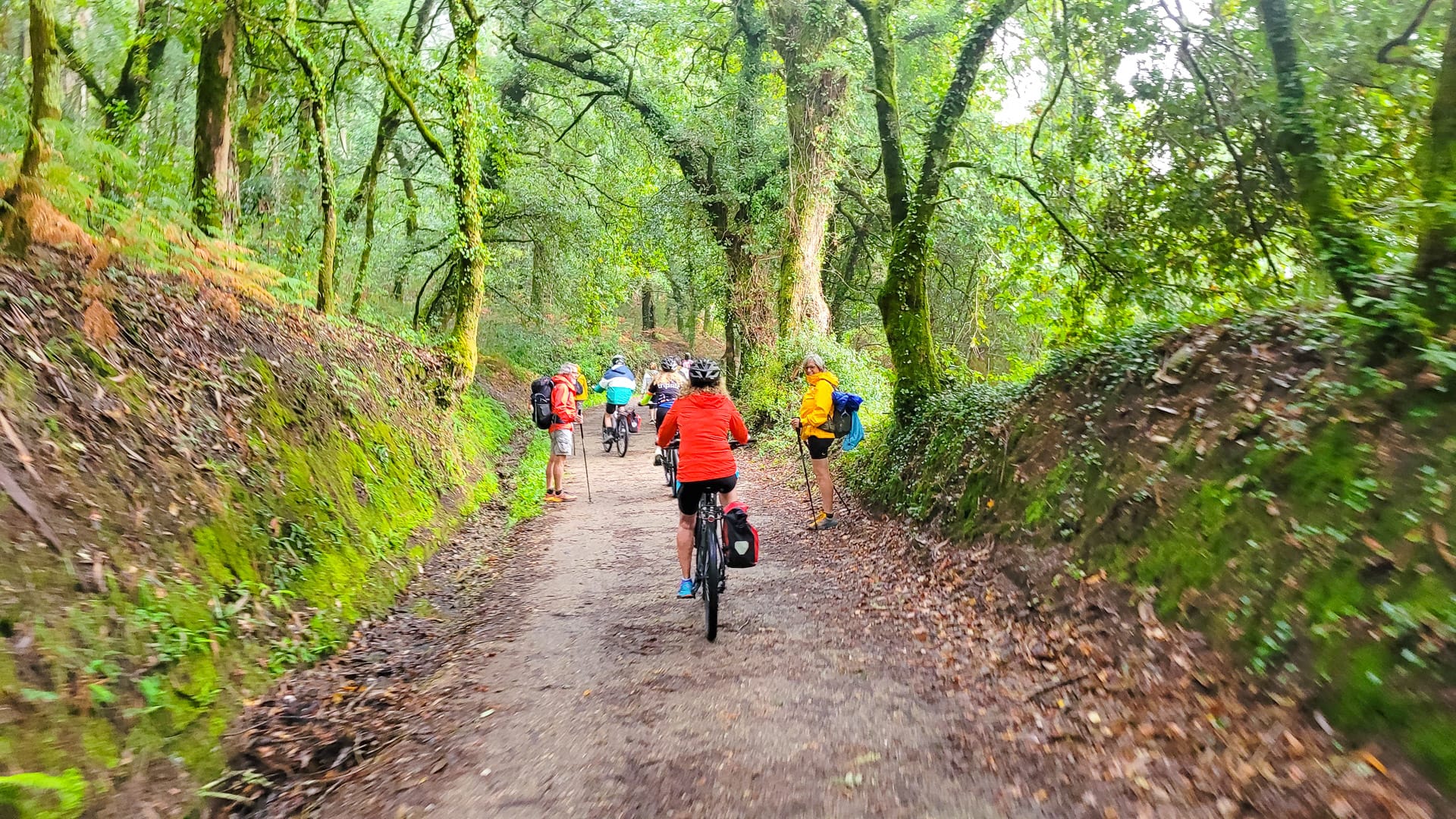
A section of the Camino Francés (photo credit: Top Bike Tours Portugal)
How fit and confident on a bike do you need to be?
You do not need to be an elite cyclist, but you should be used to spending several hours on a bike. Being able to repeat that effort on the following days matters more than completing one impressive ride at home.
For the full journey, I would suggest previous experience of multi-day riding and some off-road cycling. For the shorter option, a good level of fitness and confidence on hills are still important. For either route, get comfortable riding on uneven ground before you travel.
An e-bike can reduce the effort on climbs. You still need to steer, brake and control the bike on descents, so practise these skills whichever bike you choose. Find out more on e-bikes below.
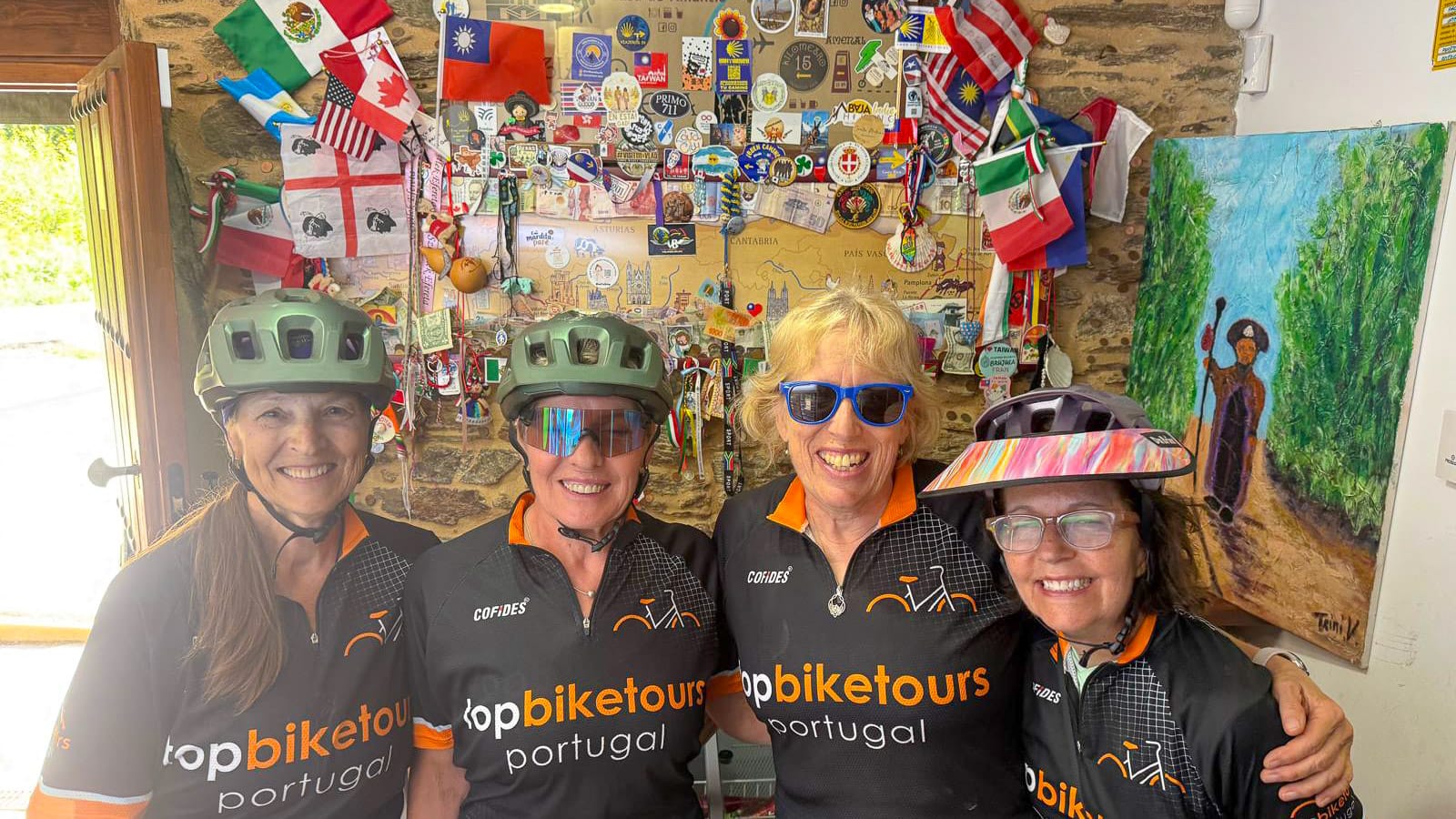
Top Bike Tours Portugal cyclists (photo credit: Top Bike Tours Portugal)
How do you choose between the two routes?
I would start with your available time, usual riding and what you want from the holiday. The full route gives you the gradual journey across northern Spain. León offers a shorter commitment while retaining demanding riding and the finish in Santiago.
| Start | Saint-Jean-Pied-de-Port | León |
| Distance | Approximately 791 km | Approximately 320 km |
| Duration | 16 days / 15 nights | 8 days / 7 nights |
| Riding days | 14 | 7 |
| Daily riding distance | 50 to 85 km | 21 to 81 km |
| Climbing | Around 12,000 m | Around 5,900 metres |
| Difficulty | Challenging (4/5) | Challenging (4/5) |
| Format | Guided | Guided or self-guided |
| Who it suits | Experienced multi-day riders who want the full journey | Confident riders with less time who still enjoy demanding terrain |
| More info | Full French Way Bike Tour | Camino de Santiago Bike Tour from León |
For help choosing between the full route and León to Santiago, share your cycling experience and preferred travel dates with the team. Contact Top Bike Tours Portugal to discuss the options, availability and prices
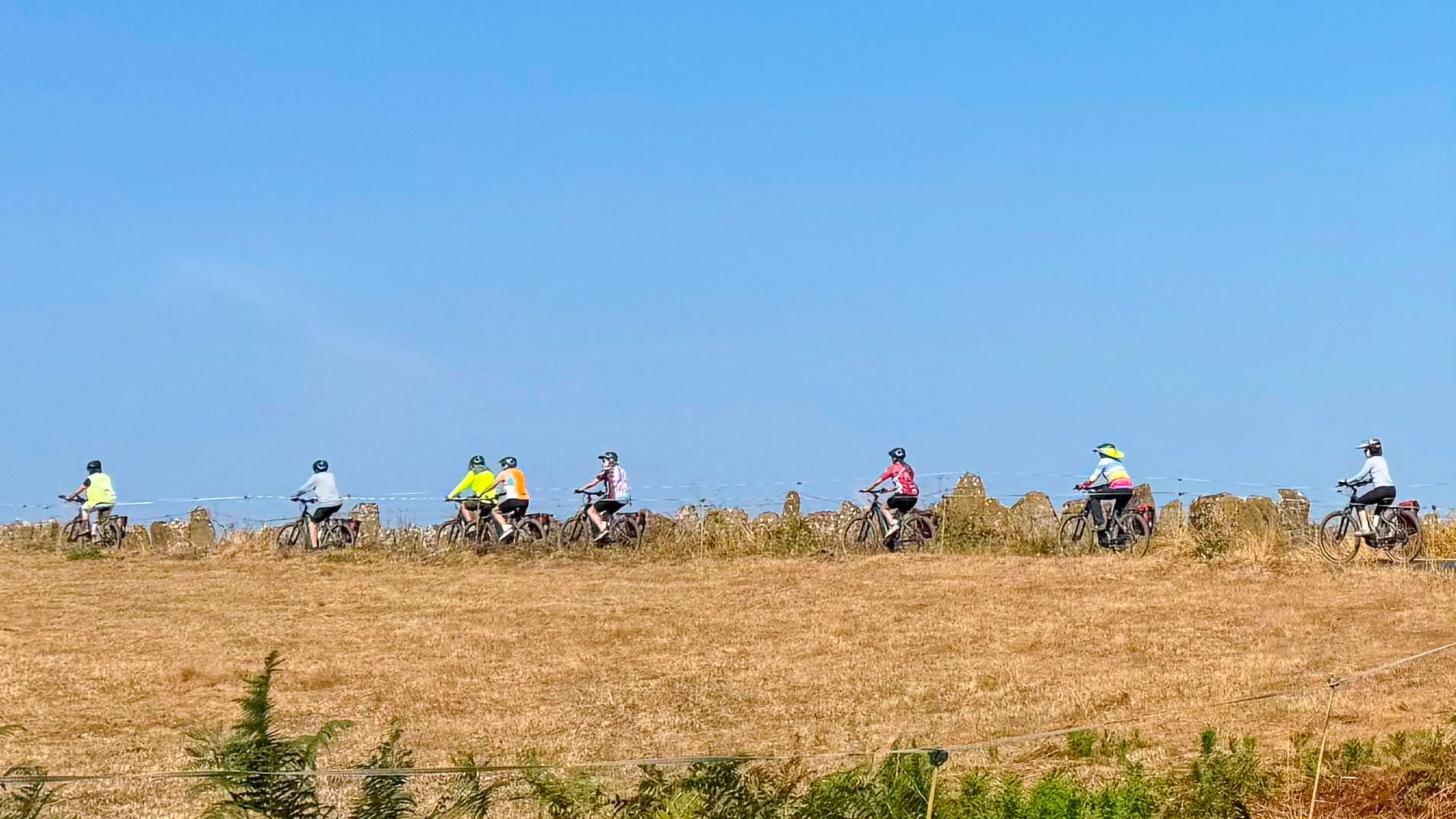
Cyclists riding along the Camino Francés (photo credit: Top Bike Tours Portugal)
Want help choosing your Camino cycling holiday?
Unsure whether to ride the full route or start in León? Ask Top Bike Tours Portugal about the two options. Share how long you have, the distances you normally ride and whether you’d prefer an e-bike.
Sponsor Message
Take the stress out of planning your Camino Francés trip!
Top Bike Tours Portugal have been helping cyclists enjoy unforgettable bike tours since 2013. Their Camino Francés trips include carefully planned routes, hand-picked accommodation and luggage transfers - all arranged for you.
Choose between guided and self-guided tours to experience the Camino your way.
Head to their website to find out more.
Got a question for Sérgio Marques from Top Bike Tours Portugal?
Fill out this form and we will pass it to Top Bike Tours Portugal who aim to reply (within 24 hours wherever they can!)
Part 4: How do you organise a Camino Francés cycling trip?
What type of bike suits the Camino Francés?
For our routes, we generally suggest a touring, gravel or mountain bike, chosen to suit the rider and the planned surfaces. Reliable brakes, suitable tyres and a wide range of gears matter more than choosing the lightest bike.
There is a mix of asphalt, gravel, dirt and uneven trails. A bike that feels comfortable on your local roads may be less suitable once you add rough surfaces and several consecutive days.
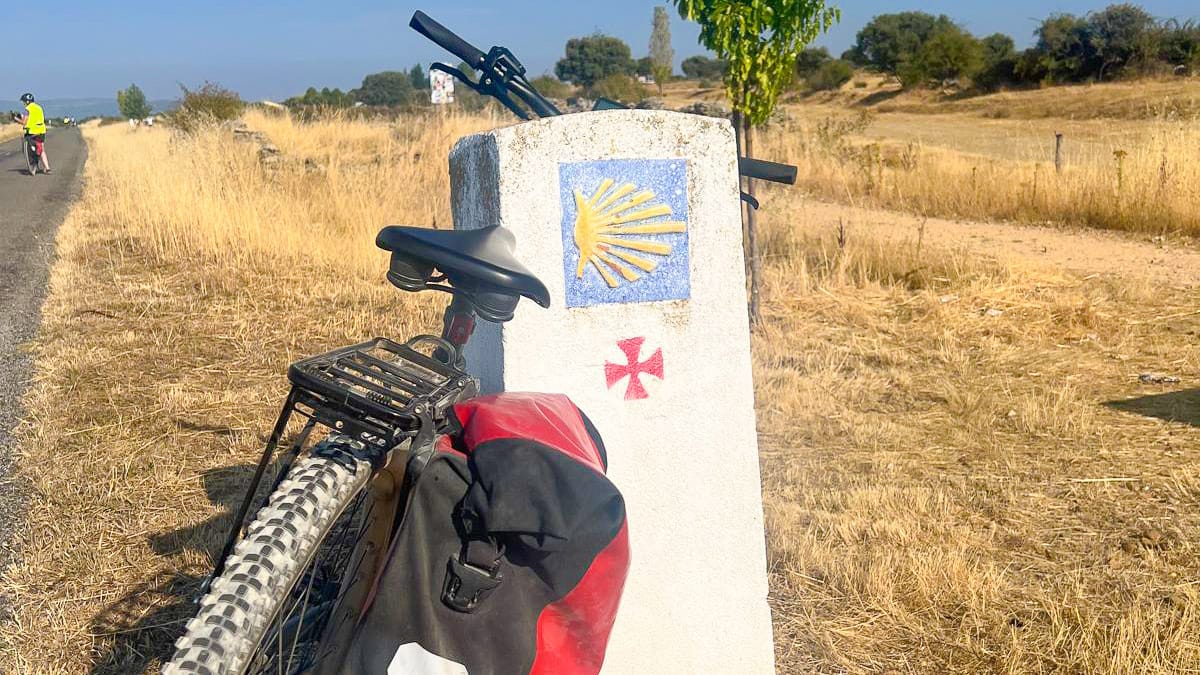
Bike beside a Camino Francés waymarker (photo credit: Top Bike Tours Portugal)
Can you cycle the Camino Francés on an e-bike?
Yes you can.
On our tours, we offer e-bikes as an upgrade, subject to availability. They are popular with guests who want assistance on longer climbs or who would prefer to reduce the physical demands of the journey.
We offer several models, including the SCOTT Sub Cross eRIDE 10, KTM Macina 500Wh, Cube Acid 500Wh and Atala B Easy 9.2. These bikes are equipped with Shimano components and are specifically chosen for multi-day cycling tours and mixed terrain. The KTM and Cube models use 500Wh batteries, providing sufficient autonomy for the stages typically found on the Camino Francés.
All overnight accommodations used on our tours provide facilities for charging e-bike batteries, allowing riders to begin each day with a fully charged battery. For longer stages, use lower support modes when possible to maximise battery range.
Battery consumption varies according to terrain, rider weight, weather conditions and the level of assistance selected. If a battery runs low during a stage, the bike can continue to be ridden without motor assistance, although with a heavier feel than a conventional bicycle. Before departure, we provide guidance on battery management to help riders complete each stage comfortably.
It is also worth practising on an e-bike before travelling, particularly if you have not handled one on descents or loose surfaces.
E-bikes and the Compostela certificate
If you’d like to receive the Compostela pilgrimage certificate, our understanding is that using one of our e-bikes does not prevent riders from qualifying. E-bikes are widely used by pilgrims on the Camino de Santiago. However, the final criteria are established by the Pilgrim’s Office in Santiago de Compostela and may change over time.
Guests who consider the Compostela an important part of their pilgrimage should check the current requirements directly with the Pilgrim’s Office before travelling. Eligibility depends on meeting the applicable rules and collecting the required stamps during the journey.
When is a good time to cycle the Camino Francés?
May, June and September are the months I suggest considering first. Temperatures are generally comfortable for cycling, with plenty of daylight and manageable numbers of pilgrims.
April and October can also work, although the weather can be less predictable.
The conditions change across the route. The Meseta can be hot and exposed in summer, while Galicia can be cooler and wetter. Mountain weather can change quickly even when the temperature feels pleasant lower down, so bring layers and rain protection.
In late autumn and winter, some accommodation and services operate reduced hours or close. A quieter month also requires more planning; it does not necessarily mean an easier journey.
Be aware! This is particularly relevant for riders who wish to complete the full Camino Francés from Saint-Jean-Pied-de-Port. Winter weather and snow can make the high Napoleon/Lepoeder crossing unsafe. Navarra’s official guidance states that the lower-altitude Valcarlos route must be used from 1 November to 31 March. Check Navarra’s French Way information when planning the opening stage.
For tours that start in Saint-Jean-Pied-de-Port and include the Pyrenees crossing, we adapt the route according to the official guidance and current conditions. When necessary, cyclists follow the Valcarlos route. This remains an official Camino route, allowing riders to continue their pilgrimage.
This does not affect our León to Santiago itinerary, as the tour begins well beyond the Pyrenees section. Riders on this tour will not encounter either the Napoleon Route or the Valcarlos alternative.
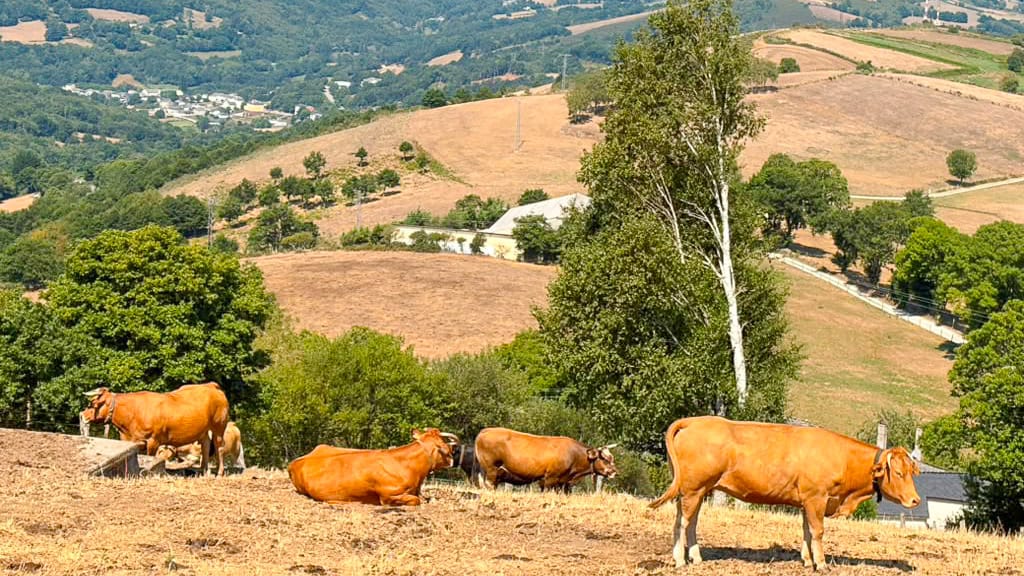
Wildlife in the hills along the Camino Francés (photo credit: Top Bike Tours Portugal)
Where can cyclists stay along the route?
There are pilgrim hostels, guesthouses, hotels and rural properties along the Camino. The right choice depends on the comfort you want and how much you prefer to arrange in advance.
For our tours, we select hotels and rural accommodation with breakfast included. Our standard options typically use three- and four-star properties, with higher-category options on Premium tours. We look for practical locations and suitable facilities for cyclists.
Be aware! Public and private pilgrim hostels, known as albergues, do not all work in the same way. In Galicia’s public albergue network, places cannot be reserved and walkers have priority over cyclists. This is one reason why an organised tour is helpful for this route!
For an independent trip, check secure bike storage, laundry or drying facilities and e-bike charging directly with each property. These details can make a noticeable difference after a wet day.
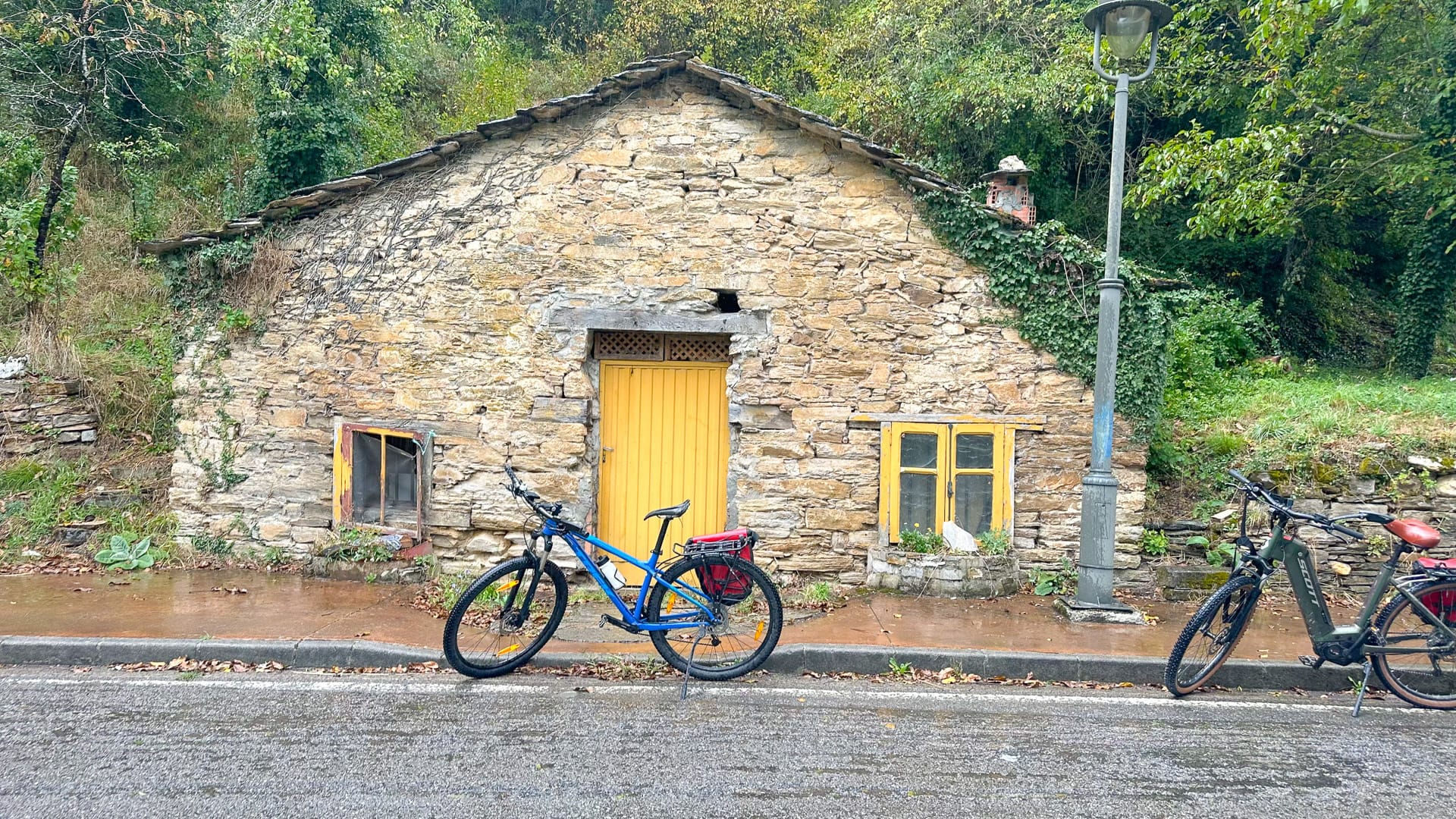
Historic house on the Camino Francés (photo credit: Top Bike Tours Portugal)
How easy is navigation and do you need GPS routes?
The yellow arrows and scallop shells make the Camino familiar to follow, but they do not replace a cycling-specific route. Town entrances, road junctions and changes between trails and roads are places where you may need to pay closer attention.
We provide GPS routes for the stages and access to Ride with GPS. I suggest a GPS bike computer as the main navigation device, with a phone as backup. Make sure you can access the route before setting off, including when you do not have a data connection.
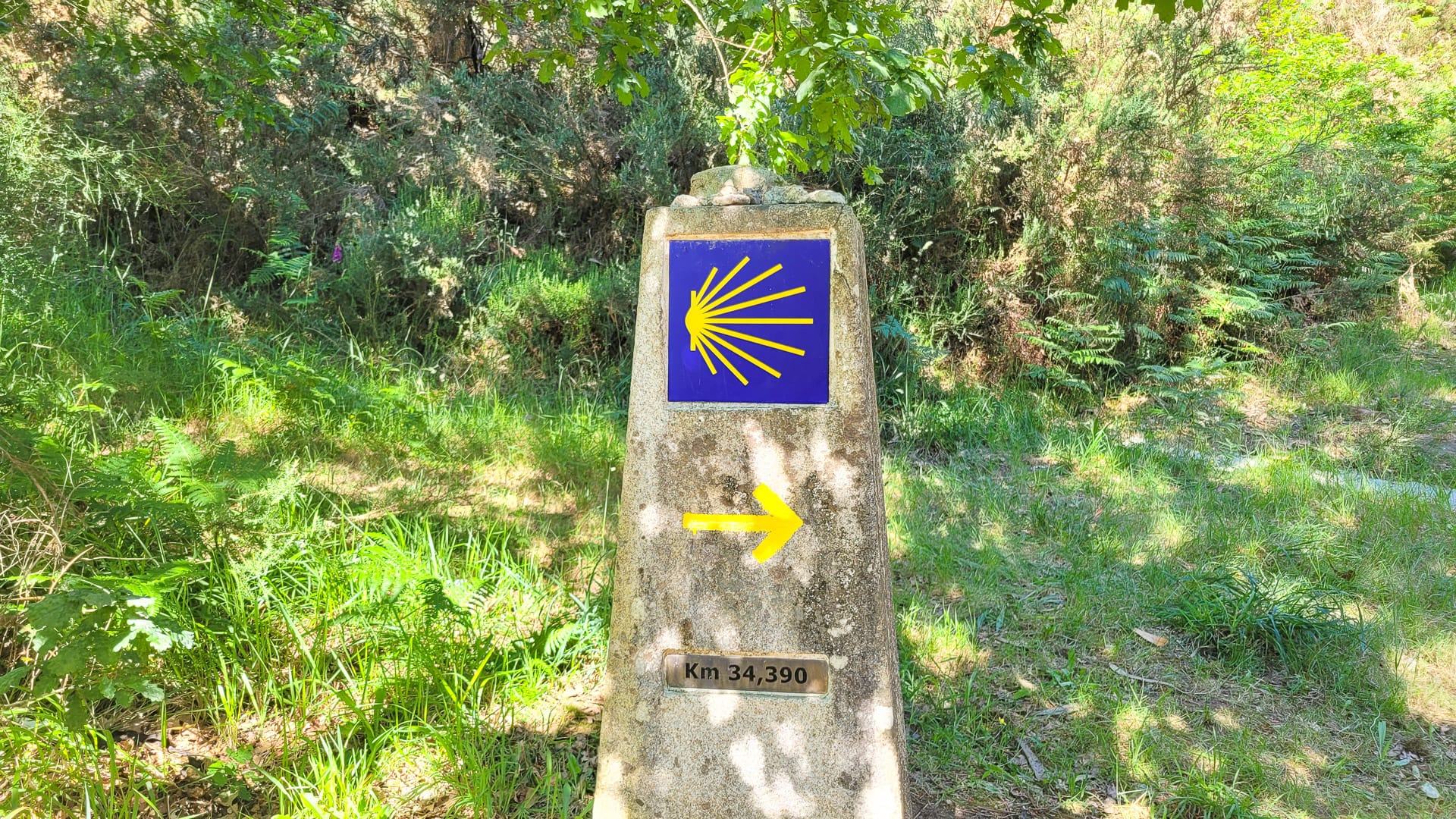
Camino Francés route marker (photo credit: Top Bike Tours Portugal)
How do you get to the start and travel home from Santiago?
If you’re starting in Saint-Jean-Pied-de-Port, consider flights to Biarritz, Bilbao or San Sebastián. The connection through Bayonne is one option for reaching Saint-Jean-Pied-de-Port by train. Check the service and, if you’re travelling with your bike, its bicycle conditions for your travel dates.
On our tours, flights to the tour starting point and return flights from Santiago de Compostela are not included. Guests are responsible for arranging these.
Guests may choose the airport and onward travel arrangements that best suit their plans. Depending on the itinerary booked, transfer options may be available. Confirm the details at the time of booking.
For the shorter tour, the starting point is León. Guests are responsible for arranging their travel to León. At the end of the tour, a transfer to Santiago Airport or Vigo Airport is included. Any additional transfers or special arrangements should be requested in advance and may be subject to a supplement.
Transfer arrangements can vary between itineraries and seasons. Confirm the exact inclusions for your booking with us before buying flights.
Bringing your own bike? Epic Road Rides’ guide to flying with a bike covers preparing and packing it for the journey.
How do luggage transfers work?
On our tours, your main luggage moves between accommodation while you ride. You leave it at the agreed collection point in the morning. We provide a pannier for the belongings you need during the ride.
Keep waterproofs, an extra layer, food, water, essential medication and your navigation equipment with you. Your pilgrim credential and valuables should also stay accessible, rather than travelling in the transferred bag.
Guests who choose to bring their own bicycle on our tours should contact us in advance regarding bike box storage or transfer. In many cases, it is possible to arrange storage during the tour, depending on the start and end locations and the facilities available.
Bike boxes are not included as part of the standard luggage transfer service, as this service is intended for normal travel luggage. Discuss your plans with us before booking flights so that we can confirm the most suitable arrangements for your specific itinerary.
What mechanical support is available along the way?
Larger towns have bike shops and repair services, but you should not expect one whenever you need it. If you ride independently, carry a basic repair kit and know how to use it. Useful essentials include:
- Spare tubes, tyre levers and a pump.
- A multi-tool and a chain quick link that fits your bike.
We inspect and test each hire bike before the tour and provide basic repair equipment. During the briefing, we explain how to deal with common problems such as a puncture.
On our guided tours, the guide and support team can assist during the ride. On self-guided trips, you contact us by phone or WhatsApp. We may help remotely, direct you to a local shop or arrange another practical solution.
On a self-guided trip, there’s no vehicle following you, so help may take time to reach you. You may also need to pay for transport. Pick our guided tour if this is a concern to you.
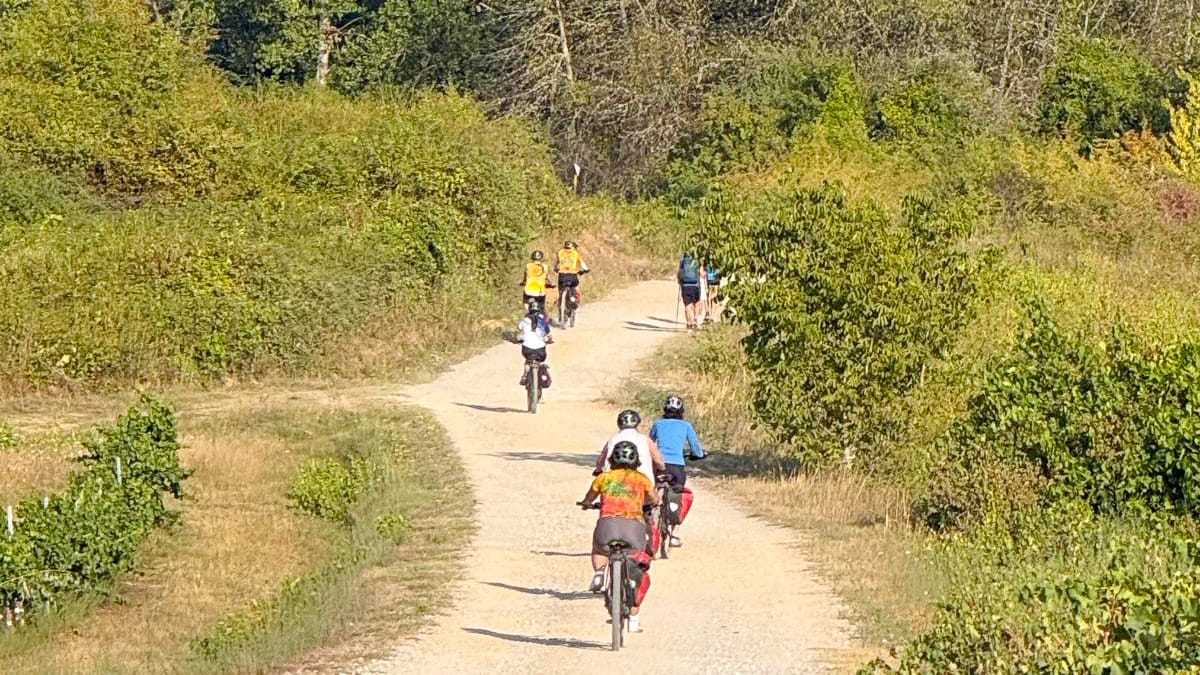
Hills along the Camino Francés (photo credit: Top Bike Tours Portugal)
Sponsor Message
Take the stress out of planning your Camino Francés trip!
Top Bike Tours Portugal have been helping cyclists enjoy unforgettable bike tours since 2013. Their Camino Francés trips include carefully planned routes, hand-picked accommodation and luggage transfers - all arranged for you.
Choose between guided and self-guided tours to experience the Camino your way.
Head to their website to find out more.
Got a question for Sérgio Marques from Top Bike Tours Portugal?
Fill out this form and we will pass it to Top Bike Tours Portugal who aim to reply (within 24 hours wherever they can!)
Part 5: What tips help you prepare for cycling the Camino Francés?
How should you train for the ride?
Build up your time on the bike gradually and practise on consecutive days. Include hills and some riding on gravel or uneven surfaces, so you become comfortable with more than just the distance.
For the full route, I suggest building towards longer rides of around 50 to 80 kilometres as part of your preparation. For León, rides of around 40 to 70 kilometres can help you prepare, but remember that some tour stages are longer. These are examples to build towards, not a guarantee that a particular itinerary will suit you.
Try to use the same type of bike you will ride on the Camino. Getting familiar with the position, brakes and gears before travelling gives you one less thing to adjust to during the first few days.
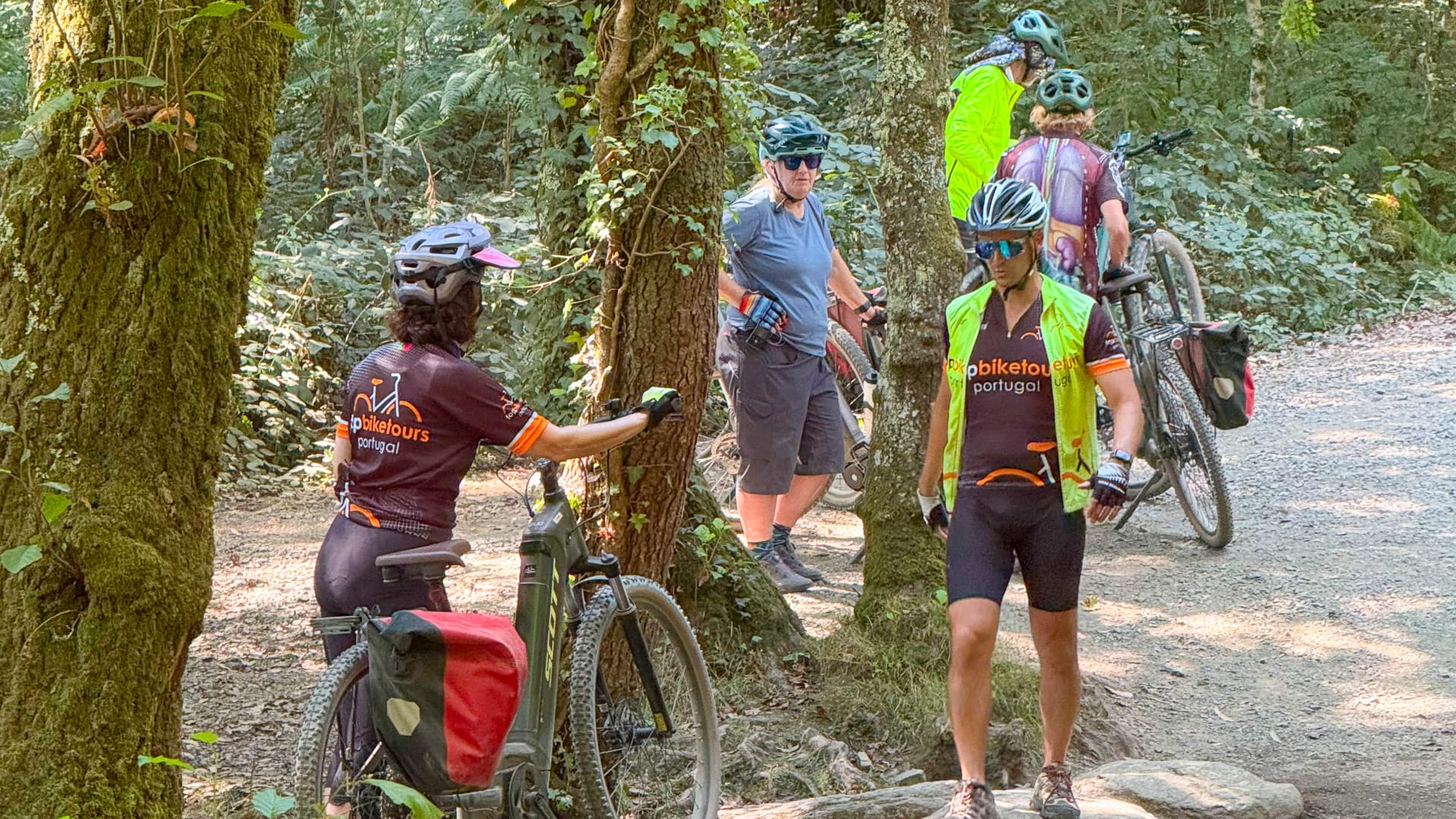
River crossing on the Camino Francés (photo credit: Top Bike Tours Portugal)
What should you pack?
You need enough kit to stay comfortable through changes in weather, plus the essentials for the day’s ride. Luggage transfers mean you only carry what you need for the day’s ride. Here are some items I’d suggest:
- Comfortable cycling clothing, including padded shorts and suitable shoes.
- Gloves, glasses, a waterproof jacket and an extra warm layer.
- Food for stretches between reliable stops.
- Your phone, chargers and a backup power source.
- Identification, payment cards, some cash and personal medication.
- Sun cream and a small dry bag for valuables and electronics.
- Any specific equipment you prefer to use yourself.
On our tours, alongside the pannier, we supply helmets, bike locks, rear lights, mobile phone handlebar mounts, GPS devices and their mounts. Guests also receive a water bottle, bottle cage, luggage tags, a digital roadbook and, on Camino routes, a pilgrim credential.
Use the supplied pannier for your daily essentials. Avoid a heavy backpack, which can become uncomfortable after several hours.
We also provide a comprehensive repair and maintenance kit. This includes a manual pump, electric pump, spare inner tubes, tyre levers, a multi-tool kit, chain quick links, chain lubricant, seat clamps, zip ties and other basic components that may be useful during the trip. E-bike users additionally receive battery chargers and keys.
Because these items are included, most guests can focus on personal riding gear, clothing and medication. This helps keep luggage lighter and makes travelling to and from the tour easier.
If you bring your own bike, have it serviced beforehand and check the tyres, brake pads, chain and gears.
For a fuller checklist, take a look at Epic Road Rides’ cycling holiday packing list.
How do the pilgrim credential and Compostela work for cyclists?
The Credencial del Peregrino is the pilgrim passport used to record the journey. We provide the Pilgrim Credential on our Camino de Santiago tours, allowing guests to collect stamps throughout their journey and record their pilgrimage. Collect stamps, or sellos, at accommodation, churches and other stops along the way. I suggest doing this from the start, so it becomes a record of the whole trip.
Cyclists must complete at least 200 kilometres to qualify for the Compostela and meet the Pilgrim’s Office’s other requirements. Religious or spiritual motivation also forms part of the requirements. Collect dated stamps throughout the qualifying section; our practical suggestion is at least two each day. Check the official Compostela requirements before travelling, particularly if you are splitting the journey into separate trips.
Riding the required distance does not automatically qualify you for the Compostela. Regarding e-bikes and support vehicles, we do not provide written confirmation from the Pilgrim’s Office. The rules governing eligibility are established by the Pilgrim’s Office in Santiago de Compostela and may change over time. If obtaining the Compostela is important to you, verify the current requirements directly with the Pilgrim’s Office before travelling, including how e-bike or support-vehicle use affects your eligibility.
Allow time in Santiago to collect the Compostela. The office uses a queue-ticket system and warns that collection on the same day cannot always be guaranteed during busy periods.
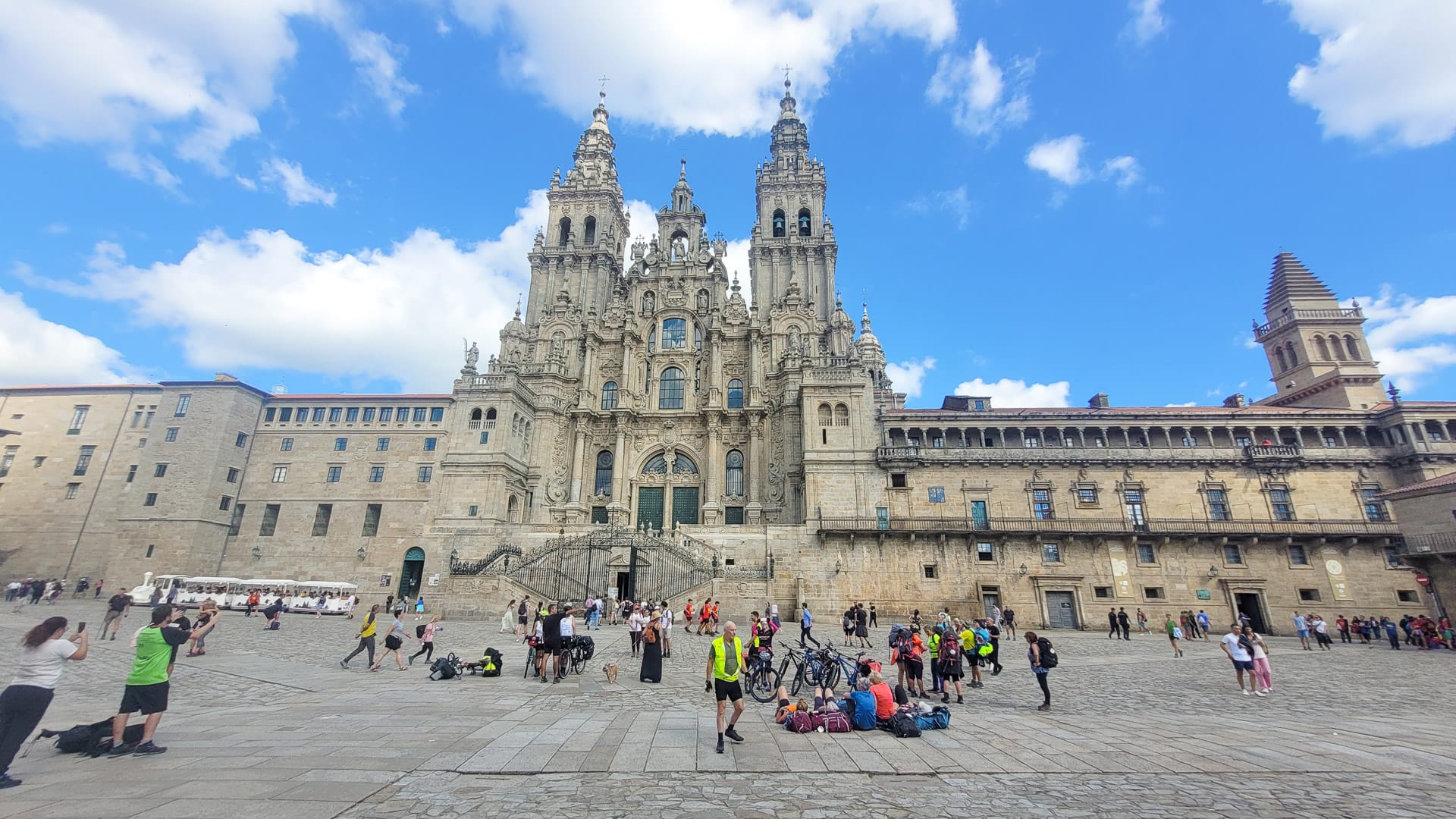
Santiago de Compostela Cathedral (photo credit: Top Bike Tours Portugal)
How easy is it to find food and drinking water?
Most towns and villages have cafés, bars, bakeries or shops, but opening hours vary. Start with enough food and water for the next section and refill when there is a reliable opportunity. Do not assume every fountain supplies drinking water.
The Montes de Oca between Santo Domingo and Burgos, and the exposed stages across the Meseta, need particular planning. We suggest carrying at least two water bottles and snacks, with more water in hot conditions. On our guided trips, we also provide water and snacks during the ride.
What food is worth trying?
Each region has its own dishes to look out for, with Galician cuisine particularly associated with the final part of the journey:
- Navarre and La Rioja: piquillo peppers, chistorra sausage and patatas a la riojana, a potato and chorizo stew.
- León and the Bierzo region: cecina, cured beef; botillo, a pork speciality; and cocido maragato, a hearty meat and chickpea meal.
- Galicia: Pulpo a la Feira, octopus; empanada gallega, a filled savoury pie; caldo gallego, a warming soup; and tarta de Santiago, an almond cake.
We encourage guests to enjoy the local bars, cafés and restaurants they encounter along the route. Many of the highlights of the Camino are the small, family-run establishments found in towns and villages along the way. Particularly enjoyable food stops can be found in Astorga, Villafranca del Bierzo, Sarria and Portomarín, where riders have a wide choice of cafés, bakeries and restaurants serving regional specialities. A tortilla, sandwich or regional lunch gives you time to recover and enjoy the place you are passing through.
On the León to Santiago route, food and water are generally easy to find, as the Camino passes through numerous towns and villages. However, carry sufficient water and snacks each day, especially during warmer months.
Some rural sections may have fewer services than the more populated areas closer to Santiago. This is particularly relevant on the longer stages between Astorga and Villafranca del Bierzo, and between Villafranca del Bierzo and Sarria. Never assume that the next café or water stop will be immediately available, and refill bottles whenever the opportunity arises.
Our GPS routes and roadbook highlight villages and key service points along the way, helping riders plan their breaks and water stops according to the day’s distance and weather conditions.
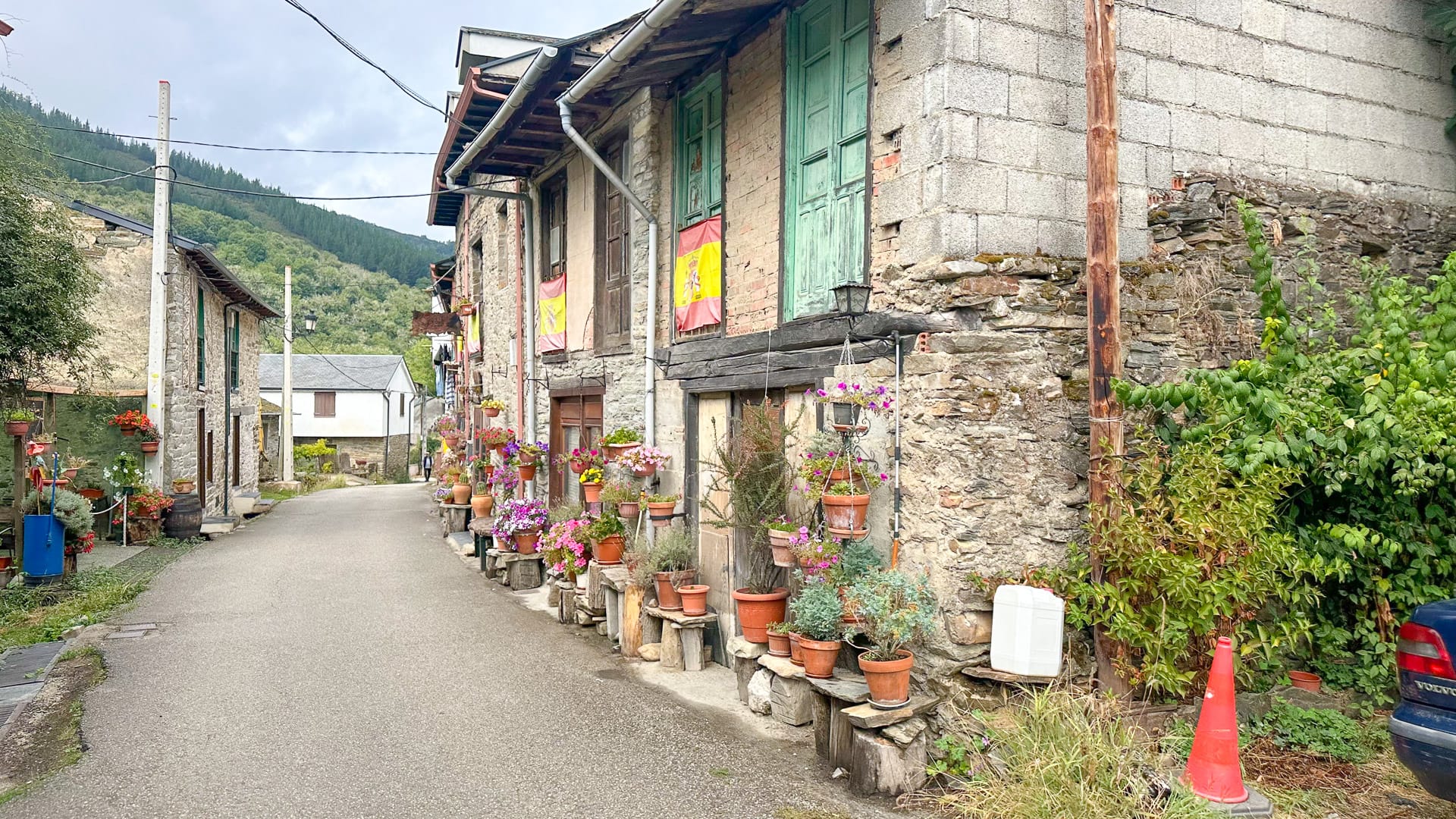
Cycling through rural northern Spain on the Camino Francés (photo credit: Top Bike Tours Portugal)
Do you need cash along the Camino?
Cards are widely accepted in larger towns and many hotels, restaurants and shops. Cash is still useful for small cafés, rural businesses and donations, or if a payment terminal is not working.
Carry a modest amount in small notes and coins. Withdraw money in larger towns rather than relying on the next village having an ATM (it might well not!).
How should cyclists share the route with walkers?
Slow down well before reaching walkers. Use your bell politely to let them know you are there, without demanding that they move. Leave room when passing and wait if the path is narrow. Be ready to stop or dismount when there is no comfortable way through.
Be especially considerate on the final stages, where there are more pilgrims. People may be tired, talking or simply not expecting a bicycle behind them. Allow time to pass safely.
Top tip! Approach livestock quietly and give animals plenty of space. Avoid sudden movements or loud noises, and follow local signs.
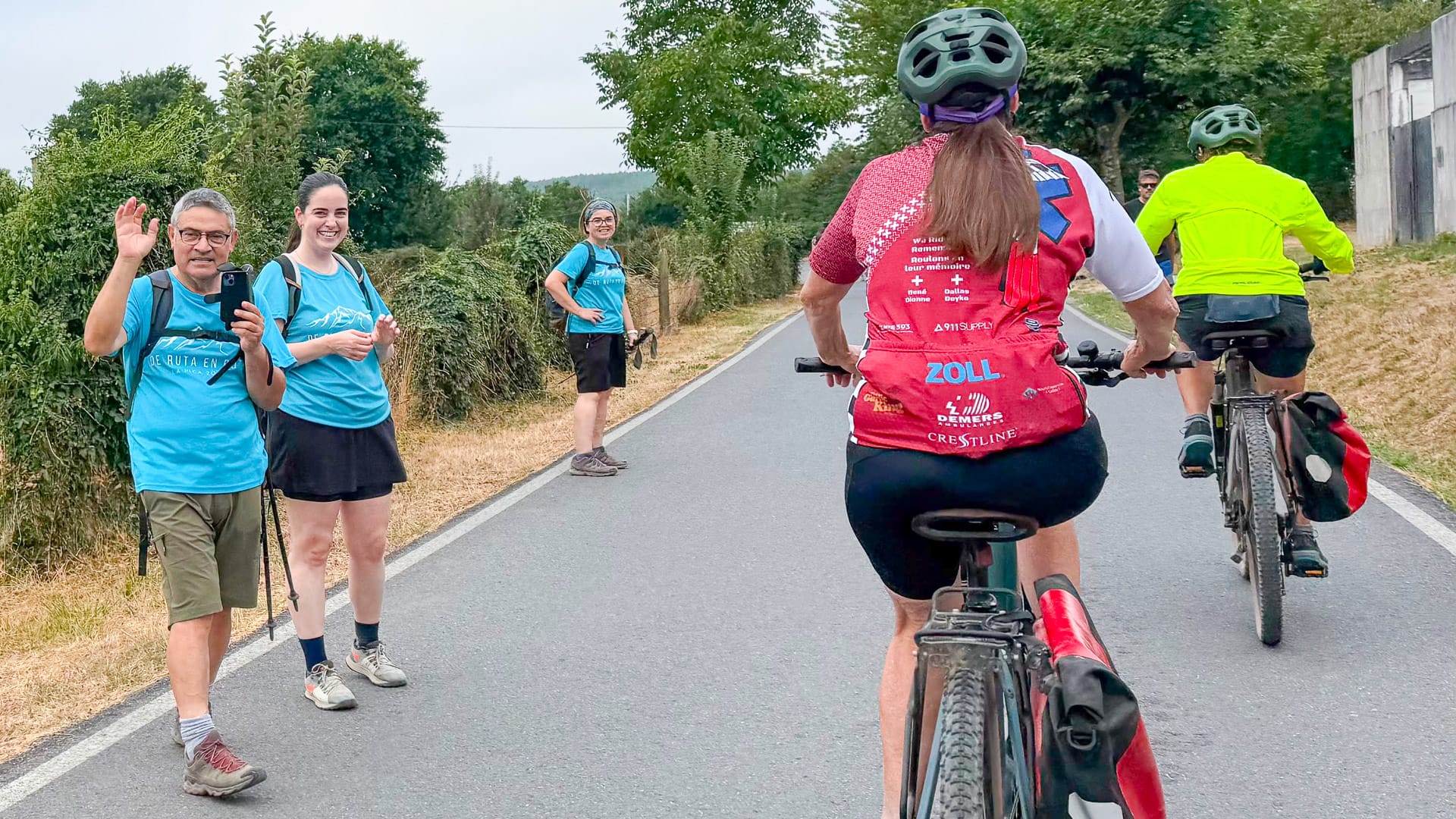
Cyclists and pilgrims on the Camino Francés (photo credit: Top Bike Tours Portugal)
What traffic and safety issues should you prepare for?
The Camino is not a traffic-free cycling route. Our itineraries include rural roads and connections through towns, with extra attention needed around junctions and the approaches to places such as Pamplona, Burgos, León and Santiago.
Tiredness can affect concentration, particularly on descents. Adapt your pace to the surface and weather, and take breaks before you feel exhausted. Rain can change the grip on dirt, clay and loose stones, while heat makes exposed sections harder work.
For road riding, familiarise yourself with Spain’s cycling rules from DGT. These cover helmets, lights, road positioning and reflective clothing. Do not hold or use your phone while riding. If you’re using your phone for navigation and don’t have it displayed on your handlebars, stop somewhere safe to check your route.
Can you use trains, buses or taxis with a bike?
Public transport can help with reaching the route or dealing with a change of plan, but bike space is not automatic. Check the exact service before relying on it, particularly if your bicycle will be assembled.
Renfe’s bicycle information distinguishes assembled bicycles from folded or dismantled ones. Some reservable services use a Train+bike option; long-distance services have separate packing and booking requirements.
Bus and taxi arrangements also vary. Tell the operator you have a bicycle, including whether it is an e-bike, and confirm space and packing requirements. On a self-guided trip, contact us if you need help finding a practical option.
Do you need to speak Spanish?
You do not need to speak fluent Spanish. English is understood in many Camino businesses and larger destinations, but it can be more limited in smaller villages.
A few phrases help:
- “Buenos días”: good morning.
- “Agua, por favor”: water, please.
- “Tengo un problema con la bicicleta”: I have a problem with the bike.
Patience and a friendly greeting go a long way.
On guided trips, the guide helps with communication. Self-guided guests can contact us by phone or WhatsApp if they need assistance.
How easy is it to find toilets?
Cafés, bars and restaurants are usually the most practical places to find facilities. A refreshment stop is a good opportunity to use them rather than assuming there will be another option shortly afterwards.
There are fewer facilities on some rural and mountain stretches. Plan around the stops you know are available, and do not expect a public toilet in every village.
Is it worth allowing extra time at the start or finish?
Yes. I suggest adding at least one extra night at the start or finish. My first choice would be Santiago, with time to visit the cathedral, explore the old town and collect the Compostela certifcate.
An extra night in Saint-Jean-Pied-de-Port gives you time to settle in before the Pyrenees crossing.
In León, allow time for the cathedral, historic centre and San Marcos, a former pilgrims’ hospital. Our full tour already includes a rest day here.
Sponsor Message
Take the stress out of planning your Camino Francés trip!
Top Bike Tours Portugal have been helping cyclists enjoy unforgettable bike tours since 2013. Their Camino Francés trips include carefully planned routes, hand-picked accommodation and luggage transfers - all arranged for you.
Choose between guided and self-guided tours to experience the Camino your way.
Head to their website to find out more.
Got a question for Sérgio Marques from Top Bike Tours Portugal?
Fill out this form and we will pass it to Top Bike Tours Portugal who aim to reply (within 24 hours wherever they can!)
Part 6: How can Top Bike Tours Portugal help you cycle the Camino Francés?
Do you need an organised tour to cycle the Camino Francés?
You can organise the ride independently. That gives you control over your stages and accommodation, but it also means arranging the route, luggage, bike and any help you might need.
Our tours suit riders who would like those practical details organised.
- A guided trip adds a guide and support vehicle.
- A self-guided trip gives you more independence during the day, with accommodation, luggage arrangements and navigation prepared in advance. Choose self-guided if you’re comfortable navigating and handling basic bike repairs. The support arrangements are explained below.
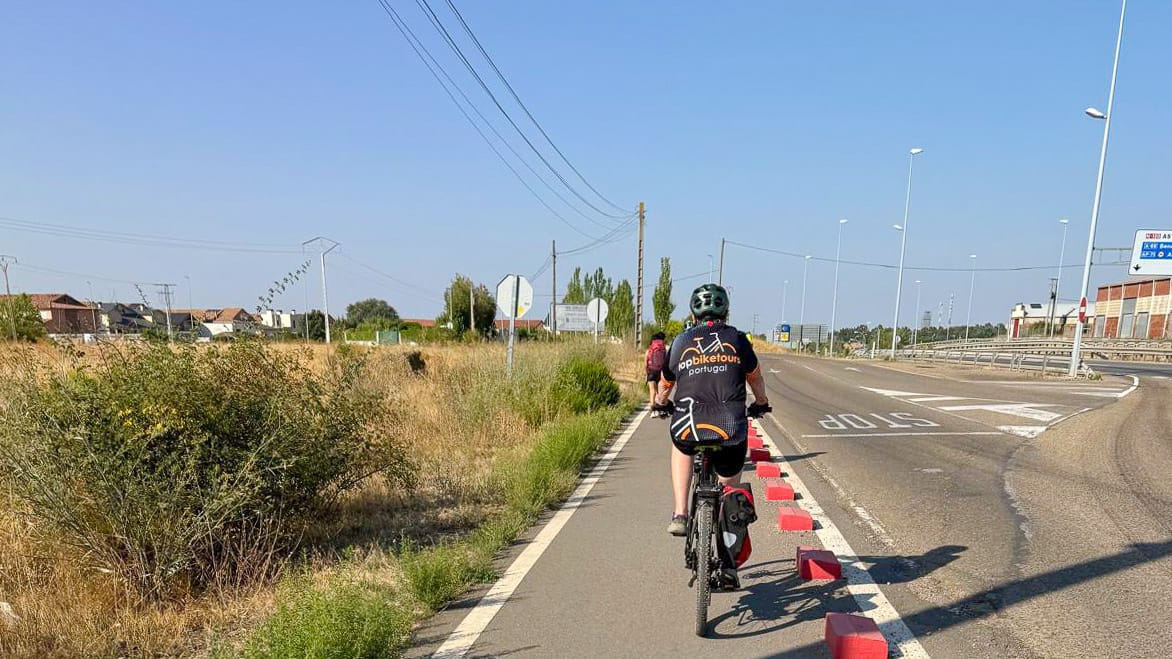
Along the Camino Francés (photo credit: Top Bike Tours Portugal)
What experience do Top Bike Tours Portugal have organising Camino cycling holidays?
Our experience comes from cycling the Camino Francés ourselves and organising the details for our guests.
I design routes and work with our team on stages, accommodation, bicycles and support logistics.
One thing we have learned is that riders want different experiences. Some enjoy a more athletic trip; others value extra time in towns, greater comfort or assistance on climbs. Those preferences matter when we discuss the route with a guest.
Feedback also helps us refine the holidays. It tells us where riders want more time, where a stage feels demanding and which practical arrangements make the journey more comfortable.
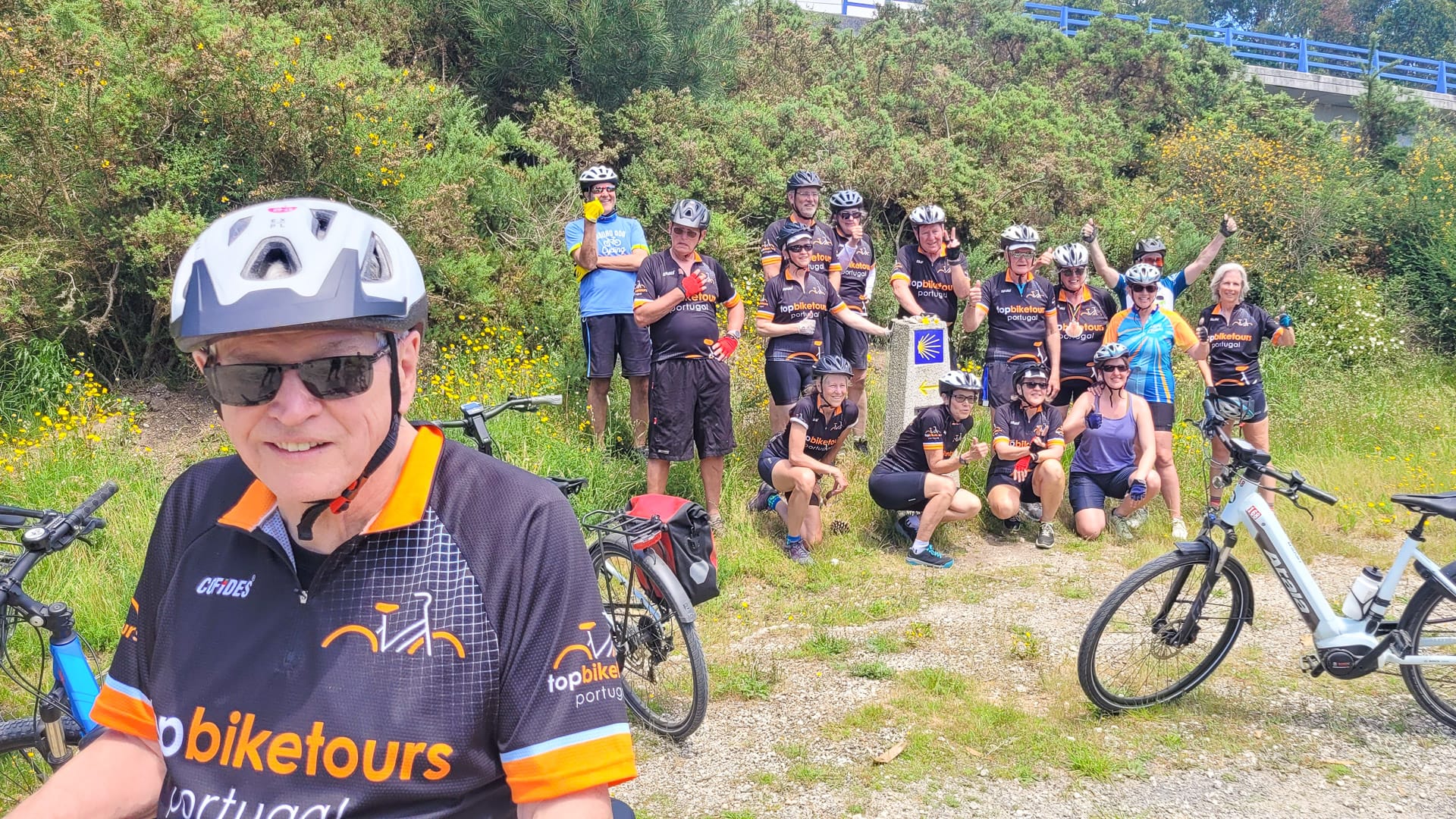
Cyclists at a Camino Francés sign (photo credit: Top Bike Tours Portugal)
Which Camino Francés tours do you offer?
We offer a full Camino Francés tour from Saint-Jean-Pied-de-Port to Santiago, lasting 16 days and 15 nights. This is available only as a guided holiday, with a guide and support vehicle. The minimum group size is eight participants and the maximum is 25.
Our León to Santiago tour lasts eight days and seven nights, with guided and self-guided options. You still ride through historic towns, tackle the climbs into Galicia and finish in Santiago. For the guided tour, the minimum group size is four participants and the maximum is 25. For the self-guided tour, the minimum is two participants and the maximum is 25.
Both tours are challenging. We compare the riding and who each option suits above.
Scheduled departure dates may vary according to the season and tour format. Check the relevant tour page or contact us directly for the latest departure schedule and availability.
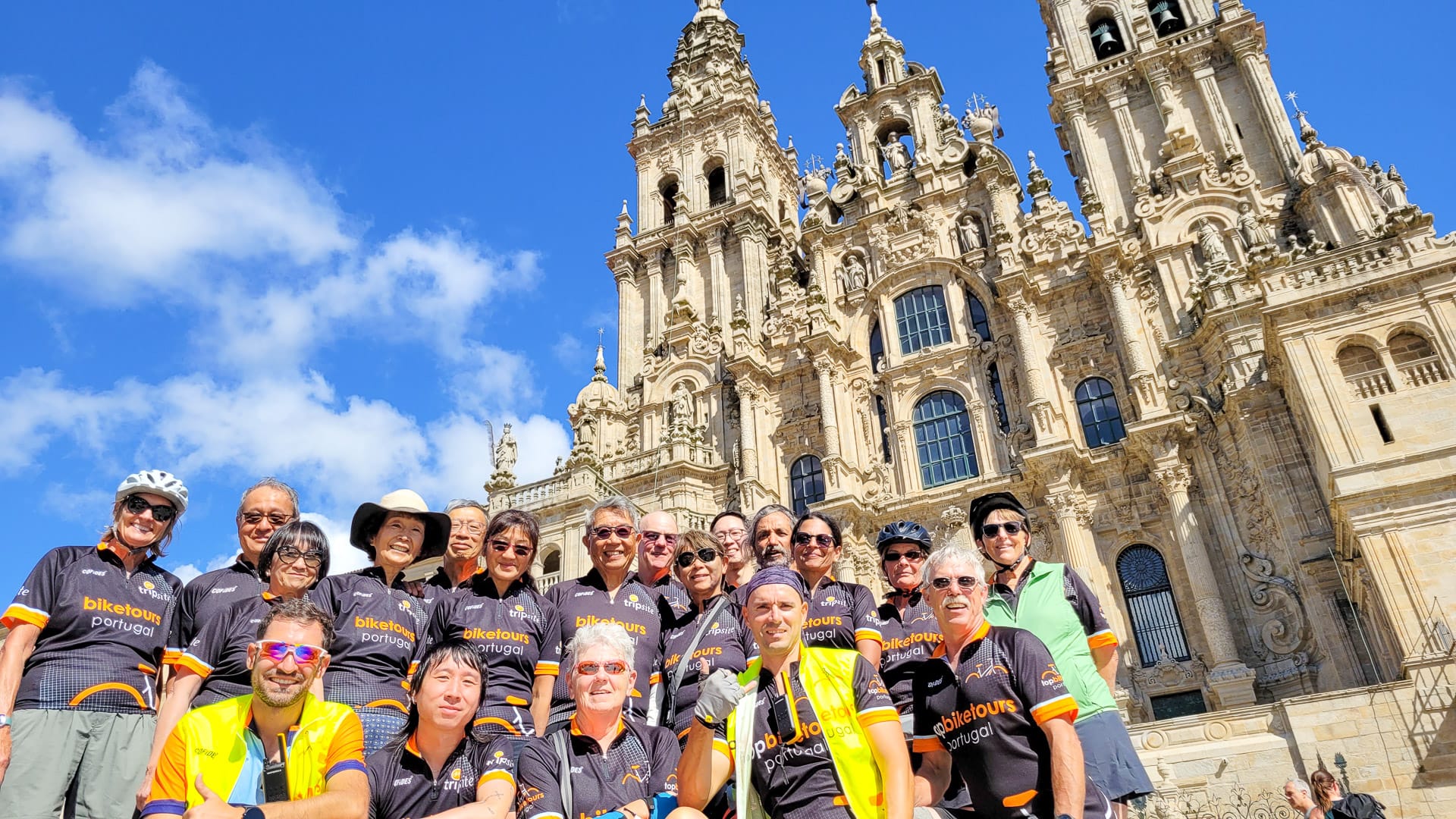
Top Bike Tours Portugal cyclists in front of Santiago de Compostela Cathedral (photo credit: Top Bike Tours Portugal)
What is included and how does support differ between the tours?
Our packages include accommodation with breakfast, luggage transfers, bike hire and GPS routes. E-bikes are an upgrade, subject to availability. Exact transfers and accommodation categories depend on the package, so check the details of your quotation.
Guided holidays: Our guides speak English and Portuguese. They share local history and food suggestions, as well as helping with navigation, pace and communication. A support vehicle meets the group at suitable points along the route.
Self-guided holidays: You ride independently, with phone or WhatsApp support if you need help. We can direct you to a bike shop or help arrange transport.
Explore both Camino Francés tours on Top Bike Tours Portugal’s website, then contact the team for current prices and details of what’s included in your preferred holiday.
What makes your trips special and can they be tailored?
Routes designed for cyclists: We consider the surfaces, climbs and traffic, as well as places to stop and stay. Where possible, we use quieter roads while keeping the Camino’s towns and traditions part of the journey.
Private and customised trips: We can arrange these subject to availability. We have arranged private departures for families and groups of friends who preferred to travel on dates outside our scheduled departures. We can adjust accommodation categories, bike types, transfers and support arrangements before the trip begins. Discuss any specific requirements with us before booking so that we can design the most suitable itinerary and support package.
One example was a private group that wanted to cycle the Camino Francés together but had riders with different fitness levels and cycling experience. We customised the trip by providing a mix of standard bicycles and e-bikes, arranging upgraded accommodation and adapting the daily logistics to suit the group’s preferences. This allowed stronger riders to enjoy the challenge of the route while ensuring that less experienced cyclists could comfortably complete each stage.
The goal is always to maintain the essence of the Camino while tailoring the experience to the needs of the particular group.
Custom itineraries need to be arranged before the trip. We cannot add overnight stops midway through an existing itinerary, because hotels and luggage transfers are already booked. During the ride, we can help with practical changes caused by weather, fatigue or mechanical problems.
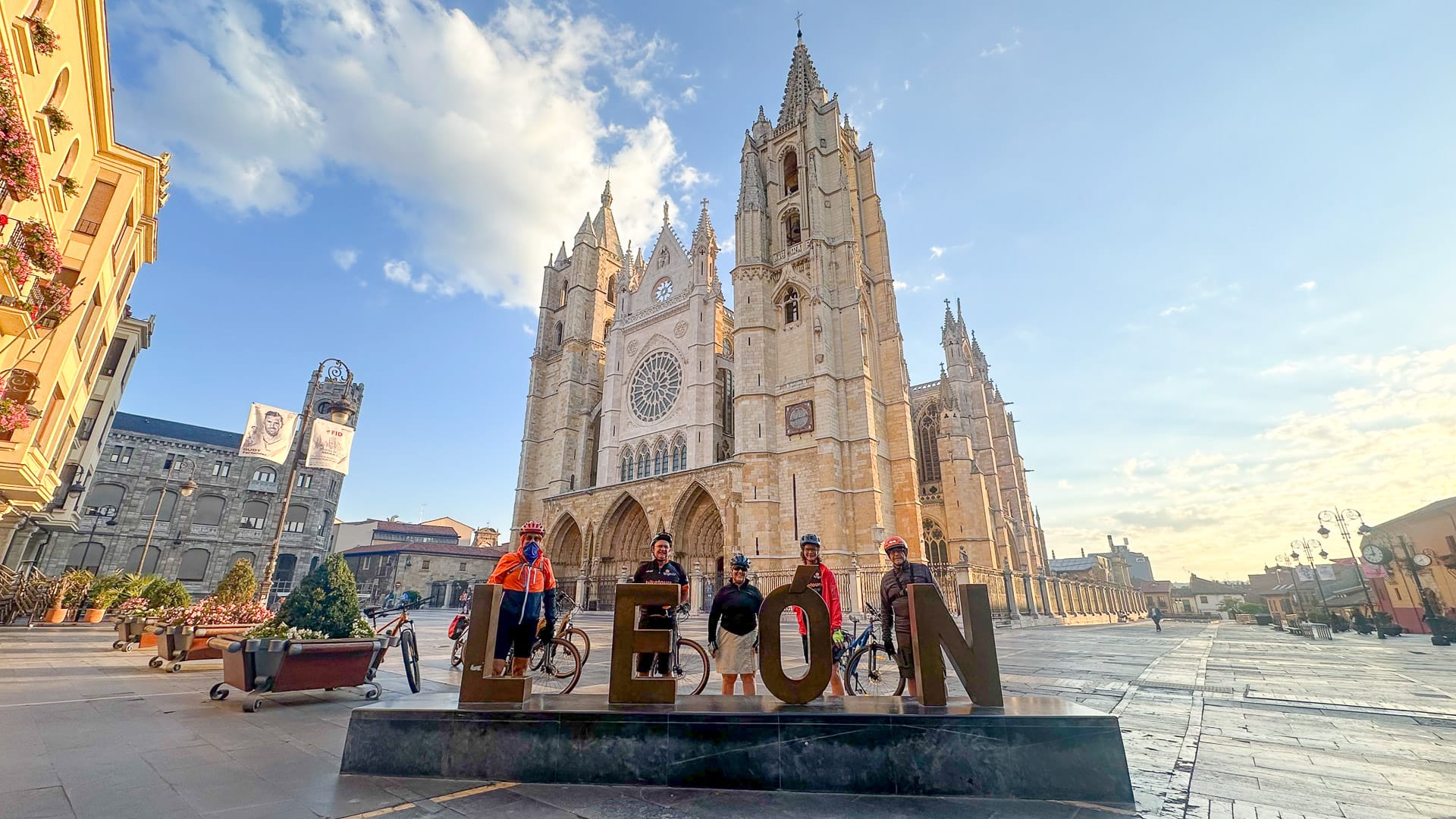
Top Bike Tours Portugal cyclists in front of León Cathedral (photo credit: Top Bike Tours Portugal)
How can readers find out more?
We love to help guests plan and are keen to discuss dates, bike choices and how much support you’d like. Just tell us about your usual riding and any preferences for your trip; we’ll do all we can to ensure you have a wonderful trip!
Ready to plan your ride to Santiago? Contact Top Bike Tours Portugal through their website to discuss availability and your preferred tour format.
What’s next?
Thanks to Sérgio for sharing his experience of cycling the Camino Francés and the practical details behind the journey.
Looking for more cycling inspiration?
Top Bike Tours Portugal have also worked with us on several other articles. To hear more from these cycling experts, take a look at:
- Porto to Lisbon cycle route: guide to Portugal’s Atlantic coast by bike
- Guide to cycling the Portuguese Camino: Porto to Santiago de Compostela
- Cycling Douro Valley
Looking further afield:
- London to Barcelona cycle route: a guide to riding from the UK to Catalonia
- Our pick of the best Spain cycling tours
- ViaRhôna cycle route: guide to cycling from Lake Geneva to the Mediterranean
Got a question for Top Bike Tours Portugal?
Fill out this form and we will pass it to Top Bike Tours Portugal who aim to reply (within 24 hours wherever they can!)
Got a question for Sérgio?
Fill out this form and we will send it to Sérgio. We aim to get you an answer within 24 hours where possible!Sérgio Marques is the founder of Top Bike Tours Portugal.
He has a background in accounting and a lifelong love of sport, including a particular passion for cycling. The idea for the company came after a life-changing ride with friends to Santiago de Compostela in 2012. From that journey, Top Bike Tours Portugal was born. Sérgio's aim was to share authentic cycling experiences.
Today, Sérgio manages the business and occasionally leads tours himself, especially for larger groups. He speaks Portuguese and English.
First Published: 28 September 2026
The contents of this website are provided for general information purposes only. It is not intended to amount to advice and you should not rely on it. You should carry out your own due diligence and risk assessments and take professional advice. Views expressed by interviewees or other users of this website do not necessarily represent our views. We make no representations, warranties or guarantees, whether express or implied, that the content on our website is accurate, complete or up to date. If you use any information or content on this website, download from, or otherwise obtain content or services through our website, it is entirely at your own discretion and risk. Epic Road Rides Ltd disclaims all liability and responsibility arising from any reliance placed on the information and content on this website. Find out more here.
Sponsor Message
Take the stress out of planning your Camino Francés trip!
Top Bike Tours Portugal have been helping cyclists enjoy unforgettable bike tours since 2013. Their Camino Francés trips include carefully planned routes, hand-picked accommodation and luggage transfers - all arranged for you.
Choose between guided and self-guided tours to experience the Camino your way.
Head to their website to find out more.
Got a question for Sérgio Marques from Top Bike Tours Portugal?
Fill out this form and we will pass it to Top Bike Tours Portugal who aim to reply (within 24 hours wherever they can!)
Comments