
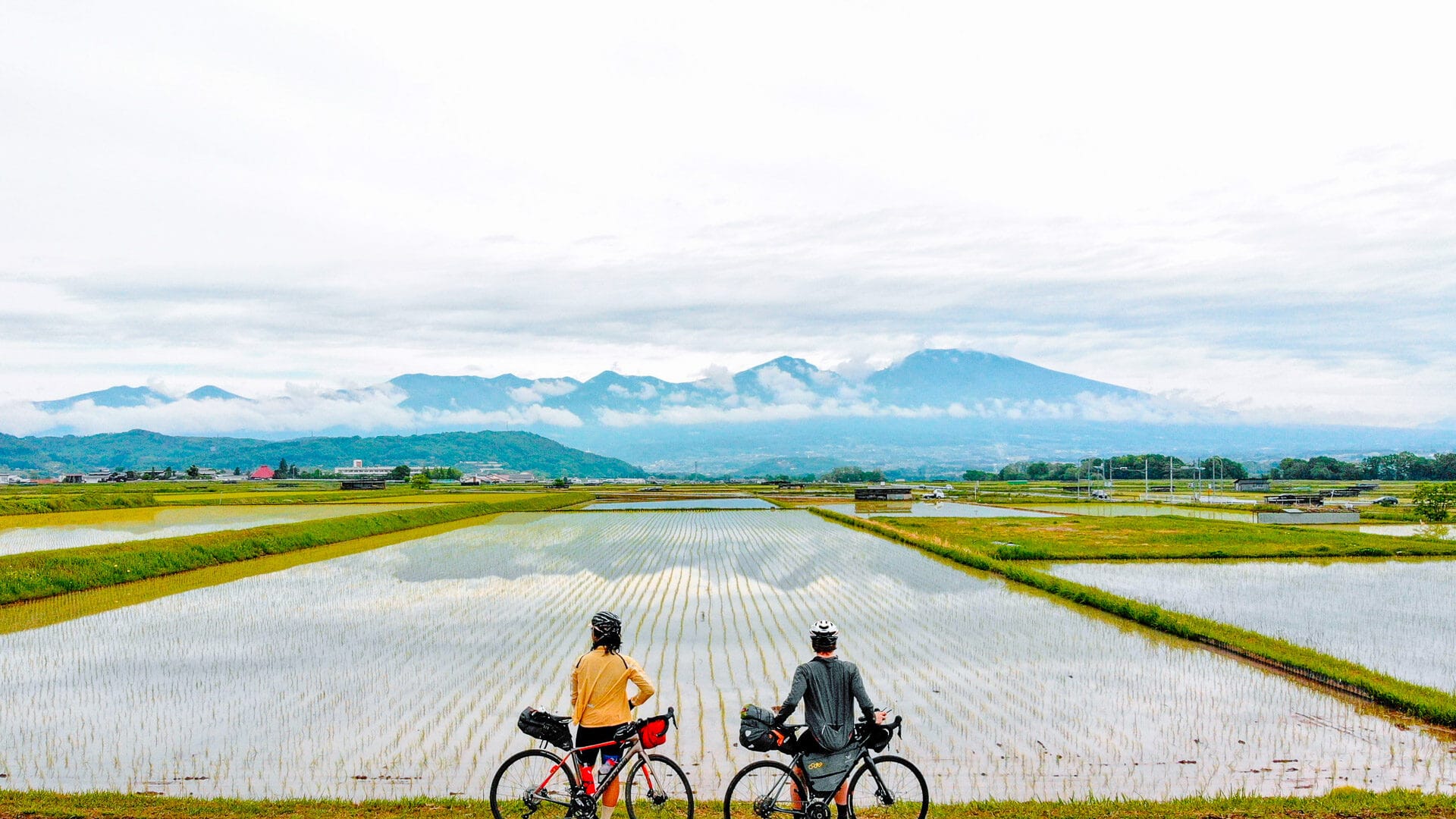

“Cycling in Japan is an experience like no other: cycling routes that snake through valleys and up volcanoes, hot springs you can soak in, unforgettable ryokan hotels, historic shrines, warm hospitality, futuristic cities and delicious food.
Experiencing Japan by bike is an experience you won’t forget.”
Japan had been on our “absolutely must-visit” list for many years when we first enlisted Rob from Rindo Bike Tour Japan (who we quote above) to help with this guide. We have since visited and rode a self-guided trip with Rindo in March/April 2026. Read our review of cycling in Japan with Rindo for a first-hand account of our experience.
Rob is originally from Syracuse, New York and moved to Japan in 2014. He started Rindo in 2017 with the aim of creating cycling tours of Japan that share the best of the country’s riding and off the beaten track places. His passion for all things Japan and cycling, makes him the perfect person to help us with this guide.
Fancy cycling Japan?
If you’ve ever wondered about a cycling holiday in Japan, you’re in for a treat.
In this guide, Rob shares tons of information about cycling in Japan, including the best cycling routes, focusing on three regions:
- Kita Kanto region: Best for quiet countryside, volcano climbs and cultural stops within reach of Tokyo.
- Setouchi Inland Sea: Best for coastal riding, island-hopping and exploring the well-signposted Shimanami Kaido.
- Nagano Highlands Region: Best for long mountain climbs and high-altitude riding in the Japanese Alps.
You’ll also find information on cycling routes, bike hotels and bike rental in Japan.
Enjoy!

Rob fell in love with cycling as a way to explore natural landscapes at the perfect pace.
After graduating from the Eastman School of Music in 2014, he spent a year working, cycling, and creating a community in Japan. Since then, Rob has returned each year to delve deeper into the secluded countryside.
Now he lives in Kiryu City, Gunma Prefecture, Japan. It's a funky mountain town about 1.5 hours by express train from Tokyo. It has a rich history of silk production and Japanese hipster cafes and restaurants.
Rob is driven by the desire to create unforgettable cycling trips for guests from all over the world. He loves surprising travellers with unique and immersive experiences that exist just outside the international hubs of Tokyo, Kyoto, Osaka and Hiroshima.
In addition to creating intimate adventures throughout Japan, Rob also previously worked with Duvine Cycling in Northern California. When he is off the bike, he enjoys playing classical guitar, and chatting with the locals at a nearby cafe or hot-spring Onsen.
Find out more about Bike Tour Japan and check out our Strava.

We love to introduce our community to cycling businesses, destinations and ideas that we think are genuinely interesting. Rindo Bike Tour Japan caught our attention because of its focus on cycling in Japan, which felt like a natural fit for Epic Road Rides and our readers. We were therefore pleased to work with the Rindo Bike Tour Japan team on this article.
Rindo Bike Tour Japan paid for this advertisement feature. Our decision to collaborate reflects our view that the brand is relevant to our readers; it is not a formal approval, audit or guarantee of its services. Unless we expressly say otherwise, we have not personally taken the trip described or independently verified information supplied by Rindo Bike Tour Japan.
As with any travel purchase, please check the latest trip details, terms and customer protections directly with Rindo Bike Tour Japan before booking. Any booking is made with Rindo Bike Tour Japan, not Epic Road Rides.
Looking for information on the Shimanami Kaido cycle route? Read our article here. Or for more information about self guided cycling tours in Japan take a look at this article. Or for the chance to ride the iconic Mount Fuji on cycling tours in Japan, read this.
Want to turn these ideas into a holiday? Explore Rindo’s guided cycling tours or browse our self-guided itineraries to compare destinations and riding options on our website.
Always check current travel information and advice. For visitors from the UK, the UK government travel information pages are here.
Table of contents
- Part 1: Why should cyclists visit Japan?
- Part 2: Japan’s cycling routes
- Part 3: Key road cycling events in Japan
- Part 4: Best accommodation for cyclists
- Part 5: Bike hire
- Part 6: When to visit
- Part 7: Tips
- Part 8: Rindo Bike Tour Japan
Sponsor Message
Want help organising your Japan cycling tour?
Rob and the team at Rindō Bike Tour Japan have been organising cycling holidays in Japan since 2017, specialising in guided and self-guided tours that explore Japan’s quieter countryside.
They're happy to tailor tours to different riding abilities and interests, and love to include stays in traditional ryokan accommodation, enjoy local food and relax in natural hot springs.
Head over to their website for more information or fill out the form below.
Got a question for Rob from Rindo Bike Tour Japan?
Fill out this form and we will pass it to Rindo Bike Tour Japan who aim to reply (within 24 hours wherever they can!)
Part 1: Why should cyclists visit Japan?
Japan is known by most for its bustling city life and dense urban areas, unique culture, and delicious traditional foods.
But for those wanting to cycle around Japan, a different side of the country awaits just beyond the tourist centres of Tokyo, Osaka, and Kyoto.
Get two hours away from the city, and you’ll find beautifully paved roads through stunning forests. Cycling through Japan lets riders explore twisting roads that climb up and over volcanoes, chat with locals in traditional villages, and finish off each day at a luxury ryokan hotel with onsen hot spring baths. Plus, there are car free river paths and a full range of routes to suit all levels, from gentle valleys to epic 2,000m+ gains.
In my opinion, Japan is home to all the perfect ingredients for an amazing cycling holiday. Every person who has joined us on a tour has left with unforgettable memories.

Map of Japan
Part 2: Japan’s cycling routes
Geography of Japan
Big cities, quiet countryside
Over 80% of Japan is uninhabitable mountainous terrain, making its cities some of the most densely populated in the world (source).
On the flipside of this, most of the 80% of Japan that isn’t inhabited is gorgeous wilderness, criss-crossed with excellent roads just ready to be explored.
Mountains
When you fly into Japan on a clear day, you can see just how huge the mountains are! The country has many volcanic peaks over 2,000 metres, alongside mountain ranges formed by tectonic uplift. And, while Mt Fuji receives all of the attention as the tallest peak in Japan, the best roads in Japan are in the centre of the country (and you can get awesome views of Fuji from Kita-Kanto and the Nagano Highlands – more on those below).
Japan’s highest paved road, for example, is a beautiful one that climbs up a volcano in Nagano Prefecture, topping at just over 2,700m above sea level. If you’re a road cyclist that loves to climb, you’re going to love Japan!
Cities v mountains
Basing yourself in a small city or town outside of Tokyo allows for many opportunities to explore a different side of Japan with direct access to nature.
Just take a direct train north or northwest of Tokyo, and you’ll find a variety of amazing scenery and cultural experiences without the bustling city streets of Tokyo. Our top recommendations for small cities that are easy to reach from Tokyo include: Kiryu, Ashikaga, and Nikko. They’re all in the Kita Kanto region (more on that below).
What are the roads like in Japan?
Kids cycle in Japan
In general, cycling in Japan is part of the culture; it’s a way of life for many locals in suburban and rural Japan. Outside of the cities, nearly every kid and young adult from 10 years+ rides their bike to school. This means most Japanese people are, or have been, cyclists since childhood. Motorists are very familiar with seeing children on bikes everyday, and their courteous driving reflects this.
Courteous drivers
Japanese drivers are notorious around the world for being cautious rule followers. Road rage and aggressive driving are virtually non-existent in Japan, and drivers tend to drive at the speed limit, which is quite low in the countryside, around 30-50kph. From 1 September 2026, the default motor-vehicle limit on qualifying local roads without centre lines or marked traffic lanes became 30kph; a signed limit takes precedence.
Road surfaces
Road surfaces in Japan are often an exact indicator of the amount of traffic a road receives. Most people in Japan drive just a handful of main roads in a town, leaving many smaller roads with great road surfaces and no traffic. What’s more, Japan is full of river valleys, many of which have bicycle lanes and beautifully-built relatively flat pedestrian and bike paths lining each side.
Route planning
When most drivers choose a route in Japan, they follow a GPS, so many end up on the same roads. So for cyclists planning cycling routes through Japan, my biggest piece of advice is don’t follow Google Maps driving directions unless you want cars passing you all day.
Instead, look at the main road, and look for parallel smaller roads, or better yet, rivers with river paths. Plan your route around these small roads and river paths, especially when in dense city areas. If you are riding out in the countryside, you can be more lax about being on major roads. Also checking the roads in Google Street View will give you a good sense of the traffic to expect through your route.


What are the best regions of Japan for cyclists
Japan is a land of huge variety in scenery, terrain, and climate. I think you find some of the best cycling in Japan in these three regions. The best one for you will depend on what kind of cycling you’re after and how important the weather and other tourist attractions are to you.
- Kita Kanto region – Japan’s sunbelt and cycling hub near Tokyo
- Setouchi Inland Sea – Home to the Shimanami Kaido bikeway, citrus and seafood, and Dogo Onsen, one of the oldest and most famous hot-spring baths in Japan
- Nagano Highlands region – Home to the highest roads in Japan
Map showing the Kita Kanto region in purple, the Setouchi Sea region in green and Nagano Highlands region in yellow
Kita Kanto
“The sunbelt and cycling hub close to Tokyo”


Location
Kita Kanto, meaning “North Kanto” is a region in the upper northwest corner of the Kanto Plains. Stretching northwest out of Tokyo, the Kanto Plains are considered the main food production zone in Japan. In ancient times, it was said that he who ruled Kanto ruled Japan.
This region is unique thanks to its proximity to Tokyo, just 1-2hrs by train, making for an easy trip from the nation’s capital. Nikko National Park is home to stunning untouched wilderness, alpine lakes, and massive shrines dedicated to the most famous Shogun in Japan, Ieyasu Tokugawa. From Nikko, you can reach the historical silk mills of Kiryu as well as Ashikaga Gakko, known as Japan’s oldest school. In between these regions are an endless string of beautiful valleys, river paths, mountains, and rindo (forest roads) connecting the region, making it perfect for exploring by bicycle.
In the western corner sits two massive stratovolcanoes: Mt Akagi and Mt Haruna. With summits over 1,500m and 1,000m respectively, both volcanoes have beautiful winding roads up to their caldera lakes. Below these towering mountains sits two of Japan’s largest rivers: the Tone River and Watarase River, both with beautiful car-free cycling paths winding through the small towns and cities they connect.
Famous for…
This region is famous for its fresh grown local veggies, Ayu sweetfish, wagyu beef, joshu pork, and shiitake and matsutake mushrooms. If you have never had matsutake mushroom soup, this is a must for anyone visiting the region in the Fall. A simple soup made from just matsutake mushrooms, daikon radish, mitsuba leaf, and a local breed of the green citrus called yuzu, it is a warm hearty broth that captures the essence of Fall in the mountains of central Japan.
Lastly, this region is known for its sun, something we all can appreciate when on a cycling trip. While the rest of Japan averages the same average sunlight as London (and about 4x as much rain!), the Kita Kanto Region is sheltered by mountains on three sides and far from the ocean enough to avoid the humidity of the sea. This means more sunny days, fewer wet days, and a much longer riding season than anywhere else in Japan.
The riding
Kita Kanto can offer good riding conditions in spring and autumn. The inland plains also have many sunny winter days, but summers can be hot and humid, and the mountains are colder. Be aware that rain, thunderstorms and typhoons can still affect the region.
For a guided holiday exploring Nikko, Lake Chuzenji and the surrounding mountains, take a look at our Nikko North Alps Tour. You’ll find the itinerary, daily riding distances and accommodation details on our tour page.
Setouchi Inland Sea
“Home to the Shimanami Kaido, citrus and seafood, and town of Dogo Onsen”

The Noto Peninsula has some of the freshest seafood in the world (photo credit: Rindo Bike Tour Japan)
Location
The Setouchi region surrounds the Seto Inland Sea in western Japan, between the islands of Honshu, Shikoku and Kyushu. The region includes coastal towns and hundreds of islands, some connected by bridges and others reached by ferry. Its sheltered waters and island landscapes offer a very different experience from Japan’s mountainous interior.
Famous for…
The Setouchi Inland Sea has arguably become the most famous region for bike riding in Japan thanks to the promotion of the Shimanami Kaido Cycling Route. But beyond the Kaido, there is much more to explore in the region for those with the curiosity to explore off the beaten path.
I love this region because of the beautiful teal-coloured water, the fresh local seafood, and the accessibility of the cycling routes. The Shimanami Kaido, for example, is very well marked and great for those looking to dip their toes into bike touring for the first time. Beyond the standard 70km course, there is a whole other set of roads and oceanside cafes.
I also recommend time to explore the famous hot spring resort of Dogo Onsen and the castle in Matsuyama City, just past the end of the Kaido’s end point in Imabari.
If you are hoping to catch the cherry blossoms, you can expect the pink flowers in this region to bloom earlier than the rest of Japan. And for Fall colours, we suggest coming here in early December, which ties nicely with the citrus season.
The riding
This region is very accessible to all levels of riders, and even non-riders on the Shimanami Kaido bike route.
Those looking for challenging days and good amounts of climbing will find the Kita Kanto and Nagano’s Highroads Regions a better bet.
For a cycling holiday exploring the Setouchi Inland Sea and the famous Shimanami Kaido, take a look at Rindo’s Shimanami Kaido Setouchi Tour.
Nagano Highlands Region
“Known as the Japanese Alps, home to the highest roads in Japan”

Location
Nagano Prefecture sits inland in central Japan, northwest of Tokyo, on the main island of Honshu. Much of the region is mountainous, with the Japanese Alps dominating the landscape. The historic city of Matsumoto, at the foot of the Northern Japanese Alps, is a useful starting point for exploring the region’s high mountain roads.
Famous for…
Beyond its mountain roads, Nagano is famous for its winter sports resorts, traditional hot springs (onsen) and historic towns. Matsumoto Castle, one of Japan’s 12 remaining original castle keeps, is a highlight for visitors spending time in the region.
Nagano is also known for its local food, particularly soba (buckwheat) noodles, apples and oyaki, traditional stuffed buns that are usually steamed or grilled. After a long day tackling the mountain climbs, there’s plenty to look forward to off the bike, whether that’s relaxing in an onsen or trying some of the region’s local specialities.
The riding
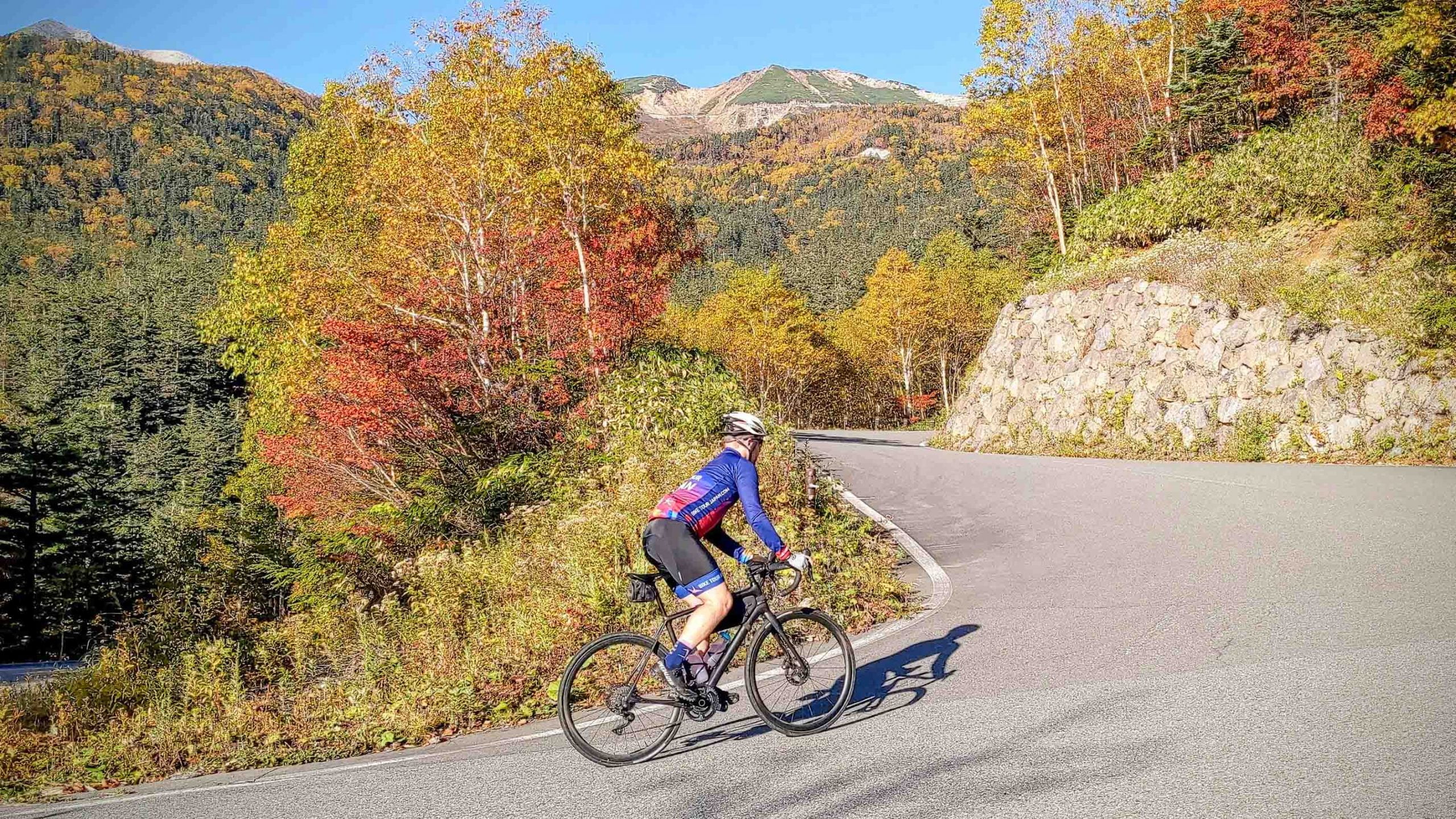
While many will recognise Nagano Prefecture as the host of the Winter Olympics back in 1998, it is also home to some of Japan’s highest roads. Mount Norikura’s highest peak, Kengamine, is 3,026 metres. The cycling road reaches around 2,720 metres near the prefectural border, while the Tatamidaira bus terminal is at 2,702 metres. These are different points: the paved road does not reach the mountain summit.
The upper Echo Line beyond Sanbondaki is closed to private motor vehicles. Buses, taxis and authorised vehicles still use it, so it is not traffic-free.
Having done many of the big passes in Europe, such as the Stelvio, Alpe d’Huez, Iseran, Izoard, etc, I have to say this climb above the tree line is really one of a kind.
But even beyond Mt Norikura, there are also many other amazing summits topping over 2,000m above sea in the area. My personal favorite is the Utsukushigahara Highlands, with the Venus Line another option for high-level riding. But due to the height of the region and heavier precipitation, much like the high passes in Europe, the season is much shorter, often just mid July to the end of October.
This can make finding the perfect time to cycle in this region a delicate balancing act with Japan’s rainy season (which runs from June through September).
If you’re interested in cycling in the Nagano Highlands, Rindo offers custom self-guided bike tours here, with routes tailored to your interests, riding ability and travel plans. Visit our website for more information.
A final note on cycling in Hokkaido
Hokkaido is not in our top 3 best places in Japan for cycling. While Hokkaido can be a great place to visit, the season is quite short and is limited to the peak summer months. While it’s less wet than Honshu, you can still expect roughly 1 out of 3 days to be rainy and cold. This is in contrast with the Kita Kanto Region in spring and fall which averages one day of rain a week.
The scenery in Hokkaido is beautiful! However, between sights most of the scenery can be long straight roads with mostly crop fields to get between areas. So for riders looking to do less than 100 kilometres/day it can be quite repetitive. Whereas in Kita Kanto, Setouchi, or Nagano areas you can have vastly different microclimates and scenery within 50km of riding.
There is a reason that Hokkaido is a favorite for bikepacking; the long distances and vast wilderness is more conducive to camping and bikepacking trips than hotel-based day rides and bike tours.
What are the best cycling routes in Japan?
Below I share some of my favourite Japanese cycling routes in the regions identified above.
Kita Kanto region
Hard – Akagi
Mount Akagi is the centerpiece of the Kita Kanto skyline. A 1,800m tall stratovolcano that looks more like a mountain range than a single mountain, Akagi erupted some 30,000 years ago. This created the jagged top and two caldera lakes you see today.
The best cycling route is to take the small old road up the southeast side where cars seldom drive. Then, into the caldera for a lap around the lake and a visit to the Akagi Jinja Shrine beside Lake Onuma. Finally, fly down the pristine two lane wide road for over 1,400 metres of ripping descent!
It’s not every day you can say you climbed up into a volcano, and Mount Akagi is the best place to do this by bike.
Interested in exploring this area over several days? Our five-day Ashikaga + Akagi self-guided adventure combines countryside riding with stays in Ashikaga and near Mount Akagi.
Easy – Kiryu Ashikaga Loop
For those looking for a more relaxing ride in Japan, the Kiryu-Ashikaga loop is a classic that any level of cyclist can enjoy.
Starting from Kiryu City, the loop takes you out of town to the Lake Umeda Recreation Area. Then, over the Nagaishi-Touge (tr Long Rock Pass) for a beautiful view of the valley below.
Then, fly down into Ashikaga City, where you can grab lunch, see Ashikaga Gakko, Japan’s first school, and stroll through the beautiful central Bannaji Temple in town.
Finally, hop on the car-free Watarase River Cycling Road back to Kiryu to check out the local silk mills. All along the way, there are options for delicious local udon and soba, as well as more international food if you prefer!
For more riding around these towns, see our four-day Kiryu + Ashikaga self-guided adventure, with forest roads to explore from a single ryokan base.
Setouchi Inland Sea
Hard – Extended Shimanami Kaido cycling road
For those looking to go beyond the Kaido’s standard route (below), our favourite route wiggles around each of the islands to hit the best sights on each one.
While it covers much more distance, exploring the islands by bike is a lot of fun and it is possible to break this into multiple days as well and stay a few nights on the islands.
Things you’ll see on the way include far-reaching views from Muku Bay Observation area, the Kousanji Temple complex, the sandy Hata Okiura Beach and the huge ship building works at Aiesu Shipyard.
If you’re interested, don’t miss our in-depth article on the Shimanami Kaido cycling route.
Our Shimanami Kaido Setouchi Tour takes this island-hopping idea further, including the Tobishima Kaido and neighbouring islands. Explore the itinerary to see how we combine the riding with boat journeys and overnight stays.
Easy – Classic Shimanami Kaido
Don’t fix what ain’t broken. The classic Shimanami Kaido route is about 70 kilometres between Onomichi and the Imabari side of the crossing. Fit riders can complete it in a day; splitting it over two days allows more time for stops. Allow extra distance if continuing to central Imabari.
As Japan’s most famous cycling course, it is well-labelled and designed with plenty of infrastructure to help riders along the way.
You’ll find sea views, small fishing towns, citrus groves, and the Kurushima Kaikyo bridges, a series of three suspension bridges. However be aware that it’s not all sandy shores as, due to the typhoon season each year, the shorelines are usually protected with concrete reinforcements.
There’s more on bike hire for the Shimanami Kaido below.
Also read our article on the Shimanami Kaido cycling route.
Nagano Highlands Region
Hard – Norikura
This challenging 148.8-kilometre route starts and finishes in Matsumoto, with around 3,100 metres of climbing overall.
There are few places in the world where you can climb for over 50km and gain more than 2,200m.
That is exactly what you’ll find on Mount Norikura, a huge stratovolcano surrounded by high peaks.
Beyond that, the final 13 kilometres of the climb follow the Norikura Echo Line, a high mountain road that is closed to private cars, although buses and taxis are still permitted (source). This section involves around 900 metres of climbing.
As the tree line recedes, a landscape of volcanic rocks and sweeping views from the top of Japan’s Alps awaits.
The Norikura Echo Line is generally open to cyclists from July to October, although weather conditions and road closures can affect access. Check the latest information before riding, here.
Easier – Utsukushigahara
While not much easier than Norikura (this is the highroads region after all!), my personal favourite climb in the area is the Utsukushigahara.
A mouthful for non-Japanese speakers, its name translates into “The Beautiful Highlands”, and it really lives up to the name.
Summiting just over 2,000m above sea, this high grassland plateau sits directly east of the high peaks of Nagano. Once you reach the ridge, the final 7km of road seemingly dangles off massive cliffs that drop to the city of Matsumoto below, giving stunning views of the high alps across the valley.
Both Norikura and the Utsukushigahara Highlands feature on our Japanese Alps Tour. Check the daily distances, climbing and support arrangements to see whether this mountain cycling holiday suits you.
Japan’s National Cycle Routes
Beyond my favourite rides, Japan’s National Cycle Routes offer more options for planning a cycling holiday. This government designation recognises routes that meet criteria covering riding conditions, signage, visitor facilities and support for cyclists.
There are now 12 National Cycle Routes, following the addition of six in July 2026 (source). Below, we introduce the original six and the latest additions, from circuits around Lake Biwa and Mount Fuji to longer journeys along Japan’s coasts.
| National Cycle Route | Distance |
| Shimanami Kaido, Setouchi Inland Sea | 70 kilometres |
| Tsukuba-Kasumigaura Ring-Ring Road, Ibaraki | 176 kilometres |
| Biwaichi, Shiga | 193 kilometres |
| Tokapuchi 400, Hokkaido | 403 kilometres |
| Toyama Bay Cycling Route, Toyama | 102 kilometres |
| Pacific Cycling Road, Chiba to Wakayama | 1,487 kilometres |
| Fuji-ichi, Mount Fuji region | 163 kilometres |
| Yukiguni Uonuma Golden Cycle Route, Niigata | 193 kilometres |
| Fukushima Hamadori Cycle Route, Fukushima | 179 kilometres |
| Ishikawa Satoyama-Satoumi Cycling Route, Ishikawa | 517 kilometres |
| Tottori Uminami Road, Tottori | 152 kilometres |
| Ama-ichi, Kumamoto | 152 kilometres |
Read our guide to Japan’s 12 National Cycle Routes for more information about what to expect from each route, including highlights, riding conditions and useful planning tips (coming soon).
Do I need a guide to do a cycling tour in Japan?
Cycle touring comes in so many different flavours, and each style is unique and valid. I love a great bike-packing trip just as much as I love a great organised tour – they just fulfil different desires and comforts.
When exploring Japan by bicycle, there are lots of ways to have a great time on a self-organised tour, and I have done many of these myself and with friends over the years, exploring different corners of Japan.
Organised cycling tours of Japan aren’t always necessary
For example, you really don’t need a guide for a route like the Shimanami Kaido as the route is impeccably marked out for you. Couple that with decent rental bike options at both ends, many lodges listed on western booking sites, and you can have a smooth and fun trip.
That said, for those looking to explore beyond these well-marked paths, I think there is a lot of value in booking a guided or self-guided cycling tour of Japan.
If you prefer to ride independently, our comparison of set and custom self-guided tours explains the differences, including how much flexibility you have over the itinerary and accommodation.
Advantages of an organised bike trip to Japan
One of the main things I hear from those that organise their own bike tours in Japan is about the heavy traffic they encountered while on their tour. Funnily enough, the exact opposite is said in our guests’ reviews for our trips. In fact, one guest mentioned how they “couldn’t believe we rode for 4 hours through amazing scenery and saw monkeys, deer, kamoshika, and just two cars!?”
Besides knowing that you are getting top-notch routes that are optimised for maximum enjoyment while on the bike, you are also getting the top picks of the area when it comes to food, hotels, hot springs, and sights to see.
For me, this is where a lot of value comes in booking a high-quality tour, guided or self-guided. Choosing an accredited tour company optimises your enjoyment of the limited time you have in Japan. Why ride in high traffic, shuttle between locations, depend on scouring the internet for the best restaurant option, or waste time doing chores such as laundry and snack shopping, when this can all be taken care of by good trip designers?
When it comes to guided tours, it really is a chance to spend the most time doing what you love and letting the guides take care of “travel chores”. Our team takes care of navigation, carrying luggage and extra layers, doing the laundry so you have a fresh pair of bibs for each day’s ride, cleaning and maintaining the bikes, and setting up scrumptious smorgasbords of Japanese treats and fresh fruit at the top of climbs. For those looking to focus on cycling, a guided tour is really the best way to make the most of it and soak it all in.
For a closer look at how the riding, food stops and support fit together, read about a day on tour with us.


Sponsor Message
Want help organising your Japan cycling tour?
Rob and the team at Rindō Bike Tour Japan have been organising cycling holidays in Japan since 2017, specialising in guided and self-guided tours that explore Japan’s quieter countryside.
They're happy to tailor tours to different riding abilities and interests, and love to include stays in traditional ryokan accommodation, enjoy local food and relax in natural hot springs.
Head over to their website for more information or fill out the form below.
Got a question for Rob from Rindo Bike Tour Japan?
Fill out this form and we will pass it to Rindo Bike Tour Japan who aim to reply (within 24 hours wherever they can!)
Part 3: Key road cycling events in Japan
Hill climbs in Japan
Japan is home to a large bustling Hill Climb Race Series. Here, hill climbs are more like mountain and volcano climbs than hills, with most gaining over 1,000m! Better yet, they are all mass start events. That means that 3-5,000 cyclists, at the sound of the horn, will begin racing up a massive volcano. Sounds fun huh?
There are five main races each year, and two of the big ones are right near us in Kita Kanto: Mt Akagi (in September) and Mt Haruna (in May). Along with them, Mt Norikura, the highest road, has one, as does the Subaru Line on Mt Fuji (in June). Take a look at the official websites and you can see how to sign up!
Tour de Noto
The Tour de Noto 400 traditionally took cyclists on a three-day, 400-kilometre journey around Japan’s Noto Peninsula, starting in Kanazawa and passing through Wajima and Notojima.
However, the event has followed shorter routes since the 2024 Noto Peninsula earthquake. In September 2026, it took place over two days, with a 133-kilometre or 55-kilometre course around Kanazawa on the first day, followed by a 90-kilometre course in the Noto region on the second. Check the organiser’s website for future event dates and routes.
We suggest that riders spend at least a week in this region to soak in the cultural and culinary experiences to be found in the small towns of Wajima, Anamizu, and Himi. We also suggest spending an extra night or two in both Wajima and Kanazawa, two unique communities that are extremely proud of their long history of traditional sea-inspired foods, crafts, and architecture. When planning in Noto, confirm that your intended roads, accommodation and attractions are open, using current local updates rather than an older cycling itinerary.
Japan Cup Cycling Race
Japan also hosts the Utsunomiya Japan Cup, with a road race around Utsunomiya Forest Park and a criterium in the city. The 2026 event weekend is scheduled for 16–18 October, with the criterium on 17 October and the road race on 18 October.
Utsunomiya is also home to the Utsunomiya Blitzen team, a professional road cycling team founded in 2009. The team competes in races across Japan and internationally, including the Japan Cup, and is known for its strong local support and work promoting cycling in the community.
Part 4: Best accommodation for cyclists
Bike hotels that cater specifically to cyclists do exist in Japan, but they tend to be in the more well-known spots for tourists, such as the Setouchi Sea.
For riders who want to explore beyond, we recommend finding accommodation at minshuku (guesthouses) or ryokan (traditional Japanese hotels). Ryokans are our favourite places to stay!
Ryokans
I love the Japanese ryokan experience. If you have never stayed in a ryokan, they are a Japanese traditional hotel most similar to a B&B in the west. Often, you will have breakfast and dinner prepared on site, and the best of these ryokan have world class chefs that go out of their way to share the freshest local flavours and cuisines.
Many ryokan have onsen hot spring baths, but some offer communal baths heated in other ways. Check the property’s facilities if a natural hot spring is important to you. After each day’s ride and soak, don your traditional yukata robe & slippers, and enjoy the zen of a beautiful Japanese room. This is the best way to step away from the busy modern world and immerse yourself into a traditional and truly serene experience each night!
There are lots of types of Ryokan, from small hotels with as little as six rooms, to larger ones that are more similar to traditional hotels, but with Japanese flair.
Our guide to the ryokan experience gives you a closer look at the rooms, meals and bathing traditions. If hot springs and traditional accommodation are priorities for your holiday, explore our private Gunma Onsen Tour.


Check the rules before you stay
When cycling, most ryokan and hotels are happy to have cyclists stay, but calling ahead and confirming their rules with bikes is important. Many hotels in Japan are not accustomed to holding bikes inside, so many will assume you will leave your bike in the parking area, with the cars. So, if you want to be able to bring your steed in with you, it is best to confirm before booking.
As long as you are willing to wipe down your frame and wheels, most hotels are very understanding. Ask politely, and most staff will permit you to keep your bicycle in your room; if your room is tatami, they will likely put your bicycle inside a locked luggage storage area. (For those not familiar with “tatami”, it means straw mat floor. Here is some info on them.)
Etiquette
As for staying at ryokan, most will have you change out of your shoes at the door and into slippers inside.
There are also two things some guests will want to watch for before booking with ryokans:
Futon bedding: Most traditional ryokans use futon bedding, which is laid on tatami floor. Multiple futons can be stacked to make a softer bed feel if that’s your preference.
Bath: Most traditional ryokan will have two ofuro, or public baths, one for each gender. These are large rooms, often crafted of fine woods or stone with showers along the walls and one or more large baths. Expect to be naked.
In my opinion, these two aspects of ryokan stays are unique opportunities to live like the locals and fully experience Japanese culture! If this is not something you are interested in though, we recommend searching for western-style hotels or checking with the ryokan to see if they have western amenities before booking.
Face masks: Though masks have never been mandated in Japan, mask-wearing is still quite common in public spaces. Recently, the government has encouraged citizens to not wear masks while outdoors, and citizens are slowly beginning to shift their behavior. Cyclists in Japan don’t need to worry about wearing a mask while on the bike. However, some riders still choose to wear a mask indoors in order to blend in. In our personal experience, most shop-owners don’t mind either way and the ones who want you to wear a mask will politely ask you to do so. When travelling in Japan, we suggest carrying a mask or a buff for these situations.
Favourite ryokans for cyclists
In the regions mentioned, my favourite ryokans are
Nikko Hoshinoyado, Kita Kanto region – close to Nikko’s Shinkyo Bridge and shrines. The hotel lists English-speaking staff, seasonal kaiseki meals and hot spring baths. Confirm current bicycle storage arrangements before booking.
ONOMICHI U2, Setouchi Sea – a waterfront hotel in Onomichi designed for cyclists, with bicycle hangers in guest rooms and a Giant and Liv bike store in the same complex. It is a hotel rather than a traditional ryokan.
Kikyotei Yumotoya, Nagano region – a traditional ryokan in Asama Onsen, Matsumoto, with hot spring baths and a top-floor observation bath overlooking the Northern Alps. Confirm bicycle storage directly. The hotel currently says its Matsumoto Station shuttle is suspended.
Sponsor Message
Want help organising your Japan cycling tour?
Rob and the team at Rindō Bike Tour Japan have been organising cycling holidays in Japan since 2017, specialising in guided and self-guided tours that explore Japan’s quieter countryside.
They're happy to tailor tours to different riding abilities and interests, and love to include stays in traditional ryokan accommodation, enjoy local food and relax in natural hot springs.
Head over to their website for more information or fill out the form below.
Got a question for Rob from Rindo Bike Tour Japan?
Fill out this form and we will pass it to Rindo Bike Tour Japan who aim to reply (within 24 hours wherever they can!)
Part 5: Bike hire
Bike rental in Japan
Japanese cities and towns have lots of great places for bike hire, as does the Shimanami Kaido cycle way.
That said, if you plan to ride outside of the main cities or the Kaido, you are best off hiring while within the city and taking the bike out, as most hires will not deliver beyond the town/cities. This will also ensure you get the quality road bikes you want without having a degree in Japanese!
Be aware that hire bikes will be set up “UK style” Left is rear, right is front for brakes. They will not switch this for you at any shops that I am aware of.
Shimanami Kaido bike rental
The Shimanami Kaido has hybrid, electric and road-bike rental options, including carbon road bikes at the Giant stores in Onomichi and Imabari. Giant’s Onomichi fleet also lists premium carbon models. One-way hire between the two stores is available for eligible road bikes rented for at least one day, with advance booking and an additional charge; premium carbon models and e-bikes are excluded. Check the store calendar and return rules before reserving.
We also supply road and hybrid bikes on our guided and self-guided tours, with e-bikes available for an additional fee and subject to availability. Our current fleet includes Specialized Aethos road bikes and Creo electric road bikes. Check the inclusions for your chosen package, particularly a bespoke private tour. We don’t currently offer standalone bike hire. Check the bike options and sizing before choosing your trip.
See our road bikes, hybrids and e-bike options for the models, frame sizes and rental arrangements available on our tours. Visit our website for more information.
Bike shops in Japan
Shimano is King. Japan is Shimano-land, and if you have Shimano parts on your bike, they can be easily repaired and replaced at most shops. If you have Sram or Campy, most parts must be ordered.
Almost every town in Japan has a bike shop, but most shops service a mix of simple town bikes, hybrids, and road bikes. So if there is something proprietary about your bike it is best to bring extras just in case.


Sponsor Message
Want help organising your Japan cycling tour?
Rob and the team at Rindō Bike Tour Japan have been organising cycling holidays in Japan since 2017, specialising in guided and self-guided tours that explore Japan’s quieter countryside.
They're happy to tailor tours to different riding abilities and interests, and love to include stays in traditional ryokan accommodation, enjoy local food and relax in natural hot springs.
Head over to their website for more information or fill out the form below.
Got a question for Rob from Rindo Bike Tour Japan?
Fill out this form and we will pass it to Rindo Bike Tour Japan who aim to reply (within 24 hours wherever they can!)
Part 6: When to visit
Japan has many microclimates and you will need to consider the weather for each unique region you plan to visit. We have run tours where guests can go skiing one day, and the next day, we are in short sleeves cycling in 25’c sunny weather just 100km away.
As regards my favourite regions, generally speaking,
- Kita Kanto region is best from March to mid-June and September to early December.
- Setouchi is best early March to May and November to mid-December.
- The Mountains of Nagano are the most limited season: September to October.
Beyond this, most of Japan’s summer is hot, humid, and wet from mid-June to the end of July. This is called Tsuyu, or the first rainy season. After this, August is typically drier but extremely hot and still very humid. Then in late August/early September, the typhoon season comes in, bringing big rainstorms weekly from the south.
This is another reason we love cycling the Kita Kanto region, the mountains to its west protect from the Sea of Japan’s rain and snow, and the southern mountains protect it from typhoons. Its distance from the sea also protects it from the Pacific Ocean’s humidity.
Lastly, for Hokkaido in the great north, the best season is when the rest of Japan is hot, in August. Though June to the end of September is generally a good time, much of Hokkaido can still be quite wet over the summer, with rainy and cloudy days not uncommon for half of each week. Note that Hokkaido is a different island that sits north of Honshu, it’s completely separated from the main island of Honshu, which includes Nagano, Gunma, Tochigi. We usually don’t recommend road cycling in Hokkaido, but it is a commonly-asked and searched place.


Part 7: Tips
Road rules in Japan
It’s vital to understand the traffic laws, and obey all signals when out riding. You’ll find some pointers below. Some are Japan specific, some are general good practice.
Since 1 April 2026, Japan’s “blue ticket” traffic-infraction system has applied to cyclists aged 16 and over. Offences such as ignoring traffic lights or using a phone while riding can lead to penalties. More serious offences, including cycling under the influence of alcohol, can be dealt with through criminal procedures.
- Ride on the left side of the road and the left side of the lane. Look out for the infamous ‘drift-right’ that is common for those from countries who usually ride/drive on the right side of the road!
- When you are at a light you must stop and wait for the signal to change. Japan has no ‘right on red’ (or in their case ‘left on red’) law.
- Cyclists do not have automatic priority in every situation. Follow signs and signals and give way where required. Where cycling on a pavement is permitted, pedestrians have priority: ride slowly and stop if you would obstruct them. If traffic builds behind you, use a safe place to let it pass when practical.
- Familiarise yourself with Japan’s traffic signs.
- Wear a helmet.
- Always ride in the direction of traffic.
- Do not wear headphones or earphones while riding. This avoids blocking traffic sounds; the detailed rules on devices depend on the prefecture.
- Be aware of your surroundings at all times.
- At signal-controlled junctions, make right turns in two stages: cross straight ahead on green, stop on the far side facing the new direction, and wait for that signal to turn green. Do not turn diagonally across traffic.
- Use lights at night and in tunnels, ride single file, obey stop signs and stop safely before checking your phone.
- Do not ride after drinking alcohol.
- Communicate with those around you with your hands/arms well in advance, for example “right turn”, “left turn”, “slowing”, “stopping”, “car up”, “car back”.
- Make eye contact with motorists when possible.
- Avoid erratic movements on the bike. Keeping a straight line is the best way for drivers to predict what you’re going to do.
- Always be aware of weather and road conditions, and how this may affect your ability to stop or turn the bike. Slow down and leave extra stopping distance in wet conditions; how much you need depends on your brakes, tyres, surface and speed.
Tips for planning a Japan cycling trip
When planning a cycling trip to Japan, it is best to consider what you are looking for. There really is so much variety in this country that you can spend a week or two and only scratch the surface of its geography, food, and culture.
Japan is really well set up for cycling in many ways, but it is not always obvious for visitors just how much cycling infrastructure and how many quiet roads there are.
If you are looking for a well-signposted ride, the Shimanami Kaido is great and anyone can figure it out on their own. If you want to hit the big mountains or get lost in the wilds of the countryside, it will take some research, Japanese language skills, or a guide to really get the most out of that side of Japan. And if you want to just connect A to B by bike, I suggest planning your route without Google Maps.
How fit you need to be to cycle Japan
Japan is very mountainous and if you want to get a taste of those mountains, it’ll help if you’re fit. We can offer guests electric road bike hire as part of a tour, for an additional fee and subject to availability – and of course we can tailor trips to include flat river routes where possible, but a base level of fitness will certainly help you get the most out of a trip.
Not sure which riding level suits you? Our cycling tour FAQs explain our difficulty ratings. You can also share a recent ride with us to help us identify a suitable trip.
Best food to buy from convenience stores
Convenience stores, known as konbini, are useful places to buy food and drinks in towns. In rural and mountain areas, gaps between shops can be much longer than 15 kilometres. Check your resupply stops and opening hours before setting off, and carry enough food and water for the route. This is great for those on a self-guided cycling tour as you can easily stock up on snacks (we recommend tasty onigiri rice balls – the dorayaki pancake sandwiches and canned iced tea are awesome too).


Do you need to speak (some) Japanese?
While it never hurts to speak the local language, Japanese people are generally very excited to help or work with foreign tourists who come to their shops.
If you are going it alone, Google Translate can help a lot, but most chains will have picture menus or some English. That said, most of the smaller local restaurants will still have handwritten signs and menus, so your mileage may vary when you get off the beaten track. Going with a tour company will allow you to have an ambassador and easier access to understanding the local language and culture.
Money
Cards and other cashless payments are widely accepted in Japan, particularly at hotels, chain shops and larger restaurants. Cash remains useful for small businesses, rural stops and places where foreign cards are not accepted.
Carry some yen as well as a card. Seven Bank ATMs, including many at 7-Eleven stores, and Japan Post Bank ATMs accept many overseas-issued cards. Check your card’s compatibility, withdrawal limits and fees.
ATM access and operating hours vary, so do not rely on finding one on a remote riding day.
Tipping is not expected (and not really done by the Japanese themselves).
Bargaining/haggling is not done (unless you’re at a flea market).
Japanese culture
Japan is the only country in the world that still has a reigning emperor. The Emperor has a constitutional role as a symbol of the state and does not exercise powers of government. The Imperial Palace in Tokyo (the home of the Emperor) is definitely worth a visit.
Japan is known for its distinctive etiquette. Here are some headline things to watch out for – but just do your best and don’t stress, you won’t be expected to know all the rules!
- Head-bowing instead of hand-shaking.
- Remove your shoes where requested, especially in homes, ryokan and some temple interiors. Look for a shoe rack or slippers at the entrance.
- Speak quietly at temples and shrines, cover up appropriately and follow any site-specific dress rules. Carry an extra layer if visiting in cycling kit.
- Tea is important and regularly offered, but you don’t have to finish your cup; stop drinking when you’ve had enough.
- If you’re in an onsen or public baths, expect to bathe naked. Shower before entering the bath. Put a small towel on your head, or beside the bath, not in the bath water. Leave your large towel in the changing area. No tattoos are permitted in some onsens. Check the policy before booking; some properties allow covered tattoos or offer private baths.
- If you’re confused, look at what the locals do and do as they do!


How to get to Japan
Getting to Japan is largely a function of where you plan to visit on your trip.
Airports
In general, most fly into Tokyo’s Narita or Haneda International Airports when riding in the Kita Kanto or Nagano Regions.
For the Shimanami Kaido’s Onomichi end, Hiroshima Airport is a useful gateway. Matsuyama Airport can suit a start on the Shikoku side. Kansai International Airport near Osaka offers another option, with onward rail travel to the region.
This site shows flight connections all over the world; it’s handy for seeing which airports in Japan you can fly to from your home airport (remember to use the city name/airport code in the search box).
Trains
Thanks to Japan Rail’s Shinkansen high speed rail, even Tokyo to Hiroshima takes just four hours on a direct Nozomi service (though slower services take longer).
From Tokyo’s Asakusa Station, Tobu limited express services connect with Ashikagashi, Shin-Kiryu and Tobu-Nikko, generally in around 1- –2 hours depending on the destination and train. These are not the same stations as JR Ashikaga, Kiryu or Nikko. Check the current timetable and your onward transfer.
For Onomichi, travel via a suitable connection such as Fukuyama; Shin-Onomichi Shinkansen station is outside the town centre.
On ordinary JR services, bicycles must be dismantled or folded and fully enclosed in a suitable bike bag (often called a rinko bag). Check the train operator’s rules before travelling. On the Tokaido-Sanyo-Kyushu Shinkansen, bicycles count as sports equipment, but you still need a reservation if you want to use the designated oversized-baggage space.
Joining one of our trips? Our guide to getting to and from your tour explains the connections to our tour starting points.
Transferring your bikes
Yamato offers luggage delivery from participating airport counters, but bike transport must be checked in advance. Standard TA-Q-BIN accepts properly packed bicycles only within its size and weight limits: a combined length, width and height of up to 200cm and a maximum weight of 30kg, with additional restrictions on individual dimensions. Many airline bike boxes exceed these limits. Confirm acceptance of your exact packed dimensions, the price and delivery date before relying on the service.
If your bike box is too large, arrange a suitable specialist transfer, discuss transport with your tour operator or hire a bike as part of your trip.
Sponsor Message
Want help organising your Japan cycling tour?
Rob and the team at Rindō Bike Tour Japan have been organising cycling holidays in Japan since 2017, specialising in guided and self-guided tours that explore Japan’s quieter countryside.
They're happy to tailor tours to different riding abilities and interests, and love to include stays in traditional ryokan accommodation, enjoy local food and relax in natural hot springs.
Head over to their website for more information or fill out the form below.
Got a question for Rob from Rindo Bike Tour Japan?
Fill out this form and we will pass it to Rindo Bike Tour Japan who aim to reply (within 24 hours wherever they can!)
Part 8: More about Bike Tour Japan
For any cyclists who want to explore a deeper side of Japan in the rural corners of this wild country, please head to our website.
You can also check out what I’m up to on Strava.
We can’t wait to ride with you!
A big thank you to Rob for sharing such valuable insights on cycling in Japan.
Don’t know about you, but we are feeling more inspired than ever to visit!
For a first-hand account of riding here, read Clare’s trip with Rindo.
Have you cycled Japan?
Let us know how you found it; share your experiences below!
Also feel free to comment below if you’ve got any questions about planning a trip here. How about our planning a bike tour in Japan article and take a look at our Shimanami Kaido FAQs!
Looking for more Japan cycling tours, including the opportunity to climb Mount Fuji? Read this.
Looking for more cycling ideas? Don’t miss:
Got a question for Rindo Bike Tour Japan?
Fill out this form and we will pass it to Rindo Bike Tour Japan who aim to reply (within 24 hours wherever they can!)
Got a question for Rob?
Fill out this form and we will send it to Rob. We aim to get you an answer within 24 hours where possible!Rob fell in love with cycling as a way to explore natural landscapes at the perfect pace.
After graduating from the Eastman School of Music in 2014, he spent a year working, cycling, and creating a community in Japan. Since then, Rob has returned each year to delve deeper into the secluded countryside.
Now he lives in Kiryu City, Gunma Prefecture, Japan. It's a funky mountain town about 1.5 hours by express train from Tokyo. It has a rich history of silk production and Japanese hipster cafes and restaurants.
Rob is driven by the desire to create unforgettable cycling trips for guests from all over the world. He loves surprising travellers with unique and immersive experiences that exist just outside the international hubs of Tokyo, Kyoto, Osaka and Hiroshima.
In addition to creating intimate adventures throughout Japan, Rob also previously worked with Duvine Cycling in Northern California. When he is off the bike, he enjoys playing classical guitar, and chatting with the locals at a nearby cafe or hot-spring Onsen.
Find out more about Bike Tour Japan and check out our Strava.
Last Reviewed: 15 October 2026
First Published: 09 November 2022
The contents of this website are provided for general information purposes only. It is not intended to amount to advice and you should not rely on it. You should carry out your own due diligence and risk assessments and take professional advice. Views expressed by interviewees or other users of this website do not necessarily represent our views. We make no representations, warranties or guarantees, whether express or implied, that the content on our website is accurate, complete or up to date. If you use any information or content on this website, download from, or otherwise obtain content or services through our website, it is entirely at your own discretion and risk. Epic Road Rides Ltd disclaims all liability and responsibility arising from any reliance placed on the information and content on this website. Find out more here.
Sponsor Message
Want help organising your Japan cycling tour?
Rob and the team at Rindō Bike Tour Japan have been organising cycling holidays in Japan since 2017, specialising in guided and self-guided tours that explore Japan’s quieter countryside.
They're happy to tailor tours to different riding abilities and interests, and love to include stays in traditional ryokan accommodation, enjoy local food and relax in natural hot springs.
Head over to their website for more information or fill out the form below.
Got a question for Rob from Rindo Bike Tour Japan?
Fill out this form and we will pass it to Rindo Bike Tour Japan who aim to reply (within 24 hours wherever they can!)
Comments