
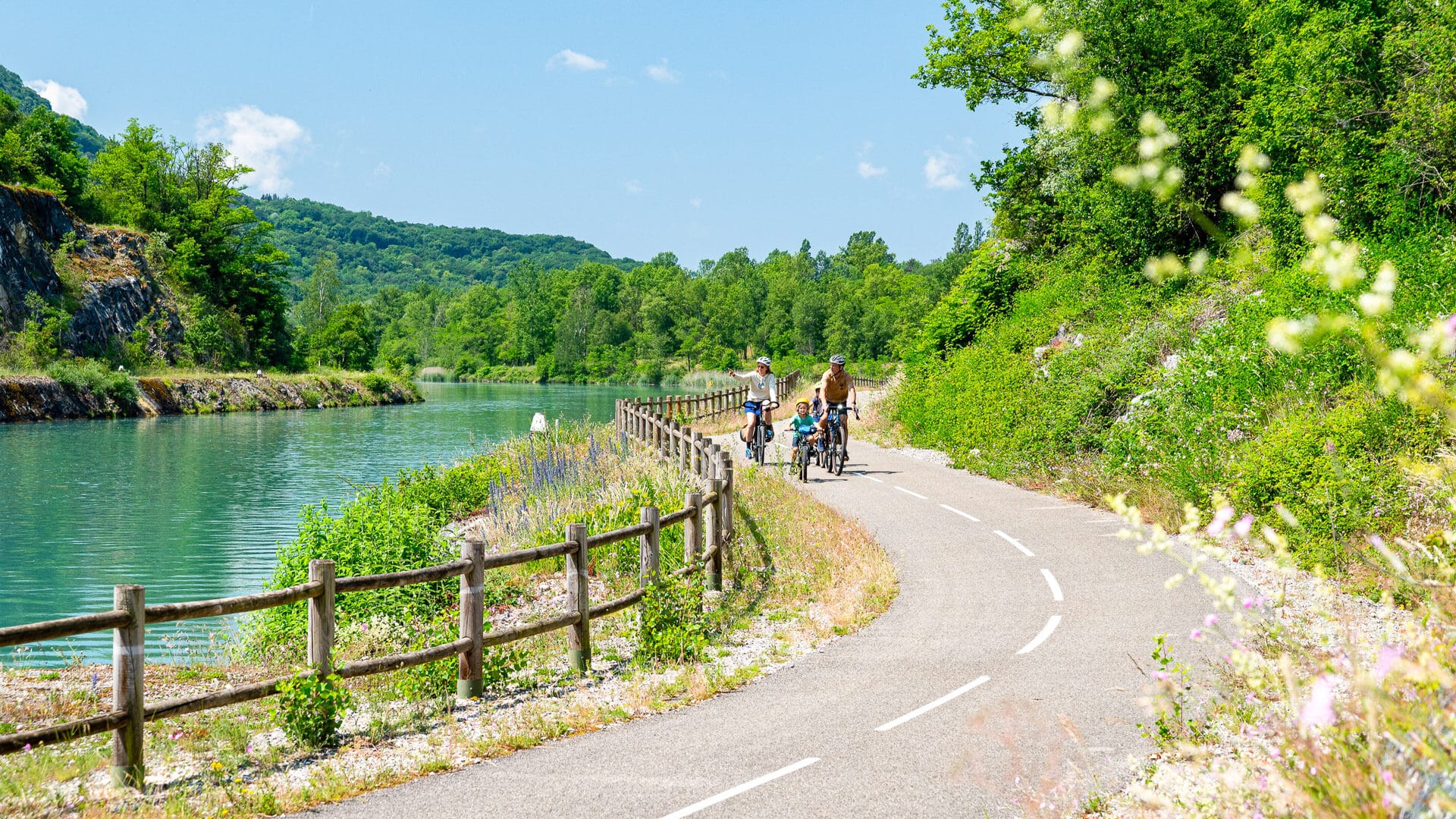
ViaRhôna is an 815-kilometre cycling route that follows the Rhône from the clear blue waters of Lake Geneva to the salt air of the Mediterranean. Part of EuroVelo 17, it carries riders past mountain-backed lakeshores, riverside towpaths, vineyard terraces, stone villages and sun-baked southern towns, making it one of France’s most varied point-to-point cycling routes.
Its appeal lies in how flexible it is. You can ride the whole Lake Geneva to sea journey, tracing the river all the way south, or choose a shorter section shaped around food, wine, history or easy-going river riding. Across its three distinct regions, the route moves from Alpine views to Rhône Valley vineyards, then on through Roman towns, Provençal markets, Camargue wetlands, Mediterranean ports and the coast.
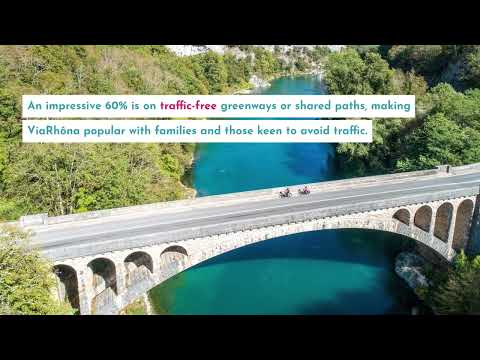
The ViaRhôna route can suit many kinds of rider. Some people ride the full route over several weeks. Others choose a shorter section for a long weekend or a five to eight-day cycling holiday. The route is fully signposted and an impressive 60% is on traffic-free greenways or shared paths, making ViaRhôna popular with families and those keen to avoid traffic.
To help you understand how the route works in practice, we asked Raphael Trichard from the ViaRhôna team to share his insight into the different sections, start and finish options, route highlights, surfaces and planning points. Their official route information is useful once you start comparing stages, checking maps, looking for GPS files or deciding which part of the route might suit your trip.
In this article, we share how ViaRhôna works from a cyclist’s point of view, including the main route options, the character of each section and the practical details to check before you ride.
For more details on the practicalities of planning a ViaRhôna cycling trip, read our full FAQs article!

For the past three years, Raphael Trichard has been leading the technical coordination of the ViaRhôna Route Committee, backed by the political vision of the Auvergne-Rhône-Alpes Region. His mission is to bring together a close-knit team of four, Sophie, Camille, Vincent and Caroline, as well as a network of dedicated partners, to deliver on every front: infrastructure, services, promotion and governance. The aim is simple: to create a cycling experience that is smooth, uninterrupted and open to everyone, whether they are out for a leisurely ride or on a long-distance adventure.
Day to day, he focuses on making things happen on the ground. Whether completing a new section of the route or rolling out an innovative service, every milestone enhances the quality of the journey and meets the different needs of cyclists. His real challenge is bringing local authorities, tourism professionals and socio-economic stakeholders together to ensure the route is intuitive, cohesive and open to all.
Cycling has always been part of who he is. From childhood, it has been his symbol of freedom and, over time, it has become his go-to for everything, whether commuting, tackling mountain passes or travelling. ViaRhôna builds on that passion, offering a unique way to explore the Rhône’s regions, landscapes and heritage at your own pace. It is an invitation to discover authentic stories, the river and the people met along the way.
Always check current travel information and advice. For visitors from the UK, the UK government travel information pages are here.
To get a feel for what cycling ViaRhôna is like, take a look at these videos showcasing the route, scenery and experience:
 There's a Youtube video here!
I'm fine with Youtube cookies
 There's a Youtube video here!
I'm fine with Youtube cookies
Table of contents
This guide contains a lot of useful information. To help make it more digestible, we’ve broken it down into several parts:
- Part 1: Overview
- Part 2: Why cycle the ViaRhôna route?
- Part 3: Ways to ride ViaRhôna
- Part 4: The full ViaRhôna
- Part 5: Shorter sections
- Part 6: Themed route ideas
- Part 7: ViaRhôna vs EuroVelo routes
- Part 8: Tips
- Part 9: Official ViaRhôna route planner
Short on time? Start with the at-a-glance table below for the key things to know about cycling ViaRhôna.
ViaRhôna at a glance
| Question | Answer |
| What is ViaRhôna? | A long-distance cycle route following the Rhône from Lake Geneva to the Mediterranean |
| How long is it? | Around 815 kilometres |
| Is it traffic free? | 60% of the route is on traffic-free greenways or shared paths |
| Is it signposted? | The route is fully signposted |
| Where does it start? | Saint-Gingolph |
| Where does it finish? | Port-Saint-Louis-du-Rhône or Sète |
| How many stages? | 25 official stages |
| Best for | Flexible cycling holidays, food and wine, history, river riding and a Mediterranean finish |
| Watch out for | Mixed surfaces, some busier road sections, summer heat, wind and mosquitoes in the south |
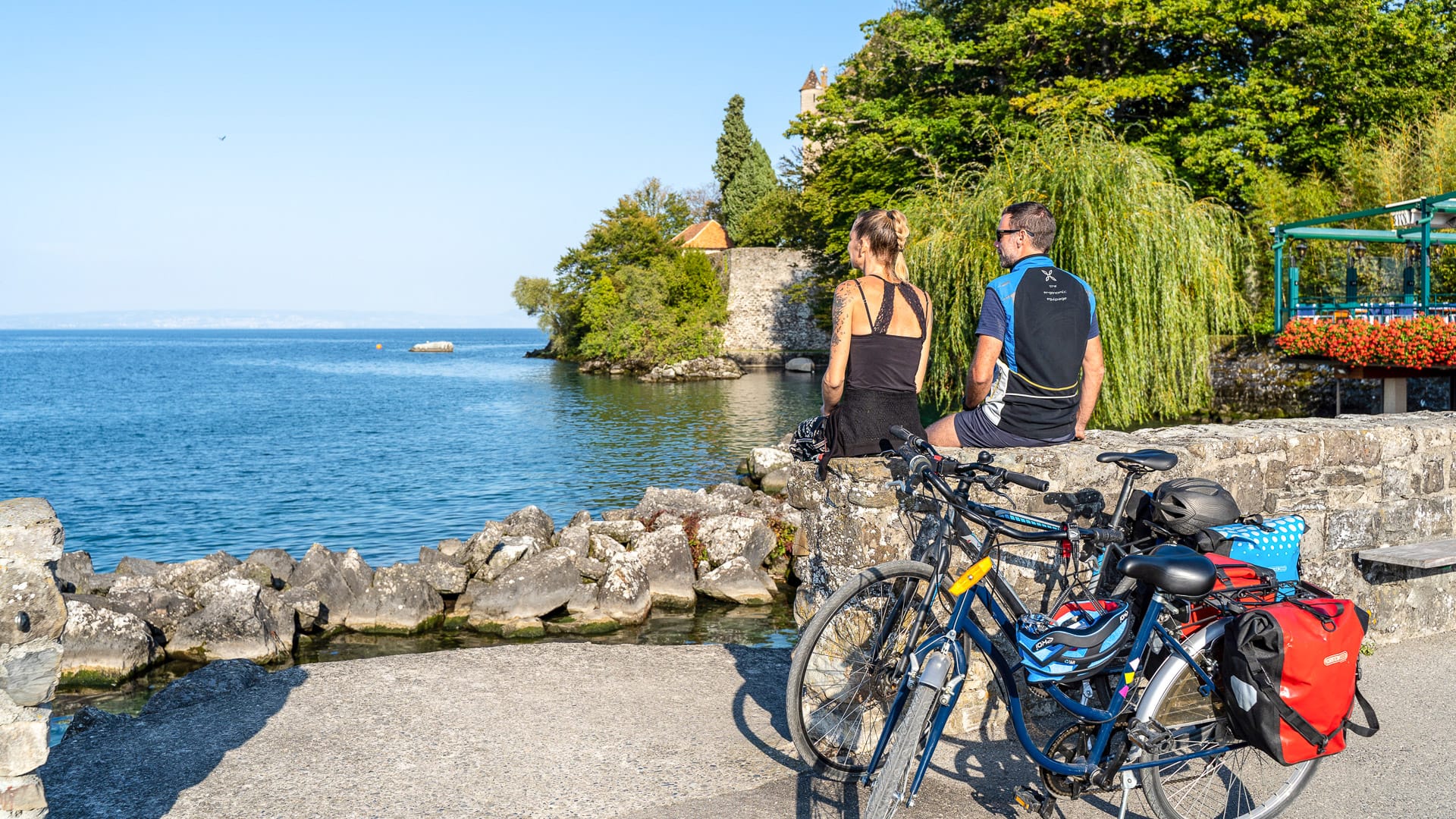
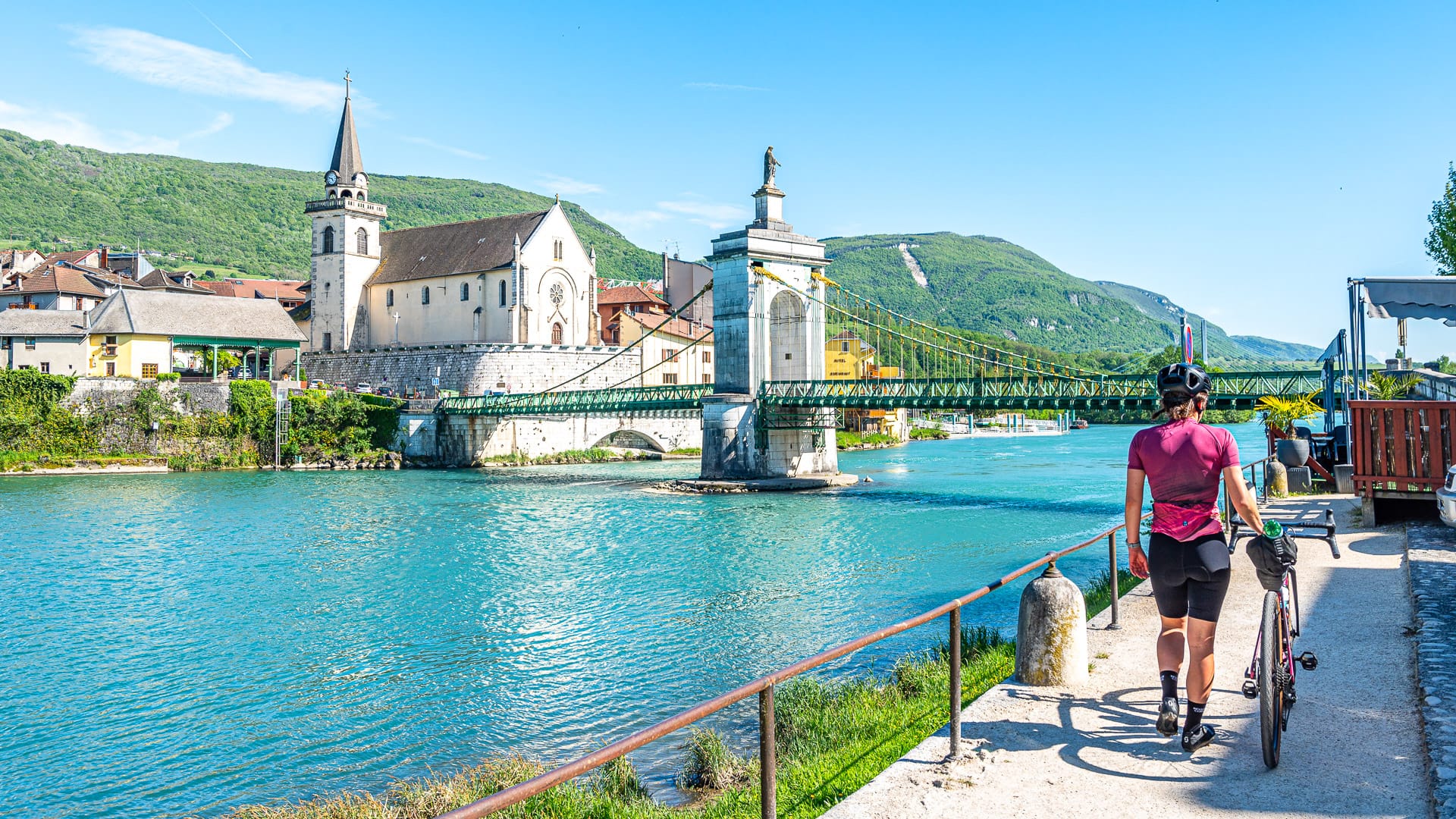
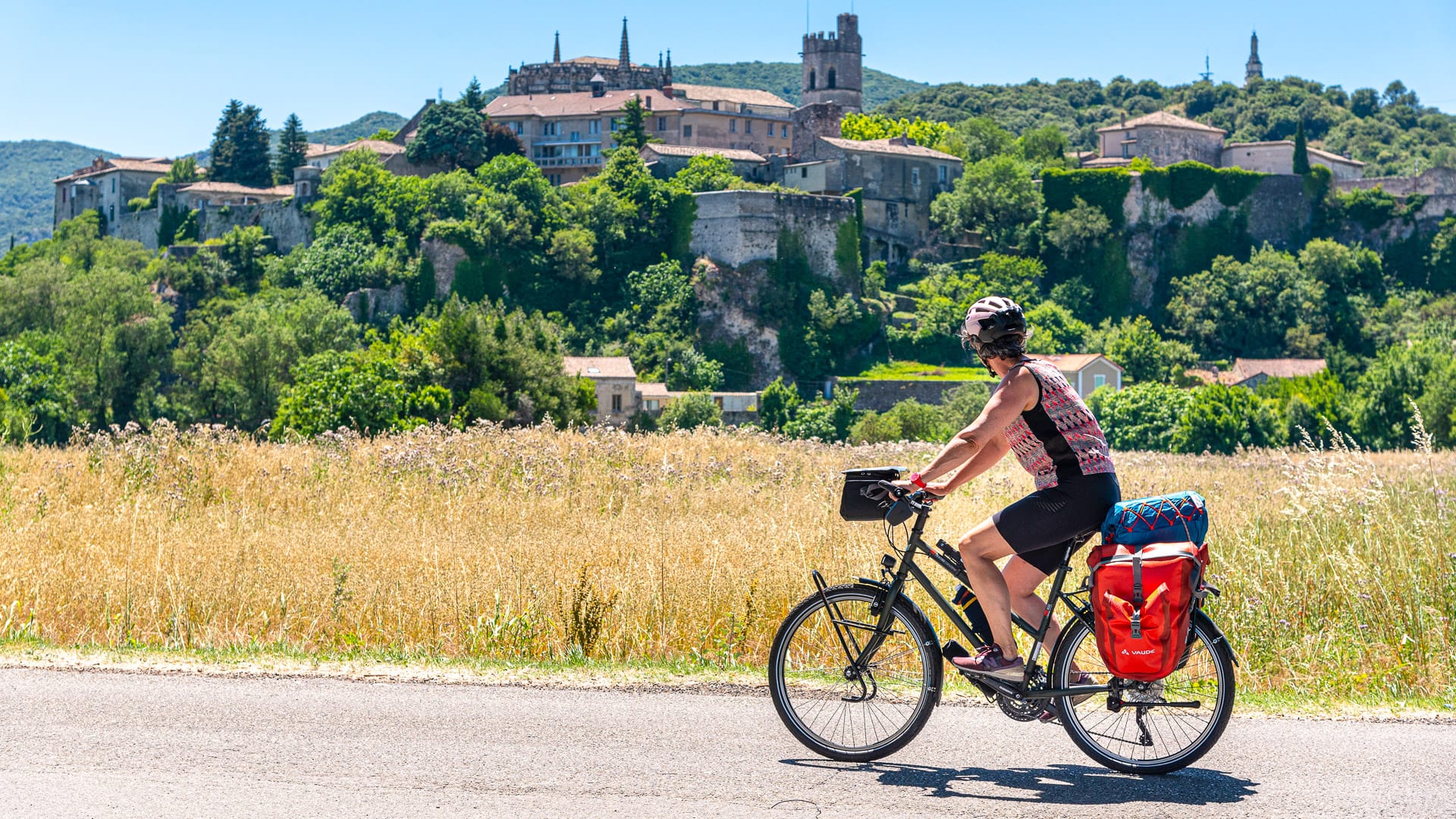
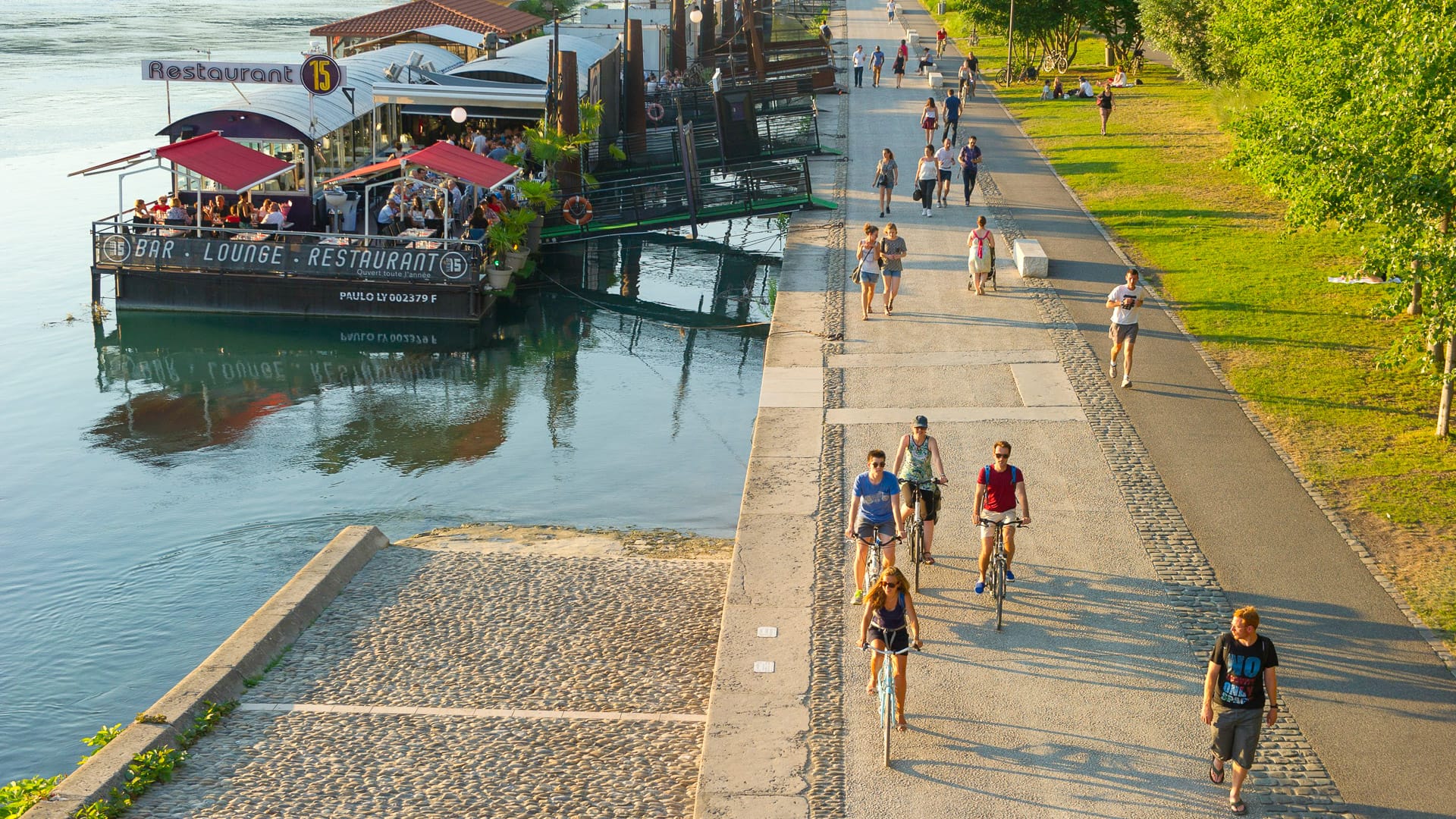
Part 1: Overview of the ViaRhôna cycle route
What is ViaRhôna?
ViaRhôna is a long-distance cycle route that follows the Rhône River from Lake Geneva, on the Franco-Swiss border, to the Mediterranean Sea.
It is designed to let cyclists experience the history, culture, food and landscapes of the Rhône Valley at their own pace. The route passes through places shaped by more than 2,000 years of history, from Gallo-Roman sites and medieval towns to wine regions, wetlands and Mediterranean ports.
It is also a flexible route. You can cycle the full ViaRhôna, ride one section, or use it as the basis for a shorter themed trip focused on wine, culture, nature or family cycling.
Where does ViaRhôna start and finish?
The ViaRhôna route starts in Saint-Gingolph, on the Franco-Swiss border at Lake Geneva. The 715-kilometre route finishes at Port-Saint-Louis-du-Rhône, at the Rhône Delta, for cyclists who want to follow the river Rhône. Throughout this article, we will refer to this route as the “full route”.
Some cyclists choose Geneva as another start point because it has stronger international transport links and city services, which can make arrival, bike hire and onward travel simpler.
Cyclists can also choose to finish at Sète, following the canal and Mediterranean beaches. This brings the route to 775 kilometres, and gives a livelier coastal finish via places such as Aigues-Mortes, Palavas-les-Flots and the Étang de Thau.
The Sète finish gives you a lively Mediterranean port, seafood and the Étang de Thau. Port-Saint-Louis-du-Rhône offers a quieter finish at the mouth of the Rhône Delta, with access to the Camargue and Plage Napoléon.
The route crosses Auvergne-Rhône-Alpes, Occitanie and Provence-Alpes-Côte d’Azur. It also passes through 12 French departments, including Haute-Savoie, Savoie, Ain, Rhône, Isère, Loire, Drôme, Ardèche, Vaucluse, Bouches-du-Rhône, Gard and Hérault.
| At a glance | |
| Start | Saint-Gingolph |
| Finish | Port-Saint-Louis-du-Rhône or Sète |
| Distance | Around 815 kilometres |
How long is ViaRhôna?
The full ViaRhôna is around 815 kilometres long. It is divided into 25 official stages, with individual stages ranging from around 19 to 52 kilometres.
That does not mean you have to ride it all in one trip. The route is set up so cyclists can ride the full Lake Geneva to Mediterranean journey, break it into shorter sections, or choose a themed route based on the kind of holiday they want.
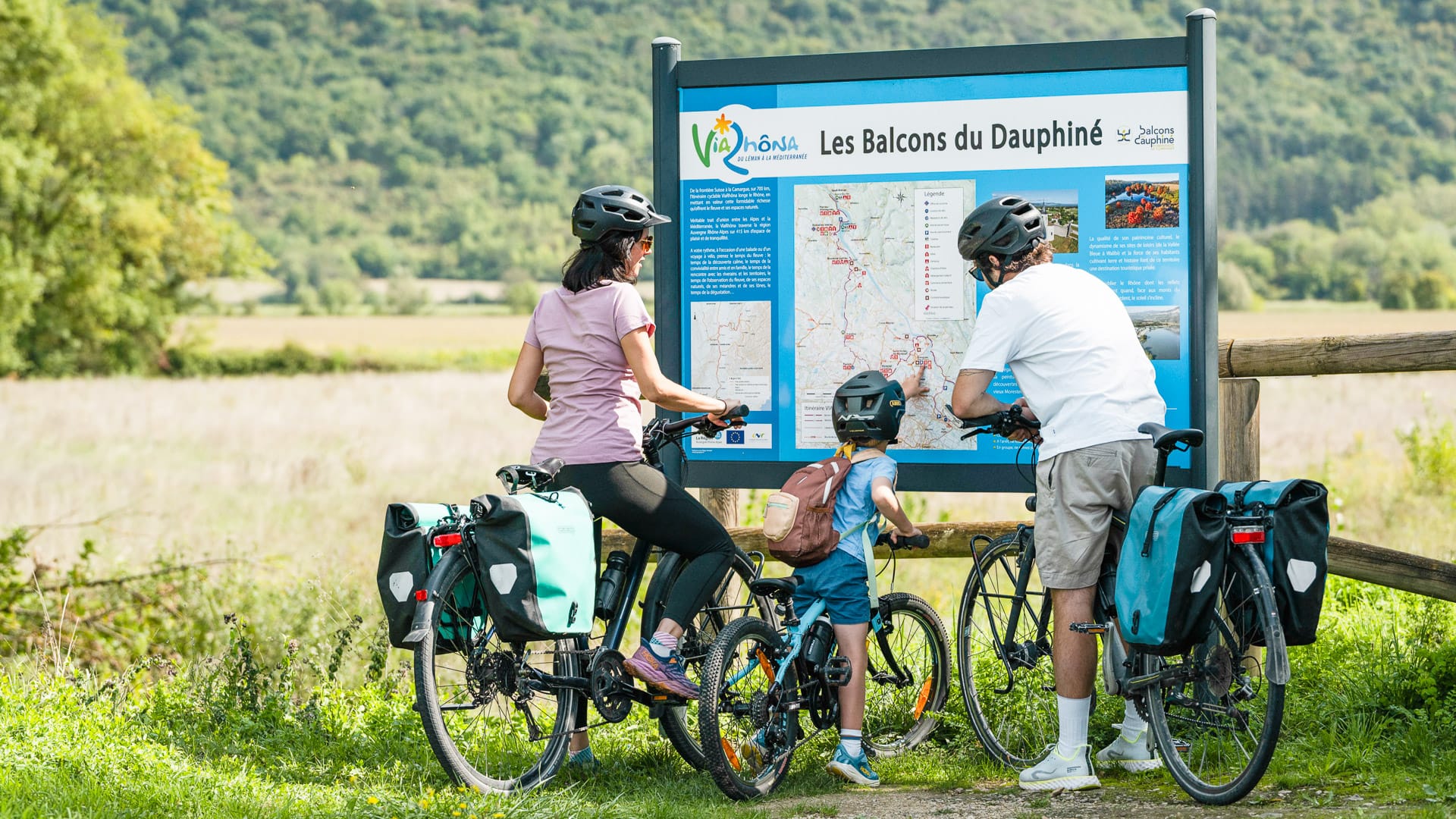
ViaRhôna on a greenway through the Balcons du Dauphiné area (38) (photo credit: Auvergne-Rhône-Alpes Tourisme/Peignée Verticale)
Is ViaRhôna suitable for all cyclists?
ViaRhôna can suit many riders, but the experience changes along the route.
60% of the route is on traffic-free greenways or shared paths, making them suitable for families or more relaxed riders. Other sections include busier roads, more undulating riding or longer daily distances. These are better suited to confident cyclists. The route is fully signposted, making it easy to navigate.
At a glance here are the rider types ViaRhôna can suit:
| Rider type | Is ViaRhôna suitable? | Planning tip |
| Beginners | Yes, on carefully chosen sections. | Start with shorter greenway sections and check stage notes first. |
| Families | Yes, but section choice matters. | Avoid busier or provisional sections unless the riders are confident. |
| Less experienced cyclists | Yes, if daily distances are modest. | Build in time for stops and avoid overambitious itineraries. |
| Touring cyclists | Yes. | Plan accommodation and train access before fixing daily distances. |
| Experienced cyclists | Yes. | More confident riders may be happier with longer days and mixed sections. |
ViaRhôna route map
ViaRhôna have provided this route on Komoot for info, but use the official ViaRhôna route map on the website to check the latest route alignment, stage details, surfaces and services before planning your trip.
 This komoot route contains cookies...
I’m fine with komoot cookies
Part 2: Why is the ViaRhôna cycle route a must-do?
A journey from Lake Geneva to the Mediterranean
ViaRhôna is not just a river route. It is a north-to-south journey through several versions of France.
The northern stages begin around Lake Geneva. Further south, the route moves through Bugey, Lyon, Rhône Valley vineyards, Provence and the Camargue.
This changing geography is one of the reasons ViaRhôna works well as a cycling holiday. Each section has a different feel, so riders can choose the part that best fits their time, fitness and interests.
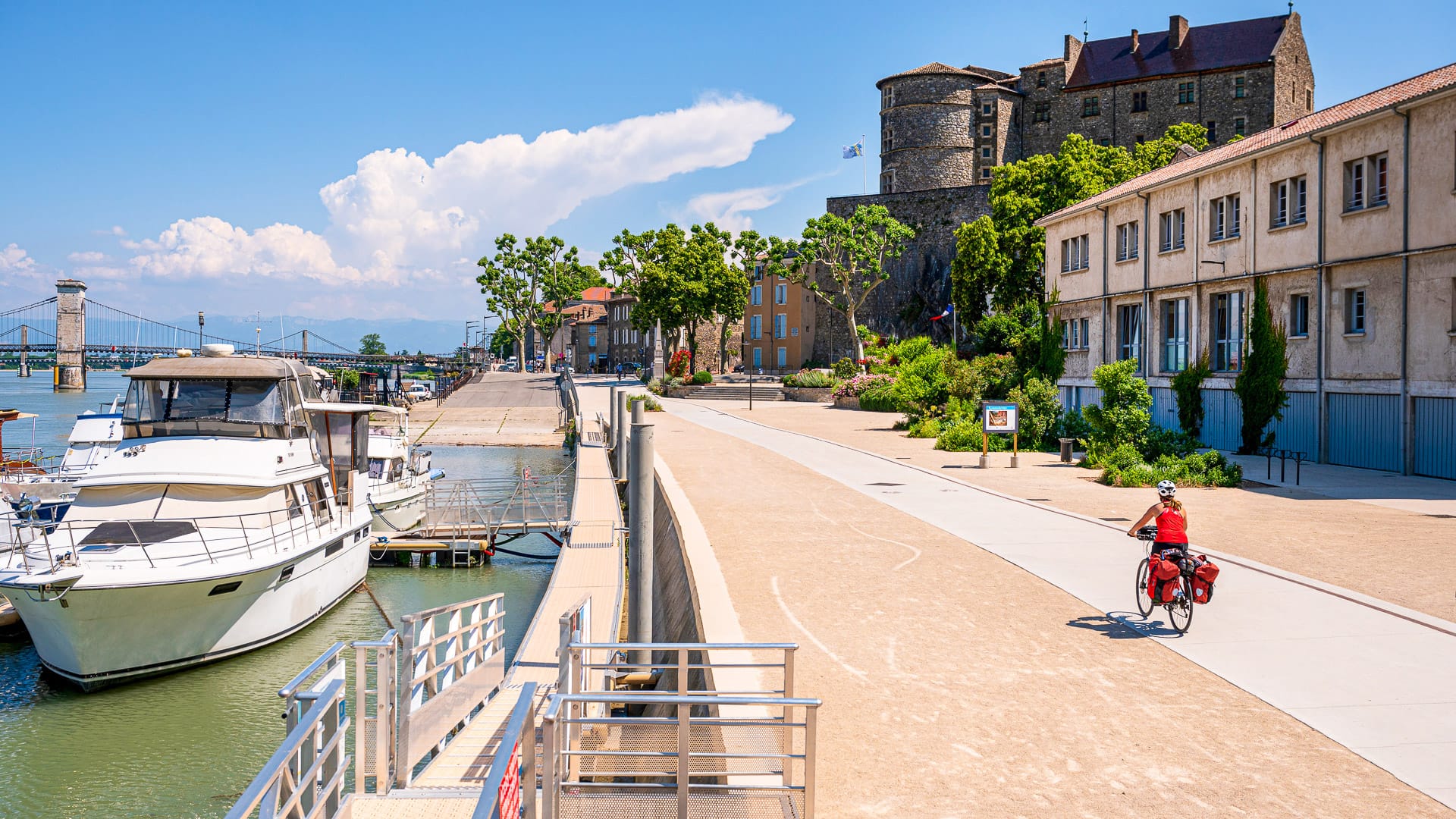
ViaRhôna on the quays in Tournon-sur-Rhône (photo credit: Auvergne-Rhône-Alpes Tourisme/Christian Martelet)
History, culture and UNESCO-listed places
The Rhône has long been one of Europe’s major routes for trade, travel and settlement. Cycling ViaRhôna lets you follow that history through towns and cities that still carry traces of the Roman, medieval and papal periods.
The route passes through places with UNESCO-listed historic centres or monuments, including:
- Lyon: the historic centre of Lyon is listed by UNESCO and makes a natural pause on ViaRhôna between the Lake Geneva stages and the Rhône Valley vineyards. It is a good place to build in time for food, culture and a rest day.
- Avignon: Avignon is one of the route’s major heritage stops, with the Palais des Papes and Pont d’Avignon among its UNESCO-listed sights. It sits on the southern part of the route, before the ride continues towards Arles and the Camargue.
- Arles: Arles brings Roman history into the final part of ViaRhôna, with monuments including the arena and Roman theatre recognised by UNESCO. It is a key stop before riders head towards the Rhône Delta or Sète.
But ViaRhôna is not just a journey through Roman history, Rhône Valley wine, vineyards, historic towns and the landscapes of Provence. It is also the story of the Rhône itself, a river that has shaped this valley over the centuries. As you ride, that story comes alive through encounters with local artisans, producers, guides and residents, as well as the many cyclists who have shared the route with family, friends or partners.
The result is a route where the riding and sightseeing work together. You can ride in the morning, then spend the afternoon exploring Roman ruins, old towns, museums, river ports or historic monuments.
Food and wine along the Rhône Valley
Food and wine are a major part of the ViaRhôna experience.
The route passes through Lyon, Bugey, the northern Rhône vineyards, the southern Rhône wine region, Provence, the Camargue and Sète. Along the way, cyclists can encounter local specialities such as Bugey wines and truffles, Lyon bouchons, Savoie dishes, Rhône Valley wines, Montélimar nougat, Camargue salt and seafood around Sète.
Wine is also part of the route’s identity. ViaRhôna passes close to names such as Côte-Rôtie, Condrieu, Hermitage, Cornas, Saint-Joseph, Châteauneuf-du-Pape, Gigondas and Vacqueyras.
Landscapes that change as you ride south
The route’s landscapes change steadily as you ride south.
Around Lake Geneva and the early stages, you see Alpine lakes, spa towns, villages and mountain views. Between Lyon and Valence, the route follows the Rhône Valley through vineyards, orchards and river landscapes. South of Valence, Provence begins to appear in the villages, fields and climate.
By the final sections, the landscape opens into the Camargue, with wetlands, salt flats, lagoons, birdlife and Mediterranean beaches.
Here’s a sample of the different experiences you can find – more on these below.
| If you like… | ViaRhôna gives you… |
| Food and wine | Lyon, Rhône Valley wines and local specialities |
| History | Roman sites, medieval towns and UNESCO gems |
| Nature | Alpine lakes, Rhône riverbanks and Camargue wetlands |
Part 3: Ways to ride ViaRhôna
Riding the full ViaRhôna route
Cycling the full ViaRhôna gives you the complete Lake Geneva to Mediterranean journey.
The full route is around 815 kilometres and can be ridden in stages. The overall distance depends on your chosen start and finish route combination. It suits cyclists who have time for a multi-week cycling trip and want to experience the full change in landscapes, food, culture and climate along the Rhône.
The route is flexible, so you can shape daily distances around your fitness and available time. The 25 official stages range from shorter days of around 19 kilometres to longer days of more than 50 kilometres.
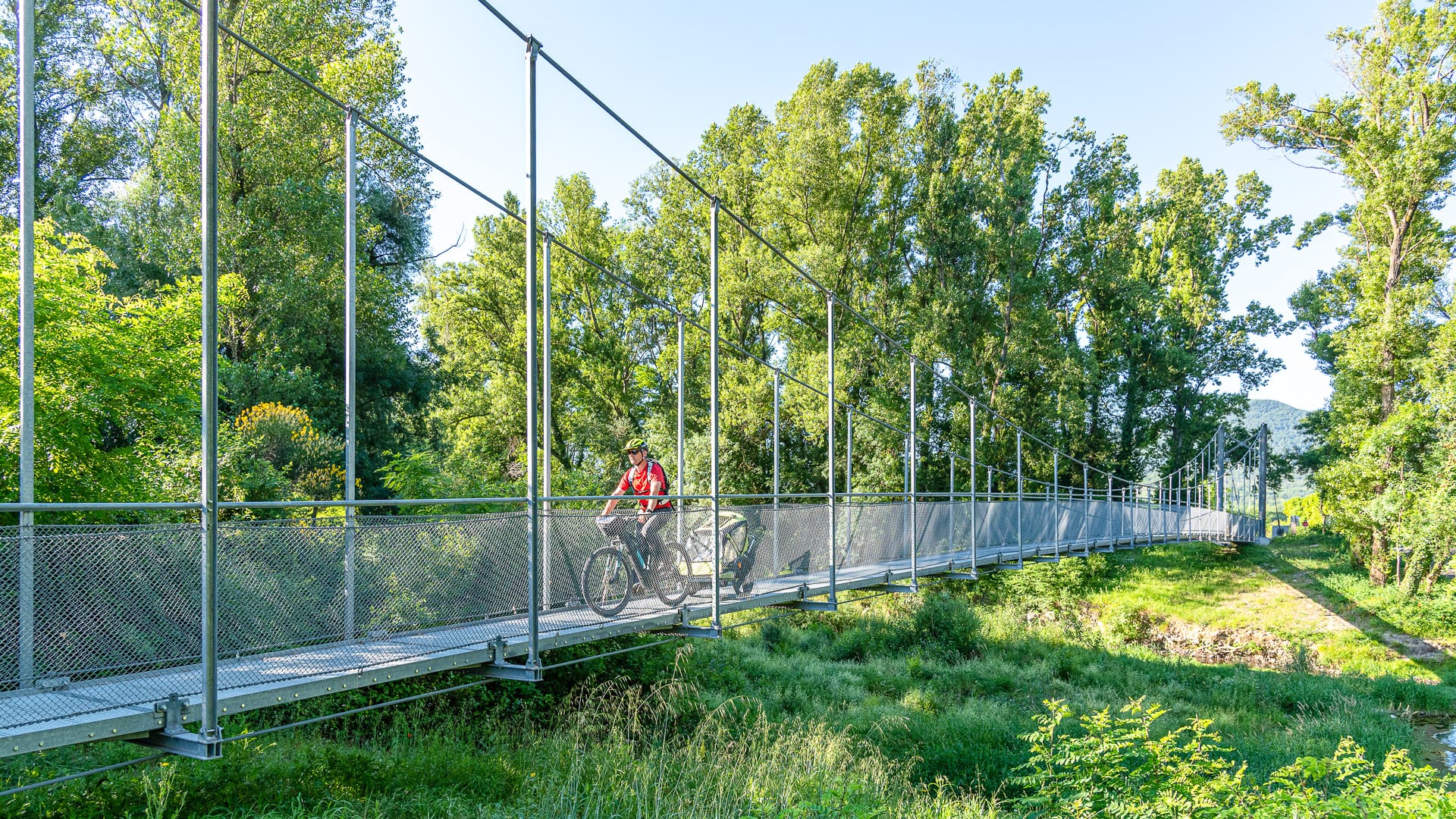
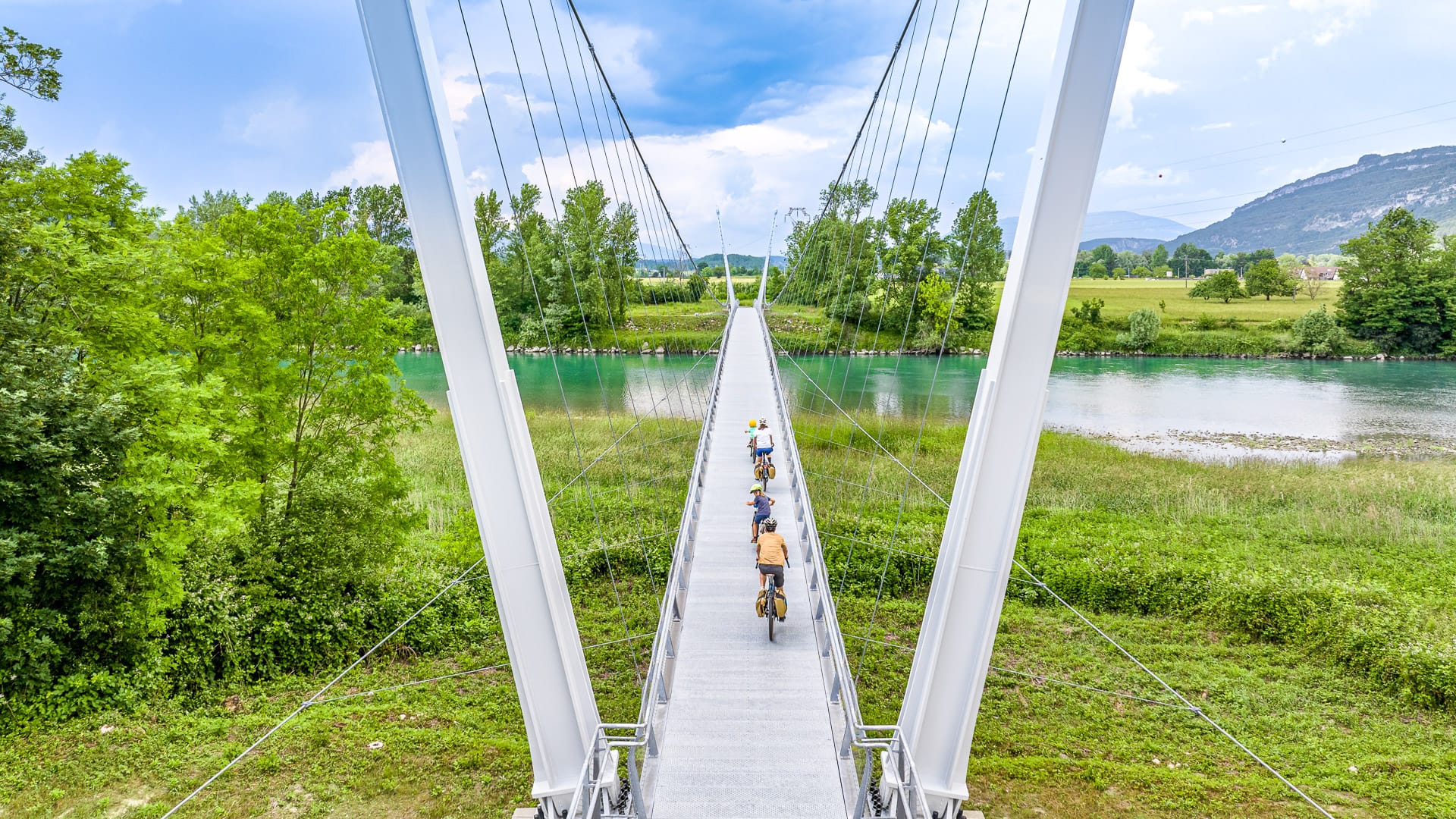
Himalayan footbridge at Baix (photo credit: Auvergne-Rhône-Alpes Tourisme/Christian Martelet)
Starting in Geneva or Saint-Gingolph
ViaRhôna officially starts from Saint-Gingolph.
Saint-Gingolph sits on the French side of Lake Geneva, on the Franco-Swiss border. Starting here gives you the authentic Lake Geneva feel, with lakeside scenery and spa towns such as Evian-les-Bains and Thonon-les-Bains.
Geneva is another practical starting point and is often used for logistical ease. It gives riders strong transport connections and a city start before joining the French sections of the route.
Finishing in Sète or Port-Saint-Louis-du-Rhône
ViaRhôna has two main Mediterranean finish options.
Port-Saint-Louis-du-Rhône is peaceful and nature-focused. It sits at the mouth of the Rhône Delta and gives access to the Camargue and Plage Napoléon.
A second finish is in Sète, a lively port city on the edge of the Étang de Thau. It is known for seafood, maritime culture and a busy harbour atmosphere. It suits cyclists who want a Mediterranean port finish.
| Finish Point | Distance from Saint-Gingolph | Distance from Geneva | Vibe |
| Port-Saint-Louis-du-Rhône | 715 kilometres | 640 kilometres | Camargue nature, the Rhône Delta and Plage Napoléon |
| Sète | 775 kilometres | 680 kilometres | A lively port, seafood and Étang de Thau |
Choosing a shorter section of ViaRhôna
Many cyclists do not need to ride the whole route to enjoy ViaRhôna.
The route works well as a shorter cycling holiday because each section has a clear character. For example:
- Lake Geneva to Lyon gives you Alpine lakes, Bugey landscapes and a big city finish.
- Lyon to Valence is strong for food, wine and Roman history.
- Valence to Avignon brings in Ardèche, Provence and Châteauneuf-du-Pape.
- The southern stages are good for Camargue, heritage and Mediterranean scenery.
Choosing a shorter section can also make logistics easier. The route has train access at many points, so riders can join or leave ViaRhôna without committing to the full route.
More ideas on shorter sections to ride in Part 5 and Part 6!
ViaRhôna route links and maps
For the latest stage information, maps and GPS files, use the official ViaRhôna route planner.
Part 4: The full ViaRhôna stage by stage
Wondering what the full ViaRhôna route is like? Here’s a break down, section by section.
At a glance
| Section | Good for | Watch out for |
| Lake Geneva to Lyon | Lakes, Bugey and a Lyon finish | Busier roads in places |
| Lyon to Valence | Wine, food and Roman heritage | Leaving Lyon |
| Valence to Avignon | Ardèche and Provence | Summer heat |
| Avignon to Arles | UNESCO places and culture | A shorter section (50km) |
| Arles to the Mediterranean | Camargue and beaches | Wind and mosquitoes |
Lake Geneva to Lyon (320 kilometres)
The Lake Geneva to Lyon section covers around 320 kilometres and takes cyclists from Alpine-influenced lakeside scenery towards one of France’s great food and culture cities.
This section includes Saint-Gingolph, Evian-les-Bains, Thonon-les-Bains, Geneva, Seyssel, Chanaz, Belley, La Balme-les-Grottes, Jons and Lyon. Highlights include the shores of Lake Geneva, the medieval village of Yvoire, Bugey vineyards, Chanaz, Lake Bourget, the Lavours Marshes, Grand Colombier mountain views and Grand Parc Miribel-Jonage.
Some stages here are easy, but others are more demanding. There are greenways and quiet roads, but also sections on departmental roads or busier roads. Families may prefer to begin in Thonon rather than Saint-Gingolph.
Lyon to Valence (132 kilometres)
The Lyon to Valence section is around 132 kilometres. It is one of the strongest parts of the route for food, wine and Roman heritage.
The route passes through Saint-Romain-en-Gal, Vienne, Sablons, Tournon-sur-Rhône, Glun and Valence. Highlights include Vienne’s Roman theatre, the Saint-Romain-en-Gal museum, L’Île au Beurre nature reserve, Côte-Rôtie vineyards, Tournon-sur-Rhône, Tain-l’Hermitage and Valence.
A provisional link follows the Rhône’s west bank on very busy roads. It is best to take the train from Lyon to Givors, which takes around 20 minutes and is free for bikes.
Valence to Avignon (160 kilometres)
The Valence to Avignon section is around 160 kilometres and marks a shift towards Ardèche and Provence.
This part of ViaRhôna includes La Voulte-sur-Rhône, Le Pouzin, Cruas, Châteauneuf-du-Rhône, Viviers, Bourg-Saint-Andéol, Lapalud, Caderousse and Avignon. Highlights include Port de l’Épervière, the Dolce Via, Printegarde Nature Reserve, Cruas Abbey, the Himalayan-style footbridge at Rochemaure, Viviers cathedral, Orange, Châteauneuf-du-Pape and Avignon.
The riding is mostly on greenways and quiet roads, with some shared-road sections. In July and August, this part of the route can be hot, so early starts, water planning and sun protection matter.
Avignon to Arles (60 kilometres)
The Avignon to Arles section is short, at around 60 kilometres, but it is rich in culture and heritage treasures.
From Avignon, the route heads towards Beaucaire and then Arles. Highlights include the Palais des Papes, Pont d’Avignon, Villeneuve-lès-Avignon, Beaucaire and Arles’ Roman amphitheatre.
This is a useful section for cyclists who want a shorter ride with a strong cultural focus. It can also be linked with the route south into the Camargue.
Arles to the Mediterranean (185 kilometres)
The final section from Arles to the Mediterranean is around 185 kilometres, depending on whether you finish in Sète or Port-Saint-Louis-du-Rhône.
The Sète option passes through Saint-Gilles, Aigues-Mortes, Palavas-les-Flots and Sète. Highlights include the Camargue plain, Saint-Gilles, the Canal du Rhône à Sète, Aigues-Mortes, salt flats, Le Grau-du-Roi, Mediterranean beaches, Maguelone Cathedral and the Étang de Thau.
The Port-Saint-Louis-du-Rhône option heads towards the Rhône Delta, Marais Vigueirat and Plage Napoléon. This gives a quieter, nature-focused finish. In the Camargue, cyclists should be ready for wind, summer heat and mosquitoes, especially around dusk.
There is also a new greenway between Beaucaire and Saint-Gilles.
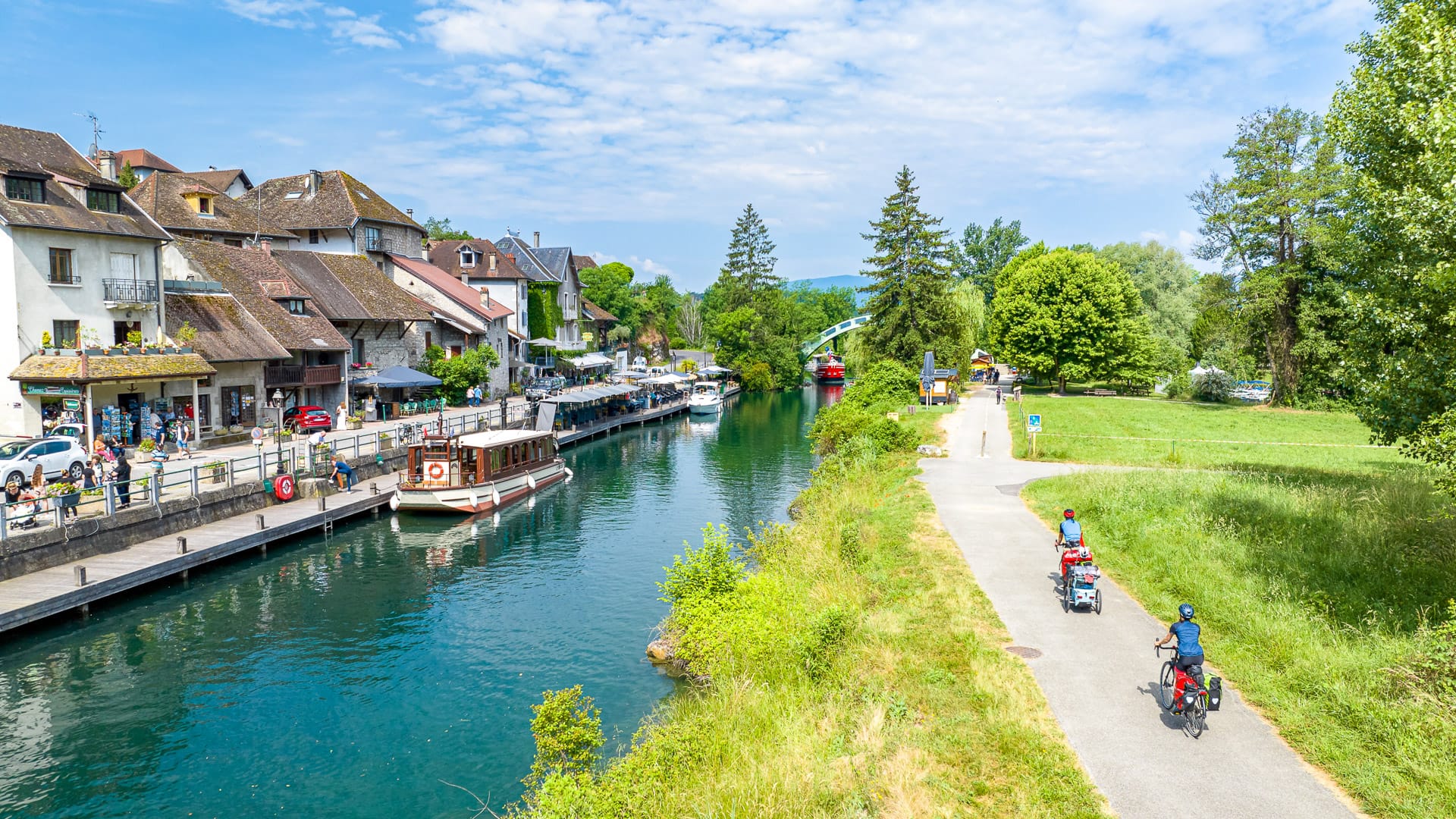
ViaRhôna in Chanaz, Savières Canal (73) (photo credit: Auvergne-Rhône-Alpes Tourisme/T. Garcia)
Part 5: Three shorter ViaRhôna itinerary ideas
Geneva or Thonon-les-Bains to Lyon (320 kilometres)
This five to seven day itinerary covers around 320 kilometres from Geneva or Thonon-les-Bains to Lyon.
It works if you want lakeside riding, Bugey villages, Alpine views and a city finish. The route includes Lake Geneva, Yvoire, Seyssel, Chanaz, Belley, La Balme-les-Grottes, Grand Parc Miribel-Jonage and Lyon.
The riding is mixed. Some sections use greenways and quieter roads, while others are more demanding or include busier roads. Riders starting from Saint-Gingolph should be confident on the bike. Families may prefer to start in Thonon-les-Bains.
You can view the itinerary page on the official ViaRhôna website. You can also use the ViaRhôna route planner to help shape your own trip along the route.
| Day range | Route | Good for |
| Five to seven days | Geneva or Thonon-les-Bains to Lyon | Lakes, villages and Lyon |
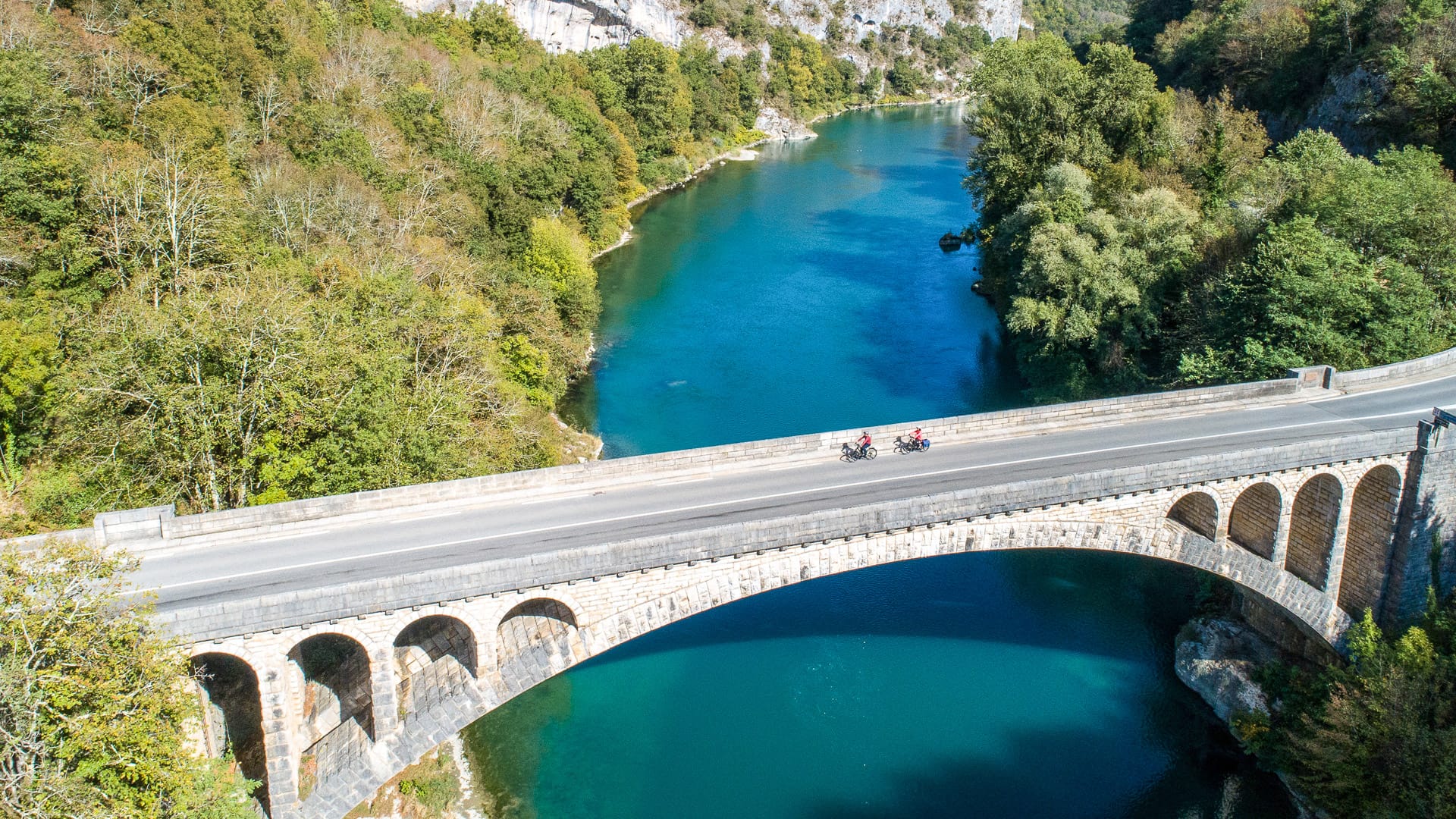
ViaRhôna on the quays in Tournon-sur-Rhône (photo credit: Auvergne-Rhône-Alpes Tourisme/T. Prudhomme)
Lyon to Avignon (305 kilometres)
This six to eight day itinerary covers around 305 kilometres from Lyon to Avignon.
It suits cyclists interested in food, wine and Roman history. The route links Lyon, Vienne, Sablons, Tournon-sur-Rhône, Valence, La Voulte-sur-Rhône, Cruas, Châteauneuf-du-Rhône, Orange and Avignon.
Highlights include Côte-Rôtie, Hermitage, Châteauneuf-du-Pape, Vienne’s Roman heritage, Tain-l’Hermitage, Valence, Viviers and Avignon. The route is largely manageable, but the first stage out of Lyon can be busier than the sections that follow.
You can view the itinerary page on the official ViaRhôna website. You can also use the ViaRhôna route planner to help shape your own trip along the route.
| Day range | Route | Good for |
| Six to eight days | Lyon to Avignon | Wine, food and Roman history |
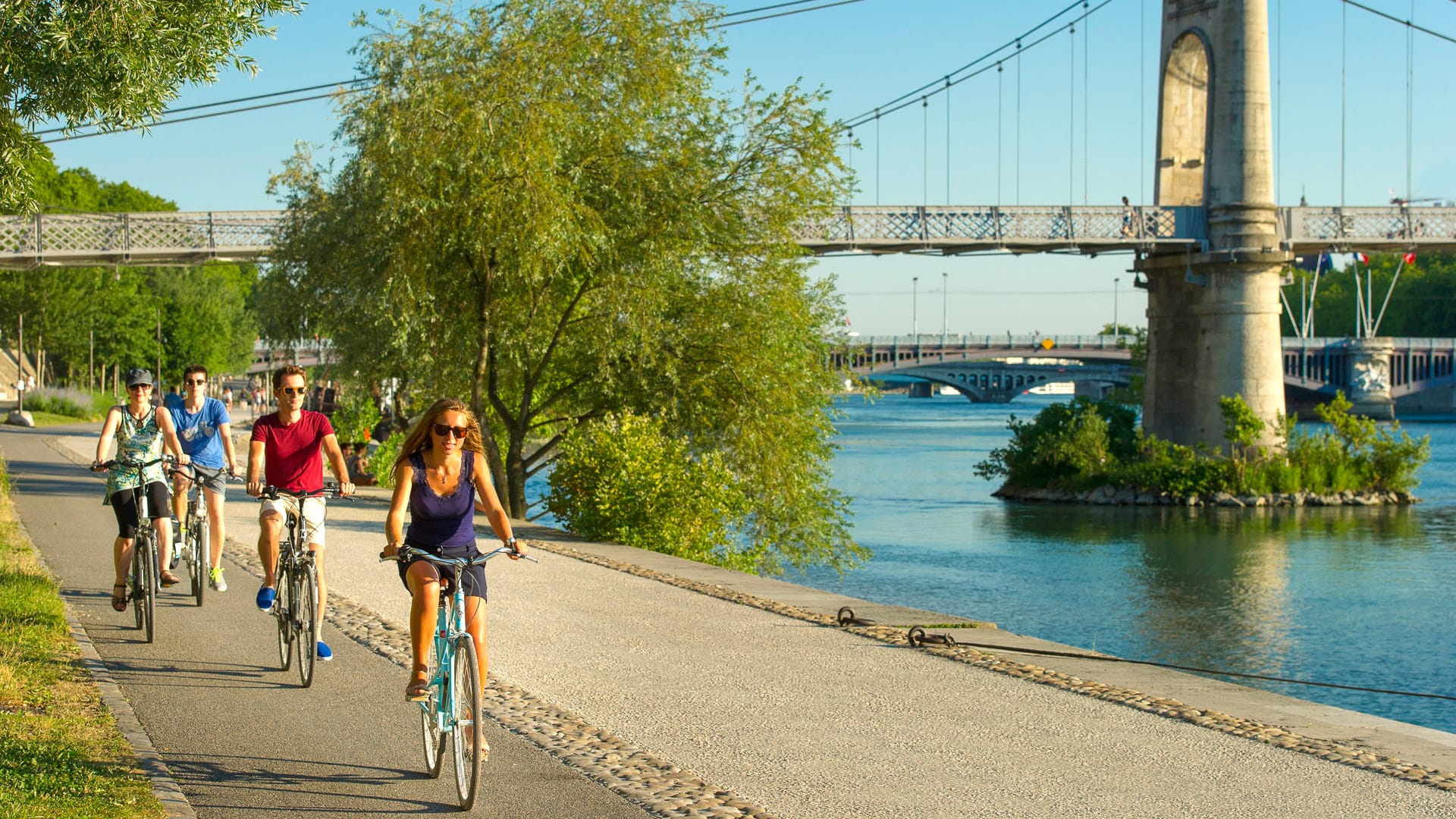
The banks of the Rhône and the ViaRhôna in Lyon (photo credit: Auvergne-Rhône-Alpes Tourisme/Christian Martelet)
Avignon to Sète or Port-Saint-Louis-du-Rhône (119 kilometres)
This five to six day itinerary takes cyclists from Avignon towards the Mediterranean. You can finish in Sète or choose the quieter route to Port-Saint-Louis-du-Rhône.
The Sète route takes in Beaucaire, Saint-Gilles, Aigues-Mortes, Palavas-les-Flots and the Étang de Thau. It works for riders who want flat cycling, Camargue landscapes, lagoons and a Mediterranean port finish.
The Port-Saint-Louis-du-Rhône option is more focused on the Rhône Delta, the Camargue and Plage Napoléon. Whichever finish you choose, allow for heat, wind and mosquitoes in the warmer months.
You can view the itinerary page for the Avignon to Sète route here, and the Avignon to Port-Saint-Louis-du-Rhône route here. You can also use the ViaRhôna route planner to help shape your own trip along the route.
| Day range | Route | Good for |
| Five to six days | Avignon to the Mediterranean | Camargue, coast and easier riding |
Part 6: Themed ViaRhôna route ideas
The official ViaRhôna inspiration routes make it easier to choose a cycling trip by theme, rather than simply by distance.
- Some focus on lakes and Alpine scenery, including the French shores of Lake Geneva, Geneva to Lyon, and the cruise on Lake Bourget.
- Others are built around food and wine, including Condrieu to Châteauneuf-du-Pape and Lyon to Valence.
- Culture-focused options include Orange to Arles and Lyon to Avignon.
- Nature and family options include cycle routes in Drôme and Ardèche, the Dolce Via, and the Camargue.
- Mediterranean options include Avignon to Aigues-Mortes and the loop from Sète to Aigues-Mortes.
Below we set out some ideas and, below that, some more detailed itineraries:
| Best for | Suggested section | Why |
| First-time ViaRhôna riders | Lyon to Valence | Food, wine, Roman heritage and manageable logistics |
| Families or relaxed riders | Selected greenway sections, especially once confirmed by the official stage pages | Easier riding depends on the latest route status |
| Wine lovers | Lyon to Avignon | Rhône Valley vineyards, Tain-l’Hermitage and Châteauneuf-du-Pape |
| Culture and history | Orange to Arles or Lyon to Avignon | Roman sites, Avignon, Arles and historic Rhône towns |
| Nature and coast | Avignon to Sète or Port-Saint-Louis-du-Rhône | Camargue, wetlands, lagoons and Mediterranean finish |
| Full route experience | Lake Geneva to the Mediterranean | The complete north-to-south journey through several versions of France |
Alpine and lakeside routes
ViaRhôna along the French shores of Lake Geneva: Saint-Gingolph to Yvoire (about 45 kilometres)
The Saint-Gingolph to Yvoire section follows the French shore of Lake Geneva and gives cyclists a strong sense of ViaRhôna’s northern starting point.
From Saint-Gingolph, close to the Swiss border, the route continues along the lakeshore via spa towns and villages including Évian-les-Bains, Thonon-les-Bains and Yvoire. Highlights include wide lake views, the Franco-Swiss setting and Yvoire’s medieval centre.
This is a scenic opening section, but it is best suited to experienced cyclists, as some sections use busier roads.
For more Alpine and lakeside route ideas, visit the ViaRhôna website. You can also use the ViaRhôna route planner to help shape your own trip along the route.
Wine and gastronomy routes
Vineyards and grands crus: Condrieu to Châteauneuf-du-Pape (about 230 kilometres)
The Condrieu to Châteauneuf-du-Pape section is a longer ViaRhôna option with a strong focus on wine, food and Rhône Valley history.
From Condrieu, the route follows the river south through one of France’s best-known wine regions, passing vineyards, historic towns and landscapes shaped by centuries of river trade. Valence marks a natural gateway towards the south, before the route continues towards Viviers, Châteauneuf-du-Pape and Avignon.
This is a good section for cyclists who want a multi-day ride with a strong food and wine focus, as well as plenty of cultural stops along the way.
For more wine and gastronomy route ideas, visit the ViaRhôna website. You can also use the ViaRhôna route planner to help shape your own trip along the route.
Cultural and historical routes
ViaRhôna on the UNESCO monuments route: Orange to Arles (about 97 kilometres)
The Orange to Arles section is a shorter ViaRhôna option with a strong focus on Roman history, UNESCO-listed monuments and some of the Rhône Valley’s major cultural stops.
From Orange, the route heads south through the Côtes du Rhône region towards Avignon, the former City of Popes and home to its famous summer theatre festival. It then continues to Arles, known for its Roman remains, later links with Van Gogh and position near the Camargue.
This is generally an easier section, suitable for many cyclists, though the longer final stage may feel tiring for less experienced riders.
For more cultural and historical route ideas, visit the ViaRhôna website. You can also use the ViaRhôna route planner to help shape your own trip along the route.
Nature and adventure routes
ViaRhôna as a family in Drôme and Ardèche: Tain-l’Hermitage to Bourg-Saint-Andréol (about 116 kilometres)
The Tain-l’Hermitage to Bourg-Saint-Andréol section is a family-focused ViaRhôna option through Drôme and Ardèche, designed around shorter daily distances and plenty of places to stop.
The route is usually split over four days, with stages of around 20 to 35 kilometres per day. Along the way, family-friendly highlights include the Cité du Chocolat in Tain-l’Hermitage, the Soyons caves, the Himalayan footbridge at Rochemaure and the crocodile farm in Pierrelatte.
This is a good option for families who want a manageable multi-day ride with regular breaks and plenty to interest younger cyclists. It can also be ridden in three days by combining stages, though this creates a longer day of around 55 kilometres between Valence and Montélimar.
For more nature and adventure route ideas, visit the ViaRhôna website. You can also use the ViaRhôna route planner to help shape your own trip along the route.
Mediterranean and Camargue routes
Loop from Sète to Aigues-Mortes (about 240 kilometres)
The Sète to Aigues-Mortes loop is a longer coastal and Camargue route, linking the Mediterranean with the Rhône Delta and the southern end of ViaRhôna.
Starting in Sète, the route follows the Mediterranean coast before joining ViaRhôna at Port-Saint-Louis-du-Rhône, where the Rhône meets the sea. From there, it continues through the Camargue, with marshes, ponds, birdlife, ranches and Camargue horses forming part of the landscape.
This is a good option for cyclists who want a week-long ride with a strong coastal and nature focus, as well as time in distinctive Camargue towns such as Sète and Aigues-Mortes.
For more Mediterranean and Camargue route ideas, visit the ViaRhôna website. You can also use the ViaRhôna route planner to help shape your own trip along the route.
Part 7: How does ViaRhôna compare with other EuroVelo routes?
ViaRhôna is one of France’s major long-distance cycle routes, but it has a different feel from better-known routes such as the Rhine Cycle Route, EuroVelo 1 and Loire à Vélo.
Its appeal lies in the mix: river riding, changing landscapes, historic towns, Rhône Valley food and wine, and a Mediterranean finish. It is also a route that can be broken into shorter sections, which makes it useful for cyclists who do not want to ride the full end-to-end route.
ViaRhôna vs EuroVelo 15 (the Rhine Cycle Route)
EuroVelo 15 follows the Rhine from the Swiss Alps to the North Sea. It is one of Europe’s classic river cycle routes and crosses several countries.
ViaRhôna is shorter and more France-focused. It links Lake Geneva, Lyon, the Rhône Valley, Provence, the Camargue and the Mediterranean. For cyclists, that means more contrast between sections, from lakeside riding and vineyards to historic cities and southern wetlands.
ViaRhôna is likely to suit riders who want a varied French journey with Roman history, Rhône Valley wine and a Mediterranean finish, rather than a longer cross-border river route.
ViaRhôna vs EuroVelo 1 (Atlantic Coast Route)
EuroVelo 1, also known in France as La Vélodyssée, follows the Atlantic coast through western France. Beaches, dunes, pine forests, ports and ocean views are a big part of the experience.
ViaRhôna has a different character. It is mainly an inland river route until its final Mediterranean sections, with more emphasis on Rhône Valley towns, vineyards, Roman heritage and Provence.
ViaRhôna is likely to suit cyclists who want food, wine and historic city stops as part of the ride. EuroVelo 1 is likely to suit riders who want a longer coastal journey with the Atlantic as the main thread.
ViaRhôna vs EuroVelo 6 (Loire à Vélo)
La Loire à Vélo forms part of EuroVelo 6 and is one of France’s best-known cycling routes. It is famous for Loire Valley châteaux, riverside riding, gentle gradients and strong family appeal.
ViaRhôna is also mainly a river route, but it has a more varied north-to-south feel. It links Lake Geneva, Lyon, the Rhône Valley, Provence and the Mediterranean, with Roman sites, wine regions and southern landscapes along the way.
ViaRhôna is likely to suit cyclists who want more contrast between sections and a Mediterranean finish. Loire à Vélo is likely to suit riders looking for a gentler Loire Valley ride centred on châteaux, riverside towns and easier touring.
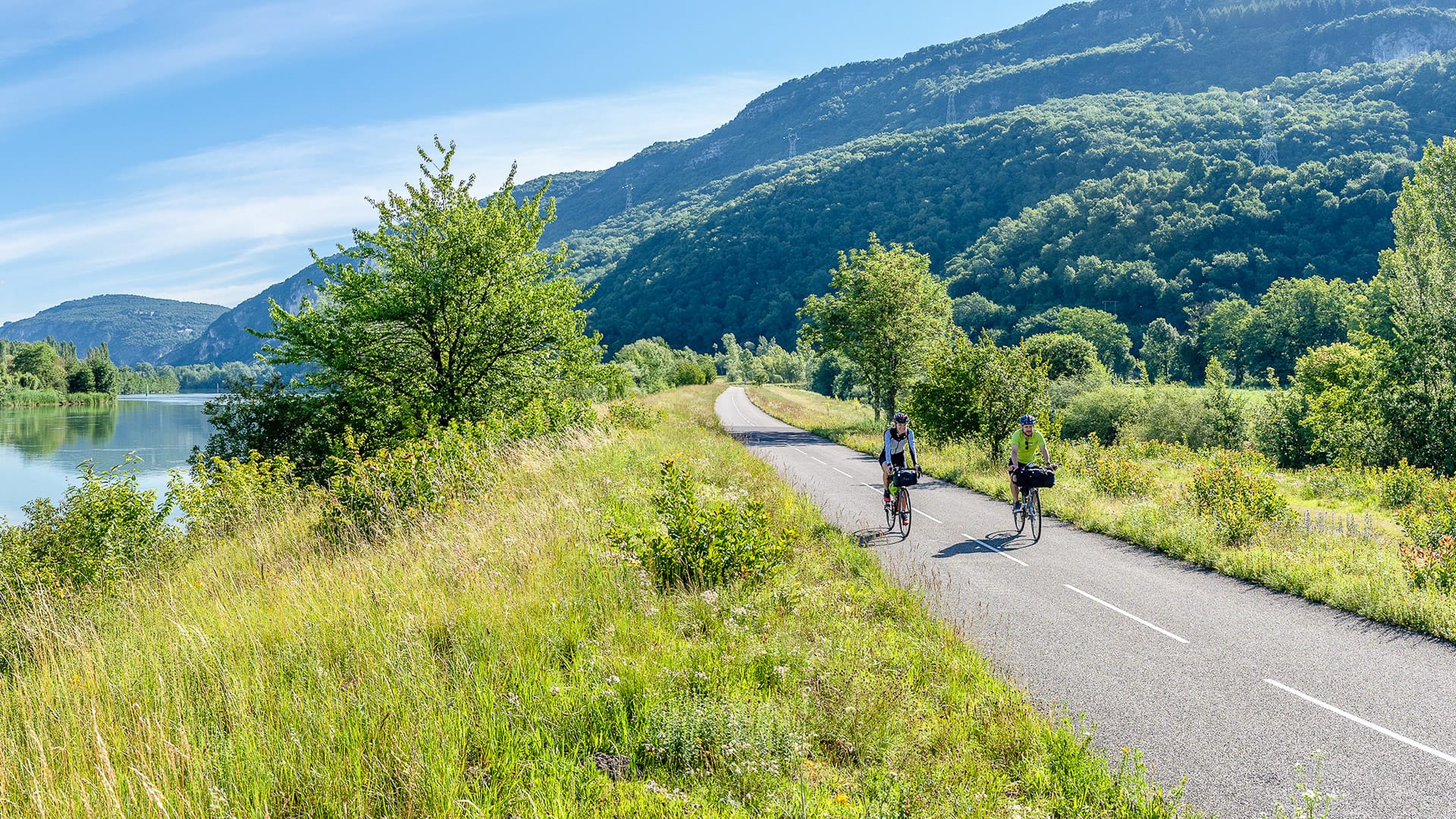
ViaRhôna and the Rhône at La Balme (73) (photo credit: Auvergne-Rhône-Alpes Tourisme/T. Prudhomme)
Part 8: Tips for cycling ViaRhôna
Think carefully about your section
ViaRhôna changes significantly from north to south. The northern sections have Alpine lakes, Bugey villages and some more demanding riding. The middle sections are strong for wine, food and Roman heritage. The southern sections bring Provence, Camargue and Mediterranean scenery.
Think about how much time you have, how far you want to ride each day and what you want from the cycling trip. The full route is not the only way to experience ViaRhôna.
Check the route surface before you ride
ViaRhôna includes greenways, shared paths, cycle tracks, quiet roads and some busier road sections.
Before travelling, check the official stage information for route surface, current status and any provisional sections. This is especially useful if you are riding with children, planning a relaxed holiday or trying to avoid busier roads.
Although ViaRhôna is a river route, cyclists should not assume the whole ride is flat, traffic-free or identical from one stage to the next. Some stages use greenways and shared paths that feel relaxed and straightforward. Others include shared roads, busier approaches to cities or more demanding riding, particularly in the northern sections and around larger urban areas.
Before choosing a section, check the official stage pages for distance, surface, elevation, provisional sections and current route status. This is especially important if you are travelling with children, riding with less experienced cyclists or planning a relaxed cycling holiday rather than a more demanding point-to-point ride.
Best time to cycle ViaRhôna
Spring and early autumn are often the most comfortable times to cycle ViaRhôna, especially if you are riding the southern sections through Provence, the Camargue and the Mediterranean coast. These periods can offer milder temperatures than July and August, while still giving enough daylight for relaxed point-to-point cycling. They can also be quieter, with fewer cyclists on the route.
One of the particularities of ViaRhôna is that it can be cycled all year round. Summer can work, particularly for shorter trips or experienced riders, but heat can be a serious factor from Valence southwards. In July and August, hot days can be over 35°C.In the Camargue, wind and mosquitoes can also affect the ride, especially later in the day. This is particularly relevant around Saint-Gilles, Aigues-Mortes, Sète and the Rhône Delta. Pack mosquito repellent and consider this when planning evening stops or outdoor meals.
In July and August, plan early starts, carry plenty of water and allow time for shade and longer breaks. In spring and autumn, also be prepared for strong winds. Long stretches along the river can feel difficult when you are riding into a headwind.
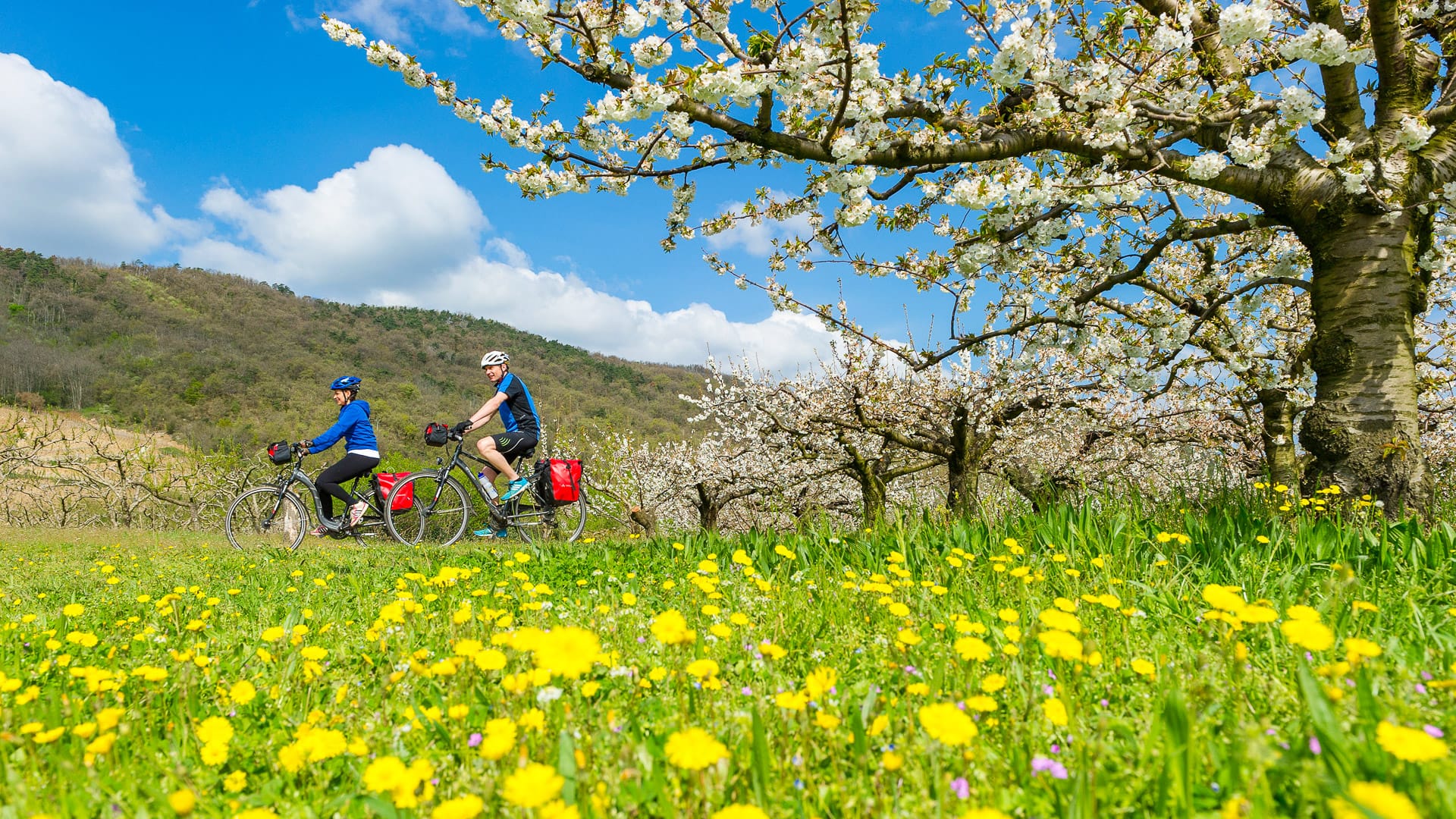
ViaRhôna, around Tournon (07) (photo credit: Auvergne-Rhône-Alpes Tourisme/Christian Martelet)
Use train access to shorten the route
Train access makes ViaRhôna more flexible.
The route has many stations along or near it, so you can shorten the ride, skip a busier section or build a point-to-point trip without riding the full 815 kilometres. Check current bike rules before travelling, as these vary by train type.
For more information on trains, read our ViaRhôna FAQs article!
Leave time for food, wine and heritage stops
ViaRhôna is not just about covering kilometres.
Some of the best stops are off the bike: for example, a museum in Vienne, wine tasting near Tain-l’Hermitage, a walk through Avignon, a pause in Arles, a visit to Aigues-Mortes, or seafood around Sète.
Cyclists planning shorter days should also check the distance between accommodation options before fixing their itinerary, as the best overnight stop is not always exactly where an official stage ends.
Accommodation is available along many parts of ViaRhôna, but availability can vary between larger towns, smaller villages and peak summer dates. If you are riding point to point, it is worth booking key overnight stops in advance, especially in popular places such as Lyon, Valence, Avignon, Arles, Aigues-Mortes and Sète.
For accommodation, restaurants, luggage transfer and other practical information, use the ViaRhôna practical information page. Accueil Vélo establishments are also worth looking for, as they meet commitments designed for welcoming cyclists.
Part 9: Where can cyclists find out more about planning a trip on ViaRhôna cycle route?
Official ViaRhôna route planner
The official ViaRhôna website is the place to continue planning your ride.
Use it to check the route, explore stages, compare sections and understand how the route fits together from Lake Geneva to the Mediterranean.
Stage maps and GPS files
The official stage pages are useful for checking maps, GPS files, distances, surfaces, services and current route information.
This matters because ViaRhôna is long, and conditions can vary between sections. Stage-level planning will help you choose the right route for your trip.
Practical information before you travel
Before travelling, check practical information such as route status, train access, accommodation, water points and bike services.
It is also worth checking the weather by section. Conditions around Lake Geneva, Lyon, the Rhône Valley, Provence and the Camargue can be very different.
For current maps, stage details, GPS files and practical planning information, visit the official ViaRhôna website.
For more safety advice, see the ViaRhôna safety page.
What’s next?
Thanks to Raphael Trichard for sharing these insights into cycling the ViaRhôna cycle route. For a detailed FAQ article, please check out our in-depth guide to cycling the ViaRhôna cycle route.
Looking for more exciting content on cycling in France?
- Cycling France, our central hub for the country.
- Cycling Morzine, for the best bases and routes.
- Cycling Corsica, with tips for cycling this beautiful island.
- Boat and bike tours in France, including the best regions, routes and tours (plus other tips!)
- 9 best long-distance cycling routes in France, featuring our top picks.
Got a question for Raphael?
Fill out this form and we will send it to Raphael. We aim to get you an answer within 24 hours where possible!For the past three years, Raphael Trichard has been leading the technical coordination of the ViaRhôna Route Committee, backed by the political vision of the Auvergne-Rhône-Alpes Region. His mission is to bring together a close-knit team of four, Sophie, Camille, Vincent and Caroline, as well as a network of dedicated partners, to deliver on every front: infrastructure, services, promotion and governance. The aim is simple: to create a cycling experience that is smooth, uninterrupted and open to everyone, whether they are out for a leisurely ride or on a long-distance adventure.
Day to day, he focuses on making things happen on the ground. Whether completing a new section of the route or rolling out an innovative service, every milestone enhances the quality of the journey and meets the different needs of cyclists. His real challenge is bringing local authorities, tourism professionals and socio-economic stakeholders together to ensure the route is intuitive, cohesive and open to all.
Cycling has always been part of who he is. From childhood, it has been his symbol of freedom and, over time, it has become his go-to for everything, whether commuting, tackling mountain passes or travelling. ViaRhôna builds on that passion, offering a unique way to explore the Rhône’s regions, landscapes and heritage at your own pace. It is an invitation to discover authentic stories, the river and the people met along the way.
First Published: 06 July 2026
The contents of this website are provided for general information purposes only. It is not intended to amount to advice and you should not rely on it. You should carry out your own due diligence and risk assessments and take professional advice. Views expressed by interviewees or other users of this website do not necessarily represent our views. We make no representations, warranties or guarantees, whether express or implied, that the content on our website is accurate, complete or up to date. If you use any information or content on this website, download from, or otherwise obtain content or services through our website, it is entirely at your own discretion and risk. Epic Road Rides Ltd disclaims all liability and responsibility arising from any reliance placed on the information and content on this website. Find out more here.
Sponsor Message
Considering cycling the ViaRhôna?
Head to the ViaRhôna website to find out more about the route.
Comments