

Riding the London to Barcelona cycle route offers the potential for a truly epic, pedal-powered adventure.
London and Barcelona are two of Europe’s most iconic cities – so what about cycling between them? Is it feasible? And with so many ways to cross France and enter Spain, how do you choose a route that does justice to the journey?
To help answer these questions, we interviewed Fiona Towell from Wild Atlantic Cycling Tours. In this article, she shares her experience of running a fully supported 1,400-kilometre ride from Hampton Court Palace to Barcelona, crossing the heart of France’s countryside and national parks before tackling the Pyrenees via the Col d’Ares. The route takes in everything from quiet farmland and historic villages to big, scenic climbs and an exciting finish in Catalonia.
If the idea of riding from London to the Mediterranean – via France’s forgotten back roads and a proper Pyrenean crossing – sounds like your kind of challenge, read on for a detailed guide to the route, the day-by-day itinerary, and how to plan your own London to Barcelona cycling adventure.

Fiona Towell is the Co-Director at Wild Atlantic Cycling. She's a cycling and outdoor life enthusiast.
Fiona’s goal is to share her experiences, encouraging riders to embrace diversity in their travels and enjoy the thrill of crossing countries and continents on an end-to-end tour on a bicycle, with the added reassurance of being fully supported.
Wild Atlantic Cycling continue to grow and offer more tours, with 2027 seeing the launch of the Northern Ireland revolution, Land's End to John O'Groats and their first single-base tour in the Algarve.
We love to introduce our community to cycling businesses, destinations and ideas that we think are genuinely interesting. Wild Atlantic Cycling Tours caught our attention because of its focus on cycling in Barcelona region, which felt like a natural fit for Epic Road Rides and our readers. We were therefore pleased to work with the Wild Atlantic Cycling Tours team on this article.
Wild Atlantic Cycling Tours paid for this advertisement feature. Our decision to collaborate reflects our view that the brand is relevant to our readers; it is not a formal approval, audit or guarantee of its services. Unless we expressly say otherwise, we have not personally taken the trip described or independently verified information supplied by Wild Atlantic Cycling Tours.
As with any travel purchase, please check the latest trip details, terms and customer protections directly with Wild Atlantic Cycling Tours before booking. Any booking is made with Wild Atlantic Cycling Tours, not Epic Road Rides.
Always check current travel information and advice. For visitors from the UK, the UK government travel information pages are here.
Contents of this article
This London to Barcelona cycling guide is packed with practical detail and route-specific insight.
- Part 1: Overview
- Part 2: Highlights
- Part 3: Itinerary breakdown
- Part 4: Planning
- Part 5: Insider tips
- Part 6: Wild Altantic Cycling Tours
Sponsor Message
Considering cycling from London to Barcelona?
Wild Atlantic Cycling Tours offers this route as a fully supported, guided trip.
Head to their London to Barcelona webpage for full details, including prices and availability.
Got a question for Fiona Towell from Wild Atlantic Cycling Tours?
Fill out this form and we will pass it to Wild Atlantic Cycling Tours who aim to reply (within 24 hours wherever they can!)
Part 1: An overview of the London to Barcelona cycle route



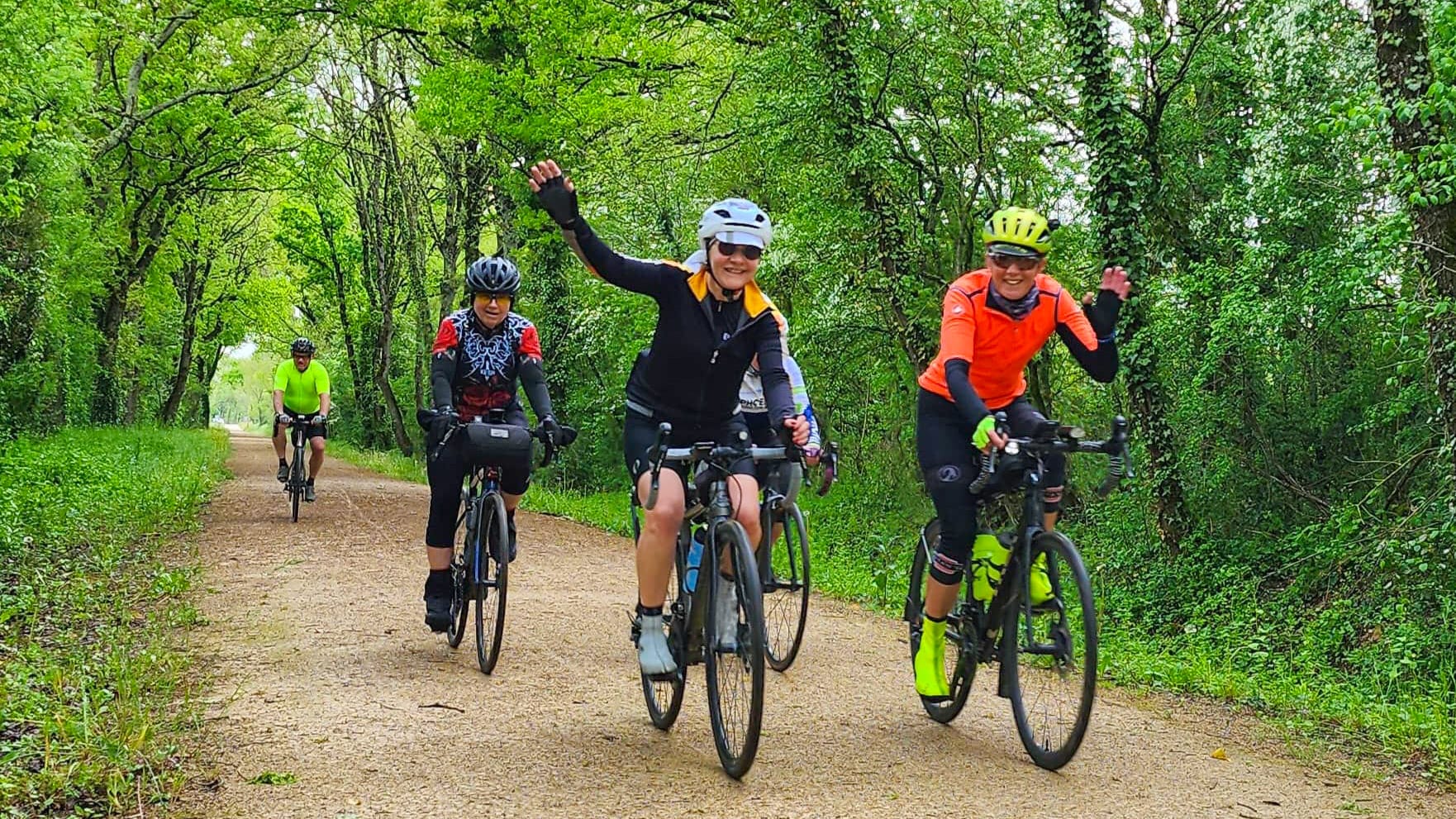


Wild Atlantic Cycling Tours’ London to Barcelona route covers approximately 1,400 kilometres over 11 cycling days, with one rest day in Carcassonne.
It’s a challenging, end-to-end journey that starts at Hampton Court Palace in West London and finishes on the beach in Barcelona. The route is chiefly a ride through the middle of France’s many beautiful villages and national parks, before crossing the Pyrenees into Spain and rolling on to Catalonia.
After an overnight ferry crossing from Portsmouth to Caen in Normandy, the route heads south through Centre-Val de Loire, Nouvelle-Aquitaine (Limousin) and Occitanie (Midi-Pyrénées). You then cross the border via the Col d’Ares climb before dropping into Spain and continuing to Barcelona through Parc Natural de Sant Llorenç del Munt i l’Obac.
See below a map of the route, highlighting some of the key places mentioned in this article. Hover over the map pins to see the names of places.
Where does the route go?
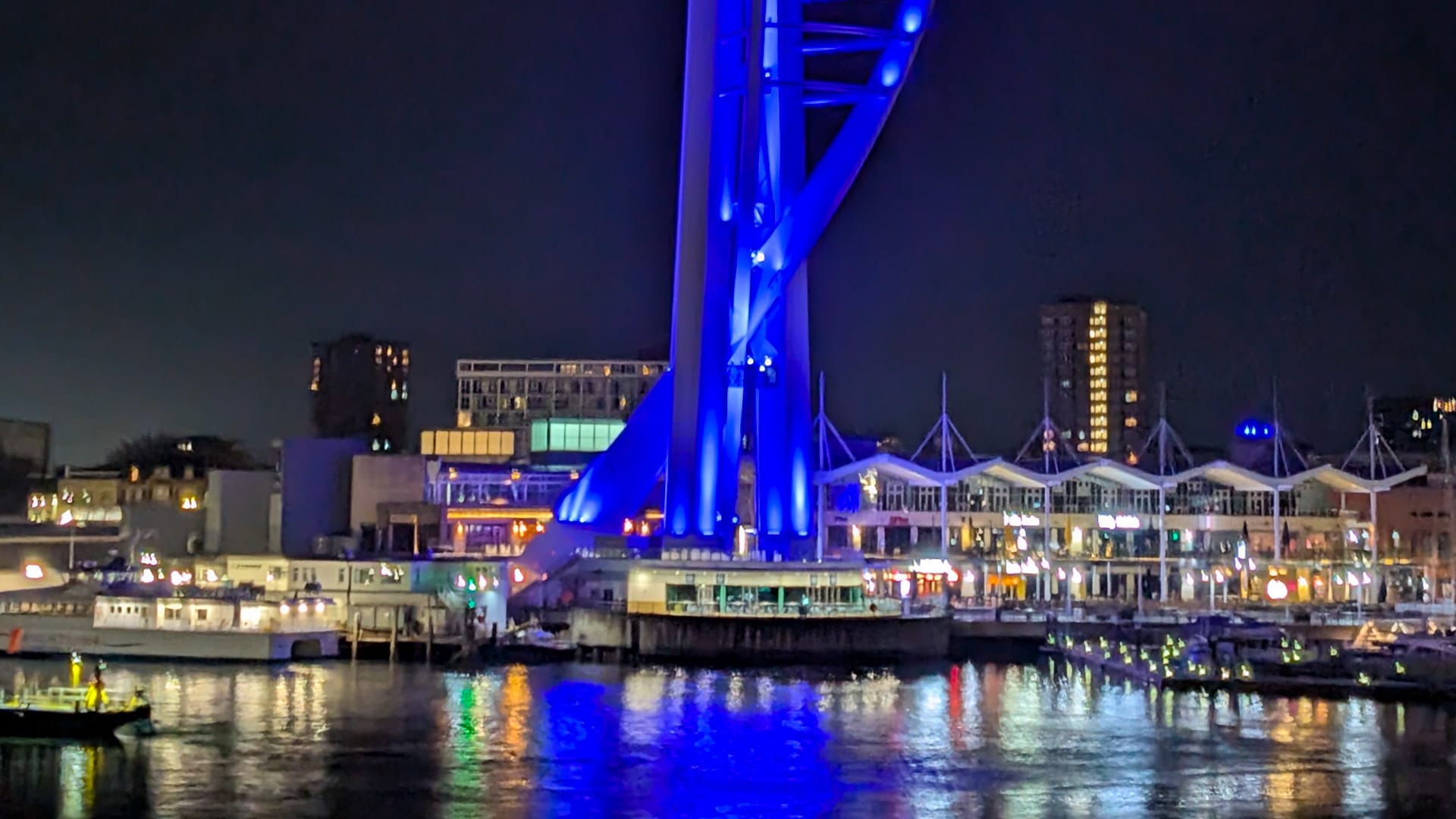
The tour sets out from the west side of London, heading south into the Surrey Hills and across the South Downs National Park to reach Portsmouth Ferry Terminal.
From there, you take the ferry overnight to France and then ride the length of the country, crossing the border into Spain. After staying overnight in the hills, you descend – via a few more climbs – into Barcelona.
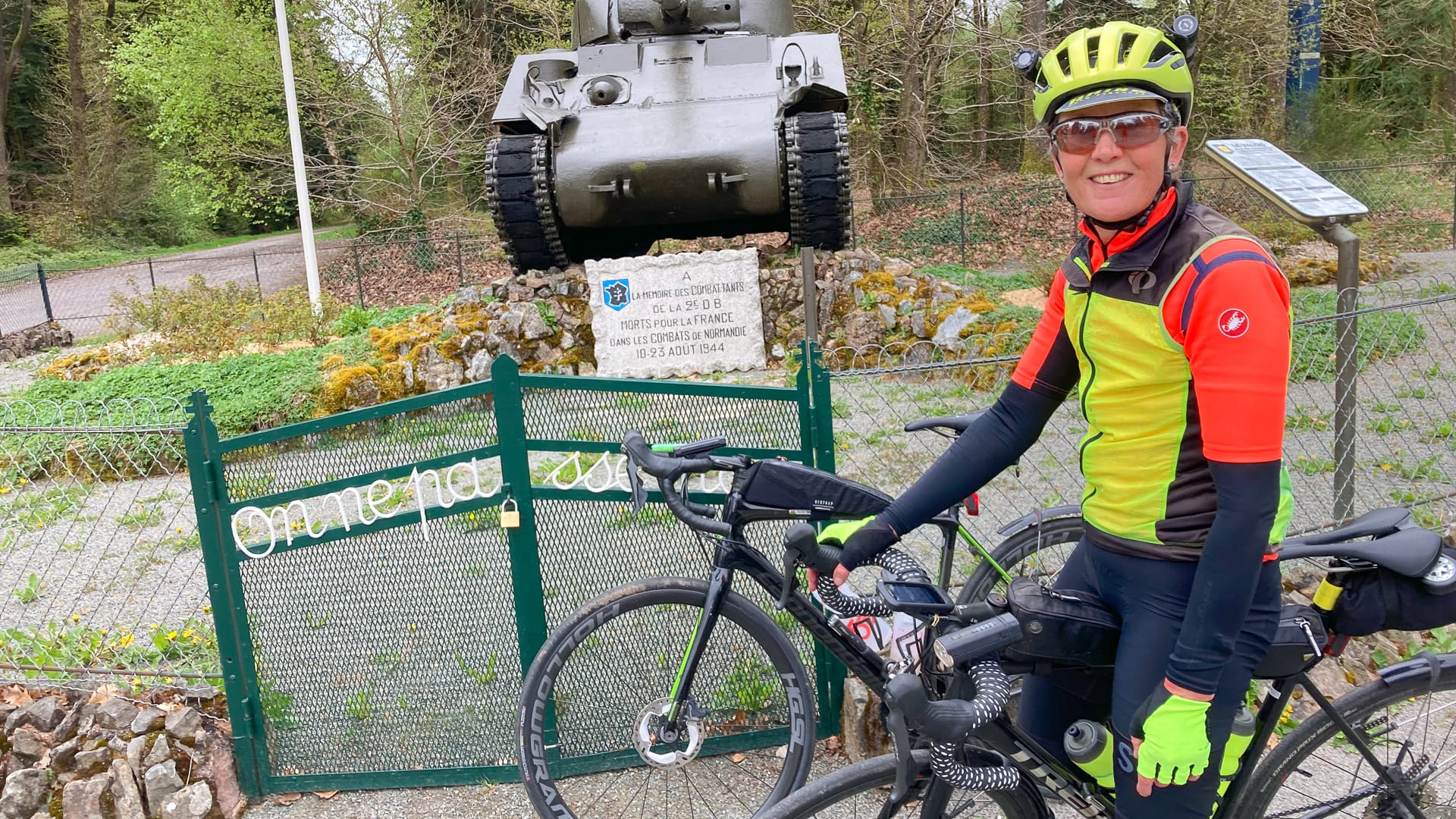
In the north of France we pass a number of war memorials (photo credit: Wild Atlantic Cycling Tours)
How many kilometres is London to Barcelona?
The full route is around 1,400 kilometres, ridden over 11 cycling days, with one rest day in Carcassonne. This makes it a big but achievable, end-to-end journey, especially when broken up into manageable daily stages.
What is the scenery like?
The scenery is a real highlight throughout – and the trip just gets better as you travel south.
The early part of the ride is “typically French”: rolling countryside, fields, farms, rivers and plenty of châteaux. There are also several powerful historical landmarks along the way. In fact, within the first two kilometres in France, the route passes the Pegasus Memorial, on the site of the famous D-Day landings.
One of the most moving stops comes a little later at Oradour-sur-Glane. The tour makes a point of stopping here so riders can walk around the site if they wish. By order of Charles de Gaulle, this village was left exactly as it was after the German massacre in 1945.
Be aware! Oradour-sur-Glane is a sobering experience, and not everyone wishes to go in. The team are happy to mind your bike for a while if you’d like to visit the site.
As you head further south, the riding becomes more scenic and more technical, especially through the national parks. The final day brings a dramatic transition into the Pyrenees, and the ride through the Parc Natural de Sant Llorenç del Munt i l’Obac in Catalonia offers a very special finish.
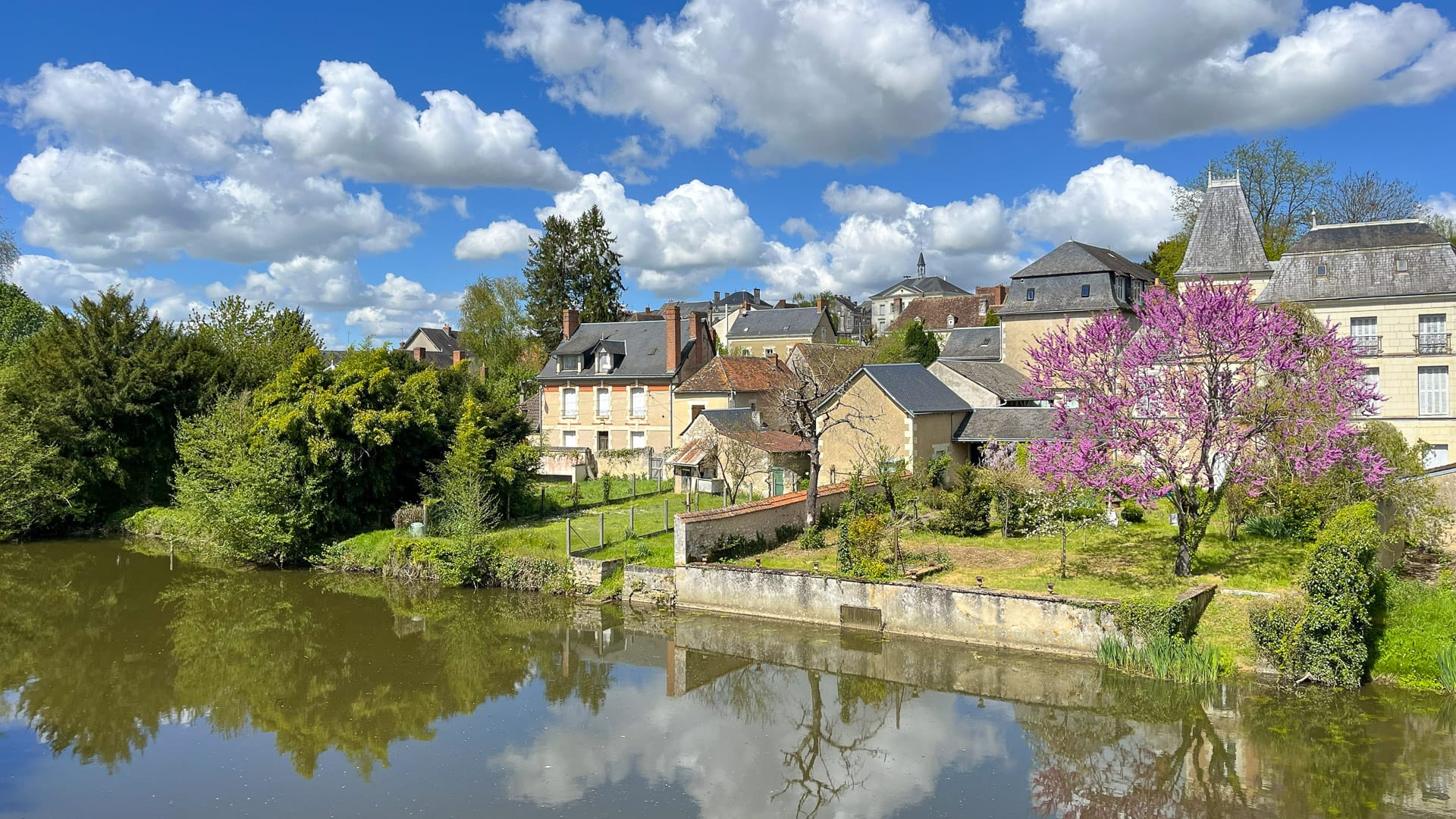
The pretty little village of Preuilly sur la Claise will take your breath away (photo credit: Wild Atlantic Cycling Tours)
What are the surfaces like?
The route is almost entirely on asphalt roads.
Be aware! There is one notable exception: a 30-kilometre section where the route leaves the road and follows a greenway on Day 8, heading into the village of Castres. This is a hard-packed gravel section and has been described by guests as “a joy to ride”. A road bike with 28″ tyres is absolutely fine on this section.
What is the terrain like?
The terrain is suitable for a road bike throughout the whole tour. The first day in the UK includes the busiest roads, although much of the route follows quieter lanes through the villages of the Surrey Hills. Roads are paved with asphalt throughout, but it is important to stay alert for the occasional pothole, particularly in dappled shade in tree-lined, forested areas.
In France, the roads are generally a pleasure to ride on, with smooth surfaces and relatively little traffic. Drivers are typically considerate and give cyclists plenty of space, supported by regular road signs reminding them to do so.
After the lowlands in northern France, the terrain becomes progressively more challenging, with hills and bends often following the natural curves of the valleys. The longer climbs are balanced by equally long descents, making for a varied and engaging ride.


How challenging is riding London to Barcelona?
This is one of Wild Atlantic Cycling Tours’ AVID tours, which means it’s a tough physical challenge. The riding gets progressively harder and more technical as the days go by.
Top tip! This 11-day tour is essentially 10 days of training for day 11, which is the toughest day of the bike tour! While many riders expect the Pyrenees crossing on Day 10 to be the hardest part, it’s actually a fairly steady “one climb day” and not too steep. Day 11 is the real test, with constant climbing, descending, twisting and turning, and very little chance to switch off mentally. The first glimpse of the Mediterranean makes all of that effort worthwhile.
In terms of who it’s suitable for, most club riders or regular commuters will manage this route with a couple of months of longer-distance training beforehand. At around 1,400 kilometres, it’s a long way to ride, so pacing yourself is key. This is an endurance ride to be enjoyed, with nice hotels and good food in between, rather than something to attack flat-out from day one.
Weather can also play a role in how challenging the ride feels. The tour doesn’t ride in extreme heat (above 39°C) or in bad storms, and a full risk assessment is made each day before setting off.
How did Wild Atlantic Cycling Tours choose the route?
The short answer is: by riding many roads that we ultimately didn’t include in the itinerary!
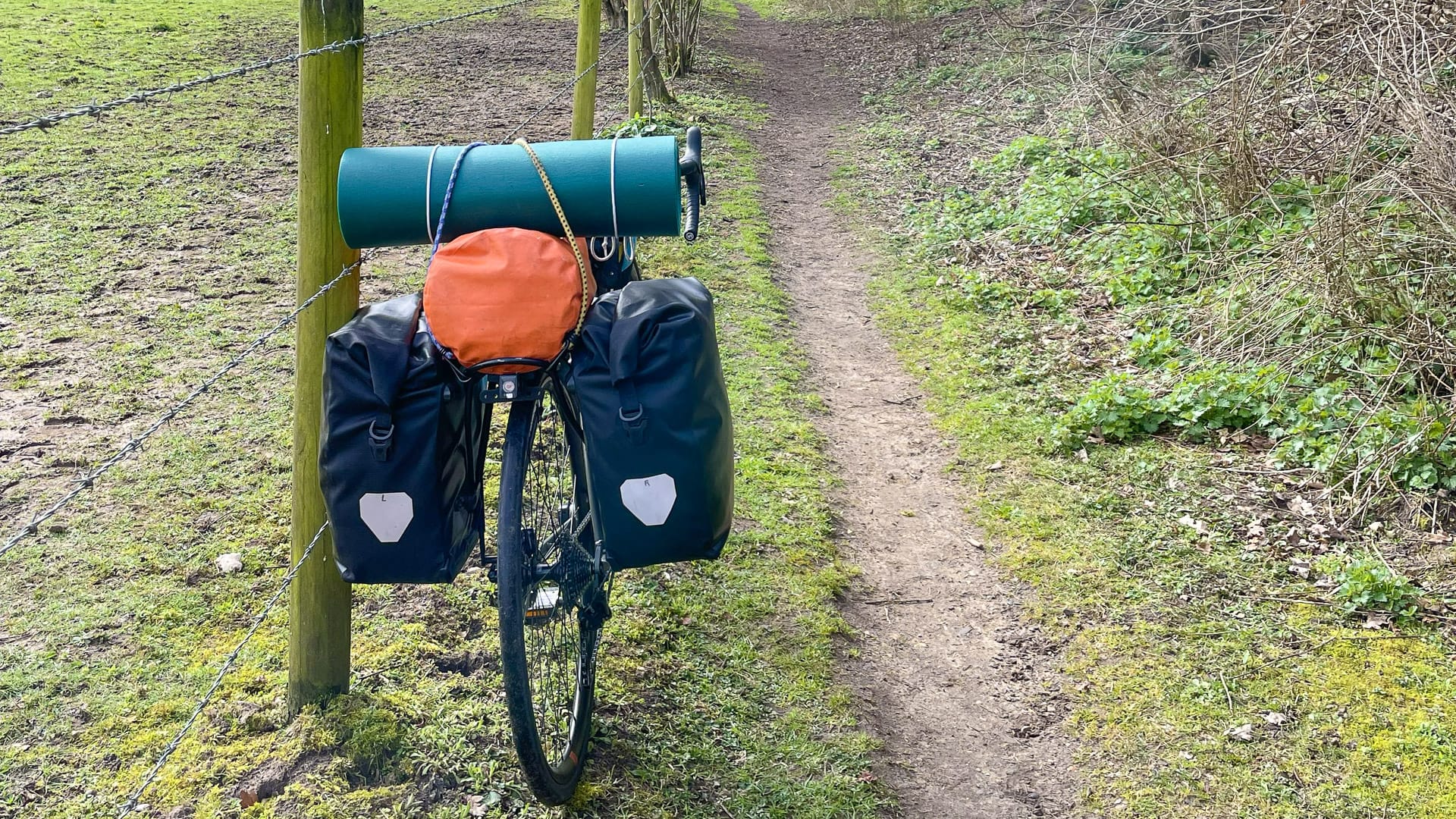
Many a joyous day in the saddle precedes all of our well researched tours (photo credit: Wild Atlantic Cycling Tours)
Because this is a long journey and time is limited, the route needs to be fairly direct. The starting point was the “crow line”, Google Maps, a Strava heatmap, and copious notes from previous travels in France. From there, the team repeatedly criss-crossed the country, refining the route with one simple aim: to have the most fun possible on a bike.
It was important to take in “all things French” – particularly the countryside and farm life that are such a big part of French culture. That means riding through fields and across rivers in the flatter north, passing enough châteaux to get a real feel for how spread out the villages are, and then moving into areas of outstanding natural beauty in the hillier national parks further south.
We also felt strongly that, as cyclists, it was important to cross the Pyrenees into Spain, rather than skirting around the edge. Drawing on our experience in northern Spain, we chose a crossing point that’s close enough to Barcelona to make sense logistically, but far enough west to ensure you still have to put in a bit of uphill effort.
Part 2: Why is London to Barcelona by bike a must-do?
There are plenty of famous long-distance rides in Europe, but the London to Barcelona cycle sits in a special category. It links two iconic cities, crosses an entire country in between, and finishes with a proper mountain crossing into Spain. It’s a bit like London to Paris – only much, much longer!
Two iconic cities – and a journey that earns its finish
Everyone has heard of riding from London to Paris. London to Barcelona follows the same idea, but on a far grander scale.
Instead of a short cross-Channel challenge, this route takes you deep into France’s lesser-ridden heartlands, through villages, farmland, and national parks that many cyclists skip in favour of chasing famous Alpine climbs like Alpe d’Huez and other big-name climbs. Here, the focus is on the journey itself: long days in the saddle, ever-improving scenery, and a real sense of travelling somewhere under your own steam.
And then there’s the finish. Barcelona makes for a brilliant endpoint: it’s warmer as you head south, you’ve already got the ferry logistics out of the way at the very beginning, and the Pyrenees crossing you take works better as a climb in this direction. The longer, slightly less steep climb offers more splendid views as you go, culminating in a memorable arrival with far-reaching views into Spain, whereas the route from the Spanish side is more consistently upward-facing.
Plus, while rarely true, everyone associates going north with going uphill – so heading south just feels right!

Landscape view of a village near Col d’Ares with surrounding mountain scenery (photo credit: Wild Atlantic Cycling Tours)
The France, many cyclists forget
One of the great strengths of this route is that it showcases a part of France that’s often overlooked by road cyclists.
Rather than beelining for the Alps, the ride heads through quiet countryside, small villages, rivers and farmland, before building into the more challenging terrain of the national parks further south. The riding gets better and better as the days go by, and the terrain becomes more interesting and more technical – always on asphalt, but with increasingly engaging roads.
From the very first day in England, cycling through the little villages sets the scene for a ‘country’ ride to Barcelona. Shere and Midhurst are two quintessential English villages we ride through on our way to lunch. In France, some villages are notable tourist destinations in their own right, including:
- Preuilly sur la claisse
- Segur le Chateau
- Gramat
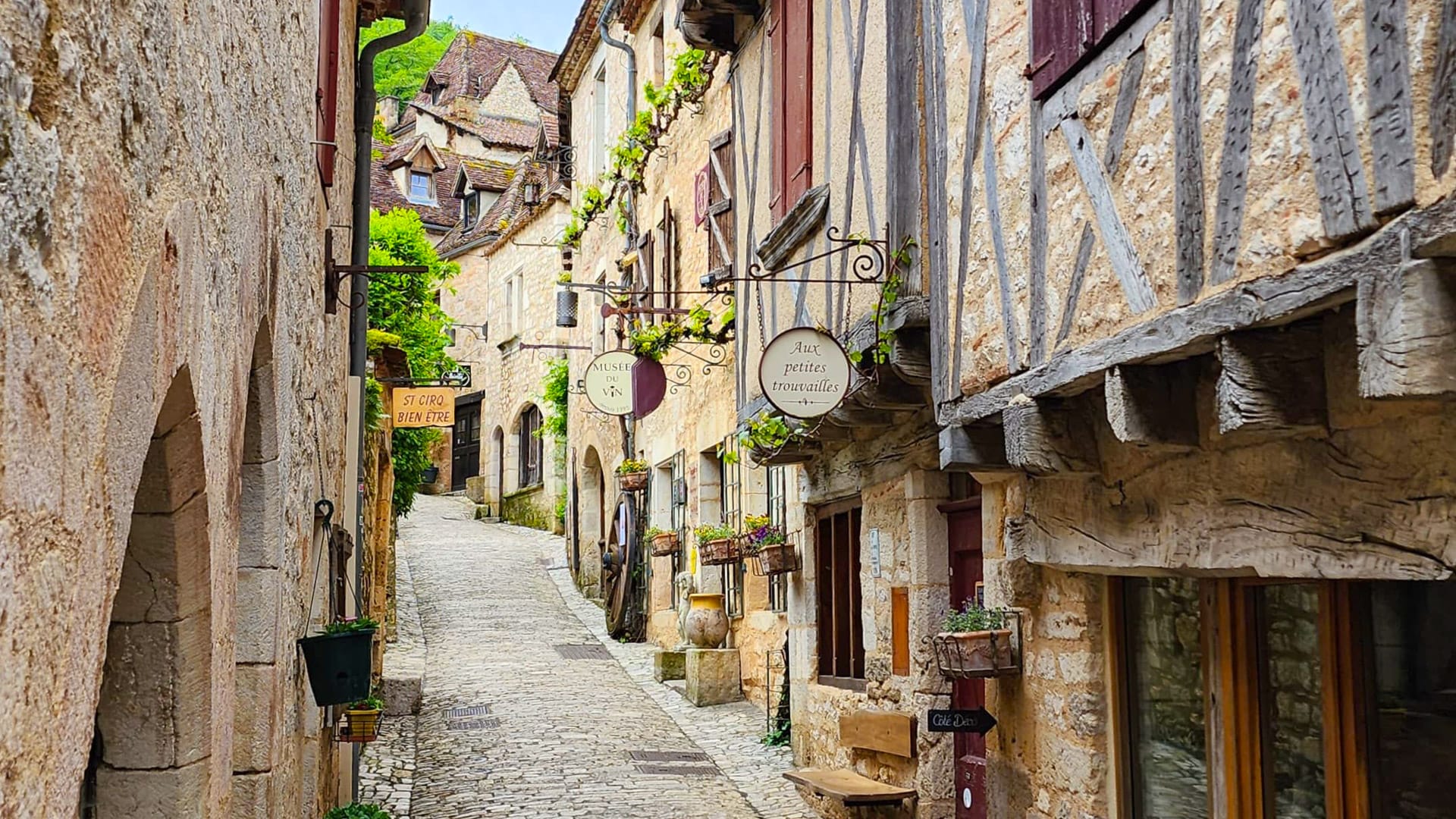
- Saint Circ Lapopie
- Lagrasse

Beautiful French village (photo credit: Wild Atlantic Cycling Tours)
Long climbs are a feature of the southern half of the route, but nothing is incredibly steep. Instead, you’re rewarded with outstanding views and, just as importantly, long, satisfying descents on the other side.
A proper Pyrenees crossing into Spain
As cyclists, we feel it’s important to cross the Pyrenees properly, rather than sneaking around the edge.
The route into Spain goes via the Col d’Ares, which strikes a nice balance: it’s a meaningful mountain crossing without being brutally steep, and it puts you in exactly the right place to continue towards Barcelona. Many riders expect this to be the hardest day of the tour, but in reality, it’s a relatively steady, “one big climb” kind of day.
The real sting in the tail comes on the final day, where the terrain is constantly changing – climbing, descending, twisting and turning – and you have to stay focused all the way to the Mediterranean.
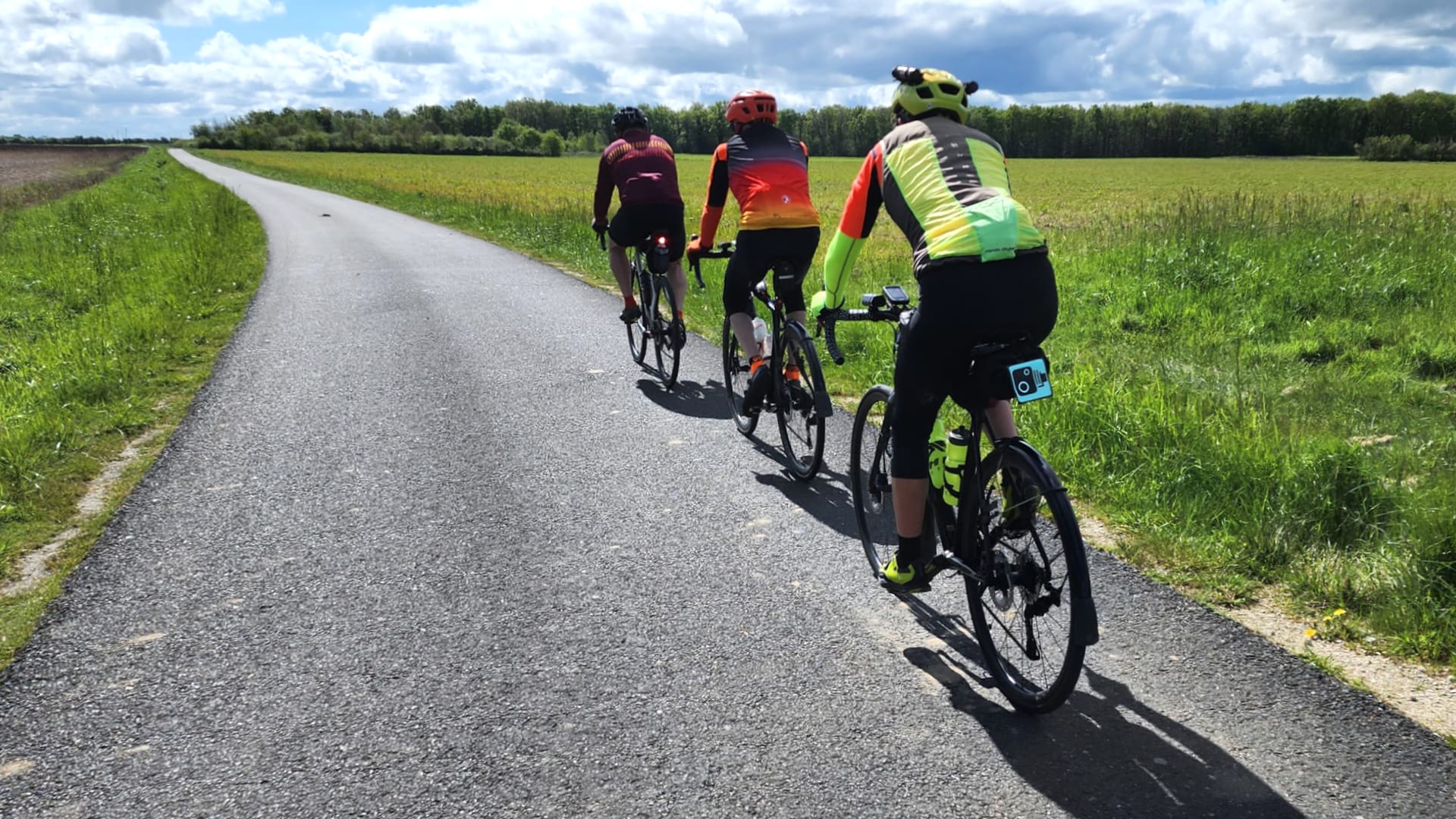
Cycling along a quiet country road (photo credit: Wild Atlantic Cycling Tours)
Ride well, eat well
There’s also a very simple, very human reason why people love this route: the food.
In the words of the team, “if you love your food, then France is simply unbeatable”. Cyclists need fuel, and when that fuel happens to come in Michelin-star quality, it somehow works like “the higher grade petrol option”. Good food, good coffee, and proper meals at the end of long days are a big part of what makes this ride feel like an adventure rather than just a sufferfest.
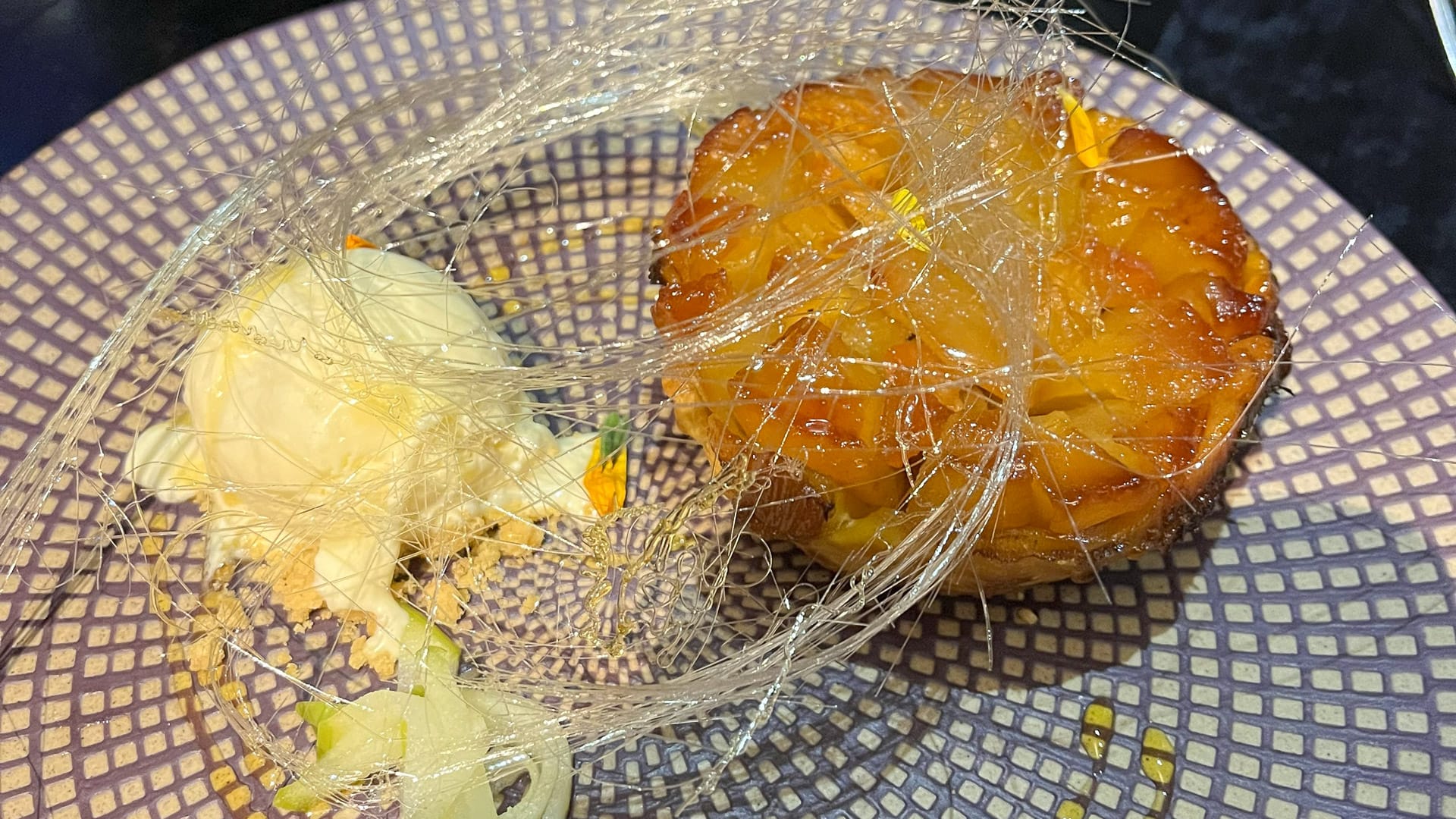
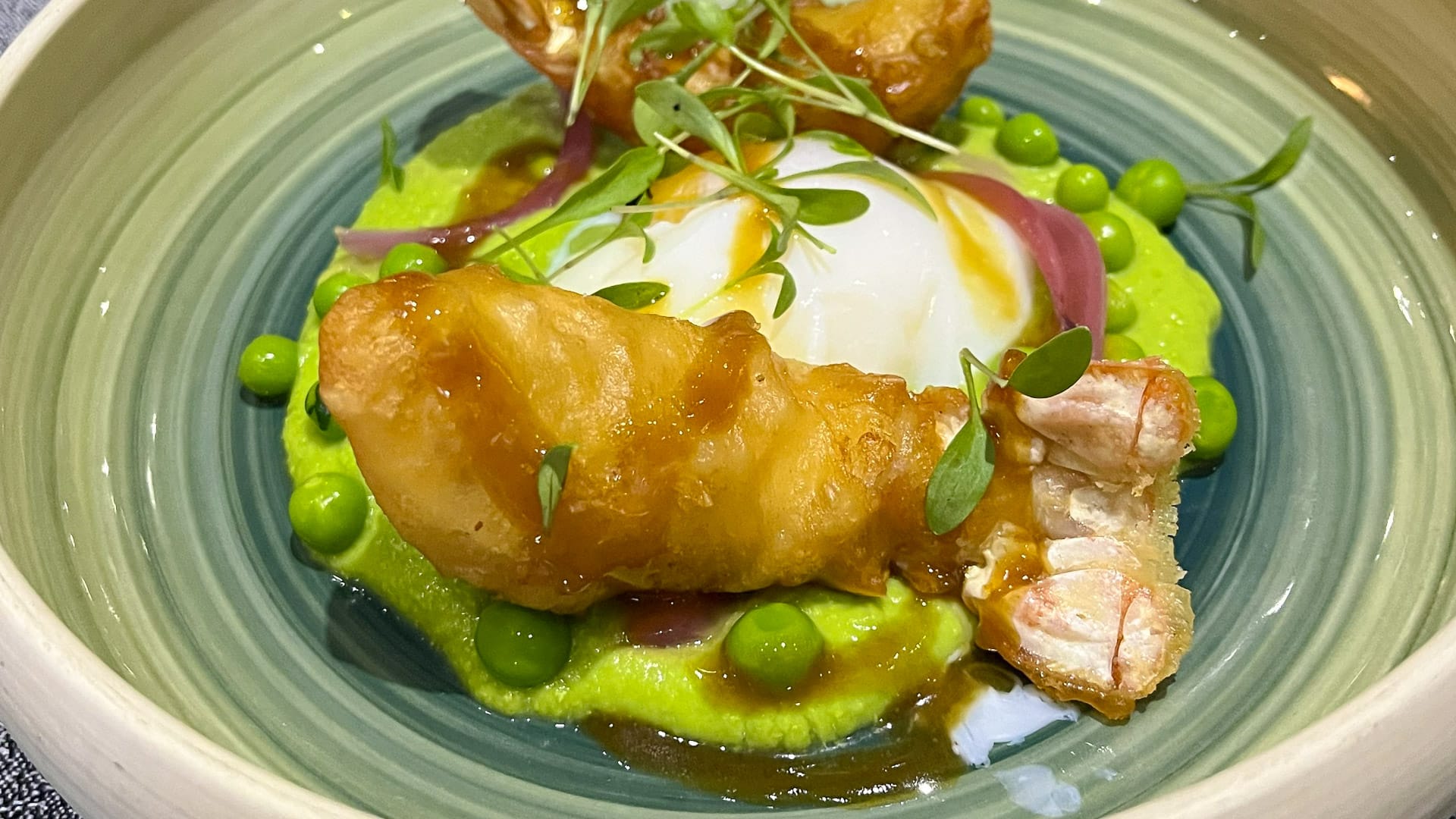
In general, one thing the French do very well is food. From a morning croissant to an elevenses tarte au citron with coffee, on to a menu du jour at lunch, and through to evening dining often followed by a crème brûlée, you can expect to give your taste buds a treat the entire tour!
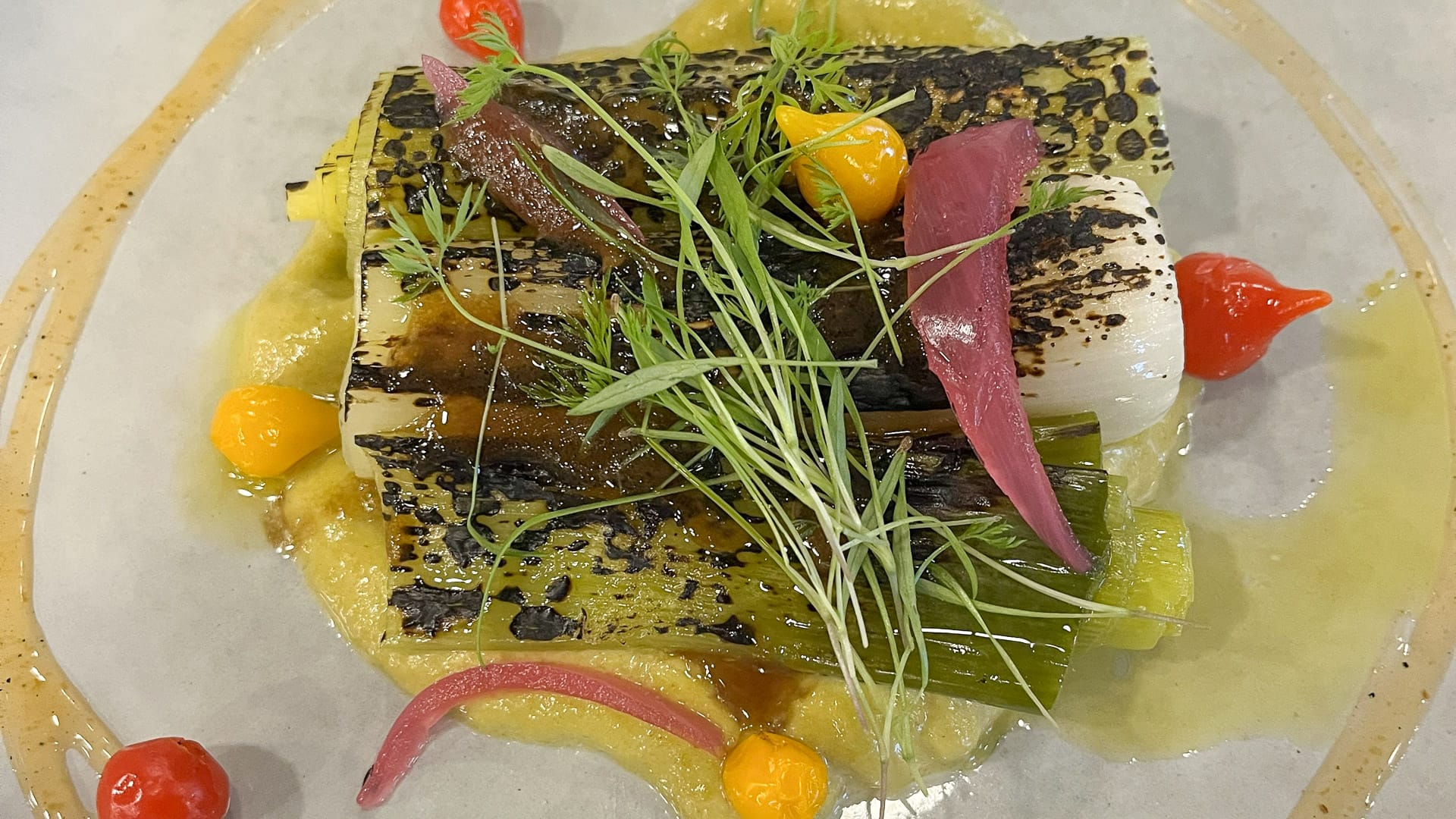
We ensure you can eat well at lunchtime, often reserving places in cafés for their menu du jour, and that you have options where possible for your evening meal. One particular hotel we stay at in Montmorillon has a Michelin-star chef, with very reasonable prices. I wholeheartedly recommend that you take the opportunity to enjoy this experience, particularly given you only have to walk downstairs (or take the lift!).
A journey that builds, day by day
Perhaps the most important reason to choose this route is the way it develops over time.
You start with classic French countryside, ease into more demanding terrain, work your way towards the mountains, cross the Pyrenees, and then finish with a full-on, technical ride into Barcelona. It’s not just a case of ticking off kilometres – it’s a journey that ramps up in difficulty and drama, and rewards you with one of the best finishes you could ask for on a bike.

It’s worth slowing down to the speed of the river as you pass through Segur le Chateau to fully appreciate this special place (photo credit: Wild Atlantic Cycling Tours)
Sponsor Message
Considering cycling from London to Barcelona?
Wild Atlantic Cycling Tours offers this route as a fully supported, guided trip.
Head to their London to Barcelona webpage for full details, including prices and availability.
Got a question for Fiona Towell from Wild Atlantic Cycling Tours?
Fill out this form and we will pass it to Wild Atlantic Cycling Tours who aim to reply (within 24 hours wherever they can!)
Part 3: London to Barcelona itinerary breakdown
Before diving into the daily stages, it’s worth noting that the London to Barcelona tour is an end-to-end ride that really does take you all the way from Hampton Court Palace to the Mediterranean. Aside from the overnight ferry crossing from Portsmouth to Caen, you ride every kilometre of the route.
Each morning starts with a full briefing from the ride leader, and daily plans are shaped around weather conditions and rider safety. On most days, cyclists can expect to be in the saddle for around six hours, although this varies depending on distance, terrain and personal pace. With a typical 9 am start, plus coffee and lunch stops, most riders arrive at the hotel between 5 pm and 6:30 pm, unless distracted by the various watering holes on the final stretch into town.
Be aware! On longer or tougher climbing days, the group may leave a little earlier. A full risk assessment is made each day before setting off, and rider safety is always the priority.
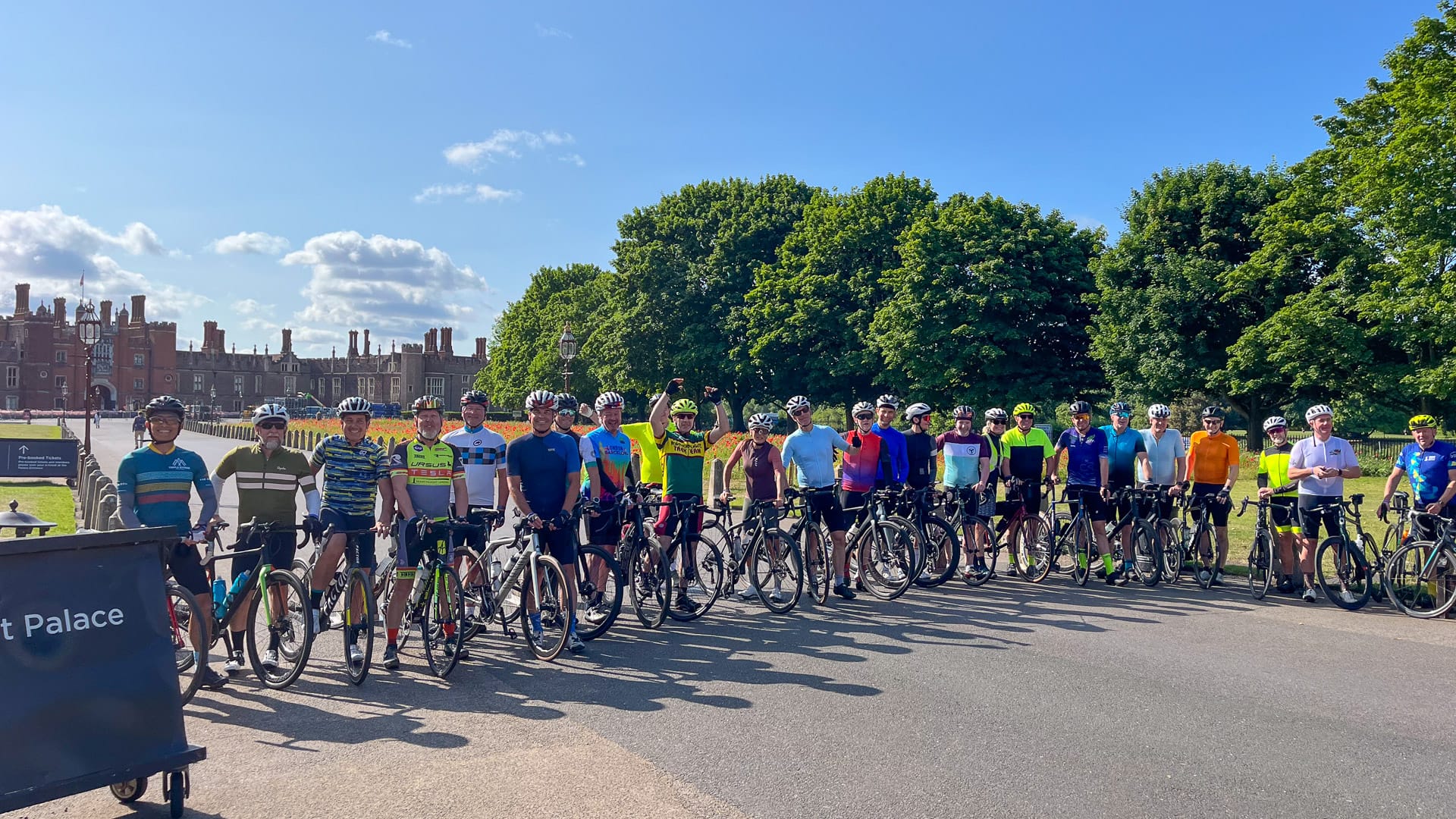
Yes, you really will ride all the way from Hampton Court Palace to Barcelona! You’ll ride on to the ferry in Portsmouth and off it in France for breakfast the next morning. (Photo credit: Wild Atlantic Cycling Tours)

London to Barcelona route map (photo credit: Wild Atlantic Cycling Tours)
Arrival day: Hampton Court (no cycling)
Overview
You arrive at the Mitre Hampton Court Hotel, close to the start point at Hampton Court Palace. This is the chance to get settled, prepare your bike, meet the group and attend the initial briefing before the ride begins.
Highlights
This is very much about setting the tone for the journey ahead: final bike checks, meeting your fellow riders and getting a sense of the scale of what’s to come as you prepare to roll out from one of the UK’s most historic starting points.
Good to know
It’s worth getting everything ready this evening so the first riding day can start smoothly and without stress.
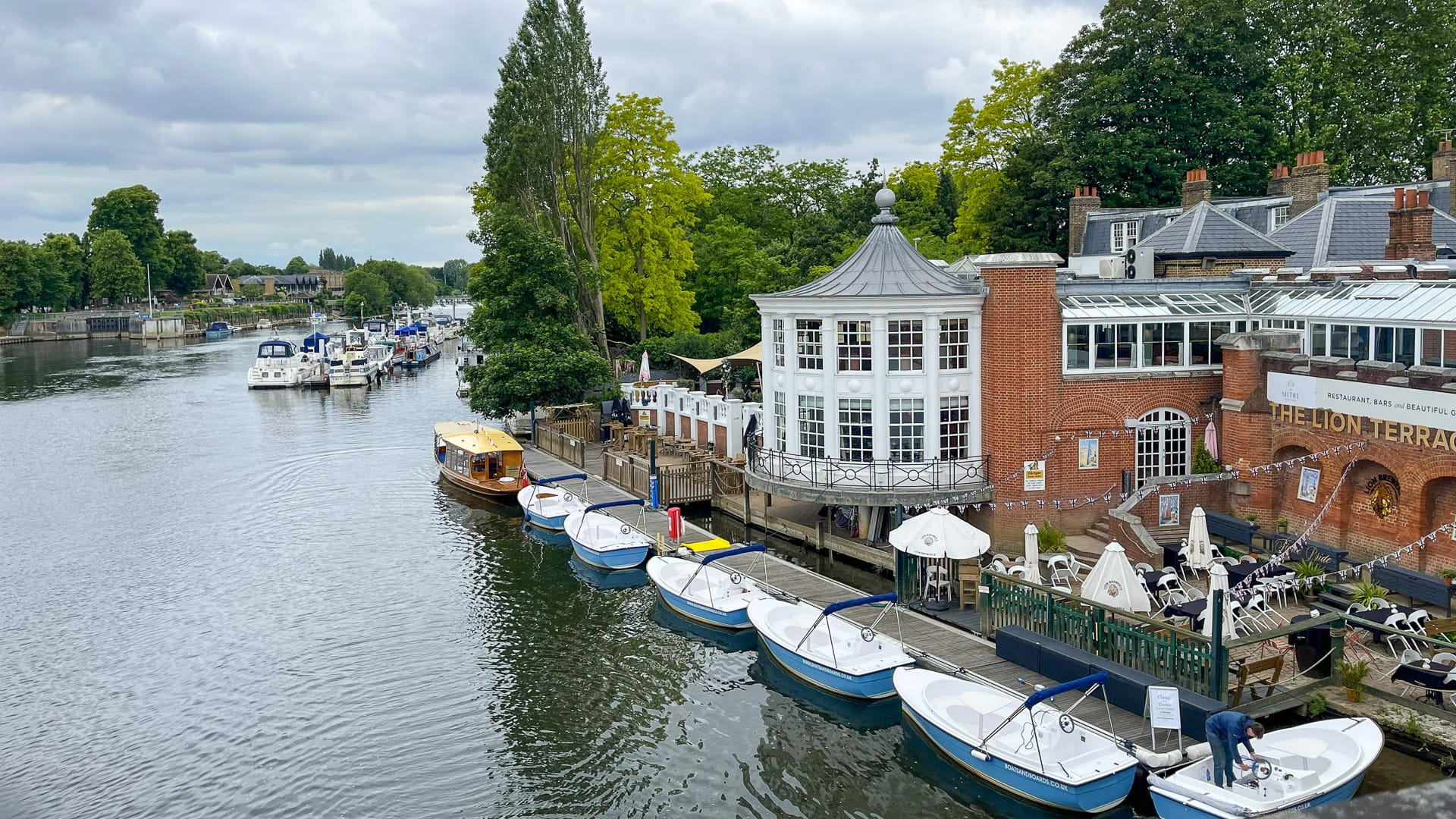
Our hotel with its prime location opposite Hampton Court and splendid view out over the Thames makes for a terrific start line to this epic journey (photo credit: Wild Atlantic Cycling Tours)
Day 1: London to Portsmouth
Key statistics
118 kilometres
1,113 metres of elevation gain
Overview
The journey begins on the west side of London, heading south towards the coast. This first day eases you into the rhythm of the tour while still delivering some beautiful riding through southern England.
Highlights
The route takes you through the villages of Cranleigh and Midhurst – the inspiration for The Midwich Cuckoos by John Wyndham – before rolling through the Surrey Hills and across the South Downs. It’s a classic English countryside ride and a fitting send-off before the continent beckons.
Good to know
This is the only day you ride in the UK, and therefore the only day riding on the left-hand side of the road. Cycling in London can be busy, but you’re avoiding the worst roads in the city centre. From tomorrow onwards, in France and Spain, you’ll be riding on the right.
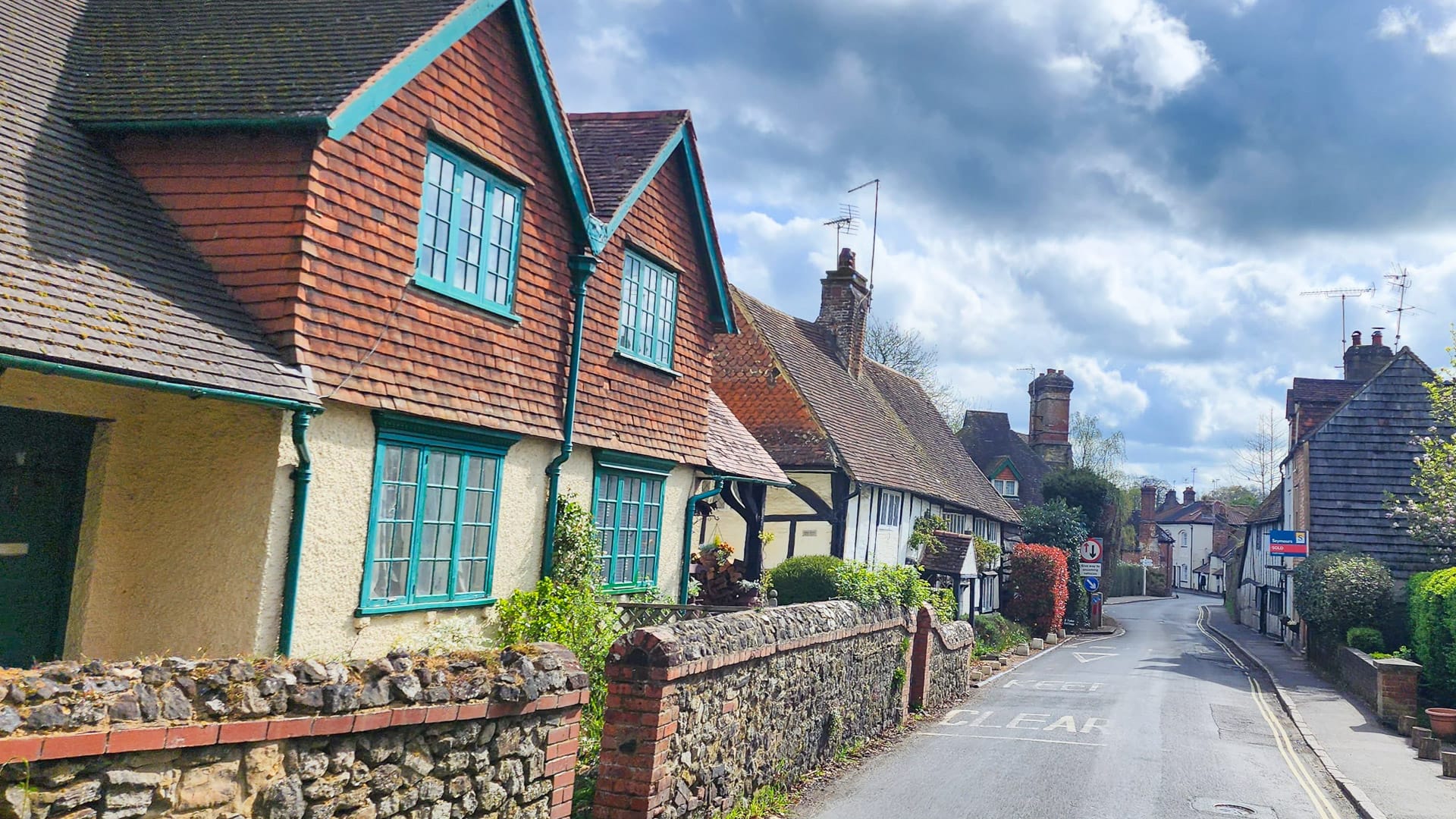
Today is the only day you’ll ride on the left hand side of the road. (Photo credit: Wild Atlantic Cycling Tours)
Day 2: Caen to Alençon
Key statistics
124 kilometres
1,051 metres of elevation gain
Overview
After the overnight ferry from Portsmouth to Caen, arriving at around 6:30 am, you have breakfast before rolling out for your first day of riding in France.
Highlights
Within the first couple of kilometres, you pass the Pegasus Memorial, on the site of the famous D-Day landings, a powerful and atmospheric start to the French section of the ride. The route then takes you past Haras du Pin, a world-class equestrian centre, and through the Calvados apple brandy region, with another poignant stop at the Canadian War Memorial along the way.
Good to know
This is a day that mixes gentle French countryside riding with some significant historical landmarks, setting the tone for the days ahead.

Feel free to stop wherever the mood takes you (photo credit: Wild Atlantic Cycling Tours)
Day 3: Alençon to Tours
Key statistics
151 kilometres
1,049 metres of elevation gain
Overview
A classic French stage that carries you further south into the heart of the country.
Highlights
The highlight of the day is your arrival in Tours, a lively and attractive town that makes a great place to explore, stretch your legs and enjoy the evening after a solid day in the saddle.
Good to know
This is a good day to settle into the rhythm of the tour and get used to the daily routine of riding, coffee stops and relaxed evenings.
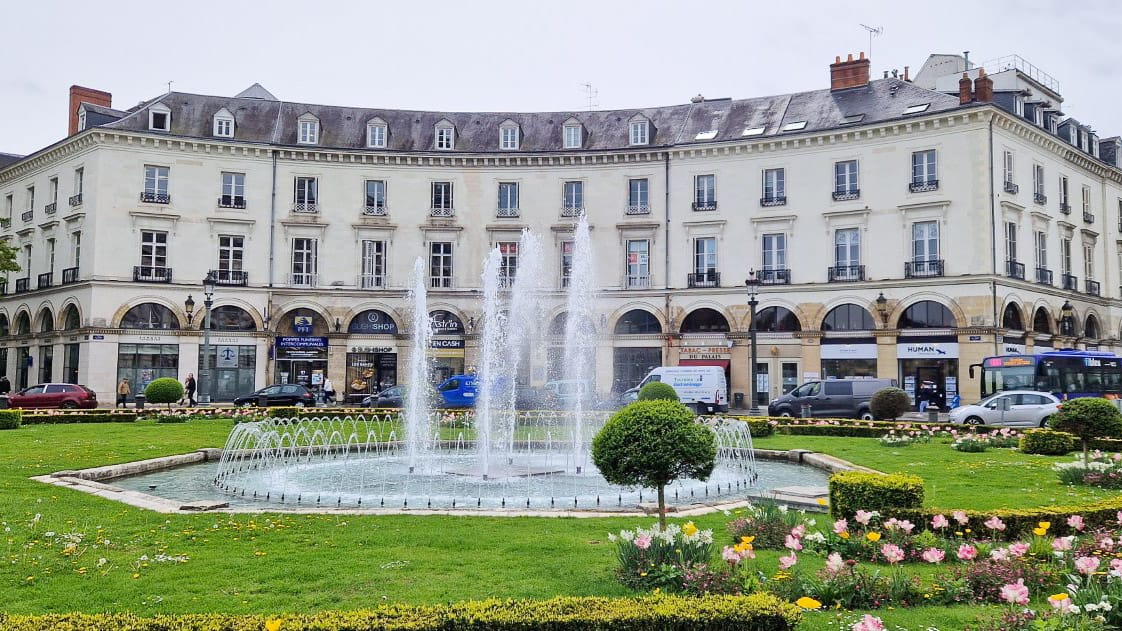
The town of Tours makes for a lovely evening walk to shake your cycle legs out (photo credit: Wild Atlantic Cycling Tours)
Day 4: Tours to Montmorillon
Key statistics
138 kilometres
1,122 metres of elevation gain
Overview
Another day that showcases the charm of rural France, with a particularly memorable lunch stop and a special dinner waiting at the end.
Highlights
You stop for lunch at La Guinguette du Lavoir, right by the river in the pretty and popular village of Preuilly-sur-Claise, a perfect spot to relax and refuel. The day finishes in Montmorillon, where your Logis hotel boasts a Michelin-star restaurant, making this a real treat after a long day’s riding.
Good to know
It’s worth arriving with an appetite – this is one of the culinary highlights of the trip.

We make sure that after a tough day’s ride you get a good night’s sleep and a hearty breakfast (photo credit: Wild Atlantic Cycling Tours)
Day 5: Montmorillon to Saint-Yrieix-la-Perche
Key statistics
130 kilometres
1,706 metres of elevation gain
Overview
A more remote, “typically French” day, passing through many small villages and quieter countryside.
Highlights
Between the coffee and lunch stops, the route passes Oradour-sur-Glane, one of the most famous and sobering stops on the entire journey. By order of Charles de Gaulle, this village was left exactly as it was after the Nazi massacre that took place after D-Day. The monument at the entrance lists all of the villagers who were murdered, making this a deeply moving and reflective place to visit. In the evening, those who wish can book ahead at Le Sportage restaurant in Saint-Yrieix.
Good to know
Not everyone wishes to walk around Oradour-sur-Glane, which is completely understandable. If you’d like to go in, the team are happy to mind your bike for a while; if not, you can rest awhile or continue to cycle to lunch.
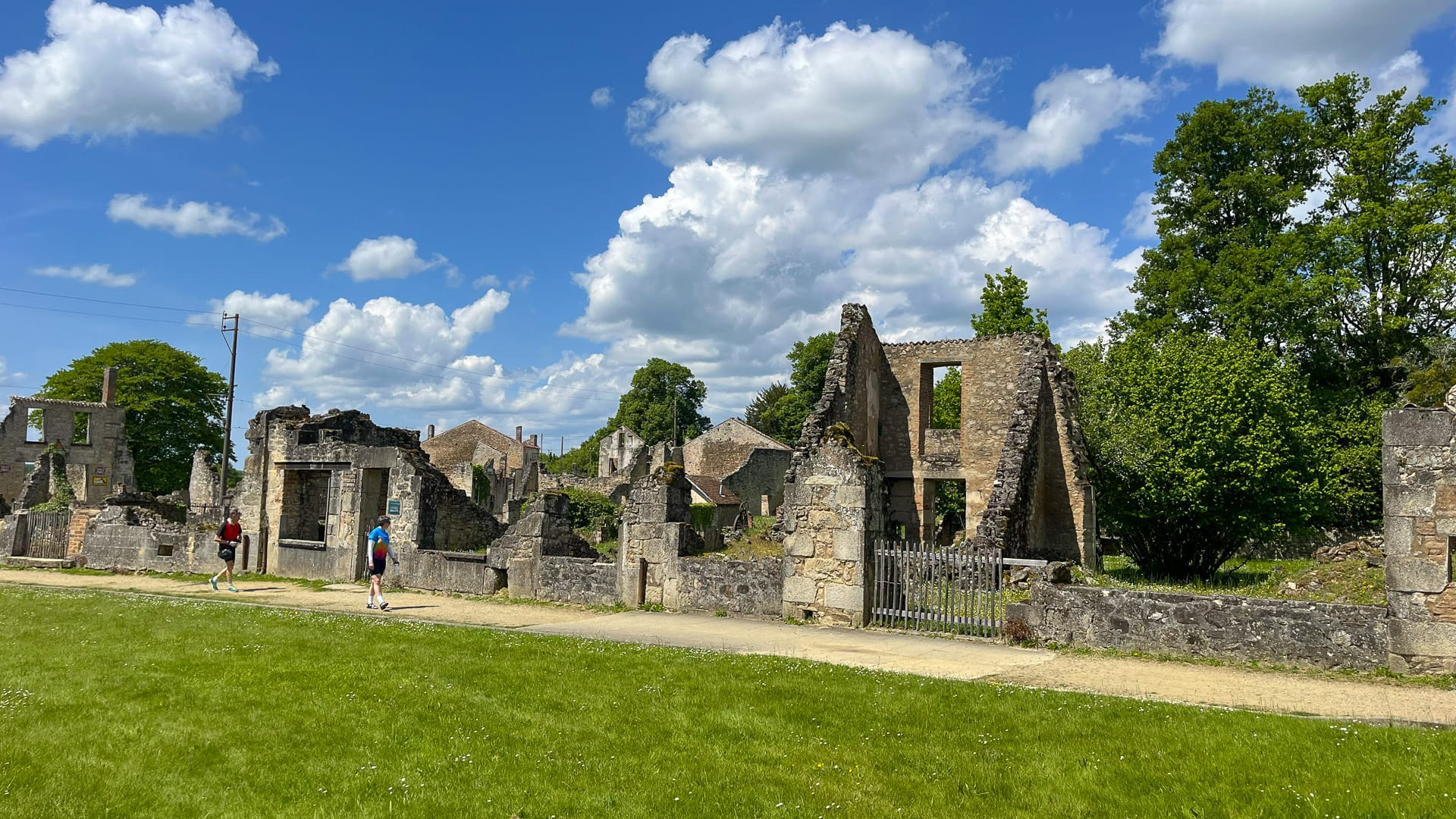
Oradour sur Glane is a special village that by order of Charles de Gaulle was left exactly as the Germans left it after the post D-Day massacre (photo credit: Wild Atlantic Cycling Tours)
Day 6: Saint-Yrieix-la-Perche to Tour-de-Faure
Key statistics
160 kilometres
1,909 metres of elevation gain
Overview
A scenic day that threads together limestone villages and quiet valley roads through the Dordogne region.
Highlights
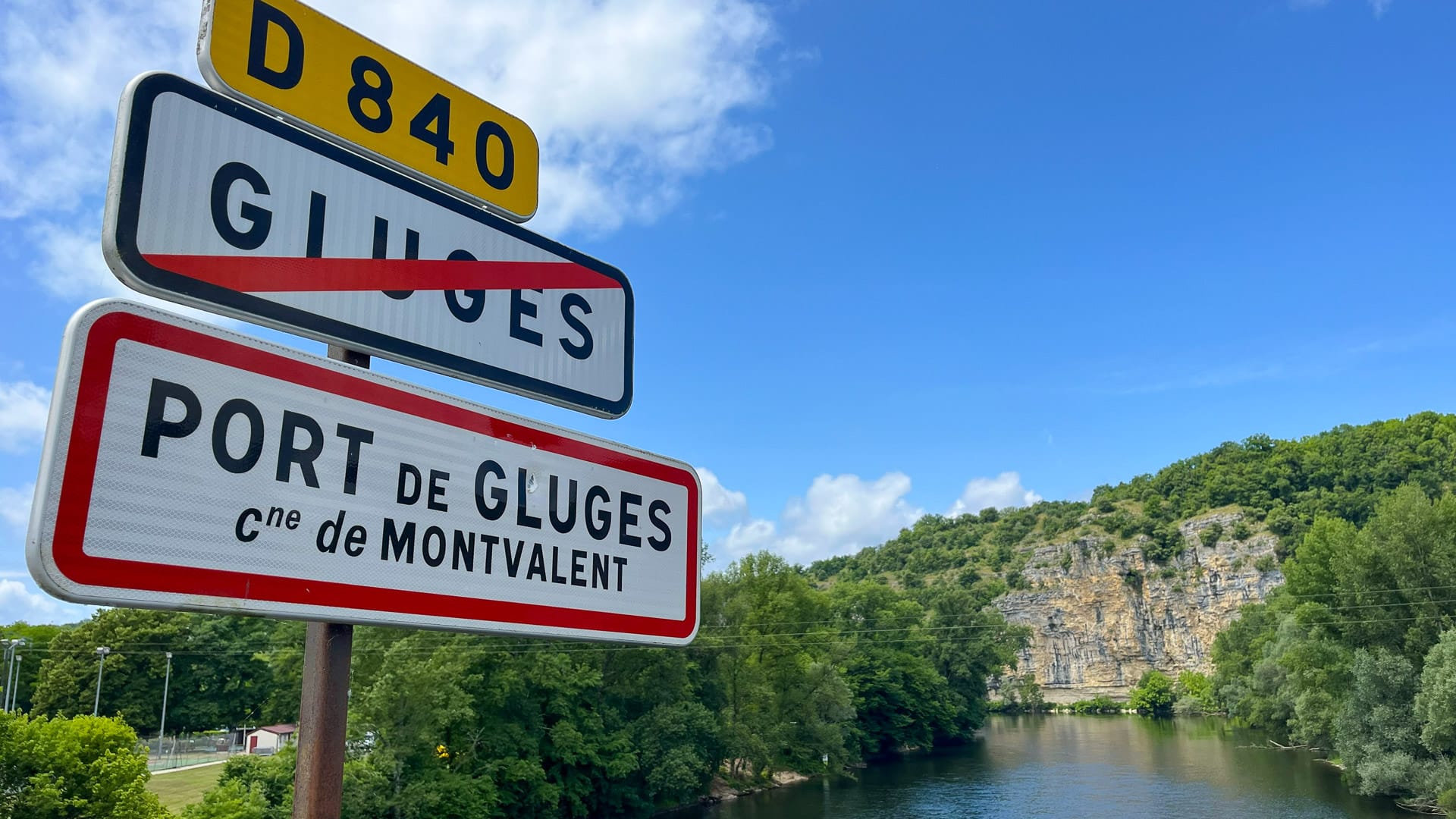
You ride through Ségur-le-Château, a popular holiday destination, pass through the square in Gramat, and continue via Montvalent, which is well known as a base for outdoor adventures such as rock climbing and abseiling.
Good to know
This is a day that really highlights the quieter, more rural side of France.
Don’t descend so fast at this bit that you neglect to look out over the gorge! This section of the ride at Tour de Faure is simply stunning. (Photo credit: Wild Atlantic Cycling Tours)
Day 7: Tour-de-Faure to Albi
Key statistics
90 kilometres
939 metres of elevation gain
Overview
Today begins with one of the most beautiful sections of the entire route and finishes in the historic town of Albi.
Highlights
The descent through Saint-Cirq-Lapopie offers an incredible view out across the Lot Valley and makes for an impressive start to the day. The ride ends in Albi, where you can enjoy the view of the weir on the River Tarn from the terrace of your destination hotel, the Mercure.
Good to know
This is often a favourite day for many riders thanks to the combination of scenery and a memorable finish.

View from the Hotel Mercure of the Weir on the River Tarn in Albi (photo credit: Wild Atlantic Cycling Tours)
Day 8: Albi to Carcassonne
Key statistics
122 kilometres
1,884 metres of elevation gain
Overview
A varied and memorable day that includes the route’s only significant off-road section and your first real taste of Carcassonne.
Highlights
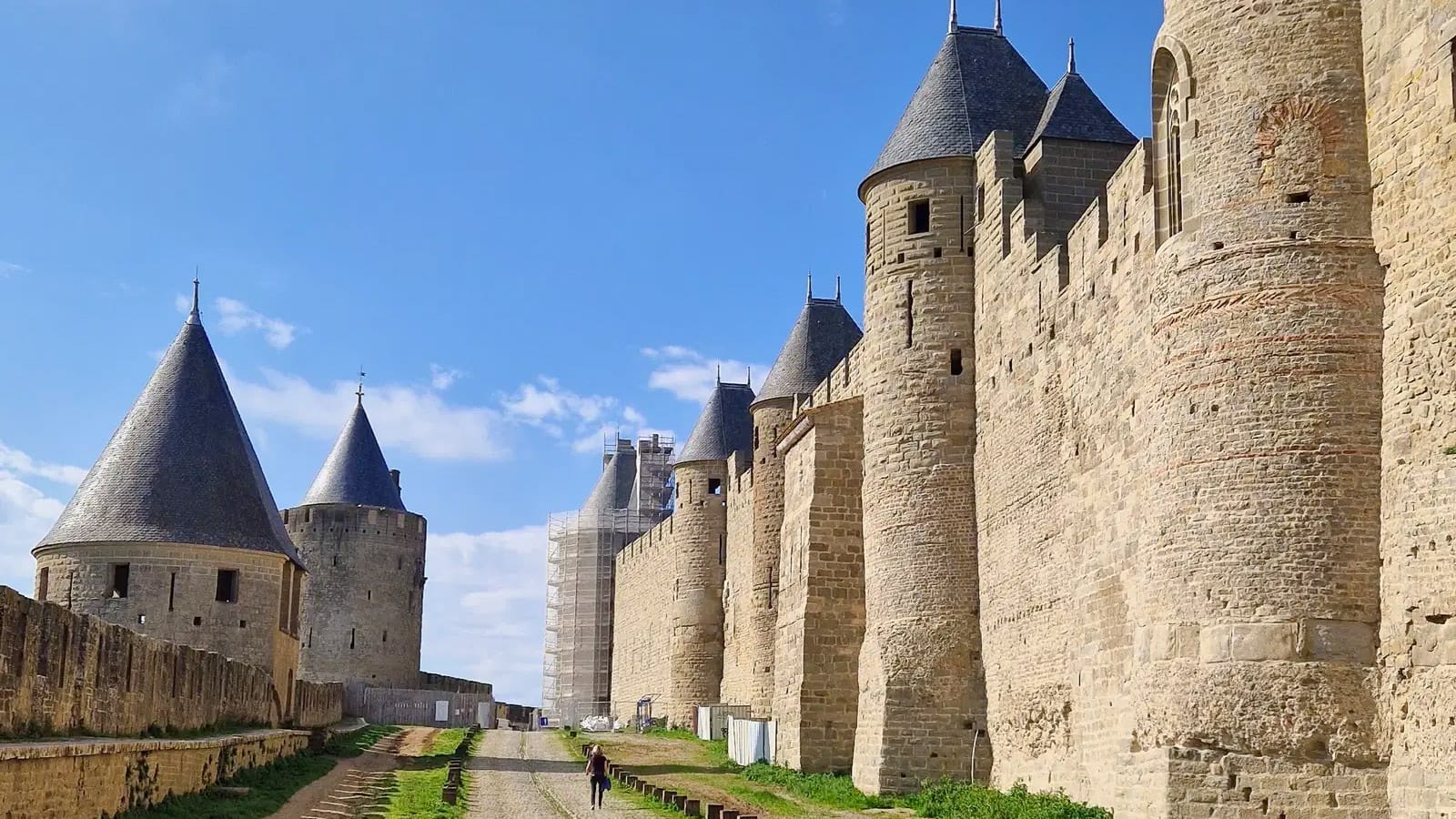
You ride a 30-kilometre greenway section into the town of Castres, which is a joy on hard-packed gravel and leads into a beautiful square. After that comes a superb view on the climb out of Mazamet, before your first glimpse of Carcassonne. You stay just a couple of hundred metres from the entrance to Carcassonne Castle, a UNESCO World Heritage site and one of the biggest tourist attractions in the region.
Good to know
Tomorrow is a rest day, so this is a great point in the trip to start thinking about recovery and enjoying the location.
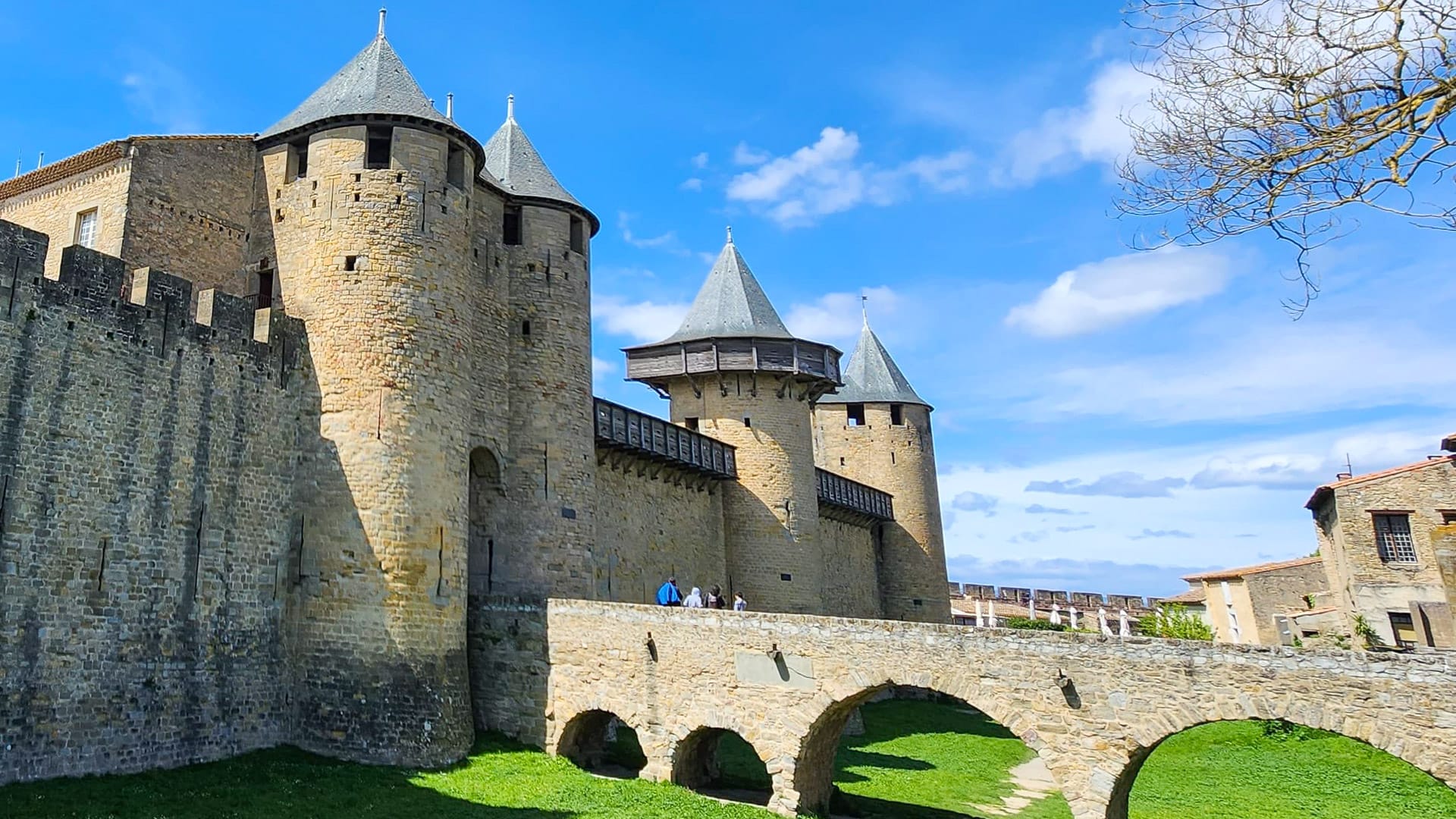
Carcassonne Castle really does look like a fairytale Medieval Castle and is a joy to walk around both at day time and in the evening. (Photo credit: Wild Atlantic Cycling Tours)
Rest day: Carcassonne (no cycling)
Overview
A well-earned rest day in Carcassonne, giving you time to explore the castle, recover from the previous stages, and prepare for the final push south towards Spain.
Highlights
With the castle so close to your hotel, it’s easy to spend the day wandering the historic streets, soaking up the atmosphere and letting your legs recover.
Good to know
This rest day makes a big difference to how fresh you feel for the Pyrenees and the final stages of the ride.
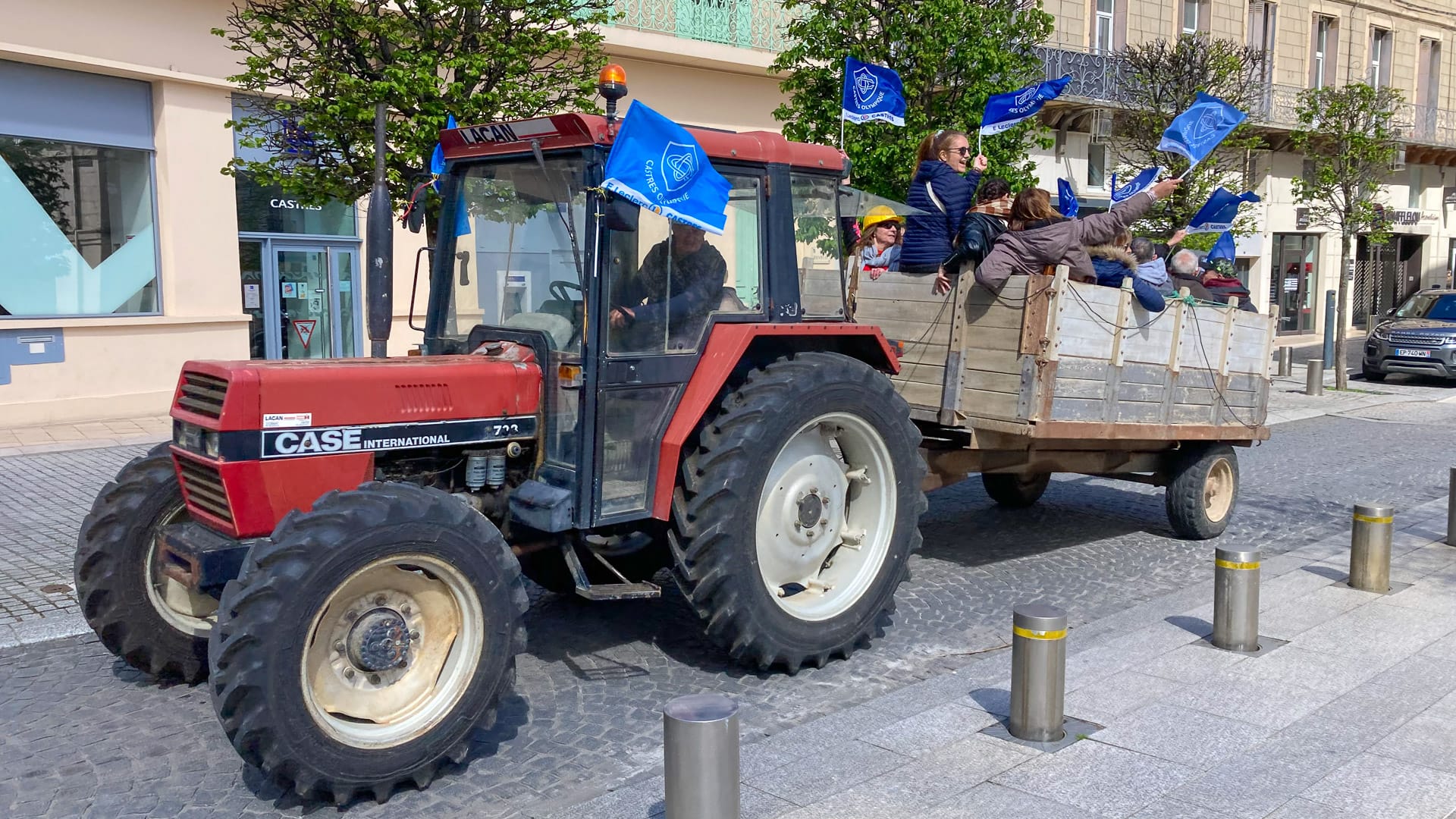
A day to soak up ‘all things French’ (photo credit: Wild Atlantic Cycling Tours)
Day 9: Carcassonne to Céret
Key statistics
136 kilometres
1,563 metres of elevation gain
Overview
The route begins to feel more mountainous as you head towards the Pyrenees.
Highlights
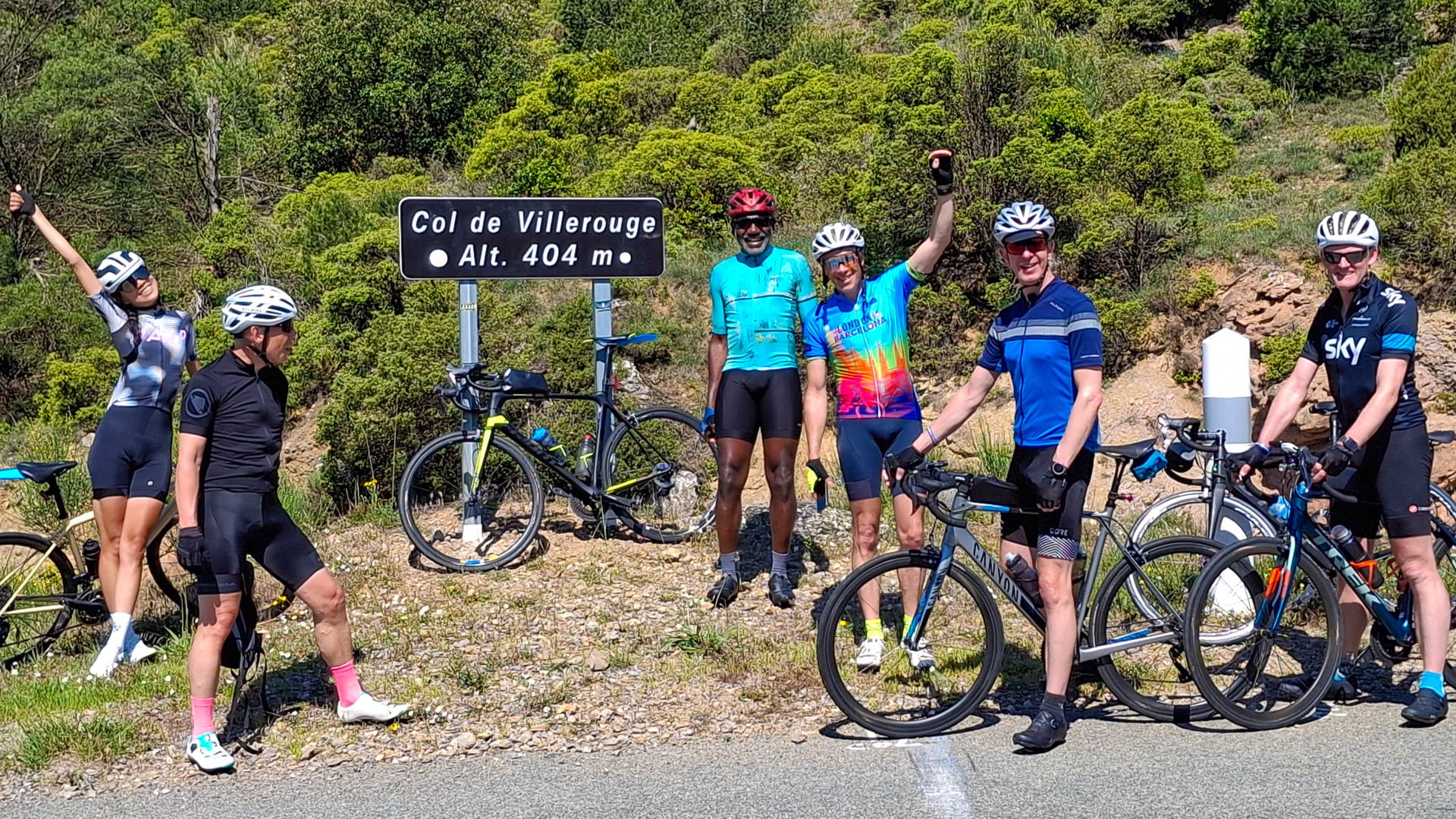
You pass no fewer than five col signs on today’s ride: Col de Villerouge (404 metres), Col de Cuisse (507 metres), Col de la Tranchee, Col de la Lauze and Col de la Dona. The route takes you through the medieval village of Lagrasse, which is a particularly memorable stop.
Good to know
This is where the character of the ride really starts to shift towards the mountains.
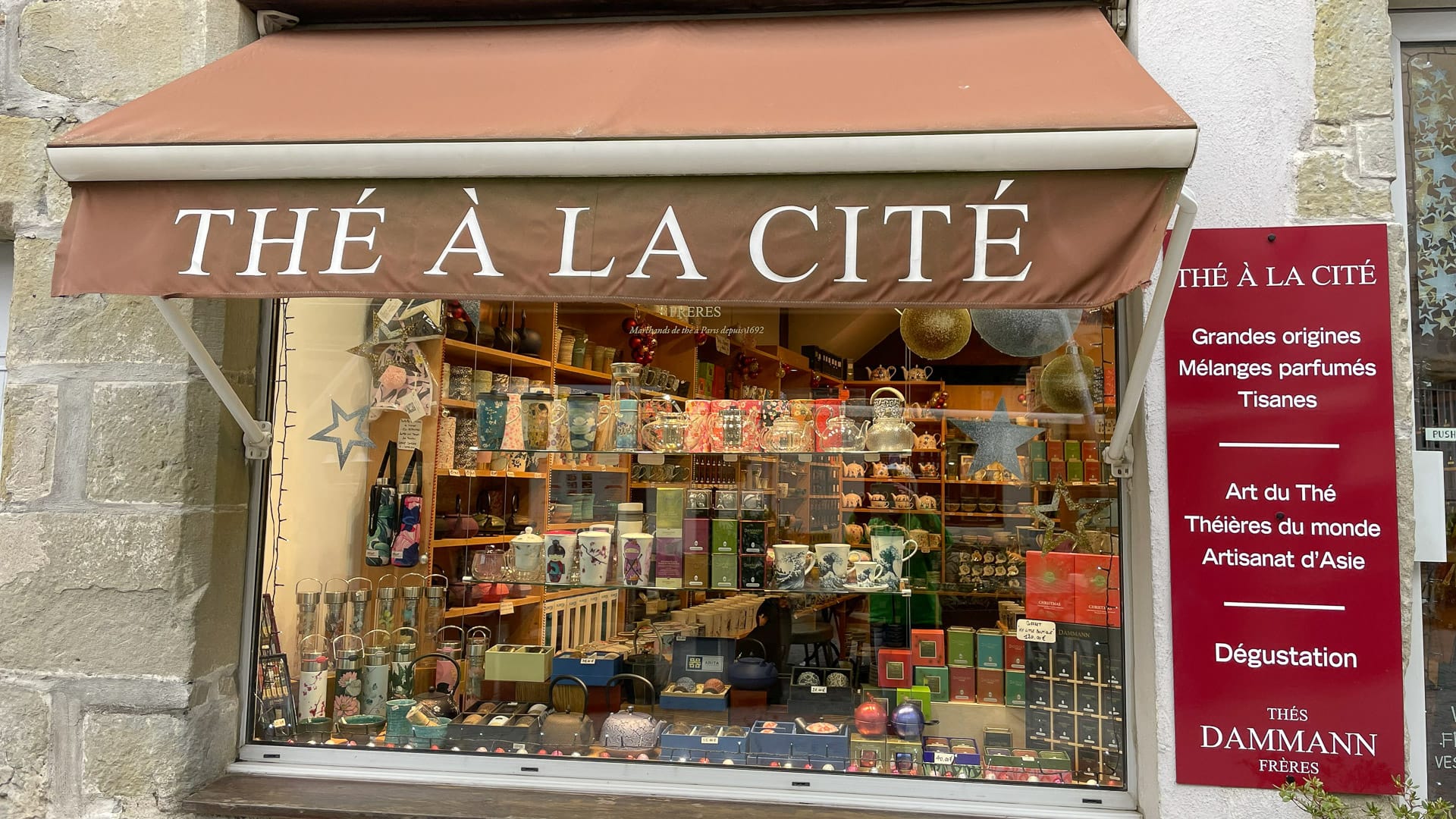
The a la Cite (photo credit: Wild Atlantic Cycling Tours)
Day 10: Céret to Ripoll
Key statistics
88 kilometres
1,513 metres of elevation gain
Overview
Today is your Pyrenees crossing day.
Highlights
You climb over the Col d’Ares, crossing from France into Spain, and pass through Prats de Lluçanès, a village that has served as the base for many cycling events.
Good to know
Many riders expect this to be the hardest day of the tour, but in reality, it’s a fairly steady “one climb day” and not too steep. Be aware! The really demanding day is still to come.
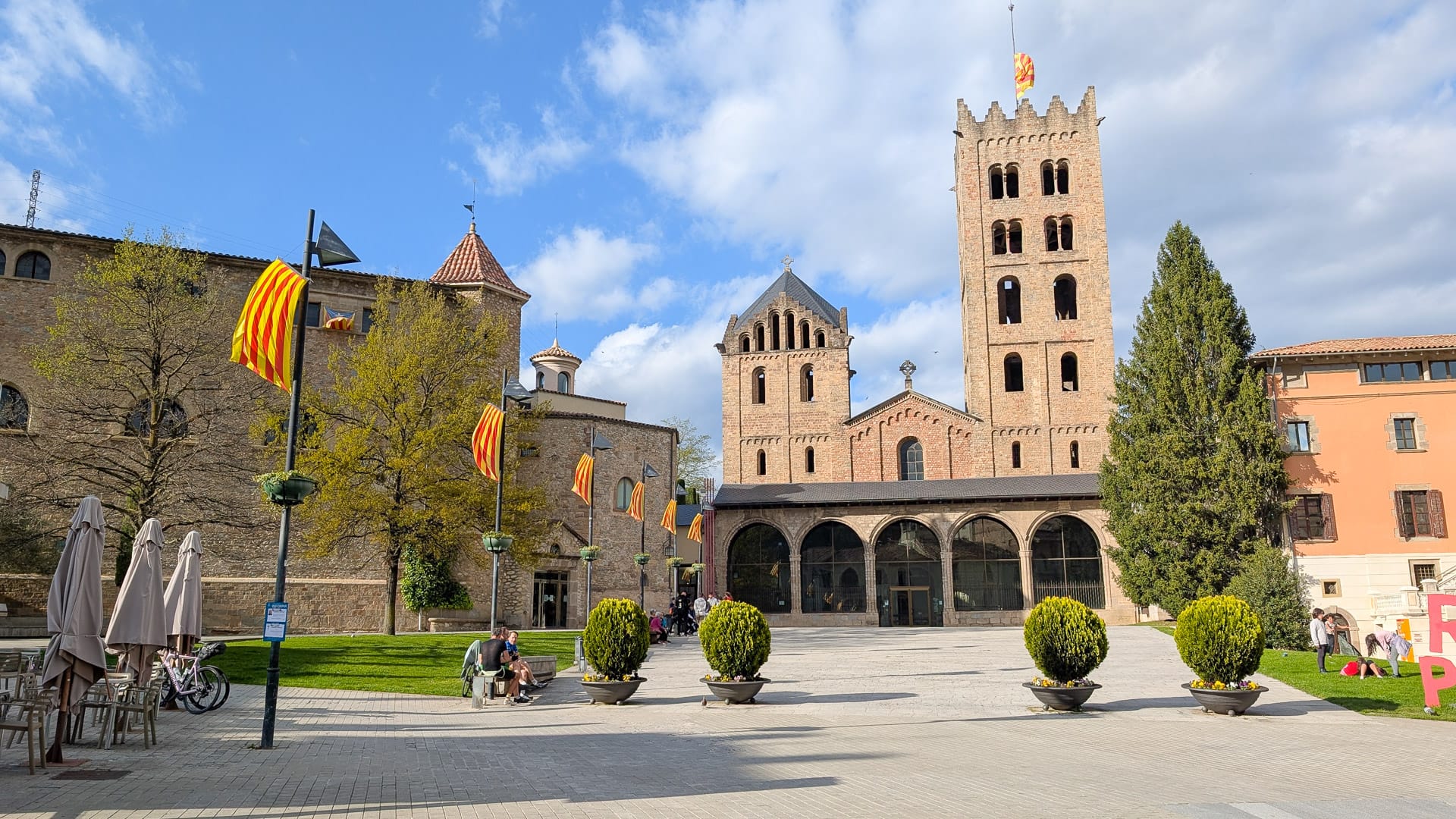
The town of Ripoll has several squares to explore (photo credit: Wild Atlantic Cycling Tours)
Day 11: Ripoll to Barcelona
Key statistics
156 kilometres
2,218 metres of elevation gain
Overview
The final day, cycling to Barcelona, is the toughest of the tour and the one that really demands your full concentration.
Highlights
There is no let-up today: you are constantly climbing, descending, twisting and turning, often all at once. The reward is your first glimpse of the Mediterranean and, finally, your arrival – cycling in Barcelona, the end point of an unforgettable journey.
Good to know
You don’t ride past La Sagrada Família on the way in, as it’s extremely busy and not suitable for a group finish on bikes. However, it can easily be visited later.

Not all of our lunch stops are in cafes or we’d miss chances like these to sit down and admire the views while we eat (photo credit: Wild Atlantic Cycling Tours)
Departure day (no cycling)
Overview
After breakfast, it’s time to organise onward travel, bike packing, and transfers to the airport or train station as needed.
Highlights
This is a chance to reflect on the journey, say goodbye, and start planning the next big ride.
Good to know
The hotel can help arrange large taxis or transfers for those heading to the airport or train station with bike boxes.
More information
Interested in this bike tour? Wild Atlantic Cycling Tours offer this as a fully supported guided London to Barcelona cycle ride. Get more details on their London to Barcelona webpage.
Part 4: Planning your London to Barcelona bike ride
What’s the best time to cycle from London to Barcelona?
Generally, it’s best ridden in spring or autumn. These seasons help you avoid potential weather extremes and also get the best out of the scenery for photographs, with great colours at both times of year. Another practical bonus is that, because much of the ride is fairly remote, you’re more likely to find cafés open in spring and autumn. Many smaller places close for the season before Christmas and don’t reopen until the daffodils come out.
Top tip! Weather patterns have changed a lot in recent years, so nothing is ever completely guaranteed. That said, this route in May is generally warm and dry, and in June it’s usually a little warmer and drier still, with temperatures often around 18 to 25°C.
Wild Atlantic Cycling Tours offer guided London to Barcelona bike tours in May and June.

View overlooking the Carcassonne fortress
Can you ride it at other times of year?
In general, yes. France in particular, has a climate that’s suitable for riding for much of the year, as long as you’re prepared for colder and wetter conditions in winter and wear appropriate clothing. And, of course, it will usually get warmer as you move south. French villagers are typically very hospitable and will quite happily refill your water bottles.
The main things to think about outside the main season are weather and the availability of food stops and accommodation. Out of season, some of the more remote sections are not a great idea unless you’re completely self-sufficient.
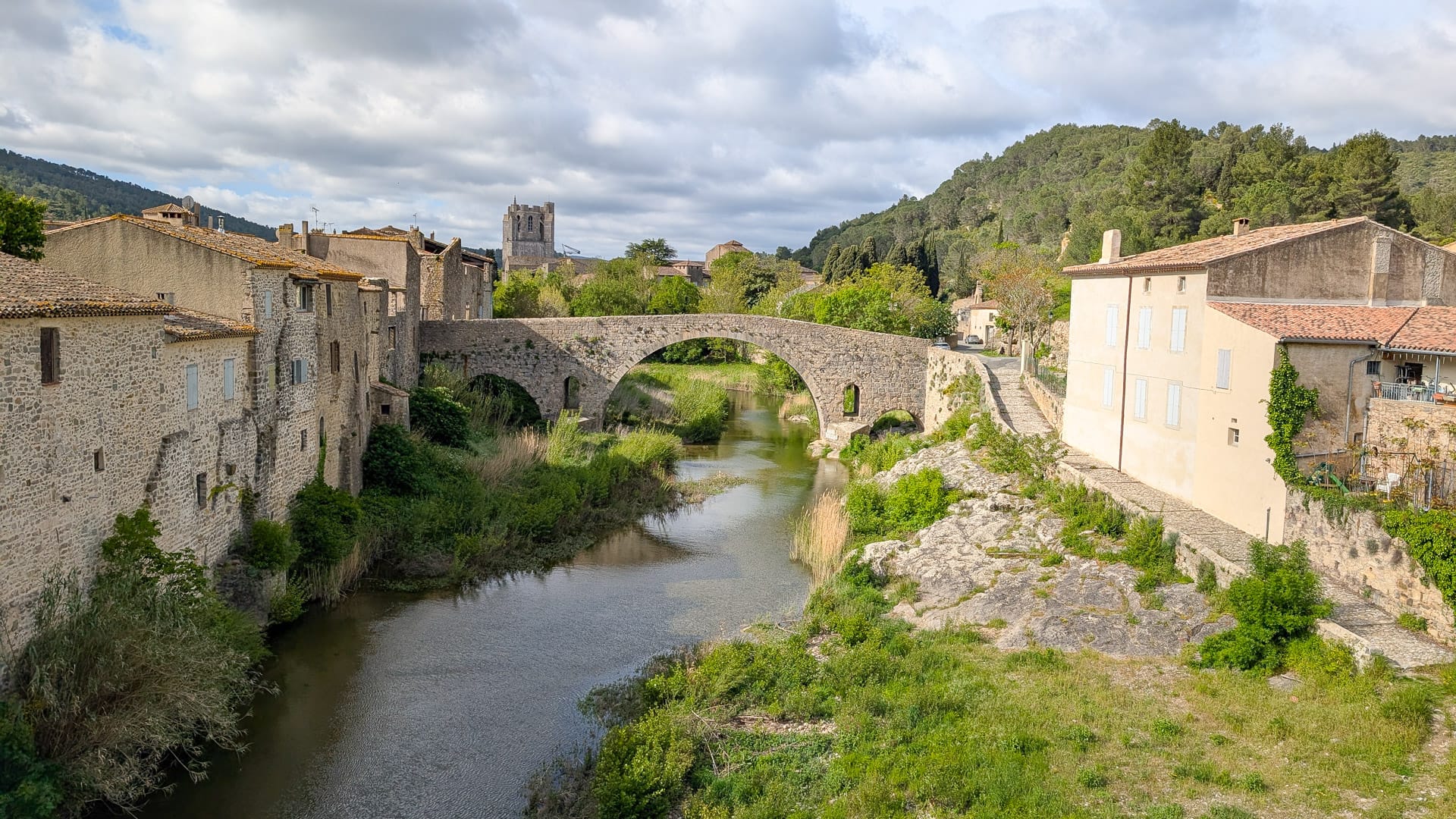
On entry over the bridge to Lagrasse for coffee you immediately know you have arrived somewhere special (photo credit: Wild Atlantic Cycling Tours)
What training do you suggest?
If you’re already cycling regularly, Wild Atlantic Cycling Tours suggests simply adding some longer-distance rides to your weekly routine, as well as doing one or two longer rides on consecutive days in the lead-up to the tour. This helps train your endurance and also gives you a chance to work out what kind of nutrition suits you best.
It’s worth remembering that this is not a race and there are no time limits (and no riding in the dark). Riders are encouraged to enjoy their coffee-and-cake stops and take time over lunch. With the right planning, there’s really no need to rely entirely on energy bars, although it’s still recommended to carry some form of nutritional food at all times.
Is there bike-friendly accommodation available on the London to Barcelona cycle route?
Top tip! It’s a good idea to look at accommodation along the route and aim for small towns with hotels. B&B-style accommodation can be found in villages, but rooms are often limited and get booked up quickly, so availability depends on group size and timing. In general, accommodation standards in France and Spain are good, and cyclists are a common sight. Many hotels and pensions have dedicated areas to store your bike.
Be aware! It can sometimes be hard to find accommodation, so it’s worth checking ahead or having a backup larger town in mind. It’s also always worth checking whether there’s a major event on – sporting or otherwise – as this can have a big impact on availability in smaller places (for example, national games, a Grand Prix, or that year’s Tour de France route passing nearby).
Wild Atlantic Cycling Tours stay in three- and four-star hotels that provide very comfortable accommodation in good locations. All provide a good breakfast and have a bar, and most offer food in the evening. If a hotel doesn’t serve dinner, an alternative is always arranged, as eating well at the end of the day is considered very important.
One of the hotels on the route even boasts a very reasonably priced Michelin-star restaurant, and the team often reserve a table there in advance.

Tower viewpoint in Carcassonne
What’s the best bike for the London to Barcelona route?
A road bike is the best choice for this route. Because the tour is fully supported and you have access to your day pack at lunchtime, there’s no need to carry much with you while riding. Road bikes make it easier to cover the kilometres at a comfortable pace and still have the energy to enjoy the views and the atmosphere along the way.
That said, a hybrid or touring bike is also suitable, and some riders do choose those options.
Does the route get very busy?
Not usually. It’s obviously busier on entry to and exit from towns, but even well-known tourist destinations like Saint-Cirq-Lapopie and Tour-de-Faure are not generally packed. Walkers and hikers are active in the area, but it doesn’t feel “busy” in the way some more famous cycling regions can.
Is bike hire possible?
Because this is an end-to-end tour, bike rental is not generally recommended. The time and cost involved in returning a rented bike from the finish point make it impractical for most riders, so the vast majority of people choose to bring their own bike.
Wild Atlantic Cycle Tours doesn’t offer bike hire, but does offer bike box and bag handling for an additional cost, so you can arrive with your bike box and have it delivered again at the end of the tour.
Can you ride this route on an e-bike?
This route isn’t really designed for e-bikes.
However, if you’re a strong cyclist who just wants a little assistance to keep up with younger or faster friends, and you’re riding a fairly lightweight road e-bike that only needs occasional “e-assist”, then it can be appropriate.
Batteries for e-bikes and Di2 should be removable and taken to your room for charging, as not all storage areas have electric points (although most do).
Why ride from London to Barcelona rather than from Barcelona to London?
There are a few simple reasons:
- Barcelona, being on the Mediterranean, offers a more reliably dry finish than London.
- It gets warmer as you head south, adding to the enjoyment of the ride.
- You get the overnight ferry crossing out of the way at the very beginning.
- The Pyrenees climb we take works better in this direction.
How do you get there and back?
When getting to the start, remember bikes can’t be taken on the Underground. However, on the Wild Atlantic Cycling Tours trip, the start hotel is close to major stations and the airport, so large taxis or Ubers can usually accommodate bike boxes. If you’re travelling by train with a fully built bike, you may need to reserve a bike space; if your bike is in a box that fits in the normal luggage rack, a reservation isn’t usually necessary.
The tour uses the overnight ferry from Portsmouth to Caen, arriving at around 6:30 am. Breakfast is taken at a hotel before setting off on the first day of riding in France.
At the end, in Barcelona, it’s generally easier to travel by train with a bike than it is in London, although for national journeys you’ll still need to make a reservation if your bike is fully built.
On the Wild Atlantic Cycling Tours trip, the hotel can arrange large taxis for those flying home from Barcelona Airport, and the team are happy to help organise this. Because riders come from all over the world, the tour doesn’t include a single group transfer at the end. This allows individuals to travel at times that suit them and avoids unnecessary waiting around or extra expense.
Any highway code and travel information I should be aware of?
As ever, it’s a good idea to check current travel information before you book and travel. For UK visitors, the UK government travel information pages for France and Spain are here.
Before cycling you should read up on France’s highway code as the “Priorité à droite” often catches people out, read more on that below. Also, you should read and follow Spain’s highway code.
Part 5: Insider tips for anyone looking to cycle London to Barcelona
Do you need cash? Which currencies are most useful?
It’s always a good idea to carry some cash for smaller shops, coffee machines and toilets. Once you cross the Channel, euros are the currency you’ll use for the rest of the trip.
Day one is the only day in the UK (and therefore in sterling), and both the coffee and lunch stops on that day take cards. After that, you’re in euro territory all the way to Barcelona.
Are there lots of water fountains, shops and cafés on the route?
Yes – there are plenty of “watering holes” along the way. Most bars and cafés are happy to refill your water bottles, and it’s good etiquette to support them by ordering a tea or coffee or buying a juice or croissant.
There are also many small village shops on the route, and on our tour, where potable water fountains are known, the team will point them out. Water is also carried in the support van, and you can signal it to stop at any time to top up your bottles.

Early evening in Tours
Should you spend time in the start and finish cities?
Absolutely. If you’ve never been to London, it’s well worth arriving a few days early – and even if you have been before, there’s always more to see and do.
Barcelona is also a hugely popular destination for a long weekend, with sights like Las Ramblas and La Sagrada Família, which is still, famously, “nearing” completion (source). Time allowing, both cities are worth dedicating a bit of extra time on either side of the ride.
Do you need to speak French or Spanish?
No – it’s not necessary to speak either language, as most people speak English. It’s also amazing how much can be communicated with universal sign language. Many menus are available in English too. That said, it’s still worth familiarising yourself with a few basic road signs and pleasantries such as please, thank you, hello and goodbye.
Are there any traffic or cycling rules you should know?
Be aware! On Day one in the UK, you ride on the left-hand side of the road. From France onwards, you ride on the right.
It’s perfectly acceptable to ride two abreast where the road and conditions permit. On narrow lanes, you should pull over if necessary to let larger vehicles pass, and keep groups to a neat six riders (two abreast) to make overtaking easier for traffic.
One rule that can catch people out in France is “Priorité à droite”. This gives traffic joining from the right priority, even onto what looks like a main road. In most places it’s no longer in operation, but in some smaller villages it still exists, and farm traffic can pull out unexpectedly. Where this is more common, there are signs – and the team will also remind riders.
Are there toilets along the route?
Yes – but not as frequently as you might like. This is another reason why cafés and small stops are often very welcome along the way.
What other transport is involved on the route?
Aside from the ferry crossing from Portsmouth to Caen, there’s no other transport involved. You quite literally ride all the way from Hampton Court to the Mediterranean, riding on and off the ferry as part of the journey.
Any safety tips?
The usual common sense applies: keep your wits about you and stay aware of traffic, especially vehicles turning right across cycle lanes in front of you. They should check their mirrors, of course, but it’s always best to be vigilant.
In France, cars will often give a small beep of the horn as they pass, simply to let you know they’re there. This isn’t generally aggressive – it’s just a way of signalling their presence.
What should you pack?
Bring everything you would normally take for riding at home, plus several changes of cycling clothing and something to wear in the evening. We often hear ladies say, “I wish I had put in just one dress!”
In terms of kit and clothing, it’s sensible to include:
- Layers for both rain and sun
- A jacket for rain and wind
- A peaked cap (useful in both sun and rain)
- A base layer
- Overshoes
- Gloves with fingers and fingerless gloves
- Sun cream
- A packet of tissues
- Some antiseptic cream or similar, just in case
For the evenings, a warm fleece or cardigan and a pair of flip flops are great for letting your feet breathe between rides. Don’t forget chamois cream, your bike lights, and all the chargers you need for your bike computer, lights and any electronic shifting – plus a suitable plug adaptor.
You can find more advice on what to pack for a cycling tour in Epic Road Rides’ ultimate bike touring packing list.
What about food and nutrition?
Bring the kind of nutrition your stomach is used to. On our supported tour, the support van carries fruit, nuts, crisps, various bars, water, and the odd bit of chocolate (as long as it’s not chocolate-melting temperature). You can top up on these between the coffee stop, lunch stop and the final stop at the hotel.
It’s important to always have something on you while riding. And one polite but practical request from the team: make sure your wrappers don’t flap off – tuck them securely into your pockets and dispose of them properly later.
Sponsor Message
Considering cycling from London to Barcelona?
Wild Atlantic Cycling Tours offers this route as a fully supported, guided trip.
Head to their London to Barcelona webpage for full details, including prices and availability.
Got a question for Fiona Towell from Wild Atlantic Cycling Tours?
Fill out this form and we will pass it to Wild Atlantic Cycling Tours who aim to reply (within 24 hours wherever they can!)
Part 6: What Wild Atlantic Cycling Tours offers
Wild Atlantic Cycling Tours offer a fully supported, end-to-end cycling journey from London to Barcelona, taking you through France, over the Pyrenees and into the heart of Catalonia.
Alongside London to Barcelona, we also offer a wide range of other multi-day rides, including:
- Ireland End to End (MIZMAL): Our signature tour, with both 7-day and 12-day options
- Scotland’s North Coast 500 (7 days)
- Croatia Islands – Southern Archipelago (6 days)
- Portugal North to South, following the N2 to finish in the Algarve (6-day and 10-day options)
- Spain: Lower Pyrenees, from San Sebastián to Girona (7-day and 12-day options)
- Spain: Andalucía, from Seville to Valencia (8 days)
- The Balkans, from Dubrovnik to Istanbul (17 days of riding, 20 days total): This is also available as a 6-day or 11-day option for those short on time. The 6-day route from Dubrovnik to Ohrid covers the more demanding section, while the easier 11-day option runs from Ohrid to Istanbul.
Head to the Wild Atlantic Cycle Tours website for further details.
Our goal is to motivate and entertain you all the way – all you really have to do is ride your bike (and follow a few simple instructions at the morning briefings… and smile occasionally for the photos!).
What’s included
Wild Atlantic Cycling Tours include accommodation and full support on the road, including help with minor medical or mechanical issues, or a lift to a bike shop or hospital if required.
Breakfast is included on all tours, and snacks and water are provided from the support van. On our Ireland tours, lunch is included as well, and on all of our tours, you’ll have access to your day pack at lunchtime.
You receive the route files around four weeks before the trip, giving you plenty of time to upload them to your bike computer and get familiar with the stages.
On the road, support typically includes:
- A support vehicle carrying water, snacks, a spare kit, and smiling support and encouragement
- Basic mechanical and medical assistance when needed
- Luggage transfers to your next hotel each day
- Pre-booked hotels, many with cycling-friendly facilities such as secure bike storage
- Daily briefings and route guidance
- Bike cleaning materials available daily
- Help with logistics at the start and finish of the tour
Memorable holidays for a variety of cyclists
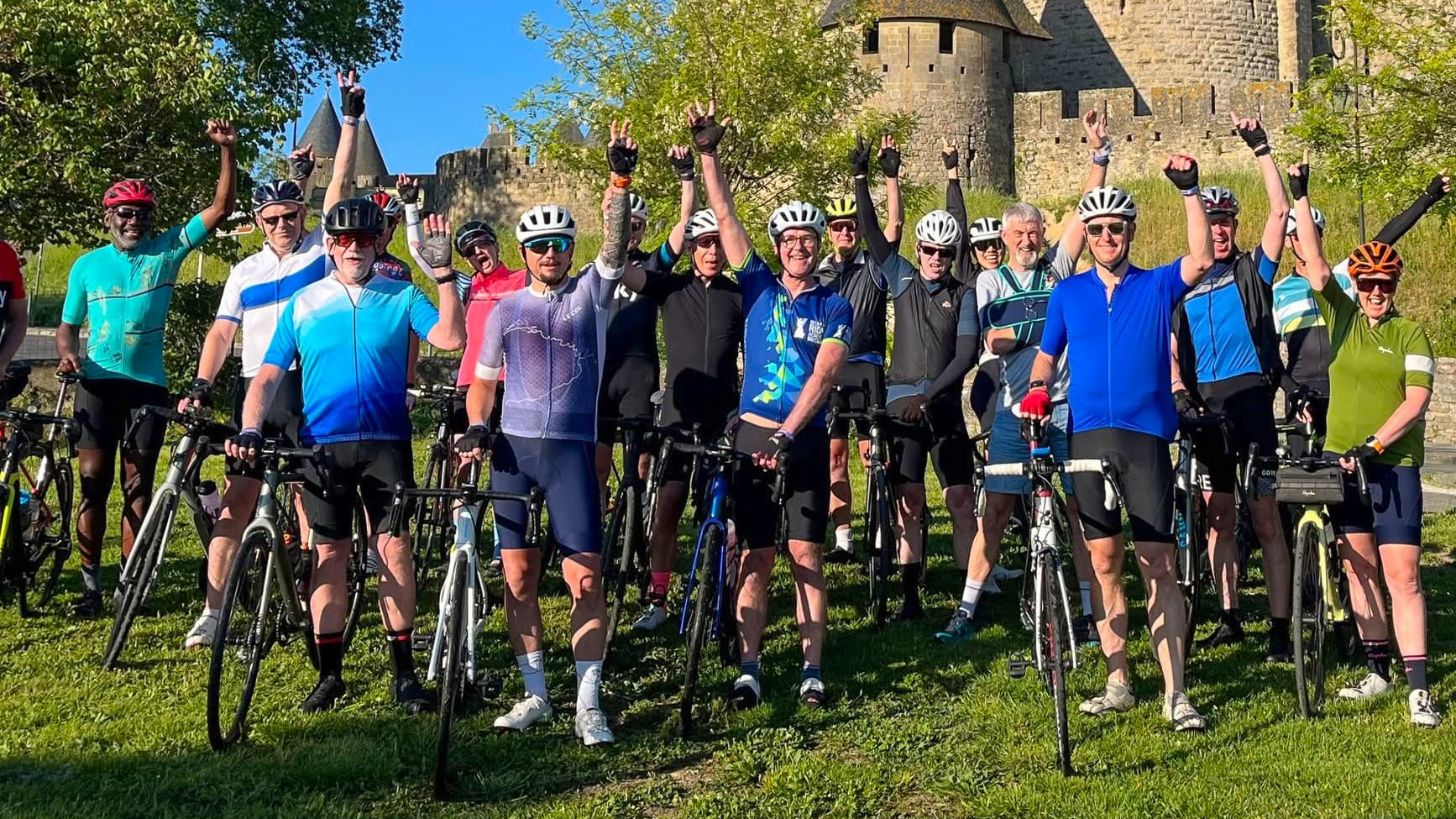
Wild Atlantic Cycling Tours welcomes cyclists from all walks of life. Whether you’re a commuter, a country rambler or a club rider, our bike tours are designed to help you get the most out of a long ride and really get a feel for a country’s landscape and culture.
We aim to answer your questions as you ride, share their local and route knowledge, and make the experience as memorable and enjoyable as possible. The focus is on riding great roads, staying in good hotels, eating well, and finishing each day tired but happy.


Where can I find out more information about Wild Atlantic Tours’ services?
Head to the Wild Atlantic Cycle Tours website for further details.
The London to Barcelona webpage also includes more specific details about this guided tour.
What’s next?
A huge thank you to the Wild Atlantic Cycle Tours team for their detailed insights on this route!
For more inspiration, check out:
- Cycling the Balkans, another region that Wild Atlantic Cycle Tours specialises in.
- Cycling the Wild Atlantic Way + MizMal®, Ireland, with practical tips on Ireland’s most epic challenge.
- 18 of the world’s best (long distance) cycling routes, if you fancy trying other multi-day tours.
- Cycling Catalonia: an insider’s guide, with more tips on the regions around Girona and Barcelona.
- How to prepare for long distance cycling, our own tips on training, kit, nutrition and more.
- 9 best long-distance cycling routes in France, along with tips on the best time to cycle the country.
- 6 best long distance cycling routes in Spain, with tips for planning your own tour.
- Cycling the Camino Francés, explore the Pyrenees in France to Santiago de Compostela in Spain.
Got a question for Fiona?
Fill out this form and we will send it to Fiona. We aim to get you an answer within 24 hours where possible!Fiona Towell is the Co-Director at Wild Atlantic Cycling. She's a cycling and outdoor life enthusiast.
Fiona’s goal is to share her experiences, encouraging riders to embrace diversity in their travels and enjoy the thrill of crossing countries and continents on an end-to-end tour on a bicycle, with the added reassurance of being fully supported.
Wild Atlantic Cycling continue to grow and offer more tours, with 2027 seeing the launch of the Northern Ireland revolution, Land's End to John O'Groats and their first single-base tour in the Algarve.
First Published: 26 March 2026
The contents of this website are provided for general information purposes only. It is not intended to amount to advice and you should not rely on it. You should carry out your own due diligence and risk assessments and take professional advice. Views expressed by interviewees or other users of this website do not necessarily represent our views. We make no representations, warranties or guarantees, whether express or implied, that the content on our website is accurate, complete or up to date. If you use any information or content on this website, download from, or otherwise obtain content or services through our website, it is entirely at your own discretion and risk. Epic Road Rides Ltd disclaims all liability and responsibility arising from any reliance placed on the information and content on this website. Find out more here.
Sponsor Message
Considering cycling from London to Barcelona?
Wild Atlantic Cycling Tours offers this route as a fully supported, guided trip.
Head to their London to Barcelona webpage for full details, including prices and availability.
Got a question for Fiona Towell from Wild Atlantic Cycling Tours?
Fill out this form and we will pass it to Wild Atlantic Cycling Tours who aim to reply (within 24 hours wherever they can!)
A suggested alternative itinerary: In June 2019 I flew out to Girona with a titanium road bike for a cycling holiday with a group of friends. (One of the group, who had hired his bike in Girona, agreed to take my empty bike box home). After a week cycling with the group around Girona, I headed west along the Spanish side of the Pyrenees following a route taken from the Cicerone “Cycle Touring in Spain” book. I departed the route to Lourdes, crossing the Pyrenees at the Col du Pourtalet. 2 nights in Lourdes (dozens of cheap hotels) enabled me to cycle the Tourmalet without Panniers. From Lourdes I cycled to Toulouse, caught a train to Paris and took the greenway to Dieppe then home on the Ferry. The adventure was memorable for the interesting people encountered, stunning scenery, variations in culture, inexpensive accommodation and sense of achievement. With more time I would have cycled the whole way using your route through France. I will certainly be using this article to plan future cycle tours across France.
By-the-way, thank you for publishing Epic Road Rides, I always check it out before embarking on my solo cycling adventures. The information is invaluable.
Hi Keith, thanks for sharing your experience, it sounds like you had a wonderful time. Appreciate your kind comments too! Happy riding and keep in touch, Clare