
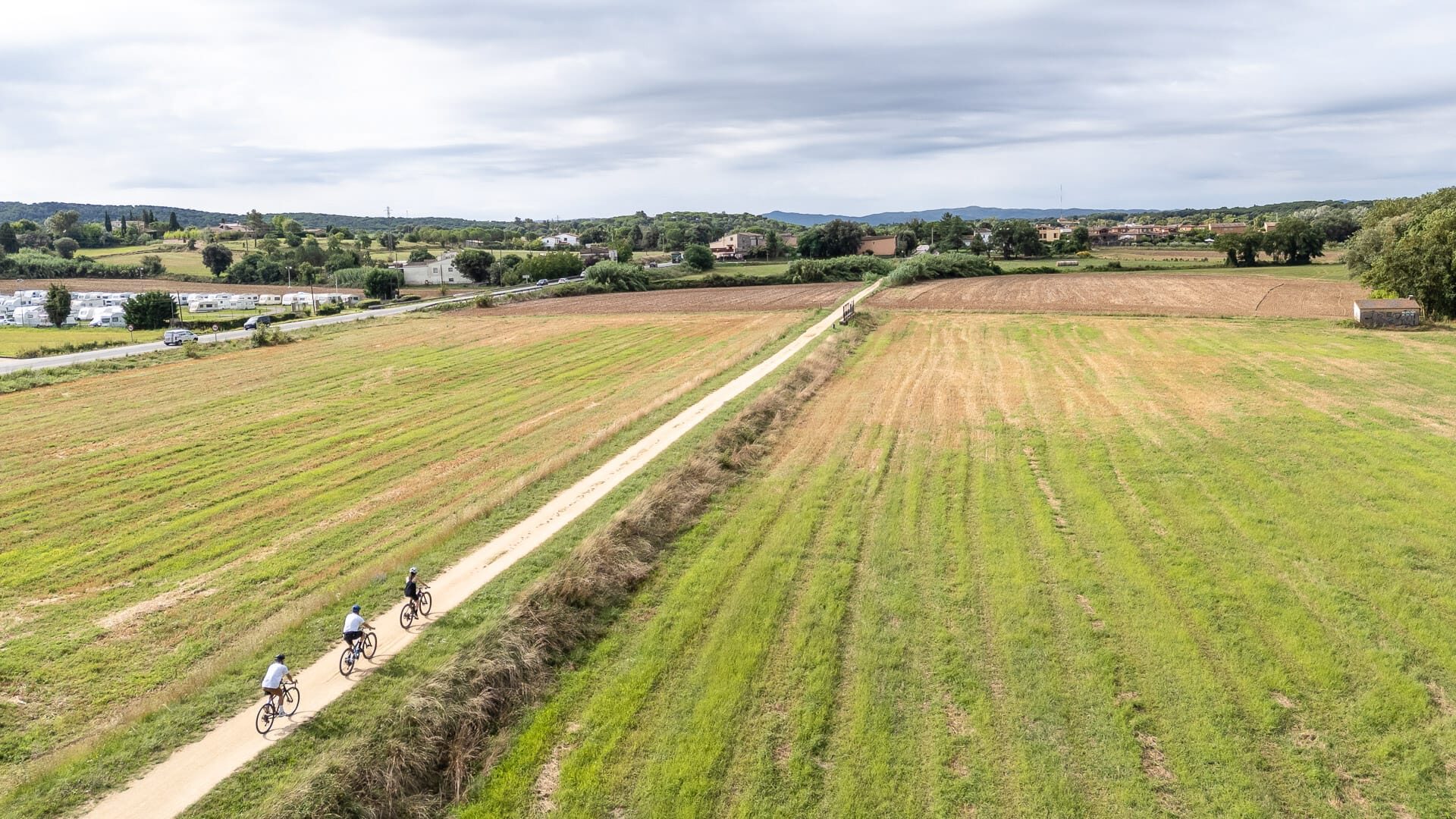


The Pirinexus is a 340 kilometre circular cycling route through northeast Catalonia and the Vallespir region of France. It links Girona’s greenways with quiet roads, ancient forest tracks and coastal paths, taking riders from Girona towards the Pyrenees, over the Col d’Ares into France, back through cork oak forests and the Empordà, then along the Costa Brava before looping back to Girona.
It is a brilliant option for cyclists who want a self-guided gravel cycling adventure with real variety. In one trip, you experience mountain passes, river valleys, volcanic landscapes, vineyards, medieval towns, Mediterranean views and the archaeological site of Empúries. That means you can experience two very different sides of the destination in one journey. This duality is central to the destination’s message of “living twice”.
To help us understand the route better, Girona Costa Brava and Ecovies of Girona put us in touch with two local cycling experts with different perspectives of the Pirinexus route:
- Jordi Cantal from Gravel Girona knows the Pirinexus as a challenge. He has ridden the full route in one go and helped turn that endurance side of the route into a race; participants have 20 hours to complete the itinerary, leaving from the city of Girona.
- Wouter Van Wezemael runs Trek and Ride. He sees the Pirinexus route through the eyes of a cycling tour operator. For him, it is a route to ride in stages, with time to discover the villages, food, landscapes and culture between the Costa Brava and Girona Pyrenees.
Their insights help explain what the Pirinexus is really like to ride, whether you want to take it on as a challenge or use it as a framework for a slower cycling holiday. It also helps show how to break it into stages and what cyclists should know before planning a trip.

Jordi Cantal owns Gravel Girona and works as an expert cycling guide. Born in 1971 in Santa Coloma de Farners, 20 kilometres south of Girona, he began working as a cycling guide in 2008 with Bikecat, one of Girona’s pioneering cycling companies.
In 2015, he designed and directed the circular, trans-border endurance race, The Pirinexus Challenge 360. This 350 kilometre gravel event goes around the province of Girona and reflects Jordi’s long-standing experience in gravel cycling, dating back to before gravel was widely talked about.
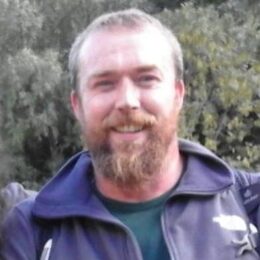
Wouter Van Wezemael is the founder and manager of Trek and Ride, where he also shares his passion firsthand as a guide. An avid hiker and mountain biker, Wouter has always found his sanctuary in the great outdoors and the quiet solitude of the mountains.
However, his connection to these landscapes goes far beyond personal enjoyment. Wouter is deeply convinced that the future of travel lies in regenerative tourism, an approach that doesn't just minimise harm, but actively heals, restores, and revitalises the environments and communities we visit.
This philosophy directly shapes how he introduces travellers to the wild places he knows best. For Wouter, a journey into the mountains is about more than just hiking or riding; it is an opportunity to foster a deep respect for the earth and empower others to leave the world better than they found it.
Always check current travel information and advice. For visitors from the UK, the UK government travel information pages are here.
To get a feel for what cycling the Pirinexus route is like, take a look at this short video:
 There's a Youtube video here!
I'm fine with Youtube cookies
Contents of this article
This guide is packed with practical information. To make it easier to use, we’ve split it into sections.
- Part 1: Overview
- Part 2: Pirinexus route
- Part 3: Route highlights
- Part 4: Suggested itineraries
- Part 5: How hard is the Pirinexus?
- Part 6: When to ride?
- Part 7: Know before you go
- Part 8: Tips for riding the Pirinexus
Part 1: Please provide an overview of the Pirinexus route
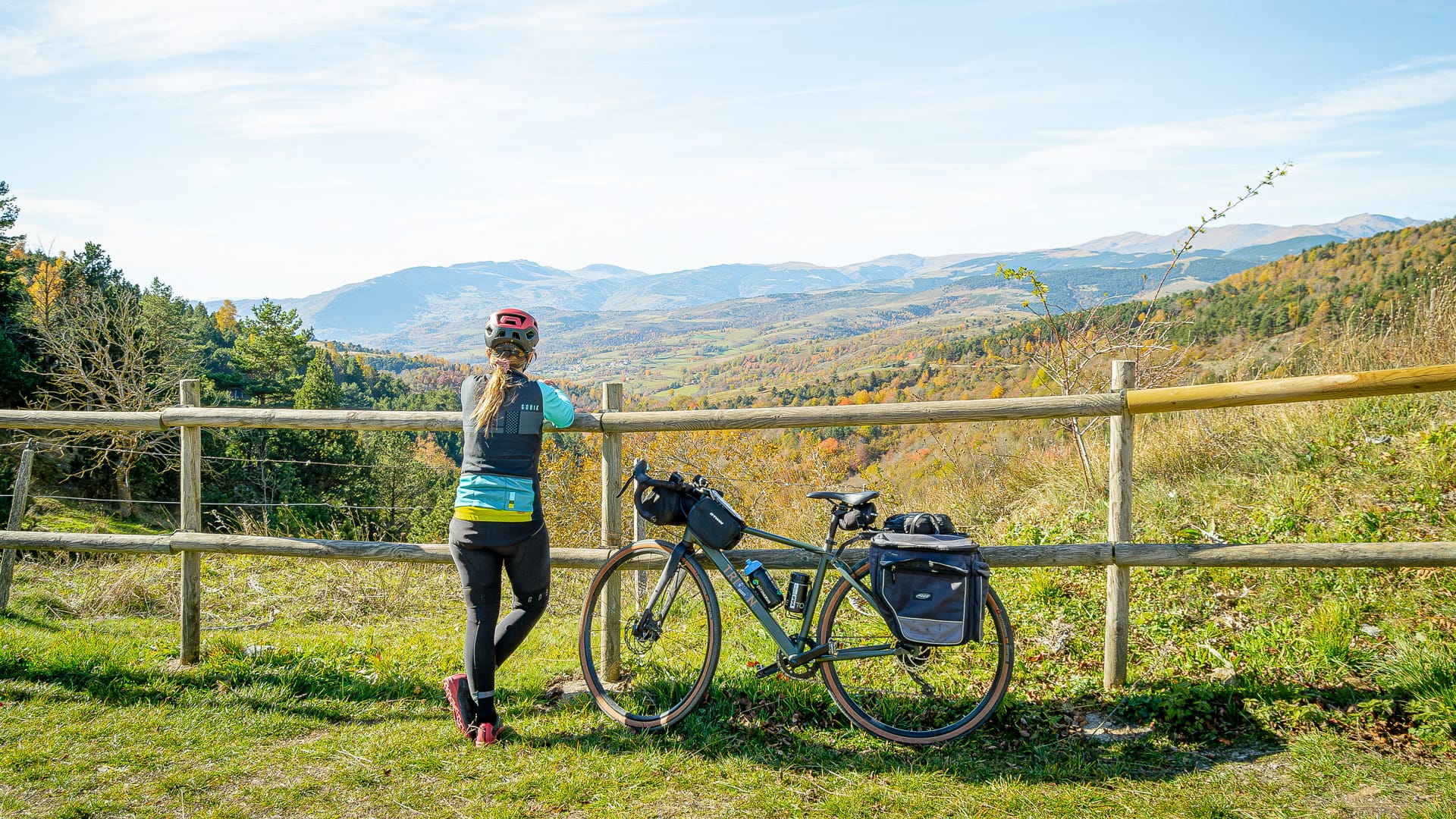
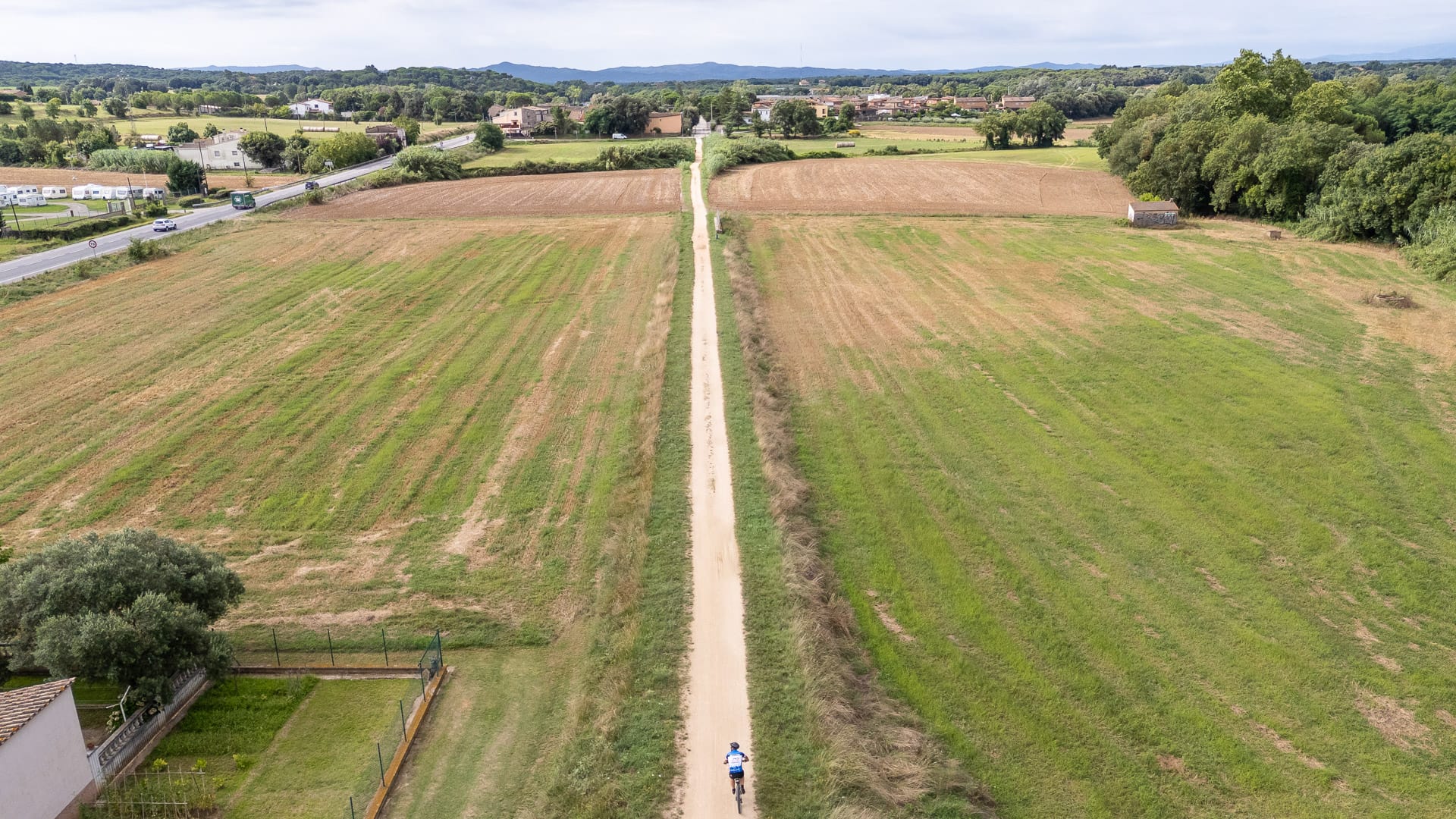
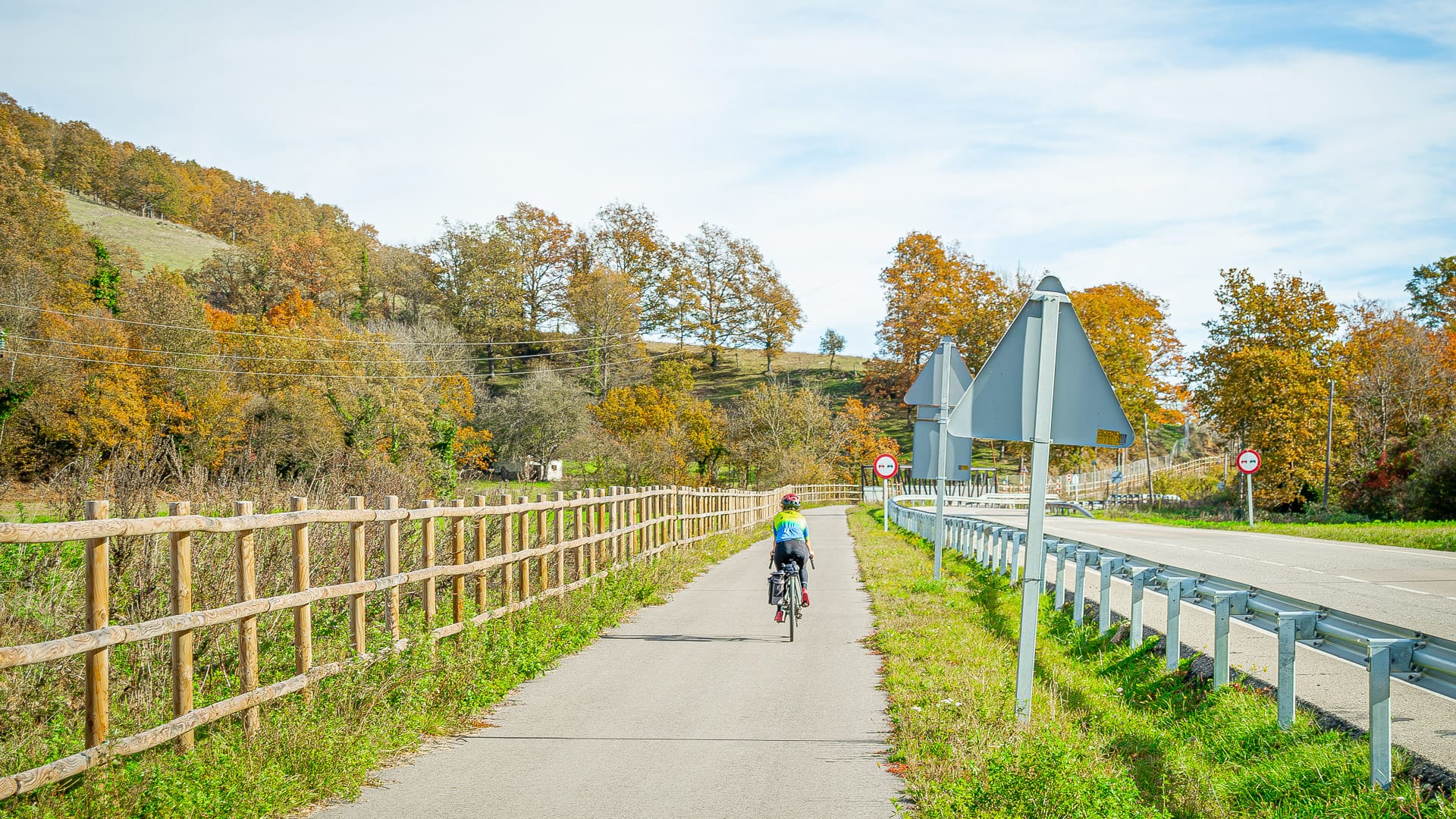
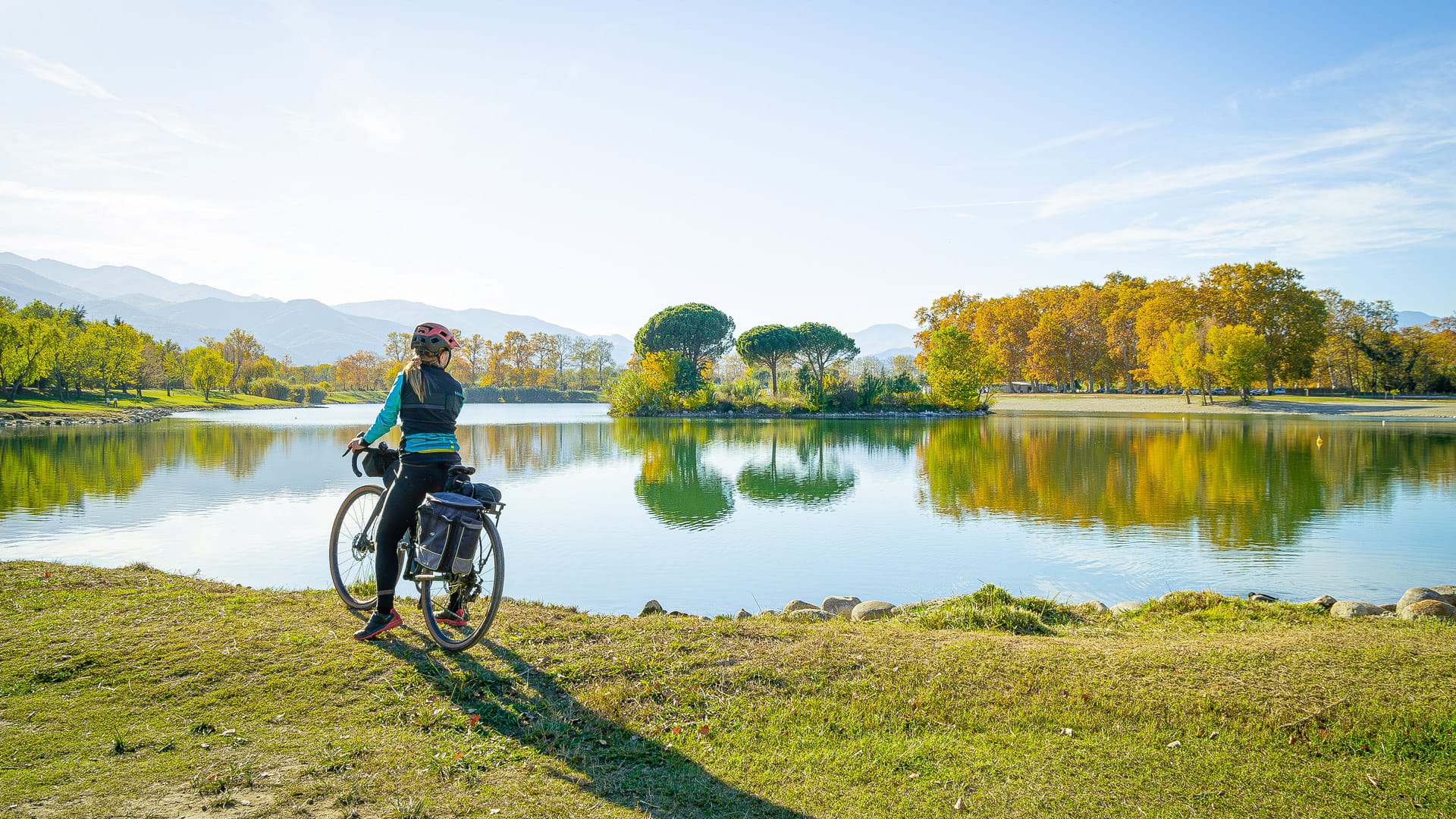
What is the Pirinexus?
The Pirinexus is a circular cycling route that links the Girona greenways with the northeast corner of Catalonia and the Vallespir region of France.
It is designed for cycle touring, gravel cycling and multi-day bike holidays. It uses a mix of greenways, forest tracks and quiet roads.
The official route is around 340 kilometres long. Local riders often describe it as a route from the Pyrenees to the Costa Brava, because those are two of its defining features. You can download the official GPX route here.
The route can be ridden in either direction. Many cyclists start and finish in Girona, because it has good transport links, bike hire, accommodation and cycling services. Of course, other start points are also possible. Since the Pirinexus route is a loop, you can begin wherever works best for your itinerary.
Key statistics
- Distance: 340 kilometres
- Elevation gain: around 3,200 metres
- Start/finish: circular route; Girona is a popular start point
- Countries: Spain and France
- Regions: Girona, Catalonia and Vallespir, France
- Highest major pass: Col d’Ares
- Typical duration: two to six days
- Surface: mixed asphalt, compacted gravel, greenways, forest tracks and cycle paths
- Suggested bike: gravel, hybrid or touring bike
Where does the route go?
A common itinerary starts in Girona and heads north-west towards Olot and Camprodon. From there, the route climbs towards the Pyrenees and crosses into France over the Col d’Ares.
In France, the route follows the Vallespir area and the Tech river valley before returning to Catalonia near La Jonquera. It then heads south across the Empordà plains and towards the Mediterranean.
The coastal section gives a very different feel. Around Empúries, you ride close to the sea and near Greek and Roman remains. From there, the route returns south and west towards Girona.
This variety is the route’s biggest strength.
You are not riding the same landscape for several days. The character changes often. One day can feel green, cool and mountainous. Another can be open, dry and agricultural. Then the route opens out towards the sea.
 This komoot route contains cookies...
I’m fine with komoot cookies
What is the history of the route?
The Pirinexus route was inaugurated in 2013.
It was created as a cross-border cycle route connecting existing greenways and quiet roads in Catalonia and France. The route was developed with European support and the involvement of local government and greenway organisations.
Its purpose was to create a connected cycling itinerary between the Pyrenees and the Costa Brava.
In practice, it does more than that. It links landscapes, history and communities. It also makes it possible for cyclists to create their own loops and variants using the wider network of Girona greenways and local roads.
Why is the Pirinexus a must-do route?
A journey suited to different kinds of rider
The Pirinexus is special because it gives you a real sense of journey.
It also works for two different kinds of cyclist.
- For some, it is a challenge route. It is long enough, varied enough and remote enough in places to feel like a serious ride, especially if ridden in one or two days.
- For others, it is a destination route. It is a way to explore the Costa Brava, Girona Pyrenees, Empordà and Vallespir over several days, with time for culture, food, villages and the sea.
Changing landscapes
You cross a border. You ride from mountains to sea. You pass volcanic landscapes, cork oak forests, vineyards, rivers, medieval towns and Mediterranean coastline.
Low traffic
Wouter says one of the biggest attractions is the low traffic routes: “the route uses many small roads and gravel tracks where you may see more farmers, animals and local people than cars. In parts of the Empordà, the riding can feel very quiet and remote, even though you are never too far from the next village.”
Independence and flexible itineraries
It is also relatively easy to ride independently. The route passes through many villages and towns, so you can usually find accommodation, food and services without needing a full expedition set-up. More on that below.
Strong riders can tackle the route in one, two or three days. This is the perspective Jordi brings to the article. For riders like him, the Pirinexus is an endurance test and a route with enough character to support a competition or race. “The Pirinexus adapts to your physical condition, if you like a challenge and are used to pedalling for many hours you can tackle it in one day!”
Touring cyclists can take four to six days. Families or leisure cyclists can use parts of the Pirinexus and combine them with greenways for a more relaxed holiday. This is closer to Wouter’s perspective. He sees the Pirinexus as a way to discover the destination, not just complete a route, “I’d recommend the Pirinexus for anyone because of the variety the route offers, it is great for people that are looking for an adventure”.
Part 2: What is the Pirinexus route like?
What is the scenery like?
The scenery changes constantly.
Around Girona and Olot, the route follows greenways and former railway lines. These sections are gentle and well-suited to touring cyclists.
Further north, the landscape becomes more mountainous. Camprodon sits at the base of the Pyrenees, and the approach to the Col d’Ares brings a more serious feel to the ride.
Crossing into France is one of the most memorable parts of the Pirinexus. The Spanish side of the Col d’Ares feels more open. As you descend into France, the roads become narrower and the landscape feels more enclosed.
The Vallespir section has a different character again. You ride through valleys, wooded areas and small French towns.
When the route returns to Catalonia, the scenery shifts to cork oak forests and then the Empordà plains. This is a great area for gravel roads, vineyards and wide views.
The route then reaches the Costa Brava. Around Empúries, the Mediterranean becomes part of the ride. This is where the Pirinexus feels less like a mountain route and more like a coastal cycling holiday.
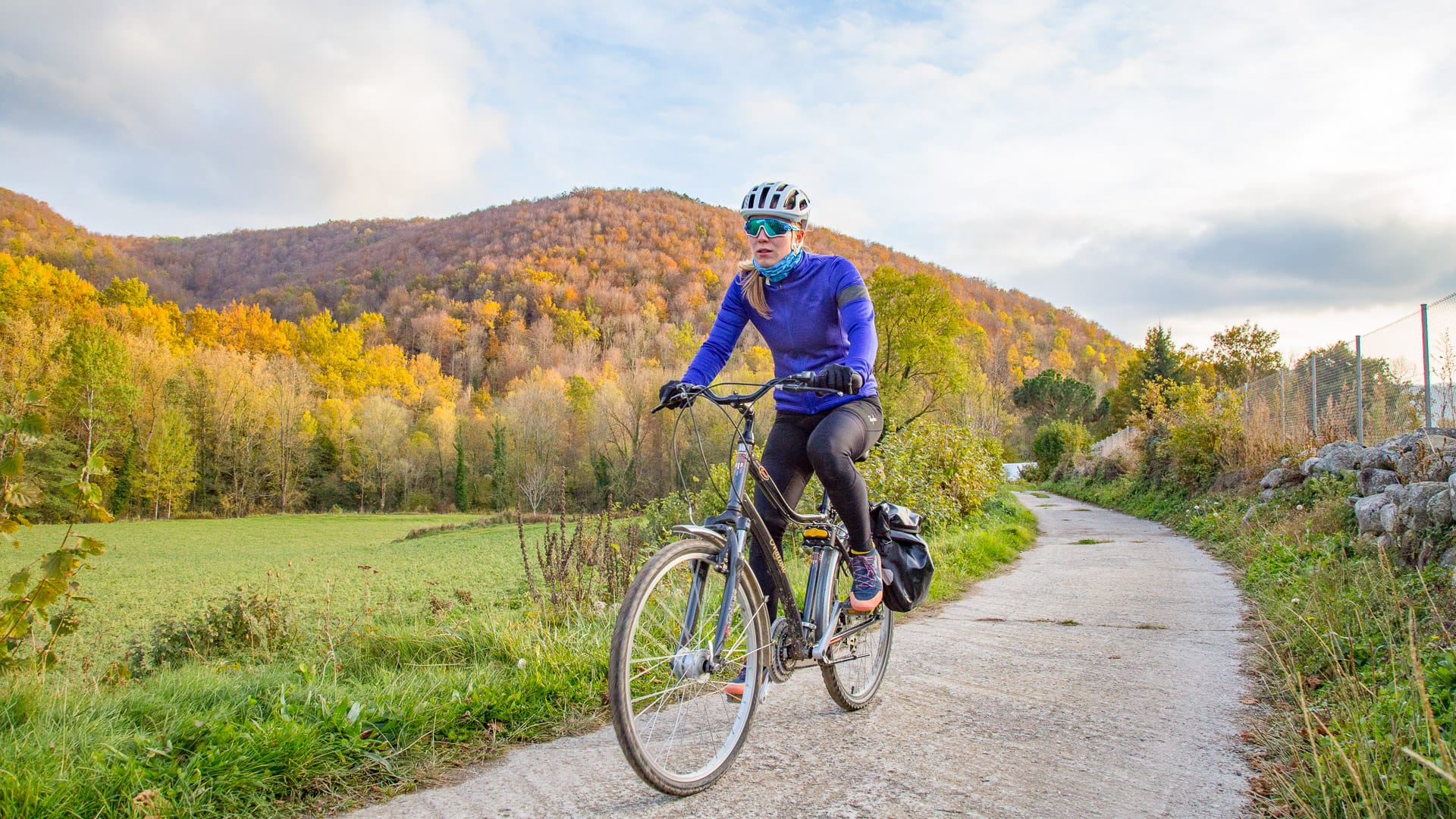
Scenic ride through Ripollès (photo credit: Ecovies de Girona)
What are the surfaces like?
The Pirinexus is a mixed-surface route.
Expect asphalt, compacted gravel, greenways, forest tracks and cycle paths. Some road sections are shared with traffic, but the roads are generally quiet.
Wouter says that “a rough guide is that the route is close to 50% asphalt and 50% unpaved or compacted gravel – but exact percentages will vary depending on the app you look at!”.
The Pirinexus gravel is generally not technical, with the exception of the descent from the Coll de Panissars. Much of it is compacted and well maintained. In places it can feel close to riding on asphalt.
This means you don’t need a mountain bike to ride the Pirinexus. It is also not ideal for a pure road bike. A gravel bike is a natural choice. A hybrid or touring bike with sturdy tyres also works well.
How is the route signposted?
The Pirinexus is generally well signposted.
In many places you can follow the route markers without needing to look constantly at a GPS device. For example, on the greenway sections, the route often feels very clear. However, on some of the road and cross-border sections, navigation needs more attention.
It’s a good idea to carry the route on a GPS device or phone to assist in such moments. It’s also a back up in case signs are missed. It is also useful to know where the next town, café or accommodation is.
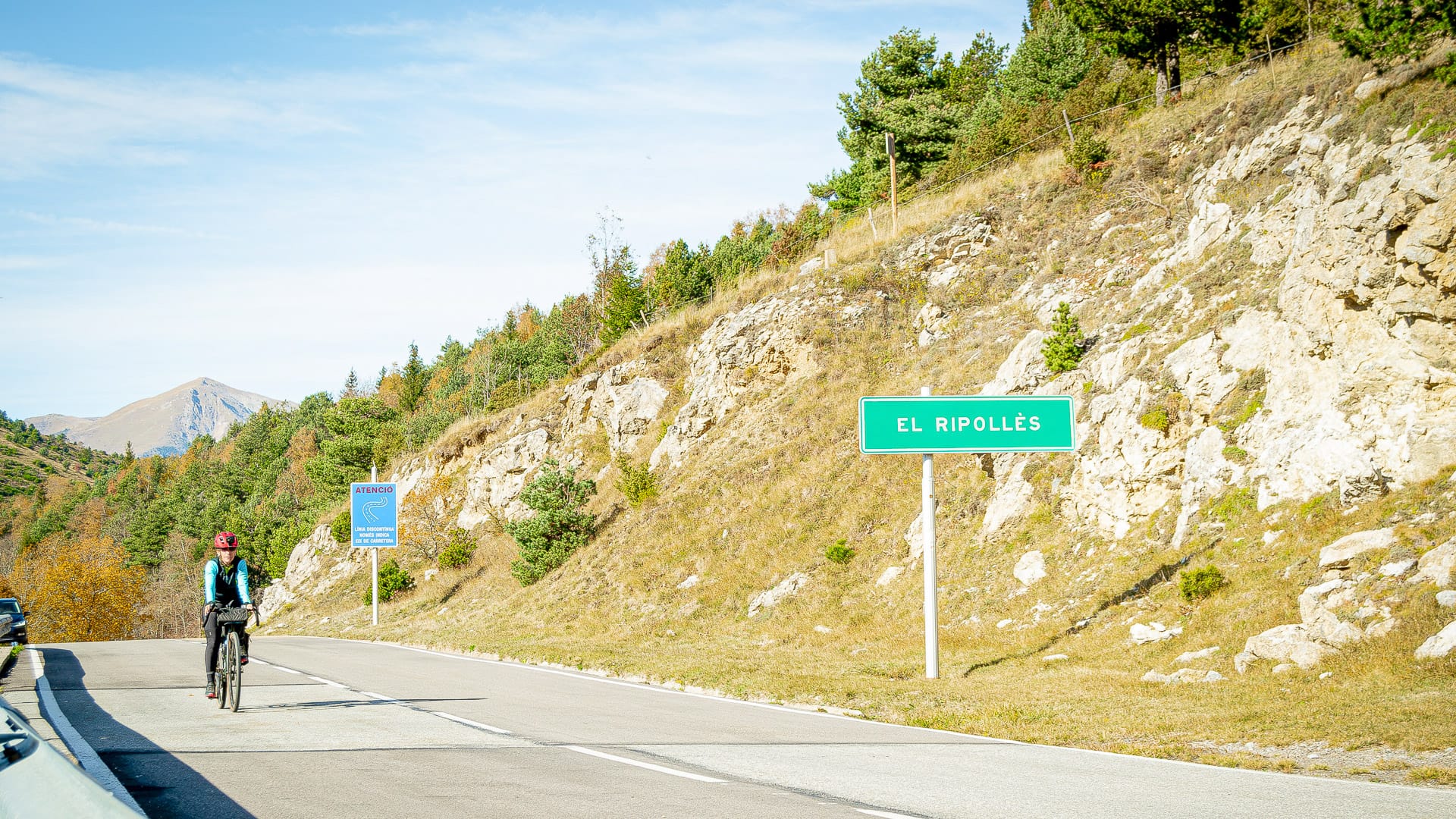
Following the way over Coll d’Ares (photo credit: Ecovies de Girona)
Is there much traffic?
One of the route’s great strengths is the amount of low-traffic riding.
Wouter says “The Pirinexus has been designed to avoid busy roads where possible. You may occasionally have to ride a short busier section, but much of the route uses quiet roads, cycle paths, greenways and gravel tracks.
The Col d’Ares is a good example. It is a proper mountain pass, but it is not the main route for most traffic crossing the border. As a result, it can feel far quieter than you might expect.”
In towns and near the coast, expect more vehicles, especially in summer. The coastal areas are busier in July and August, which is one reason Jordi and Wouter suggest avoiding those months.
Can you ride it unsupported?
Yes.
The Pirinexus is very suitable for self-supported cyclists. You pass through enough villages and towns to make this realistic, especially if you plan ahead and make sure you are carrying the basics like water, snacks and essential tools.
There are a few quieter sections, especially in the Pyrenees and parts of France. Here it is sensible to leave each town with enough food and water for several hours.
Supported trips are also possible. Local cycle tour companies can arrange accommodation, luggage transfer, bike rental and on-trip support. You can find out more about Jordi’s services at Gravel Girona and Wouter’s services at Trek and Ride.
Having support can be especially useful if you do not want to ride with heavy luggage, you do not speak Spanish, Catalan or French, or you want help if something goes wrong mechanically.
Part 3: What are the highlights of the Pirinexus?
Girona to Olot
The section between Girona and Olot is one of the classic parts of the route.
It follows an old railway line and forms part of the Girona greenway network. The gradients are generally gentle, the surface is good and the riding feels relaxed.
This is a good introduction to the Pirinexus. It is also a reminder that this route is not only about climbing and endurance.
You ride through wooded areas, past small towns and into the volcanic landscape around Olot.
The Col d’Ares and the Pyrenees crossing
The Col d’Ares is the route’s main mountain crossing.
It takes you from Catalonia into France and gives the Pirinexus much of its adventure feel.
The climb starts properly above Camprodon and Molló. The road becomes quieter and more open as you get closer to the border.
Wouter explains the area also has deep historical significance. Parts of the route follow paths associated with La Retirada, the mass retreat of people fleeing Franco’s forces at the end of the Spanish Civil War. Jordi says “knowing this history changes the way the landscape feels. This is not just a scenic border crossing. It is also a place marked by hardship and movement.”
Once over the border, the descent into France gives a clear change of atmosphere. The roads narrow. The valley feels enclosed. The villages feel different. It is one of the best examples of how varied the Pirinexus is.
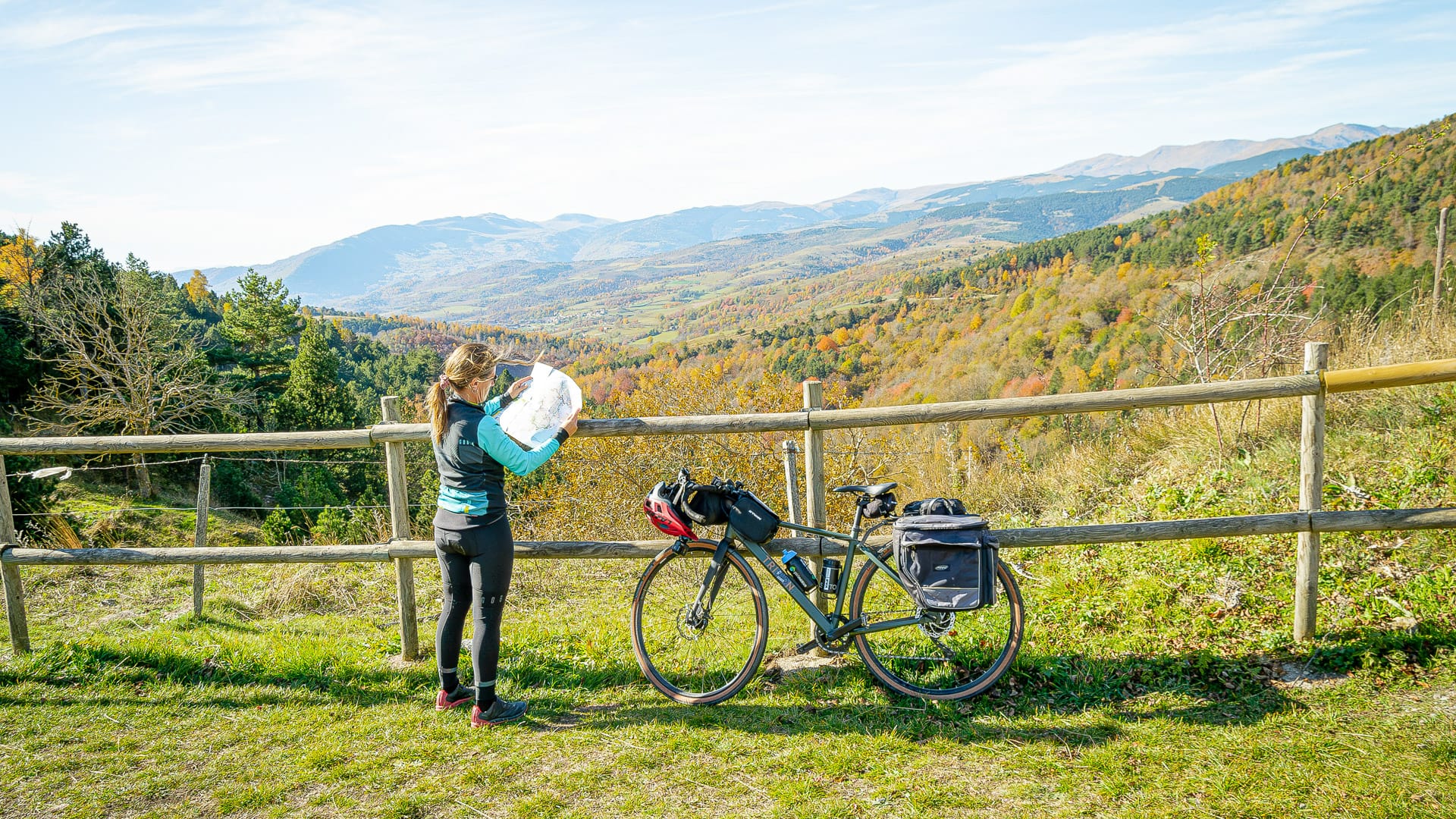
Planning the next climb on Coll d’Ares (photo credit: Ecovies de Girona)
Vallespir and the Tech valley
The French section of the route brings a different flavour.
The Vallespir region is greener and more enclosed than much of the Spanish side. The route follows the Tech valley and passes through small towns and villages.
Amélie-les-Bains-Palalda is one of the better-known places in this section. It is a spa town and a useful overnight stop on some itineraries.
This section is also a reminder that the Pirinexus is not simply a Catalan route. It is a cross-border route with two distinct cycling cultures and landscapes.
Cork oak forests near the border
As the route returns to Catalonia, it passes through areas of cork oak forest.
These sections can feel quiet and tucked away. The roads and tracks are often peaceful, with very little traffic.
This is a good part of the route for riders who enjoy solitude and steady progress. It also helps bridge the mountain and plain sections of the Pirinexus.
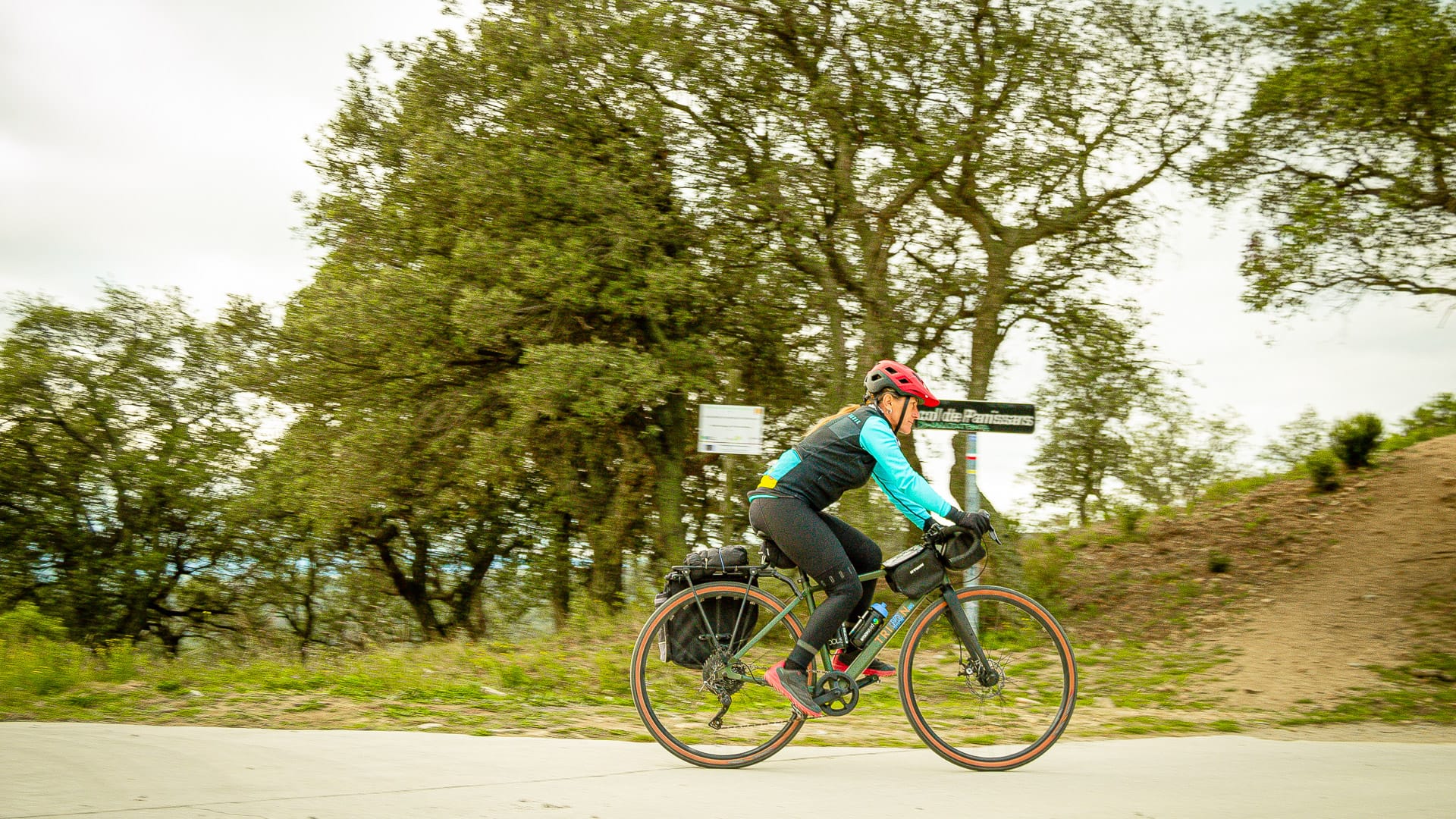
Riding past the trees on Coll de Panissars (photo credit: Ecovies de Girona)
The Empordà
The Empordà is one of the route’s gravel highlights.
This area has quiet tracks, open agricultural landscapes, vineyards, historic villages and wide views towards the mountains. The riding can feel calm and spacious.
Jordi says “I really like the area between Castelló d’Empuries and Sant Marti d’Empuries. There are soft, wide, fine gravel tracks and even if it rains they are always the same, there is no mud.”
It is also a good place to slow down.
Cyclists who are not trying to complete the route quickly may want to spend extra time here. The area has a strong food and wine culture, plus villages that are worth more than a quick stop.
Empúries and the Mediterranean coast
The coastal section around Empúries is a clear highlight.
Here, the route brings you close to the Mediterranean. You also ride near the ruins of Empúries, one of the most important archaeological sites in the region. Empúries has both Greek and Roman remains, which gives the ride an unusual cultural layer.
After the mountains and inland plains, the arrival at the sea feels like a real milestone. Jordi says “It’s a short stretch but if you do the route counterclockwise, this is the first time you see the Mediterranean Sea.” For many cyclists, this will be one of the most memorable parts of the trip.
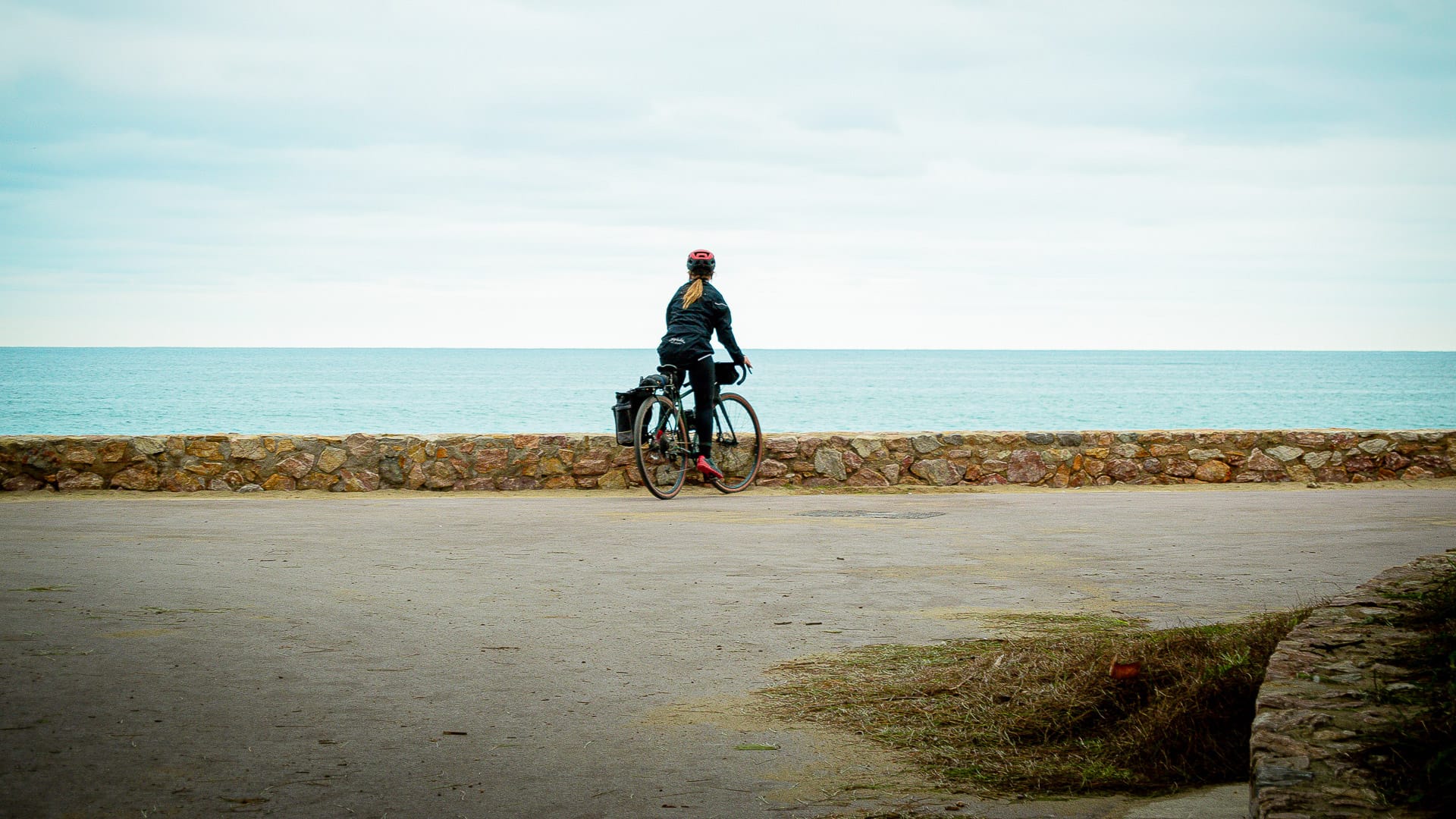
Coastal views from the saddle in Empúries (photo credit: Ecovies de Girona)
Sant Feliu de Guíxols and the return towards Girona
Sant Feliu de Guíxols is another popular coastal stop.
It is a lively seaside town with accommodation, restaurants and good cycling connections. It also sits at one end of the famous coastal road towards Tossa de Mar, which some cyclists may want to add as an extra ride.
From Sant Feliu de Guíxols, the Pirinexus heads inland again and returns towards Girona via the greenway network.
This makes for a satisfying finish. After the mountains, France, the Empordà and the coast, the final section brings you back into Girona’s cycling infrastructure.
Part 4: Suggested Pirinexus itineraries
The Pirinexus can be ridden in many ways.
That flexibility is part of its appeal. The same route can support a race-style challenge, a gravel adventure, a touring holiday or a slower cultural trip.
The official website suggests two, four or six-day options. Local riders also adapt the route depending on whether cyclists want a gravel cycling challenge, a touring holiday or a slower cultural trip.
Below are some ways to think about it.
One-day or race-style Pirinexus challenge
The Pirinexus can be ridden in one day, but this is a serious endurance challenge! Jordi has completed the challenge, “after I saw the news about the creation of the Pirinexus route, I decided to the entire loop in a day, I was one of the first”.
This is not the way most visitors will ride it. It is the perspective of strong local riders and racers who see the route as a test of fitness, pacing, navigation and resilience.
A one-day attempt means riding the full loop, including the mixed surfaces, the Col d’Ares and the return through the Empordà and Costa Brava, without the time to linger. It is about the achievement as much as the scenery.
This point of view matters because it shows the route’s sporting credibility. The Pirinexus is not just a gentle greenway. It has enough distance, climbing and variety to be a real cycling challenge.
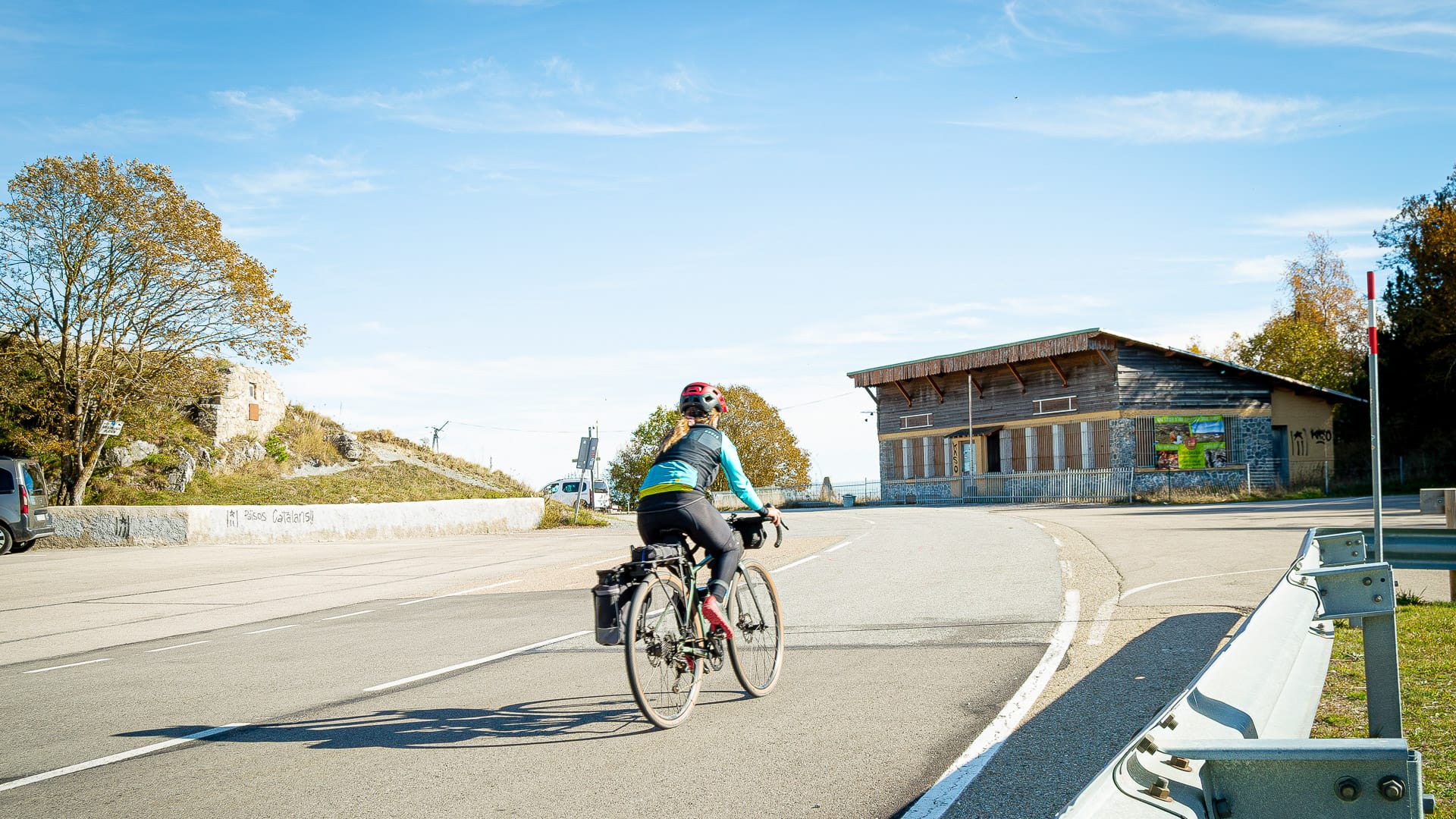
Climbing the smooth road of Coll d’Ares (photo credit: Ecovies de Girona)
Two-day Pirinexus itinerary
A two-day itinerary is only suitable for strong cyclists.
You need to be comfortable riding around 170 kilometres per day on mixed surfaces, with a major mountain crossing included.
This option is best for experienced riders who see the Pirinexus as a challenge rather than a relaxed holiday.
Jordi says, “one option could be a shorter first stage from Girona to Camprodon, and a stop at the hotel Sant Roc. Then a longer second stage back to Girona.”
Three-day Pirinexus itinerary
A three-day itinerary is still demanding, but more realistic for fit cyclists.
A possible version is:
- Day one: Girona to Camprodon.
- Day two: Camprodon to the Empordà, via the Col d’Ares and France.
- Day three: Empordà to Girona, via the Costa Brava.
This gives you the core experiences of the route in a compact format. You still get Girona, the Pyrenees, France, the Empordà and the coast.
However, the days are long. There will be limited time for sightseeing, long lunches or cultural stops.
Four-day Pirinexus itinerary
A four-day itinerary is a good target for many experienced cyclists.
It keeps the trip moving, but gives a little more space than the three-day version.
One option is to start in Sant Feliu de Guíxols and ride:
- Day one: Sant Feliu de Guíxols to Olot.
- Day two: Olot to Amélie-les-Bains-Palalda.
- Day three: Amélie-les-Bains-Palalda to Castelló d’Empúries.
- Day four: Castelló d’Empúries to Sant Feliu de Guíxols.
This version works well because it gives you a coastal start and finish, plus a clear mountain and French section in the middle.
Another popular version is to start in Girona. This may be easier for travel logistics, bike rental and accommodation.
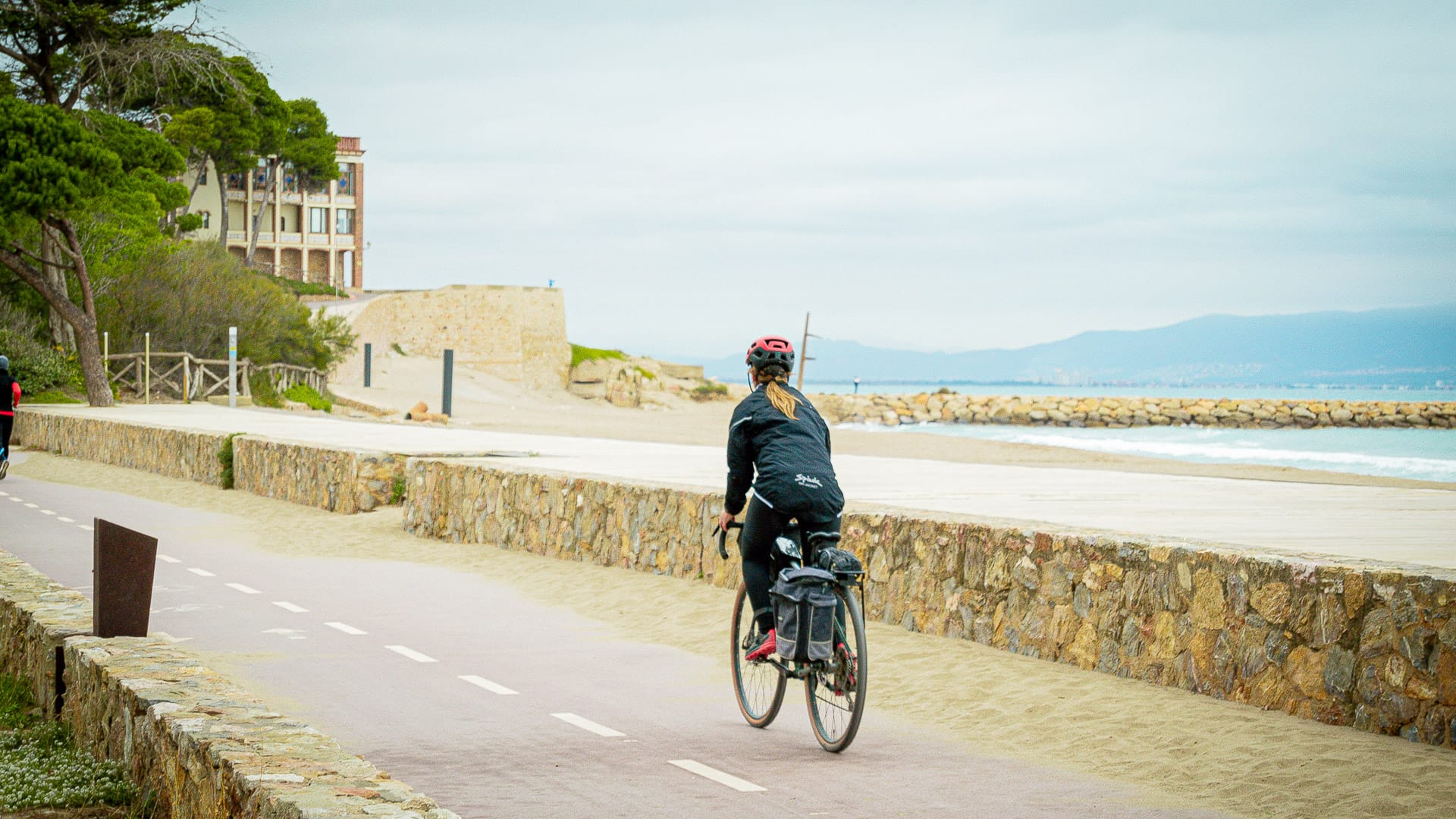
Following the Pirinexus route in Empúries (photo credit: Ecovies de Girona)
Five or six-day Pirinexus itinerary
A five or six-day itinerary suits touring cyclists who want more time off the bike. It is also better for mixed-ability groups.
If you are riding with panniers, an e-bike or a hybrid bike, this slower pace will probably make the trip more enjoyable.
This pace allows you to stop in towns, visit Empúries, enjoy the coast and spend more time in Girona or the Empordà. Wouter says “There are many villages where it is worth stopping for a while but my favourites are: Camprodon, Peratallada, Girona, Sant Feliu de Guixols, Calella de Palafrugell.” Jordi echoes Wouter with this recommendation of Camprodon; he says that Palamos, on the coast, is always somewhere he stops too.
Ride part of the route
You do not have to ride the full Pirinexus as one continuous loop.
This is the other side of the route. It can be less about completion and more about discovery.
A slower version gives you time to experience the “living twice” idea on the ground. You can ride from mountains to sea, but also stop in the landscapes between them. That might mean a longer lunch in the Empordà, time at Empúries, an extra night in Girona or a relaxed finish on the Costa Brava.
Some cycling holidays use the Pirinexus as a backbone and combine it with Girona’s greenways, local gravel roads and themed cultural cycling routes. This makes the route useful for cyclists who want the essence of the Pirinexus without needing to complete every kilometre.
This can work very well for riders who want daily distances of 30 to 60 kilometres. It can also suit cyclists who prefer luggage transfer, hotel stays and time for food, wine, museums or beaches.
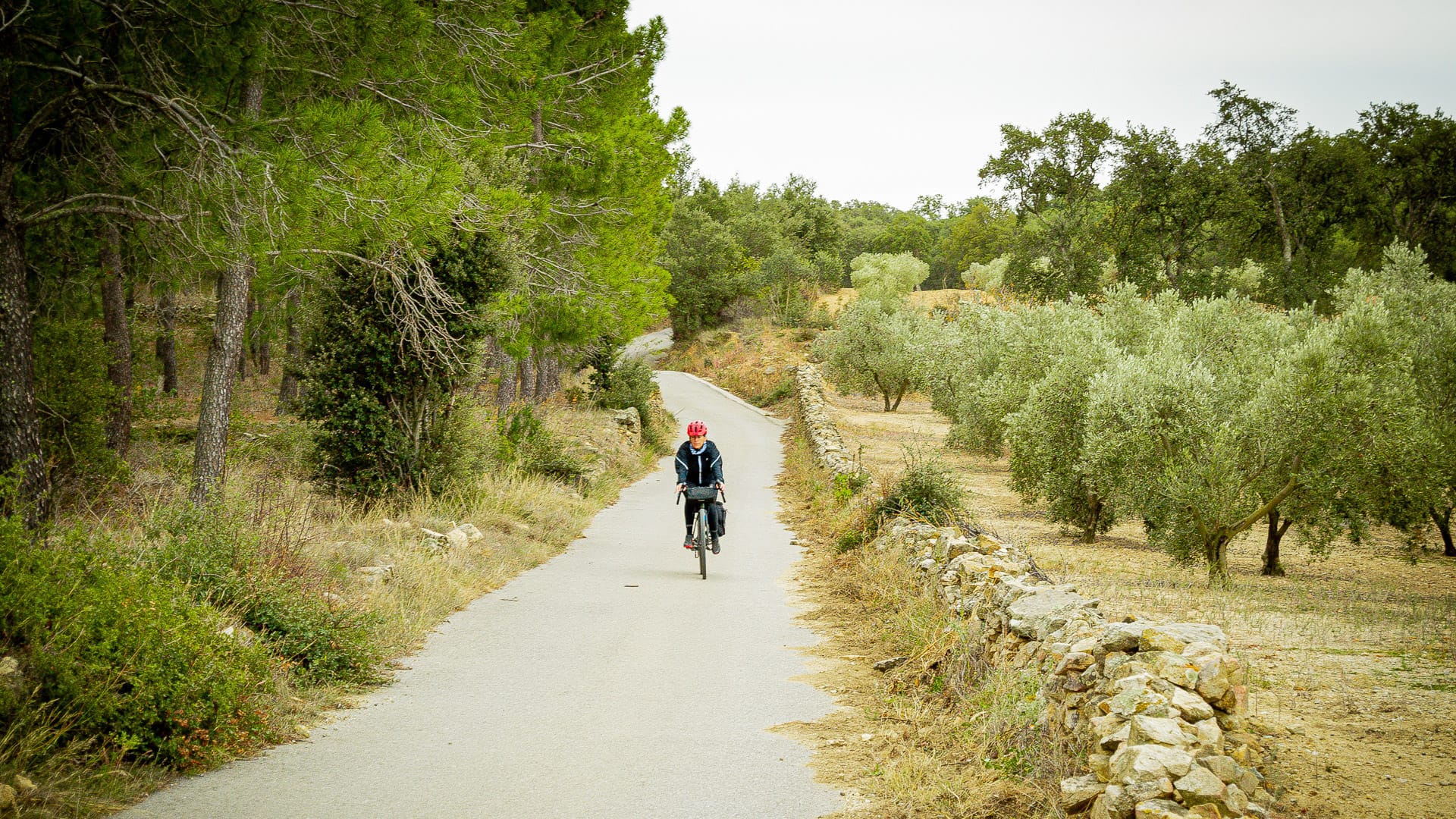
Quiet road cycling in Capmany (photo credit: Ecovies de Girona)
Part 5: How hard is the Pirinexus?
Is the Pirinexus difficult?
For experienced cyclists, the Pirinexus is likely to feel like a medium-difficulty route if ridden over four or more days.
Most of the Pirinexus route does not present a technical challenge, other than the gravel descent from Coll de Panisars, which does add some technical difficulty.
The main challenge is the combination of distance, mixed terrain and the Col d’Ares.
If you ride it in two or three days, the difficulty increases a lot. Long days on mixed surfaces can become tiring, even when the route is not technically hard.
If you ride it in five or six days, the route becomes much more approachable.
Who is it suitable for?
The Pirinexus suits several types of cyclist.
It is a good choice for:
- Gravel riders who want a multi-day route with cultural interest.
- Touring cyclists who want a circular route with varied scenery.
- E-bike riders who want a supported or semi-supported trip.
- Strong leisure cyclists who are comfortable riding several days in a row.
- Bikepackers who want a route with plenty of villages and services.
It is less suitable for:
- Pure road cyclists on skinny tyres.
- Riders who want technical mountain biking.
- Beginners with no experience of longer rides.
- Cyclists who dislike mixed surfaces.
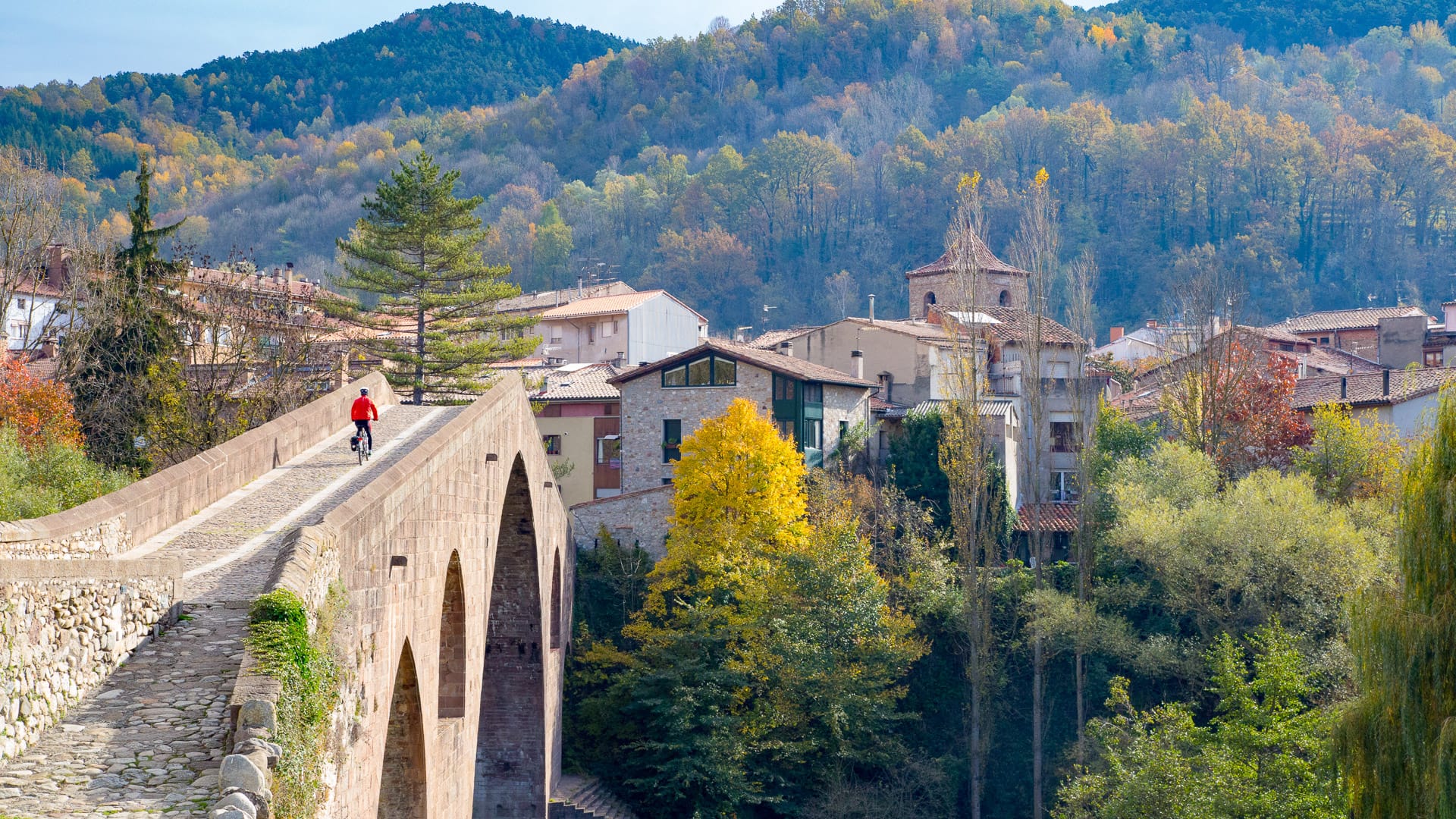
Passing by the historic streets of Sant Joan de les Abadesses (photo credit: Ecovies de Girona)
What training should you do?
Training depends on your itinerary.
For a four-day trip, you should be comfortable riding 70 to 90 kilometres on consecutive days. You should also have experience of climbing for long periods and riding on gravel or compacted tracks.
For a five or six-day trip, the distances can be shorter. You still need good general fitness, but the route becomes more of a touring challenge than a performance challenge.
Before you go, try to ride several back-to-back days. Include climbs and mixed surfaces if you can.
You should also practise eating and drinking on the bike. The route has plenty of places to stop, but you still need to look after yourself between towns.
Part 6: When is the best time to ride the Pirinexus?
Spring
Spring is one of the best times to ride the Pirinexus.
From mid-March to mid-June can work well, depending on the year. Earlier in spring, snow is still possible on or near the high sections of the Pyrenees.
April, May and early June are often good choices. Temperatures are usually more comfortable than in summer, and the inland landscapes can be green.
However, conditions vary. Always check the weather before setting off, especially around the Col d’Ares.
Summer
We would avoid July and August.
The route can be very hot. Accommodation near the coast is also more expensive and harder to find. Roads and towns are busier too.
If you do ride in summer, start early, carry plenty of water and avoid the hottest part of the day.
For most cyclists, there are better months to choose.
Autumn
Autumn is another excellent time.
From early September to the end of October can be very good. The first week of September may still be hot, but conditions usually improve as the month goes on.
Autumn is also a good time for food, wine and quieter coastal towns.
Mid-November can still be possible in some years. However, the weather becomes less predictable, especially in the mountains.
Winter
Winter is not ideal for the full route.
The Pyrenean sections can be cold and may have snow. Areas north of Girona, including around Olot and Sant Joan de les Abadesses, can be wet and dark in winter.
Some lower sections may still be rideable. But for the full Pirinexus, winter is not the season we would choose.
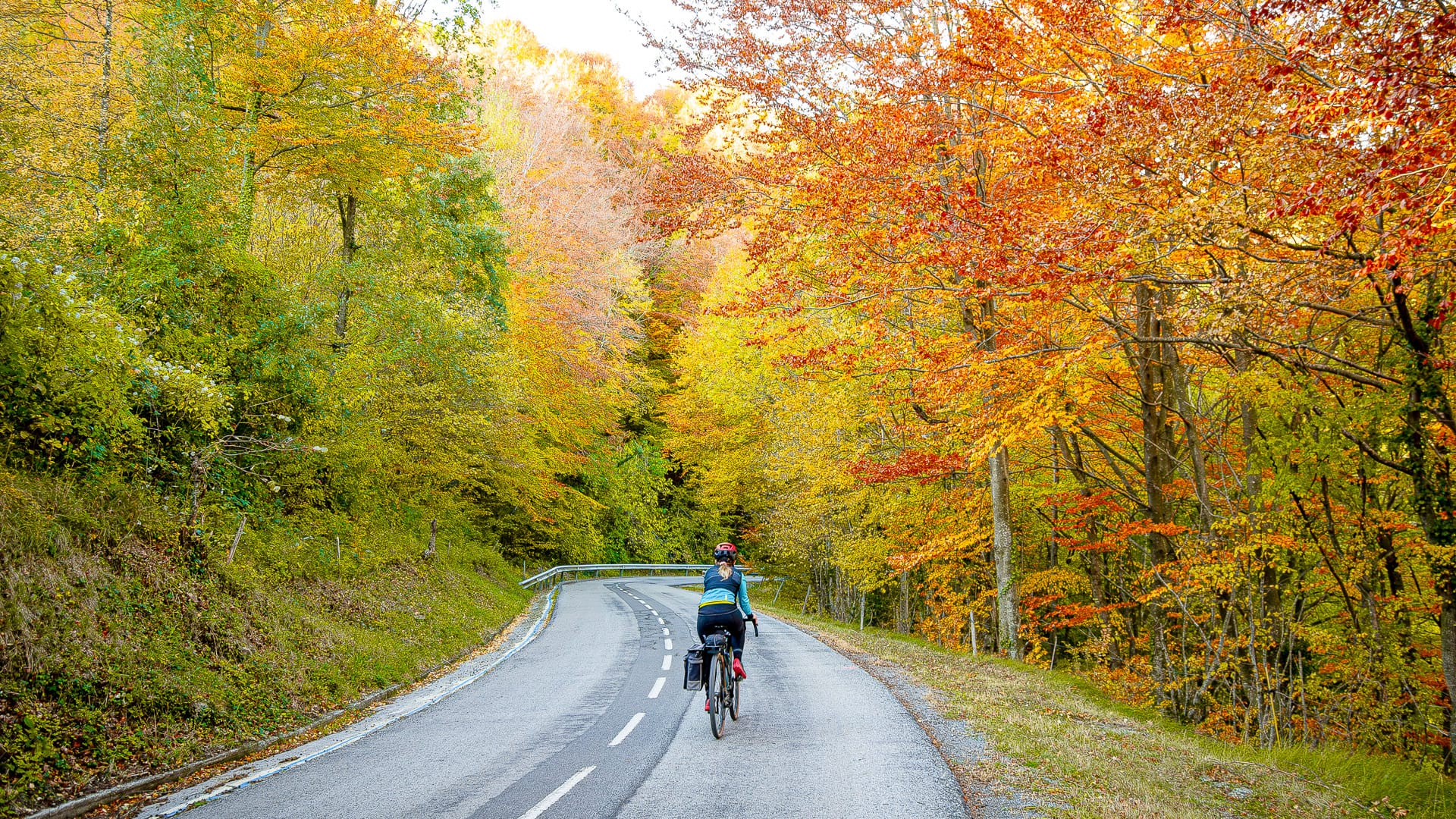
Autumn colours on Coll de Santigosa (photo credit: Ecovies de Girona)
Part 7: Know before you go
What bike should you ride?
A gravel bike is the obvious choice for many cyclists.
It gives you enough speed on asphalt and enough comfort for compacted gravel. Use tyres wide enough for rougher tracks and long days.
A hybrid or touring bike is also a good option. This may suit riders who prefer a more upright position or are carrying panniers.
A mountain bike will work, but it is not necessary. A road bike is not a good plan, because a large part of the route is on gravel or mixed surfaces.
E-bikes are also suitable. Make sure your battery range is enough for each day. Accommodation and restaurants may be able to help with charging and you can find dedicated charging points along the route. Check out the official map for details.
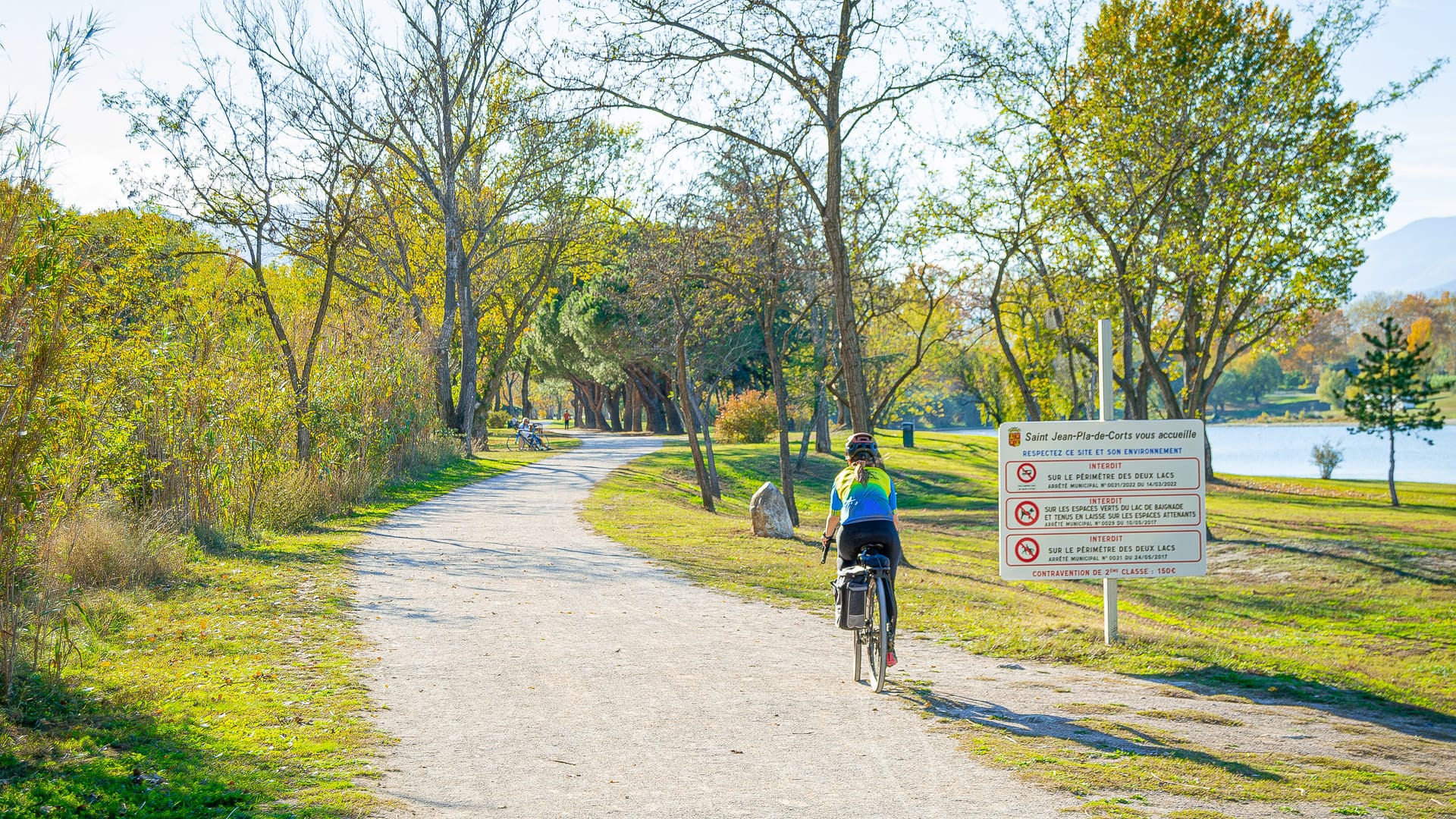
Finding the route in Saint-Jean-Pla-de-Corts (photo credit: Ecovies de Girona)
Can you rent bikes?
Girona is the main bike rental hub.
You will find a good choice of gravel bikes, road bikes, hybrids and e-bikes in and around the city. Some rental options may also be available on the coast.
Book in advance, especially in spring and autumn, when cycling demand in Girona can be high.
Which way to ride the route?
The route can be ridden in either direction.
Different people have different opinions on what’s best, but the final word comes from the Ecovies (Vias Verdes consortium):
“Although the Pirinexus route can be completed in either direction, it is generally recommended to ride it clockwise due to the overall elevation profile. The Coll de Panissars section is the most challenging part of the entire route, and tackling it clockwise means largely riding downhill. Similarly, the cross-border section between France and the Alt Empordà region involves significant elevation gain, so it is more comfortable to cycle in a clockwise direction.
Another factor to consider is the Tramuntana wind. When riding the route counterclockwise, cyclists often face headwinds along several sections, which can significantly increase the effort required.”
Where should you stay?
There is a wide range of accommodation along the Pirinexus.
You can find campsites, hostels, bed and breakfasts, small hotels and higher-end hotels. Girona, Olot, Camprodon, Sant Feliu de Guíxols and some Empordà towns have particularly good options.
France can be a little trickier in places, so plan that section carefully.
If you are camping, check opening dates. Many campsites are seasonal and may close outside the main holiday period.
Wild camping is generally not allowed. If you want to camp outside official sites, you need permission from the landowner and should check local rules.
Is luggage transfer available?
Yes, luggage transfer is available through local cycling holiday companies, though neither Gravel Girona or Trek and Ride offer this as a standalone service.
This can make a big difference, especially on the climbing days. Riding a loaded bike over the Col d’Ares is possible, but it is not for everyone.
A supported trip can also include accommodation booking, bike rental, route files and help if something goes wrong.
What about mechanical support?
The route passes through many towns, and some have bike shops or workshops. Girona and Olot are particularly useful cycling hubs but there are also towns such as Olot, Camprodon, Le Boulou, Castelló d’Empuries, L’Escala, Palafrugell, Platja d’Aro that should have bike shops.
However, there are quieter stretches where help may not be immediate. Carry tools, spare tubes, plugs if you are tubeless, a pump, a quick link and any small spares specific to your bike.
If you are not confident with mechanical issues, consider booking a supported trip. Having a local contact can be reassuring, particularly if you do not speak Spanish, Catalan or French. Trek and Ride offer two variants on the Pirinexus itinerary:
- From Olot to the Mediterranean Sea (7 days, 6 nights)
- From the Pyrenees to the Mediterranean Sea (8 days, 7 nights)
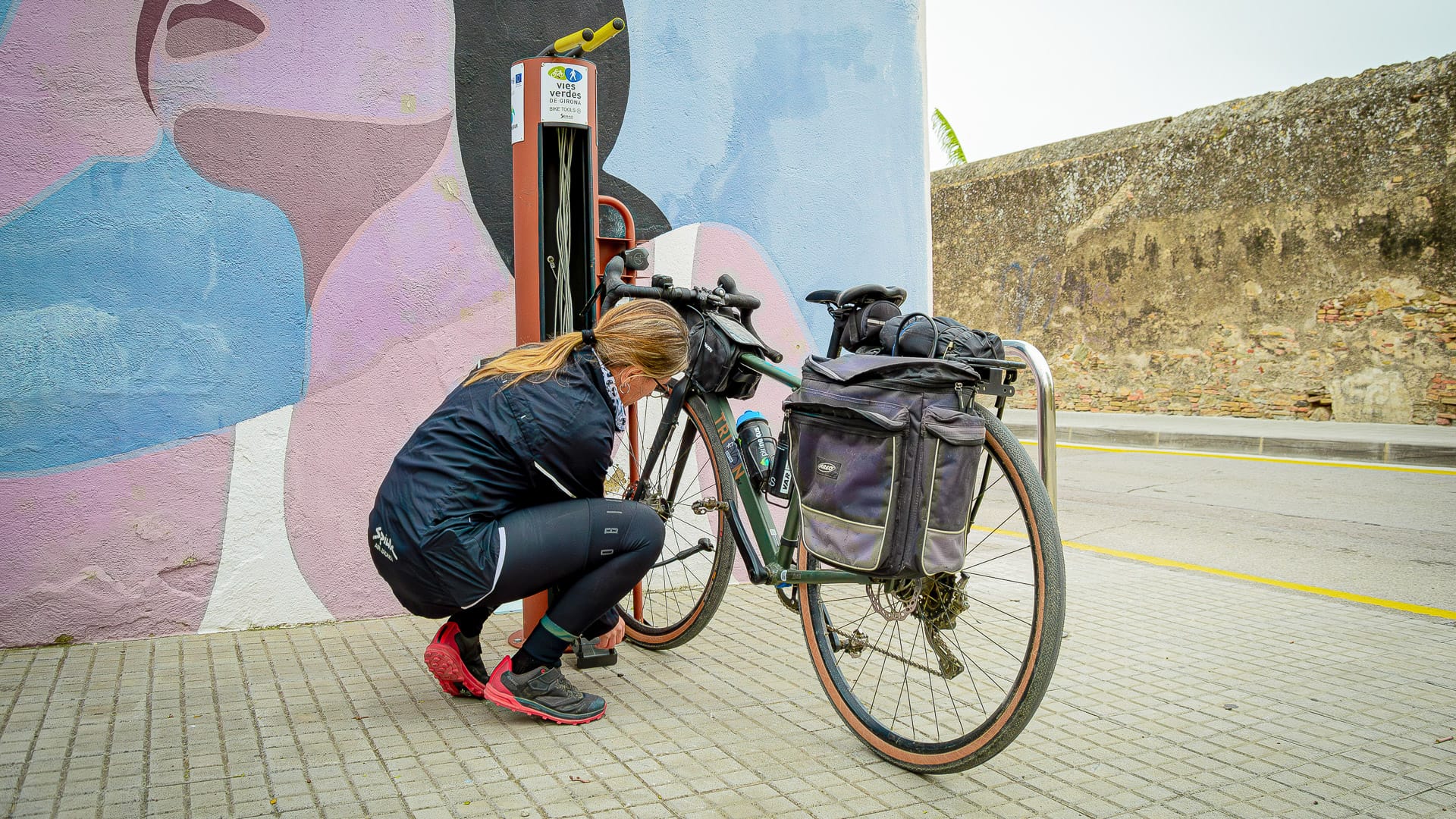
Topping up the tyres in Castelló d’Empúries (photo credit: Ecovies de Girona)
How easy is it to find food and water?
It is generally easy.
The Pirinexus passes through many towns and villages with shops and restaurants. Jordi says “the longest area without towns is when you cross the Pyrinees, from Mollò in Spain to Prats de Mollò in France when there are around 30 kilometres without any towns and between Mourellas les Illes and La Jonquera there are 23 kilometres without towns. The rest of the route there is a town roughly every 15 kilometres and each town typically has a bar and a supermarket.”
That said, do not rely on finding food at every hour of the day. In Spain, shops may open later than UK cyclists expect, often around 9 or even 10am. Some may close during the afternoon, for example between 2 and 5pm.
If you want to start early, buy food the day before.
Do you need cash?
Cards are widely accepted.
It is still sensible to carry some euros in cash. This is useful for small purchases, cafés, local shops or places where card machines are not working.
Do you need to speak Spanish, Catalan or French?
You can ride the Pirinexus without speaking Spanish, Catalan or French.
Many people working in tourism speak some English, especially in Girona and on the coast. In smaller villages, English may be limited.
Learning a few basic phrases is helpful and polite. It can also make mechanical problems, accommodation questions and food stops easier.
What are the rules for cycling in Spain?
Check the latest rules before you travel, but key points include:
- Helmets are required when cycling outside urban areas.
- Drivers must usually leave at least 1.5 metres when overtaking cyclists.
- Cyclists may ride two abreast where it is safe and permitted.
- Lights and reflective equipment are required in low light, at night and in tunnels.
Rules can change, and local interpretation can vary. Ride defensively and follow signs on the route.
Can you take bikes on public transport?
Girona is well connected by train and bus.
Bikes can often be taken on trains and some buses, but conditions vary by operator, route and time of day. Busy commuter times may have restrictions. Wouter highlights ” on the peak time morning trains, you’re not allowed with a bike on the train because of the commuters so make sure to check ahead of time!”
For buses, it is sensible to book your bike space in advance where possible. Do not assume there will be room if you simply turn up.
If you are flying into Barcelona, Girona is a practical start point because of its rail and road connections.
Are there toilets on the route?
Public toilets can be limited.
Most cyclists rely on cafés, bars, restaurants and accommodation. This is worth remembering when planning your day, especially in quieter sections.
Are there any safety considerations?
The Pirinexus is in a generally safe and well-travelled part of Europe. The main risks are practical rather than unusual.
Watch for heat in summer, cold in the mountains, sudden weather changes, gravel corners, tiredness and navigation mistakes.
Wild boar live in the region. They are unlikely to be an issue, but give them space if you see them.
Hunting can take place in some rural areas. Pay attention to local signs, especially in autumn and winter.
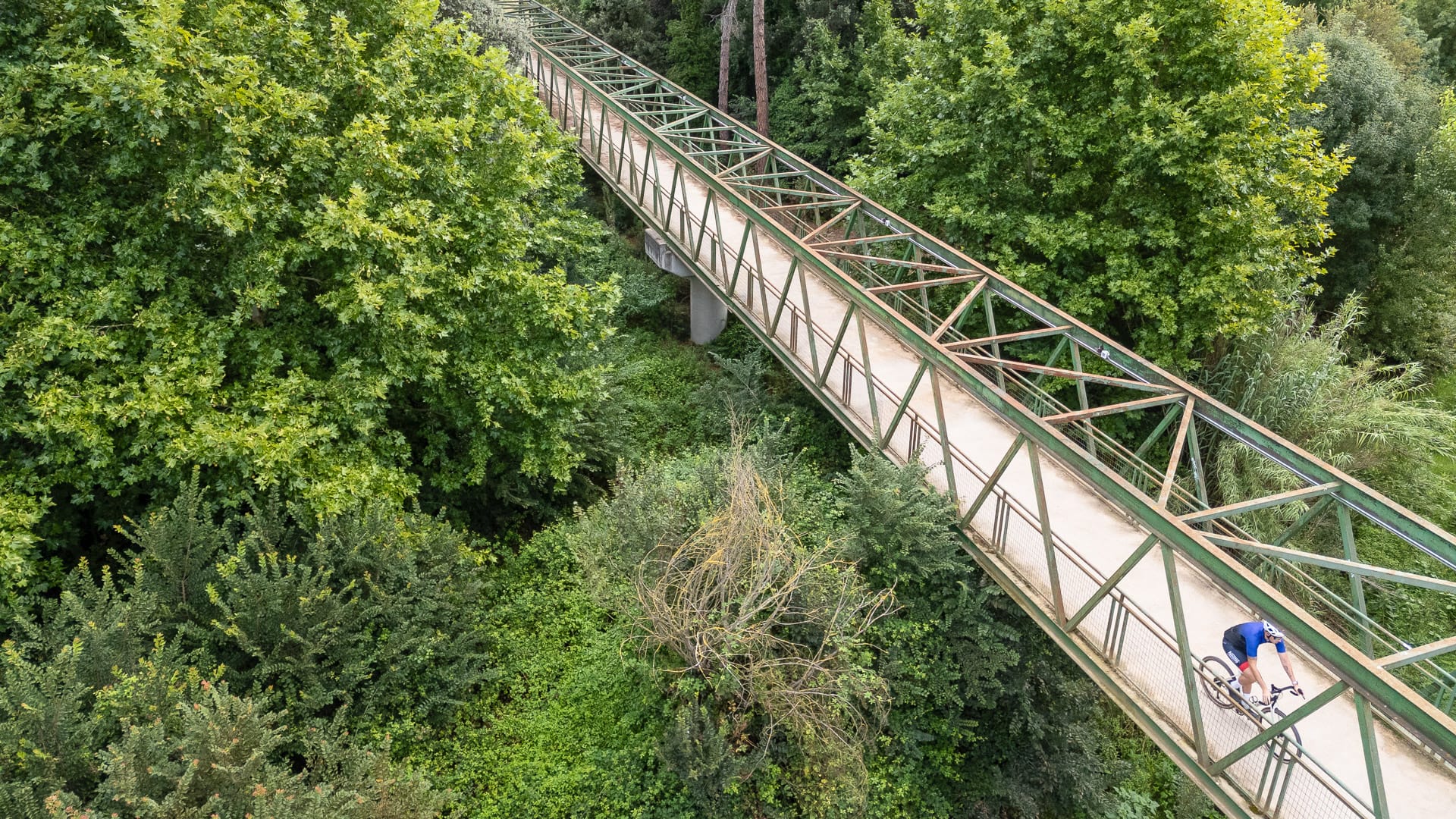
Crossing a narrow bridge in Palol d’Onyar (photo credit: Ecovies de Girona)
Part 8: Tips for riding the Pirinexus
Do not rush every section
It is tempting to treat the Pirinexus as a challenge ride.
That can be fun. But the route also rewards slower travel.
Allow time for Girona, Olot, Camprodon, the Vallespir, the Empordà, Empúries and the Costa Brava. These places are part of what makes the route interesting.
Plan the French section carefully
The French part adds a lot to the route, but services can be less frequent in places.
Check accommodation, food stops and opening times before you go. This is especially important outside peak season.
Carry layers
The route covers different environments.
You may be warm on the coast and cold in the Pyrenees. Pack rain gear and warm layers, even if the forecast looks good.
Choose tyres carefully
Do not “under-bike” the Pirinexus.
A road bike with narrow tyres will limit your enjoyment. Choose tyres that are comfortable on compacted gravel and reliable for long days.
Book accommodation ahead
This is particularly important in early spring and late, autumn (when accommodation may not yet have opened) and anywhere near the coast.
Summer is the hardest time for accommodation because coastal towns are busy and prices rise.
Be ready to adapt
The Pirinexus is a route, not a race.
Weather, accommodation, bike issues and how you feel on the day can all affect your plan. Build in some flexibility where you can.
Any highway code and travel information I should be aware of?
As ever, it’s a good idea to check current travel information before you book and travel. For UK visitors, the UK government travel information pages for Spain are here.
You should also read and follow Spain’s highway code.
Where can cyclists find out more?
The official Pirinexus website is the best place to start. It includes route information, downloadable tracks and links to itinerary options.
The Ecovies of Girona planner is also useful for creating your own version of the route and checking services along the way.
For cyclists who want a supported trip, local Girona cycling companies can help with route planning, accommodation, luggage transfers, cycling rentals and support. Feel free to get in touch with Wouter from Trek and Ride or Jordi from Gravel Girona. While they don’t offer standalone Pirinexus trips, they will be happy to point you in the right direction.
Final thoughts
The Pirinexus is one of those cycle routes that is hard to define in a single phrase.
That is why it benefits from both Jordi’s and Wouter’s perspectives. Jordi’s view shows the Pirinexus as a challenge. Wouter’s view shows it as a route for discovering the destination in stages.
Both are true.
It is part gravel route, part cycle tour, part cross-border journey and part coastal escape. It has enough climbing to feel adventurous, but enough infrastructure to make the trip manageable.
For riders who want a mixed-surface cycling holiday with varied scenery, low-traffic riding and plenty of cultural interest, the Pirinexus is an excellent choice.
Ride it fast if you want a challenge. Ride it slowly if you want a holiday. Either way, it is a route that shows off the extraordinary variety of Girona, the Pyrenees, Vallespir and the Costa Brava.
It also captures the destination’s sea-and-mountains duality especially well. The Pirinexus lets you experience the Costa Brava and the Girona Pyrenees in one journey, with enough variety in between to make the route feel like more than one cycling trip.
Got a question for Jordi and Wouter?
Fill out this form and we will send it to Jordi and Wouter. We aim to get you an answer within 24 hours where possible!Jordi Cantal owns Gravel Girona and works as an expert cycling guide. Born in 1971 in Santa Coloma de Farners, 20 kilometres south of Girona, he began working as a cycling guide in 2008 with Bikecat, one of Girona’s pioneering cycling companies.
In 2015, he designed and directed the circular, trans-border endurance race, The Pirinexus Challenge 360. This 350 kilometre gravel event goes around the province of Girona and reflects Jordi’s long-standing experience in gravel cycling, dating back to before gravel was widely talked about.
Wouter Van Wezemael is the founder and manager of Trek and Ride, where he also shares his passion firsthand as a guide. An avid hiker and mountain biker, Wouter has always found his sanctuary in the great outdoors and the quiet solitude of the mountains.
However, his connection to these landscapes goes far beyond personal enjoyment. Wouter is deeply convinced that the future of travel lies in regenerative tourism, an approach that doesn't just minimise harm, but actively heals, restores, and revitalises the environments and communities we visit.
This philosophy directly shapes how he introduces travellers to the wild places he knows best. For Wouter, a journey into the mountains is about more than just hiking or riding; it is an opportunity to foster a deep respect for the earth and empower others to leave the world better than they found it.
First Published: 08 July 2026
The contents of this website are provided for general information purposes only. It is not intended to amount to advice and you should not rely on it. You should carry out your own due diligence and risk assessments and take professional advice. Views expressed by interviewees or other users of this website do not necessarily represent our views. We make no representations, warranties or guarantees, whether express or implied, that the content on our website is accurate, complete or up to date. If you use any information or content on this website, download from, or otherwise obtain content or services through our website, it is entirely at your own discretion and risk. Epic Road Rides Ltd disclaims all liability and responsibility arising from any reliance placed on the information and content on this website. Find out more here.
Comments