

Cycling in Georgia and Armenia is an exciting way to experience the striking landscapes and rich cultures of the dramatic Caucasus Mountains, a region once threaded by the Silk Road.
Set on the eastern edge of Europe, these destinations are ideal for cyclists who’ve already explored the continent’s more familiar cycle routes and are craving a fresh challenge.
That said, this is very much an off-the-beaten-track cycling trip and best suited to confident riders with a strong sense of adventure. But Epic Road Rides Community Contributor Isobel Duxfield certainly thinks the rewards are worth it!
In this article, Isobel shares what you can expect in this under-the-radar region, along with a detailed breakdown of her memorable eight-day route across Armenia and Georgia, between Yerevan (Armenia) and Tbilisi (Georgia), which she completed on 3 October 2025.
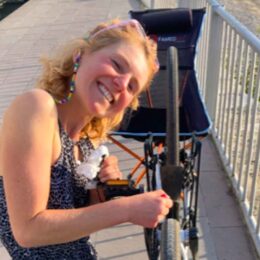
Isobel has cycled in many countries around the world, sometimes solo, sometimes with company. She has combined cycling with other ways of experiencing the world, hauling her surfboard on her bike down the west coast of America and lugging rock-climbing gear around Canada and Turkey.
She now works for the Campaign for Better Transport, the national transport organisation working across England and Wales to make transport better, greener and fairer.
Always check current travel information and advice. Note that Georgia borders Russia. At the time of writing, the South Ossetia and Abkhazia regions of Georgia are occupied by Russia; these are areas that UK government advises against all travel. They also advise against all travel along the border between Armenia and Azerbaijan. For UK visitors, the UK government travel information page for Georgia is here and for Armenia is here.
Table of contents
To make this article more digestible, it is broken up into five parts:
Part 1: An overview of cycling in Georgia and Armenia
This border-hopping journey through Armenia and Georgia covers more than 600 kilometres. It takes cyclists on a remarkable ride through the Caucasus, a dramatic mountain region between the Black Sea and the Caspian Sea.
The Caucasus region forms a natural bridge between Eastern Europe and Western Asia and offer riders a rare window into a lesser-visited corner of the world. It’s a place where staggering landscapes and fascinating cultures collide, creating a fantastic setting for a true cycling adventure!
Below is a map of the route showing some of the key places mentioned in this article. If you hover over the map pins you can see the names of places.
What was the terrain like?
The trip begins with a big day of climbing. I pedalled out of Yerevan and gained around 1,000 metres almost straight away before enjoying a long descent towards the Georgian border. Once across into Georgia, the terrain becomes more gently undulating, with rolling roads all the way until Gori. Leaving Gori, however, the character of the ride changes again as you climb back into the mountains. The gradients start off steady and then ramp up to become much steeper.
If you really wanted to avoid the larger climbs, you could stay in central Georgia rather than heading north into the high mountains, but I wouldn’t recommend it. The traffic is heavier here, and you lose some of the wildest and most rewarding riding of the whole trip.
What were the surfaces like on your route?
The road surfaces were far better than I expected across the whole trip. In recent years, Georgia has resurfaced many rural roads, which means riders can now access more mountainous regions that once really demanded a gravel bike and a strong stomach for rough terrain.
This route was entirely on-road and generally well-maintained, though you should be prepared for some very steep climbs where you’ll almost certainly find yourself out of the saddle.
How did you navigate?
I didn’t follow an official route for this trip. There aren’t many options if you want to cross between Armenia and Georgia while avoiding the busiest main roads. Instead, I pieced the route together myself based on the towns and regions I most wanted to see. For example, Gori is a beautiful city, and the mountainous region to the north is a spectacular medley of forests, sheer rock and historic monasteries.
Be aware! Many of the major roads into the mountains lead to dead ends. The route I took during this trip is perhaps one of the only backroad loops possible.
How challenging is the route?
I’d rate this as a fairly challenging tour. There is noticeably more traffic in Georgia and Armenia than in central Europe; it’s not like cycling in France or the Netherlands, where you often have off-road bikeways. This is especially true around major urban areas, and getting into and out of Tbilisi in particular demands confidence navigating heavy traffic.
On top of that, accessing the mountainous regions requires the ability to climb for several hours at quite steep gradients. Cyclists who are comfortable in the Alps or over major North American passes should find the level of difficulty manageable, but it’s not a route I’d recommend for beginners.
Is it safe to cycle in Georgia and Armenia?
Be aware! Before embarking on a trip here, it is important to remember that due to heavy traffic, cycling in Armenia and Georgia does require a bit more fortitude and resilience than a trip to central or southern Europe, or indeed North America.
I have biked in countless cities from Istanbul to Athens, Los Angeles to Rome, even Tirana. However, even I was petrified as drivers brushed past at 100kmph, screeching into a U-turn 50cm away from my face, and overtaking on hairpin bends, forcing me to choose between the ditch and head on collision.
Find out more useful information below.
Part 2: What makes this route special?




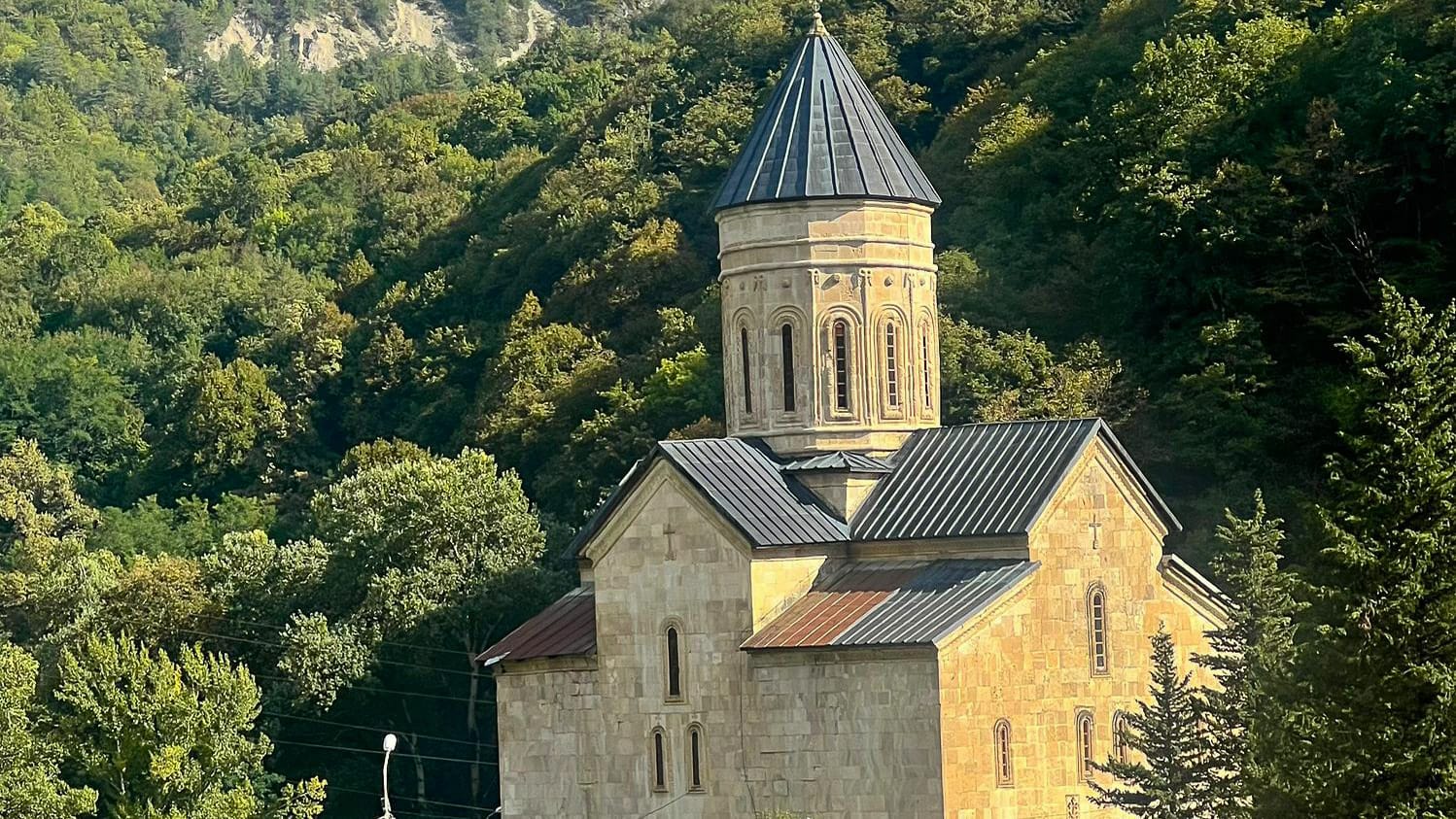


An off-the-beaten-track adventure
The Alps offer beautiful climbs, the Netherlands’ exhaustive bike paths make for relaxing getaways, and Italy’s gastro scene is a tantalising option; yet, some of you might now be seeking to test the limits of your comfort zone.
In contrast to Europe’s more popular cycling destinations, Armenia and Georgia offer something a little more under the radar.
Having cycle toured in Turkey, Central Europe, the Balkans, Canada and the USA, the challenge presented by the Caucasus called to me as an opportunity to experience new cultures, politics and landscapes.
Top tip! Despite being off the beaten track, both counties offer a useful level of infrastructure for bike travellers, which makes it easier to explore than you think.
Dramatic, scenic landscapes
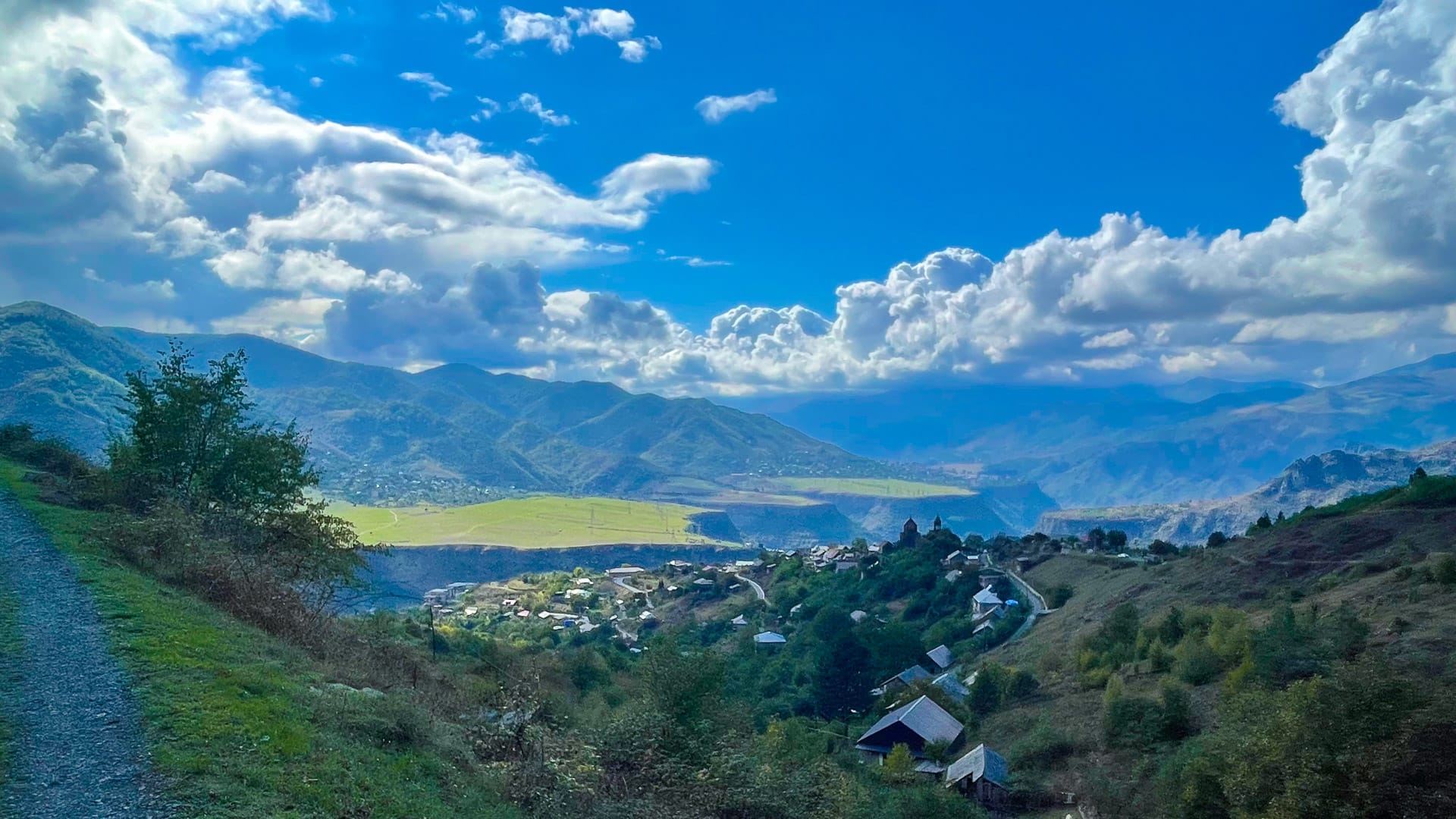
The two countries have beautiful and varied landscapes, from forested mountains to arid plains, incredible gorges and steep climbs, making for interesting and challenging riding.
Some of the standout highlights of this route include:
- Debed Canyon, Armenia: On day two of the route, you ride through Debed Canyon, a spectacular gorge on the way to the Georgian border. The road cuts steeply down into the river valley below, with houses constructed both above and below you. Along the route, you pass abandoned factories and warehouses, which have fallen into disrepair since the fall of the USSR. It feels a little eerie at first, but it offers an incredible insight into Armenia’s recent history and how its politics and culture have evolved over the last few decades. Find out more below.
- Khikhata Pass: Rising to 2,000 metres above sea level, you’ll enjoy incredible views of the surrounding greenery. You can experience it on day 6 of my Georgia cycling itinerary. Find out more below.
- Ambrolauri wine region: A lesser-known wine region located in the northwest of Georgia. Famous for producing sweet red wines. You can also experience this region on day 6 of my Georgia cycling itinerary. Find out more below.
Yet, as I quickly discovered, when travelling by bicycle, things can get tricky, and sometimes you have to think laterally! For example, my bike broke between the Armenian–Georgian border and Tbilisi, leaving me on a major highway with the nearest bike shop almost 70 kilometres away in the capital. I had to rely on a series of temporary fixes that only lasted about 10 kilometres at a time, wobbling down the road with traffic roaring past me until I finally reached Tbilisi and could get some proper assistance.
An emerging cycling destination
The region is growing in popularity amongst cyclists (including plenty of mountain bikers), who are eager to explore these previously inaccessible countries. In fact, the B&B owner told us that over the last few years, she has received a steadily increasing number of cycle tourers.
Roads leading up to mountainous areas have also been newly paved (enabling new circuits for those reluctant to brave gravel routes), there are a huge range of affordable guest houses in almost all urban centres and train connections enable you to avoid traffic-heavy areas.
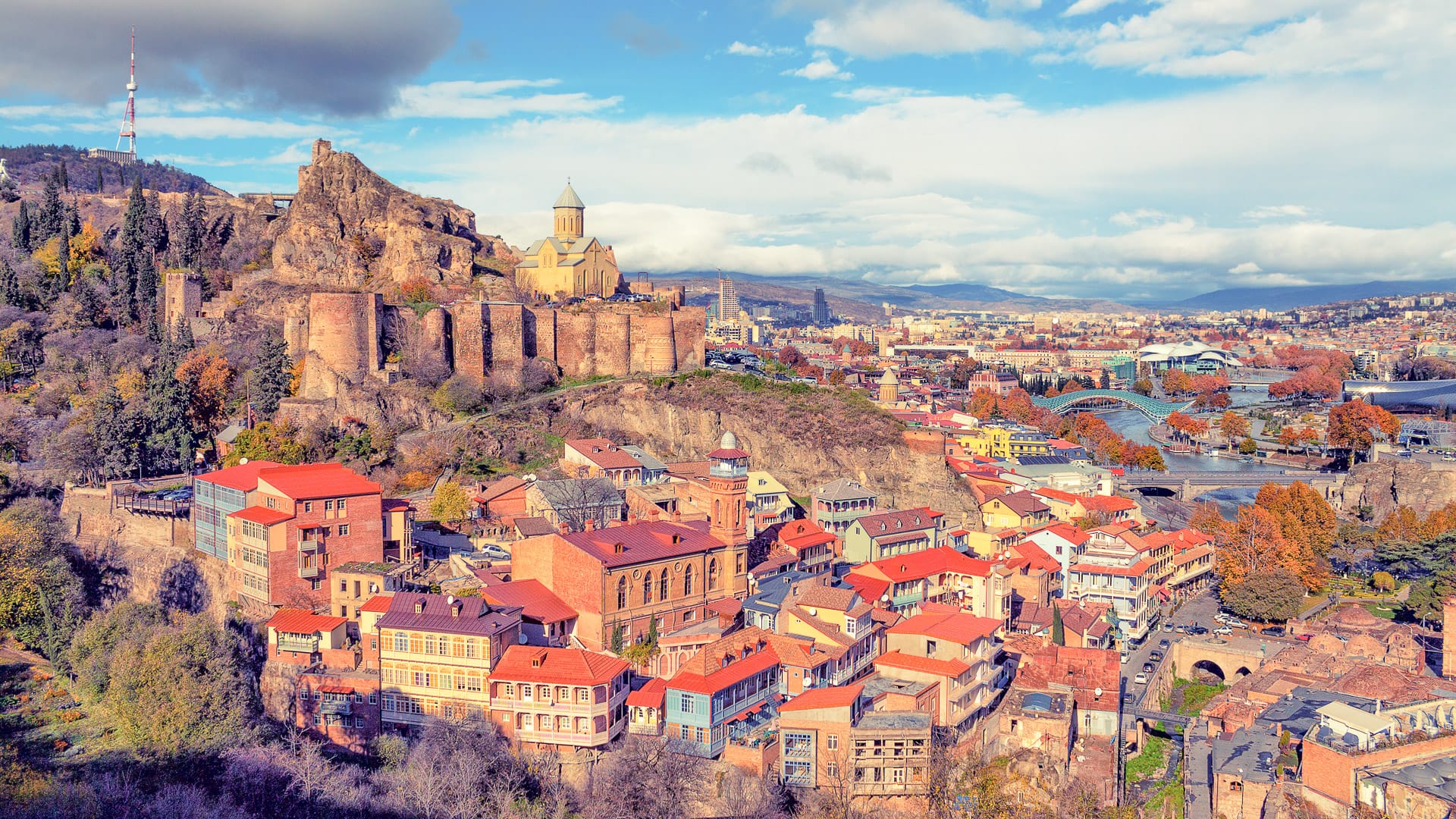
Tbilisi (capital of Georgia) and Yerevan (capital of Armenia) are both incredibly historic and cosmopolitan centres, yet distinctly different. They are also often the last stop for many who have pedalled across Europe and Turkey! So, it is not uncommon to see seasoned tourers laden with bags hanging around both capitals, often swapping intel on routes like the Goderdzi Pass, Zekari Pass, and the wilder high crossings such as Abano Pass and Atsunta Pass.
Part 3: My cycling route through Armenia and Gerogia
Day 1: Yerevan to Vanadzor (Armenia)
 This komoot route contains cookies...
I’m fine with komoot cookies
Key statistics
133 kilometres
2,020 metres of elevation gain
Overview
Leaving Yerevan, you take back roads to the junction of the main road at Hartavan to avoid the metropolitan traffic. It is a steady climb with a few steep gradients, through small villages. The dogs bark and snap at your heels for a bit, but I only had one encounter with a particularly ferocious canine. More information below.
There is a chance to stop at a lovely market and café at the junction with the main road, where you can get delicious local fruits and pastries. It is then time to head along the main road. The traffic gets heavier, but it is not too bad, and the gorgeous views of the snowcapped mountains take your mind off the passing vehicles.
You climb gently up to Pamb Pass, which sits at approximately 1,200 metres above sea level, then take the long, beautiful descent to Vanadzor. The traffic gets busier in this section, so stay alert when entering Spitak.
The town of Vanazador itself is not necessarily ‘classically’ beautiful, but as a previous industrial hub, there are some interesting pieces of architecture and a range of cheap hotel and guesthouse options.
Where I stayed
I stayed in an incredibly cheap hostel above a shop, essentially just two small rooms and a tiny toilet. At around £8 per night, it definitely fell into the “you get what you pay for” category. I wouldn’t recommend it to anyone looking for comfort, especially as the town has plenty of other accommodation options.
Day 2: Vanadzor to Alaverdi (Armenia)
This komoot route contains cookies...
I’m fine with komoot cookies
Key statistics
60 kilometres
1,360 metres of elevation gain
Overview
This section continues the descent towards the Georgian border. It is perhaps one of the most spectacular sections of biking in Armenia.
Following the snaking road, down through the gorge, you are surrounded by a lush green landscape littered with abandoned soviet factories and monasteries dotted on the hilltop, a complete contrast to the previous day’s riding. The wide, open landscape is suddenly replaced by a far more forested, narrow river valley that twists down towards the border, and the traffic noticeably tails off.
As this is a relatively short day, there is plenty of time to take in the surroundings and visit a few of the monasteries and villages which provide an insight into the country’s complex religious and political history.
There are a few small marketplaces, but the main town is Alaverdi, where you will find supermarkets, pharmacies and other stores selling essentials. It is a peculiar, but beautiful town, half of the buildings beside the river in the gorge, and the other half seated above on the hilltop.
Where I stayed
I stayed in Hagput, a village five kilometres outside of the town, in a beautiful location which overlooks the valley below. There are many cheap guesthouses to choose from here, as the village’s monastery is a leading attraction for tourists.
I opted for Mary’s Guesthouse, a characterful B&B run by a mother and daughter who make cyclists feel genuinely at home. Expect an excellent, hearty breakfast and, if you’re lucky, an evening piano performance from the mother.
But beware! You do have to cycle up 600 metres in elevation to reach the village. It’s worth it, though.
Day 3: Alaverdi to Tbilisi (Armenia and Georgia)
This komoot route contains cookies...
I’m fine with komoot cookies
Key statistics
111 kilometres
1,380 metres of elevation gain
Overview
Be aware! This section is likely to require gritted teeth as we found the traffic increased and the drivers grew more erratic as we neared the Georgian capital. I was warned about Georgian drivers, but I wasn’t quite prepared for their speed and… ‘agility’ with the steering wheel.
I cycled around 25 kilometres to the border, where passport control does not take too much time (disclosure here that I am white and have a British passport and am therefore never usually asked any pressing questions – except for where my husband is).
The only really direct option for getting into Tbilisi is along the main road. This directs you through a few urban centres, where the volume of traffic increases every few kilometres. It is therefore not the most thrilling or beautiful section of the route. But a necessity if you wish to visit the capital, which really is worth it! More on this below.
Where I stayed
I suggest staying at Fabrika, a large central hostel in Tbilisi with ample storage for bicycles. What was once a soviet sewing factory has been converted into a beautiful hostel and multipurpose hospitality space, accommodating 400 people!
Day 4: Tbilisi to Gori
This komoot route contains cookies...
I’m fine with komoot cookies
Key statistics
86.5 kilometres
900 metres of elevation gain
Overview
Be aware! Unfortunately, the density of traffic continues as you exit the city, and it is difficult to avoid. However, once you reach Mtskhate (a beautiful suburb to the north) it quietens down, and you enter the Georgian countryside which attracts many tourists.
Continuing to Gori takes you along an undulating road, passing through many nice villages. I particularly remember Alaverdi, Tumanyan and Haghpat, which are all lovely towns built into the hillsides. Gori itself is a great city to visit for an evening. The fortress on the hill is the main attraction, and visiting at sunset makes for a great view of the town and the surrounding region.
Where I stayed
I stayed at the wonderful Nitsa guesthouse in the city centre, run by a woman who provides the warmest of welcomes to her customers and has hosted travellers from across the world.
Day 5: Gori to Sachkhere (Georgia)
This komoot route contains cookies...
I’m fine with komoot cookies
Key statistics
98 kilometres
1,090 metres of elevation gain
Overview
The day begins by following the backroad used to get to Gori. Again, it is an undulating route travelling through some lovely small villages.
As we pedalled, locals were busy harvesting their grapes from vines which hung majestically across their front yards. There are a few places to stop for food and drink along the 40-kilometre stretch to where this road crosses the main highway. After this, you climb gently (approximately 300 metres) along a beautiful river valley.
Be aware! Whilst we found less traffic than in previous sections, drivers still thundered along the winding road, sometimes gliding perilously close to us. There are a few steep hills until you get to whizz down to the town at the bottom of the valley. The road is paved, but there were renovations underway while we were there. This meant that many sections required pedalling over gravel.
Where I stayed
When in Sachkhere, I suggest staying at the Shalvaseuli guesthouse. The owner produces his own wine (which is incredible) and can cook guests’ dinner (also incredible). The price includes breakfast, which again is superior to any high-priced restaurant you might find.
Day 6: Sachkhere to Ambrolauri (Georgia)
This komoot route contains cookies...
I’m fine with komoot cookies
Key statistics
71 kilometres
1,860 metres of elevation gain
Overview
Today is perhaps the highlight of the trip – and maybe also the toughest!
Leaving Sachkhere, you climb steeply to 2,000 metres, over the Khikhata pass towards Oni.
This road provides incredible views of the surrounding mountains, and has only just finished being paved. With over 25 kilometres of continual switchbacks, it is not for the fainthearted. However, the ride down the other side, with the Georgian countryside below, is well worth the effort.
It is then a gentle 25 kilometres down to Ambrolauri, a small wine-producing area, where there are plenty of affordable accommodation options.
Top tip! For those interested in exploring Georgian wine production, this may be a place to take a rest day and visit the wineries which line the valley. There are tours available, and information can be found at the tourist information office in the town centre.
Where I stayed
I stayed at the AMBROssador guesthouse. While it’s certainly not quite what’s advertised on Booking.com, the owner is a lovely host who serves a wonderful, filling breakfast and is happy for you to sample his homemade wine. There’s plenty of space in the yard to store bikes undercover, making it a practical and welcoming stop for cycle tourers.
Day 7: Ambrolauri to Kutaisi (Georgia)
This komoot route contains cookies...
I’m fine with komoot cookies
Key statistics
76 kilometres
570 metres of elevation gain
Overview
Having recovered from a tough day climbing, it’s time to start all over again. Climbing 700 metres out of the town and over the hill, it’s a steep, but bearable ride towards the Shaori reservoir. After summiting, you are then treated to 10 kilometre downhill into the town of Tqibuli.
There are a few supermarkets and a roadside coffee kiosk here, before it’s time for a short climb and a slow descent into Kutaisi. This beautiful city was once the country‘s capital of Georgia and straddles the Rioni River. It is full of cobbled streets, churches and squares.
Where I stayed
There are plenty of places to stay and eat. I suggest the Gantiadi guesthouse, as there is ample space for your bike in the backyard, the rooms are lovely and the owner is a sweet woman.
Day 8: Kutaisi to Tbilisi via train (Georgia)
Overview
If you have time and want to see more of the country, continuing on the Black Sea and Batumi is the obvious next step. However, we returned to Tbilisi via train.
Be aware! You could attempt to cycle back, but this involves a major highway, which, after experiencing Georgian driving… you will likely want to avoid.
Train to Tbilisi
Now for the difficult part. It took a significant amount of sleuthing to understand the regulations around getting a bike onto a train in Georgia. Some said it wasn’t possible, others said it was easy. According to the railway operating company, the bike needed to be ‘packaged’… but a box was ‘not necessary’.
Armed with this cryptic information, we purchased a large piece of bubble wrap and simply wrapped our bikes – fully assembled – in the plastic film (see image). Essentially a wildly wasteful and environmentally irresponsible performative measure; nonetheless, it was good enough for the conductors who were super helpful in finding a place for the bicycles on the train. Top tip! Don’t forget to have five Lari to hand to pay the conductor!
The train runs three times per day to Tbilisi, with tickets purchasable online or at Rioni train station (a 10-kilometre cycle out of Kutaisi centre).
Although not bike-friendly, Tbilisi is a great city to spend some time in at the end of your tour, and you will meet many fellow cyclists doing the same thing.
I then returned to Yerevan via the night train, and my father returned to the United Kingdom by plane from Tbilisi.
Where I stayed
I suggest staying at Fabrika, a large central hostel in Tbilisi with ample storage for bicycles. As mentioned earlier, what was once a soviet sewing factory has been converted into a beautiful hostel and multipurpose hospitality space, accommodating 400 people.
Part 4: Practicalities for cycling in the Caucasus
What is the best time to go cycling in Georgia and Armenia?
I rode this route at the end of September, which I’d say is an ideal time if you want to avoid the region’s brutal summer temperatures. Days were generally mild to warm, with temperatures between about 13–25°C, but we did have some rainy days, especially when climbing into the Georgian mountains.
Top tip! Incase you encounter bad weather along the way, it is worth noting that every village you ride through has a bus stop. These spaces provide the perfect place for sheltering from the elements when needed.

The mountain landscape of Alaverdi in Armenia
How do you stay safe whilst cycling in heavier traffic?
As mentioned several times in this article, for those who have not cycled in traffic-heavy European regions, braving the Georgian and Armenian roads by bike will take a while to get used to. This is putting it mildly.
In all honesty, you will need to be able to hold your nerve as cars and trucks brush past, overtake one another on hairpin bends, and attempt U-turns right in front of you.
Ensuring you stay visible (I wear a hi-viz jacket) and paying attention to your surroundings can help prevent nasty accidents.
Be aware! Leaving Tbilisi is perhaps the worst section, and it is not until around 50 kilometres outside of the centre that the traffic begins to dissipate. For this reason, we took the train back to Tbilisi, rather than pedalling the busy highway back.
Is there cycling-friendly accommodation along the route?
Make the most of the guesthouses. I would suggest staying in the cheap, yet incredibly welcoming, Georgian guesthouses, which can be found in almost every town.
For around £10 per night, you can find a large, clean room and a delicious breakfast. I would therefore avoid Airbnb if you want to experience the warm hospitality which Georgia is famous for. Ensure you have cash to pay.
In terms of bike storage, some guesthouses had inside areas where I could safely keep my bike overnight. However, as on any cycle tour, you should also be prepared to lock your bike up outside from time to time. In the rural areas in particular, I never felt my bike was vulnerable to theft, but I’d still recommend bringing a decent lock for peace of mind.
What bike is best for cycling in Georgia and Armenia?
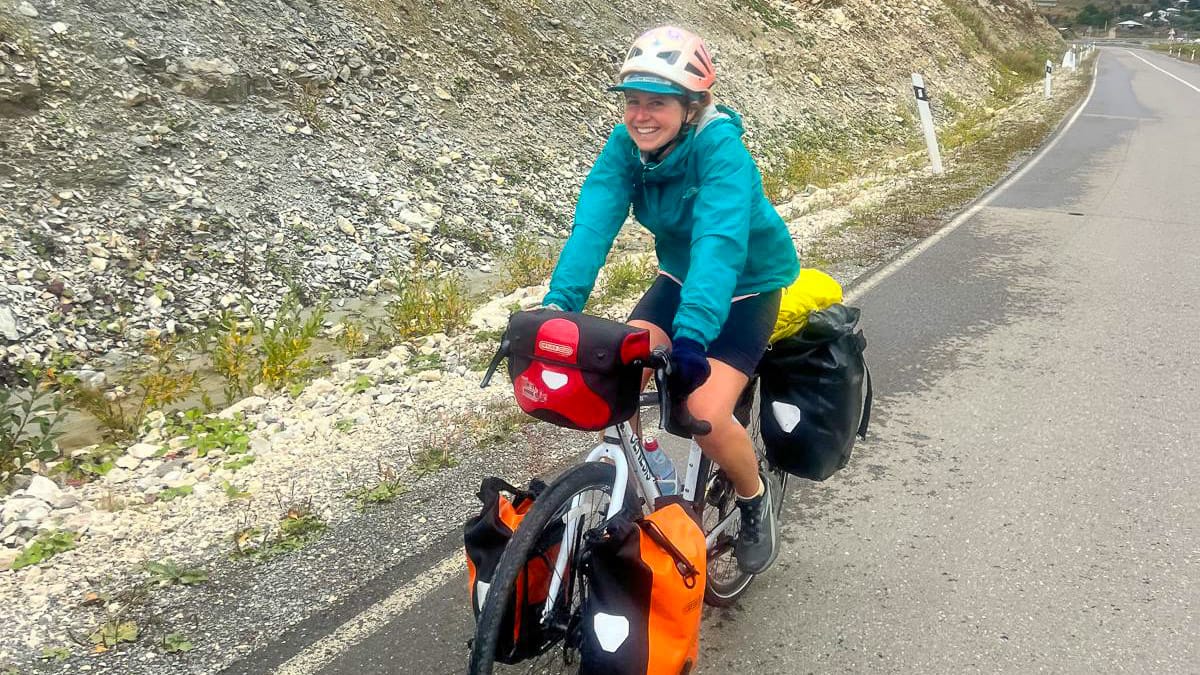
I rode the route on my own Genesis Croix de Fer, a second-hand gravel bike that’s about ten years old but has proved really resilient for touring. I didn’t look into hiring locally, so I’d recommend bringing a bike you already know and trust if possible. This tour is also possible on a road bike, but it needs to be robust enough to carry panniers.
Can you take your bikes on public transport?
Taking your bike on the trains is possible, but not simple! Patience and good humour go a long way when attempting to transport your bike around Armenia and Georgia.
Be aware! Official websites will not provide you with any information, so you need to email or call them directly.
A clear example was attempting to transport my bike back to Yerevan via the night train. Having emailed the Armenian railway, I was informed that it required buying two separate bed tickets (in the same compartment), and the bike had to be wrapped in plastic.
However, to purchase two tickets, you need two passports, as the Tbilisi ticket office will not sell two tickets to one individual. I was lucky that somebody allowed me to borrow their passport to complete the transaction – and honestly, I’m not sure how one would get around it without this!
It took an hour haggling with the railway office staff to sell me two tickets. Then, when I boarded the train (bike wrapped in plastic as instructed), nobody batted an eyelid. So just trust the system!
Here are some useful contacts:
- Armenian Rail can be contacted at: mail@railway.am
- Georgian Railways can be contacted on: Railway@railway.ge

Bike stored in the night train back to Yerevan (photo credit: Isobel Duxfield)
How did you get to Armenia and Georgia?
I started the trip in Yerevan, flying in from Calgary (I had just finished touring in British Columbia and Alberta).
From the Armenian capital, I pedalled alone towards Tbilisi, where I met my father. After this, we headed west into the mountains.
I then returned to Yerevan with a mixture of cycling and train travel (see above).
Be aware! From this review, you will find is possible, but not necessarily a simple process to navigate.
Any highway code and travel information I should be aware of?
As ever, it’s a good idea to check current travel information before you book and travel. At the time of writing, the South Ossetia and Abkhazia regions of Georgia are occupied by Russia; these are areas that UK government advises against all travel. They also advise against all travel along the border between Armenia and Azerbaijan. For UK visitors, the UK government travel information page for Georgia is here and for Armenia is here.
You should also read and follow Georgia and Armenia’s highway code.
Do you need any travel vaccinations and insurance?
Make sure you have all the recommended travel vaccinations and consider whether malaria precautions are necessary.
Ensure you have comprehensive travel insurance that covers all the activities you plan on undertaking.
Part 5: Tips for bike rides in Georgia and Armenia
What do you need to be aware of culturally?
I found most people in Georgia and Armenia to be incredibly generous and accommodating. Guesthouse owners would ply me with homemade wine and local delicacies, and more than once, a driver stopped to help me fix my bike. However, the hospitality felt quite different to what I’d experienced in Canada and North America (where I had just come from). Rather than lots of gushing niceties, people tended to be more reserved at first, and you often have to gain their trust before they properly open up. As a cyclist, it’s worth being aware of this so you don’t mistake that initial reserve for unfriendliness. Once you’ve broken the ice, the welcome is warm and genuine.
How much time do you need for this tour?
For cyclists who are comfortable covering around 100 kilometres a day, this tour can be completed in roughly seven days. However, I’d really recommend allowing extra time if you can. The region around Ambrolauri, for example, offers some fantastic wine tours (if that’s your thing) and great hiking. It’s well worth taking a rest day or even two there to explore.
Tbilisi is also a beautiful city, and it would be a shame to miss out on what the capital has to offer, so I’d factor in at least one full day off the bike to wander, eat and soak up the atmosphere.

Stopping for lunch on the way to Sachkhere (photo credit: Isobel Duxfield)
Do you need to do any training to ride the route?
Given the amount of climbing on this route, I’d definitely recommend doing some training beforehand. In particular, try a few rides with more than 600 metres of elevation gain to check you’re comfortable with long climbs, especially if you’re eyeing up Khikhata Pass. That said, this tour isn’t as committing as riding in western Canada, where you often need to cover at least 100 kilometres a day and carry a tent because there’s very little between major towns. In Georgia and Armenia, accommodation is more frequent, so if you’re not confident about riding big distances every day, it’s easy to apportion the trip into shorter daily sections and spread it over more days.
What gear do you need for the route?
For this tour, my setup included the following key items:
- Solid panniers: I used a set of rear and front panniers from Ortlieb
- Handlebar bag: I also used the Ortlieb handlebar bag
- Sleeping bag: I used the RAB Neutrino
- A sturdy tent: I brought the MSR Hubba Hubba two-man, which allows me to store my belongings inside, thus keeping them safe and dry. I did not use this on this trip, but it was useful for ensuring I had an alternative if no other accommodation was available.
- Small multitool: This is essential for roadside tweaks and fixes.
- Dependable waterproofs: I invested in a new Patagonia Torentshell and also purchased a pair of Vaude overshoes.
- Lights and high-vis jacket: I completed this tour in September, when the sun begins to set much earlier. These are needed for ensuring you stay seen while on the road.
Don’t miss our in-depth guide to what to pack on a cycling holiday for more ideas.

Sheltering from the sun on the way out of Tbilisi (photo credit: Isobel Duxfield)
Do you need to speak the local language?
In the more rural regions of Armenia and Georgia, most people I met did not speak English, and Russian tended to be the most common second language. I found English was more widely spoken in Georgia.
I relied a lot on Google Translate, which was perfectly adequate for getting around and making myself understood. It’s helpful to arrive with an open, patient attitude and be ready to gesture, smile and take your time. You don’t need to be fluent in the local languages to enjoy the trip.
Do you need to carry cash?
The trip cost approximately £200 in total (excluding flights). I’d definitely recommend carrying some cash, especially for roadside market stalls and small local shops, where cards aren’t always accepted. Most of my accommodation could be booked and paid for online, but having cash as a backup made things much easier and meant I never had to worry about being caught out.
What food and drink should you try?
I tried as much local food as I could. I’m usually vegetarian, but when I cycle tour, I allow myself to eat meat, as in many regions there are very few alternatives. I’d really recommend khinkali (dumplings) and mtsvadi (skewers), as well as the famous cheese-filled bread, khachapuri. These are all absolutely incredible after a tough day in the saddle. At guesthouses, we were often treated to amazing fried vegetables, homemade wine and local honey, so it’s well worth keeping an eye out for these, too, and saying yes when your hosts offer you something to taste.

A traditional Georgian dinner (photo credit: Isobel Duxfield)
Can you easily refuel along the route?
Don’t expect coffee shops every 30 kilometres in the same way you find in Southern or Western Europe.
However, you are able to find small markets, bread shops and fruit stands to keep you going.
What should you do if you encounter a stray dog?
Be aware! Stray dogs are a mainstay of urban and rural life in the region, so cycling here demands the ability to stay calm when faced with a pack of canines yapping at your heels. However, I found them to be far less aggressive than those I encountered in Turkey and Greece.
Top tip! Stay calm and pedal past any you encounter slowly. You may even meet big livestock guardians like Caucasian shepherd dogs in rural areas. Give them plenty of space.
Is it possible to ride this route as a solo female?
Touring as a solo female is something I have written about extensively in previous blogs and articles. I have encountered very few problems with personal safety and security, particularly while travelling in regions which many might suggest are ‘unsafe’ for women to cycle alone.
On the whole, I did not feel particularly threatened and was encouraged and welcomed by those I met. However, as mentioned earlier, I was riding the route with my father.
Nonetheless, I cannot refute that there were a handful of instances which made me question my choice to attempt sections of the route solo. I rode solo from Yerevan to Tbilisi, and then continued the journey around Georgia with my father.
In Canada and Europe, I frequently hitchhike if I encounter serious mechanical issues which require professional assistance. Following a scary encounter on the road in Georgia, I would suggest against women doing this here.
Discover more useful solo cycling tips for women in this in-depth article.
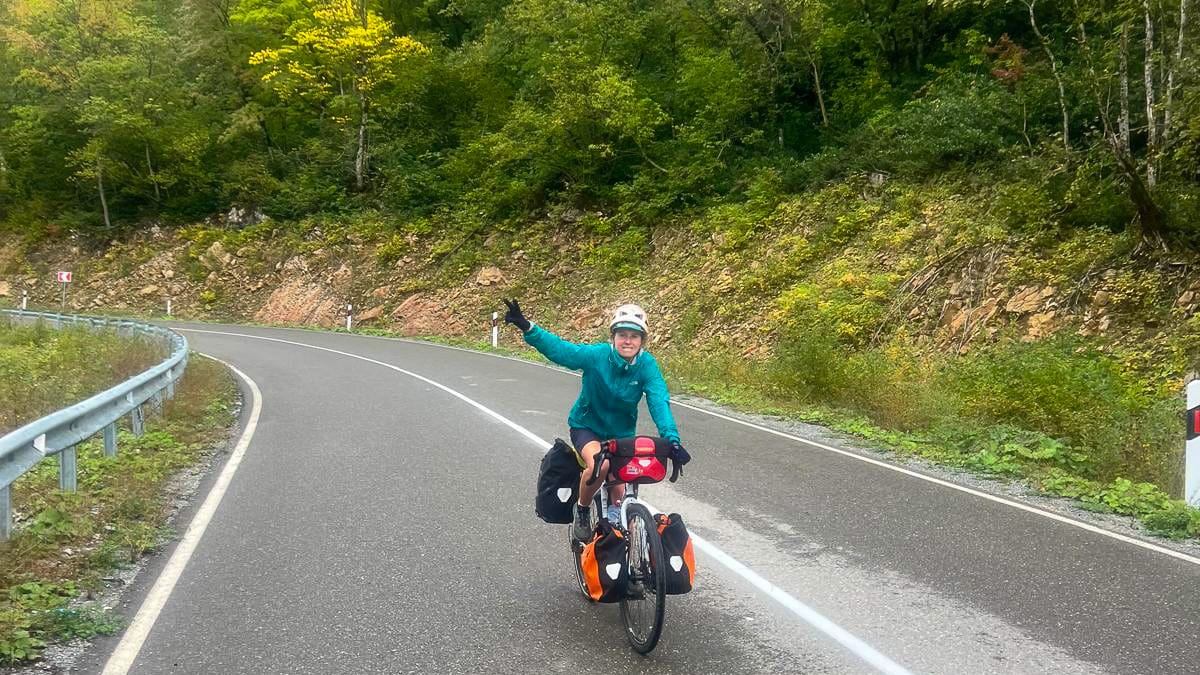
Gliding down the hill (photo credit: Isobel Duxfield)
Is it worth extending your trip to spend time in Tbilisi?
I’d definitely recommend adding at least an extra day to spend in Tbilisi. It’s a historic city with a beautifully preserved old town, winding streets and incredible churches. I took a full day to wander around the city and visited the Holy Trinity Cathedral, the futuristic Bridge of Peace, the Botanical Gardens and the Kartlis Deda statue looking out over the skyline. It’s a brilliant place to relax, eat good food and soak up some culture before or after your time in the mountains.
What’s next?
A huge thanks to Isobel for sharing this fantastic bike ride through Georgia and Armenia! We think this sounds like an incredible adventure for intrepid cyclists seeking something a little bit different.
Have you tried Georgia bikepacking, or cycling in Armenia? We’d love to hear from you! Drop us a comment below.
Want to hear more from Isobel? Don’t miss:
- Biking Canada from Calgary to Vancouver: Cycling itinerary + tips
- Cycling Vancouver to Prince Rupert (via Whistler + Vancouver Island): British Columbia, Canada itinerary
- Solo cycling: tips for where to stay + staying safe
Please support Epic Road Rides
A huge amount of time and effort goes into the article you’ve just read, all with the aim of helping you!
If you found what you’ve read useful, I’d really appreciate it if you dropped something in the tip jar here.
It’s a way you can say thank you and help us carry on creating top quality content with no annoying ads and no pay wall.
Got a question for Isobel?
Fill out this form and we will send it to Isobel. We aim to get you an answer within 24 hours where possible!Isobel has cycled in many countries around the world, sometimes solo, sometimes with company. She has combined cycling with other ways of experiencing the world, hauling her surfboard on her bike down the west coast of America and lugging rock-climbing gear around Canada and Turkey.
She now works for the Campaign for Better Transport, the national transport organisation working across England and Wales to make transport better, greener and fairer.
All metrics in this article are approximate.
First Published: 09 March 2026
The contents of this website are provided for general information purposes only. It is not intended to amount to advice and you should not rely on it. You should carry out your own due diligence and risk assessments and take professional advice. Views expressed by interviewees or other users of this website do not necessarily represent our views. We make no representations, warranties or guarantees, whether express or implied, that the content on our website is accurate, complete or up to date. If you use any information or content on this website, download from, or otherwise obtain content or services through our website, it is entirely at your own discretion and risk. Epic Road Rides Ltd disclaims all liability and responsibility arising from any reliance placed on the information and content on this website. Find out more here.
Comments