

The French Alps and French Pyrenees are France (and probably Europe’s!) two most famous mountain ranges. As a result, we often get asked about the Alps vs. Pyrenees comparison and which is best for a cycling holiday. I’ve ridden in both mountain ranges while researching destinations for Epic Road Rides, and while each offers famous climbs and serious days in the saddle, the experience on the bike can feel very different.
The Alps are probably more famous than the Pyrenees, in part due to their strong winter season reputation. They are home to a vast choice of cycling regions, famous passes and established bases, including Alpe d’Huez the most famous cycling climb in the Alps.
In comparison, the Pyrenees feel wilder than the Alps. The riding is tough: gradients can be unpredictable, roads are often narrower and steeper than in the Alps, and fickle mountain weather can add another challenge. For cyclists who enjoy quieter roads and a sense of adventure, that is part of the appeal. The Pyrenees are also not lacking cycling heritage: around the Col du Tourmalet in the western French Pyrenees, climbs including Hautacam, Luz Ardiden, the Col d’Aspin and Col d’Aubisque pack a huge amount of cycling history into a relatively small area.
So which should you choose?
In this guide, I compare the climbs, scenery, crowds, weather, accessibility and cycling bases in the Pyrenees and the Alps, to help you decide which better suits the kind of cycling holiday you have in mind.

Clare Dewey is a cyclist with a passion for travel. She set up epicroadrides.com in 2018 to help make it easy for cyclists to explore the world by bike. Today her mission is still inspiring cyclists to discover new places on two wheels - and doing what she can to make sure they have the best possible time while they're there. Clare has visited 50+ destinations around the world, many of them by bike.
Want to connect with Clare? Find her over on LinkedIn.
Always check current travel information and advice. For visitors from the UK, the UK government travel information pages are here.
In this article we focus on the Alps and Pyrenees in France. We refer to Alps as a shorthand for the French Alps and Pyrenees as a shorthand for French Alps. Of course both ranges extend beyond France.
The tour at a glance
If you’re short on time here is the comparison at a glance:
| Alps | Pyrenees | |
|---|---|---|
| Altitude | Higher mountains and higher roads | Generally lower, with fewer roads and peaks above 2,000 metres |
| Landscape | More open, with higher mountains and more ski resort development | Greener, more enclosed and secluded, with forests, rivers and traditional villages |
| Climbs | Often longer and more gradual | Broadly shorter and steeper, often with unpredictable gradients |
| Tour de France history | Strong Tour heritage, including climbs such as the Galibier and Alpe d’Huez | Rich Tour history, including the Tourmalet, Aubisque, Aspin and Peyresourde |
| Visitor levels | Generally busier, with more visitors | In our experience, quieter and less commercialised |
| Development | More established ski resorts and larger-scale visitor infrastructure | More small-scale villages, guest houses and B&B-style accommodation |
| Access | Generally easier to reach, particularly via Geneva and Lyon | Often requires more planning, with Toulouse or Lourdes common gateways and onward transfers |
| Cycling bases | Wider choice of established cycling centres, accommodation and bike-hire services | Smaller bases such as Argelès-Gazost, Luz-Saint-Sauveur and Gavarnie |
| Weather | Generally drier than the Pyrenees, though conditions still vary with altitude | Wetter, particularly in the Western Pyrenees, with fast-changing mountain conditions |
| Best suited to | Riders looking for higher mountains, longer climbs, easier access and more established cycling infrastructure | Riders looking for quieter roads, steeper climbing, greener landscapes and less development |
Alps vs Pyrenees: what are the key differences for cyclists?
Altitude
In summary: The Pyrenees are generally lower and more compact, while the Alps reach higher elevations and often feature longer climbs.
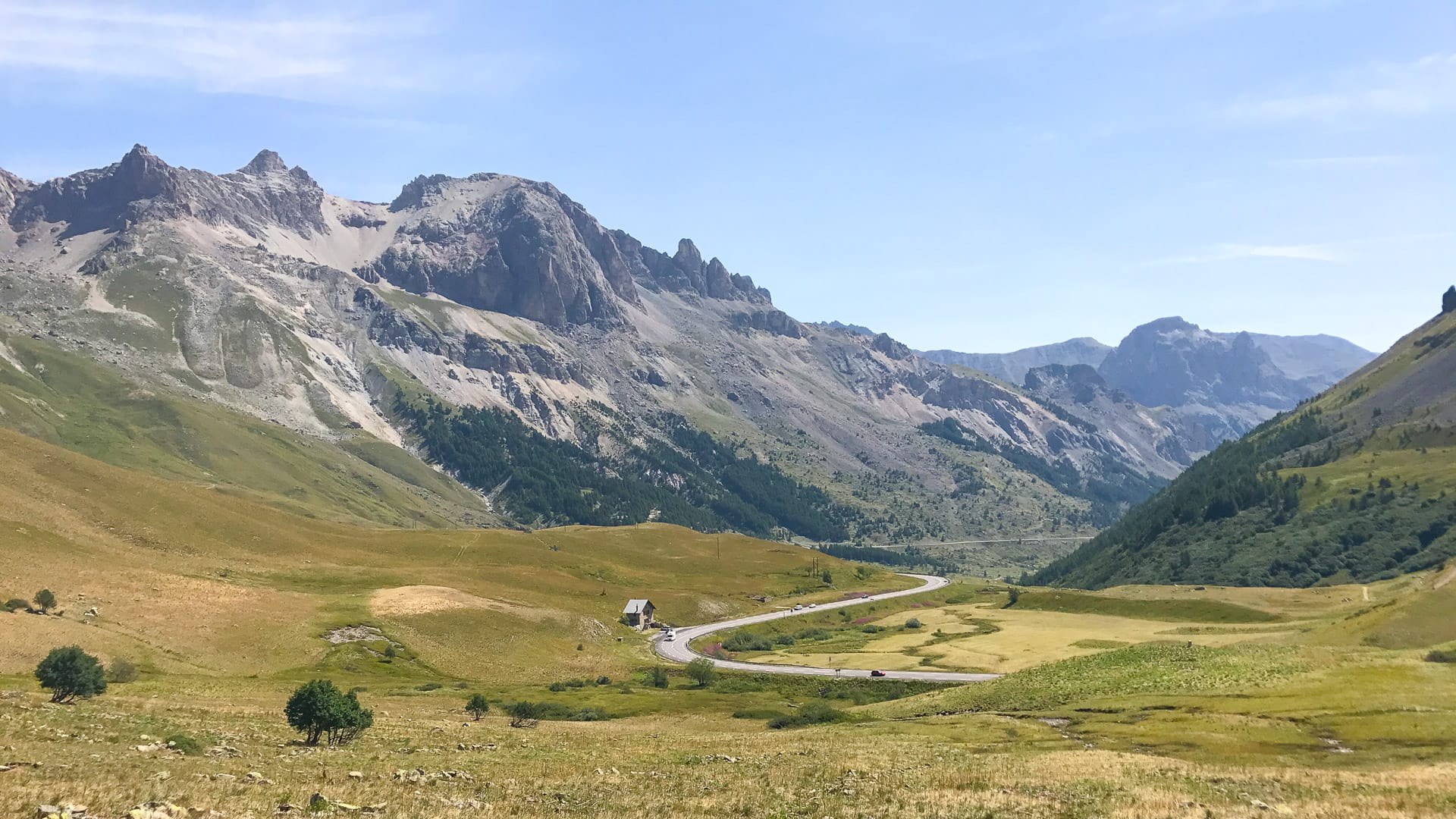
The Pyrenees are generally lower in altitude than the Alps, with far fewer peaks extending above 2,000 metres. This means the peaks in the Pyrenees don’t glisten with snow in summer; the higher terrain has a more verdant, craggy and moorland-like feel.
This difference in altitude is worth considering when planning an Alps or Pyrenees cycling trip. The Alps generally offer higher roads and longer individual climbs, while the Pyrenees can feel more compact and intense.
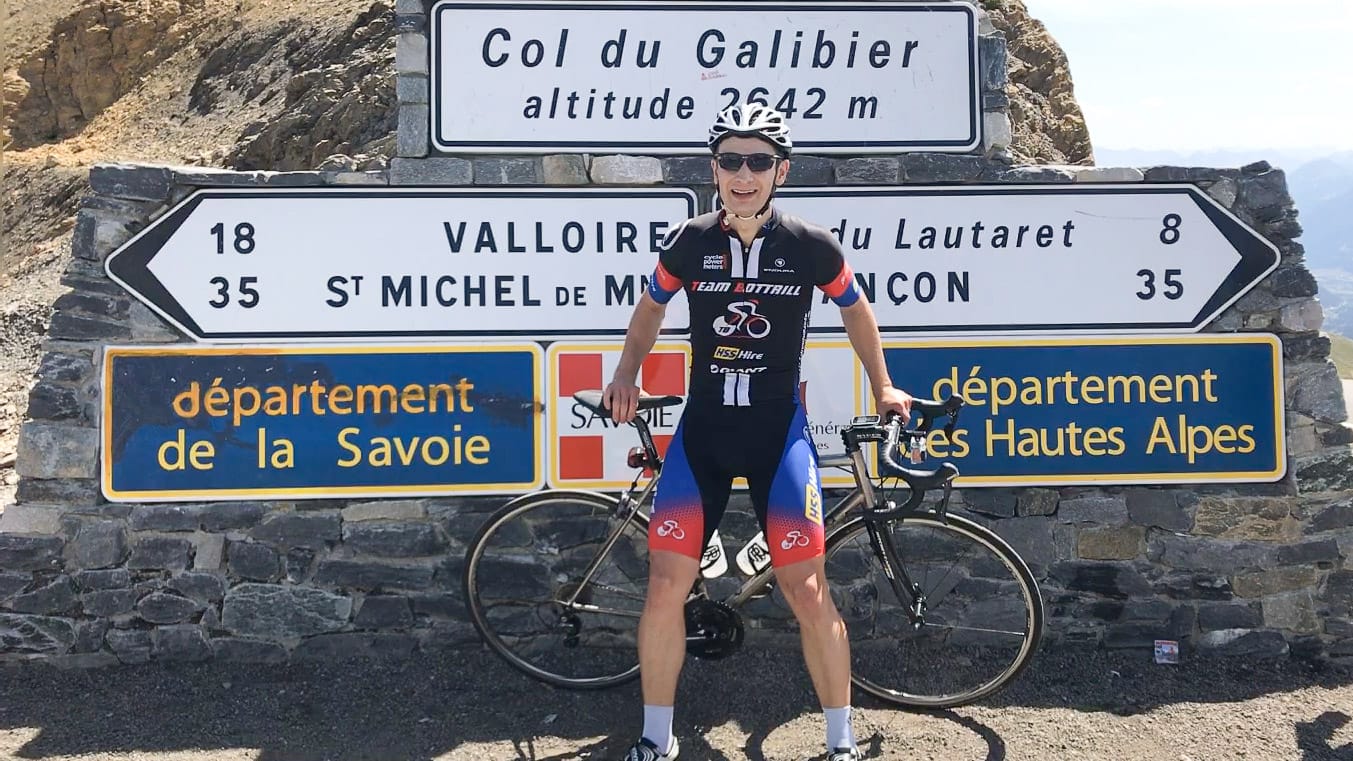
The highest Alpine mountain passes tend to reach greater elevations, with roads such as the Col du Galibier, Col de la Madeleine and Col de la Loze among the best-known examples. The mountain passes of the Pyrenees generally sit lower, but they can still deliver demanding gradients and highly changeable conditions.


Landscape
In summary: The Pyrenees tend to feel greener, more enclosed and secluded, while the Alps feel higher and more open.
The landscape also has a noticeably different character. When cycling the Pyrenees, you are often surrounded by dense forests, rivers and streams, with traditional villages tucked into the valleys. Around Gavarnie, the scenery becomes especially dramatic, with towering walls of rock rising above the surrounding greenery.
Around the central French Pyrenees, landmarks such as the Pic du Midi add to the distinctive mountain backdrop. This is also some of the wildest country in the range. Brown bears still live in the Pyrenees, with their population concentrated mainly in the central massif. They are elusive and rarely seen, but their presence adds to the sense that these mountains remain genuinely wild.
By comparison, cycling the Alps can feel bigger and more open, with higher mountains and extensive ski resort development. Both regions are spectacular, but the Alps tend to offer a greater sense of scale, while the Pyrenees often feel greener, more enclosed and more secluded.
That sense of seclusion is one of the biggest attractions of cycling in the Pyrenees. The region is home to some of cycling’s most famous roads, yet the surrounding landscape can still make you feel as though you have escaped deep into the mountains.
Climbs
In summary: Pyrenean climbs tend to be shorter and steeper, while Alpine climbs are often longer and more gradual.
The climbs in the Pyrenees may start at a lower altitude, but they are still incredibly challenging. The region contains some of the Tour de France’s most feared roads.
Broadly speaking, cycling climbs in the Pyrenees tend to be shorter and steeper. Think of the legendary Hautacam and Luz Ardiden climbs, for example.
By comparison, cycling climbs in the Alps are often longer and more gradual. Alpe d’Huez is perhaps the best-known Alpine example, with its 21 numbered hairpin bends forming one of road cycling’s most recognisable climbing experiences.
The Alps generally take you to higher elevations, while the Pyrenees can deliver a more compact and intense climbing experience. However, these are broad differences rather than firm rules. The Col du Tourmalet, for example, is a long climb where riders can settle into a steady rhythm, particularly when approaching from Luz-Saint-Sauveur.
The lower altitude of the Pyrenees should not be mistaken for easier riding. Climbs such as the Tourmalet, Col d’Aubisque, Hautacam and Luz Ardiden still involve sustained effort, significant elevation gain and demanding mountain conditions.
Look beyond the headline climbs and you will also find quieter roads such as the Col de Spandelles. Forested slopes, little traffic and a real sense of solitude can make these lesser-known climbs feel very different from the busiest Alpine cycling roads.
Whether you are interested in independent cycling trips or organised guided tours, both regions offer enough variety to build a challenging week around a combination of famous climbs and quieter roads.
For more detail, explore our in-depth guides to the climbs and cycling regions mentioned in this article:
Alps:
- Cycling in the Alps: an overview of the best Alpine cycling destinations
- Cycling Alpe d’Huez (and surrounds): your ultimate guide
- Alpe d’Huez cycling climb, French Alps
- Col d’Ornon loop, French Alps
- Col de Sarenne, French Alps
- Croix de Fer and Glandon (from south), French Alps
- Cycling Lauteret and Galibier (from south), French Alps
- Saint-Christophe-en-Oisans and La Bérarde, French Alps
- Villard-Reculas loop,French Alps
Pyrenees:
- Cycling in the Pyrenees: an overview of the Pyrenees from a road cyclist’s perspective
- Cycling Col du Tourmalet region, French Pyrenees
- Col du Tourmalet and Col d’Aspin
- Col d’Aubisque via Col des Bordères and Col de Soulor
- Cycling Col de Peyresourde region, French Pyrenees: your ultimate guide
- Little known climbs: Col de Couraduque, Bordères and Lac d’Estaing
- Trans Pyrenees route: Expert tips for your Pyrenees cycling tour
- TdF finishes: cols Hautacam, Luz Ardiden (and Cauterets)
- Pyrenees cycling holidays (for gravel cyclists): the inside guide to planning a trip


Tour de France history
In summary: Both ranges are deeply connected with the Tour de France, although the Col du Tourmalet has been crossed more often than the most frequented Alpine pass, the Col du Galibier.
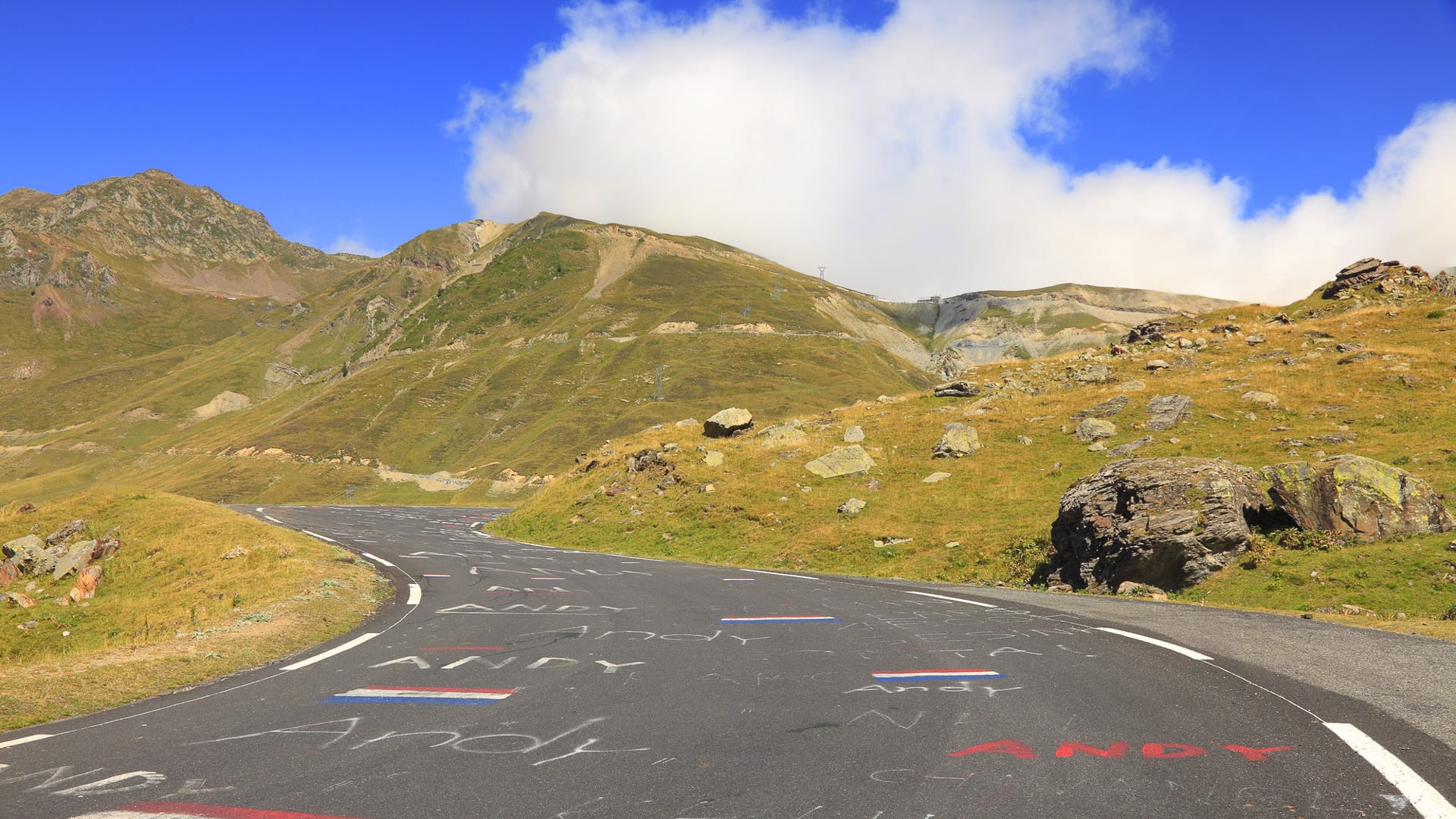
The Tour de France has helped turn climbs such as the Col du Tourmalet, Col d’Aubisque, Col d’Aspin and Col de Peyresourde into some of the best-known roads in professional cycling.
The Tourmalet has an especially remarkable history. It first appeared in the race in 1910 and, following its return in 2026, has now been crossed 87 times.
By comparison, the Col du Galibier, the most frequently crossed Alpine pass in Tour de France history, has featured 64 times.
For more information, take a look at these articles:
- 10 iconic Tour de France climbs + tips to ride them
- Tour de France cycling tours in 2026: behind the scenes of cycling’s biggest race
- Tour de France Nice: ride the TdF 2024 routes, tips + how to plan your own Nice bike tour
- Watching the Tour de France in person: essential tips for following the Tour de France!
- L’Étape du Tour 2026: expert tips for riding the Étape 2026
Number of visitors
In summary: The Pyrenees feel quieter and less commercialised, while the Alps attract more visitors and can feel busier.
In my opinion, the Pyrenees feel less commercialised than the Alps; there’s less building and less in the way of ski resorts and traffic. We’ve found cycling in the Pyrenees to be a lot quieter than cycling in the Alps.
That quieter atmosphere is one of the clearest differences between the two regions. Despite the Pyrenees’ close association with the Tour de France, many of their mountain roads can feel surprisingly peaceful, even during the summer.
You may still meet local riders and professional teams, but cyclists are spread across a wide network of climbs and valleys. This can make the roads feel much less crowded than you might expect from such an iconic cycling destination.
Even roads connected with cycling legends and famous Tour de France moments can feel surprisingly calm away from the busiest dates and locations.
Our theory is that this has something to do with the fact that the French Alps are close to the borders with Germany, Italy and Switzerland, so they get many more visitors from other countries in mainland Europe. In contrast, the French Pyrenees only share a border with Spain.
Development
In summary: The Pyrenees have a smaller-scale village feel, while the Alps are home to more large-scale ski resorts with more visitor infrastructure.
The style of development also shapes the experience. Many famous Alpine bases are established ski resorts, with larger-scale accommodation and more visitor infrastructure. This can be convenient, but some resorts feel quite built-up and “high rise” outside the ski season.
The Pyrenees tend to retain more of a village atmosphere. Smaller hotels, guest houses and B&B-style accommodation are more common, while local markets, traditional buildings, rivers and working communities remain a visible part of the experience.
That does not mean every Alpine resort lacks character or every Pyrenean base is untouched by tourism. However, cyclists looking for a quieter and less resort-led mountain holiday may find the Pyrenees better suited to them.
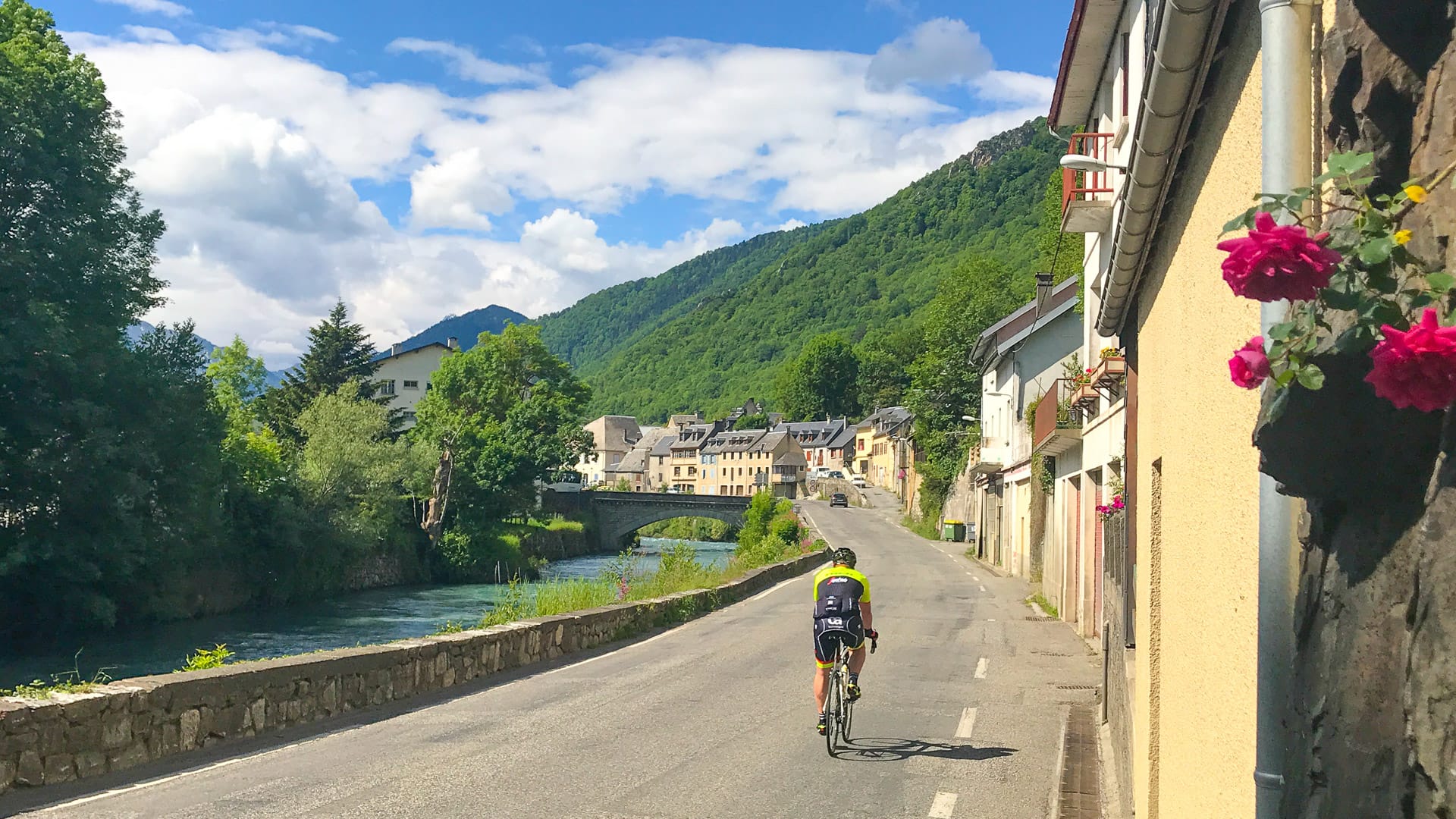
The pretty village of Arreau at the base of Col d’Aspin
Access and travel
In summary: The Alps are generally easier to reach, while getting into the Pyrenees often requires more travel planning and an additional transfer.
The Alps are generally easier to reach, particularly via airports such as Geneva and Lyon.
Geneva is especially well connected, making many Alpine cycling destinations relatively straightforward to access from the UK and elsewhere in Europe. This can be a major advantage if you are planning a shorter cycling holiday or want to keep transfer times to a minimum.
By comparison, travelling to the Pyrenees often involves flying into Toulouse or using more limited services to Lourdes.
Flights to Toulouse can be less frequent, depending on where you are travelling from, while Lourdes has a smaller selection of services. Another option is to travel by train from Toulouse to Lourdes before continuing into the mountains.
The extra journey can require more planning, but it may also help explain why the Pyrenees often feel quieter and less commercialised.
Reaching bases such as Argelès-Gazost, Luz-Saint-Sauveur or Gavarnie will usually involve a further road transfer. However, once you are in the valley, many famous and lesser-known cycling climbs are within relatively easy reach.
Cycling bases
In summary: The Alps offer a wider choice of established cycling bases and facilities, while Pyrenean bases tend to be smaller and more personal.
Many established Alpine cycling centres have extensive accommodation, visitor facilities and bike-hire services. This can make it easier to find bike hire and places to stay.
Bases in the Pyrenees tend to be smaller and can feel more personal. Argelès-Gazost, Luz-Saint-Sauveur and Gavarnie each provide a different starting point for exploring the surrounding valleys and climbs.
Argelès-Gazost is a particularly practical base. Many cycling routes return to the town on a descent, which can make the final kilometres of a demanding climbing day more manageable. It also has a wider choice of accommodation and facilities than some of the smaller settlements farther into the mountains.
The smaller scale does mean that accommodation can fill quickly. The best cycling-friendly places may have relatively few rooms, so it is worth arranging your stay early if you plan to travel during the main summer season.
Look for bases that offer several bike hire and bike rental options, which can be useful if you do not want to travel with your own bike. Bike hire may also be available through cycling hotels, local shops and guided tours.
Looking for somewhere to base yourself? Take a look at our guides to the best places to stay for cycling in the Alps and Pyrenees:
- Choosing the right accommodation in the French Alps
- Best places to stay in the Pyrenees (for cyclists): top towns & cycling accommodation, French Pyrenees
- 10 best bike hotels near Alpe d’Huez (our independent pick)
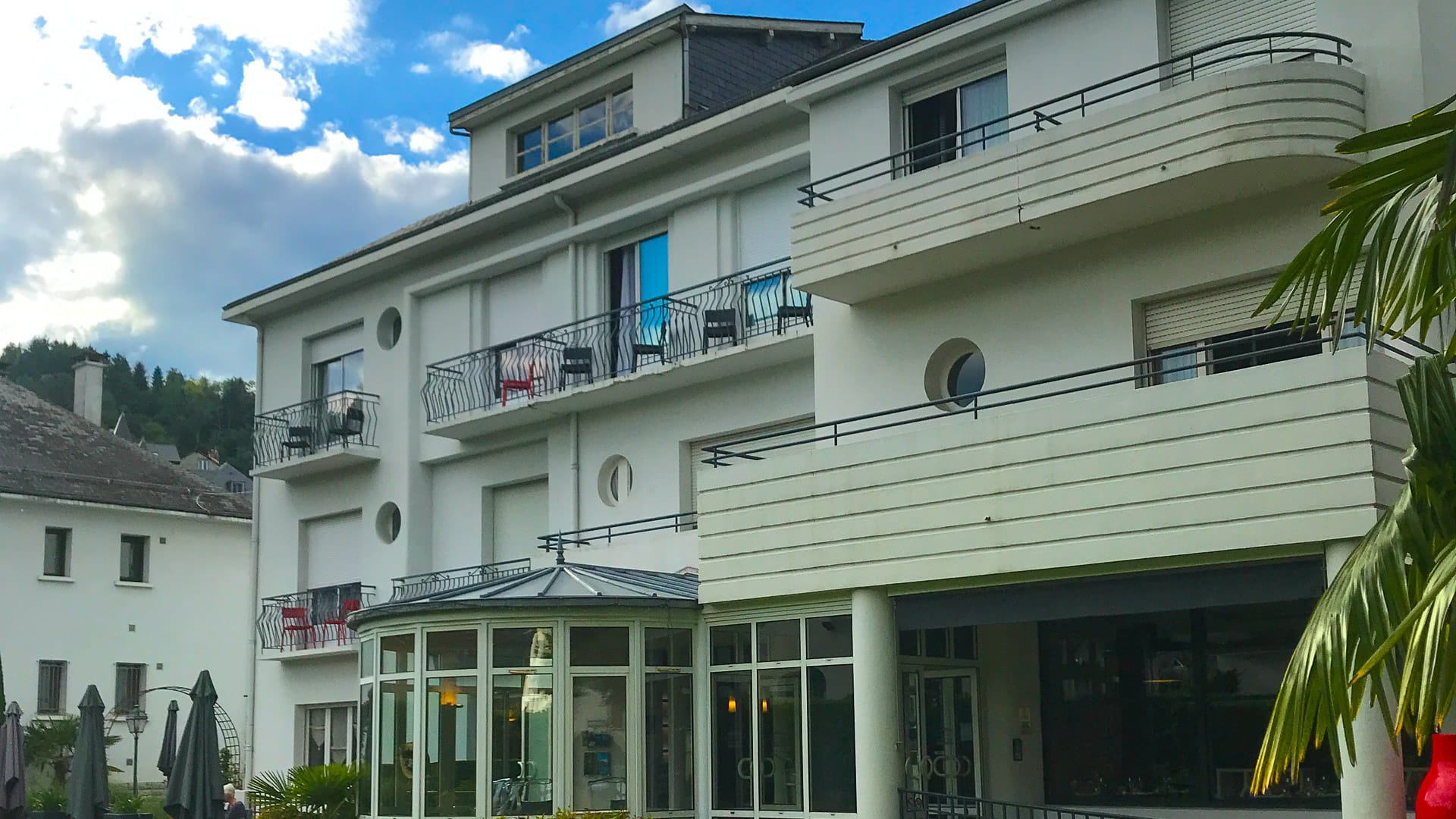
Hotel Miramont, Argelès-Gazost
Weather
In summary: The Pyrenees receive more rain than the Alps, particularly in the west.
And finally, it’s worth noting that the Pyrenees get more rain than the Alps, particularly in the Western Pyrenees, which receive the weather fronts from the Atlantic Ocean.
The advantage of this is that you can expect the landscape and light to be more misty and moody than you’ll find in the Alps.
This weather also helps create the dense woodland and lush valleys that make cycling in the Pyrenees feel so distinctive. Cloud and mist gathering around the higher slopes can also give famous climbs such as the Col du Tourmalet a dramatic atmosphere.
The downside is that a rain jacket is an essential item at any time of year!
Conditions can change quickly, even during July and August. A ride may begin in warm sunshine in the valley before becoming cold, wet or windy near the summit. This is the case anywhere in high mountains, whether Alps or Pyrenees, but we have experienced it more in the western Pyrenees than the Alps. A waterproof jacket and gloves are therefore worth carrying, particularly when your route includes a long mountain descent.
Always check the forecast for the summit rather than relying only on conditions at your cycling base.
Read more: Cycling weather: where to ride when and when to ride where for more tips on choosing the best destinations and timing your cycling trips.
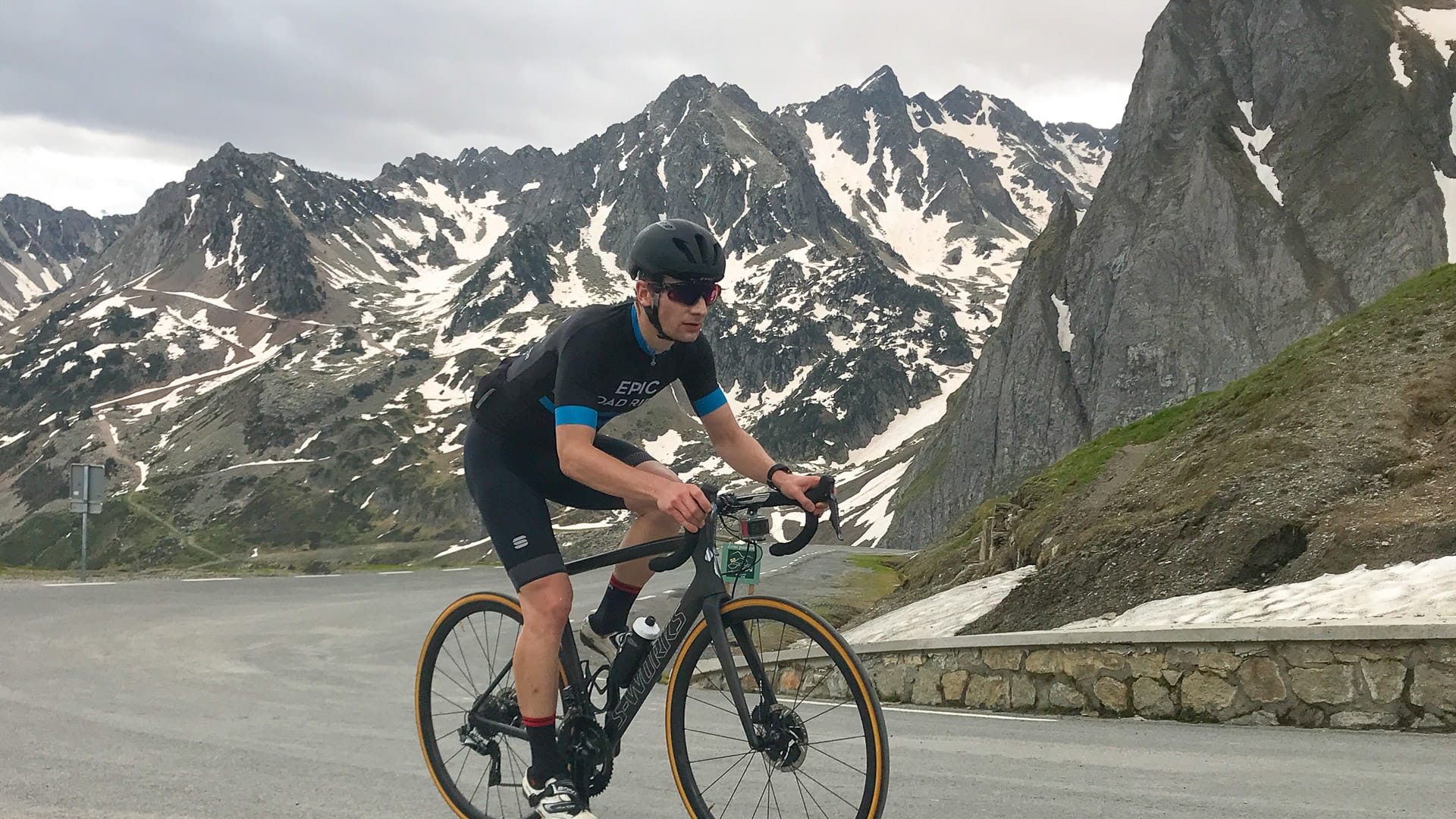
Riding past rocky peaks and lingering mountain snow
What’s next?
The Pyrenees may suit you better if you are looking for quieter roads, shorter and steeper climbs, greener landscapes and less development. However, the Alps may be the better fit if you prefer higher mountains, longer climbs, easier access and a wider choice of major cycling bases.
Ultimately, choosing between cycling the Pyrenees and cycling the Alps depends on the kind of mountain experience you want.
Looking for more inspiration? Don’t miss:
- Cycling Col de l’Iseran (and surrounds): your ultimate guide
- Cycling Alpe d’Huez (and surrounds): your ultimate guide
- Cycling holidays over 50, for tips on planning your first mountain cycling holiday in your 50s
Please support Epic Road Rides
A huge amount of time and effort goes into the article you’ve just read, all with the aim of helping you!
If you found what you’ve read useful, I’d really appreciate it if you dropped something in the tip jar here.
It’s a way you can say thank you and help us carry on creating top quality content with no annoying ads and no pay wall.
Got a question for Clare?
Fill out this form and we will send it to Clare. We aim to get you an answer within 24 hours where possible!Clare Dewey is a cyclist with a passion for travel. She set up epicroadrides.com in 2018 to help make it easy for cyclists to explore the world by bike. Today her mission is still inspiring cyclists to discover new places on two wheels - and doing what she can to make sure they have the best possible time while they're there. Clare has visited 50+ destinations around the world, many of them by bike.
Want to connect with Clare? Find her over on LinkedIn.
First Published: 31 August 2026
The contents of this website are provided for general information purposes only. It is not intended to amount to advice and you should not rely on it. You should carry out your own due diligence and risk assessments and take professional advice. Views expressed by interviewees or other users of this website do not necessarily represent our views. We make no representations, warranties or guarantees, whether express or implied, that the content on our website is accurate, complete or up to date. If you use any information or content on this website, download from, or otherwise obtain content or services through our website, it is entirely at your own discretion and risk. Epic Road Rides Ltd disclaims all liability and responsibility arising from any reliance placed on the information and content on this website. Find out more here.
Comments