
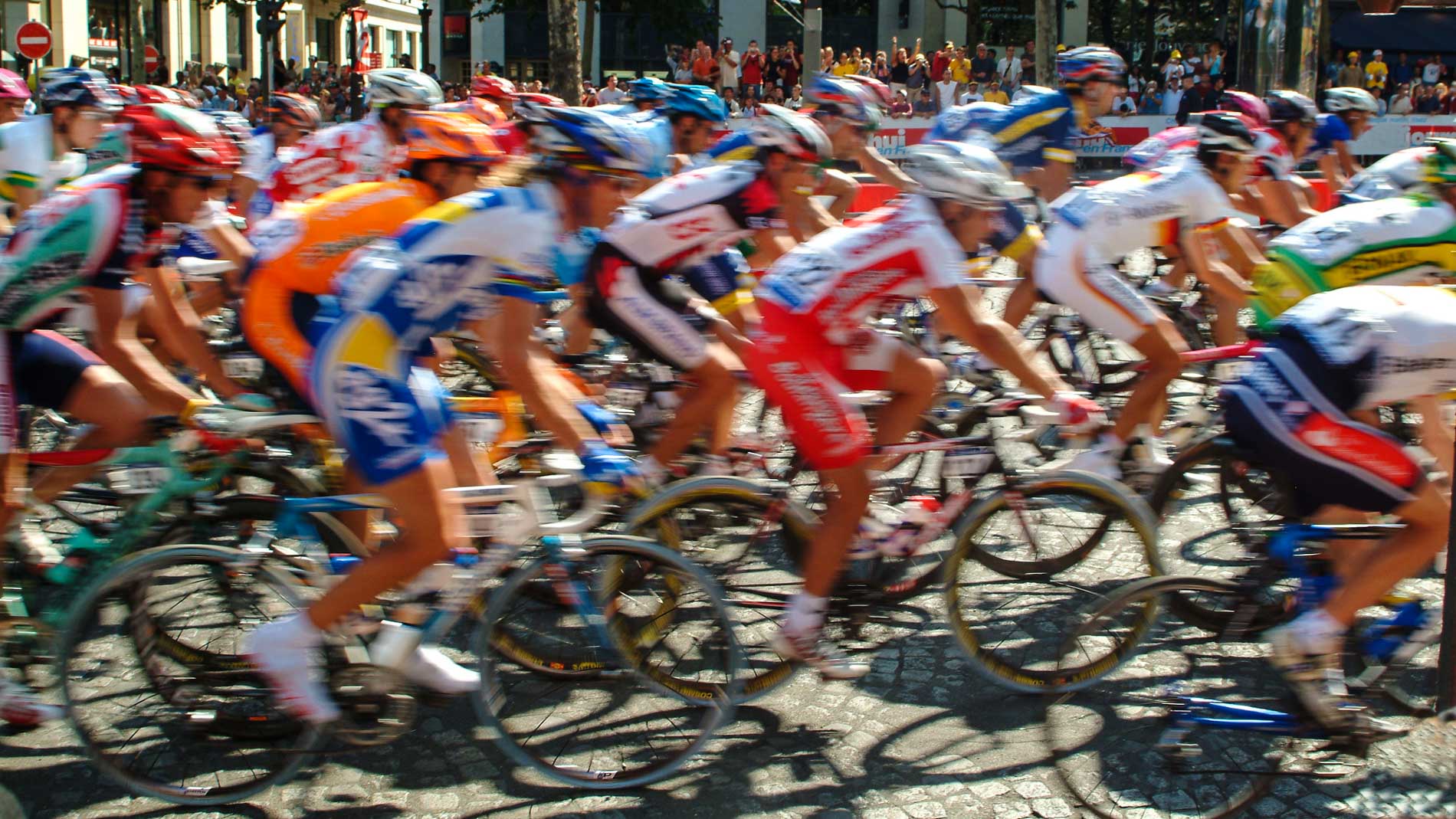

A couple of weeks ago we went on a recce mission to check out the 130km road race route of the 2018 UCI Gran Fondo World Championships being held in Varese on 2nd September.
Here we answer your questions on the course and share our in-depth route profile that includes tips for race-day tactics.

Clare Dewey is a cyclist with a passion for travel. She set up epicroadrides.com in 2018 to help make it easy for cyclists to explore the world by bike. Today her mission is still inspiring cyclists to discover new places on two wheels - and doing what she can to make sure they have the best possible time while they're there. Clare has visited 50+ destinations around the world, many of them by bike.
Want to connect with Clare? Find her over on LinkedIn.
What’s the Varese gran fondo world champs road race course like?
The 2018 course is 130km with 1,950m of elevation gain. The hilly course is both technical and testing. The official information confirms that the three major climbs come in the first half – but there are still three potentially significant hills later on, with the final hill just before the finish.
Most of the hills are on narrow, wooded roads. There’s no need to fear Alpine-style monsters; the hills are generally a short 3-5km with average gradients in the region of 4-7%.
In between the hills are flat sections around the three lakes.
There are also two sections of pavé to watch out for. The first one is up a short climb at Roggiano Valtravaglia (climb 4) and the second (easier) section is at Rancio Valcuvia, just before the Brinzio climb (climb 5).
We think the course will suit a powerful, all-around rider.
Looking for an in-depth route profile? Read on (or skip there now).
Is there a GPX route for the road race course?
We used the official GPX route (long course) and marked the climbs, which makes them easier to see:
Note that the race is on closed roads so this GPX route goes contrary to a number of one way systems etc. Don’t follow the GPX route – follow the rules of the road!
Any tips for race tactics?
Read our course profile below, where we break the course into nine sections and give our opinion on tactics.
What are the key pinch points?
Just 12 kilometres out of town you turn off the main road onto a narrow road that passes through the village of Valganna and then up the Alpe Tedesco climb.
The initial 12 kilometres are easy, so the race won’t have broken up much. You’ll want to be near the front in order to get yourself a good position going through Valganna and onto the climb. The descent from Alpe Tedesco is also quite technical (more details below), so another reason it would be good to get near the front.
For more pointers, read our in-depth UCI Gran Fondo road race route profile below.
Any tips for things to watch out for?
The hills on this course are short and sharp in nature, generally on narrow roads with hairpins. The hills are mostly wooded so expect dappled light and poor visibility – a particular issue when descending around corners.
The road surfaces are mixed – in places there’s brand new perfect asphalt but elsewhere, it can be a bit broken up.
The course passes through a lot of small villages and we often found that the road narrowed through these, there were ill-placed manhole covers and other road furniture plus somewhat hairy 90 degree turns. Let’s hope these are well-signed and marshalled to avoid riders over-shooting.
If you’re riding the course before race day, note that the route goes the wrong way down one way systems. Be aware of this and follow the rules of the road, not the GPX file.
Check the in-depth profile below for more.
What should I recce?
We’d recommend arriving a few days early and riding the whole course in advance.
If that’s not possible and you’re short on time, the first climb up Alpe Tedesco is worth a look, especially as it’s only 10km or so out of Varese. It’s (probably) the hardest climb on the course too.
You could also check out the last climb of the day in the last 5km before the finish.
What set-up do I need on my bike?
This is going to be a personal choice.
We rode a semi-compact chainset with 11-30 cassette, and it was a good choice for us. It’s not generally exposed or with very long climbs, so deep-section wheels are fine.
Can you give me an in-depth profile of the course?
Sure!
Based on our recce we’ve broken the route up into nine sections and give an overview of each. As you’ll appreciate, it will have gaps/won’t tell you everything you need to watch out for – but we hope it forms a useful starting point. We recommend you do your own recce!
Before we start, here’s the route profile map again in case it helps.
1. The start
The first 12km is a combination of gentle uphill and false flat, out of Varese. Road surfaces are mixed, much is on brand new smooth asphalt but there are also some older, cracked and rutted sections.


After you turn off a roundabout, onto the S233, there are two short-ish tunnels. The first is lit. The second isn’t.
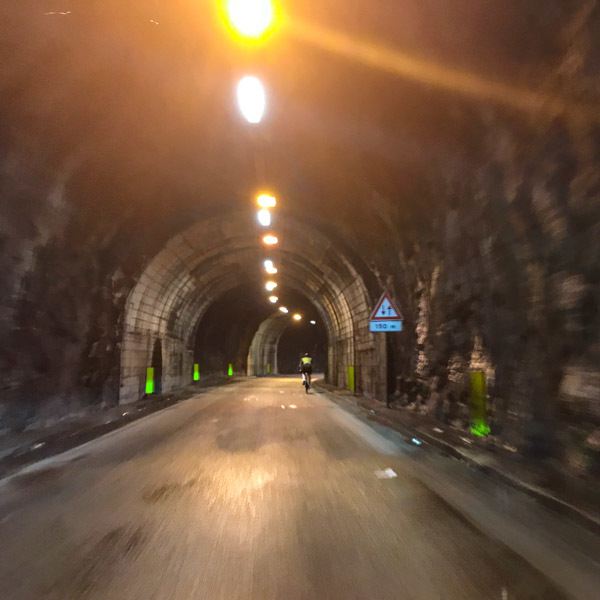

At a roundabout you turn right and the road is relatively narrow through the first village of Valganna.

Tactics: With around 2,000 riders expected to take part (albeit in waves) and an easy course profile through Varese, the start is probably going to be tense and fast. Take care and try to be at the front to ensure your position on the first narrow climb up Alpe Tedesco.
2. Alpe Tedesco: climb 1
After Valganna, at around kilometre 12, it’s a right turn onto the first, and probably the hardest climb of the day (at least on paper; you’ll feel fresh so it probably won’t seem that hard).
This 4.5km climb averages a pretty consistent 7% and includes a handful of tight hairpins.
When we rode it, there were large chunks of rock on the road. Presumably the road will have been checked and cleared before the race begins, but worth bearing in mind.


Shortly after the wooded summit, the road narrows through a tiny hamlet with a few buildings scattered along the road. After the buildings you’re straight into a sharp left hand corner then right hand corner. The descent also chucks in some badly placed drain covers, mixed road surface and tricky visibility on the narrow, heavily wooded lanes.


It’s a quick 11km descent down to Lake Lugano.
As you approach the lake, the road twists through urban areas. It generally narrows as it passes through these: you’ll need to try and anticipate this and keep an eye out for drain covers and road furniture too.


Tactics: You’ll be fresh on the Alpe Tedesco climb and the road will be busy as the peloton won’t have broken up much at this stage. Don’t blow it up, keep your climbing gradual and watch out for possible rocks and obstacles on the descent.
3. Lake Lugano: flat and fast
Once you hit Lake Lugano, it’s 5km of fast riding around the lake to the start of the next climb.


Tactics: Expect some full-gas speed around the lake road, before you turn inland. Try to tuck in to a group and conserve energy.
4. Santuari Madonna di Ardena (the “Ardenna climb”): climb 2
This is quite a tough climb that starts at 33.5 kilometres in. Overall the stats are 5.3km at an average 4.7% gradient. However it’s really a climb of two halves – in the first 3km the average is around 6%, but in the later section it flattens out considerably as you twist through the forest. Don’t pay attention to the road markings – they mark the end of the steep part and there is a little more climbing after this.


Tactics: Remember the first half of the climb is much harder than the second and pace yourself accordingly.
5. Montegrino Valtravaglia and the lumpy section: climb 3
The top of the Ardenna climb is at around 530m and so is the top of the Montegrino Valtravaglia climb, 10km later. Unfortunately, it’s not flat between the two; it’s a lumpy 10km as the small country road weaves up and down little hills through villages and woods.


The last lump is the 2.5km climb at an average around 5% up into the village of Montegrino Valtravaglia. There are some short, steeper sections within this.


It’s 5km of fast descent from the village with straight sections and some technical bends towards Lake Maggiore. The road is wider than on some of the descents but watch out for the sharp left turn at the Pont de Brich roundabout at the bottom of the descent.
Tactics: This 10km doesn’t look too tough on paper, but we think it’s got the potential to be disproportionately energy-sapping. This is time to try and conserve energy. You’re not even halfway through the race, so breakaways are unlikely to be decisive.
6. Lake Maggiore: fast and flat
It’s 9km from the bottom of the descent along Lake Maggiore. It’s flat and fast.


Tactics: Hopefully you’ll be in a good group for this section and can fly along the flat, smooth tarmac along the lake.
7. Roggiano Valtravaglia: climb 4
At the 62.5km point you turn inland and climb again through villages and non-descript semi-urban areas at easy gradients, for around 8km.


Just before kilometre 71 you hit the climb. It’s a short 2.5km at an average around 5% but the last 1.5km felt steep (average for this section around 8%).
The climb is narrow and wooded. There are a few potholes to watch out for but generally it’s in reasonable condition.


Like Alpe Tedesco, this is another technical descent since the road is narrow and sightlines are often poor. Take care coming into the village of Rogiano Valtravaglia as there are 90 degree bends on narrow roads around buildings (for example the sharp right pictured below).


As you leave Rogiano be ready for an unwelcome kick up over a section of cobbles. If you can, position yourself to get onto the smooth path to the right-handside.


The descent continues down to the main road.
Tactics: If you’re feeling strong, this hill presents a good opportunity to make up some time and get some space for the descent and cobbles.
8. Brinzio: climb 5
From the bottom of the Roggiano Valtravaglia climb, you’re on a flat, fast, wide main road with a good surface for about 5km until taking a sharp left on a roundabout to Ferrera.
There’s a 13% sign for a short climb up soon after the roundabout and then at the 81km mark it’s a sharp right on a small road that takes you to the penultimate climb of the day up to Brinzio.
At the start of the climb you pass through the village of Rancio Valcuvia and there is a section of cobbles. They’re smaller than the ones in Rogiano and easier to ride, but still worth knowing about.


We found this the easiest of the main climbs. It’s a wider road, with a lane each way, there’s a good surface and at around 4km and 5% gradient, it’s neither too long nor too steep.
At the top of the climb there’s a 5km flat-sh section, before the road descends from Orino through the plains near Lake Maggiore and Lake Varese.
Tactics: The combination of the Roggiano Valtravaglia climb and this section including the Brinzio climb, offers scope for a decisive move – could a group build up some time here and work together to defend it ahead of the final run in to Varese?
9. Casbeno climb (climb 6) and the final run in to Varese
The last 20-25 kilometres are relatively flat, with some long straight sections of road and a few short sharp kicks to keep you paying attention.


The main and final kick comes at 4km to go, just before the finish. The Casbeno climb is 3km long with gradients around 4%.
The finishing straight is wide, quick and flat.
Tactics: This relatively flat run in to Varese is quite exposed in places, so may be liable to catching the wind. The final kick up the Casbeno climb gives opportunity to anyone with something left in their legs to empty the tank. If the group is still together at this stage, this final climb will be decisive.
Good luck!
Have a great ride and take care.
Want a holiday after the UCI Gran Fondo World Championships?
We were staying in Lake Como when we decided to come and check out the Varese course. It’s just over an hour away and it’s a superb place for a cycling holiday. Our guides to cycling Como, Bormio and the Dolomites will be available soon.
Sign up to our email list to be the first to know when they’re published!
Got a question for Clare?
Fill out this form and we will send it to Clare. We aim to get you an answer within 24 hours where possible!Clare Dewey is a cyclist with a passion for travel. She set up epicroadrides.com in 2018 to help make it easy for cyclists to explore the world by bike. Today her mission is still inspiring cyclists to discover new places on two wheels - and doing what she can to make sure they have the best possible time while they're there. Clare has visited 50+ destinations around the world, many of them by bike.
Want to connect with Clare? Find her over on LinkedIn.
First Published: 08 August 2018
The contents of this website are provided for general information purposes only. It is not intended to amount to advice and you should not rely on it. You should carry out your own due diligence and risk assessments and take professional advice. Views expressed by interviewees or other users of this website do not necessarily represent our views. We make no representations, warranties or guarantees, whether express or implied, that the content on our website is accurate, complete or up to date. If you use any information or content on this website, download from, or otherwise obtain content or services through our website, it is entirely at your own discretion and risk. Epic Road Rides Ltd disclaims all liability and responsibility arising from any reliance placed on the information and content on this website. Find out more here.
Sponsor Message
Like the kit we're wearing?
We’re proud to be brand ambassadors for Stolen Goat. Their kit is fantastic quality and we love their bold, bright designs. Their customer service is second to none.
Find out how we got to know Stolen Goat and read our candid kit reviews here, or head straight to their site and check them out yourself.
Can you send us a link to the ladies 50+ course in GPX form too please.
Hi there, here’s a link to the ladies 50+ GPX route: https://www.varesegranfondouci2018.com/september-2nd Best of luck for the race!
Thanks the internet is so slow where I live (France) that I’ve not managed to download the route. Am hoping it will all be marked out by the time I arrive on 29th August.
That must be super frustrating for you. Fingers crossed it’s all marked in advance!
Great write-up. Thank you, and best of luck to all team GBR
Thank you and best of luck to all!
Not at all, so glad to hear it’s useful!