
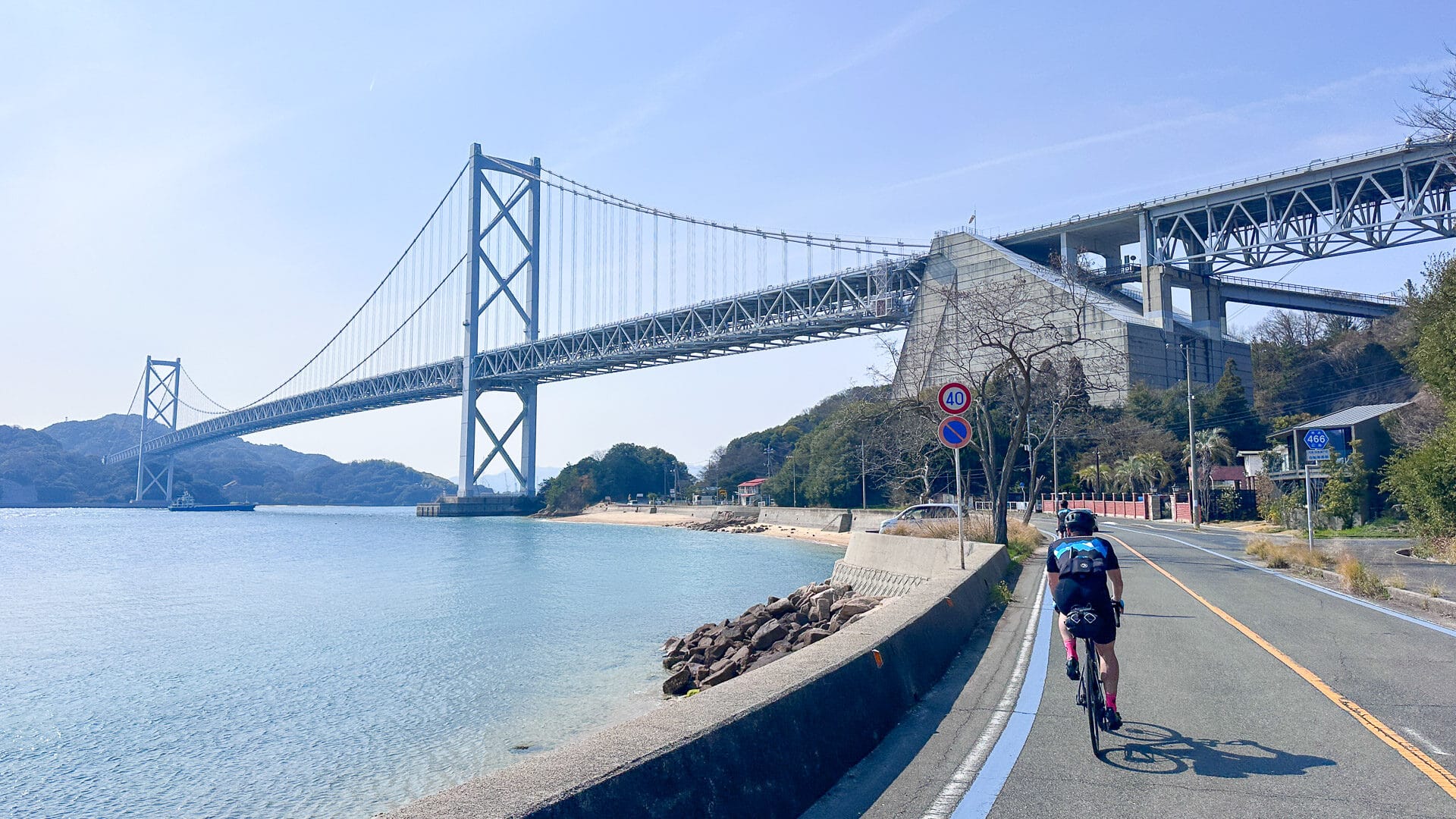
I visited Japan in March 2026, and one of the things I most wanted to do was cycle the Shimanami Kaido. I had interviewed Rob at Rindo Bike Tour Japan about the route previously (here) and spent years drooling over the photos, so finally getting the chance to plan it for myself and ride it unsupported felt pretty special.
Riding the Shimanami Kaido independently also meant I got to see the route beyond the polished images, from the practical logistics and small decisions on the ground to the details that can make the ride feel either seamless or stressful.
In this article, I share the tips that felt most useful from my trip, based on first-hand experience of finally riding the Shimanami Kaido, a route I had long wanted to see for myself.
I hope you find this useful!

Clare Dewey is a cyclist with a passion for travel. She set up epicroadrides.com in 2018 to help make it easy for cyclists to explore the world by bike. Today her mission is still inspiring cyclists to discover new places on two wheels - and doing what she can to make sure they have the best possible time while they're there. Clare has visited 50+ destinations around the world, many of them by bike.
Want to connect with Clare? Find her over on LinkedIn.
Always check current travel information and advice. For visitors from the UK, the UK government travel information pages are here.
Table of contents
This article contains a lot of useful information. To help make it more digestible, we’ve broken it down into several parts:
- Part 1: Getting started
- Part 2: The route explained
- Part 3: Level of challenge
- Part 4: Planning your trip
- Part 5: Bikes and support
Part 1: What do you need to know before planning your Shimanami Kaido ride?
Start here: introduction to cycling the Shimanami Kaido – for a really useful overview of what you need to know and to help you decide if the Shimanami Kaido is for you.
Then read: planning a Shimanami Kaido bike tour– for our itinerary and thoughts on a self-guided bike tour versus a guided tour
And finally: read the below! For in-depth FAQs to help you plan your tour once you’ve decided you want to ride it.
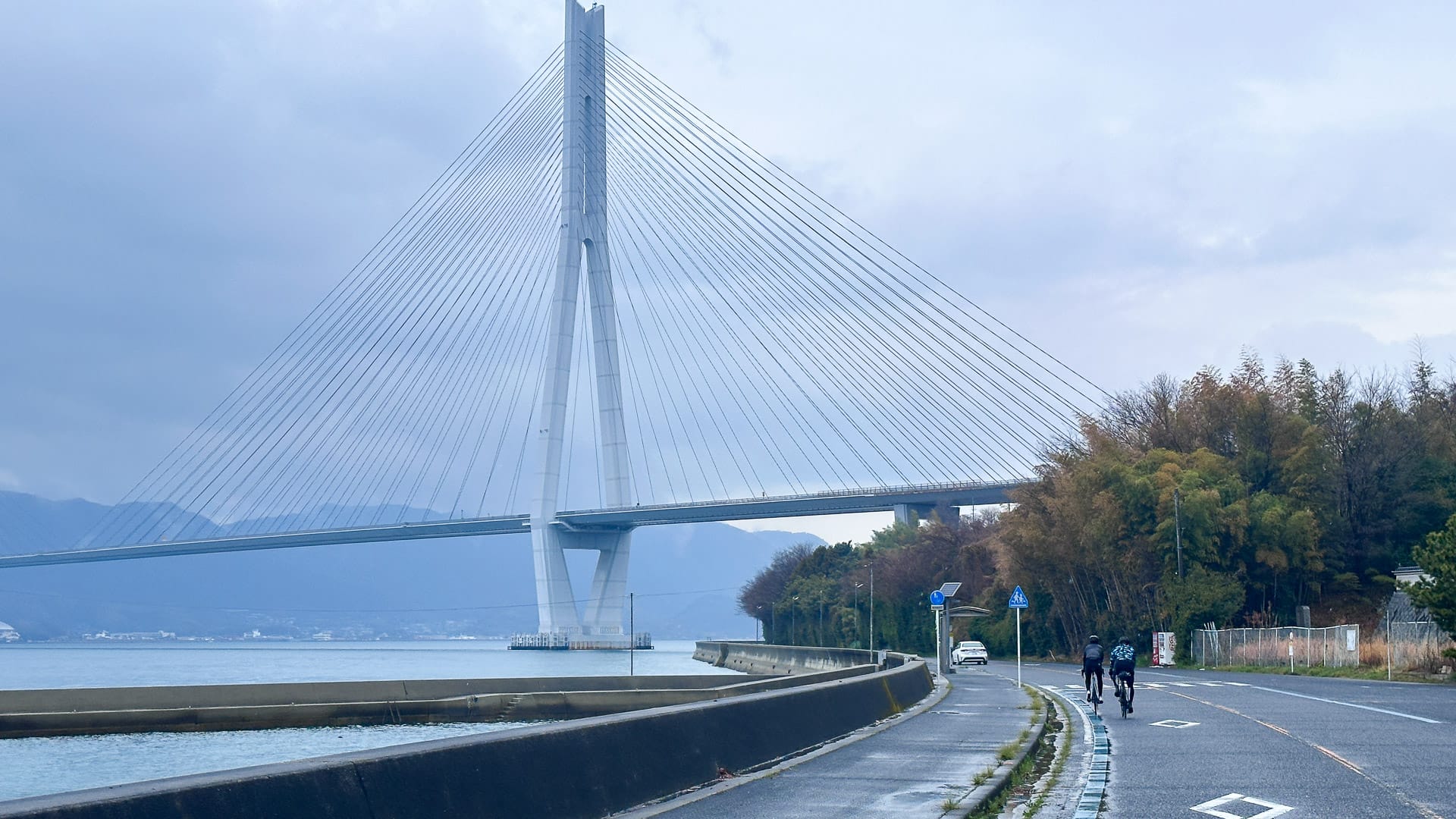
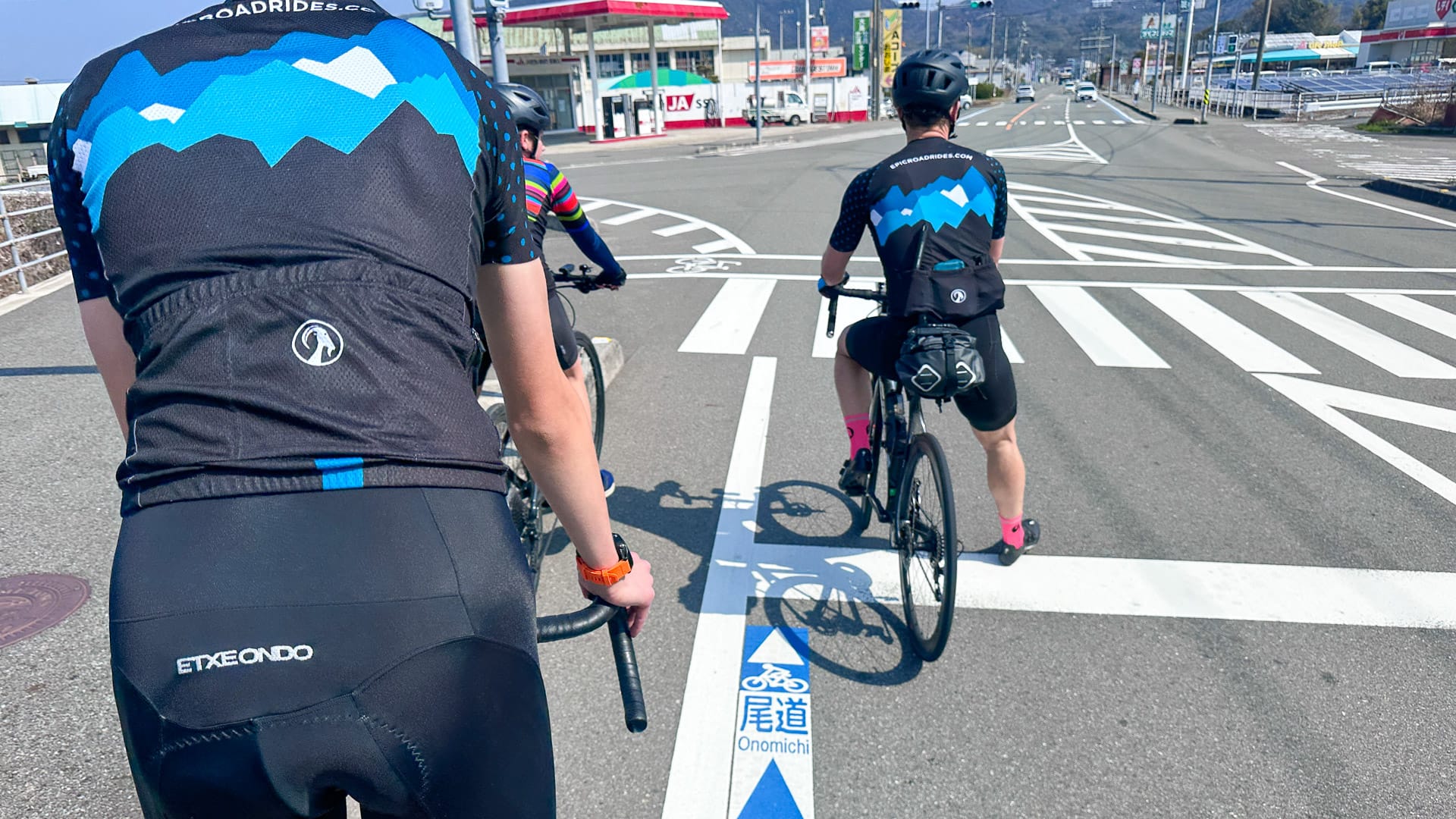
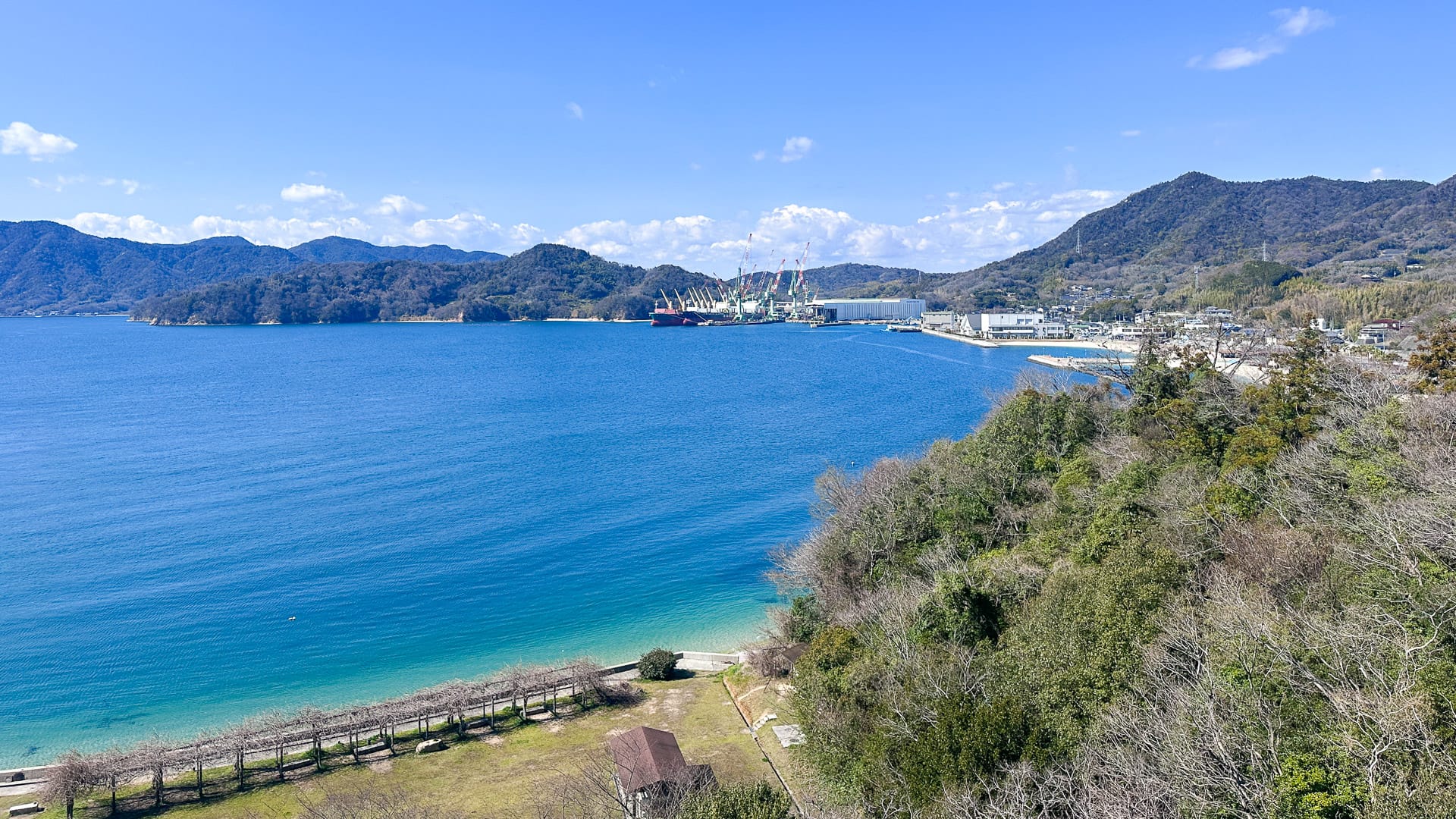

Part 2: What is the Shimanami Kaido route like?
1. What were your highlights of riding the Shimanami Kaido?
- There are lots of bike-friendly hotels on the route. We loved the places we stayed (though they were pretty eclectic!).
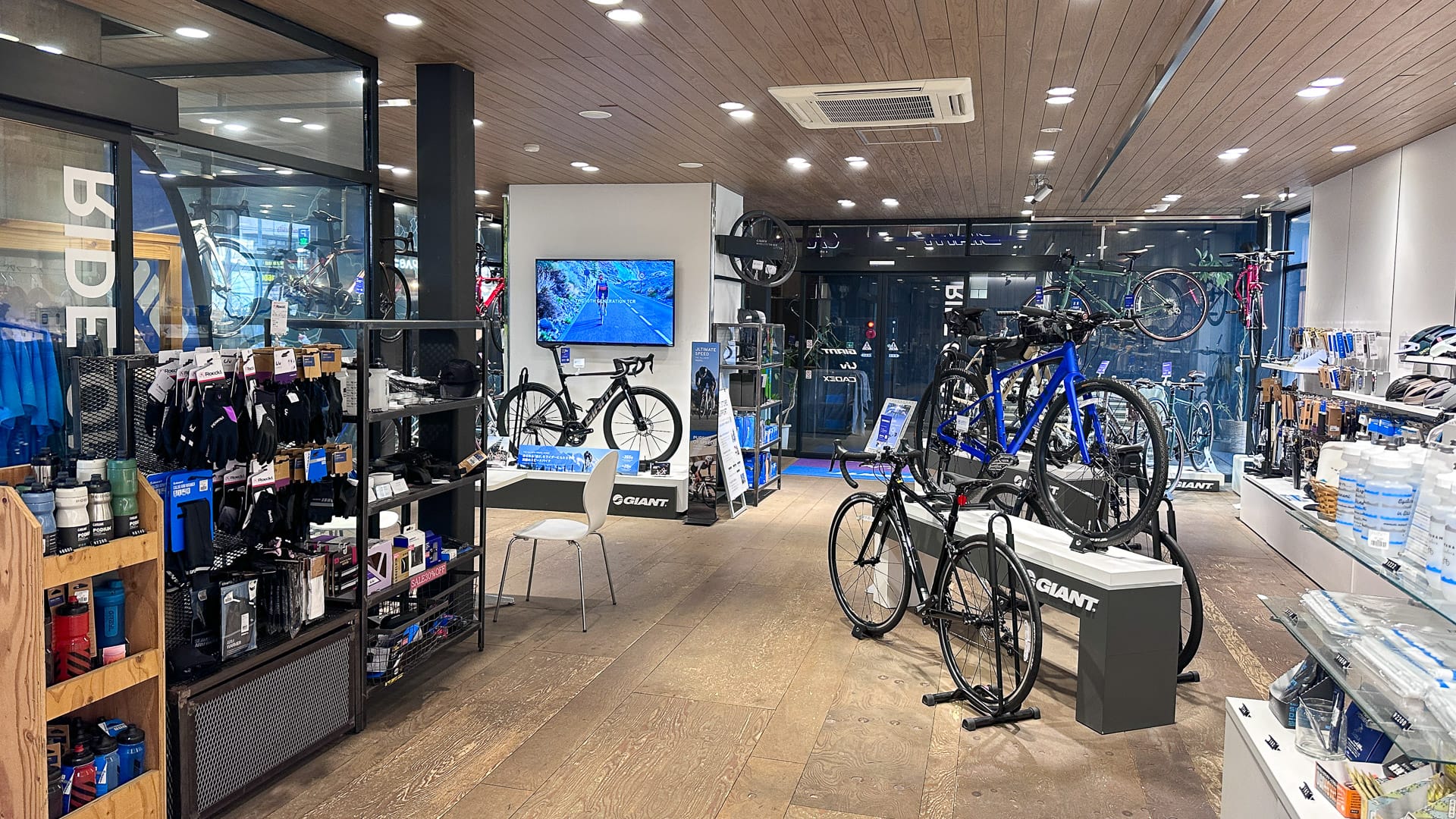
- Giant bike stores in Onomichi and Imabari provide high quality road and e-bike alternatives to the more easily available city bike experience.
- If you’re more relaxed about the quality of what you ride, there are plenty of bike hire options; there are 10 bike hire terminals between Imabari and Onomichi.
- Road quality was excellent, as were the purpose built facilities around the bridges.
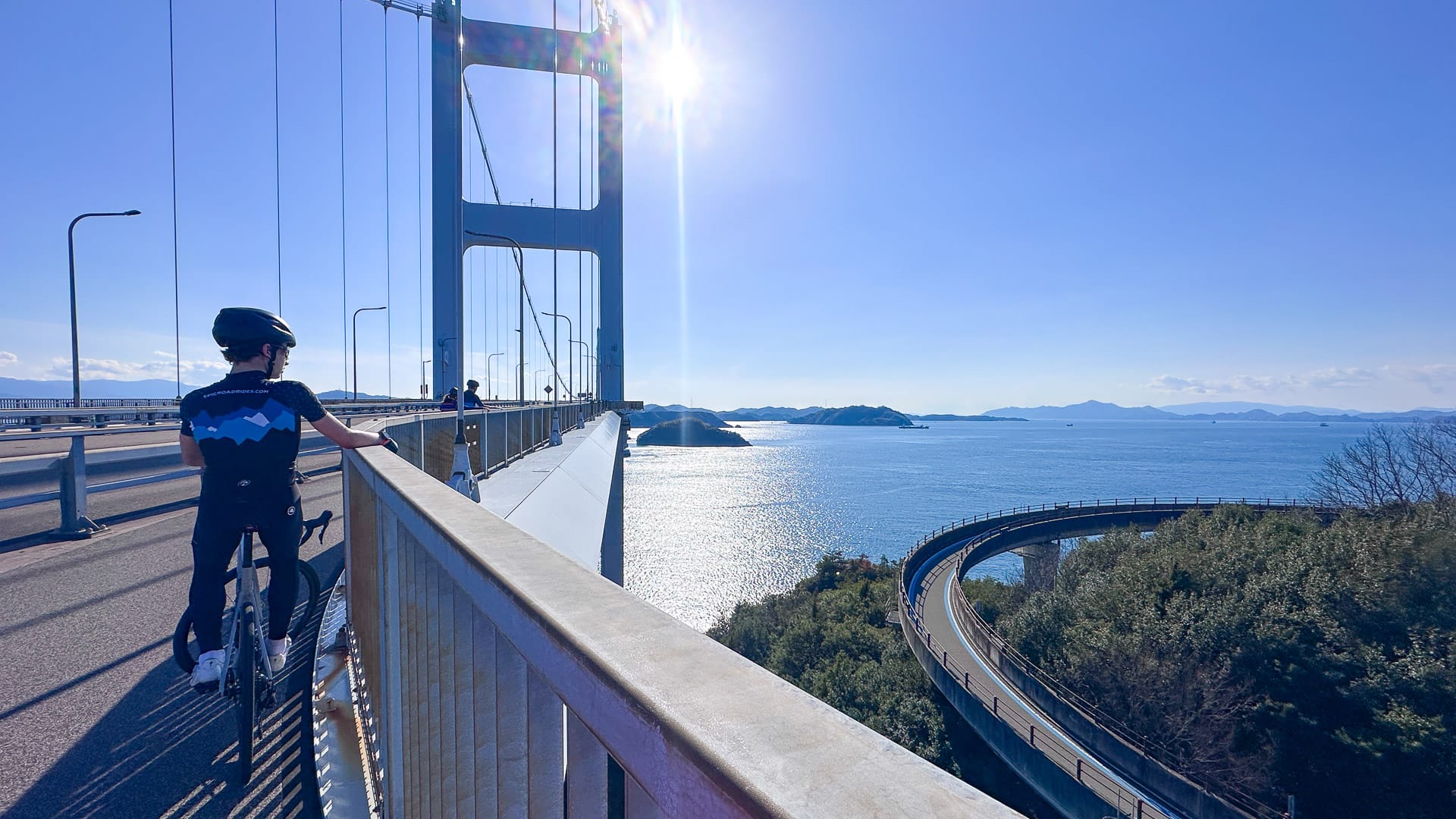
- Scenery was often spectacular, with views across the Seto Inland Sea, and the industrial edge providing an interesting counterpoint.
- Sagawa luggage transfer is brilliant and makes a DIY multi-day journey doable.
2. Do you have a map of the Shimanami Kaido route?
See below! Also check out this map the authorities have created. And our Shimanami Kaido bike tour article contains a GPS file.
3. Is the Shimanami Kaido signposted?
Yes, there are signposts and also road markings.
4. Is the Shimanami Kaido cycle route a segregated bike path?
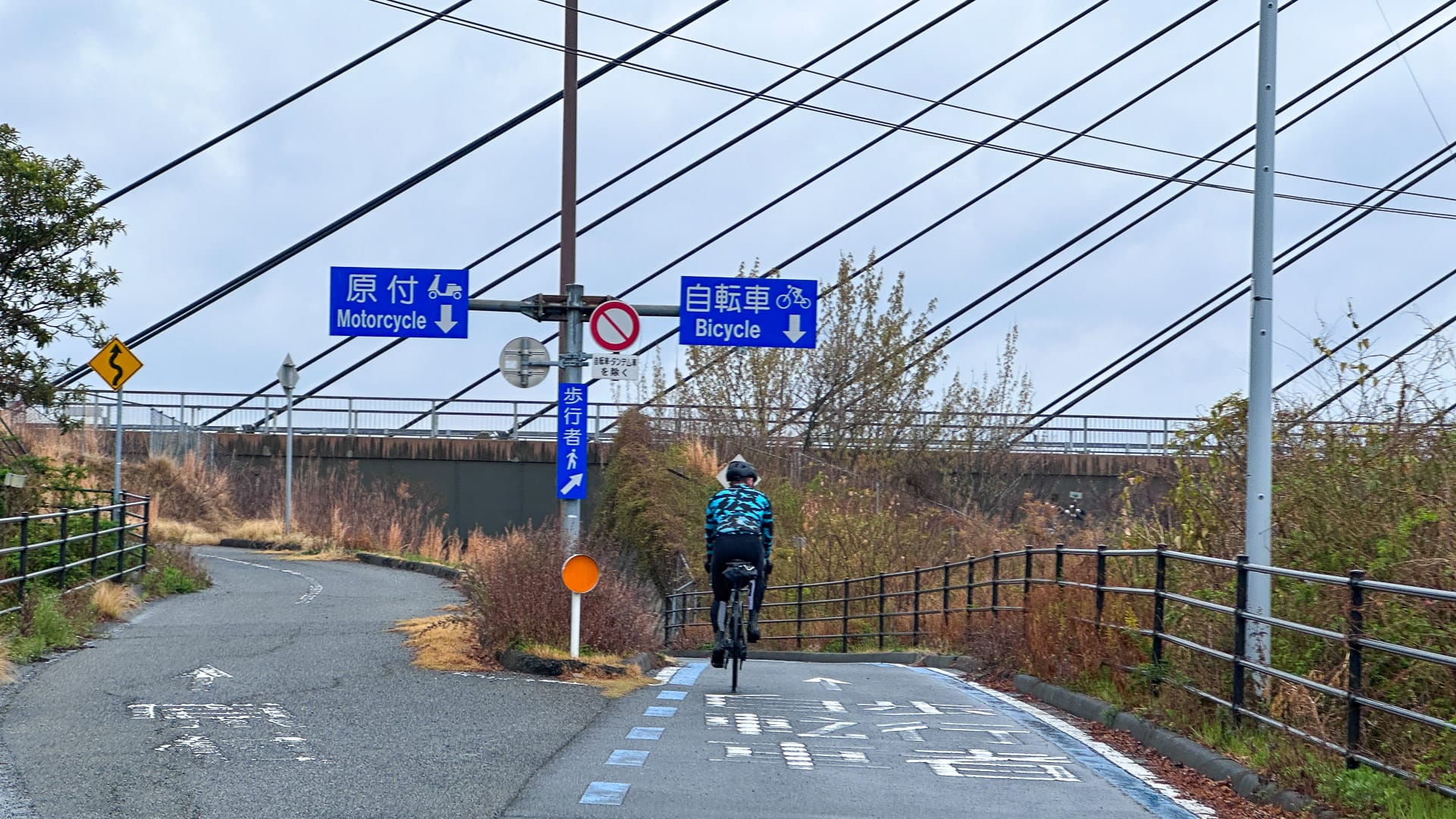
This confused me too! The answer? No. There are bike (and pedestrian and scooter) paths up, down and over the bridges, but in between, you’re on the road.
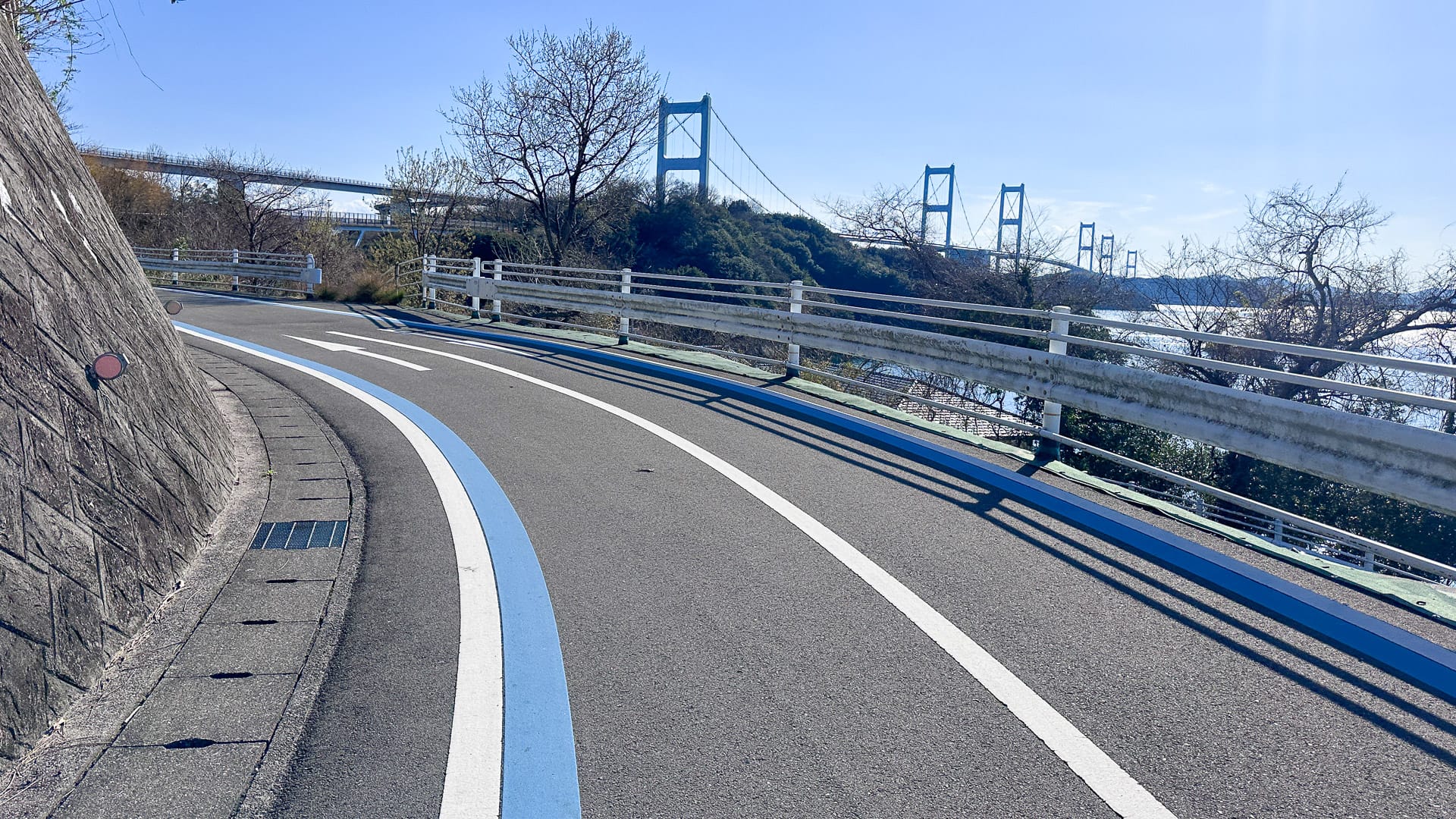
Some of the time, especially on the main route, there are separated bike paths, but some of the time and especially off the main route, there aren’t. However, on the main route there is the constant presence of the “blue line” and we found that the vast majority of the roads were incredibly low traffic. More details in our Shimanami Kaido bike tour article.
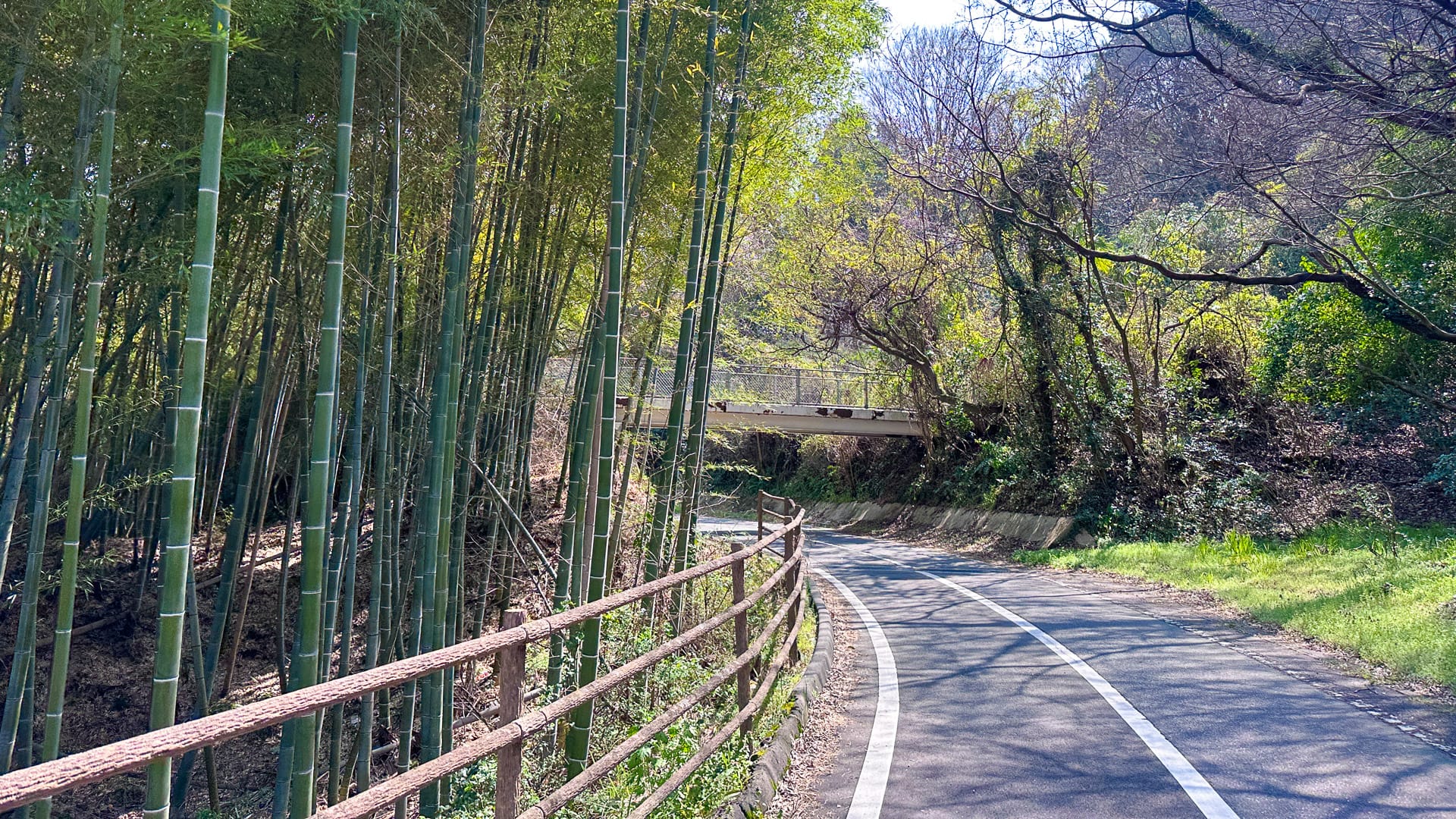
Bike path on Omishima Island
5. Is the Shimanami Kaido just for cyclists?
No, the Shimanami Kaido Expressway is for vehicles. The Shimanami Kaido paths on bridges are also used by motorcycles and pedestrians.
6. Is the Shimanami Kaido all on bike paths?
No! Other than on bridges and alongside very busy sections of road, the Shimanami Kaido is mostly on road rather than bike paths. We found the roads very low-traffic and calm to ride.
7. Is the Shimanami Kaido all asphalt?
Yes!
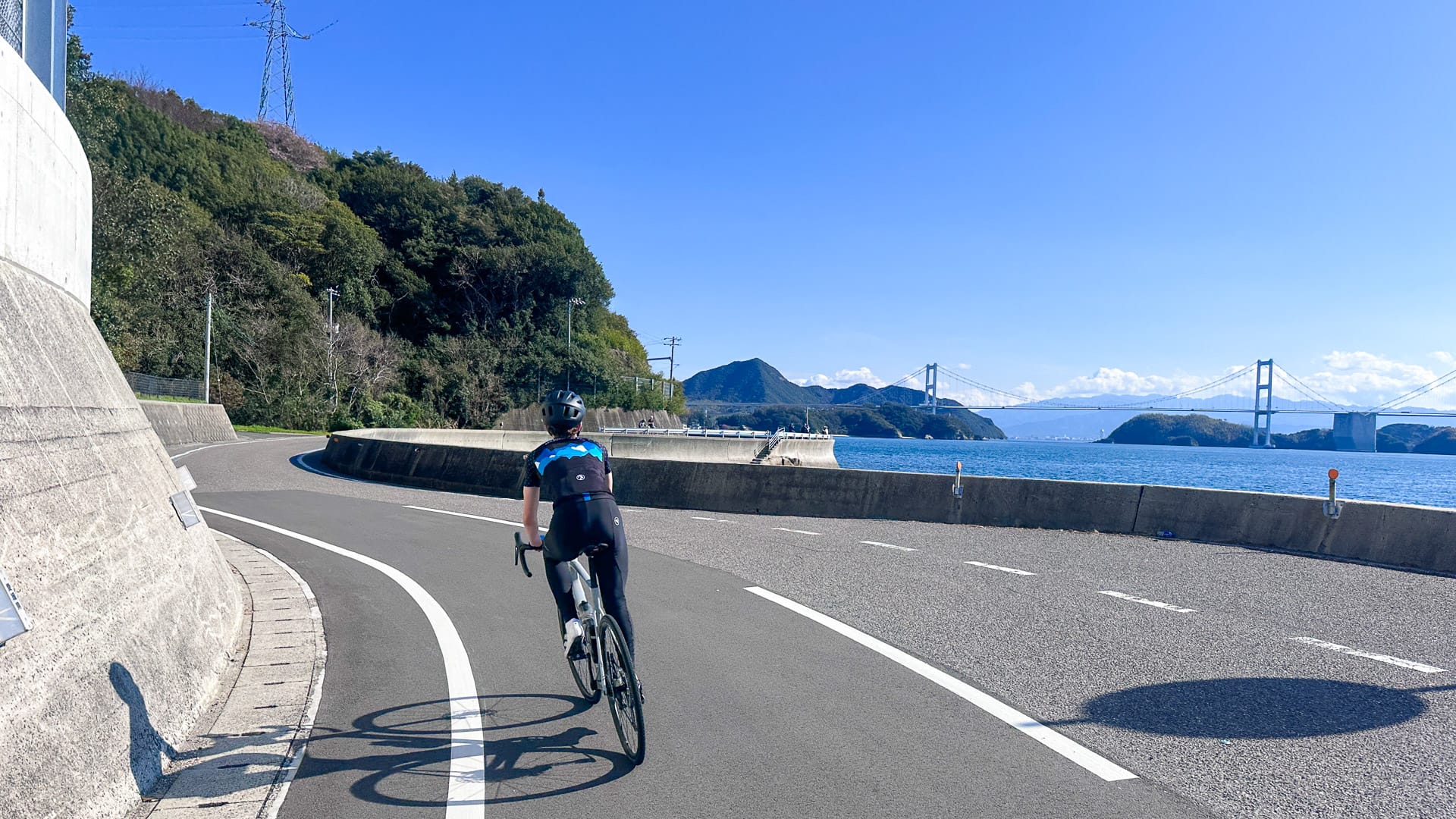
Cycling on Oshima Island in Japan on day two of our Shimanami Kaido trip (note no blue line – we were off the main route)
8. Which is the best route to take on the Shimanami Kaido?
When referring to the Shimanami Kaido, most people think of the main 80km route between Imabari and Onomichi. However, the Shimanami Kaido isn’t just one route. The main route is the famous one, but the authorities have also signposted other route options, including the Island Explorer route.
There are plenty of alternative routes for riding the Shimanami Kaido. It all comes down to how many days you have and how much of the islands you want to see.
We loved getting off the main route – more thoughts on that in our Shimanami Kaido bike tour article.
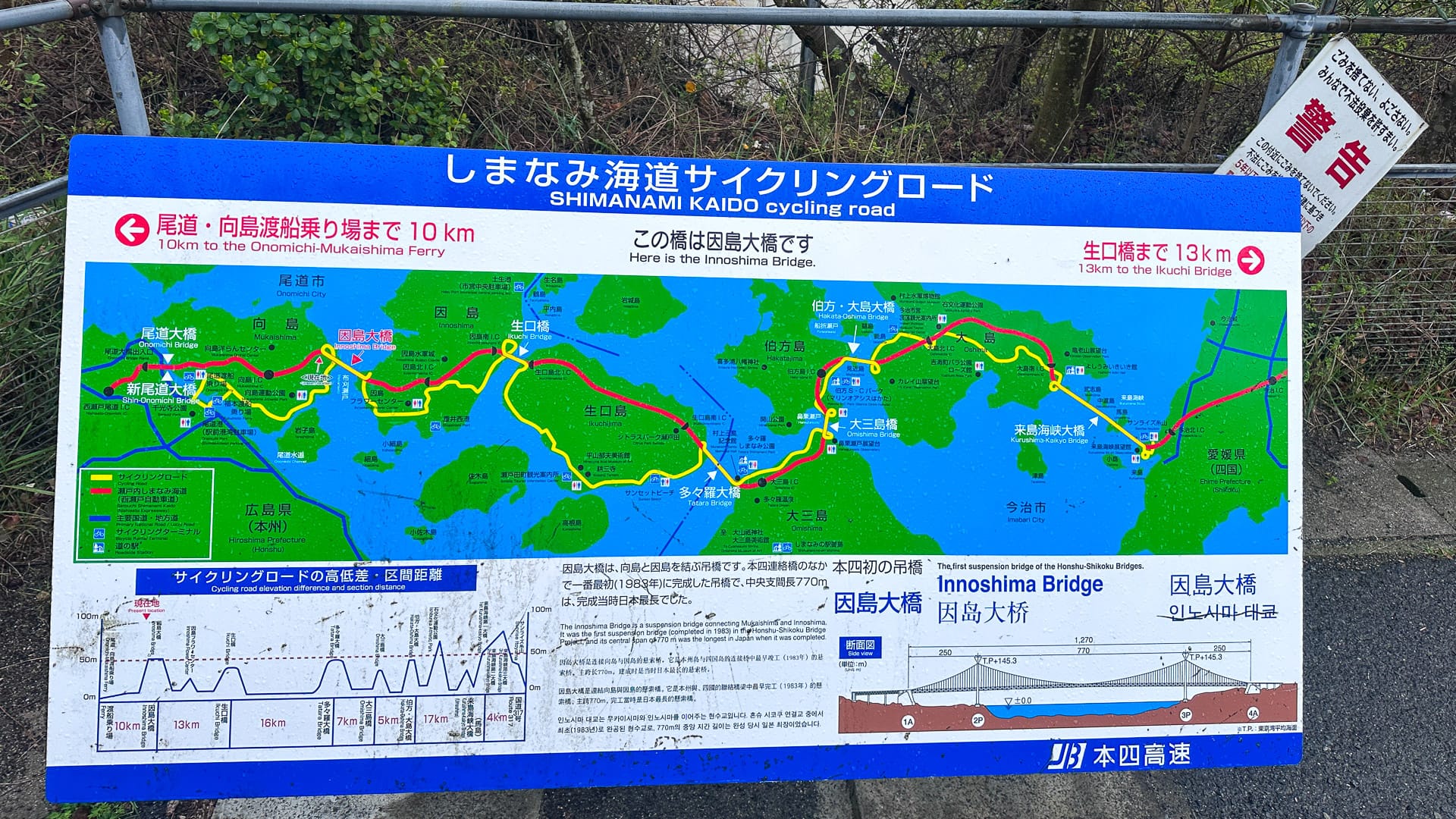
Close up photo of the Shimanami Kaido route map at Innoshima Bridge 1
9. Which way to ride the Shimanami Kaido? Onomichi to Imabari or Imabari to Onomichi?
Most people ride the Shimanami Kaido between Onomichi and Imabari, and either direction works well. Your choice will usually come down to your wider travel plans.
We rode from Onomichi to Imabari over two days on a quieter “Rindo Route”, then returned from Imabari to Onomichi on the main “blue line” route. This worked really well, as it gave us a mix of peaceful backroads and the classic Shimanami Kaido experience. More details on that in our Shimanami Kaido bike tour article.
If you’re concerned about things like wind direction and uphill slopes, people suggest it’s easier to start from Imabari City.
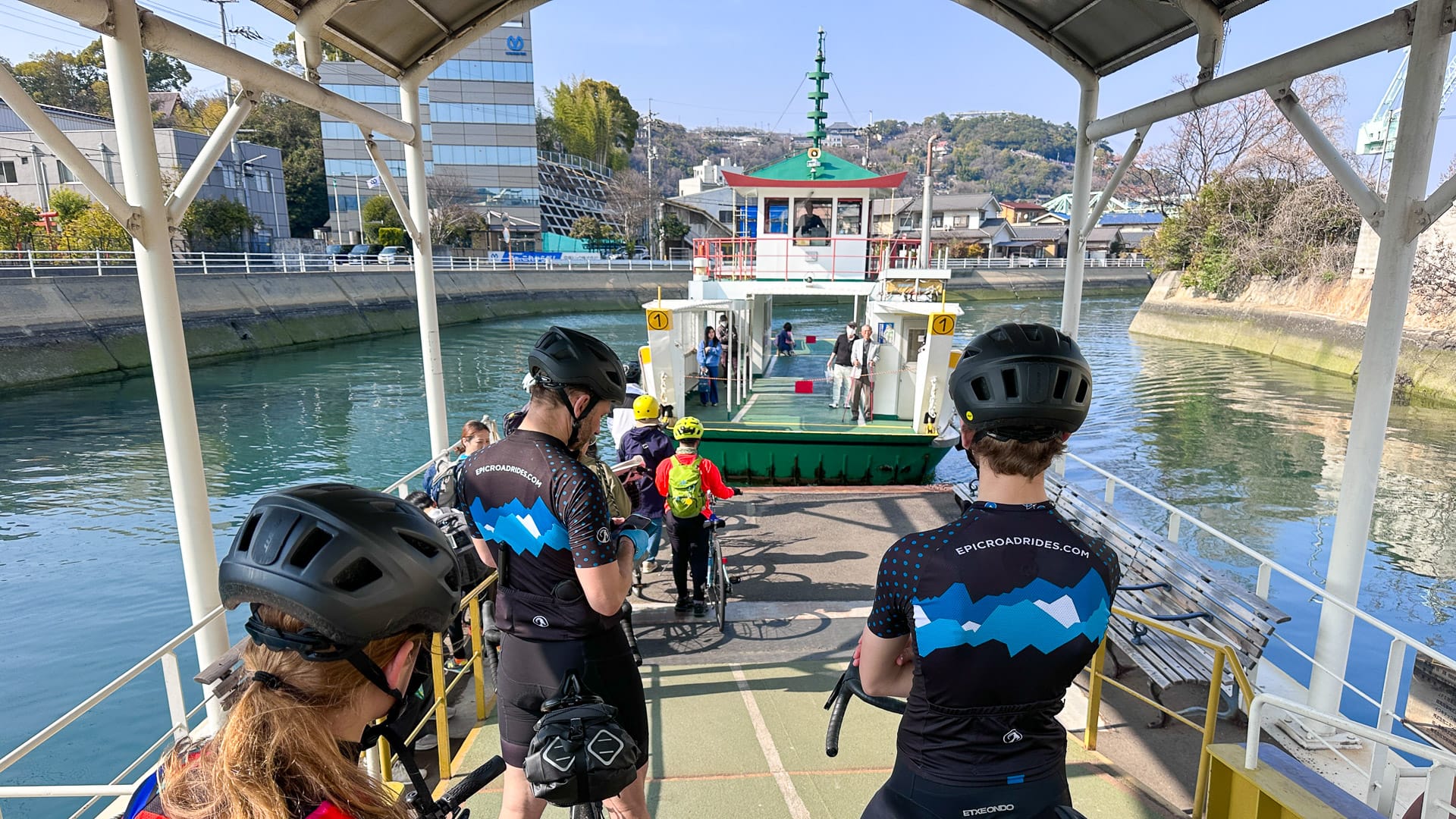
Ferry back to Onomichi
Part 3: How difficult is the Shimanami Kaido?
10. Is the Shimanami Kaido suitable for beginners?
Yes, I think the Shimanami Kaido is suitable for beginners, especially compared with many of the other bucket-list rides people talk about. The gradients are generally manageable, the route is well signposted, and there is a reassuring sense that the cycling infrastructure is built with cyclists in mind. That said, “beginner-friendly” does not mean effortless. It is still worth being comfortable riding for multiple hours, handling and navigating shared spaces with other cyclists and pedestrians. For riders who are new to cycle touring or longer days in the saddle, the Shimanami Kaido can be a great first big ride, particularly if you keep your daily distance realistic, start early and allow time to stop and enjoy the islands along the way.
11. What makes the Shimanami Kaido accessible for cyclists?
There are lots of things that make the Shimanami Kaido accessible. For example,
- The blue line on the main route makes it hard to get lost, even if you don’t have a GPS file/aren’t used to following one.
- The route is relatively flat and the approach to the bridges have been designed with gentle slopes to make getting onto the bridges easier.
- Bicycle rental is easy – there are lots of portions and some allow one-way bike trips.
12. Is there much climbing on the Shimanami Kaido?
The main route is relatively manageable, but it is not completely flat. You climb up to each bridge, though the bridge approaches are designed with gentle gradients. Detours and island explorer routes can be much hillier, so check your route carefully if you’re not confident with climbs.
Check out our Shimanami Kaido bike tour article for Shimanami Kaido route profiles and GPS files.
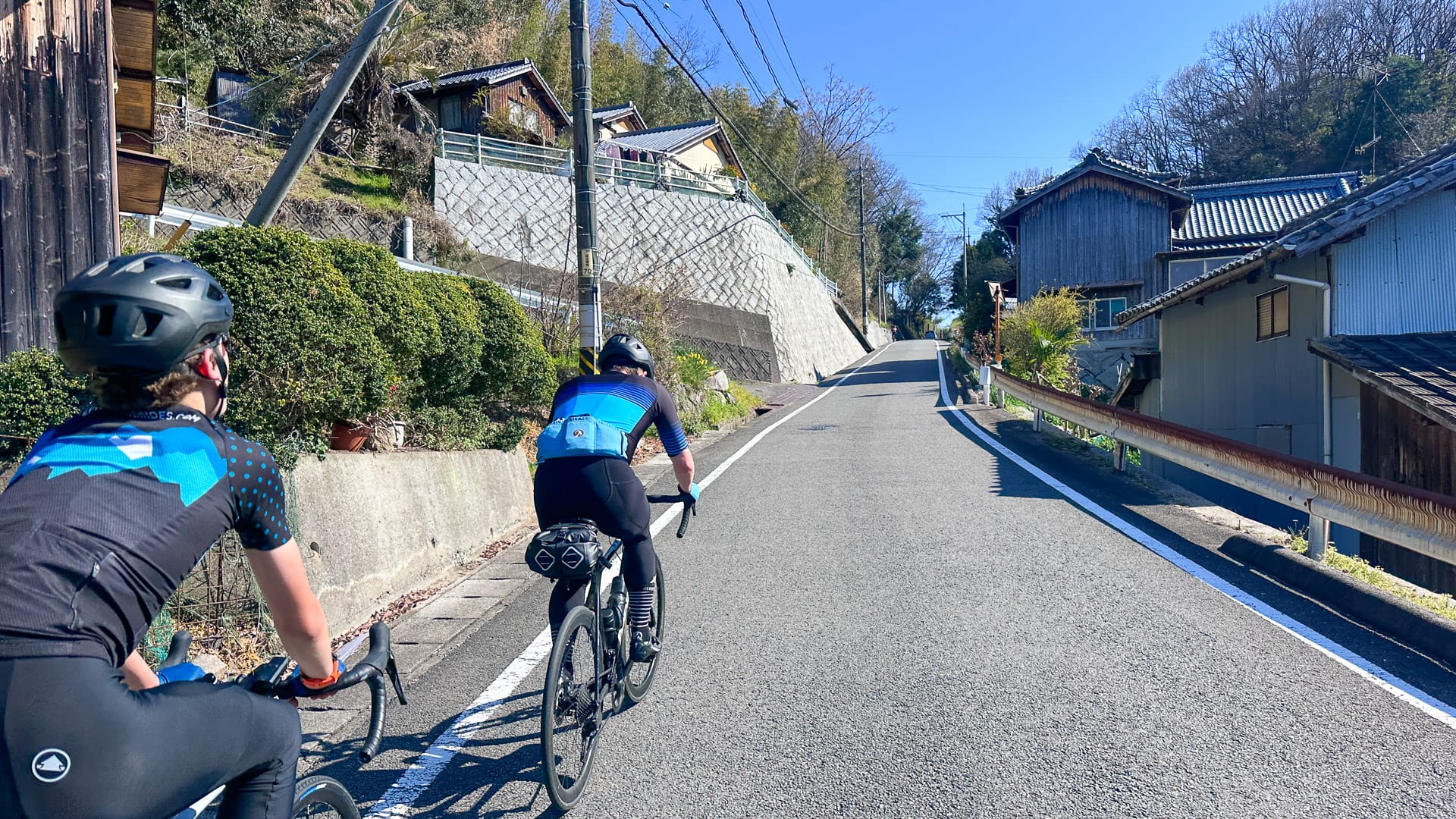
Steep climb near Tanoura (again, no blue line – this was on day 2 of our ride when we weren’t on the main route)
13. Can you ride to the observatories on the Shimanami Kaido?
Yes, but some are much harder than they look on the map. We’ve heard Kirosan Observatory on Oshima, for example, involves a steep climb. Be especially careful descending from observatories, and avoid doing these climbs close to sunset.
14. Can you ride the Shimanami Kaido with kids?
We rode the route with our 10 and 13 year old. While you’d want to adjust the distances depending on your children’s fitness and cycling experience, there’s lots to like here given the terrain is easygoing and there are lots of places to refuel on the way. The variety of inexpensive accommodation also makes it an appealing option for families on a budget.
15. Can you ride the Shimanami Kaido in one day?
Yes, I’m told a lot of people ride the Shimanami Kaido main route in one day.
There’s about 600 metres of elevation gain across the 78 kilometre route from Onomichi to Imabari, so it depends if you feel that’s feasible in one day.
If you aren’t confident with that distance, you can always just ride a section. Or turn it into a multi- day adventure like we did. There’s plenty of accommodation along the route or you can get a bus or a ferry ride part of the way. Or perhaps even a support van if you’re on a guided tour – or book with WAKKA Hotel – details below.
Check out our three-day itinerary here.
If you are hiring a bike, note the times you need to return the bike by to avoid extra charges. These were correct at the time of writing but check in case there are any seasonal differences or changes:
- Giant’s hours are 9am to 6pm.
- The regular bike hire terminals are as follows: Onomichi, Itoyama and Imabari – until 7pm and Mukaishima, Innoshima, Ikuchijima Island (both), Omishima, Hakata and Oshima – until 5pm
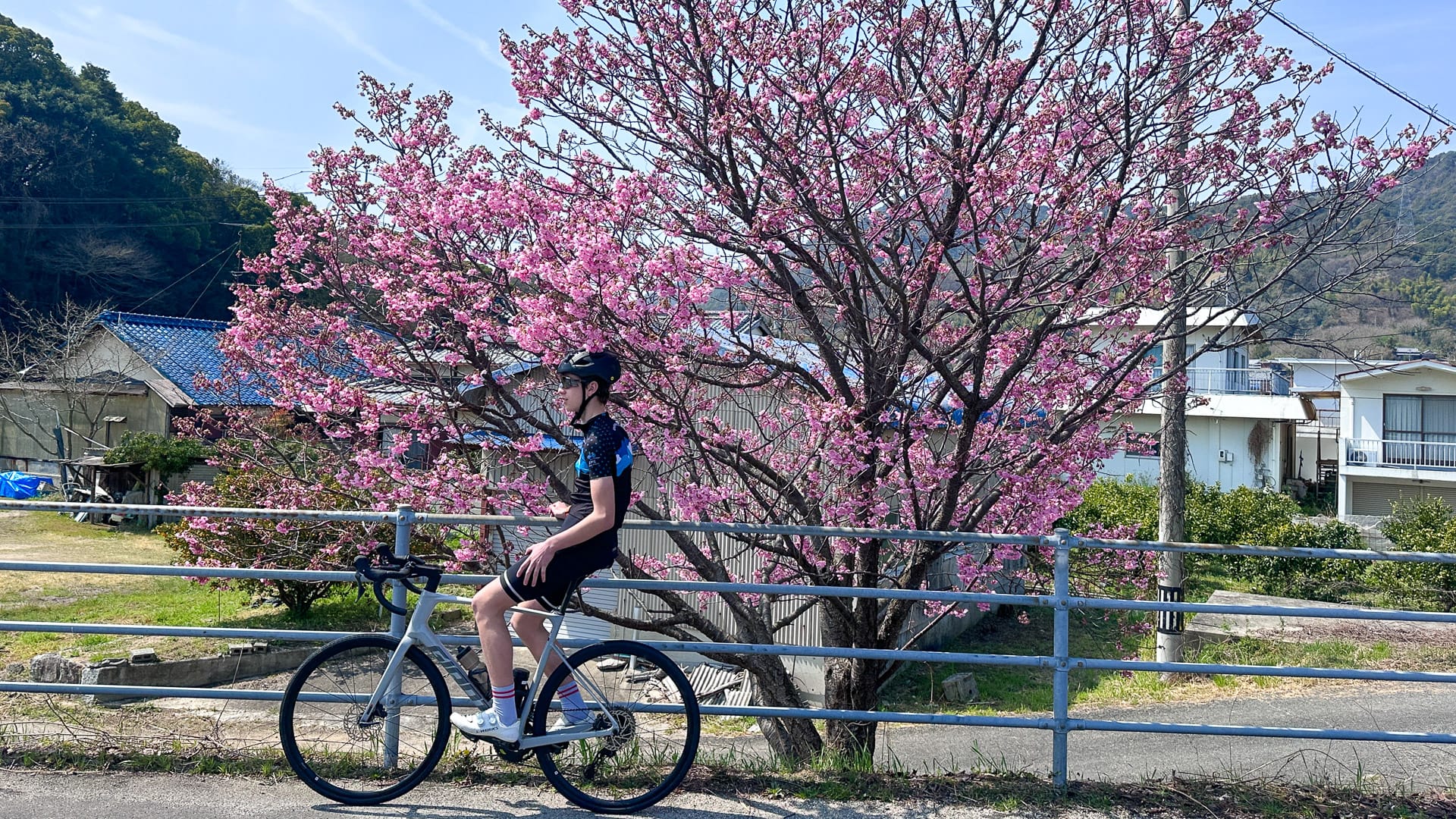
Quiet break beneath cherry blossom on Omishima Island
Part 4: How should you plan your Shimanami Kaido trip?
16. Do you need an organised tour to ride the Shimanami Kaido?
No you don’t and there are lots of cycling friendly services on the Shimanami Kaido that help make it possible to DIY – see below. However, I think the benefit of a tour would be:
- Hassle free – for example not having to book individual hotels or worry about food resupply and hitting restaurant opening times
- Get off the beaten track – the two days we spent following a BTJ route took us away from the busier Shimanami Kaido blue route allowing us to get a sense of the islands beyond the main route
- Get under the skin of the islands’ history and heritage – a guide will explain what you’re seeing and opens up the story of the destination which it’s hard to get otherwise.
You can find out more about BTJ’s Shimanami Kaido tours in this article.
17. Can you suggest an itinerary for the Shimanami Kaido?
Check out our Shimanami Kaido bike tour article.
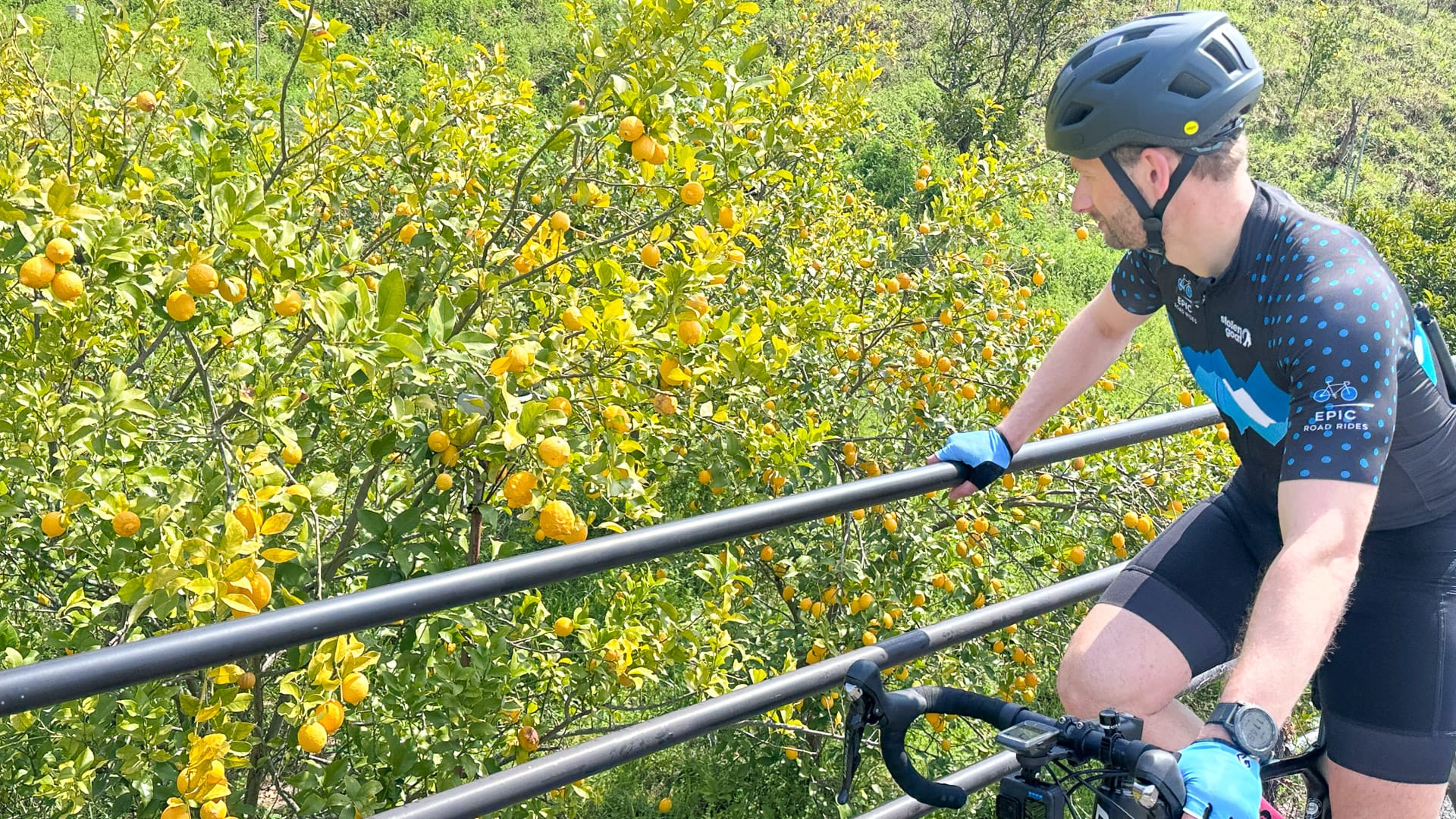
Cycling through the Lemon Valley on Ikuchi Island
18. Are there any rules of the road you need to be aware of when riding the Shimanami Kaido?
Helmet use is strongly recommended in Japan. Since April 2023, the law requires all cyclists to make an “effort obligation” to wear a helmet, but it is not strictly mandatory for adults.
As for rules of the road, the Shimanami Kaido follows standard Japanese cycling laws, as it is made up of public roads. Key things to know include:
- You must ride on the left-hand side of the road, the same as cars
- Bicycles are treated as vehicles, so you must obey all traffic lights and road signs
- At large junctions, a two-stage right turn is required rather than turning directly across traffic
- Do not ride side-by-side or against traffic, especially on narrow bridge paths
- Give way to pedestrians on shared paths and ride carefully in these areas
- Using a mobile phone while riding is illegal
- Riding under the influence of alcohol is treated seriously and can result in heavy fines or penalties
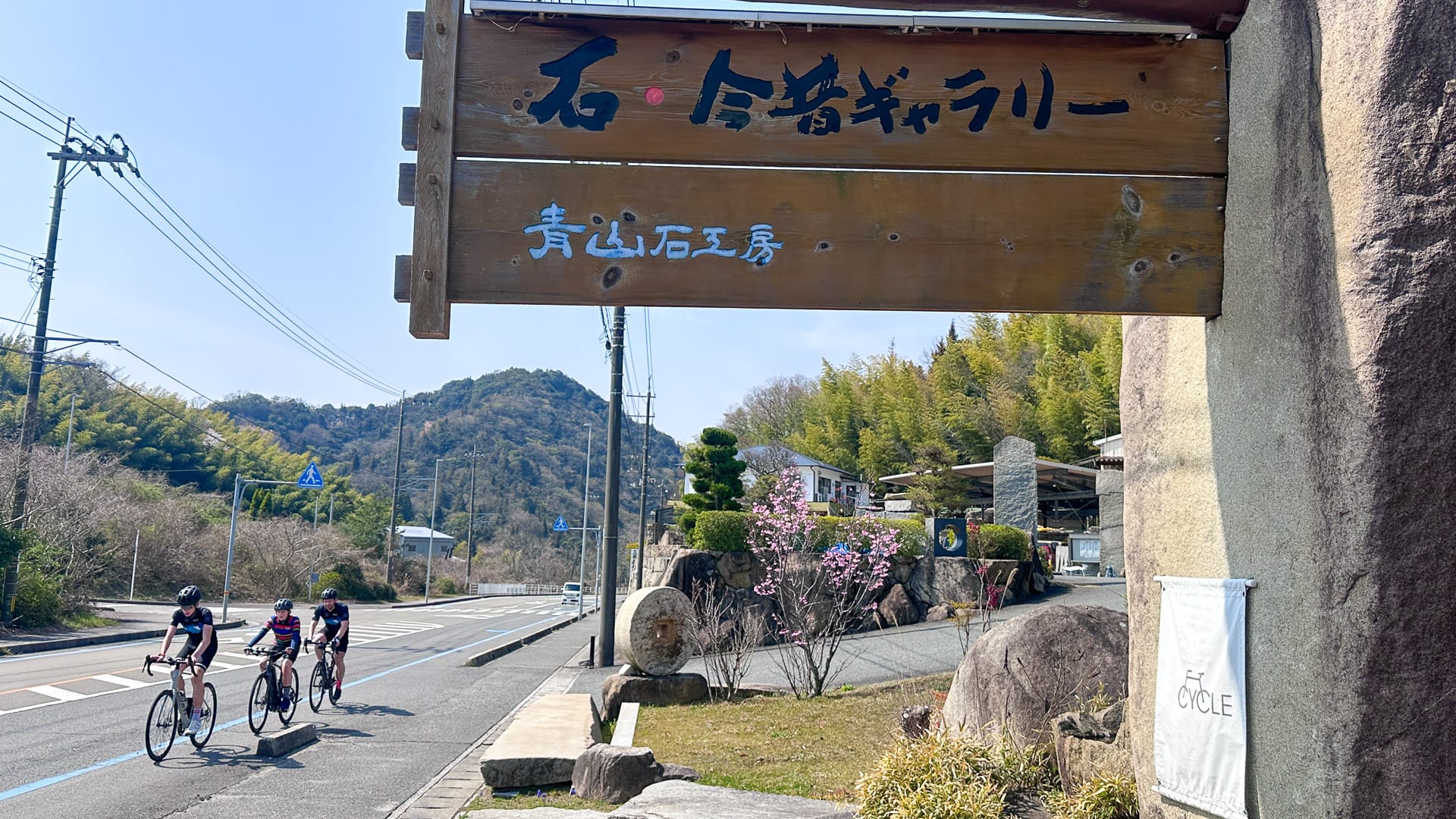
Riding on the roads of Oshima Island (blue line – riding the main route on day 3)
19. What should you do if it rains on the Shimanami Kaido?
The usual rules apply; always come ready for rain. However, if you’re new to cycling, it’s worth having a wet weather plan. Wet roads, white lines, manholes and downhill bends can be slippery in rain, so if the forecast is poor, allow extra time, ride cautiously or consider using buses, ferries or sightseeing stops instead. Convenience stores usually sell simple raincoats, but we’d suggest bringing proper waterproofs if you’re planning a multi-day ride.
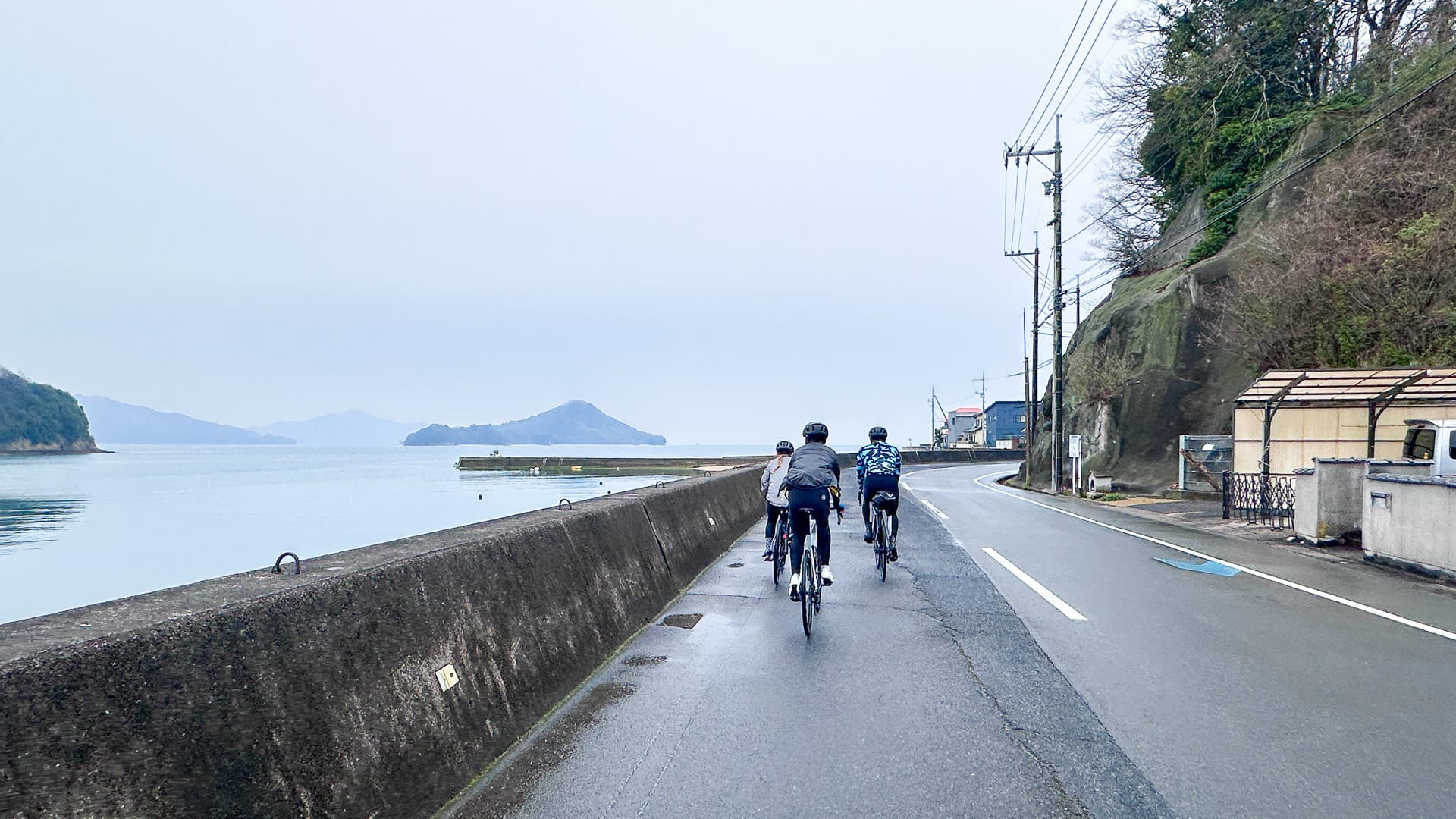
Rainy ride along Mukaishima Island’s south coast (day 1 of our trip – no blue line so you can tell we’re off the main route)
20. Is there luggage transfer on the Shimanami Kaido?
Yes! We used Sagwa (more details below), which was great.
WAKKA Hotel also offers luggage transfer, which might be a good option for groups. We stayed at the hotel but didn’t use this.
21. What do you need to know about using Sagwa luggage transfer on the Shimanami Kaido?
- Your bag needs to have a L+W+H of no more than roughly 160cm and it needs to weigh less than 30kg.
- When we travelled, it cost 2,200 yen per bag per transfer.
- Remember to book your Sagwa the night before!
22. Are there cycling friendly hotels on the Shimanami Kaido?
Yes, though some are not so accessible for international visitors as they don’t have websites and staff may not speak English. Here are the ones we stayed at and considered.
- Hotel Cycle u2: A stylish, higher-end option in Onomichi with secure bike storage, located in a converted warehouse with an on-site restaurant that makes a great end point to a multi-day ride.
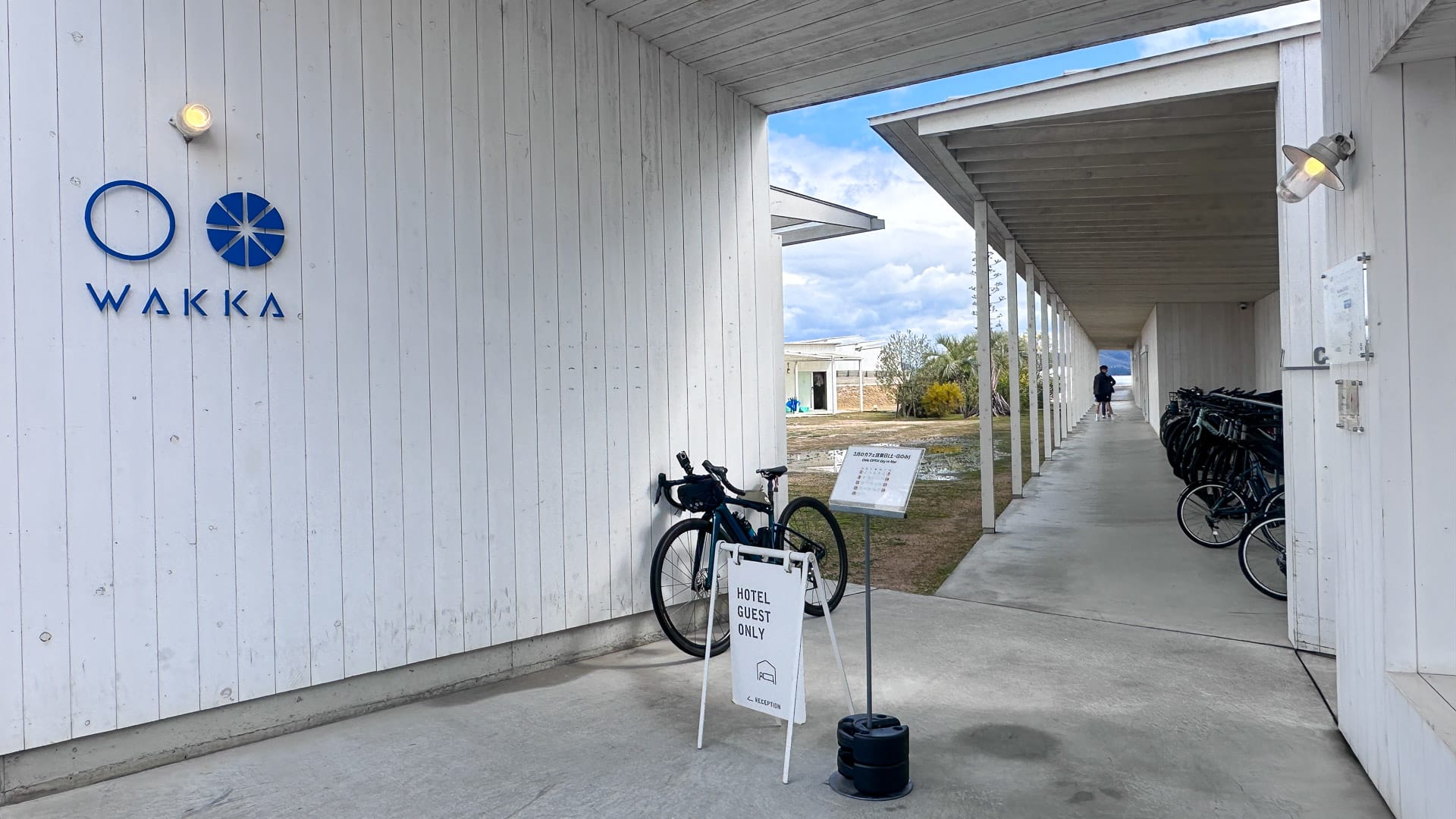
- WAKKA Hotel: A modern, cyclist-focused hotel near the water with a range of accommodation options, plus a café with views of the bridge and organised activities to explore the islands.
- Cyclo No Ie hostel: A small, budget-friendly hostel in Imabari designed specifically for cyclists, with a social atmosphere, bike storage, tools and useful route information.
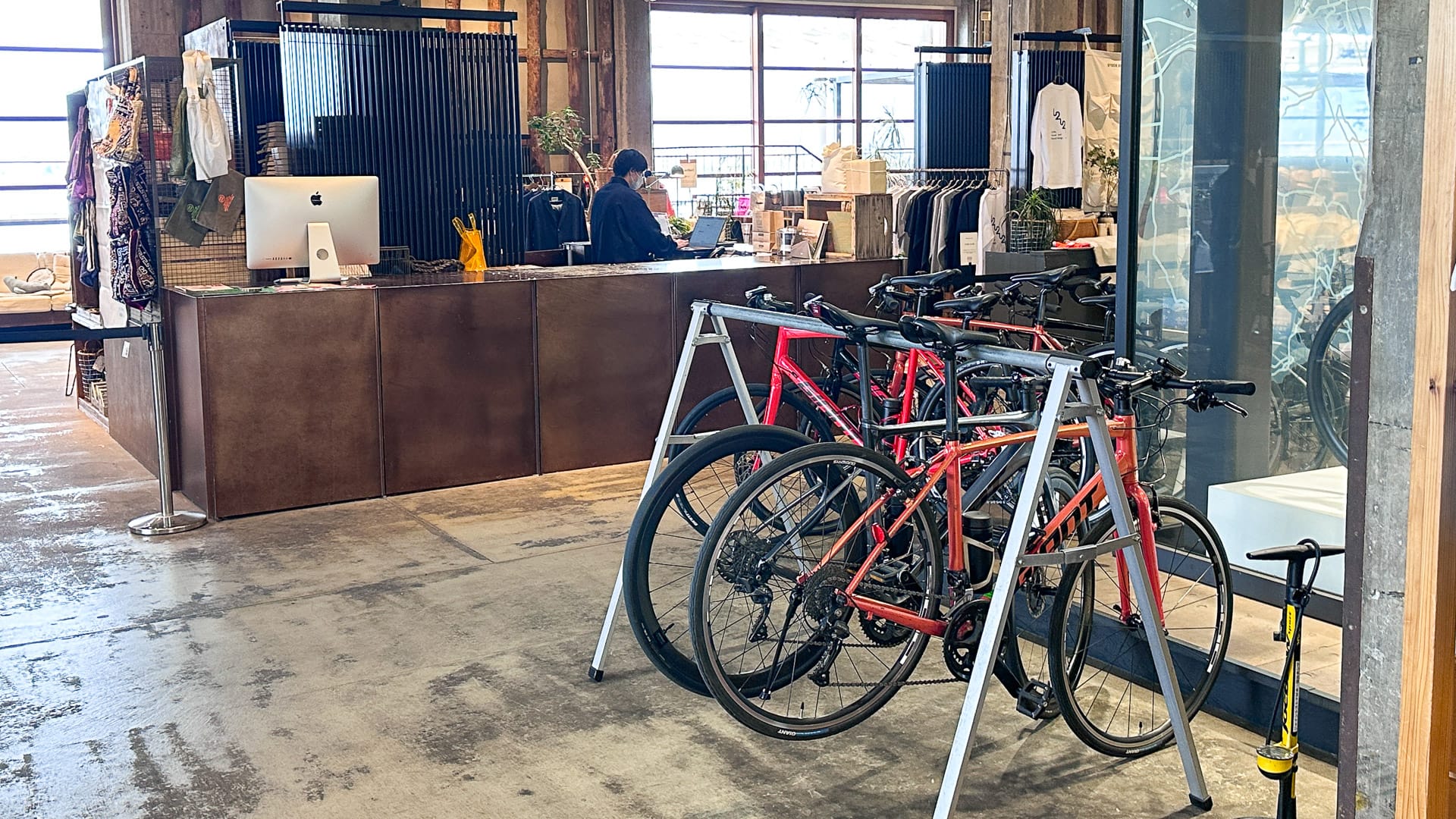
Inside Hotel Cycle U2, one of the bike-friendly hotels we stayed at on our trip
23. Are there food shops along the way?
The main “blue route” felt well provisioned and even off route, there are lots of towns and villages so if you’re riding on the coast you’re generally not far from a shop or restaurants. We did have one section when riding on day 2 where we were desperate to reprovision and had to ride about 8km more than we’d have liked. But that was more due to our bad planning than a lack of shops!
Also bear in mind that we found that lunch places usually have limited opening hours – roughly 12-2pm.
24. Can you buy water on the Shimanami Kaido?
Yes. It is not difficult to buy drinking water, with vending machines, convenience stores and shops on the islands. That said, it’s still worth topping up whenever you can, especially in summer or when leaving the main blue route.
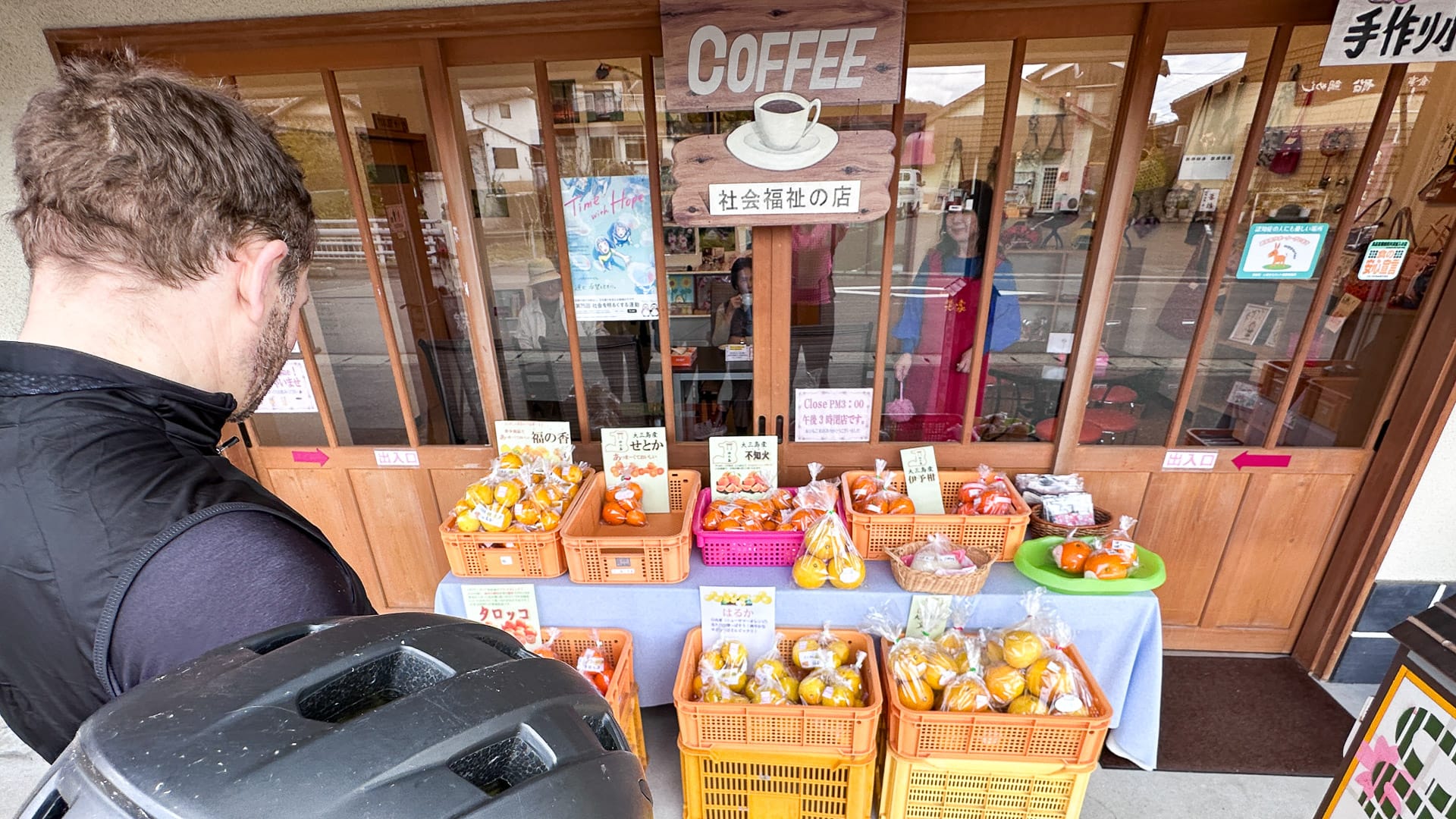
Coffee and fruit shop on Omishima Island with local produce
25. Can you shower after riding the Shimanami Kaido?
Yes. There are showers, public baths and onsen around Imabari, Onomichi and some of the islands. This is particularly useful if you finish riding before catching a train or continuing your trip.
26. What are the best days of the week to ride the route?
On Tuesdays, lots of businesses in the area are closed – make dinner reservations well in advance.
27. When is the best time of year to ride the Shimanami Kaido?
Cyclists ride the Shimanami Kaido year-round, but it’s worth thinking carefully about weather and daylight. Spring and autumn are popular times to ride, while summer can be hot and humid and the rainy season can make conditions less pleasant. Winter can still be rideable, but you’ll want to check sunset times and dress for colder conditions.
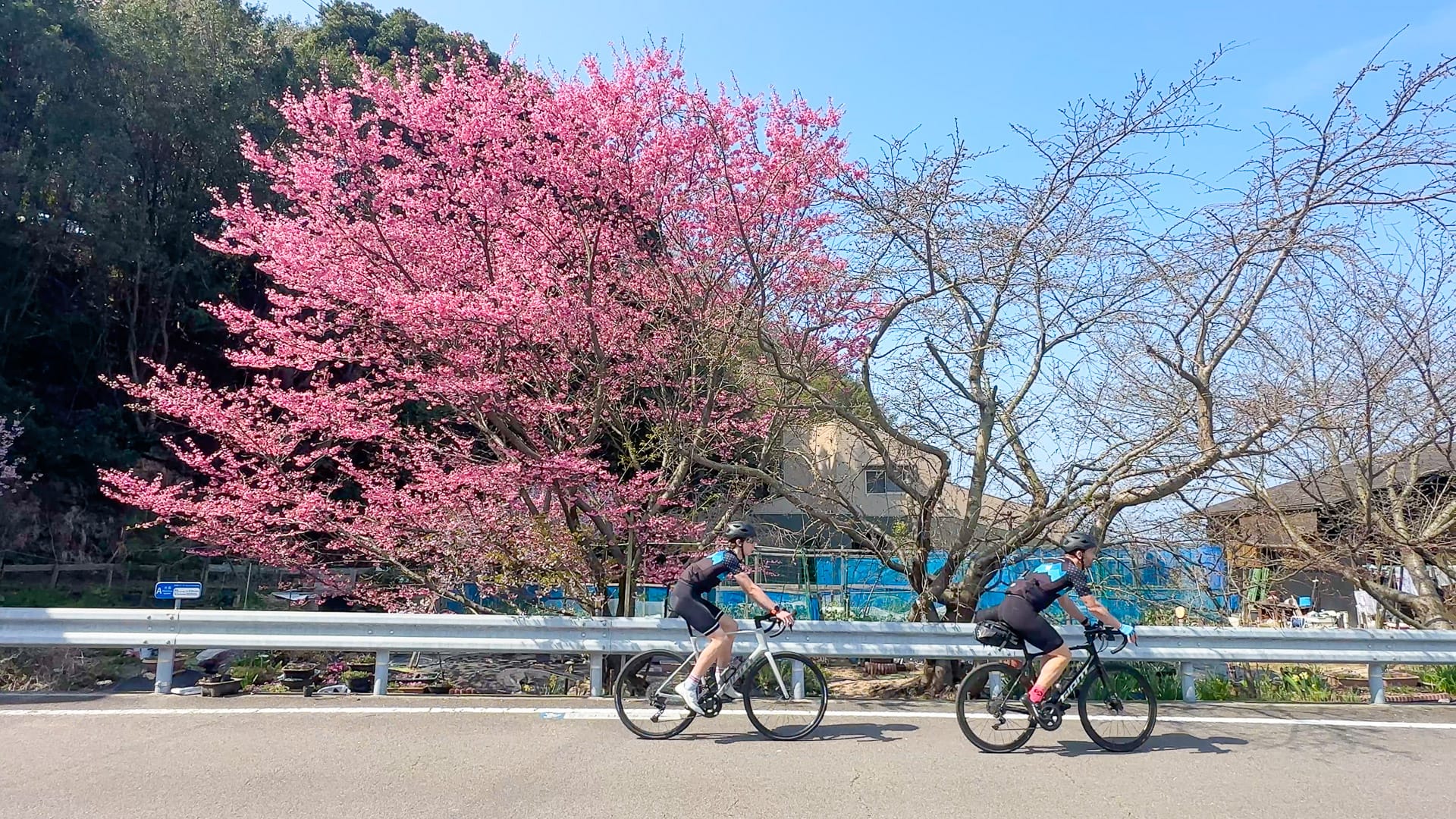
Cycling past cherry blossom on Oshima Island (not on the main route)
28. How do you get to Imabari or Onomichi?
Both cities are connected to Japan’s fantastic train network. We were arriving from Kyoto and were going back to Tokyo, and found it absolutely straightforward to get the Shinkansen to Fukuyama and the regional train on from there (it’s about 20 minutes on the train between Fukuyama and Onomichi).
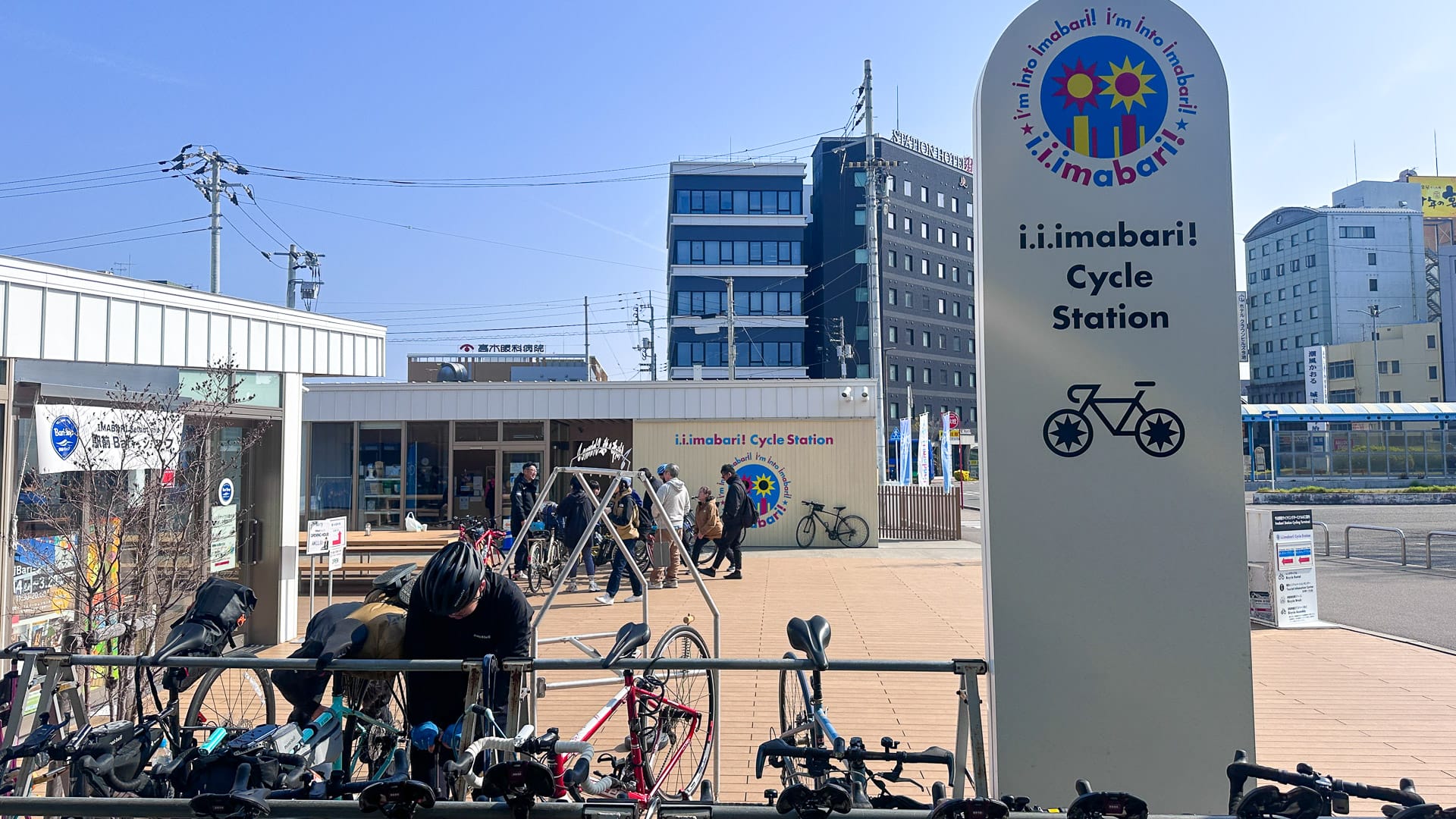
Imabari Cycle Station beside the train station
29. Can you get the bus back to your starting point?
Bikes are allowed on buses, but it’s worth noting that they need to be in a bag and if the storage trunk is full then you might not be allowed onboard.
A sign at Imabari station stated “You will need to take two buses to Onomichi. Take the highway bus to Fukayama and get off at the Innoshima Ohasi bus stop. Transfer to a bus bound for Onomichi Station at the Innoshima Ohasi bus stop.”
Note that you will need cash to pay the bus.
30. Can you get the ferry?
A ferry runs from Setoda port to Onomichi. If you just want to ride 30 kilometres or so then get the ferry back from Setoda. Note that the Lazuli ferry has a bike rack but the Citrus ferry doesn’t and bikes can get scratched when stored outside. If using the Citrus, ask the member of staff to store the bike inside.
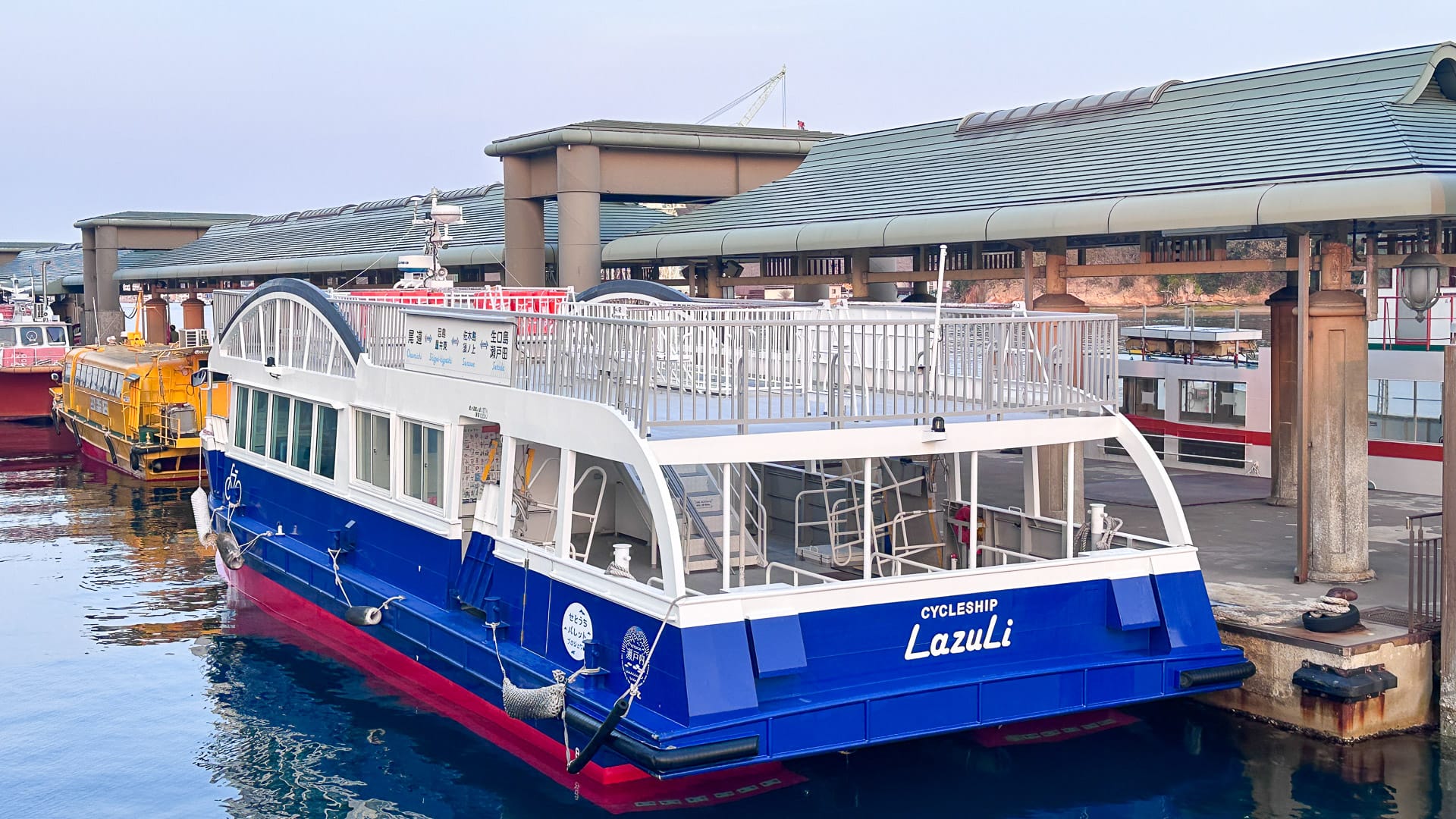
LazuLi ferry travelling between islands in Japan
31. Are there any routes to ride once you’ve done the Shimanami Kaido?
Yes! We haven’t done them, but here are a few suggestions:
- Sazanami Kaido between Onomishi and Kure – around 85km
- Tobishima Kaido between Akinada Bridge and Okamurajima – around 31km
- Takanawa Road between Imabari and Matsuyama – around 48km
- Ishizuchi Kaido between Imabari and Kan-only – around 90km
- Yumeshima Kaido – connecting the islands of Kamijima – around 50km
32. What is the history of the Shimanami Kaido cycling route?
Opened in 1999 to much excitement, the Shimanami Kaido (also known as the Setouchi Shimanami-Kaido) went through roughly a decade of stagnation between 1999 and late 2000s (source). Annual public rental cycle users fell below 30,000 in 2005. Fortunately, three turning points moved the dial toward cycle tourism:
- Municipal mergers around 2005-2006 consolidated ten municipalities into just two cities (Imabari City and Onomichi City), making coordinated policy much easier.
- Grassroots civic movements emerged – model cycling courses were developed around 2005, the Shimanami Slow Cycling Council was established in 2008, and NPO Cyclo-Tourisme Shimanami was founded the following year.
- Governor Tokihiro Nakamura of Ehime Prefecture took office in 2010 and actively championed cycling culture , creating a dedicated government office for bicycle promotion and co-hosting the international “Cycling Shimanami” event with Hiroshima Prefecture.
In October 2014, the Shimanami Kaido signed a sister cycling road agreement with Taiwan’s Sun Moon Lake cycling course, and the first international cycling event was held. That same year, CNN named the Shimanami Kaido as one of the world’s seven greatest cycling routes. In 2019, Japan’s Ministry of Land, Infrastructure, Transport and Tourism designated it as one of the country’s first National Cycle Routes.
Today, more than 300,000 bicycles travel the cycling route annually, and nearly half of all riders are first-time cycling travellers.
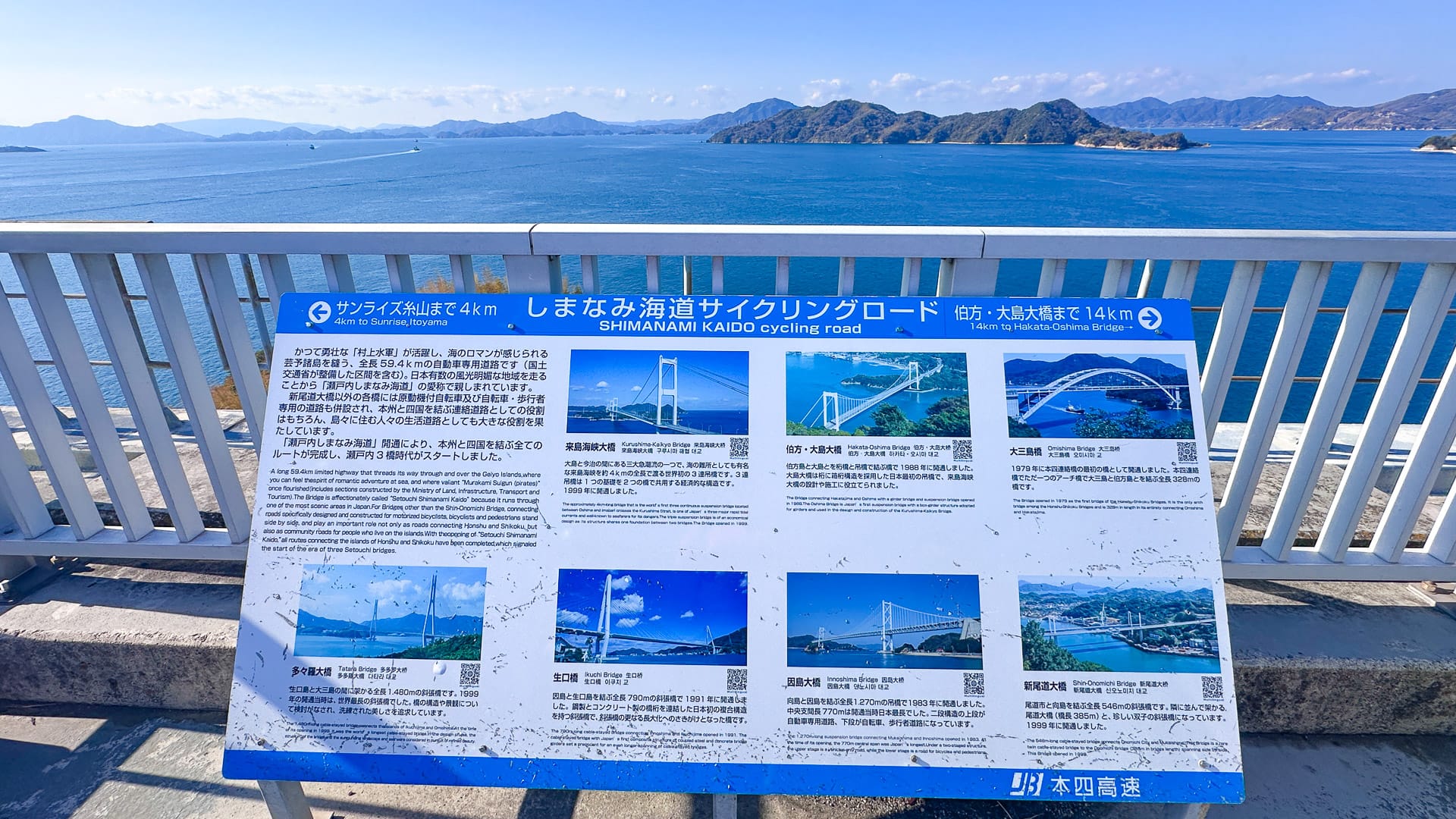
Information board about the Shimanami Kaido cycling route
Part 5: What do you need to know about bike hire and support?
33. What type of bike do you need for the Shimanami Kaido?
Whatever you are comfortable riding for several hours is the best choice. The route is all on asphalt, so road bikes are absolutely fine. Hybrid bikes, e-bikes and city bikes are also common, especially if you are riding at a more relaxed pace. The main thing is to choose a bike that fits you well and feels comfortable for the distance you plan to ride.
34. Can you hire bikes on the Shimanami Kaido?
Yes, we hired from Giant in Onomichi City. They also have a large shop in Imabari City. What I liked about Giant is that I was able to reserve a bike in advance (note their booking opens 60 days in advance and at peak periods it’s a really good idea to book in advance as they often sell out quickly). I thought the bikes we hired were good quality and suitable for European sizing – for example I am 180cm tall.
There are other hire options, indeed I understand that the public bike rental system has 10 bike hire outlets along the route. I understand they offer cross bikes, mountain bikes, city bikes, e-assist and even tandem bikes. I am sure things will develop over time, but I’ve seen plenty of reports that you can only get smaller bike sizes from such outlets. Also be aware that you can only reserve here up to 4 days in advance.
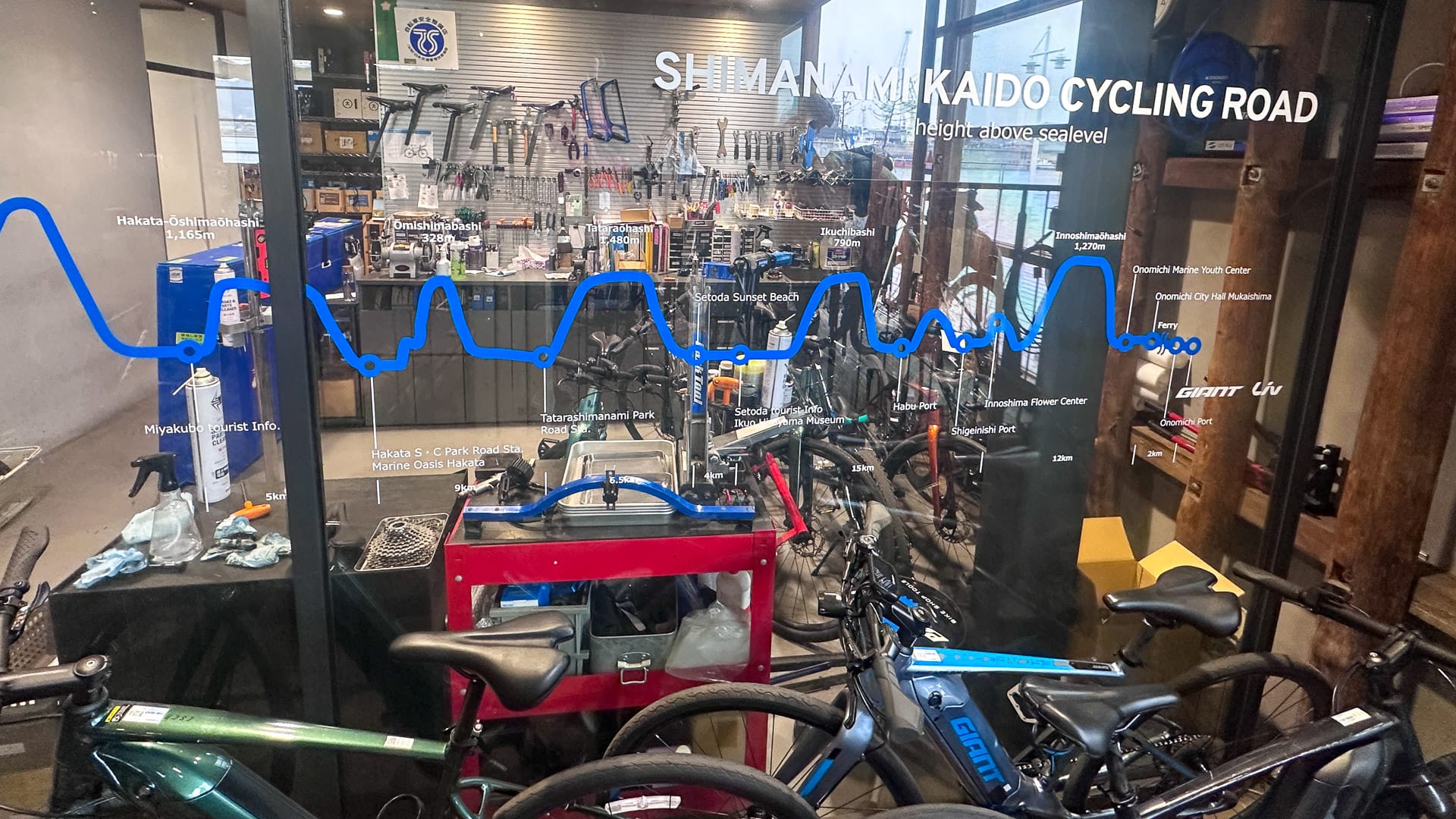
Hire bikes from Giant
35. Can you bring your own bike to the Shimanami Kaido?
Yes, but if you’re taking your bike on Japanese public transport, it needs to be packed in a proper bike bag. There are bike assembly spaces at both Imabari Station (served by JR Imabari Station) and Onomichi Station (served by JR Onomichi Station), which is useful if you’re arriving with your own bike rather than hiring.
36. What if you only want to cycle one way on the Shimanami Kaido?
One way bike hire is possible, but make sure you leave yourself enough riding time to get back before the store closes.
37. Is support available if cyclist or bike break down?
WAKKA Hotel has some fantastic cyclist support services including bike taxis, including a van that can transport up to 5 bikes and five passengers. This is particularly useful for group travel.
If you hire your bike from Giant they show you the following sign when you hire “When you go to Imabari, be sure to make a bike rental reservation for at least two days and return it by yourself, or get a drop-off reservation. Even if you have no choice but to drop off the bicycle at Imabari, we cannot accept it because another reservation has already been made at Onomichi. In that case, an emergency collection fee of 55,000 yen will be charged.”
If you hire your bike from the main bike terminals (rather than Giant) you can return your bike at any of the 10 terminals without having to tell them in advance. If your bike has problem, you can replace it at one of the terminals.
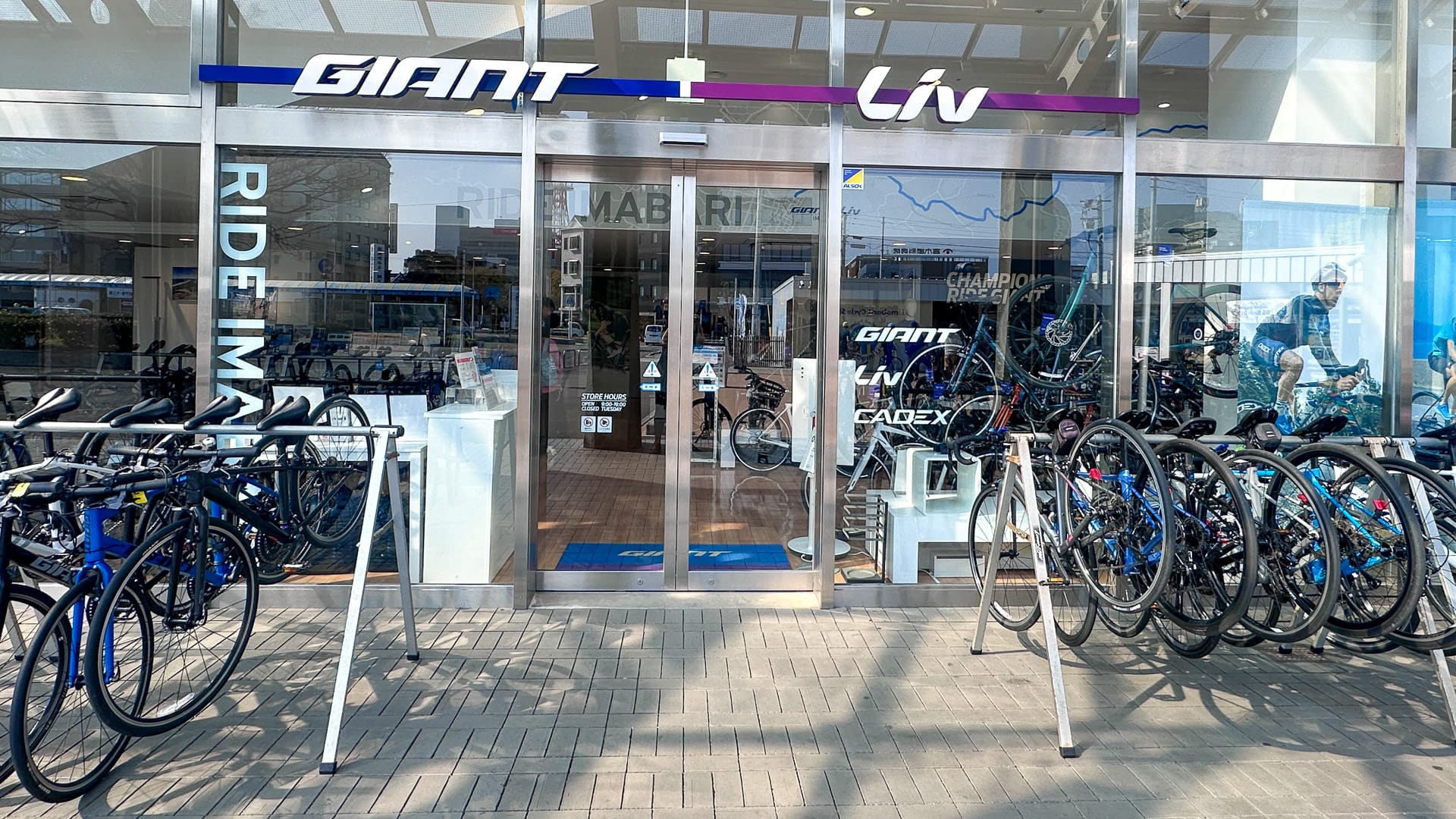
Giant bike store in Imabari
Final thoughts
The Shimanami Kaido is one of those rides that looks simple on the surface, but has a lot of small details that can shape your experience.
From choosing which direction to ride, to deciding how many days you need, to understanding how bike hire, luggage transfer and transport options work, there are plenty of decisions to make along the way. None of them are complicated, but getting them right can make the difference between a smooth trip and a stressful one.
That’s really what this FAQ is about. It’s not just whether you can ride the Shimanami Kaido, but how to make the most of it.
If you’re thinking about riding it yourself, you’ll find more help in our other articles:
- Shimanami Kaido cycling route, for tips on riding Japan’s most famous cycling route
- Planning a bike tour in Japan, 14 things you need to know
- Planning a Shimanami Kaido bike tour (itinerary and tips)
- Cycling Japan, our central hub page for the country
- Cycling Japan with Rindo Bike Tour Japan 2026: 6-day itinerary + review
- Self guided cycling tours in Japan: what you need to know before you book
Hopefully, this gives you everything you need to start planning your own trip.
Please support Epic Road Rides
A huge amount of time and effort goes into the article you’ve just read, all with the aim of helping you!
If you found what you’ve read useful, I’d really appreciate it if you dropped something in the tip jar here.
It’s a way you can say thank you and help us carry on creating top quality content with no annoying ads and no pay wall.
Looking for an organised cycling trip?
If you want someone to help you plan and book your cycling holiday, fill out this form. We aren’t a tour operator/agent but we work with lots of people who are and will do our best to put you in touch with someone that can help (within 24 hours where possible)!Clare Dewey is a cyclist with a passion for travel. She set up epicroadrides.com in 2018 to help make it easy for cyclists to explore the world by bike. Today her mission is still inspiring cyclists to discover new places on two wheels - and doing what she can to make sure they have the best possible time while they're there. Clare has visited 50+ destinations around the world, many of them by bike.
Want to connect with Clare? Find her over on LinkedIn.
First Published: 05 May 2026
This article includes details of products and/or services that we have used ourselves or which we would consider using. Some are paid features or include affiliate links or referral codes which we may earn commission from. As an Amazon Associate we earn from qualifying purchases. Please read our disclosure policy for further information.
The contents of this website are provided for general information purposes only. It is not intended to amount to advice and you should not rely on it. You should carry out your own due diligence and risk assessments and take professional advice. Views expressed by interviewees or other users of this website do not necessarily represent our views. We make no representations, warranties or guarantees, whether express or implied, that the content on our website is accurate, complete or up to date. If you use any information or content on this website, download from, or otherwise obtain content or services through our website, it is entirely at your own discretion and risk. Epic Road Rides Ltd disclaims all liability and responsibility arising from any reliance placed on the information and content on this website. Find out more here.
We just rode the Shimanami Kaido from Ominichi to Imabari Aug 19-20, 2026 I wish I had come across your excellent post before our trip! Post trip thoughts: 1) it was amazing and so beautiful, 2) great 2 day trip for our family of 4 (kids 17 and 13), 3) it was insanely hot in August, 4) we rented from the main bike rental place—bikes were great, helmets included, bring your own multi tool to adjust seat heights etc as along the way, 5) luggage forwarding was awesome and very easy to coordinate at our hotel in Ominichi the day before starting, as long as you have a hotel as your next destination to receive the bags and it was next-day delivery. Loved this trip so much, highly recommend!
Thanks so much for sharing your experiences and tips! I’m so glad to hear you had an amazing time.