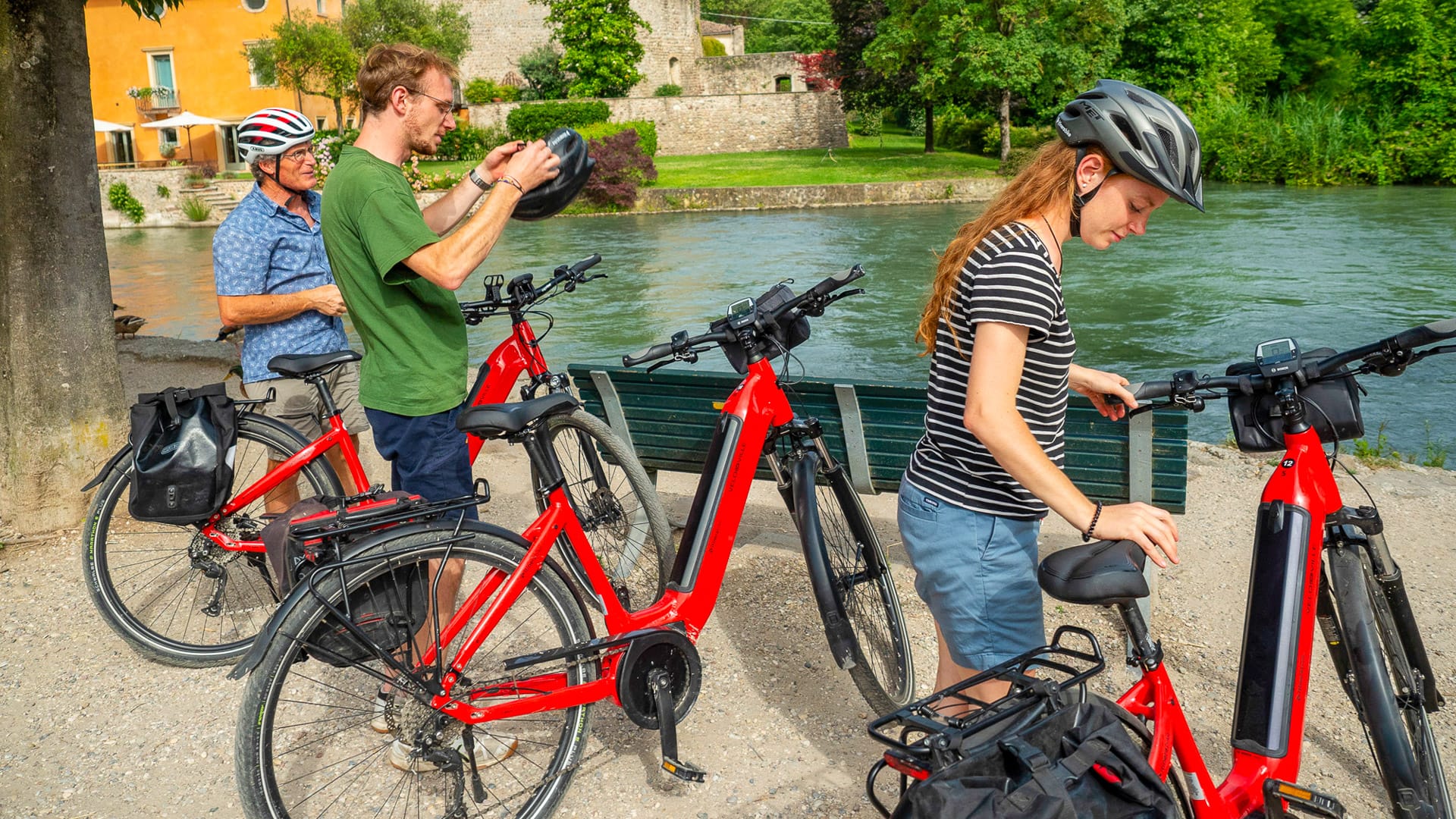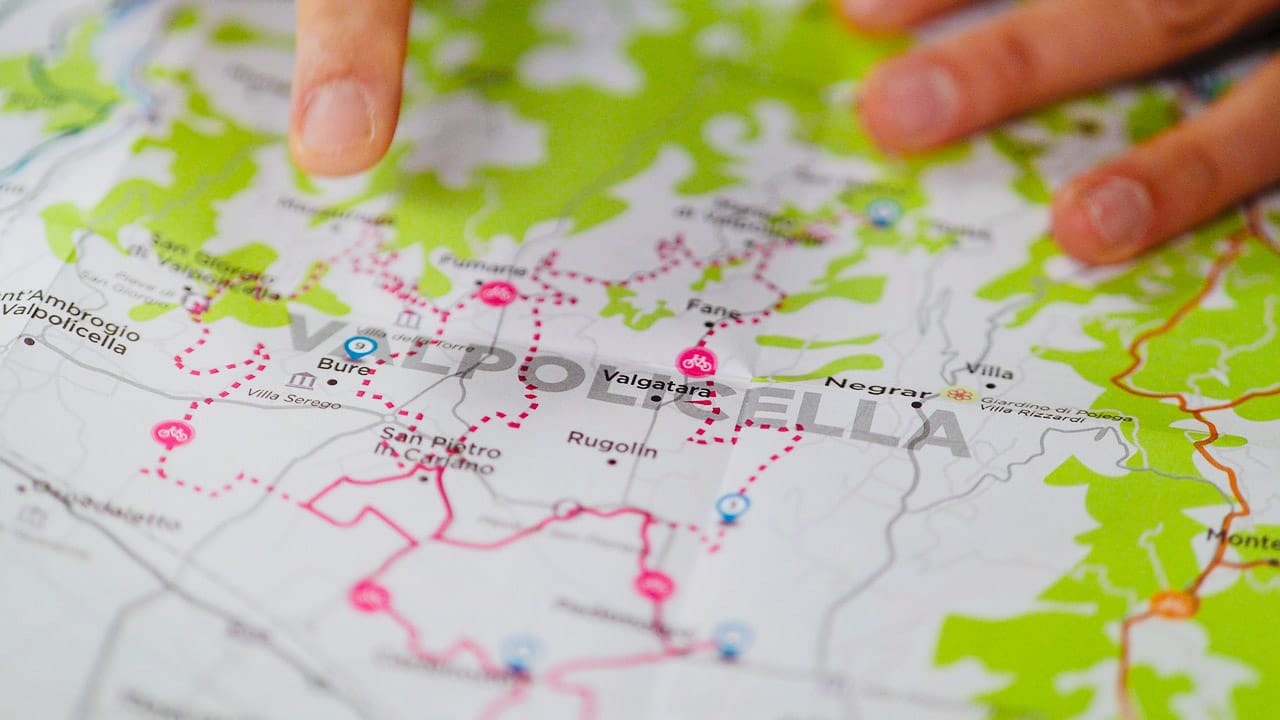

Cycling in Verona belongs on your wishlist. This UNESCO World Heritage city in northern Italy’s Veneto region is well-known, but the real magic starts once you ride beyond the headline sights.
In minutes, you can trade busy squares for beautiful back roads that roll through Valpolicella’s vineyards and towards the Lessinia foothills. With the legendary Lake Garda close by, it’s easy to stitch together culture-packed days with scenic lakeside spins.
To help you plan the perfect bike-friendly city break, we’ve enlisted the local expertise of Francesco Vaccaro, a tour leader at Itinera Bike & Travel. Verona-based Itinera runs both self-guided and guided tours that combine the gorgeous surrounding countryside with tastings of locally produced food and wine.
In this guide, Francesco explains why Verona is a standout cycling destination and shares the practical tips you need to plan a memorable bike tour.
Enjoy!

Always check current travel information and advice. For visitors from the UK, the UK government travel information pages are here.
Table of contents
This guide is packed with useful information. So, to help make it more digestible, we’ve broken it down into several parts. This includes:
- Part 1: Why visit
- Part 2: Overview
- Part 3: Bases and routes
- Part 4: Practicalities and tips
- Part 5: Itinera Bike & Travel
Sponsor Message
Looking for Verona bike tours?
Itinera Bike & Travel have operated Verona bike tours for well over a decade and knows the city extremely well! Today their services include bike hire of e-bikes, gravel bikes and touring bikes. Head to the Itinera Bike & Travel website for further details.
Exclusive discount
Claim 10% off* all Itinera Bike & Travel services, including their Verona bike tours and bike hire, when you book directly with them before 31 October 2026. *T&Cs apply.
Got a question for Francesco Vaccaro from Itinera Bike & Travel?
Fill out this form and we will pass it to Itinera Bike & Travel who aim to reply (within 24 hours wherever they can!)
Part 1: Why go cycling in Verona, Italy?
A culture-rich city break
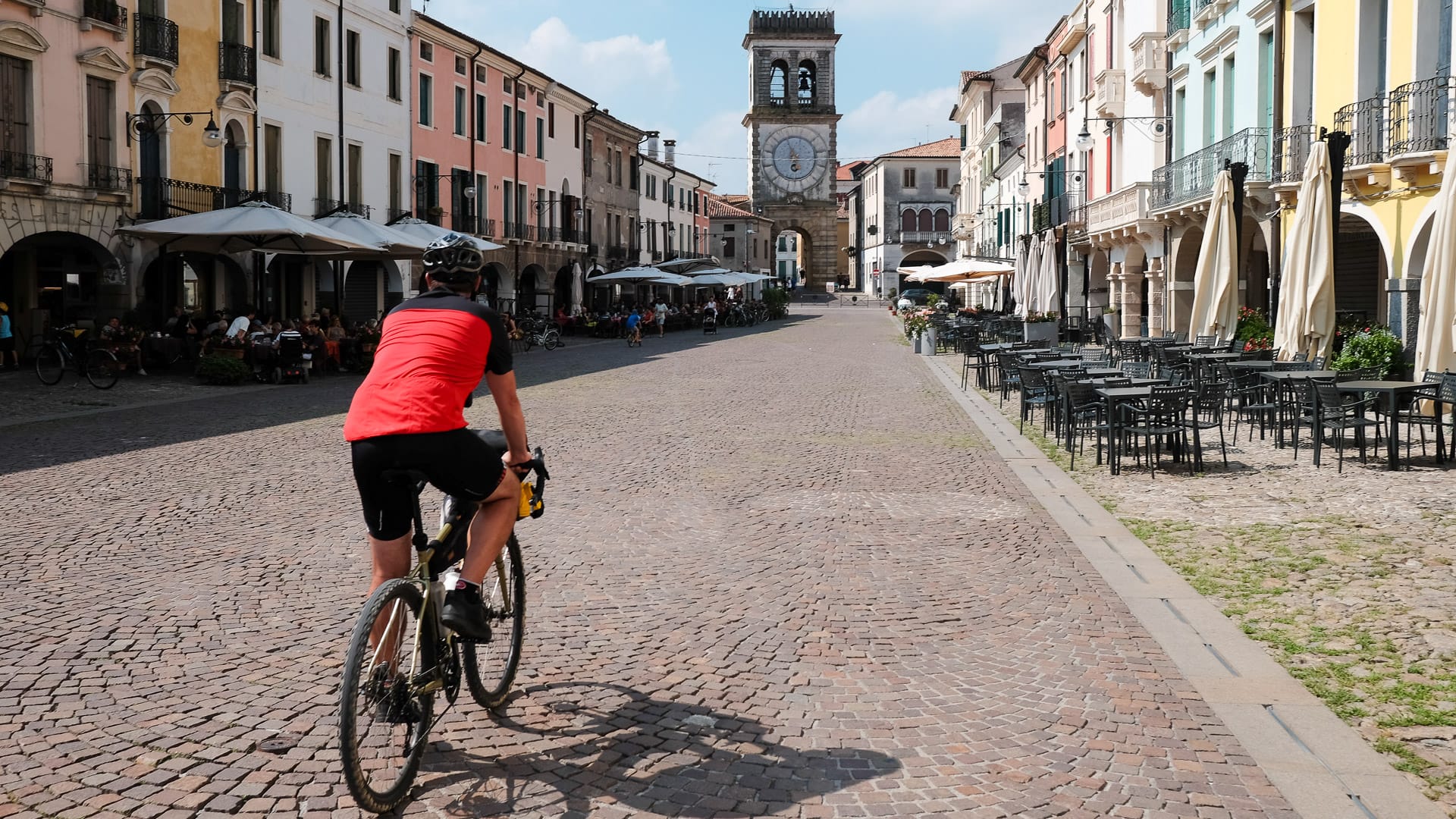
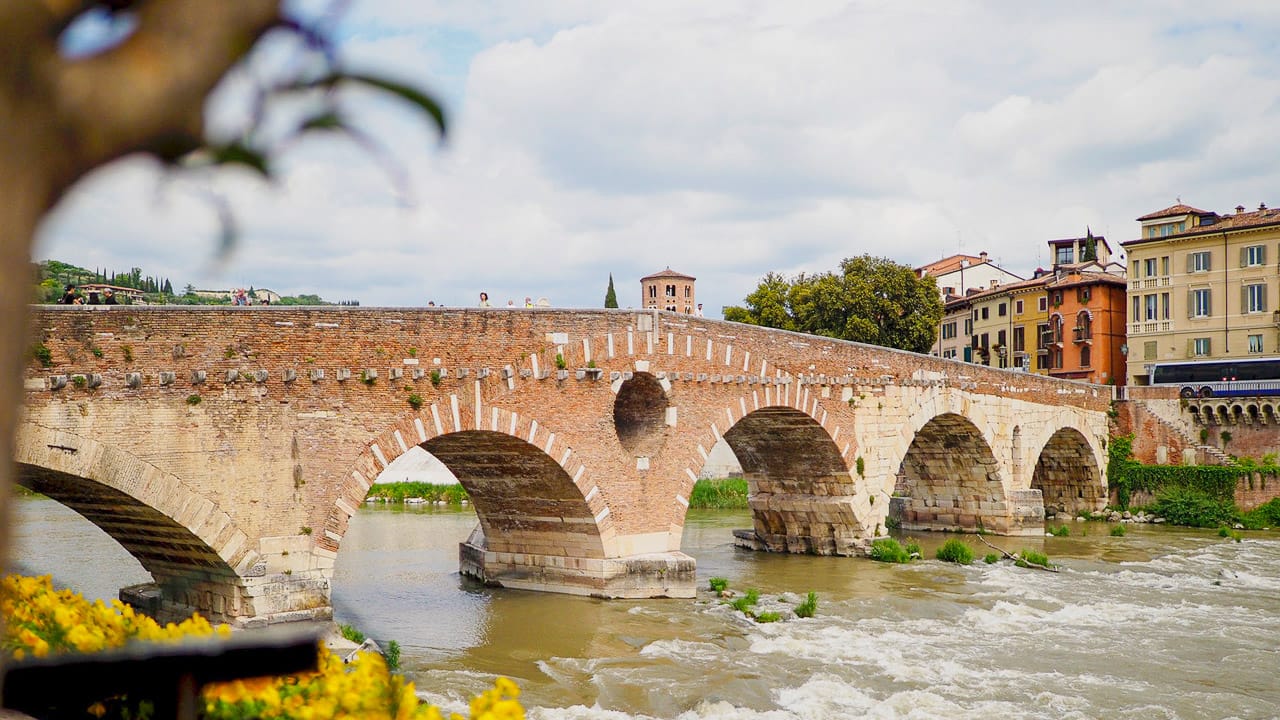
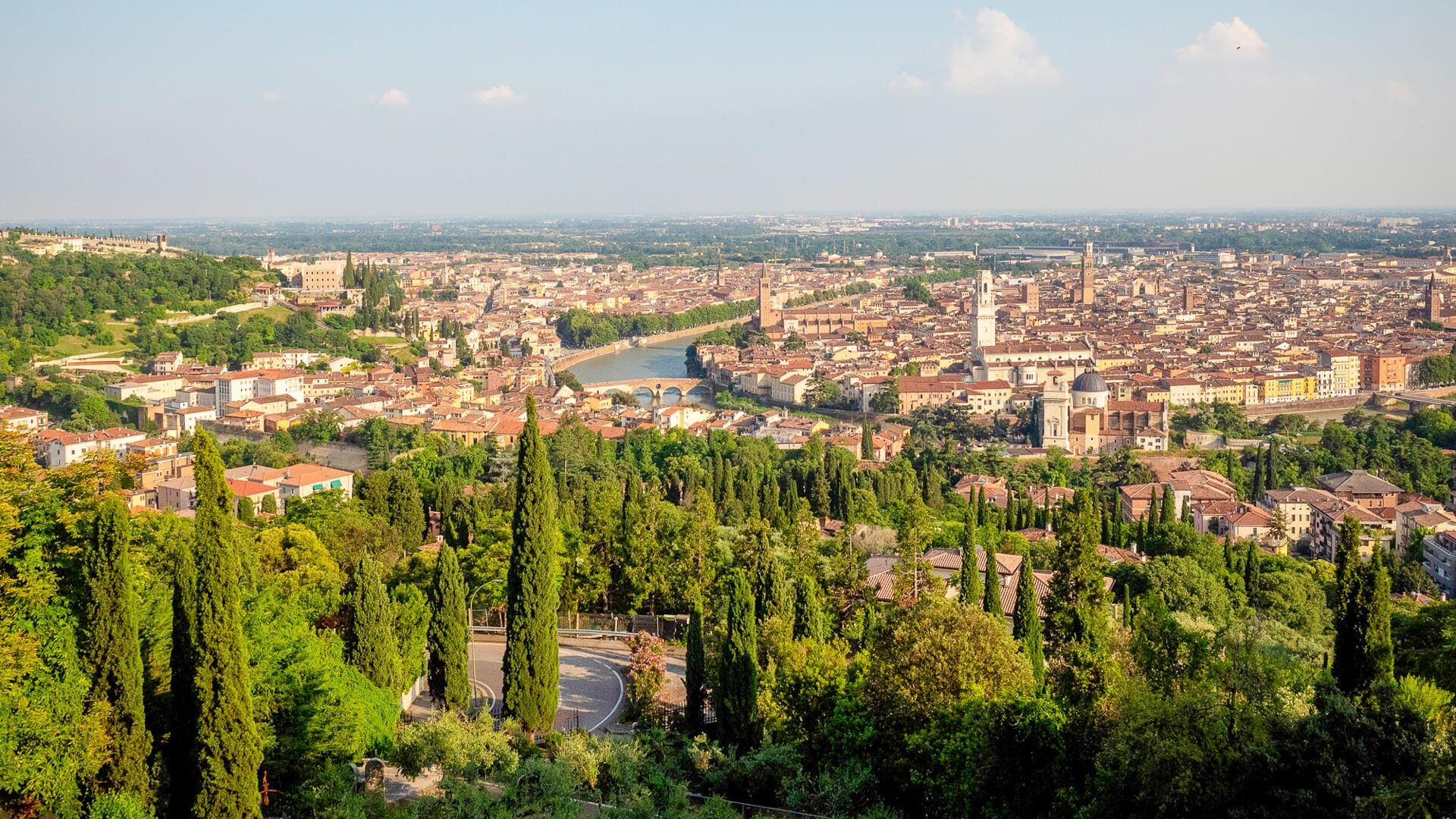
Verona is a UNESCO World Heritage city that masterfully layers Roman engineering, medieval walls and Renaissance palazzi into a compact centre. The city’s small historic core makes it feel effortless to explore on two wheels.
You can roll between landmarks in minutes, pause for a coffee in a frescoed square, then follow the River Adige out towards vineyard-lined hills, all without breaking the spell of the old town.
It’s ideal for riders who are fascinated by history and want maximum culture for minimum faff! Here are some of the noteworthy attractions you won’t want to miss:
- Arena di Verona: A Verona classic and unmissable. The Arena is Verona’s Colosseum, but, unlike the monument in Rome, it is still alive and kicking! With a capacity of up to 15,000 spectators, it hosts concerts, events and the famous opera season that runs from mid-June to mid-September. It is a great thrill to watch a show on steps that are 2,000 years old. Bring along a cushion to sit on!
- San Zeno Square and Church: Made of local pink and cream-coloured stone and marble, the basilica stands placidly on the square of the same name, which is largely pedestrianised. History, legends and city life intertwine in this place. Enter the large basilica and discover the work of Mantegna, an important Italian artist of the 1400s, and the ancient bronze bell that was rung before storms (it is right where Romeo and Juliet are said to have been married!). Stroll through the beautiful cloister adorned with rows of columns. The square hosts a monthly antiques market, celebrates carnival in February, and is the perfect place for an evening aperitif every day of the year.
- Castelvecchio Bridge: A medieval, fortified bridge over the Adige River in Verona. You’ll also find the Castelvecchio Museum (Museo di Castelvecchio) here, Verona’s flagship museum. Expect a best-of collection spanning medieval to 18th-century art, sculptures, arms and ceramics, plus time to wander its courtyards and the iconic bridge.
- Castel San Pietro: Located on a cypress-lined hill above the centre, this red-brick fortress has a broad panoramic terrace with sweeping views over the Adige, the bridges and the Roman Arena.
- Juliet’s House (Casa di Giulietta): Verona’s most photographed balcony! It’s iconic and very busy; access is now ticketed and timed, useful to know when plotting your city break!
Natural escapes on the doorstep
Verona is a small city with the countryside right next door. The historic centre is easy to pedal, but it gets busy. If you ride a few kilometres away from this urban hub, you’re in green, quiet spaces where trees and breeze take the edge off the summer heat.
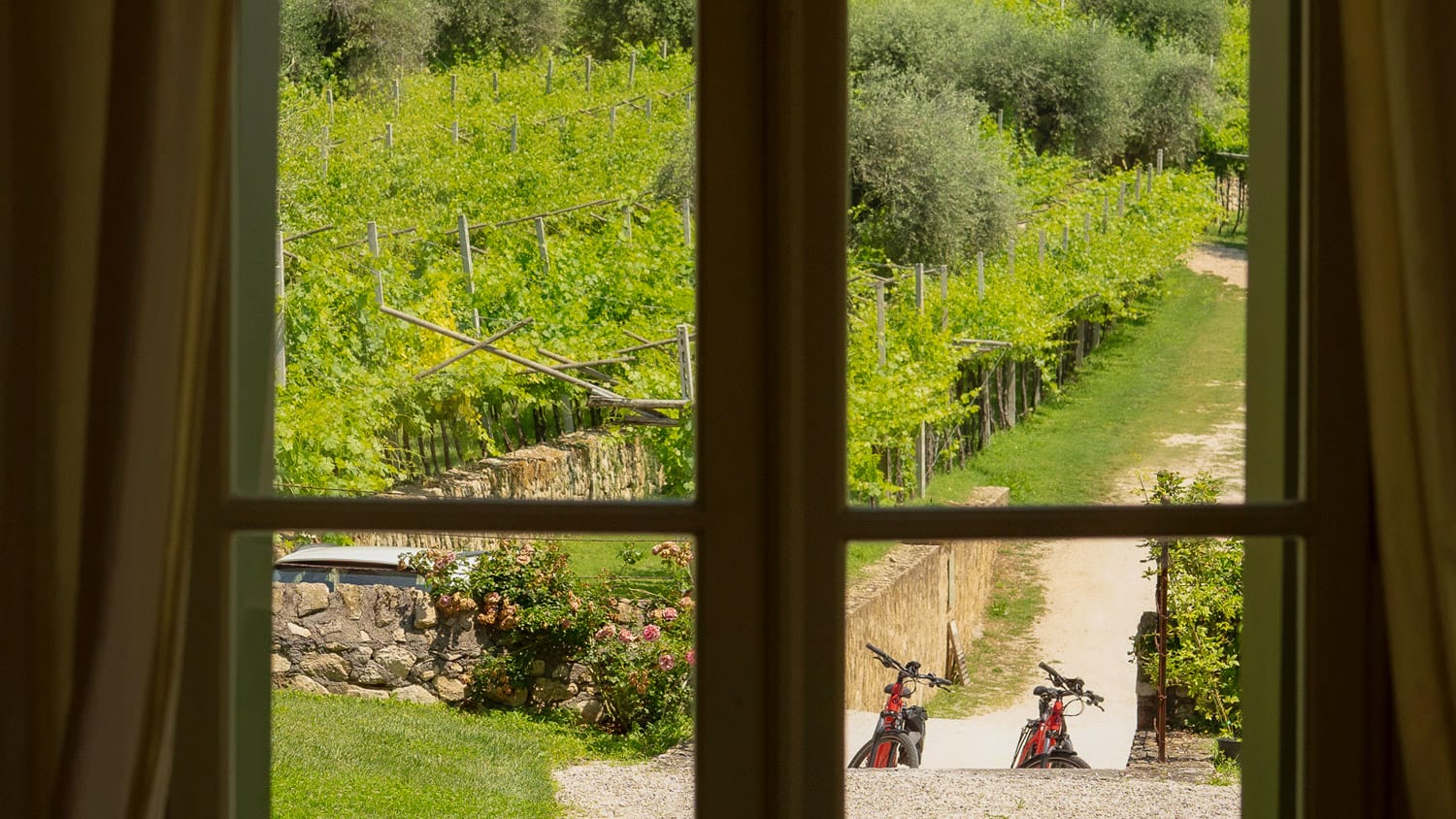
North of the city, the land lifts into vine-striped hills and olive groves, perfect for gentle touring with café pauses and photo stops. Climb a little higher and the Lessinia foothills bring cooler air, hush on the lanes and big, balcony views, ideal when you want a calmer, crowd-free ride.
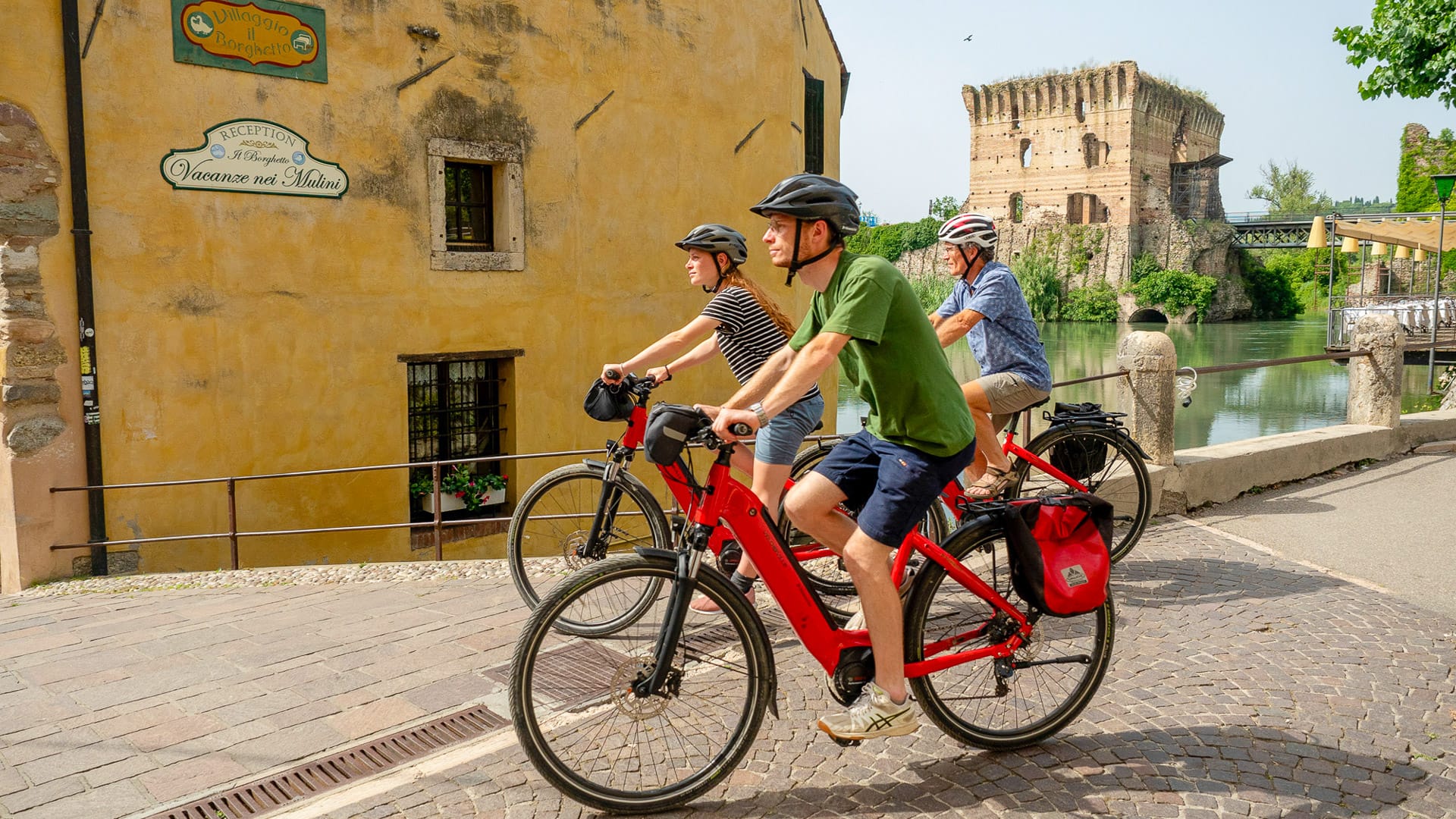
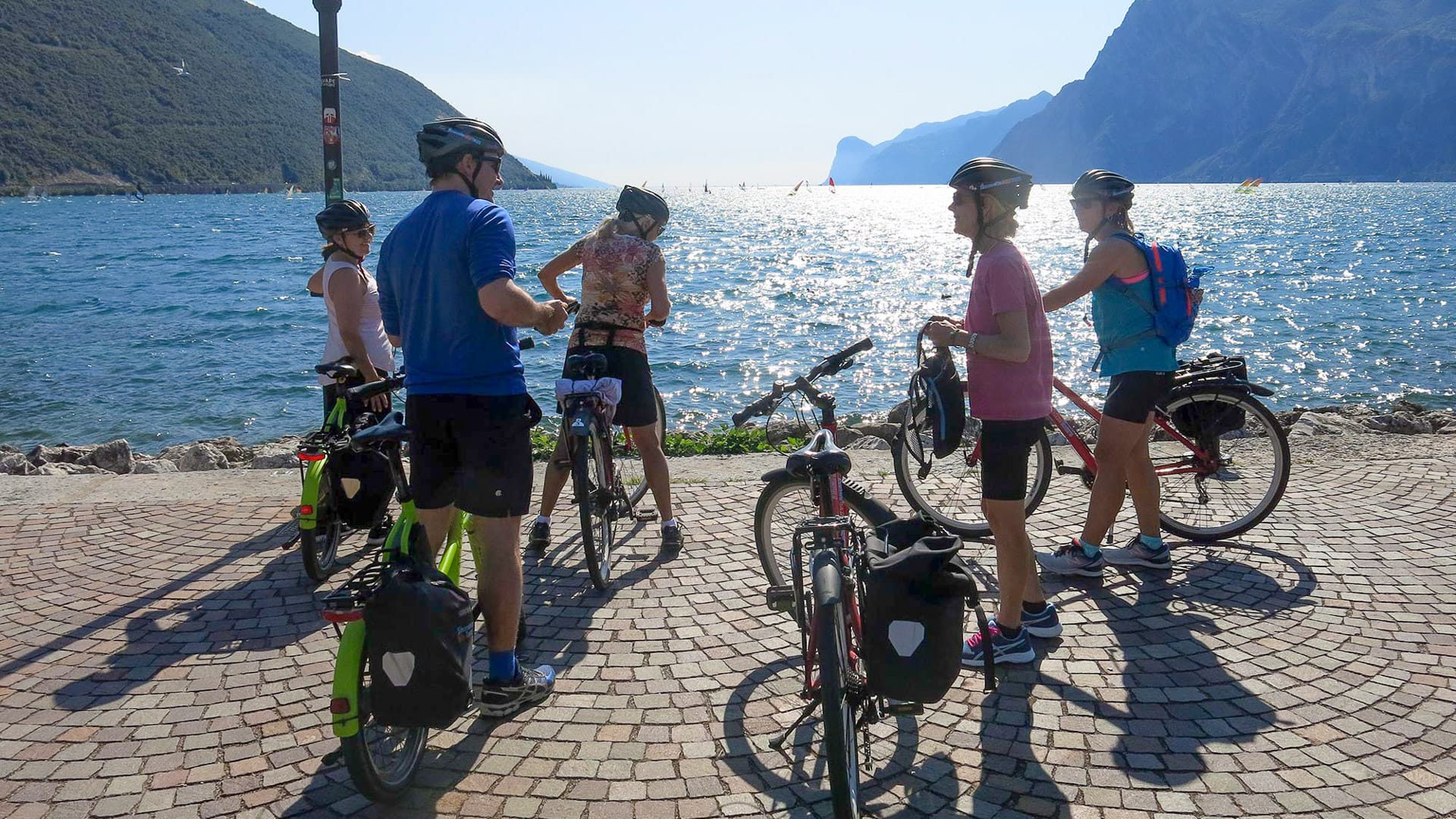
The wider landscape is wonderfully varied: vineyards and olives give way to patches of wild scrub, then on to cherry orchards, beech woods and high pastures as you near the pre-Alps. Fancy riding beside water? Lake Garda sits roughly 30 kilometres west of Verona, with a mild, almost Mediterranean feel. It’s popular for good reason: sparkling shoreline paths, breezy promenades and gelato whenever you fancy.
An established cycling culture
Verona wears its cycling pedigree proudly. The city has twice hosted the UCI Road World Championships (1999 and 2004), and it provided the showpiece finale of the 2022 Giro d’Italia with an arena-side time trial that sealed the overall title (source). Besides these big events, there are also many other national and regional events held here regularly. More on that below.
The EuroVelo 7 – the Sun Route – also runs through Verona on its way down Italy via the Ciclopista del Sole, tying the city into a north–south spine from the Alps to Sicily. The well-developed Adige cycle path also drops you straight into the city from Bolzano and Merano, following the ancient Via Claudia Augusta, which makes point-to-point itineraries and relaxed one-way rides simple to plan!
Verona also hosted the closing show of the 2026 Winter Olympics, cementing its status as a serious outdoor destination.
World-class wine
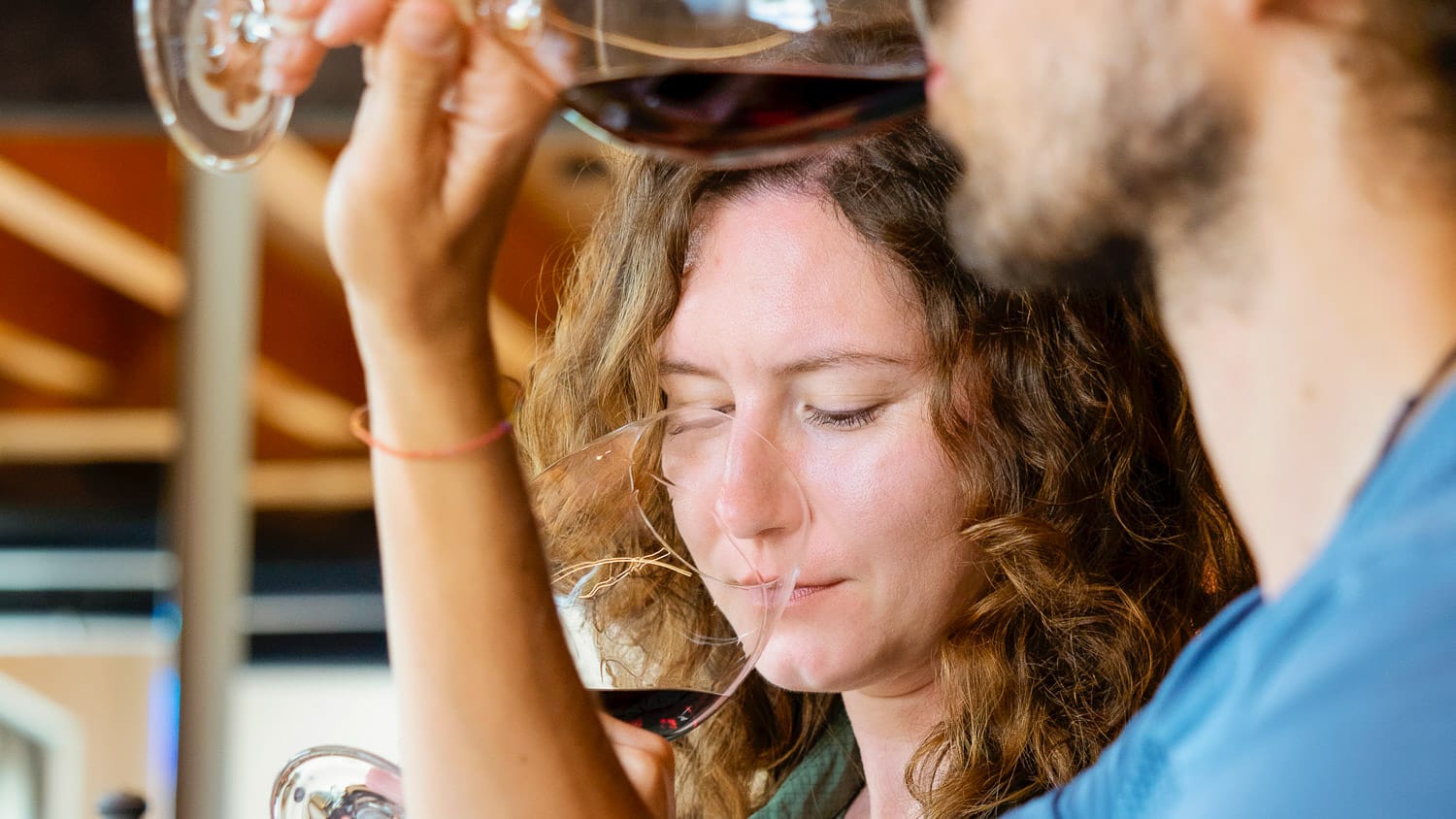
Verona is one of Italy’s top wine destinations and a fantastic option for food-loving cyclists. Vine-lined lanes, with cellar doors and hilltop villages, are located not far from the city and the perfect place to sample locally produced wines!
To the north, Valpolicella serves up smooth reds alongside the iconic Amarone, the rich, slow-crafted wine made from partially dried grapes. East of the city, Soave offers crisp, mineral whites that pair beautifully with a light lunch.
Sponsor Message
Looking for Verona bike tours?
Itinera Bike & Travel have operated Verona bike tours for well over a decade and knows the city extremely well! Today their services include bike hire of e-bikes, gravel bikes and touring bikes. Head to the Itinera Bike & Travel website for further details.
Exclusive discount
Claim 10% off* all Itinera Bike & Travel services, including their Verona bike tours and bike hire, when you book directly with them before 31 October 2026. *T&Cs apply.
The post Planning a bike tour in Japan: 14 things you need to know appeared first on Epic Road Rides.
]]>However, Japanese culture and food can feel very different to what you might be used to at home. This is a huge part of the charm, but it’s good to be prepared.
The key is not only route planning. It is understanding how to move through the country respectfully and with as little friction as possible. The more prepared you are, the easier it becomes to enjoy the riding, the food, the scenery and the sense of discovery that makes a bike trip here feel so memorable.
We visited Japan in March 2026. Here are my top tips to help you have an amazing time.
Want to find out where we rode and get the lowdown? Read the rest of our articles on cycling in Japan, including our in-depth destination guide, 6-day itinerary and guide to planning a bike tour on the Shimanami Kaido cycling route.
Always check current travel information and advice. For visitors from the UK, the UK government travel information pages are here.
1. Respect and quiet matter
One of the most useful things to understand before a cycling trip in Japan is the value placed on quiet. In practical terms, that means keeping noise to a minimum and showing patience around other road users. If you come up behind pedestrians, do not assume you should ring your bell to move them aside. It is usually better to slow down, wait for space and pass calmly when it feels natural.
This quieter, more patient approach tends to fit local expectations well, especially when riding on shared spaces such as a bike path, cultural sites or sacred trails.
This may feel odd if you are used to a more assertive cycling culture. In Japan, a calm approach often goes a long way. Riding quietly, speaking softly and avoiding unnecessary fuss usually makes everyday interactions feel easier.

Passing a traditional shrine on a quiet road between Nikko and Ashikaga
2. Think carefully about bringing your own bike
Many riders instinctively want to bring their own bike, and sometimes that will be the right choice. But in Japan, it is worth thinking through the practicalities before committing to that plan – how much riding will you do? Is it easier to hire? Will you be able to get decent bike hire?
Train travel can be one of the main sticking points. On the Tokaido, Sanyo and Kyushu Shinkansen, baggage measuring more than 160 centimetres in total dimensions and up to 250 centimetres requires a reserved seat with oversized baggage space. Anything above 250 centimetres is not allowed on board. That is a strong reason to think carefully before assuming a standard bike case will be easy to manage.
However, bikes can often be sent within Japan using delivery services, and many railway companies also allow bicycles on trains only if the front wheel is removed and the whole bike is placed in a special bag (more on that below).
For some riders, bringing their own bike will still be worth it, but in Japan it is not automatically the easiest solution.
If you’re joining a guided tour, check what bikes the tour operator provides. Many offer high-quality rental bikes, which can be a simpler option than bringing your own. On our bike trip with Rindo Bike Tour Japan, we used their high quality Specialized bikes (more details in this article). On the Shimanami Kaido, we hired from Giant (more details in this article).

Giant bike rental in Onomichi (conveniently located inside Hotel U2 complex, where we stayed)
3. If you do bring your own bike, learn about rinkō bags
If you decide to bring your bike to Japan, a very Japan-specific tip is to understand rinkō. This is the practice of partially dismantling your bike, putting it in a dedicated bag and carrying it as luggage on public transport. It can make train travel much more manageable if your itinerary mixes riding with rail travel.
In practical terms, a rinkō bag can be far easier than trying to wrestle a large bike box through stations, gates and platforms or work out the logistics of luggage transfer. It also fits much better with the way many Japanese rail operators expect bikes to be carried.
4. Pack light
I am terrible at packing light, but Japan definitely rewards a lighter approach to packing.
You’re likely to find yourself using bullet trains, staying in compact hotels or inns, and moving between places more often than expected. A smaller load makes station transfers easier, reduces the hassle of stairs and platforms, and leaves more room for the things you really need on the bike. Packing only your most essential, top-quality gear also helps keep things simple and reliable on the road.
We found that many hotels we stayed in had laundry facilities, which also helps reduce the amount of kit you need.

Lake stop near Mount Akagi
5. You won’t go hungry…
Japan’s convenience stores are especially useful for riders. 7-Eleven, Family Mart and Lawson are widespread. Many are open all day and night, and they sell a broad range of meals, snacks and drinks. You’ll find them regularly along most cycling routes. There might be a bit of guessing when it comes to precise flavours, but Google Translate will help you! We developed a particularly soft spot for the fluffy pork buns. They also have microwaves and hot water in the shops, so you can even get a hot meal; amazing.
Convenience stores such as 7-Eleven often provide access to international ATMs, which can be a real help when you need more cash in smaller towns.
Japan is also home to over 5 million vending machines (source). Even in the middle of the countryside, you find them dotted along the road side! We found these were mostly full of drinks rather than snacks, but they’re great if you run low on energy and need a quick, sugary, pick me up. Some machines even vend both hot and cold drinks from the same machine.

Snack stop on the Nikko Lake Chuzenji cycling loop
6. …unless perhaps you’re vegan!
Vegetarians and vegans are not brilliantly catered for in Japan as it’s not common amongst locals. The main issue is that fish broth (dashi) gets hidden in many sauces and soups.
In large, futuristic cities like Tokyo and Kyoto, you should be able to find plenty of foods, but cycling in rural areas will be trickier. Book ahead with hotels and make sure you have your translation app on hand to check ingredients.
The good news is that tofu is widely available, miso is in many dishes and rice and noodles are common bases for dishes. You’ll still get a strong sense of local flavour and food culture, even if choices are slightly limited.

Some of the food we ate in Ashikaga
7. Be ready to carry your rubbish
One small surprise was the lack of public bins. Japan has relatively few public rubbish bins, and travellers are often expected to carry their rubbish with them until they can dispose of it properly, whether that is at a hotel, a station or a suitable convenience store.
For riders, a small zip bag for wrappers, empty bottles or snack packaging can be surprisingly useful. It is a tiny thing, but it can make a day on the bike much tidier and easier.
8. Carry cash and bring a coin purse
Japan is famous for its technological strengths, but on the ground we found it still felt surprisingly cash focused. A considerable number of ATMs do not accept cards issued outside Japan, and we found that cash was essential for smaller businesses and everyday purchases.
It is also worth carrying coins, not just notes. Small payments come up often, and a simple coin purse makes vending machines, convenience stores and quick local purchases much easier to manage.

Inside the Watanabe sake brewery
9. Prepare for language barriers
In large cities and major tourist centres, you may find some English support. In particular, it was a relief to find that train station names are written using the English alphabet as well as Japanese characters.
In the countryside of the Kita-Kanto region, north of Tokyo, we found that barely anyone spoke English. But we didn’t find it was a monumental problem. It just means you should make sure you have mobile data so you can use Google Translate when needed. You could also try downloading useful phrases in advance – and it’s a good idea to save accommodation details, route notes and booking confirmations on your phone in case you don’t have data at a critical moment.
Body language helps too. A smile, a pause and a respectful tone can smooth over a surprising amount! If you prefer a smoother experience, riding with a local guide can make communication and logistics much easier (more on our experience with Rindo Bike Tour Japan, here).
10. Learn a few social basics
Japan’s social customs are intricate, but fortunately the Japanese are forgiving of foreigners. That said, there are some basics you should know and try and incorporate in your interactions.
For example, bowing is more common than handshakes, especially in more formal situations. Tipping is generally not expected, so there is usually no need to add extra for service.
You should also be ready to remove your shoes indoors in certain places. Traditional accommodation (including onsen ryokans), some restaurants and other indoor spaces may expect this.
You do not need to get every detail perfect, but a little awareness helps you fit in more naturally and keep locals and tourists on the same side.
11. Try an onsen
After a day on the bike, an onsen can feel like one of the highlights of a trip. We found the warm water, quiet atmosphere and sense of ritual was deeply relaxing, especially after a long ride. Experiencing natural hot spring baths is a key part of a bike tour in Japan.
It helps to know what to expect: onsen bathing is done without clothes and segregated into men and women’s onsens. When you visit an onsen, the usual routine is simple once you know what to expect. First, leave your shoes at the entrance if required, then head to the changing area and undress fully, as people normally bathe naked. Take only a small towel with you. Before getting into the water, wash yourself thoroughly at the shower stations using the stool, shower and soap provided. This part matters, as the baths are for soaking, not washing. Once you are clean, step into the bath quietly and relax. Keep your towel out of the water, speak softly and take your time. Afterwards, dry off a little before returning to the changing room so you do not drip everywhere.
Tattoos can be an issue, with some onsens asking guests to cover them and others reserving the right to refuse entry if tattoos are visible. Policies vary, so if you have a tattoo, it is worth checking ahead rather than assuming.

Traditional onsens are a big part of the experience
12. Know the rules of the road
Before you start riding, make sure you understand the basics of road behaviour in Japan.
The starting point is that you ride on the left. It is also worth learning the Japanese stop sign so it stands out immediately when you see it – and you do actually need to stop at these.
There are quite a few rules to know and do familiarise yourself with these – the police here do issue fines for non compliance (source).
In better news, we found drivers respectful and patient, and the overall road culture can feel considerate. Even so, it is still important to stay alert, especially in unfamiliar places.

Climb to Lake Chuzenji, near Nikko
13. Remote forest roads need extra care
If your cycling route includes remote rindō forest roads, expect a more variable surface and a less polished cycling experience. These roads can be wonderful to ride, with a real sense of getting away from it all, but they are not always neat or predictable. They don’t get lots of traffic and so don’t expect them to be swept or for the asphalt to be uniformly perfect.
Debris such as leaves, twigs and small branches can be common, especially after bad weather or in quieter areas. That does not mean you should avoid these roads. It just means you should approach them with the right expectations and stay cautious on descents.

Rindo roads aren’t always perfectly swept
14. Be a little more self-sufficient than usual
You’ll find a cycling trip in Japan will be easier if you are able to solve small problems yourself – and if you are heading into rural areas, basic bike mechanic skills are especially useful. At the very least, you should be comfortable fixing a puncture and making minor adjustments.
As with a trip anywhere, the key thing is to reduce reliance on bike shops when you may be far from one. In Japan the added nuance is that the language barrier is also likely to make technical help harder to access quickly. A little mechanical confidence brings more freedom and makes it easier to keep the trip moving.

Scenic loop ride in Ashikaga
Final thoughts
We loved bike touring in Japan. The roads, landscapes, food and local experiences can make even an ordinary day feel memorable.
The key is to arrive with the right expectations. Travel light. Carry cash and a few coins. Be ready for limited English. Learn the road basics. Ride patiently and quietly. Know how trains handle bikes and oversized baggage. Bring enough mechanical confidence to handle the simple things. Do that, and many parts of the trip become much easier.
Whether you’re riding the Shimanami Kaido, exploring the Japanese Alps, visiting Mount Fuji or planning a self guided cycling tour itinerary through Nikko National Park, preparation makes all the difference.
Want to read more about cycling in Japan?
Check out these Epic Road Rides guides to help plan your adventure:
- Cycling Japan, our central hub page for the country
- Self guided cycling tours in Japan: what you need to know before you book
- Planning a Shimanami Kaido bike tour, for tips on riding Japan’s Setouchi Sea region
- Shimanami Kaido cycling route FAQs, with answers to common questions before you ride
- Shimanami Kaido cycling route, for tips on riding Japan’s most famous cycling route
- 8 of the best cycling holiday destinations in the world 2026 for more inspiration
- Cycling holidays in Autumn, for the best places to cycle September + October
Let us know in the comments if you’ve got tips to add or questions about planning your Japan cycling holiday. Read on and plan your next cycling adventure!
The post Planning a bike tour in Japan: 14 things you need to know appeared first on Epic Road Rides.
]]>The post Shimanami Kaido cycle route: 37 FAQs (answered!) appeared first on Epic Road Rides.
]]>Riding the Shimanami Kaido independently also meant I got to see the route beyond the polished images, from the practical logistics and small decisions on the ground to the details that can make the ride feel either seamless or stressful.
In this article, I share the tips that felt most useful from my trip, based on first-hand experience of finally riding the Shimanami Kaido, a route I had long wanted to see for myself.
I hope you find this useful!
Always check current travel information and advice. For visitors from the UK, the UK government travel information pages are here.
Table of contents
This article contains a lot of useful information. To help make it more digestible, we’ve broken it down into several parts:
- Part 1: Getting started
- Part 2: The route explained
- Part 3: Level of challenge
- Part 4: Planning your trip
- Part 5: Bikes and support
Part 1: What do you need to know before planning your Shimanami Kaido ride?
Start here: introduction to cycling the Shimanami Kaido – for a really useful overview of what you need to know and to help you decide if the Shimanami Kaido is for you.
Then read: planning a Shimanami Kaido bike tour– for our itinerary and thoughts on a self-guided bike tour versus a guided tour
And finally: read the below! For in-depth FAQs to help you plan your tour once you’ve decided you want to ride it.
Part 2: What is the Shimanami Kaido route like?
1. What were your highlights of riding the Shimanami Kaido?
- There are lots of bike-friendly hotels on the route. We loved the places we stayed (though they were pretty eclectic!).
- Giant bike stores in Onomichi and Imabari provide high quality road and e-bike alternatives to the more easily available city bike experience.
- If you’re more relaxed about the quality of what you ride, there are plenty of bike hire options; there are 10 bike hire terminals between Imabari and Onomichi.
- Road quality was excellent, as were the purpose built facilities around the bridges.
- Scenery was often spectacular, with views across the Seto Inland Sea, and the industrial edge providing an interesting counterpoint.
- Sagawa luggage transfer is brilliant and makes a DIY multi-day journey doable.
2. Do you have a map of the Shimanami Kaido route?
See below! Also check out this map the authorities have created. And our Shimanami Kaido bike tour article contains a GPS file.
3. Is the Shimanami Kaido signposted?
Yes, there are signposts and also road markings.
4. Is the Shimanami Kaido cycle route a segregated bike path?
This confused me too! The answer? No. There are bike (and pedestrian and scooter) paths up, down and over the bridges, but in between, you’re on the road.
Some of the time, especially on the main route, there are separated bike paths, but some of the time and especially off the main route, there aren’t. However, on the main route there is the constant presence of the “blue line” and we found that the vast majority of the roads were incredibly low traffic. More details in our Shimanami Kaido bike tour article.

Bike path on Omishima Island
5. Is the Shimanami Kaido just for cyclists?
No, the Shimanami Kaido Expressway is for vehicles. The Shimanami Kaido paths on bridges are also used by motorcycles and pedestrians.
6. Is the Shimanami Kaido all on bike paths?
No! Other than on bridges and alongside very busy sections of road, the Shimanami Kaido is mostly on road rather than bike paths. We found the roads very low-traffic and calm to ride.
7. Is the Shimanami Kaido all asphalt?
Yes!

Cycling on Oshima Island in Japan on day two of our Shimanami Kaido trip (note no blue line – we were off the main route)
8. Which is the best route to take on the Shimanami Kaido?
When referring to the Shimanami Kaido, most people think of the main 80km route between Imabari and Onomichi. However, the Shimanami Kaido isn’t just one route. The main route is the famous one, but the authorities have also signposted other route options, including the Island Explorer route.
There are plenty of alternative routes for riding the Shimanami Kaido. It all comes down to how many days you have and how much of the islands you want to see.
We loved getting off the main route – more thoughts on that in our Shimanami Kaido bike tour article.

Close up photo of the Shimanami Kaido route map at Innoshima Bridge 1
9. Which way to ride the Shimanami Kaido? Onomichi to Imabari or Imabari to Onomichi?
Most people ride the Shimanami Kaido between Onomichi and Imabari, and either direction works well. Your choice will usually come down to your wider travel plans.
We rode from Onomichi to Imabari over two days on a quieter “Rindo Route”, then returned from Imabari to Onomichi on the main “blue line” route. This worked really well, as it gave us a mix of peaceful backroads and the classic Shimanami Kaido experience. More details on that in our Shimanami Kaido bike tour article.
If you’re concerned about things like wind direction and uphill slopes, people suggest it’s easier to start from Imabari City.

Ferry back to Onomichi
Part 3: How difficult is the Shimanami Kaido?
10. Is the Shimanami Kaido suitable for beginners?
Yes, I think the Shimanami Kaido is suitable for beginners, especially compared with many of the other bucket-list rides people talk about. The gradients are generally manageable, the route is well signposted, and there is a reassuring sense that the cycling infrastructure is built with cyclists in mind. That said, “beginner-friendly” does not mean effortless. It is still worth being comfortable riding for multiple hours, handling and navigating shared spaces with other cyclists and pedestrians. For riders who are new to cycle touring or longer days in the saddle, the Shimanami Kaido can be a great first big ride, particularly if you keep your daily distance realistic, start early and allow time to stop and enjoy the islands along the way.
11. What makes the Shimanami Kaido accessible for cyclists?
There are lots of things that make the Shimanami Kaido accessible. For example,
- The blue line on the main route makes it hard to get lost, even if you don’t have a GPS file/aren’t used to following one.
- The route is relatively flat and the approach to the bridges have been designed with gentle slopes to make getting onto the bridges easier.
- Bicycle rental is easy – there are lots of portions and some allow one-way bike trips.
12. Is there much climbing on the Shimanami Kaido?
The main route is relatively manageable, but it is not completely flat. You climb up to each bridge, though the bridge approaches are designed with gentle gradients. Detours and island explorer routes can be much hillier, so check your route carefully if you’re not confident with climbs.
Check out our Shimanami Kaido bike tour article for Shimanami Kaido route profiles and GPS files.

Steep climb near Tanoura (again, no blue line – this was on day 2 of our ride when we weren’t on the main route)
13. Can you ride to the observatories on the Shimanami Kaido?
Yes, but some are much harder than they look on the map. We’ve heard Kirosan Observatory on Oshima, for example, involves a steep climb. Be especially careful descending from observatories, and avoid doing these climbs close to sunset.
14. Can you ride the Shimanami Kaido with kids?
We rode the route with our 10 and 13 year old. While you’d want to adjust the distances depending on your children’s fitness and cycling experience, there’s lots to like here given the terrain is easygoing and there are lots of places to refuel on the way. The variety of inexpensive accommodation also makes it an appealing option for families on a budget.
15. Can you ride the Shimanami Kaido in one day?
Yes, I’m told a lot of people ride the Shimanami Kaido main route in one day.
There’s about 600 metres of elevation gain across the 78 kilometre route from Onomichi to Imabari, so it depends if you feel that’s feasible in one day.
If you aren’t confident with that distance, you can always just ride a section. Or turn it into a multi- day adventure like we did. There’s plenty of accommodation along the route or you can get a bus or a ferry ride part of the way. Or perhaps even a support van if you’re on a guided tour – or book with WAKKA Hotel – details below.
Check out our three-day itinerary here.
If you are hiring a bike, note the times you need to return the bike by to avoid extra charges. These were correct at the time of writing but check in case there are any seasonal differences or changes:
- Giant’s hours are 9am to 6pm.
- The regular bike hire terminals are as follows: Onomichi, Itoyama and Imabari – until 7pm and Mukaishima, Innoshima, Ikuchijima Island (both), Omishima, Hakata and Oshima – until 5pm

Quiet break beneath cherry blossom on Omishima Island
Part 4: How should you plan your Shimanami Kaido trip?
16. Do you need an organised tour to ride the Shimanami Kaido?
No you don’t and there are lots of cycling friendly services on the Shimanami Kaido that help make it possible to DIY – see below. However, I think the benefit of a tour would be:
- Hassle free – for example not having to book individual hotels or worry about food resupply and hitting restaurant opening times
- Get off the beaten track – the two days we spent following a BTJ route took us away from the busier Shimanami Kaido blue route allowing us to get a sense of the islands beyond the main route
- Get under the skin of the islands’ history and heritage – a guide will explain what you’re seeing and opens up the story of the destination which it’s hard to get otherwise.
You can find out more about BTJ’s Shimanami Kaido tours in this article.
17. Can you suggest an itinerary for the Shimanami Kaido?
Check out our Shimanami Kaido bike tour article.

Cycling through the Lemon Valley on Ikuchi Island
18. Are there any rules of the road you need to be aware of when riding the Shimanami Kaido?
Helmet use is strongly recommended in Japan. Since April 2023, the law requires all cyclists to make an “effort obligation” to wear a helmet, but it is not strictly mandatory for adults.
As for rules of the road, the Shimanami Kaido follows standard Japanese cycling laws, as it is made up of public roads. Key things to know include:
- You must ride on the left-hand side of the road, the same as cars
- Bicycles are treated as vehicles, so you must obey all traffic lights and road signs
- At large junctions, a two-stage right turn is required rather than turning directly across traffic
- Do not ride side-by-side or against traffic, especially on narrow bridge paths
- Give way to pedestrians on shared paths and ride carefully in these areas
- Using a mobile phone while riding is illegal
- Riding under the influence of alcohol is treated seriously and can result in heavy fines or penalties

Riding on the roads of Oshima Island (blue line – riding the main route on day 3)
19. What should you do if it rains on the Shimanami Kaido?
The usual rules apply; always come ready for rain. However, if you’re new to cycling, it’s worth having a wet weather plan. Wet roads, white lines, manholes and downhill bends can be slippery in rain, so if the forecast is poor, allow extra time, ride cautiously or consider using buses, ferries or sightseeing stops instead. Convenience stores usually sell simple raincoats, but we’d suggest bringing proper waterproofs if you’re planning a multi-day ride.

Rainy ride along Mukaishima Island’s south coast (day 1 of our trip – no blue line so you can tell we’re off the main route)
20. Is there luggage transfer on the Shimanami Kaido?
Yes! We used Sagwa (more details below), which was great.
WAKKA Hotel also offers luggage transfer, which might be a good option for groups. We stayed at the hotel but didn’t use this.
21. What do you need to know about using Sagwa luggage transfer on the Shimanami Kaido?
- Your bag needs to have a L+W+H of no more than roughly 160cm and it needs to weigh less than 30kg.
- When we travelled, it cost 2,200 yen per bag per transfer.
- Remember to book your Sagwa the night before!
22. Are there cycling friendly hotels on the Shimanami Kaido?
Yes, though some are not so accessible for international visitors as they don’t have websites and staff may not speak English. Here are the ones we stayed at and considered.
- Hotel Cycle u2: A stylish, higher-end option in Onomichi with secure bike storage, located in a converted warehouse with an on-site restaurant that makes a great end point to a multi-day ride.
- WAKKA Hotel: A modern, cyclist-focused hotel near the water with a range of accommodation options, plus a café with views of the bridge and organised activities to explore the islands.
- Cyclo No Ie hostel: A small, budget-friendly hostel in Imabari designed specifically for cyclists, with a social atmosphere, bike storage, tools and useful route information.

Inside Hotel Cycle U2, one of the bike-friendly hotels we stayed at on our trip
23. Are there food shops along the way?
The main “blue route” felt well provisioned and even off route, there are lots of towns and villages so if you’re riding on the coast you’re generally not far from a shop or restaurants. We did have one section when riding on day 2 where we were desperate to reprovision and had to ride about 8km more than we’d have liked. But that was more due to our bad planning than a lack of shops!
Also bear in mind that we found that lunch places usually have limited opening hours – roughly 12-2pm.
24. Can you buy water on the Shimanami Kaido?
Yes. It is not difficult to buy drinking water, with vending machines, convenience stores and shops on the islands. That said, it’s still worth topping up whenever you can, especially in summer or when leaving the main blue route.

Coffee and fruit shop on Omishima Island with local produce
25. Can you shower after riding the Shimanami Kaido?
Yes. There are showers, public baths and onsen around Imabari, Onomichi and some of the islands. This is particularly useful if you finish riding before catching a train or continuing your trip.
26. What are the best days of the week to ride the route?
On Tuesdays, lots of businesses in the area are closed – make dinner reservations well in advance.
27. When is the best time of year to ride the Shimanami Kaido?
Cyclists ride the Shimanami Kaido year-round, but it’s worth thinking carefully about weather and daylight. Spring and autumn are popular times to ride, while summer can be hot and humid and the rainy season can make conditions less pleasant. Winter can still be rideable, but you’ll want to check sunset times and dress for colder conditions.

Cycling past cherry blossom on Oshima Island (not on the main route)
28. How do you get to Imabari or Onomichi?
Both cities are connected to Japan’s fantastic train network. We were arriving from Kyoto and were going back to Tokyo, and found it absolutely straightforward to get the Shinkansen to Fukuyama and the regional train on from there (it’s about 20 minutes on the train between Fukuyama and Onomichi).

Imabari Cycle Station beside the train station
29. Can you get the bus back to your starting point?
Bikes are allowed on buses, but it’s worth noting that they need to be in a bag and if the storage trunk is full then you might not be allowed onboard.
A sign at Imabari station stated “You will need to take two buses to Onomichi. Take the highway bus to Fukayama and get off at the Innoshima Ohasi bus stop. Transfer to a bus bound for Onomichi Station at the Innoshima Ohasi bus stop.”
Note that you will need cash to pay the bus.
30. Can you get the ferry?
A ferry runs from Setoda port to Onomichi. If you just want to ride 30 kilometres or so then get the ferry back from Setoda. Note that the Lazuli ferry has a bike rack but the Citrus ferry doesn’t and bikes can get scratched when stored outside. If using the Citrus, ask the member of staff to store the bike inside.

LazuLi ferry travelling between islands in Japan
31. Are there any routes to ride once you’ve done the Shimanami Kaido?
Yes! We haven’t done them, but here are a few suggestions:
- Sazanami Kaido between Onomishi and Kure – around 85km
- Tobishima Kaido between Akinada Bridge and Okamurajima – around 31km
- Takanawa Road between Imabari and Matsuyama – around 48km
- Ishizuchi Kaido between Imabari and Kan-only – around 90km
- Yumeshima Kaido – connecting the islands of Kamijima – around 50km
32. What is the history of the Shimanami Kaido cycling route?
Opened in 1999 to much excitement, the Shimanami Kaido (also known as the Setouchi Shimanami-Kaido) went through roughly a decade of stagnation between 1999 and late 2000s (source). Annual public rental cycle users fell below 30,000 in 2005. Fortunately, three turning points moved the dial toward cycle tourism:
- Municipal mergers around 2005-2006 consolidated ten municipalities into just two cities (Imabari City and Onomichi City), making coordinated policy much easier.
- Grassroots civic movements emerged – model cycling courses were developed around 2005, the Shimanami Slow Cycling Council was established in 2008, and NPO Cyclo-Tourisme Shimanami was founded the following year.
- Governor Tokihiro Nakamura of Ehime Prefecture took office in 2010 and actively championed cycling culture , creating a dedicated government office for bicycle promotion and co-hosting the international “Cycling Shimanami” event with Hiroshima Prefecture.
In October 2014, the Shimanami Kaido signed a sister cycling road agreement with Taiwan’s Sun Moon Lake cycling course, and the first international cycling event was held. That same year, CNN named the Shimanami Kaido as one of the world’s seven greatest cycling routes. In 2019, Japan’s Ministry of Land, Infrastructure, Transport and Tourism designated it as one of the country’s first National Cycle Routes.
Today, more than 300,000 bicycles travel the cycling route annually, and nearly half of all riders are first-time cycling travellers.

Information board about the Shimanami Kaido cycling route
Part 5: What do you need to know about bike hire and support?
33. What type of bike do you need for the Shimanami Kaido?
Whatever you are comfortable riding for several hours is the best choice. The route is all on asphalt, so road bikes are absolutely fine. Hybrid bikes, e-bikes and city bikes are also common, especially if you are riding at a more relaxed pace. The main thing is to choose a bike that fits you well and feels comfortable for the distance you plan to ride.
34. Can you hire bikes on the Shimanami Kaido?
Yes, we hired from Giant in Onomichi City. They also have a large shop in Imabari City. What I liked about Giant is that I was able to reserve a bike in advance (note their booking opens 60 days in advance and at peak periods it’s a really good idea to book in advance as they often sell out quickly). I thought the bikes we hired were good quality and suitable for European sizing – for example I am 180cm tall.
There are other hire options, indeed I understand that the public bike rental system has 10 bike hire outlets along the route. I understand they offer cross bikes, mountain bikes, city bikes, e-assist and even tandem bikes. I am sure things will develop over time, but I’ve seen plenty of reports that you can only get smaller bike sizes from such outlets. Also be aware that you can only reserve here up to 4 days in advance.

Hire bikes from Giant
35. Can you bring your own bike to the Shimanami Kaido?
Yes, but if you’re taking your bike on Japanese public transport, it needs to be packed in a proper bike bag. There are bike assembly spaces at both Imabari Station (served by JR Imabari Station) and Onomichi Station (served by JR Onomichi Station), which is useful if you’re arriving with your own bike rather than hiring.
36. What if you only want to cycle one way on the Shimanami Kaido?
One way bike hire is possible, but make sure you leave yourself enough riding time to get back before the store closes.
37. Is support available if cyclist or bike break down?
WAKKA Hotel has some fantastic cyclist support services including bike taxis, including a van that can transport up to 5 bikes and five passengers. This is particularly useful for group travel.
If you hire your bike from Giant they show you the following sign when you hire “When you go to Imabari, be sure to make a bike rental reservation for at least two days and return it by yourself, or get a drop-off reservation. Even if you have no choice but to drop off the bicycle at Imabari, we cannot accept it because another reservation has already been made at Onomichi. In that case, an emergency collection fee of 55,000 yen will be charged.”
If you hire your bike from the main bike terminals (rather than Giant) you can return your bike at any of the 10 terminals without having to tell them in advance. If your bike has problem, you can replace it at one of the terminals.

Giant bike store in Imabari
Final thoughts
The Shimanami Kaido is one of those rides that looks simple on the surface, but has a lot of small details that can shape your experience.
From choosing which direction to ride, to deciding how many days you need, to understanding how bike hire, luggage transfer and transport options work, there are plenty of decisions to make along the way. None of them are complicated, but getting them right can make the difference between a smooth trip and a stressful one.
That’s really what this FAQ is about. It’s not just whether you can ride the Shimanami Kaido, but how to make the most of it.
If you’re thinking about riding it yourself, you’ll find more help in our other articles:
- Shimanami Kaido cycling route, for tips on riding Japan’s most famous cycling route
- Planning a bike tour in Japan, 14 things you need to know
- Planning a Shimanami Kaido bike tour (itinerary and tips)
- Cycling Japan, our central hub page for the country
- Cycling Japan with Rindo Bike Tour Japan 2026: 6-day itinerary + review
- Self guided cycling tours in Japan: what you need to know before you book
Hopefully, this gives you everything you need to start planning your own trip.
The post Shimanami Kaido cycle route: 37 FAQs (answered!) appeared first on Epic Road Rides.
]]>The post Cycling Japan with Rindo Bike Tour Japan 2026: 6-day itinerary + review appeared first on Epic Road Rides.
]]>That curiosity only intensified when I worked with Rob and the team at Rindo Bike Tour Japan (Rindo, for short) on our guide to cycling in Japan. The more I learned, the more the country sounded almost impossibly appealing: networks of pristinely maintained roads, bullet trains, beautiful landscapes, extraordinary food and a cycling experience unlike anywhere else.
But planning a bike tour of Japan for four people feels difficult when you don’t speak Japanese and you’re limited on time.
So when Rindo suggested a press trip, I didn’t need asking twice.
Rindo offer a very tailored approach to self-guided cycling tours; the trip they created for us was based on their Nikko, Kiryu and Akagi self-guided itinerary but tweaked to add in some cultural stops. Our group comprised four cyclists: two very strong riders and two less strong riders, all up for a challenge and experiencing authentic, rural Japan.
Here’s how we got on.
Always check current travel information and advice. For visitors from the UK, the UK government travel information pages are here.
Overview of our trip with Rindo Bike Tour Japan
Length: 6 days, 5 nights in March/April 2026
Location: Nikko region in the Kita Kanto area, including Nikko, Ashikaga, Kiryu, in Gunma and Tochigi Prefectures, a couple of hours train ride north of Tokyo.
Distance: 332 kilometres
Climbing: 5,241 metres
Format: Self-guided tour
Accommodation: We stayed in traditional ryokans; two nights in two of the ryokans, one night in the final one. Rindo have asked us not to share the names of these ryokans, as they are key to their business and increased visitor numbers would adversely affect their ability to use the accommodation for their guests. Honestly, I was a bit skeptical about this request before I visited. Having been, I totally understand their concern and my lips are sealed!
Guests: 2 adults, 2 children (10 and 13, both experienced youth race-level cyclists)
What did we love about our trip with Rindo?
Our trip with Rindo gave us the confidence and means to explore a little-known part of Japan, far from the tourists. It gave us a truly authentic insight into Japan. The way Rindo create their trips offers a bridge between visitors such as us and the real, raw Japan that most people don’t get to see.
When so much of tourism, even cycling tourism, feels superficial and involves carbon copy trips, this felt like a rare privilege.
Here are the things we loved the most about cycling with Rindo:
The riding
Riding no name singletrack, moss-centred roads, through still, calm forest with nothing but birdsong and the ever-present rushing of a Japanese mountain stream. This was not a city-to-city tour, this was a tour where we felt immersed in the Japanese countryside – and it’s very different to the depiction I saw in Lost in Translation all those years ago!
These routes also felt much more local and untouched than the coastal rides around the Setouchi Sea, where we passed fishing harbours, citrus orchards and crossed dramatic suspension bridges. More details on our Shimanami Kaido bike tour article.
Experiencing Japan
There were some special moments on this trip that will stick with us. They were the unexpected, quiet moments that you don’t plan for. They were the times we felt we experienced religion and culture in practice: alone in the orange pre-dusk light, in pine forests surrounding an ancient shrine; witnessing a Buddhist ceremony, complete with chanting and conch shells, on a random Monday afternoon by the roadside; taking part in the rituals of sakura season.
It feels to me that everything in Japan has meaning. A lot is sacred. It’s a deeply complex and intriguing culture with a highly intricate degree of tradition and custom, far removed from the futuristic cities and neon lights many people associate with the country. We saw and felt more of this during our six days than during the rest of the time we spent in cities and more touristy parts of the country. It was incredible.
Traditional accommodation
We loved the deeply traditional hotels we stayed at, places that we never would have found ourselves. Each one felt a million miles from corporate chain, and we loved the kind, smiling service, even if there was little in the way of conversation due to language barriers.
The highlight was our final night, where we stayed in a quiet, owner run ryokan with just seven rooms (we were the only guests). The ryokan was located way up a winding forest road, with pine forests blanketing the valley sides and drifting into magnolia, cherry and chysantha blossoms alongside a babbling waterfall.
We loved finishing a ride, with legs burning, heading to the onsen, soaking aching muscles in the thermal waters, then dressing in a comfy, traditional yukata gowns (supplied by the hotel) for dinner.
Authentic food
Each night, we were served kaiseki: a multi-course seasonal feast of small, beautifully composed dishes designed to celebrate freshness, balance and the time of year. There might be sashimi, grilled fish, delicate soups and other impeccably presented plates, each arriving like a small work of art. It was a memorable experience, though not an entirely gentle one for unfamiliar palates; some of the flavours were unlike anything we had tasted before. Black soybean natto or pickled and spicy cod roe anyone?
Breakfast was cut from the same cloth. Sashimi and smoked fish are not what we would normally choose to start the day. It took a little while for us to adjust, but it certainly felt like an authentic introduction to Japanese food culture.
Meeting Japanese people
From the formal kaiseki dinners to the simple lunches in humble udon shops, from helpful servers in 7-Eleven stores to the group of grandmothers we met near Mt Agaki, the trip allowed us to meet people in a way you often don’t when travelling in a larger group or without a bike.
Despite the language barriers, I felt a warmth and kindness from people we met, who seemed intrigued to find a group of four lycra clad tourists in their village and keen to help. The sense of mutual interest and respect felt palpable.
Great bikes
The bikes Rindo provided us were all in excellent condition: two Specialized Vado e- road bikes and two Specialized Aethos regular road bikes. They came set up with Wahoo ELMNT ROAM bike computers and a nice-looking bike bag, plus the usual puncture repair kit you’d expect. A branded cycling jersey and buff (of a quality you’d actually want to wear again at home!) was also a nice touch.
Excellent support
I’d also say that the self-guided tour format offered by Rindo provided a level of service I haven’t experienced before with a self-guided format: the team met us at the train station, took time and care on our bike set up and were ever-present on the WhatsApp group. They checked in with us regularly and offered transfers on the odd day we encountered heavy rain. They were also on hand for questions, from route related questions to restaurant recommendations and reservations. When we had the odd bike issue like a shifter issue we couldn’t fix, they were swift to assist.
This level of service goes far beyond the kind of self-guided support I’ve experienced previously. It’s fair to say that kind of experience comes with a price tag, but credit goes to the RIndo Bike Tour Japan for executing their service so well.
Cherry blossom
Sakura season is undeniably beautiful, but it can also be unpredictable. The bloom shifts from year to year, so even a carefully timed visit can miss the moment. You’re also not guaranteed sunshine and warm temperatures at this time of year.
Had we not been tied to the school holidays, I might have been tempted to choose a slightly quieter time to visit – partly for the flight prices, but also to avoid some of the cherry-blossom chasing crowds we encountered in places like Kyoto and Tokyo.
In many ways, later spring appeals just as much: milder temperatures, fewer people and landscapes newly vivid with fresh green growth. Equally, I can imagine autumn being a magnificent time to ride, with the wooded rindo roads glowing in rich shades of red, gold and amber.

At the G7 Nikko sign at Lake Chuzenji
Is a self-guided bike tour with Rindo for you?
It’s worth asking yourself this question, because in truth, this kind of trip is not for everyone.
- You need to be happy navigating using a GPS device.
- The vast majority of people you’ll meet won’t speak English. This means you need to be confident relying on Google Translate (and energetic pointing/body language) if you don’t speak Japanese.
- Rindo set you up on your bike on day 1 and are there if you need them, but make sure you’re happy fixing a flat tyre, or make minor adjustments such as to saddle height, since you don’t have anyone riding with you.
- Rindo offer a wonderful range of rides for each day of your route, and will happily suggest the best route to pick, based on your riding level and interests. Just don’t over-estimate how demanding you want your ride to be that day, as you’ll be riding unsupported (though of course the team is there in case of breakdown).
- We didn’t see many bike paths in the Kita Kanto region, but nearly all the roads we were on were low traffic, or with a decent hard shoulder.
- If you stay in a ryokan that provides breakfast and dinner, you need to be prepared to try food you’re unlikely to have eaten before. Western options aren’t available and you’ll be eating a set menu. For us, this was a big part of what made the trip special, but if you aren’t willing to embrace the traditional Japanese cuisine, you will miss out on part of the experience.
- More generally, staying in these traditional ryokans requires a level of respect for local customs. Japanese people prize calm and quiet and the rules of the onsen are taken seriously. If you don’t want to flex to the local way of doing things, there may be better places to stay.
- Be aware that a bike tour in rural Japan can be tricky if you are a strict vegetarian (let alone a vegan!). I am a pescatarian and Rindo did a great job of making arrangements ahead of time. Dietary restrictions are an area it could definitely be difficult to navigate in Japan without this kind of support!
Compare guided versus self guided with Rindo
Guided
I haven’t experienced one of Rindo’s guided bike tours, but I’ve worked with Rob, the founder of the company for many years and I am confident that if any of the things above are concerns, most would be solved by opting for one of Rindo’s guided trip.
On these, you’ll always have someone on hand to assist, guide and explain. Organised food stops will mean you don’t need to rely on Google Translate so much and a travelling mechanic will mean there’s no concern if you have issues with the bike.
Self-guided
For us self-guided worked brilliantly because we were riding as a family unit, we are pretty experienced and like to go at our own pace.
Rindo’s version of self-guided also offered an unusually high level of support that might not be necessary in countries that are more accessible, but works really well in Japan. Being met from the train, being offered cultural stops and transfers for riders and bikes when the rain poured down, was perfect for us.
For me one of the downsides of a self-guided trip can be that you don’t get much feeling for the culture and authentic customs of a place; these things tend to pass over you. So it’s unusual that this wasn’t the case on Rindo’s trip. I think this was for a few reasons:
- their GPS routes are very helpful at including great suggestions for places to stop and eat;
- the premium ryokan experience allowed us to try out the onsens and the kaiseki menus pushed our food boundaries in a way we wouldn’t have experienced if left to our own devices; and
- Rindo are happy to incorporate cultural stops into their self-guided itineraries – you can find a list on this page of their website (i.e. these weren’t a “special exception” they offered us).
Yes, it was a self-guided trip but it incorporated many of the advantages of a guided trip that let us really experience Japan.
Our itinerary with Rindo
As mentioned, Rindo pride themselves on tailoring their trips to their clients. They also have a fantastic library of cycling routes available. This means that even once you’ve picked an itinerary, there are multiple route choices available each day so even if the weather doesn’t play ball or someone isn’t feeling up for the ride you selected at home, you’ll have options.
Here are the cycling routes we rode to give you a sample. Note that the routes don’t start and finish at the hotels we stayed at.
Day 1: Nikko loop
Warm up ride, punctuated by tall cedar trees and quiet shrines
Distance: 35.6 kilometres
Elevation gain: 563 metres
GPX DownloadTerms of use reminder
Route notes
We weren’t able to arrive in Nikko until mid afternoon, but we were met at the station by Elena from Rindo. She took us to the hotel and got us set up on our bikes, ably supported by her team mate, Taka.
We headed out on our bikes; this is a nice warm up ride, that took us south down to Nikko, looping through agricultural land and forest, past homes and peaceful shrines where we were the only visitors.
A short off-road section saw us cycling along the Nikko Kaido Cedar Avenue, registered by Guinness World Records as the world’s longest avenue of trees. More than 50,000 trees were planted, of which around 12,000 remain, over a period of 20 years starting in 1625. Cedar trees were chosen due to the ancient belief that the gods descend from the heavens down to earth through this species of tree. It was lovely to ride through, but we found the fallen pine needles and leaves had made the road a little too boggy for road bikes; the road was always there to bail out onto.
We crossed the Daiya River and then headed north again up a relatively busy road (but with decent hard shoulder) before turning off and escaping onto tiny single track rindo roads that weaved through dense forest, never far from the sound of tinkling water.
Tips
- The rindo roads are typically covered by a canopy of trees; this means they don’t get tons of sun and, even when it’s not riding, can be damp and strewn with tree debris. Care is needed on the winding descents.
- The Watanabe Sake Brewery is close to the route. I love a bit of history and culture on a bike trip, and I loved the short tour Rindo booked us with Mr Watanabe, the 7th generation owner of Watanabe Sake Brewery. A jovial soul, he shared his passion for the history of sake as well as the process of making it.
- Nikko is popular with day trippers from Tokyo, and this means that you won’t have it to yourself especially at busy times like cherry blossom season. Book your train a few weeks in advance especially if you want to arrive in the morning or at weekends.
Day 2: Lake Chuzenji loop
A day of climbing, descending and spectacular views
Distance: 55.4 kilometres
Elevation gain: 1,020 metres
GPX DownloadTerms of use reminder
Route notes
The climbing begins almost immediately; this route is in essence a long climb, followed by a tour around the lake, followed by a long descent.
The ride takes you out through villages and fields to the Irohazaka climb, an iconic series of switchbacks that leads you into the highlands.
The wonderful thing about this climb is that both the road up and the road down are one way but spread over two lanes. This means that there’s plenty of room for cars to pass cyclists with lots of room.
Lake Chuzenji is a dramatic spot within Nikko National Park, surrounded by towering mountains. It’s no surprise it’s a popular local attraction and a gaggle of little shops and local restaurants gather around the lakeside.
From the lake, you can decide whether to descend back home or keep riding.
To the observatory
We opted to head on up the switchbacks on a singletrack road, to Lake Chuzenji Observation Deck, where we enjoyed a gobsmacker of a view down over Lake Chuzenji and towards Mt Nantai.
Note: this isn’t marked on the GPS route above, but it’s easy to find, just take a look at the wiggly road to the southeast of Lake Chuzenji.
To the Ryuzu Falls
Back at the lake, you continue around the lakeside, through forest and past grand old homes built between 1870 and 1940 for ambassadors and dignitaries. Then it’s up a few switchbacks to the Ryuzu Falls. You come to the car park for the Falls first, but if you ignore that and continue to the road bridge, you find two distinct views of the Ryuzu Falls – to the north is a narrow valley with white water frothing down it; to the south are more gently cascading falls.
To Lake Yu
We turned around at the Ryuzu Falls, but if you’ve got more juice in your legs, continue on to the Yutak Falls observation deck for the 70m high Yudaki Cascades waterfall.
Tips
- Lake Chuzenji sits at around 1,300 metres above sea level and the observatory sits at around 1,800 metres, so it can get pretty cold. Dress accordingly.
- Note there is quite a long tunnel on the way up the climb. It’s lit but remember to switch on your lights!
- While in Nikko, you can’t miss the UNESCO-listed Toshogu Shrine complex, famous for its ornate carvings, rich history, and surrounding cedar forest. Take your time wandering through the intricate gates, halls, and moss-covered stone paths. We stumbled upon a prayer ceremony inside one of the pavilions, led by a priest whose chanting cut through the quiet morning with startling force. Rhythmic, powerful and deeply controlled, it gave the ritual an energy that felt urgent rather than serene. It felt like a small window into a living tradition continuing on its own terms.
Day 3: Nikko to (near) Ashikaga
A day of wide valley roads and steep, narrow forested climbs that take you from the highlands of Nikko down to Ashikaga. The Furumine Shrine is a highlight.
Distance: 96 kilometres
Elevation gain: 1,203 metres
GPX DownloadTerms of use reminder
Route notes
Nikko to Furumine Shrine
From Nikko, the route heads broadly downhill, though not without enough short, sharp ramps to keep you on your toes, as it winds deep into the Mae-Nikko Forest. It is a peaceful, rural-feeling ride, with long sections of forest and others tracing waterways through quiet countryside.
The day’s principal climb is the 8.4-kilometre ascent to Furumine Shrine. At an average gradient of around 4.5%, it is steady rather than ridiculous, although the steeper sections near the top verge on brutal.
The Shrine is known for its many tengu, long-nosed guardian figures believed to protect visitors. The Shrine has a deeply calm, authentically Japanese, ritual-like atmosphere. When we visited, there were barely any other people there, which only heightened the sense of tranquillity. There is also a water garden to explore, though it was closed during our visit. A few shops and vending machines just outside the Shrine make this a sensible place to stop for lunch.
Furumine Shrine to Ashikaga
We chose not to eat at the Furumine Shrine, which turned out to be slightly optimistic. Not long afterwards, we found ourselves diverting off-route, to Kamihinata in search of food. We settled on one of the local convenience stores, 7-Eleven, with the added bonus of excellent custard-filled choux buns from Hana patisserie (worth a stop if you pass!).
Back on the route, a short tunnel led us onto narrow forest roads, where startled deer scattered into the trees and the climbing resumed in earnest. For some distance, the road skirted a vast mine below. Then, just as we neared the top of the climb, an air-raid-like siren sounded, followed by an explosion that shook the ground beneath us. It was a somewhat startling reminder that this is a very active working landscape.
Tips
- The tunnel on this route was lit, but be aware that when riding in tunnels, vehicles can sound quite intimidating. Remember to remove your sunglasses and take lights!
- Plan your lunch stop carefully; there’s a lot of rural riding on this route and while you’ll find vending machines, have a careful think about where to eat.
Day 4: Ashikaga loop
Quiet forest roads and a dose of culture and history in Ashikaga
Distance: 64 kilometres
Elevation gain: 487 metres
GPX DownloadTerms of use reminder
Route notes
The ride began with a steady climb through the outskirts of Ashikaga. After leaving Route 201, we pedalled through small villages on smooth roads that climbed gradually north up the valley, before turning onto a narrow forest road that rose in a series of hairpins for the day’s main ascent. At the top, a short lit tunnel led us through to the descent: more sweeping hairpins on a broader road, this time dropping us back down the hillside towards Ashikaga.
Lunch was at Mahler’s Parlor, where a compact four-dish menu still managed to include a pasta option.
With the weather worsening, we cut the ride short and took up Rindo’s alternative sightseeing tour of Ashikaga instead. Rindo guides, Kate and Masashi, showed us around Bannaji Temple, a beautiful Buddhist temple built by Minamoto no Yoshiyasu, a powerful samurai and first generation of the Ashikaga family, from the 1100s onwards. We also took in Ashikaga Gakkō, widely regarded as Japan’s oldest school; and Orihime Shrine, a striking vermilion-lacquered shrine dedicated to the god of love. We capped the cultural extravaganza off with the excellent Ashikaga Flower Park, famed for its wisteria displays in April and May, but also a joy in cherry blossom season.
It was a pleasure to explore the city in the company of two thoughtful and generous Ashikaga locals, and to hear more about the history and ancient cultures of this under-touristed city.
Day 5: Ashikaga to Lake Umeda
Deep valleys, rushing rivers and narrow forest roads, plus a silk museum
Distance: 39.5 kilometres
Elevation gain: 670 metres
GPX DownloadTerms of use reminder
Route notes
Ashikaga to Kiryu
With three main climbs to tackle, there was a certain sense of foreboding from the outset – heightened, briefly, by an earthquake alert that flashed up on our phones. The locals seemed entirely unfazed, so we carried on riding and, in the end, felt nothing at all. It turned out the earthquake was far to the east.
After a final push through the forest, the road tipped down towards Kiryu.
Kiryu highlights
In Kiryu, we spent time at the Yukari Silk Museum, one of the day’s highlights, learning about the city’s long association with silk production. We loved the way the museum charts the evolution of the machinery, and even better, visitors can try some of the machines for themselves. Who knew that a single silkworm cocoon can yield more than 900 metres of thread?!
Lunch was at Garment District, where we were treated to an excellent western-style meal, complete with truly memorable pancakes and French toast – a welcome change for anyone beginning to crave a break from raw fish.
Kiryu to Lake Umeda
By the time we emerged, the rain was hammering down, and Rindo came to the rescue with the offer of a transfer up the valley to our hotel. This is not the kind of flexibility you would necessarily expect from a standard self-guided tour operator, but it says a great deal about the level of care that Rindo brings to the experience.
Tip
The road from Kiryu along Lake Umeda, and the river flowing into it, was so pretty. It would have been an idyllic, winding ride through the forest alongside the river with its moss-clad boulders, white water and, at the time we were there, clumps of bright yellow chysantha blossoms. Beyond the ryokan, the road continues and with hardly any traffic, so there would be scope to continue on for those with the energy.
Day 6: Mt Akagi
A testing climb up Mt Akagi, with caldera views and an incredible descent
Distance: 41.8 kilometres
Elevation gain: 1,298 metres
GPX DownloadTerms of use reminder
Route notes
Mt Akagi wasn’t on the door step of our hotel near Lake Umeda, but we were keen to ride this prized climb, so Rindo transferred us over to the start.
Miyosawa Akagi Shrine to summit
We left the stillness of Akagi Miyozawa Shrine, an atmospheric, pine-lined shrine at the foot of Mount Akagi, known for its sixteenth-century wooden gate and ancient cedar, and headed onto Route 16: an old, winding single-track road that climbed into dense forest.
This road is one for the mountain goats: a 13 kilometre squiggling line, with no less than 100 switchbacks to the summit! At around 11 kilometres, the road levels out into a section of false flat and a short descent before a final kick up to the summit of the Haccho Pass at over 1,500m above sea level. From Torii Pass, the views are spectacular, with the land dropping away in sweeping folds towards the Kanto Plain below.
A little further on, the road reaches Lake Onuma, the main caldera lake of Mt Akagi, where a small cluster of weather-beaten buildings sits by the shore. The eye is drawn immediately to the vermilion bridge leading across to Akagi Shrine on Kotorigajima, its bright red lacquer standing out vividly against the dark blue water and the forested slopes beyond.
The descent
The main descent is an incredible 15 kilometres long! We found the asphalt was great quality and there was barely a car on the road. There are some bumps designed to slow cars down but fortunately the way they are designed means they are barely noticeable on a bike. Be aware – you can build up some serious speed!
Even after you turn right off the main climb, the descent keeps going – barring a few small kick ups, you’re descending through farms (which you often smell before you see!) and agricultural properties all the way into Kiryu. The views are spectacular and you also get glimpses of the behemoth you’ve just ridden as it dominates the skyline.
We finished the ride at Cafe 1203; run by their club sandwiches, espresso and homemade ginger ale provided the perfect finish to a great ride.
Our final stop was the station, just five minutes away by car, and the train to Tokyo.
Tips
- It’s best to ride this loop the way we did it. Descending the well-maintained two lane road is a lot more fun than trying to descend the narrow climb we rode up.
- Cyclists from around Japan know of Mount Akagi for the Annual Hill Climb Race held each September up the main Route 4 road.
- The morning started cold and grey for us; we couldn’t see the summit and the top was significantly cold and windswept. Wrap up warm and pack good quality gloves; they are essential for the descent.
Final thoughts
Can you ride in Japan without support? Of course!
But would you have as good as an experience? I think it’s unlikely.
Yes, a tour frees you from logistical hassle, gives you route confidence and back up, but the real joy of the Rindo tour was the perspective it gave us on Japan, the experiences and the memories we wouldn’t otherwise have found or gathered. It was the tiny rindo roads snaking up a forgotten hillside, it was the cosy ryokans, the steaming onsens, the little stops at Buddhist shrines and udon shops. It was the insights into Japan that delighted, fascinated and intrigued.
So would I like to ride in Japan again? Yes please!
And would I recommend Rindo to a friend? I certainly would.
Find out more about Rindo Bike Tour Japan’s trips on their website.
Convinced you to ride in Japan? Here are some more articles and guides that will help you!
- Cycling Japan, our central hub page for the country
- Self guided cycling tours in Japan: what you need to know before you book
- Planning a bike tour in Japan, 14 thing you need to know
- Shimanami Kaido cycling route, for tips on riding Japan’s most famous cycling route
- Shimanami Kaido cycling route FAQs, with answers to common questions before you ride (coming soon!)
- Shimanami Kaido cycling route, for tips on riding Japan’s most famous cycling route
- 8 of the best cycling holiday destinations in the world 2026 for more inspiration
- Cycling holidays in Autumn: the best places to cycle September + October
The post Cycling Japan with Rindo Bike Tour Japan 2026: 6-day itinerary + review appeared first on Epic Road Rides.
]]>The post Planning a Shimanami Kaido bike tour: our 3 day itinerary (and firsthand tips) appeared first on Epic Road Rides.
]]>Why?
For me, the spectacular Seto Inland sea setting is alluring, the juxtaposition of heavy industry (shipbuilding) and beautiful island scenery is intriguing and the incredible infrastructure the Shimanami Kaido route offers reduces the overwhelm of organising your own bike tour in Japan.
In this article I share my experience of our three day Shimanami Kaido bike tour in 2026. I was with my husband and children aged 10 and 13 (both experienced cyclists). We organised it ourselves, but with help from Rindo Bike Tour Japan, who supplied the route. Big shout out to them for this, as the best parts of our tour were on their cycling route rather than the official route (and yes, GPS files are below!).
Here’s the in-depth take on our Shimanami Kaido tour, including itinerary and tips, to help you plan your own.
Looking for info on the practicalities of planning a cycling trip on the Shimanami Kaido? Read this: introduction article on planning a cycling holiday on the Shimanami Kaido and our Shimanami Kaido Cycling FAQs.
Always check current travel information and advice. For visitors from the UK, the UK government travel information pages are here.
The Shimanami Kaido cycle route
The main Shimanami Kaido route
The main Shimanami Kaido “blue route” is 76 kilometres long. It connects six islands, via six bridges, on the Seto Inland Sea, between Onomichi station (served by JR Onomichi Station) in Hiroshima Prefecture and Imabari station (served by JR Imabari Station) in Ehime Prefecture.
What to expect from a Shimanami Kaido bike tour
A few introductory points:
- The Shimanami Kaido is a well organised route. The signposting and cycling services around it are impressive, which simplifies organising a bike tour on the Shimanami Kaido. Just be aware that sticking to the Blue Route won’t necessarily let you see the most beautiful areas; consider investigating the “Island Explorer” routes marked by the authorities or speak to a tour operator if you want support in getting to the quieter, less-visited areas of the Seto Inland Sea.
- The Shimanami Kaido is pretty do-able, it’s relatively flat and while it might be 80 kilometres on the quickest route, you can easily break this up into sections.
- Is the Shimanami Kaido beautiful? As ever, it depends on your definition of beauty! Don’t come expecting classic, palm-fringed island vibes: you’re riding by the water for much of the time, but there aren’t many sun loungers and sandy beaches. Yes, you can find these, but it’s a much more “real” aesthetic. The region’s ship building heritage means that the islands are peppered with vast shipyards and tankers dot the horizon, not yachts. A Shimanami Kaido bike tour gives you a sense of the real Japan.
How we created our 3-day Shimanami Kaido bike tour itinerary
The conundrum
Our dilemma was this: I was in Japan with my husband and two children aged 10 and 13 (but experienced cyclists). We had three days to ride. We wanted to ride the Shimanami Kaido main route but also experience the islands’ quieter side all within 60-80km each day.
The solution
Our friends at Rindo Bike Tour Japan (“Rindo”) came to the rescue and proposed the following itinerary:
- ride two days Onomichi City to Imabari City on their route (we’ll refer to this as the “Rindo Route”) and
- one day back on the main route (we’ll refer to this as the “Blue Route” since it’s marked by blue signposting and a blue line).
This would give us a taster of the kind of riding Rindo incorporate on their eight day tour itinerary on and around the Shimanami Kaido route.
While their Shimanami Kaido tour (more on that below) sits at around 375 kilometres and takes in many more of the smaller islands off the Blue Route, this sample would let us see a little of what you get if you venture off the Blue Route.
Rindo Route versus the Blue Route
We really enjoyed both the Rindo Route and Blue Route, but spotted significant differences between the two.
- The Blue Route gives you “bang for buck” – it takes you over all six islands in a do-able 80 kilometres-ish of relatively flat riding. It’s doable in one day for many people.
- All the islands (but particularly while on the official route) seem to have embraced cycling tourism, with bike-friendly cafes, restaurants, and I think we counted eight bike service stations along the Blue Route (not including Imabari and Onomichi). There are also ferries along the Blue Route so that you can just ride part of the route and get a ferry back. More detail on that below.
- The downside of the Blue Route is that it felt like we were riding on busier roads for quite a bit of the time. There was typically a hard shoulder or bike lane to ride in, but it wasn’t overly relaxing especially through the towns.
- In comparison, the Rindo Route wound through tiny towns and villages on very quiet roads for most of the time. There were some incredible moments of natural beauty juxtaposed with plenty of memorable moments, such as when we turned a corner and it felt like we were about to ride into the mouth of a giant shipbuilding yard.
- We would have loved a little more time to experience the islands you need to get a ferry to, but which Rindo visit on their tour, such as Mt Sekizen Park on Iwagi Island, which is apparently a riot of colour with 3,000 cherry blossom trees in spring.

Bike path on Omishima Island
DIY Shimanami Kaido bike tour versus guided Shimanami Kaido bike tour
Even though the islands have embraced cycling tourism, there is still a lot to think about when organising a cycling holiday yourself. Especially in Japan, where English is not widely spoken. Booking the hotels, bike rentals, luggage transfer and thinking about food takes up quite a lot of energy and advance planning. Not everyone has the time or inclination for that.
The Rindo Route was really very quiet, with noticeably less in the way of support for cyclists or tourists generally. My takeaway? If you want to head off the Blue Route, make sure you’re confident being self-sufficient or opt for a guided tour.
We didn’t visit some of the cultural stops I later found out about because we rode right past them! I could have avoided this by doing a bit more planning in advance, but it was a reminder of the difference between DIY and having someone look after you.
There are also the things you can’t plan for like the weather. For example, on the first day it rained heavily all day. Luckily our kids are used to riding in miserable weather in the UK and we were properly dressed, but the advantage of being on a guide tour would have been that we could have chosen to hop into the support vehicle at some stage if we had wanted!
And then there are the easy mistakes to make. Like the fact I woke up at 4am on the final day with the cold realisation that I hadn’t booked our bags on to the luggage transfer for that day. Would I be able to get them on despite that? Would our whole trip be ruined as a result?! It all worked out, but these are the kinds of stresses you deal with when going DIY.

Checking route map at Hakata Bridge
Rindo’s guided Shimanami Kaido bike tour
In case you’re interested in what a guided tour could look like, Rindo offer an eight-day guided, fully supported cycling tour through Japan’s Setouchi Sea region, starting and ending in Onomichi. The main draw is riding the famous Shimanami Kaido, plus quieter island routes such as the Tobishima Kaido, with a mix of coastal roads, bridges, ferries, temples, Buddhist shrines, onsens and ryokan stays. The tour includes:
- a fully serviced road bike or hybrid bike, helmet and accessories
- all accommodation in premium ryokan hotels, with Japanese futon beds, kaiseki-style meals, hot-spring onsen baths and some extraordinary views
- all meals including snack and hydration stops on ride days
- cultural stops such as Senkoji Temple, Oyamazumi Shrine, Sankoji/Kosanji Temple complex
- luggage delivery
- support and gear vehicle
- expert local guides.
More information on their website, here.
Sponsor Message
Want help organising your Japan cycling tour?
We’ve been delivering self-guided cycling holidays since 2017 and would love to help you plan yours.
Get in touch and let's discuss the best holiday for you.
Head over to our website or get in touch so we can start helping you cycle in Japan.
Got a question for Rindo Bike Tour Japan?
Fill out this form and we will pass it to Rindo Bike Tour Japan who aim to reply (within 24 hours wherever they can!)
Our itinerary: day by day
Day 1 Shimanami Kaido bike tour: Onomichi to Kamiuracho Inokuchi
- Distance: 58km
- Elevation gain: 550m
- Ferries: 1
- Bridges: 3
- Islands: 3 (Mukaishima, Innoshima, Ikuchi)
Note: this GPS route is the route we rode, which starts at the Hotel U2 and finishes at the WAKKA Hotel.
GPX DownloadTerms of use reminder
Onomichi, Hiroshima Prefecture
Stormy clouds and heavy droplets of rain greeted us as we left the Giant Store Onomichi heading for a short ferry ride over to the start of the ride on Mukaishima island.
There are (at least) two ferries that run between Onomichi and Mukaishima island. We followed some other cyclists on to the ferry and in a few minutes were getting off the other side on Mukaishima island.
Mukaishima Island
The route skirts the eastern shore of the island and takes you past pretty yellow sand beaches and sleepy hamlets that didn’t look overly affluent despite their incredible outlook, staring out over calm waters of the Seto Inland Sea. We barely passed a shop on the entire route.
Crossing Innoshima Bridge is very impressive; it was the longest single arch bridge in Japan when it was built and has a very cool bike lane under the main road.
Innoshima Island
More quiet roads and tiny villages, with pockets of massive marine industry including a huge shipyard with what looked like a vast naval vessel and cruise ship in for repair. Quite a bizarre sight especially with the hybrid-position of the very ordinary town surrounding it.
It’s worth a pause at Mukunoura Rest Area for the spectacular views – though the low cloud made our views a bit murky! A little further on, a short tunnel came as a surprise, but thankfully it was lit and free from any other traffic when we road through.
In the lacklustre shipbuilding town of Innoshimahabucho, we chanced upon a tiny Italian resident, Tre Bambini. For less than £10 per person we feasted on a plate of appetisers followed by delicious pizza.
Then another vast suspension bridge, taking us across the glimmering sea, this time with bike path to the side.
Ikuchi Island
The flat, easygoing route again hugs the south and southeastern coasts of the island on calm roads, on the opposite side of the island to the Blue Route, all the way around to the third and final bridge of the day.
Just over the other side of the bridge on Omishima Island, is the fabulous WAKKA Hotel.
Where we stayed in Onomichi: Hotel Cycle
A wonderfully stylish hotel – all the details below!
Where we stayed in Imabari: WAKKA Hotel
The hotel opened in March 2020 and is built in a simple, natural, modern style. It occupies a wonderful site, with land right down to the water’s edge. A particular feature is the café, with huge windows that frame views back to Ikuchi Island’s mountains, as well as the bridge.
WAKKA is something of a travel agency, hotel and café combined and positions itself as a destination for cyclists. There’s a fantastic variety of accommodation, from awesome looking clear walled pods which must have fantastic views, to the 4-bed dorms we slept in. If you have some extra time, they offer lots of activities to help visitors explore the islands, from cruises to trekking, visits to citrus fields and traditional activities such as weaving, pottery and metal forging.
Day 2 Shimanami Kaido bike tour: Kamiuracho Inokuchi to Imabari
- Distance: 73 kilometres
- Elevation gain: 794 metres
- Ferries: 0
- Bridges: 3
- Islands: 3 (Omishima, Hakta, Oshima)
Note: this GPS route is the route we rode, which starts at WAKKA Hotel and finishes at the Family Mart just after you descend the bridge. We rode from here into Imabari to the Cyclo No Ie Hostel (details below).
GPX DownloadTerms of use reminder
A brighter start boded well and we loved eating a bento style breakfast on the WAKKA Hotel terrace, with picture-postcard views out over the Tatara bridge and Ikuchi Island.
The route today traces a back to front S shape, almost circumnavigating the beautiful, tranquil Omishima and Hakata Islands.
Omishima Island
We cut across the middle of the island and found a tiny café for coffee and orange juice. Oranges (and also lemons) were for sale across the island at both an industrial and home-grown level.
We must have had our eyes shut as we managed to miss the Oyamazumi Shrine, which is one of Japan’s oldest shinto shrines and home to some wonderful camphor trees; by all accounts worth a visit…
The route turned southwest and the impressive Toyo Ito Museum of Architecture appeared on the skyline, a striking museum with black lines and a jaw-dropping spot on the cliffs. We cycled the southern coastline, which was one of the most lovely parts of the route, with barely anyone around and views over towards Oshima Island.
This is one of the islands where you really get away from the Blue Route and you really sense the solitude.
Hakata Island
Historically known for salt production and as a maritime centre, today it is known for the shipbuilding industry.
Looping around diminutive Hakata Island also offered glorious riding, though almost ended in us all totally running out of fuel! The previous islands had lulled us into a sense of there being regular shops, but after about two hours of riding since the coffee stop on Omishima Island, we hadn’t found anywhere to stop.
Help came in the form of an ancient supermarket with limited stock but yet still the ubiquitous cabinet of steamed pork dumplings! And a few kilometres later, in Hakatachokinoura, we found a fantastic little pizzeria (Pizzeria da Isolani in Hakatachokinoura), where we sampled the joys of a lemon pizza (citrus is definitely a theme on these islands!).
The bridge over to Oshima offered typically wonderful views.
Oshima Island
We loved the ride around the northwest coast of Oshima island; it was beautifully quiet with spectacular views over to the other islands. The island is also known for being the home base of the Murakami Pirates, the most famous pirates in Japanese history; no sign of them today!
Be warned there’s a sharp stinging climb down the west coast of the island, around Tanoura with gradients hitting 8-10%. A few kilometres further on, you come to the behemoth I-S Shipyard; it feels like you’re going to be swallowed up by the vast buildings.
The final five kilometres to the bridge was gorgeous, with the road hugging the coast through quiet villages, fishing harbours, and the Kurushima Kaikyo Bridges on the horizon. The bridges are a feat of magnificent engineering; a series of three suspension bridges over four kilometres long, crossing the Kurushima Strait that is dotted with mountainous islands. What’s brilliant is that they’ve been built with cycling enthusiasts in mind and the infrastructure for the approach to get on to the bridge was quite something, with its looping entrance ramp that keeps gradients easy while winding up to bridge height.
We were feeling pretty exhausted so skipped a stop at Kurushima Strait Observatory, just the other side of the bridge. The views look wonderful so this would be a good place to add in to your route.
Imabari, Ehime Prefecture
Imabari is the second largest shipbuilding hub in Japan and also famous for its towel manufacture. It has been the top producer of towels in Japan for more than 120 years!
It didn’t seem an overly tourist town, but we found several things to love including
- Cyclo No Ie Hostel (details below).
- Dinner at Yorito, a Izakaya Japanese pub: the famous menu here is Imabari Yakitori, comprising chicken skin and fried chicken. Perfect washed down with a beer. The sashimi was also fantastic.
- On an after-dinner stroll came across the Imabari Castle flooded in dramatic lighting; it was also one of those moments you don’t forget quickly.
Where we stayed: Cyclo No Ie hostel
The hostel is totally focused on those cycling the Shimanami Kaido and while diminutive, manages to provide a community pace serving as café, bar and kitchen area, small library with information on the route and city plus a bike garage with room to store bikes, bike tools and washing machines and dryers.
While the accommodation is not luxurious (no ensuite rooms for example), the pricing reflects this and cyclists looking for information on the route are very well served.
Day 3 Shimanami Kaido bike tour: Imabari to Onomichi
- Distance: 78 kilometres
- Elevation gain: 564 metres
- Ferries: 1
- Bridges: 6
- Islands: 6 (Oshima, Hakata, Omishima, Ikuchi, Innoshima, Mukaishima)
GPX DownloadTerms of use reminder
Imabari, Ehime Prefecture
If you’re in need of baked goods, don’t miss the Little Mermaid bakery at Imabari station; it’s a mecca of delicious, very reasonably priced baked goods! The huge and impressive main bike rental set up is located just next door.
The main road back to the bridge is a gentle uphill drag that isn’t overly exciting, but work was ongoing for a segregated bike path, which would be a good addition.
Oshima Island
Rather than cornering the northwest coast, the Blue Route takes you 11.6 kilometres through the centre of the island. There’s a long gradual, two kilometre climb a few kilometres before the bridge (average gradient around 3.7%).
Hakata Island
The Blue Route only spends 3.3 kilometres on this island. But even here, the smallest of the six islands on the route, three ship building companies call this home. If you have time for a diversion, the island is home or the famous salt-producing company, Hakata-no-Shio, a household name in Japan.
Omishima Island
Again, the Blue Route only runs 5 kilometres through this island, just whipping you along the eastern shore before popping you over the Tatara bridge.
Ikuchi Island
One of the highlights of the 12 kilometres spent on Ikuchi Island is Lemon Valley, which you cycle through as you descend from Tatara bridge on to the Blue Route. Lemon Valley has been the home of Japan’s domestic lemon production for the last 116 years, since 1910.
Innoshima Island
The Blue Route runs 7.4 kilometres on Innoshima Island and it’s quite a different experience to the Rindo Route. A few kilometres after having turned off the bridge, there’s a busy urban section, so take care.
Mukaishima Island
The 9.1 kilometre Blue Route includes the northern stretch of this island which is very urban; it has become a base for those working in Onomichi. It makes quite a contrast with our experience on day 1 of the ride on the south coast of the island which felt very quiet and traditional. As with Innoshima, there were a few kilometres where we were riding with busy traffic and a segregated path would have been welcome.
From here we caught the small ferry back to Onomichi; there were more cyclists with bikes than cars, which was a pleasure to see.
Where we stayed: Hotel Cycle, Onomichi
In Onomichi, we stayed again at the Hotel U2, who had stored our bags for us. It’s significantly more luxurious (and expensive) than Cyclo No Ie hostel in Imabari the night before. Dinner in the restaurant housed in the same building provided a nice way to end three days of adventure on the Shimanami Kaido.
Final thoughts on planning a Shimanami Kaido bike tour
Cycling the Shimanami Kaido is a fabulous experience, with awe-inspiring scenery that can be enjoyed on a route suitable for beginners and less experienced Milford. There’s interesting history and industry to explore if that’s your thing, plus impressive cycling bridges and a great set up for cyclists.
The one day Shimanami Kaido Blue Route gives you a taste of the islands, but to immerse yourself, you need to take a bit longer. A guided bike tour of the Seto Inland Sea and Shimanami Kaido region can be a great way to do it to get you to the quieter areas and the special places that most people don’t see.
But if budget doesn’t run to a guided Shimanami Kaido bike tour and you’re someone confident in quiet places, I’d really suggest spending some time on studying the map and plotting a route that gets you off the beaten cycle track and into rural Japan. The people are kind, the roads are great and we found the drivers almost uniformly courteous.
Hopefully this article gives you a great starting point. So, go, explore!
Ready to ride in Japan? These additional articles and guides will help you plan your trip.
- Cycling Japan, our central hub page for the country
- Cycling Japan with Rindo Bike Tours, 6-day intinery and review
- Planning a bike tour in Japan, 14 things you need to know
- Shimanami Kaido cycling route, for tips on riding Japan’s most famous cycling route
- Self guided cycling tours in Japan: what you need to know before you book
- 8 of the best cycling holiday destinations in the world 2026 for more inspiration
- Cycling holidays in Autumn, for the best places to cycle in September + October
The post Planning a Shimanami Kaido bike tour: our 3 day itinerary (and firsthand tips) appeared first on Epic Road Rides.
]]>The post 5 of the best boat and bike tours in the Netherlands (+ how to pick the one for you) appeared first on Epic Road Rides.
]]>With its flat landscapes, world-class cycling infrastructure and network of canals, rivers and coastline, the Netherlands feels almost tailor-made for this kind of trip. One moment you’re riding through the heart of Amsterdam, the next you’re pedalling past windmills, meadows and quiet waterways.
But with so many different routes and itineraries available, choosing the right tour can feel a little overwhelming.
To help, we spoke to Judith Blanken, Head of Marketing at Boat Bike Tours. She has been with the company since 2018 and regularly joins trips, frequently in the Netherlands. In this guide, she shares five of their most popular Netherlands boat and bike tours:
- Northern Tour of Holland: Best for first-time visitors wanting an easy, varied introduction to the Netherlands.
- Southern Tour of Holland: Best for a mix of countryside riding and classic Dutch cities.
- 8-day Tulip Tour Premium: Best for spring cycling through tulip fields, with added comfort and guided support.
- Sail & Bike Wadden Sea: Best for a more adventurous trip combining easy cycling with sailing and island scenery.
- Amsterdam to Bruges Premium: Best for easy point-to-point cycling between two iconic cities, with cultural highlights throughout.
Judith also shares practical tips on how to choose the one that’s right for you.
Read on to find out more.
Always check current travel information and advice. For visitors from the UK, the UK government travel information pages are here.
Table of contents
To make this article more digestible, it is broken up into five parts:
- Part 1: Is a boat bike tour right for you?
- Part 2: Best boat and bike tours
- Part 3: How to pick the right boat and bike tour
- Part 4: Things to know before booking
- Part 5: About Boat Bike Tours
Sponsor Message
Looking for Netherlands bike and boat tours?
We have our roots in the Netherlands more than 40 years ago, starting with a small number of passenger ships before developing our dedicated boat-and-bike concept in the late 1990s.
Our Netherlands bike and boat tours explore some of the country’s most iconic cycling landscapes, from Amsterdam’s canals and historic cities like Utrecht and Haarlem to windmills, dunes, islands and quiet waterways. Each day brings a mix of countryside, coastline and harbour towns, with evenings spent relaxing on board. We would love you to join us.
Head over to our website and get in touch to discuss!
Got a question for Boat Bike Tours?
Fill out this form and we will pass it to Boat Bike Tours who aim to reply (within 24 hours wherever they can!)
Part 1: Is a boat and bike tour in the Netherlands right for you?
Why go on a boat and bike Netherlands tour?
One of the most natural ways to explore the Netherlands
The Netherlands is one of the best countries in the world for cycling. It offers excellent infrastructure and a strong everyday bike culture, with around 35,000 kilometres of dedicated cycle paths. As a result, more than 27% of all journeys in the country are made by bike (source).
Cycling is part of daily life here, and water is just as important: canals, rivers, lakes and the sea are everywhere. That makes a boat and bike tour one of the most natural and authentic ways to experience the country.
Flat landscapes, canals, dunes and historic towns
Although the Netherlands is a relatively small country, it is surprisingly varied. Guests are often surprised by how quickly the scenery changes – you can leave Amsterdam city centre and be among meadows and cows within 20 minutes.
The landscape never feels boring. You’ll find wide open fields, forests, dunes, waterways and historic harbour towns, often all within a single itinerary. Tulip season is one of the most popular times to visit, as it offers the chance to cycle through colourful flower fields.
Towns, culture and everyday Dutch life
Boat bike tours make it easy to explore the Netherlands’ beautiful cities beyond Amsterdam, including Leiden, Haarlem and Utrecht.
Guests enjoy the combination of famous highlights and smaller, more personal stops along the way. Memorable experiences can be very simple and local – such as having tea in a farmer’s garden or discovering a small private art gallery on the route.
Historic towns, local traditions and everyday Dutch life are all part of the experience.
What is cycling in the Netherlands really like?
Cycling in the Netherlands is generally easy and very comfortable.
The routes are mostly flat, and the cycling paths are excellent. In many places, you ride on dedicated bike paths that take you through meadows, forests or dunes, often with little or no car traffic.
This allows you to stay close to the landscape and ride in a relaxed way. The most difficult thing you’re likely to encounter is the occasional strong wind!
What type of boat to pick?
Water plays a central role in these trips, as much of the country is connected by rivers, canals, lakes and coastline.
On river cruise-style cycling tours, guests usually spend only a short time on the water during the day. The ship often sails while guests are cycling and meets them again at the next harbour.
On sail-and-bike tours, there are typically longer stretches on the water, so the boating experience becomes a bigger part of the journey.
In both cases, the combination of cycling and travelling by water offers two very different perspectives on the Netherlands.
Who is a boat and bike tour in the Netherlands best suited for?
Slow travellers who like active tourism
These tours are ideal for people who enjoy slow travel and want to experience a region in depth, rather than simply ticking off the main highlights.
They suit travellers who like being active during the day, but in a relaxed and comfortable way. There is a strong focus on combining nature, Dutch culture and local life, with the comfort of returning to the same boat each evening.
Many guests also appreciate that they don’t need to pack and unpack every day, while still seeing a wide variety of places.
Leisure cyclists
Boat and bike tours in the Netherlands are suitable for a wide range of cyclists, largely because the landscape is so flat.
“Gentle cycling” here typically means easy terrain, good cycle paths and no long climbs. Daily distances vary depending on the tour, but the riding is generally manageable for anyone with a reasonable basic level of fitness.
The main challenge is usually not the terrain, but the wind.
Varying fitness levels
These tours are designed to support a range of fitness levels.
E-bikes make the routes easier to manage for more people, and many tours offer both shorter and longer route options, so guests can choose what suits them best each day.
There is plenty of time to ride at a relaxed pace, with regular breaks and opportunities to stop for coffee, sightseeing or lunch. Guests don’t all need to ride in exactly the same way or at the same speed.
Depending on the tour, you can also choose between riding independently or cycling with a group and tour leader.
Looking for flexibility
One of the big advantages of a boat and bike holiday is flexibility.
These trips are well suited to guests who don’t want to cycle every day. If you feel like taking a break, you can usually stay on board and enjoy the sailing or cruising instead.
Depending on the itinerary, it’s often possible to rejoin the cycling group later in the day or again the next day. This allows you to make the trip more active or more relaxed, depending on how you feel.
Sponsor Message
Looking for Netherlands bike and boat tours?
We have our roots in the Netherlands more than 40 years ago, starting with a small number of passenger ships before developing our dedicated boat-and-bike concept in the late 1990s.
Our Netherlands bike and boat tours explore some of the country’s most iconic cycling landscapes, from Amsterdam’s canals and historic cities like Utrecht and Haarlem to windmills, dunes, islands and quiet waterways. Each day brings a mix of countryside, coastline and harbour towns, with evenings spent relaxing on board. We would love you to join us.
Head over to our website and get in touch to discuss!
Got a question for Boat Bike Tours?
Fill out this form and we will pass it to Boat Bike Tours who aim to reply (within 24 hours wherever they can!)
Part 2: Five of the best boat and bike tours in the Netherlands
There’s no single “best” bike and boat Netherlands tour – it really depends on what kind of experience you’re looking for.
Some itineraries focus on classic Dutch highlights like windmills, historic cities and canal landscapes. Others are centred around spring flowers, coastal scenery and islands, or longer journeys that extend beyond the Netherlands.
1. Northern Tour of Holland
Best for: First-time visitors wanting an easy, varied introduction to the Netherlands

Northern Tour of Holland route map (map credit: Boat Bike Tours)
Overview
One of the best bike and boat tours Netherlands can offer, this 8-day tour explores the classic landscapes of North Holland and Friesland, combining flat countryside, coastal scenery and historic harbour towns.
Starting and ending in Amsterdam, the route takes you through some of the most iconic and varied scenery in the Netherlands, with the boat moving between destinations while you cycle independently at your own pace.
Key information
- Region: North Holland and Friesland
- Start / finish: Amsterdam to Amsterdam
- Distance: Approximately 221–291 kilometres total
- Climbing: Very flat
- Terrain: Easy (Level 1)
- Surfaces: Mostly traffic-free and mostly paved cycle paths
What’s the riding like?
This is a classic Dutch cycling experience, with very flat terrain throughout.
The route follows a network of quiet cycle tracks that crisscross the region, often running along dykes, canals and through open polder landscapes. Much of the riding takes place on dedicated bike paths rather than roads, making it feel relaxed and accessible.
Because the landscape is so open, wind can sometimes be a factor – particularly along the coast, on dykes and near the IJsselmeer. The IJsselmeer is the Netherlands’ largest freshwater lake and one of the country’s defining geographical landmarks, known for its sailing, historic harbour towns and rich Dutch heritage.
What makes this tour special?
What makes this route stand out is the variety it packs into a very manageable itinerary.
Over the course of a week, you experience a wide cross-section of the Netherlands: classic polder landscapes, windmills and canals, North Sea beaches and dunes, the island of Texel and a series of historic harbour towns along the IJsselmeer.
It’s a great introduction to the country, especially for first-time visitors.
Highlights
- Zaanse Schans and its traditional windmills.
- The historic cheese town of Alkmaar.
- Cycling on the island of Texel.
- Harbour towns such as Medemblik, Hoorn and Enkhuizen.
- The historic villages of Volendam and Marken.
- Amsterdam at the start and end of the trip.
Tips before you book
This is a very approachable tour, but it’s worth being prepared for wind, especially in more exposed areas such as the coast and dykes.
Several days offer both shorter and longer route options, so you have options based on your energy levels.
As the cycling is independent, guests should make good use of the provided maps, route notes and GPS app. If you prefer a more relaxed day, you can always stay on board.
There is also a guided version, Boat Bike Tour North Holland: Highlights of the Journey, with a very similar itinerary on a smaller ship.
More information
Boat Bike Tours’ website to find out more.

Enkhuizen harbour (photo credit: Boat Bike Tours)
2. Southern Tour of Holland
Best for: A mix of countryside riding and classic Dutch cities

Southern Tour of Holland route map (map credit: Boat Bike Tours)
Overview
This 8-day bike and boat tour offers a classic introduction to the Netherlands, combining some of the country’s most famous cities with its rural heartland.
Starting and ending in Amsterdam, the route takes you through the “Green Heart” of Holland as well as major cultural highlights such as Utrecht, Rotterdam, Delft and Haarlem, with the boat travelling between destinations while you cycle at your own pace.
Key information
- Region: South Holland, North Holland and the Green Heart of Holland
- Start / finish: Amsterdam to Amsterdam
- Distance: Approximately 206–292 kilometres total
- Climbing: Very flat
- Terrain: Easy (Level 1)
- Surfaces: Mostly traffic-free and mostly paved
What’s the riding like?
This is a very classic Dutch cycling route, with flat terrain throughout.
You’ll ride through meadows, polders, canal landscapes, villages, dunes and coastal areas, using a mix of dedicated cycle lanes and quiet roads. As with most routes in the Netherlands, the main challenge is not climbing, but occasionally the wind – especially in open countryside or near the coast.
What makes this tour special?
What makes this route stand out is how complete a picture it gives of “typical” Holland in one week.
It combines iconic Dutch scenery – windmills, waterways and farmland – with some of the country’s most interesting cities, offering a balance of culture, history and relaxed countryside riding.
Highlights
- Amsterdam at the start and end of the trip.
- Utrecht, with its historic canals and old town.
- Rotterdam’s modern architecture.
- Delft and its famous ceramics.
- Haarlem’s historic centre.
- Gouda, known for its cheese.
- Kinderdijk’s UNESCO-listed windmills.
- The North Sea coast and dune landscapes.
- Zaanse Schans, a traditional village to see Dutch windmills and wooden houses.
Tips before you book
This is a great choice for anyone looking for easy cycling combined with a wide variety of experiences.
Because the route includes both major cities and quieter rural areas, it suits travellers who enjoy mixing cultural sightseeing with relaxed riding.
More information
Boat Bike Tours’ website to find out more.

Rotterdam Erasmus Bridge (photo credit: Boat Bike Tours)
Sponsor Message
Looking for Netherlands bike and boat tours?
We have our roots in the Netherlands more than 40 years ago, starting with a small number of passenger ships before developing our dedicated boat-and-bike concept in the late 1990s.
Our Netherlands bike and boat tours explore some of the country’s most iconic cycling landscapes, from Amsterdam’s canals and historic cities like Utrecht and Haarlem to windmills, dunes, islands and quiet waterways. Each day brings a mix of countryside, coastline and harbour towns, with evenings spent relaxing on board. We would love you to join us.
Head over to our website and get in touch to discuss!
Got a question for Boat Bike Tours?
Fill out this form and we will pass it to Boat Bike Tours who aim to reply (within 24 hours wherever they can!)
3. 8-day Tulip Tour Premium
Best for: Spring cycling through tulip fields, with added comfort and guided support

8-day Tulip Tour Premium route map (map credit: Boat Bike Tours)
Overview
This 8-day premium bike and boat Netherlands tour showcases the country at its most iconic, during the spring flower season.
Starting and ending in Amsterdam, the route combines classic Dutch cities with some of the country’s most famous flower-related highlights, including Keukenhof and the tulip fields, with the boat travelling between destinations while guests cycle.
Key information
- Region: North Holland and South Holland
- Start / finish: Amsterdam to Amsterdam
- Distance: Approximately 170–225 kilometres total
- Climbing: Very flat
- Terrain: Easy (Level 1)
- Surfaces: Mostly traffic-free and mostly paved
What’s the riding like?
Cycling takes place on well-developed Dutch cycle paths through flower-growing areas, rural landscapes, dunes and historic towns. The tour is fully guided, although guests can also choose to ride independently using the Ride With GPS app and provided route information.
What makes this tour special?
This tour is all about experiencing the Netherlands in spring, when the landscape is at its most colourful.
It brings together some of the country’s most iconic seasonal sights, including the world-famous Keukenhof gardens and vast fields of tulips, alongside historic cities and traditional Dutch landscapes.
The premium version also offers a higher level of onboard comfort, with more spacious, climate-controlled cabins and additional inclusions.
Highlights
- Keukenhof and its famous flower displays.
- The Aalsmeer flower auction.
- Cycling through tulip fields.
- Zaanse Schans and its windmills and wooden houses.
- A visit to a traditional Dutch cheese farm.
- The North Holland dune reserve.
- Historic towns such as Haarlem, Leiden, Gouda and Alkmaar.
Tips before you book
This is an excellent choice for anyone wanting an easy cycling holiday combined with a classic springtime experience in the Netherlands.
It’s worth noting that shorter route options may skip some highlights, so it’s worth checking the details depending on how much you want to see.
As with other cycling tours, there is flexibility built in, with shorter and longer cycling options on some days, and the option to stay on board if you prefer a more relaxed day.
More information
Boat Bike Tours’ website to find out more.

Keukenhof tulip gardens (photo credit: Boat Bike Tours)
Sponsor Message
Looking for Netherlands bike and boat tours?
We have our roots in the Netherlands more than 40 years ago, starting with a small number of passenger ships before developing our dedicated boat-and-bike concept in the late 1990s.
Our Netherlands bike and boat tours explore some of the country’s most iconic cycling landscapes, from Amsterdam’s canals and historic cities like Utrecht and Haarlem to windmills, dunes, islands and quiet waterways. Each day brings a mix of countryside, coastline and harbour towns, with evenings spent relaxing on board. We would love you to join us.
Head over to our website and get in touch to discuss!
Got a question for Boat Bike Tours?
Fill out this form and we will pass it to Boat Bike Tours who aim to reply (within 24 hours wherever they can!)
4. Sail & Bike Wadden Sea
Best for: A more adventurous trip combining easy cycling with sailing and island scenery

Sail & Bike Wadden Sea route map (map credit: Boat Bike Tours)
Overview
This 8-day sail-and-bike tour offers a more adventurous take on the Dutch boat and bike experience, combining cycling with longer stretches under sail.
Starting and ending in Enkhuizen, the route explores the IJsselmeer and the UNESCO-listed Wadden Sea, with visits to the islands of Texel and Terschelling as well as historic harbour towns along the coast.
Key information
- Region: North Holland, Friesland and the Wadden Islands
- Start / finish: Enkhuizen to Enkhuizen
- Distance: Approximately 150–200 kilometres total
- Climbing: Very flat
- Terrain: Easy (Level 1)
- Surfaces: Mostly traffic-free and mostly paved
What’s the riding like?
The cycling is gentle, with flat terrain throughout.
Routes follow quiet cycle paths and small roads across the mainland and the islands, taking you through harbour towns, beaches, dunes and open landscapes. As with other coastal routes in the Netherlands, wind can sometimes make sections feel more challenging – especially on exposed stretches near the sea.
What makes this tour special?
What sets this tour apart is the stronger sailing element.
Compared to more typical bike and boat trips, there is more time spent on the water, giving the journey a more maritime feel. Guests also have the option to get involved in sailing the ship, which adds a completely different dimension to the experience.
The setting is also unique, with the Wadden Sea being a UNESCO World Heritage biosphere reserve.
Highlights
- The UNESCO-listed Wadden Sea.
- The islands of Texel and Terschelling.
- Long sandy beaches and dune landscapes.
- Wildlife, including birdlife and seals.
- Historic harbour towns such as Enkhuizen, Stavoren, Harlingen and Franeker.
Tips before you book
This is a great option for travellers who like the idea of combining cycling with a more hands-on sailing experience.
It’s worth being prepared for wind and changing weather conditions, particularly on the islands and along the coast.
As the cycling is independent and the ship continues on to the next destination, it’s important to feel comfortable navigating using the provided route information and riding at your own pace. This tour is also available as a guided premium tour.
More information
Boat Bike Tours’ website to find out more.

Cycling on Terschelling with Brandaris lighthouse on the horizon (photo credit: Boat Bike Tours)
5. Amsterdam to Bruges Premium
Best for: Easy point-to-point cycling between two iconic cities, with cultural highlights throughout

Amsterdam to Bruges Premium route map (map credit: Boat Bike Tours)
Overview
This 8-day premium bike and boat tour links two of Europe’s most attractive cities, taking you from Amsterdam in the Netherlands to Bruges in Belgium (or vice versa).
Along the way, you cycle through Dutch waterways, Zeeland landscapes and into the Belgian region of Flanders, while the boat carries you between destinations.
Key information
- Region: North Holland, South Holland, Zeeland and Flanders (Belgium)
- Start / finish: Amsterdam to Bruges (one-way, also available in reverse)
- Distance: Approximately 200–280 kilometres total
- Climbing: Very flat
- Terrain: Easy (Level 1)
- Surfaces: Mostly traffic-free and mostly paved
What’s the riding like?
This is a comfortable route, with very flat terrain throughout.
Cycling takes place on well-maintained bike paths and quiet country roads, passing through villages, waterways and historic towns. Guests can choose to ride fully guided with a tour leader or independently using the Ride with GPS app and provided route information.
What makes this tour special?
What makes this route stand out is the sense of journey.
Rather than a loop, this is a true end-to-end trip, starting in Amsterdam and finishing in Bruges. It combines some of the best-known highlights of the Netherlands with the added cultural richness of Belgium.
It feels like a more expansive version of the Dutch boat and bike experience.
Highlights
- Amsterdam at the start of the trip.
- Kinderdijk’s UNESCO-listed windmills.
- Dordrecht, one of the oldest cities in the Netherlands.
- Antwerp and its historic centre.
- Ghent’s medieval architecture.
- Bruges as a picturesque finish.
Tips before you book
This is an excellent choice for travellers who want easy cycling combined with lots of cultural highlights and a sense of travelling from one place to another.
It’s particularly well suited to those who enjoy variety – from Dutch countryside and waterways to historic Belgian cities.
As with other tours, there is flexibility built in, and guests can stay on board for a day if they prefer a break from cycling.
More information
Boat Bike Tours’ website to find out more.

Dutch cheese shop (photo credit: Boat Bike Tours)
Sponsor Message
Looking for Netherlands bike and boat tours?
We have our roots in the Netherlands more than 40 years ago, starting with a small number of passenger ships before developing our dedicated boat-and-bike concept in the late 1990s.
Our Netherlands bike and boat tours explore some of the country’s most iconic cycling landscapes, from Amsterdam’s canals and historic cities like Utrecht and Haarlem to windmills, dunes, islands and quiet waterways. Each day brings a mix of countryside, coastline and harbour towns, with evenings spent relaxing on board. We would love you to join us.
Head over to our website and get in touch to discuss!
Got a question for Boat Bike Tours?
Fill out this form and we will pass it to Boat Bike Tours who aim to reply (within 24 hours wherever they can!)
Part 3: How to pick the right Netherlands boat and bike tour for you
What do all of these tours have in common?
All of Boat Bike Tours’ Netherlands itineraries share a similar core concept.
They combine easy, mostly flat cycling with the comfort of travelling on a floating hotel. Guests unpack once, then explore a new area each day by bike while the boat moves on to the next destination.
The routes are designed around what makes the Netherlands so enjoyable by bike: excellent cycling infrastructure, flat landscapes, historic towns and life on the water.
On board, guests can expect a comfortable, hotel-style stay, usually in double cabins with private bathrooms.
Another shared feature is the style of the trip: active cycling during the day, followed by a relaxed and sociable evening on board, often with a freshly prepared three-course dinner.
What are the biggest differences between the tours?
Route character
The biggest difference between the bike boat tours in the Netherlands is the character of the route.
Some focus on classic Dutch highlights, while others are centred around spring flowers, coastal and island scenery, or a longer journey that extends beyond the Netherlands into Belgium.
Ship style and comfort
Another key factor is the ship itself.
Each boat has its own atmosphere and style, which plays an important role in the overall experience. Premium ships tend to carry fewer guests and offer more space, comfort and a more exclusive feel.
Guided vs self-guided
Tour format is another important distinction.
Some tours are self-guided, where guests ride independently using maps, route notes and GPS. Others are fully guided, with a tour leader cycling with the group.
This choice can make a big difference depending on whether you prefer independence or a more structured group experience.
Price and overall experience
Price differences are influenced not only by the route, but also by the type of ship and level of comfort.
Premium tours are typically more expensive, but include a higher level of onboard comfort and additional features. Standard tours can offer excellent value, especially for guests who prioritise the route itself.
Which tour is best for…?
Classic Dutch highlights
The Southern Tour of Holland is one of the best all-rounders, combining cities, countryside, windmills and iconic Dutch sights.
Historic harbour towns and classic Holland scenery
The Northern Tour of Holland is a strong choice, with its mix of polders, dunes, Texel and traditional IJsselmeer towns.
Tulips and spring flowers
The 8-day Tulip Tour Premium is the obvious choice for a classic springtime experience, with Keukenhof, flower fields and historic cities.
Coast, wildlife and a more adventurous feel
The Sail & Bike Wadden Sea stands out for its island landscapes, beaches, dunes and stronger sailing element.
Culture and history
The Amsterdam to Bruges Premium tour is ideal for travellers interested in culture and history, combining Dutch highlights with Belgian cities such as Antwerp, Ghent and Bruges.
Food and drink
The Amsterdam to Bruges Premium tour also works particularly well for food lovers, as it combines Dutch cuisine with the culinary appeal of Belgium.
Nature-focused riding
The Northern Tour of Holland and Sail & Bike Wadden Sea are especially strong for nature, thanks to their open landscapes, coastal scenery, dunes and island environments.
How do price and duration compare?
All five tours follow a similar format, typically lasting 8 days, so duration is not the main differentiating factor.
Instead, price differences come down to the route, the ship and the level of comfort.
Premium tours sit at the higher end of the price range, offering more spacious cabins, a higher standard of onboard facilities and a more exclusive atmosphere.
Standard tours can offer very good value, particularly for guests who are more focused on the cycling experience and itinerary than on onboard luxury.
When comparing options, it’s worth looking not just at the route, but also at the type of ship and overall experience included.

Amsterdam to Bruges tour (photo credit: Boat Bike Tours)
Sponsor Message
Looking for Netherlands bike and boat tours?
We have our roots in the Netherlands more than 40 years ago, starting with a small number of passenger ships before developing our dedicated boat-and-bike concept in the late 1990s.
Our Netherlands bike and boat tours explore some of the country’s most iconic cycling landscapes, from Amsterdam’s canals and historic cities like Utrecht and Haarlem to windmills, dunes, islands and quiet waterways. Each day brings a mix of countryside, coastline and harbour towns, with evenings spent relaxing on board. We would love you to join us.
Head over to our website and get in touch to discuss!
Got a question for Boat Bike Tours?
Fill out this form and we will pass it to Boat Bike Tours who aim to reply (within 24 hours wherever they can!)
Part 4: What should you know before booking a boat and bike tour in the Netherlands?
What does a typical day look like on a Netherlands boat and bike tour?
A relaxed start to the day
The day usually begins in a relaxed way, with breakfast served on board between around 7:30 and 9:00.
Breakfast is typically fresh and hearty, European-style, with a selection of bread and pastries, cheese, cold meats and jams. There are also usually options such as yoghurt, cereals, fruit and eggs.
Guests often have time to prepare or pack a lunch for the day ahead.
Setting off for the ride
After breakfast, guests head out for the day’s cycling, either independently or with a tour leader.
The pace is generally relaxed, and there is plenty of freedom to stop and enjoy places along the route. Daily distances usually range from around 20 to 60 kilometres, with shorter and longer options often available.
Coffee stops, sightseeing and lunch
During the day, there are usually several natural stopping points, such as coffee breaks, lunch stops, short cultural visits or scenic viewpoints.
The day doesn’t feel overly structured, and guests can often ride at their own pace, stopping whenever something catches their attention.
Lunch is often a packed picnic prepared on board in the morning, although on some days there are opportunities to eat locally in a café.
Returning to the boat
By late afternoon, guests return to the boat, where there is time to relax, freshen up and enjoy the atmosphere on board or in the harbour town.
Evenings on board
In the evening, dinner is usually served on board as a three-course meal.
After dinner, guests might go for a walk in town, have a drink at the bar, chat with fellow travellers or simply relax on deck or in the salon.
A pace that works
One of the nicest aspects of this type of holiday is the balance it offers: active and outdoors during the day, followed by a comfortable and sociable evening on board.
You get to explore a new place each day without needing to pack and move between hotels, which helps the whole tour feel relaxed while still letting you see multiple destinations.

Traditional cheese market (photo credit: Boat Bike Tours)
When is the best time of year to go?
Spring for flowers and fresh landscapes
The Netherlands cycling season runs from spring through to early autumn, with April and May being especially popular thanks to the tulip season.
Spring brings fresh green landscapes and colourful flower fields, particularly around Keukenhof (open in 2026 from 19 March to 10 May). It’s a beautiful time to visit, although the weather can be changeable, with average daytime temperatures rising from around 9°C in March to 17°C in May.
Summer for long days and easy riding
Summer is often the easiest and most straightforward time to travel.
Days are long, temperatures are generally comfortable rather than extreme, and there is plenty of time for cycling, sightseeing and enjoying outdoor cafés in the evening. Coastal routes also feel more lively during this time.
Summer also brings festivals, including flower parades and events such as the North Sea Jazz Festival.
Early autumn for a quieter experience
Early autumn can be an excellent time to visit, with fewer crowds and a more relaxed atmosphere.
Temperatures are still good for cycling (around 18°C in September), and the softer light and quieter towns appeal to many travellers.
What weather should you expect?
Across the whole season, the main thing to prepare for is not heat or hills, but wind and occasional rain showers.
This is typical of the Netherlands, especially in open landscapes, along the coast and on dykes.

Tulip fields in bloom (photo credit: Boat Bike Tours)
How hard is cycling in the Netherlands?
Flat terrain
Cycling in the Netherlands is generally easy, with very flat terrain throughout.
The routes follow excellent cycling infrastructure, including around 35,000 kilometres of dedicated bike paths, many of which are separated from traffic.
Typical daily distances
Daily distances are usually between 25 and 60 kilometres, depending on the tour and the route option chosen that day.
This makes the tours a good option for leisure cyclists, rather than requiring a high level of fitness.
Wind, not hills, is the main challenge
As we’ve said before, the biggest challenge is usually the wind, particularly in open areas, on dykes or along the coast.
This can make otherwise easy routes feel more demanding on certain days.
Do you need to be fit?
You don’t need to be a highly trained cyclist, but you should be comfortable riding a bike for several hours at an easy pace.
A reasonable basic level of fitness and confidence on a bike is enough for most tours.
What bikes are used, and should you choose an e-bike?
Standard rental bikes
Bike rental is optional on Boat Bike Tours’ Netherlands trips, and guests can also bring their own bike if arranged in advance.
Standard rental bikes are designed for comfort, with lightweight aluminium frames, an upright riding position, around 7 gears, gel saddles, locks and puncture-resistant tyres.
What to know about e-bikes
E-bikes are available on many tours and make the routes more manageable for a wider range of riders.
They typically use a 400Wh battery with multiple levels of assistance.
It’s worth noting that an e-bike provides assistance, not a full motor – you still need to pedal. They are also heavier and accelerate faster, so some confidence in handling a bike is important.
If bringing your own e-bike, batteries cannot be charged in cabins for safety reasons – the crew will advise where charging is permitted.
Bringing your own bike or saddle
Guests can bring their own bike (or e-bike) on many ships, but only if space is available and arranged in advance.
While bringing your own pedals for a rental bike is not permitted, you can bring your own saddle. Rental bikes can be adjusted to suit your height and preferences, and the crew can help with setup.
What should you pack?
The key is to travel light and pack in layers.
Essentials include comfortable cycling clothing, a waterproof jacket, sunglasses, sunscreen and a windproof layer. Padded cycling shorts and gloves can also improve comfort on longer rides.
A waterproof jacket is particularly important, as rain is possible at any time of year in the Netherlands.
Guests who prefer to wear a helmet should bring their own, although helmets are often available to rent in advance (and included on some premium tours).
Rental bikes typically come with useful extras such as a waterproof pannier, a refillable water bottle and sometimes a phone holder for navigation.

Cycle touring bag with Boat Bike Tours logo (photo credit: Boat Bike Tours)
How can you get the most from your trip?
Cash or card?
Card payments are the norm in the Netherlands, including contactless payments and mobile wallets such as Apple Pay and Google Wallet.
It’s still worth carrying a small amount of cash for occasional purchases, but most places accept cards. Very large notes (€100 and above) may not be accepted in smaller businesses.
On board, drinks are often settled at the end of the week, usually in cash (though some ships also accept card).
Tipping is appreciated but not expected – rounding up or leaving a small extra amount for good service is typical.
Any tips for staying comfortable on the bike?
The key to comfort is preparing for wind and changeable weather.
Layered clothing, a windproof jacket and light rain gear make it easy to adapt throughout the day. Staying hydrated is also important – carrying a water bottle and a few snacks is a good idea, even on shorter rides.
A steady pace, regular breaks and not underestimating the wind all help make the experience more enjoyable.
Do you need to speak Dutch?
No – English is widely spoken throughout the Netherlands, particularly in cities and tourism settings.
Boat Bike Tours’ tour guides are multilingual, and all route notes, maps and GPS support are provided in English.
Cycling rules to be aware of?
The Netherlands is one of the safest countries in the world for cycling, with extensive bike infrastructure.
Basic rules include using cycle paths where available, riding predictably, signalling clearly and paying attention at junctions.
Bike lights are required in low visibility, with a white or yellow light at the front and a red light at the rear.
Helmets are not compulsory but it’s best to wear them.
As ever, it’s a good idea to check current travel information before you book and travel. For UK visitors, the UK government travel information pages for Netherlands are here.
You should also read and follow Netherlands’ highway code.
How Boat Bike Tours takes guest safety seriously?
Safety starts with route design, with most routes following quiet paths and manageable daily distances.
On guided and semi-guided tours, daily briefings cover the route, navigation and any important considerations. Tour leaders are available throughout the trip, and on guided tours they ride with the group (often with a second guide on larger departures).
Guests are also supported with maps, route notes and GPS navigation, making it easy to stay on track.

Passing through the Veerpoort gate in Schoonhoven (photo credit: Boat Bike Tours)
Sponsor Message
Looking for Netherlands bike and boat tours?
We have our roots in the Netherlands more than 40 years ago, starting with a small number of passenger ships before developing our dedicated boat-and-bike concept in the late 1990s.
Our Netherlands bike and boat tours explore some of the country’s most iconic cycling landscapes, from Amsterdam’s canals and historic cities like Utrecht and Haarlem to windmills, dunes, islands and quiet waterways. Each day brings a mix of countryside, coastline and harbour towns, with evenings spent relaxing on board. We would love you to join us.
Head over to our website and get in touch to discuss!
Got a question for Boat Bike Tours?
Fill out this form and we will pass it to Boat Bike Tours who aim to reply (within 24 hours wherever they can!)
Part 5: About Boat Bike Tours
How long has Boat Bike Tours been running tours in the Netherlands?
Boat Bike Tours has its roots in the Netherlands more than 40 years ago, when it started out with a small number of passenger ships.
The dedicated boat-and-bike concept developed later, in the late 1990s, and this is when the company evolved into the specialist operator it is today.
What’s Boat Bike Tours’ overall approach?
The overall approach is focused on relaxed, well-organised travel rather than mass tourism.
Boat Bike Tours describes its trips as a combination of movement and relaxation, nature and culture, and comfort and adventure. The aim is to allow guests to be active and explore a region in depth, while still travelling at a comfortable and manageable pace.
Small-group travel is an important part of this approach. Depending on the ship, group sizes typically range from around 12 to a maximum of 112 guests.

Posing for a photo in Willemstad in the Netherlands (photo credit: Boat Bike Tours)
What makes Boat Bike Tours different?
One of the key differences is the character of the ships.
Rather than offering a one-size-fits-all experience, each ship has its own atmosphere and style, which plays an important role in the overall feel of the trip.
Another difference is the balance between structure and flexibility. The itineraries are carefully planned, but still leave room for guests to explore at their own pace.
Guests can choose between independent, semi-guided and fully guided cycling formats:
- Independent: ride using maps, route notes and GPS
- Semi-guided: ride independently, with support and daily briefings from a tour leader
- Fully guided: cycle as a group with a tour leader (and often a second guide on larger trips)
Boat Bike Tours places strong emphasis on the quality of its tour leaders. The company works with more than 130 tour leaders, all of whom are experienced, multilingual and at least English-speaking.
The atmosphere on board is designed to feel personal and welcoming, with attentive crews and a pace that is enjoyable rather than rushed.
Sustainability is also part of the approach. Cycling-based travel is naturally lower impact, and the company continues to modernise its ships to conserve resources while working with local partners that share similar values.
Today, Boat Bike Tours operates more than 70 tours across 15 European countries and welcomes over 25,000 guests each year – while still maintaining its roots in the Dutch boat-and-bike tradition.
What’s included on Boat Bike Tours’ Netherlands trips?
Boat Bike Tours’ Netherlands itineraries are designed as all-in-one packages, combining accommodation, meals, cycling support and a range of practical extras to make the experience as smooth and comfortable as possible.
Accommodation on board
All tours include accommodation on board the ship, typically for 7 nights as part of an 8-day itinerary.
Guests stay in twin cabins, usually located on the lower deck, with private bathrooms and climate control. While cabin sizes vary depending on the ship, they are designed to be comfortable and practical, with features such as comfortable beds, storage space and en-suite facilities.
Onboard spaces typically include a dining area, lounge or saloon and an outdoor deck, creating a relaxed and sociable atmosphere throughout the trip.
Meals and refreshments
Meals are an important part of the experience, with most tours including:
- Daily breakfast on board
- Packed lunches for cycling days
- Multiple three-course dinners on board (often around 5–6 during the week)
- Coffee and tea on board
Breakfast is usually served buffet-style, while lunches are often prepared in the morning and taken on the ride. Evening meals are freshly prepared and served on board, creating a social end to the day.
A welcome drink is also typically included at the start of the trip.
Cycling and navigation support
Guests are well supported throughout the week, whether riding independently or with a guide.
Included elements typically include:
- Daily briefings about the route and day ahead
- GPS tracks and navigation support
- Boat Bike Tours cycling maps (usually one per cabin)
- Fully guided cycling (on guided tours, often with one or two tour leaders depending on group size)
Depending on the itinerary, some short walking tours or guided visits may also be included.
Equipment and practical extras
A range of useful cycling items are included to make riding more comfortable:
- Waterproof pannier bag
- Refillable (often biodegradable) water bottle
- Helmet use (included on some tours or available if requested)
Bed linen and towels are provided, and cabins are cleaned regularly during the trip.
Wi-Fi is also available on board on most ships.
Excursions and experiences
Many tours include selected entrance fees and local experiences, depending on the itinerary.
These might include:
- Visits to attractions such as Keukenhof or museums
- Entry to natural areas (for example dune reserves)
- Local experiences such as cheese farm visits or tastings
- Boat trips or guided city visits
Not all excursions are included, so it’s worth checking the details of each tour.
Travel and logistics
Boat Bike Tours also includes a number of logistical elements that make the trip seamless:
- Ferry crossings where required
- Daily route planning and organisation
- Luggage transport (your luggage stays on board throughout)
In addition, the company offsets the CO₂ emissions of its trips through environmental initiatives.
What’s usually not included
While the tours are comprehensive, a few things are typically not included:
- Bike or e-bike rental (usually available at an additional cost)
- Drinks on board
- Some meals (often 1 dinner during the week)
- Personal insurance
- Transfers to and from the start point
- Gratuities

Cycling across the Magere Brug in Amsterdam (photo credit: Boat Bike Tours)
What are the boats and onboard experience like?
Boat Bike Tours operates a range of ships across the fleet, grouped into four main categories: Comfort, Premium, Deluxe and Superior.
The tours featured in this guide typically take place on Premium or Deluxe ships, which offer a higher level of comfort and more spacious onboard environments.
In general, the higher the ship category, the more space, comfort and additional features you can expect – from larger cabins to upgraded shared areas and extra onboard amenities.
Cabins and accommodation
Accommodation is on board in private cabins, usually located on either the lower or upper deck.
Cabins typically include:
- Twin beds (often configurable as a double on request)
- En-suite bathroom with shower and toilet
- Climate control (heating and/or air conditioning)
- Storage space and practical features such as a safe or hairdryer
Higher-category ships may offer more spacious cabins or suites, sometimes with additional features such as larger windows or French balconies.
Onboard facilities and atmosphere
All ships are designed to offer a comfortable and sociable base for the week.
Typical onboard spaces include:
- A dining area or restaurant
- A lounge or saloon with seating and bar
- An outdoor deck or sun deck
On higher-category ships, you may also find more premium features such as larger deck areas, more refined interiors or additional facilities.
The overall atmosphere tends to be relaxed and informal, with a focus on small-group travel and a friendly, social feel among guests.
A floating hotel with character
One of the things that sets Boat Bike Tours apart is that each ship has its own character.
Many vessels are converted cargo boats that have been carefully redesigned as passenger ships, combining traditional charm with modern comfort.
This means that while facilities are consistent in standard, each ship offers a slightly different onboard experience.

Interior of a cruise ship (photo credit: Boat Bike Tours)
What support is available during the trip?
Boat Bike Tours’ Netherlands trips are designed to be flexible and low-stress, with support available throughout the week.
Before each day’s ride, guests receive a briefing covering the route, navigation and any key points to be aware of. Depending on the tour format, support varies slightly:
- Fully guided tours: a tour leader cycles with the group (often with a second guide on larger departures)
- Semi-guided tours: guests ride independently, but with a tour leader nearby and available if needed
- Self-guided tours: guests follow routes using maps, notes and GPS tracks
All guests are provided with route notes, maps and GPS navigation, making it easy to follow the route at their own pace.
There is also built-in flexibility throughout the week. If you don’t want to complete a full day’s ride, you can usually choose a shorter route or stay on board and rejoin the group later.
Overall, the focus is on giving guests the confidence to ride independently while knowing help is available if needed.
Who are these tours best for: solo travellers, groups and families?
Boat Bike Tours’ Netherlands trips are well suited to a wide range of travellers, particularly those looking for a relaxed, sociable and active holiday.
Solo travellers
These tours work well for solo travellers, thanks to the small-group format and shared onboard spaces.
There is a naturally social atmosphere, with guests coming together at dinner and spending time on board in the evenings. At the same time, the cycling itself offers plenty of independence during the day.
Single cabins may be available on some ships, or a supplement may apply – worth checking when booking.
Couples and small groups
Couples and friends travelling together are a particularly good fit for this style of trip.
The combination of shared experiences during the day and relaxed evenings on board creates an easy, sociable environment, while still allowing flexibility to ride at your own pace.
Families
Boat Bike Tours does offer family-friendly cycling holidays, but the Netherlands boat and bike tours featured here are generally not designed specifically for families with younger children.
The daily distances, group format and onboard setup tend to be better suited to adult travellers or older teenagers who are comfortable riding independently.
If you’re travelling with children, it’s worth looking at Boat Bike Tours’ dedicated family itineraries in other destinations such as Greece.
Flexibility to ride less
One of the advantages of this type of trip is the flexibility it offers.
Guests don’t need to cycle every day – it’s usually possible to stay on board, enjoy the sailing or cruising, and rejoin the cycling group later.
This makes the tours suitable for mixed-ability groups or travellers who want to balance activity with downtime.

River Lek boat scene (photo credit: Boat Bike Tours)
How can you find out more?
If you’re interested in a boat and bike tour in the Netherlands, the best next step is to head to the website to explore the available itineraries and check dates and availability.
From there, you can compare routes, ships and departure dates, and find the tour that best fits the kind of experience you’re looking for.
Sponsor Message
Looking for Netherlands bike and boat tours?
We have our roots in the Netherlands more than 40 years ago, starting with a small number of passenger ships before developing our dedicated boat-and-bike concept in the late 1990s.
Our Netherlands bike and boat tours explore some of the country’s most iconic cycling landscapes, from Amsterdam’s canals and historic cities like Utrecht and Haarlem to windmills, dunes, islands and quiet waterways. Each day brings a mix of countryside, coastline and harbour towns, with evenings spent relaxing on board. We would love you to join us.
Head over to our website and get in touch to discuss!
Got a question for Boat Bike Tours?
Fill out this form and we will pass it to Boat Bike Tours who aim to reply (within 24 hours wherever they can!)
What’s next?
Thanks to Judith and the team at Boat Bike Tours for sharing their insights into cycling holidays in the Netherlands.
If you’re looking for a relaxed and scenic cycling trip, a boat and bike tour is hard to beat – combining easy riding, beautiful landscapes and the unique experience of travelling by water.
For more inspiration, check out:
- Croatia bike and boat tours, a unique way to explore the Adriatic coastline.
- Turkey cycling tours, for tips, routes and things to consider.
- Boat and bike tours France, featuring the best regions, routes and tours.
- Bike and Barge tours in Europe, a fantastic way to discover some of Europe’s most scenic waterways.
- 10 useful tips for cycling holidays in the Netherlands, for anyone who loves exploring by bike
The post 5 of the best boat and bike tours in the Netherlands (+ how to pick the one for you) appeared first on Epic Road Rides.
]]>The post An insider’s guide to the best cycling in Romania: where to ride + what to expect appeared first on Epic Road Rides.
]]>Which is surprising when you come to think of it, given Romania has hosted multiple UCI calendar events in recent years, and has incredible mountains (much more on the famous Transfagarasan and Transalpina below), culture and history.
Epic Road Rides reader and passionate Romanian cyclist, Costin Davidescu, first helped us prepare this guide in 2020. Roll on to 2026 and we’ve been delighted to update this guide with the expert help of Ionut Maftei. Ionut is from Bucharest in Romania and set up Bike in Time in 2019 to help cyclists discover Romania by bike. Today he runs road, gravel and leisure trips all over Romania.
So, if you’ve ever fancied venturing beyond the confines of western Europe and the climbs made famous by the Grand Tours, this guide will make interesting reading. Read on!
Looking for help planning a cycling holiday in Romania? Don’t miss this article.
Always check current travel information and advice. For visitors from the UK, the UK government travel information pages are here.
Table of contents
This guide contains a lot of useful information. To help make it more digestible, we’ve broken it down into several parts:
- Part 1: Why cycle in Romania?
- Part 2: Best cycling routes
- Part 3: Where to stay
- Part 4: Bike shops/hire/rental
- Part 5: When to visit
- Part 6: Tips
Part 1: Why should cyclists visit Romania?
Cycling in Romania is amazing. It’s a fascinating country and many people say that visiting Romania’s countryside is as close as you will ever get to life in the Middle Ages (but with nicer hotels!). Even King Charles is a fan (he owns a guesthouse in Viscri).
Romania is a country of dramatic mountains, magnificent castles, baroque manor houses, terracotta tiled roofscapes, medieval towns, fortified churches, unfenced countryside and meadows of wildflowers. If you’re into ornithology, biodiversity or anything to do with the natural world to be honest, you’ll be in heaven.
One of the big advantages of a cycling holiday in Romania is that it is a European country but it is still inexpensive compared to most countries in Europe. The people will give you a warm welcome and most of them speak English.
In recent years, Romania’s cycling and road infrastructure has continued to improve so some incredible road rides have begun to appear on the map – for example the Transfagarasan Highway (made famous by Jeremy Clarkson/Top Gear) and the TransAlpina Road.
These two roads are probably Romania’s most famous cycling climbs, but they are just the tip of the iceberg when it comes to cycle holidays in Romania.
Part 2: What are the best cycling routes in Romania?
There are two very famous roads in Romania for cyclists, the Transfagarasan and Transalpina. These two awesome roads are the starting point for many people researching a cycling trip to Romania.
Below we discuss the Transfagarasan and Transalpina, as well as less famous but still very beautiful and demanding routes.
Carpathian Mountains climbs and routes
Transfagarasn and Transalpina
The Transfagarasn and Transalpina both cross the Carpathian Mountains and link two historical regions of Romania, Transylvania and Valachia. Fortunately, they’re also located quite close to each other, which makes conquering these two giants feasible in one trip.
Click through to the guides below to read more.
Rides
Valcan Pass
GPX DownloadTerms of use reminder
Ionut says “While the Transfagarasan is considered the most scenic climb in Romania, and the Transalpina is the highest, the Valcan Pass is considered the most difficult.
Not far from Transalpina, the Valcan Pass also crosses the Carpathians, connecting the town of Vulcan in Transylvania to Targu-Jiu in Valachia. Currently only the north side of the Valcan Pass is paved, but the plan is to pave the entire route. The following describes the whole route, despite the fact that the southern part is currently only suitable for gravel bikes due to the dirt roads.
For cyclists, the interesting part is from Vulcan to the village of Sambotin, which avoids the high traffic section from Sambotin to Targu-Jiu. The road is most beautiful for the first 11 kilometres, where the average gradient is 9.2%!
After the summit, the descent is not paved for the first 16 kilometres. Once you reach the village of Schela, the route is paved to the end.
Where to stay
The start/end points of the route are not tourist destinations, so there aren’t many options for accommodation and for meals. On the north side, you could stay in in Petrosani or Vulcan, but there are not too many options. On the south side, Targu-Jiu is the main city.
For more cycling friendly accommodations in Romania, you can also see a platform dedicated to „welcome cyclists” certification sites: www.velopopas.ro.
How Bike in Time can help
Read more about planning a Romania cycling holiday – or for a customised tour including this pass, get in touch.
Prislop Pass
GPX DownloadTerms of use reminder
This route connects two iconic regions of Romania: Maramures and Bucovina. The route includes Ciocanesti, which is often called “the most beautiful village of Romania”.
The starting point is Borsa, a winter resort in Maramures. Maramures has a lot to offer, mainly for cultural and outdoor trips. The village of Viseu has a narrow railway steam train which can take you in the middle of the woods, in a “back in time” trip. In Borsa you can have hiking trips in the mountains.
Once you’ve left Borsa, the climb to the top is 23 kilometres long, and on the way you have more options to stop for breaks. On top you have a nice view both over Maramures and Bucovina. It’s also home to Prislop Monastery, which is worth a short visit. The route has been renovated and improved, so the asphalt is quite good on most of the route.
The downhill is steep to start with (around 6-7 kilometres), while the rest is a relaxing descent through the forest, on the border of Maramures and Bucovina. The route ends in the village of Ciocanesti, which was awarded “the most beautiful village in Romania” for its decorated houses and for maintaining traditions, such as egg painting (there is a museum of painted eggs in the village).
Where to stay?
The starting point of the route is Borsa, a winter resort which offers lot of options for accommodation. On the way you can find a few inns and small hotels, and on top of the route there is a monastery and a few restaurants. We also like the town of Viseu, although its 20 kilometres from the start point of the climb.
The ending point is the beautiful village of Ciocanesti, where you can find one of the beautiful traditional guesthouses for accommodation and for meals. Also close by is Vatra Dornei.
The main town in Maramures is Baia Mare, and in Bucovina the main town is Suceava.
For more cycling friendly accommodations in Romania, you can also see a platform dedicated to „welcome cyclists” certification sites: www.velopopas.ro.
How Bike in Time can help
We’d love to share our tour of Bucovina, which includes the Prislop Pass.
Lepsa Pass
GPX DownloadTerms of use reminder
I love this 85 kilometre crossing from Vidra in Moldova to Targu-Secuiesc in Transylvania. It’s a beautiful, scenic road which connects the town of Focsani to Targu-Secuiesc. The interesting section for cycling starts from the village of Vidra. The first 20 kilometres is rolling hills, along Putna River, passing small, traditional villages. Then, the road starts to climb, up to 1,162 metres altitude. The descent is steep, but the asphalt is good enough for enjoying the ride. The last part of the route is almost flat, with a beautiful entrance in the Szekely Region of Transylvania.
Interesting points to note for the start/end of your trip:
- The starting point for the route is on the Moldavian side, close to the wineries area, and you can combine cycling with wine tasting in Odobesti, Jaristea, or Panciu.
- Targu-Secuiesc is one of the authentic Szecklar towns, with a Hungarian majority population. The traditional architecture and a few museums are available here.
Where to stay?
On the Moldavian side, the accommodation is mainly in the villages of Tulnici and Lepsa. Alternatively, Focsani is the main city in the region.
Targu-Secuiesc is a pleasant city where you can find enough accommodation options, with good quality services.
For more cycling friendly accommodations in Romania, you can also see a platform dedicated to „welcome cyclists” certification sites: www.velopopas.ro.
How Bike in Time can help
This route is contained within our Mineral Water route.
Cycling along the Danube to the Black Sea
GPX DownloadTerms of use reminder
If you want something a little different, with little climbing but lots of views, the Danube Route from Calarasi to the Black Sea is an attractive route.
The EuroVelo 6 is one choice, but I love our more direct route. Whereas the official EuroVelo 6 route follows the Danube River, including the Danube Delta, our alternative route to EuroVelo 6, is a lovely, quiet choice. The route has excellent surfaces and you can experience the wilderness of the Danube region, the “back in time” feeling of rural villages, and the beautiful landscapes of Dobrogea region. The villages are poor, but authentic, so you get a real sense of history. You’ll find carts pulled by donkeys, kids swimming in the river, sheep and goat herds crossing the villages, and agriculture done by hand.
The wildlife is very diverse, and it is all around. From turtles crossing the route to various coloured birds – you have a lot of opportunities for taking photos and to admire.
For the beauty of the experience, our route also includes the Danube crossing by ferry, after starting in Calarasi. You’re also riding very close to the Bulgarian border, so you can do a short trip into Bulgaria, if you have the time
Once you are on the southern part of the Danube, you’ll find quiet roads where traffic is minimal, and you have the time to enjoy the landscape on good, paved road. Despite the highest altitude being just 200 metres, along the 150+ kilometres route, you will have a total climb of 1,200+ metres, which means lot of short, but steep climbs between the villages. Don’t expect a flat and boring landscape, crossing an endless plain; there are canyons, riverbanks, small forests, and vineyards on the route.
The trip ends on the southern side of the Black Sea shore. From here, you can easily reach other Black Sea resorts such as Constanta.
Where to stay
Calarasi is a big city; you can choose between various hotels in the city or in the surrounding area.
If you want to spend the night on the way, we suggest the village of Adamclisi, very close to the proposed route. You can find here an old Roman castrum, as well as a renovated museum dedicated to the Roman emperor Traian. If you want to nip over to Bulgaria, you can also find in the villages near the Danube (Ostrov or Silistra, on the Bulgarian side).
The finish point is the city of Mangalia, where you can find a lot of options for accommodation, including in the low season.
For more cycling friendly options, you can use the dedicated platform for the “welcome cyclists” certified sites in Romania: www.velopopas.ro.
How Bike in Time can help
We would love to support you on this route: read more about planning a Romania cycling holiday – or ask us about this route here.
Looking to cycle the Danube in Germany, Austria, Slovakia and Hungary? Read this article on Danube bike and boat tours.
Cycling in/around Bucharest
The city
Bucharest is the capital of Romania. The history of Bucharest started with famous Vlad the Impaler (yes, you don’t have to travel to Transylvania if you are searching for vampires!). It then became an important city during the 19th century, when it was nicknamed “little Paris” due the architecture and the lifestyle, before being transformed again by Communism after the WWII. Still, today you can find great buildings, large green areas, and modern infrastructure, which make it suitable for living and for spending part of your Romanian holiday.
It’s a flat region, which makes it very suitable for cycling. While the cycling infrastructure is improving, it’s still not overly cycling friendly – unless you know what you’re doing of course!
Our dedicated cycling tour of Bucharest uses suitable cycling lanes to visit the main sites of the city centre in about 4 hours, including the historical sites, a few parks, and the old historical town. If you want to explore the wildlife, there is a natural protected reserve right in the city, which is unique in Europe: Vacaresti Natural Park, “the Delta of Bucharest”.
Our in-depth guide to Bucharest can be found here.
Dealu Mare
As Bucharest is in the middle of a huge plain, there are not too many options for cyclists that love to climb. However, if you drive about one hour to the north, you can find a proper area for climbing. “Dealu Mare” (The Big Hill) is a 70-kilometre region along the 45 degrees latitude, with a maximum 600-metre altitude. It’s also perfect for vineyards.
Many people compare this area with Burgundy in France or Tuscany in Italy. The slopes are very similar. There are about 40 wineries in the area, and the wine tourism is growing here. Various road and off-road cycling races are organised in the region, and some of the slopes get up to 30% gradients!
Our favourite climbs are those reaching the edge of the hill, so you can have a nice view both toward Bucharest, but also to the Carpathians. Here is one of them, about 10 kilometres long, leaving from a winery and finishing at a small church on top of the hill, with a nice view.
The RWGPS route is here.
Our guided cycling tour of the winery area includes this climb.
Sultan climb
One of the hidden gems that I love to ride is also one of the steepest roads in Romania! The climb is called Sultanu (the Sultan) and although it’s short, it averages 17%. At the top it’s even steeper! This is the Strava segment here.
It’s a very short climb, similar to the Flemish “walls”, but it can also be incorporated into longer tours. The climb is about two hours north from Bucharest.
The RWGPS route is here.
A longer route, which include the Sultan climb, is a 55-kilometre loop from the city of Pucioasa, with more climbs and beautiful views. The RWGPS route is here.
Alba Iulia
In the centre of the country, starting from the beautiful city of Alba Iulia, you can experience another great climbing, which we like for the dedicated cycling path. The “Mammut Hill” is a climb starting from the city of Alba Iulia (250-metre altitude) and reaches the altitude of 750 metres after 6 kilometres. The route can be done as a loop, and there is also an option for gravel/MTB.
The climb is quite constant, with an average grade of 8%.
The RWGPS route is here.
Sponsor Message
Want help organising your Romania cycling holiday?
Bike in Time have been planning bike tours in Romania since 2007 and would love to help plan yours.
Head over to Bike in Time's website to start crafting your perfect Romania cycling trip.
Exclusive offer: use the code below and get 10% discount* on any services that you book direct with Bike in Time before 30 March 2027. *T&Cs apply
Got a question for Bike in Time?
Fill out this form and we will pass it to Bike in Time who aim to reply (within 24 hours wherever they can!)
Part 3: Where to stay (for cyclists)
Romania remains relatively affordable for accommodation, meals, and transport. The conditions for cycling tourism are improving, but not all accommodation is yet ready to receive visitors with bicycles. It’s best to check in advance whether the accommodation you are looking at is cycling friendly.
Ionut says a “Welcome Cyclists” certification scheme has been established, and the platform continues to list cycling-friendly accommodations, restaurants, and touristic sites. You can check the platform at velopopas.ro.
We’ve set out suggestions for where to stay next to the routes mentioned above and summarised the places to stay that work well for the most famous climbs, below.
Transfagarasan
Curtea de Arges
Curtea de Arges is the main city on the southern part of the route is Curtea de Arges. It is one of the most visited cities in Romania, as the former royal family members of Romania are buried here. The main attraction is the Monastery Curtea de Arges, one of the most beautiful architectural churches in Romania. The city has more options for staying, and some of them are cycling friendly. You can follow velopopas.ro website to find out which one are cycling friendly.
Arefu
Arefu is the last village before starting the climb on Transfagarasan. You can find about 30 guesthouses, glamping, camping, and other types of accommodation in this village.
Vidraru Dam and Balea Lake
Both are on the climb. Vidraru Dam is a touristy area with a few hotels. Balea Lake is the popular name of the top of Transfagarasan. You can find three hotels and restaurants, in case you decide to spend more time here.
Cartisoara
Cartisoara is a village on the north side of Transfagarasan. It’s usually the starting point if you want to climb from the north. There are about 25 guesthouses within the village, but you can find even more in the nearby area, which is becoming more touristy.
Sibiu
Sibiu is 40 kilometres from Transfagarasan, but it’s a good point if you want a transition stop from Transfagarasan to Transalpina. Sibiu is the former European Cultural City (2007), so you can spend at least one day here for visiting their cultural attractions.
Transalpina
Sibiu
Sibiu is mentioned above for Transfagarasan; it is at the same distance from Transalpina (approximately 40 kilometres).
Saliste
Saliste is the village where officially Transalpina starts. It is also a good place to find suitable accommodation for cyclists. Some similar villages are Sibile, Tilisca, Rod, or Poiana Sibiului
Vidra Lake
Vidra Lake is the top area of Transalpina, where you can find about five hotels and a few restaurants.
Ranca
This is a ski resort on the Transalpina, with lot of options for accommodation, but we find it crowded.
Novaci
Novaci is the starting point of Transalpina on the southern part of the climb. The village developed as a touristy destination, so you can find accommodation here. Some of them are also cycling friendly, and they are mentioned on the velopopas.ro platform for cycling friendly points.
Targu-Jiu
Targu-Jiu is the main city close to Transalpina. It’s approximately 45 kilometres from the starting point.
Horezu
Horezu is another important tourist destination close to Transalpina. Horezu is an UNESCO World Heritage Site, 30 kilometres from the starting point of Transalpina, where you can find suitable accommodation and you can use it as a starting point.
Prislop Pass
Borsa and Viseu
These are the two cities where you can organise your start for Prislop Pass. Both villages are tourist destinations with lot of options for accommodation.
Ciocanesti
Ciocanesti at the other end of Prislop Pass is considered the most beautiful village in Romania, due to its decorated houses. There aren’t many options for accommodation, so it’s a good idea to book in advance.
Lepsa Pass
Lepsa and Tulnici
These are the two villages on the Moldova side of the climb – you can find suitable guesthouses, but if you want to visit the area at the weekend, it would be wise to book in advance
Targu-Secuiesc
This is one of the most beautiful cities in Romania, but it’s not very touristy. You can find suitable accommodation for cyclists, and there is not much tourism in the area.”
Sponsor Message
Want help organising your Romania cycling holiday?
Bike in Time have been planning bike tours in Romania since 2007 and would love to help plan yours.
Head over to Bike in Time's website to start crafting your perfect Romania cycling trip.
Exclusive offer: use the code below and get 10% discount* on any services that you book direct with Bike in Time before 30 March 2027. *T&Cs apply
Got a question for Bike in Time?
Fill out this form and we will pass it to Bike in Time who aim to reply (within 24 hours wherever they can!)
Part 4: Bike shops/hire/rental in Romania
Bike rental in Romania
Ionut says “If you are looking for bike rental in Romania, we suggest booking in advance. The rental market is still developing, though options have improved in recent years, so the providers are not offering the entire range of bikes. Especially if you are looking for road bikes, gravel bikes or e-bikes, you need to ask very specific questions about the components and condition of the bike.
In the main cities (Bucharest, Sibiu, Timisoara, Brasov, Cluj-Napoca, etc), you have a good chance to find suitable bicycles, and the rental shops can also ship them where you start the trip.
However, if you can, I would suggest you bring your own bike as it’s safer due to the possible issues of finding somewhere to rent you a bike, size availability, choice of gearing etc.”
Bike shops in Romania
There are plenty of bike shops in Romania, particularly in the main cities. It’s also worth knowing that there are Decathlon shops in main cities around Romania.
During high season, the shops get busy and it’s helpful to have an appointment. Before you journey in Romania, it is good to have a good research and find the closest bike repair shops along your routes. There’s a list of bike shops in Romania, here.
Sponsor Message
Want help organising your Romania cycling holiday?
Bike in Time have been planning bike tours in Romania since 2007 and would love to help plan yours.
Head over to Bike in Time's website to start crafting your perfect Romania cycling trip.
Exclusive offer: use the code below and get 10% discount* on any services that you book direct with Bike in Time before 30 March 2027. *T&Cs apply
Got a question for Bike in Time?
Fill out this form and we will pass it to Bike in Time who aim to reply (within 24 hours wherever they can!)
Part 5: When to visit Romania
I’d suggest you visit any time between April and late October. Probably May to end of June and September to October are best because the temperatures should be just right. In the mid-summer, we get about 32-35℃ in the city. On the mountains the temperature never really gets over 30℃ even between May and October. October also has beautiful colours in the countryside and the chance of rain is relatively low.
Transfagarasan and Transalpina should be rideable from early June until early November (but that might be subject to change – July to September is probably a safer bet and check before you head out there). This Facebook page has a lot of information on the conditions on Transfagarasan.
A good source for checking the roads status, including secondary roads, is here.
Part 6: Tips for cycling Romania
What should we know about bears and dogs in Romania?
Please be aware that Romania is home to more than 60% of all the wild brown bears in Europe (source). They are a particular issue on the Transfagarasan but may be found on many routes, especially those through forested areas. Of course, they are potentially very dangerous. It is also important to be aware of both stray dogs and sheep dogs in Romania. In some cases, they can be even more dangerous than the bears. Obviously cyclists are particularly vulnerable targets for both bears and dogs and you should be aware of these risks if planning a trip to Romania.
Ionut has been riding Romania’s roads since 2007. He says: “Meeting wildlife on the Romanian roads is very likewise, including bears!
Fortunately, although the bears you will meet on the roads are wild, they are begging bears, who are waiting for food from humans; I have never found them to be aggressive. However, wild animals are not predictable, so cycling with precautions it is recommended. Using cars as shields for bears is the best tip I can advise. After two or three meetings, you may even find yourself feeling used to them! But please do not stop when you see a bear and, even more important, do not feed the bears, or any other wild animal.
Even more likely than meeting a bear is meeting a shepherd dog. Most of them are not aggressive, but they will probably bark. Try not to be scared. If they are becoming aggressive and run towards you, I find it helps to stop, put your bike between you and them and talk with them.
Foxes, deer, and other small wild animals can also be seen along any road crossing a forest in Romania. Of course the wildlife is one of Romania’s attractions.”
Eating and drinking
Ionut says “Romanian gastronomy is a mix of Turkish, Russian, Hungarian, and Austrian cuisines. It is hard to give a specific national dish, but we like soups, polenta, cabbage rolls (“sarmale”), and the famous “papanasi” for dessert. Food is one of the strong points in Romania, and we always suggest our guests “eat local” as much as possible.
The local drink is “tuica”, a home made brandy similar to “slibovita” in Serbia, “rakia” in Bulgaria, or “palinka” in Hungary. It is traditionally made of plums, but it can be produced by any fermented fruit, so you might come across tuica that is made from apple, pear, quince, etc.
Romanian wine is getting better and better, and most of our visitors like sampling them. Most of the international grapes are produced here, and a few local grapes are also known. We recommend “Feteasca”, which can be white and red, and is becoming the national brand for the wines. We also suggest getting white wines produced in Transylvania and red wines produced in Dealu Mare area.”
What’s your advice for coffee/bar/café stops in Romania?
The big cities have amazing places to stop for a good coffee, but my advice is to enjoy the small local bars and restaurants in the village centres.
That will show you the real Romanians, the hard-working people that really enjoy a bottle of beer after a hard day in the field. Sharing a story with them will make your day. Local pubs are still a place to socialise in the rural areas.
Most of the pubs have espresso machines and the coffee in Romania is drunk strong and black. It might not be some hipster coffee shop, but the raw beauty will win you over for sure.
Meeting local people
Ionut says “One of the main “must dos” on a visit to Romania is the interaction with locals. Romania is home to more than 20 ethnic communities – one of the highest in Europe. All of them live peacefully with one another and most of them are willing to show their values. So, if you have the time, I really recommend you interact with anyone you come across.”
Do you need a guide for a cycling holiday in Romania?
Ionut comments “If you are cycling in Romania for the first time, you need to either be well prepared or get a local cycling guide.
The reason for this is that the sights are often not well marked and you can spend a lot of time finding the right places, visiting museums, or ordering food at the restaurants. A good guide will save your time and money, will take you to most suitable roads (avoiding the high traffic). And it is not expensive.
Cycling alone is possible, but be sure you are not ending on high traffic roads, and you are choosing cycling friendly hotels.”
What are your best tips for people cycling in Romania for the first time?
- Bring cash because the village bars and restaurants don’t use cards or have ATMs. So if you want to order that beer, it’s safer to have cash!
- One other tip would be don’t be afraid to explore. The cycling culture in Romania is booming and if you take a look on Strava, you will see lots of routes. They may seem odd choices, but have faith and you will find some amazing gems.
- Also, Romanians are very warm people and no matter what trouble you’re in, they will help you the best they can.
- In general, avoid roads marked DN; these are the country’s major highways. That said, the Transfagarasan is DN7C and Transalpina is DN67C, so you’ll have to use some discretion on that one!
A big thank you to Ionut and our reader Costin for sharing their insights. Read more from Ionut in this article about planning a cycling holiday in Romania. If you’ve been to Romania, we’d love to hear from you. Please comment below!
What’s next?
A huge thank you to Ionuț of Bike in Time for sharing all these insights around cycling in Romania!
Have you been on a cycling holiday in Romania before? We’d love to hear from you! Drop us a comment below.
Looking for more inspiration? Don’t miss:
- Cycling in France, our destination hub covering regions and routes
- Cycling Slovenia, featuring the Julian Alps,
Ljubljana (and surrounds), and the Vipava Valley - Cycling Austria, an overview of the country with key tips
- The best places to cycle in Europe, for a broader overview of top regions
- The best destinations you can drive to from the UK, for easy-access options
The post An insider’s guide to the best cycling in Romania: where to ride + what to expect appeared first on Epic Road Rides.
]]>The post 7 of the best ultra cycling events appeared first on Epic Road Rides.
]]>Community Contributor Geneviève Healey has plenty of perspective to help you navigate the options. She’s an experienced ultra cyclist who logs around 10,000 kilometres a year and has taken on events worldwide.
In this guide, she shares insights on three of her favourite ultra cycling events: BikingMan Corsica, Race Across Québec, and Desertus Bikus. She also shares four famous ultra cycling events on her wish list: Tour Divide, North Cape 4000, Log Driver’s Waltz and Across Andes – plus what she’s learned preparing for Bright Midnight 2026, a 1,100-kilometre self-supported mixed-terrain bikepacking challenge in Norway.
Read on to discover Geneviève’s top ultra cycling events (including those on her wishlist!), what makes each one worth doing, and practical tips to help you pick the right challenge for you.
Want to learn more about the basics of ultra cycling? Don’t miss Geneviève’s helpful beginner’s guide. Or if you already have an ultra cycling event booked and are looking for some training tips for endurance cycling, we think you’ll find this article useful.
Always check current travel information and advice. For visitors from the UK, the UK government travel information pages are here.
Part 1: Geneviève’s favourite ultra cycling events
1. BikingMan Corsica, France (May)
Best for riding through some of Europe’s most striking scenery
Key statistics
1,000 kilometres
18,000 metres of elevation gain
Start/ end
Bastia, France
What you loved about it
I rode BikingMan Corsica in 2024, mainly drawn by its reputation as one of the most beautiful ultra cycling routes in Europe. And it truly earns it. The landscapes are the main reward here.
Corsica is called the Island of Beauty for a reason, and riding across it feels immersive and timeless. Even when fatigue sets in, the scenery keeps pulling you forward. It is an event that reminds you why you ride long distances in the first place, not just to finish, but to experience a place slowly and fully. As part of the BikingMan series, it captures what draws many riders to ultra-endurance cycling and the appeal of big, self-managed bike races.
Tips
- Look up often; the scenery is part of the experience.
- Pack light to make climbing more enjoyable.
- Pace conservatively from the outset; the island sets its own rhythm.
- Before you go, decide your bike type early (road, all-road, or gravel) because Corsica’s surfaces can influence tyre choice and comfort, especially on rougher gravel sections. Since the event is entirely on paved roads, I opted for an endurance road bike with climbing-friendly gearing and 32 mm tyres to better absorb road imperfections.
2. Race Across Québec, Canada (August)
Best for an ultra cycling event with lots of distance options to suit your fitness
Key statistics
200 kilometres, 300 kilometres, 500 kilometres, 1,000 kilometres, and a new 2,500 kilometre distance announced for 2026
10,000 metres of elevation gain for the 1,000 kilometre route
Start/ end
Eastern Quebec, Canada (though this is subject to change)
What you loved about it
I rode the first edition of the Race Across Québec in 2024. What makes this ultra-distance cycling race stand out is how it turns familiar roads into a true ultra cycling challenge.
Unlike many European events, there are no long mountain passes here. Climbs are shorter, often steeper, and repeated constantly, which requires frequent changes in rhythm. You rarely settle into a long, steady effort, and fatigue accumulates quietly over time.
I loved how the landscapes felt both local and expansive, moving through forests, rivers, and small towns. With the addition of a 2,500 kilometre distance in 2026, Race Across Québec is clearly growing as one of the most compelling bike races, while maintaining a strong and distinctive Québec identity. You feel this in the character of the places you pass through, with many lakes and forests, and vast green spaces and waterways that define Québec.
Tips
- Train for repeated short and steep climbs.
- Expect constant changes in pace.
- Plan sleep carefully; fatigue builds faster than expected.
3. Desertus Bikus, Spain (April)
Best for ultra cyclists looking for more autonomy and flexibility
Key statistics
1,400 kilometres
15,000 metres of elevation gain
Start/ end
Hasparren, France / Almuñécar, Spain (though these have changed in previous editions)
What you loved about it
I rode Desertus Bikus in 2025, and what truly sets it apart is its format. No route is provided. Riders must design their own itinerary between mandatory checkpoints, choosing roads and terrain themselves. This adds a strong strategic element and often leads to long periods of solitude, as riders spread across different routes. The experience becomes deeply introspective, requiring constant decision making and self trust.
Combined with vast landscapes and unpredictable conditions, Desertus Bikus feels as much like a mental journey as a physical one. It’s a striking example of ultra distance cycling, built around independence and decision-making rather than the usual dynamics of bike races.
Tips
- Expect long stretches of solitude.
- Train for extreme temperature swings, including cold and snow at altitude.
- Dust is unavoidable, so protect your drivetrain and electronics.
Part 2: Famous ultra cycling races for the wish list
4. Tour Divide, Canada and USA (June)
Best for an informal ultra cycling event without the sense of competition
Key statistics
4,400 kilometres
60,000 metres of elevation gain
Start/ end
Banff (Alberta), Canada/ Antelope Wells (New Mexico), USA
What riders can expect
The Tour Divide is the reference point of off-road ultra cycling. It follows the Great Divide Mountain Bike Route from Banff to the Mexican border and is based on a grand départ format.
While a date is suggested each year so riders can gather and start together, participation remains fully open. Anyone can ride the route at any time, since the course is publicly available as a GPS track. With no entry fee and no formal organisation, the emphasis is on self-reliance, logistics, and long-term consistency rather than competition. It is less about racing others and more about managing yourself over weeks of riding.
It’s one of those bike races where the “result” matters less than how you manage yourself. It has shaped the global conversation around ultra endurance cycling, and it’s a clear cousin of iconic ultra events like the Transcontinental Race, which also built its reputation around autonomy, strategy, and long-form suffering.
5. North Cape 4000, Europe (July)
Best for a self-supported journey to the Arctic Circle
Key statistics
4,000 kilometres
30,000 metres of elevation gain
Start/ end
Rovereto, Italy/ North Cape, Norway
What riders can expect
North Cape 4000 is intentionally not a race. Riders are not allowed to finish before a set minimum time, which prevents any competitive approach. There is also a maximum time limit, but the emphasis is clearly on the journey rather than speed. This framework encourages sustainable pacing, proper rest, and deeper immersion in the route.
Crossing multiple countries (eight in total, including Italy, Austria, Germany, Poland and Sweden) and climates, often under the midnight sun, the event feels closer to a long expedition than a competition. It is well-suited to riders who value experience, autonomy, and consistency over performance.
6. Log Driver’s Waltz, Canada (August)
Best for beginners to ultra cycling events
Key statistics
800 kilometres
15,000 metres of elevation gain
Start/ end
Almonte (Ontario), Canada
What riders can expect
Log Driver’s Waltz is a Canadian bikepacking route rooted in history and landscape, passing through the Ottawa Valley and Outaouais regions in Eastern Canada.
Riders can expect quiet gravel roads, remote sections, and steady climbing. What makes it appealing is its accessibility, and its grand départ format. It offers real challenge without overwhelming scale, making it a strong option for riders stepping into longer self supported adventures.
Top tip! If you’re new to ultra distance cycling, this is the type of event that can function as a realistic stepping stone: a serious mileage challenge, but without the “deep-end” pressure of the longest ultra-distance cycling race formats.
7. Across Andes, Chile (November)
Best for a high altitude ultra cycling endurance event
Key statistics
800 to 1,100 kilometres
20,000 metres of elevation gain
Start/ end
Pucón, Chile
What riders can expect
Across the Andes takes riders deep into the dramatic Andes Mountains of Chile.
Long climbs, high altitude, and rapidly changing weather define the experience on this route. What makes it special is the combination of elevation and remoteness. Preparation and acclimatisation are essential. It is an ultra endurance cycling event that rewards respect for terrain as much as physical fitness.
Part 3: What are your top tips for choosing the right ultra cycling challenge?

SaintFlorent view in Corsica (photo credit: Geneviève Healey)
Look for local events
Choosing the right ultra cycling event often starts closer to home than you might think.
Opting for a local or regional event can significantly reduce logistical stress, such as flying with a bike, disassembly, transport risks, and added costs. These elements can quickly become an extra mental load before the race (and training for it) even begins.
For example, in the United Kingdom, you could build experience through events like Chase The Sun, Dunwich Dynamo, Norfolk 360, Norfolk 500 Bikepacking, Headstock 500 Bikepacking, or routes such as the Yorkshire Divide Headwaters Trail, and even bigger point-to-point ambitions like Land’s End to John o’Groats (or John o’Groats to Land’s End) and The Wild West Country.
Be realistic
It is also essential to choose a distance that realistically matches your current training and available time.
Knowing the terrain is just as important.
A flat-looking profile can hide repeated short climbs or rough surfaces that change the nature of the effort entirely.
Be curious
Follow previous editions through dot watching platforms, read race reports, and don’t hesitate to ask questions on social media.
Ultra cycling communities are generally generous with information. Looking at past finishers on Strava can provide valuable insight into pacing, sleep strategies, and daily distances.
Finally, exploring previous routes on GPS platforms can help you understand what kind of challenge you are truly signing up for, long before you clip in.
What’s next?
A huge thanks to Geneviève for sharing such thoughtful insight into what makes great ultra endurance cycling events, and how to choose one that fits your experience, time and appetite for adventure.
Have you taken part in an ultra cycling event before, or are you planning your first? We’d love to hear what you’re considering. Leave us a comment below.
Looking for more inspiration? Don’t miss:
-
- How to get into ultra cycling: an insider’s guide to ultra endurance cycling
- How to train for an ultra cycling endurance event
- Guide to the Midnight Sun Randonne
- Ride the Tour de France route: Q&A with Le Loop
- Our pick of the best cycling challenges in Europe
- Guide to Gran Fondos/ Sportives
- Guide to gravel cycling for beginners: what you need to know
The post 7 of the best ultra cycling events appeared first on Epic Road Rides.
]]>The post 5 of the best gravel bike holidays: Our top picks appeared first on Epic Road Rides.
]]>I love gravel riding (you can read about my most recent escapade in Slovenia here) and within the Epic Road Rides team, we have interviewed every tour operator featured below to get a better sense of what the experts think make a truly great gravel experience.
This is not an exhaustive list of gravel tour operators. Instead, it is a carefully curated selection of companies we would happily suggest to our friends, based on our conversations with their teams and their approach to gravel cycling holidays.
Our aim is to help you get a feel for the different styles of trips available, so you can find the right fit for your next off-road adventure!
We’ve worked with all of the bike tour operators featured in this article over the years (there are links to our interviews with them in the relevant section). We have chosen to include them in this article because the gravel cycling experiences they offer are ones we’d suggest to a friend, or book ourselves, if we were planning a gravel bike adventure.
Always check current travel information and advice. For visitors from the UK, the UK government travel information pages are here.
1. Mont Ventoux with GravelUp

Gravel route on Ventoux (photo credit: GravelUp)
The riding
Riding Mont Ventoux from Sault on a gravel cycling tour offers a fresh take on one of France’s most famous summits.
Step away from the famous road climb and you discover a quiet web of forest tracks, ridge lines and stony farm roads. This is Ventoux at its most peaceful. You ride through raw Provençal landscapes, far from the busy asphalt that draws thousands each summer.
Local expertise matters here. GravelUp runs small-group tours with certified guides, pre-scouted routes and smooth logistics. You are led to big viewpoints, remote cafés and welcoming overnight stays. The focus stays firmly on riding, scenery and adventure.
What we love
We love how this experience shows a completely different side of Ventoux.
You avoid busy road climbs and instead follow hidden gravel lines through forests, plateaus and forgotten mountain tracks. The riding feels remote and calm and the sense of adventure is very real.
There is also real depth to the experience. You are not just ticking off a famous climb. You are discovering quiet landscapes, small villages and local food stops that many other riders never see.
What else they offer
GravelUp runs small-group gravel cycling tours across France and beyond. As well as a point to point gravel tour of Mont Ventoux, they also offer a shorter 3-day centre-based tour exploring the trails around this iconic peak.
Their current destinations include the Basque Country, Brittany, Swiss Alps, Ventoux, Grands Causses, Champagne, Norway, Andalusia, Côte d’Azur, Provence, Pyrenees, Corsica, Vosges and Morvan.
Tours range from short, centre-based escapes to multi-day, place-to-place adventures. E-gravel bikes are available, making these trips suitable for mixed-ability groups.
More information
- Mont Ventoux from Sault, for an in-depth guide to this route based on an interview with GravelUp.
- Gravel cycling in France, for another in-depth from GravelUp.
- GravelUp’s website to find out more.
2. Sardinia with Saddle Skedaddle

Early morning gravel riding along the Cabras Lagoon on the Sinis Peninsula (photo credit: Lighttrapper Photography via Saddle Skedaddle)
The riding
Gravel riding in Sardinia is remote, varied and wonderfully quiet. The island is criss-crossed by farm tracks, forestry roads, old railway lines and rugged tracks that feel made for gravel bikes. Routes move away from busy coastal areas and into open plains, rolling farmland and low mountain terrain, where the riding becomes more adventurous and isolated.
You’ll encounter fast, hard-packed gravel, dusty limestone tracks and rougher, rock-strewn climbs, especially as you push inland. The riding balances long, flowing sections with short, punchy efforts and delivers big scenery without the crowds found in more famous European gravel destinations.
What we love
We love how this trip showcases how wild and untouched Sardinia is for gravel riding. It’s easy to ride for hours without seeing traffic or other cyclists, which makes every day feel like a real adventure.
The landscapes are constantly changing, from coastal lagoons such as the Cabras lagoon and bird-filled wetlands to oak forests, abandoned mining tracks and tiny rural villages such as Assolo and Mogorella. It feels authentic, quiet and deeply connected to local life.
What else they offer
Saddle Skedaddle runs guided and self-guided cycling holidays around the world, covering road, gravel, mountain biking, leisure and family-style trips. Their tours range from fully supported small-group adventures to independent, hotel-to-hotel rides with luggage transfers.
Beyond Sardinia, they operate trips across Europe, Africa, Asia and the Americas, creating carefully planned cycling experiences for riders of all abilities and travel styles.
More information
- Cycling Sardinia, for a detailed guide on riding in Sardinia including how Saddle Skedaddle can help.
- Saddle Skedaddle’s website, to find out more.
3. Heart of Puglia landscapes with Puglia Cycle Tours

Exploring the picturesque Itria Valley (photo credit: Puglia Cycle Tours)
The riding
Gravel riding in the heart of Puglia is gentle, scenic and full of character. You ride on pale limestone farm tracks, dirt roads and quiet rural lanes that wind through olive groves, vineyards and low rolling hills.
The riding is technically straightforward, with mostly hard-packed surfaces and occasional loose gravel or rougher patches. Routes link small stone villages, dry-stone walls and wide, open farmland, with stretches through wild parkland such as the Murge and Terra delle Gravine.
It is more about rhythm and scenery than technical difficulty, offering long, flowing days with a strong sense of place.
What we love
We love the contrast between landscapes here.
One minute you are pedalling through endless olive trees, the next you are skirting canyons, rock-cut settlements and vast open plateaus. The atmosphere feels calm and deeply rooted in tradition. It is a region that rewards slow travel and curious riders.
What else they offer
Puglia Cycle Tours delivers guided and self-guided cycling holidays across southern Italy. Their portfolio includes road, gravel and leisure tours, as well as centre-based and point-to-point itineraries.
They provide local support, bike hire, luggage transfers and tailored trips, with a strong focus on cultural experiences, regional food and small, characterful accommodation.
More information
- Cycling tours in Puglia, for more on cycling routes in Puglia and how Puglia Cycle Tours can help.
- Puglia Cycle Tours’ website, to find out more.
4. Cazorla National Park with Sierra Sports and Tours

Admiring the views of Cazorla National Park (photo credit: Sierra Sports & Tours)
The riding
Cazorla National Park is big, remote and heavy on mountains – making it one of the more iconic gravel bike routes. You ride a mix of hard-packed forestry tracks, limestone gravel and old four-wheel-drive roads that climb onto high plateaus and drop into deep valleys.
The surfaces vary from smooth white gravel to rougher, rock-strewn sections that keep the riding engaging without being overly technical.
Routes follow turquoise reservoirs, mountain streams and long ridgelines, with wide open views and long, steady climbing, including peaks like El Yelmo, rising up 1,800 metres. The riding feels adventurous and expansive, delivering a real sense of space.
What we love
We love the scale and silence of this landscape. The high plateaus feel almost otherworldly, with wide skies and empty tracks stretching to the horizon.
The wildlife encounters, especially soaring vultures, add to the raw, untouched feel. It’s a place where every ride feels like a proper expedition.
What else they offer
Sierra Sports and Tours delivers guided (and some self-guided) cycling holidays across southern Spain, covering both road and gravel.
They operate fully supported small-group tours with local guides, support vehicles and mechanical backup. They’re an owner-run company with high attention to detail and ensuring their guests have a fantastic experience.
Their wider portfolio includes road cycling trips around Granada and Andalucía, designed for riders who want challenging routes with expert local support.
More information
- Cycling Granada, for a detailed dive into the region and the bike holidays that Sierra Sports & Tours offers.
- Sierra Sports & Tours’ website, to find out more.
5. Carretera Austral with Cicloaustral

Heading towards General Carrera Lake (photo credit: Cicloaustral)
The riding
Riding the Carretera Austral is remote, rugged and demanding. You cover long distances between towns on a mix of rough gravel and sealed roads, with frequent rolling climbs and sustained ascents.
Surfaces range from hard-packed dirt to loose, corrugated sections that reward steady pacing and good bike handling. Expect some big elevation, with over 8,501 metres of elevation gain to conquer on the Southern Carretera Austral alone. There’s also fast-changing weather to contend with, and riders will experience a true sense of isolation as they cycle through sparsely populated regions.
The northern section combines smoother asphalt with stretches of gravel, while the southern section leans heavily towards off-road, with fewer services and longer gaps between resupply. It is point-to-point riding at its most raw.
What we love
We love the grandeur of the landscapes that this tour traverses and the sense it brings of riding through real wilderness.
Turquoise rivers, hanging glaciers and empty gravel roads make every day feel like a small expedition. The sense of achievement after each stage is hard to beat.
What else they offer
Cicloaustral runs guided and self-supported tours along the Carretera Austral. They offer gravel bike hire (plus other options to suit your needs), navigation support, luggage transfers and local guides.
Their team also creates tailor-made itineraries for riders who want a customised Patagonia cycling experience.
More information
- Guide to cycling the Carretera Austral, for a detailed look at the route and how Cicloaustral can help you tackle this Patagonian adventure.
- Cicloaustral’s website, to find out more.
What’s next?
Do you love the idea of gravel bike holidays? Perhaps you have been on a gravel bike tour already? Let us know in the comments below!
Or, if you’re looking for more inspiration, don’t miss:
- What is gravel bike touring, for a clear introduction to what gravel touring really involves.
- 9 best gravel bike adventures in Europe, for more inspiration on epic gravel bike trails to explore.
- Guide to gravel cycling in Austria, for alpine routes, forest tracks and mountain scenery.
- Gravel cycling Girona, to explore one of Europe’s most famous gravel riding hubs.
- Gravel cycling in the Algarve, for a look at coastal trails and quiet inland tracks.
- Trans Dinarica: Gravel bike touring in Slovenia, for a deep dive into one of Europe’s newest long-distance gravel routes.
The post 5 of the best gravel bike holidays: Our top picks appeared first on Epic Road Rides.
]]>The post 5 of the best places to go cycling in July appeared first on Epic Road Rides.
]]>July is prime time for many of Europe’s most iconic cycling regions. High mountain passes are usually fully accessible, alpine scenery is at its most dramatic and the long days give you the freedom to plan ambitious routes. In northern destinations, cooler temperatures and striking coastal or fjord scenery add a different dimension to mid-summer riding.
The Epic Road Rides team has spent time cycling in several of the places featured in this guide. That on-the-ground knowledge helps us understand what makes a July bike escape truly special, whether you are chasing big climbs, rolling countryside or quiet northern roads.
From Ireland’s rugged beauty to Austria’s mountain valleys, these are the destinations that come into their own in July.
Always check current travel information and advice. For visitors from the UK, the UK government travel information pages are here.
1. Ireland
Best for a mid-summer mix of greenway touring, coastal scenery and long-distance adventure.

Cycling the Great Western Greenway (photo credit: Tourism Ireland)
Why cycle in July
July is one of the most appealing months to cycle in Ireland, especially if you want the best chance of warm, relatively dry conditions for a longer trip. It is often the most settled point of the year, which makes it a strong month for everything from trying a multi-day challenge such as the Wild Atlantic Way or MizMal route to taking things more gently on the country’s excellent greenways.
With long daylight hours, you can cover a serious distance without feeling rushed, or build in plenty of café stops, castle visits and detours to beaches and small towns.
July also suits the variety that makes Ireland such a joy by bike. You can ride traffic-free greenways through river valleys, along old railway lines and canal paths, or head for the coast where the scenery feels bigger, wilder and more exposed.
Conditions can still change quickly, so a waterproof remains essential, but if you want Ireland at its most rideable and inviting, July is a very strong choice.
Other times to consider
Late April to June can be even better for riders who prioritise quieter routes and easier accommodation availability, with mild weather and fresh spring landscapes. August remains a good summer option, particularly for greenways and coastal touring, though roads and popular bases can be busier.
September is another excellent month, often with softer light, fewer visitors and pleasant temperatures for longer days in the saddle.
More information
- Cycling Ireland, our destination hub for the country.
- Ireland’s Greenways, a detailed look at the six greenways of the country.
- Cycling Ireland’s Wicklow Mountains, including routes and tips for the region.
- Cycling the Wild Atlantic Way and MizMal, Ireland, with everything you need to know for these iconic routes.
2. The Dolomites, Italy
Best for iconic alpine climbs and unforgettable July event atmosphere.

Looking at the view whilst cycling in the Dolomites, Italy
Why cycle in July
July cycling in the Dolomites is high season in every sense: big climbs, big atmosphere and big calendar moments. This is the month when the region truly feels like the beating heart of Italian road cycling. Prestigious events such as the Maratona dles Dolomites and the Giro delle Dolomiti take centre stage, drawing thousands of riders to test themselves on legendary passes including Passo Pordoi, Passo Sella and Passo Gardena. Even if you are not pinning on a number, the buzz is infectious.
Roads are generally clear of snow, lifts and mountain cafés are fully open, and long daylight hours make ambitious loops like the Sella Ronda achievable without rushing. Expect warm valley temperatures, cooler air at altitude and the occasional dramatic afternoon thunderstorm.
It is busy, and accommodation needs booking well in advance, but for riders who want iconic climbs, organised events and a truly alpine cycling atmosphere, July in the Dolomites is hard to beat.
Other times to consider
June offers similar access to the high passes with slightly quieter roads, particularly outside event weekends. September can be superb, with fewer tourists, cooler climbing temperatures and often stable, clear conditions.
Early autumn light adds a different character to the rock faces, though snowfall can return to the highest passes later in the month.
More information
- Cycling Italy, our hub page for the country.
- Cycling the Dolomites, your ultimate guide for planning your own Dolomites holiday.
- Maratona dles Dolomites, including route details and statistics for this event.
- Giro delle Dolomiti cycling event, an in-depth look at this route.
- Dolomites bike hotels, a look at accommodation options for cyclists in the region.
- 16 tips to ensure the perfect Dolomites cycling holidays, including packing tips, bike prep and more.
3. Austria
Best for gravel riders wanting a mix of terrains, smooth logistics and bike-friendly hotels.

Gliding past the Hintersee in Mittersill (Pinzgau) (photo credit: SalzburgerLand Tourismus)
Why cycle in July
July is one of the best months to explore the gravel routes of Austria. Snow has long cleared from higher tracks, forest roads are dry and fast-rolling, and long daylight hours make it easy to link valleys, lakes and alpine passes into satisfying full-day adventures. From the big mountain backdrops of Tyrol to the gentler vineyard and riverside trails further east, July opens up the full spectrum of Austria’s off-road network.
What makes Austria particularly appealing for gravel riders is the combination of different terrain and strong cycling infrastructure. Well-marked routes, quiet farm tracks and extensive cycle paths allow you to stitch together mixed-surface days with minimal traffic.
Add to that a culture of bike-friendly, well-equipped hotels – many with secure storage, workshops and knowledgeable hosts – and logistics feel refreshingly straightforward. Do be aware that popular alpine valleys can be busier in peak summer, and afternoon thunderstorms are always possible, so an early start and a light waterproof are wise additions.
Other times to consider
Late May and June are excellent if you prefer quieter trails and slightly cooler climbing temperatures, though some very high routes may only just be opening. September is another standout month, particularly in southern regions, with stable weather, harvest season colours and fewer visitors. Early spring and late autumn can work well in lower areas, but high alpine gravel routes may be limited by snow.
More information
- Cycling Austria, our overview of the country and your route options.
- Guide to gravel cycling in Austria, with a look at the various off-road options available to you.
- Cycling the Salzkammergut region, Austria, one of the lesser-known cycling routes in the country.
- Cycling holidays in summer, with various options including Austria, for a summer season cycling break.
4. Norway
Best for long summer days, cooler temperatures and quietly impressive riding.

Boats docked in Lillesand harbour (photo credit: Erik Duncan)
Why cycle in July
Cycling in Norway in July means riding beneath the lingering glow of the midnight sun, with long daylight hours that stretch well into the evening. It’s the month when the country feels fully open: mountain passes are clear, coastal ferries are running frequently, and rural cafés are in full swing.
In southern Norway, the lower mountains and coastal routes around Kristiansand offer a superb mix of sea views, white wooden harbours and rolling inland terrain. Further east, around Hamar, you’ll find long, undulating roads through farmland and forest, with quiet stretches skirting Lake Mjøsa. These landscapes feel expansive rather than extreme, making them ideal for steady mileage and multi-day touring.
Temperatures are typically far more comfortable than southern Europe in high summer, often sitting in the high teens or low twenties. You’ll still need a light waterproof and layers for cooler mornings, but July strikes a rare balance: dramatic scenery, manageable riding temperatures and daylight that makes every route feel bigger.
Other times to consider
August remains a strong option, with similar daylight and slightly warmer sea temperatures along the coast, though it can feel busier in popular holiday towns.
Late May and June bring quieter roads and fresh green landscapes, with cooler air that suits climbing. By September, colours begin to shift inland, but daylight hours shorten quickly, and weather becomes more changeable.
More information
- Cycling Norway, our central hub for the country.
- Cycling Kristiansand, Agder, a detailed guide to this southern region of Norway.
- Cycling Hamar, with information on this lakeside town and the surrounding cycle routes.
5. French Alps
Best for high-altitude riding, legendary climbs and July cycling spectacle.

Conquering Col du Glandon in the French Alps (photo credit: Sierra Sports & Tours)
Why cycle in July
July is prime time for cycling in the French Alps. High mountain passes are reliably open, snow has cleared from the upper slopes and, thanks to the altitude, temperatures are far more manageable than many lowland European destinations. While valleys can be warm, long climbs quickly bring cooler air, making big elevation days far more comfortable than you might expect.
It’s also the heart of the sportive and pro-race season. Major events animate the region, from high-profile amateur challenges to the spectacle of the Tour de France crossing Alpine giants. In 2026, the Col de la Loze event on 19th July offers riders the chance to test themselves on one of the Tour’s most demanding modern climbs, while July Tour stages bring closed roads, electric atmosphere and unforgettable roadside spectating.
In the Oisans, the Oisans Col Series runs through July (and into August), with selected climbs closed to motor vehicles on Tuesday mornings. Expect exclusive access to classics such as Alpe d’Huez’s 21 bends, Col d’Ornon, Col de Sarenne, the Cols du Glandon et de la Croix de Fer, Col du Sabot, Auris en Oisans and Villard Reculas. For altitude, atmosphere and access, July is hard to beat.
Other times to consider
June can be excellent if you prefer quieter roads, though some of the highest cols may only just be opening early in the month.
August offers similar access to July, including further Oisans Col Series dates, but is typically busier during peak holiday weeks. September is a strong alternative for stable weather and lighter traffic, though daylight shortens and occasional early snow can affect the very highest passes.
More information
- Cycling in the Alps, an overview of the region.
- Cycling Col de la Loze, with more detail on the climb.
- French Alps weather, with even more information on the best time(s) to cycle here.
- French Alps cycle tours, our pick of the best tours available.
- Tour de France cycling tours in 2026, with information on the sort of tours available and how to book.
- Watching the Tour de France in person, with tips on following the event.
- 10 iconic Tour de France climbs, and tips on how to ride them.
- Official Tour de France website for Stage 19, including Alpe d’Huez.
What’s next?
- June cycling holidays, with tips on destinations for an earlier summer break.
- Cycling holidays in summer, a look at eight regions to visit across Europe.
- Guided cycling holidays, with information on how they work compared to self-guided options.
- 9 of the best cycling holidays in Europe, including information on tour operators you can book with.
The post 5 of the best places to go cycling in July appeared first on Epic Road Rides.
]]>The post 5 of the best places to go cycling in August appeared first on Epic Road Rides.
]]>In some regions, that means heading into the mountains for cooler air and classic climbs. In others, it is about exploring more remote terrain where vast scenery and open roads define the experience. August is also a month that hosts a range of August cycling events, adding atmosphere and extra motivation for riders who enjoy being part of something bigger.
At Epic Road Rides, we have travelled to and ridden in many of the destinations included here, from the towering passes of the French Pyrenees to the striking terrain of Iceland and the dramatic landscapes of Ladakh. Our experience helps us identify where conditions tend to work best in late summer and which routes are worth the effort.
Whether you are considering far-flung August bike tours in Namibia or island-hopping in the Ionian Islands, these destinations offer memorable riding to round out the summer season.
Always check current travel information and advice. For visitors from the UK, the UK government travel information pages are here.
1. French Pyrenees

Switchback part of the way up the Col d’Aspin
Why cycle in August
August is one of the most exciting months to cycle in the French Pyrenees. The high mountain passes are typically fully open, snow has long cleared from the upper slopes and the full drama of the range is accessible from Atlantic to Mediterranean. Thanks to the altitude, temperatures are generally cooler and more manageable than many lowland European destinations, making long climbs far more comfortable than you might expect in peak summer.
The prestige of the Pyrenean cols is a huge draw. Legendary Tour de France climbs such as the Col du Tourmalet, Col d’Aspin and Col d’Aubisque offer that unmistakable sense of history, while coast-to-coast challenges across the range deliver serious elevation and serious satisfaction. August often coincides with Tour de France stages in the mountains, adding atmosphere and the chance to combine riding with roadside spectating.
Beyond the famous road climbs, the region also offers exceptional gravel and bikepacking terrain, with quiet border roads and remote passes linking small mountain villages. It is a month for big rides, big views and fully open horizons.
Other times to consider
Late June and July also provide excellent access to the high passes, with slightly longer daylight and major event atmosphere, though roads can feel busier around key climbs. September is a strong alternative for cooler temperatures and fewer visitors, but weather becomes more changeable and there is a greater risk of early snow on the highest cols later in the month.
More information
- Cycling Col du Tourmalet region, a look at the routes and events around this area of the French Pyrenees.
- Trans Pyrenees route, a full guide to this impressive route with expert tips from a leading tour operator in the region.
- Pyrenees cycling holidays (for gravel cyclists), offering information on the wider region, the gravel routes available and tour options.
2. Iceland

Dynjandi, the thunderous pearl of the Westfjords (Credit: Gusti Productions)
Why cycle in August
August is one of the best months to cycle Iceland, especially for gravel riders and bikepackers drawn to big landscapes and remote roads. By this point in the season, high routes and interior gravel tracks are typically clear of snow, opening up adventurous options that can be inaccessible earlier in the summer.
In regions such as the Westfjords, you can link quiet asphalt with long stretches of well-compacted gravel, riding between fjords, waterfalls and hot springs with relatively little traffic.
After the first weekend of August, conditions are often calmer but still reasonably mild. While the days are shorter than in June and July, there is still ample daylight for long rides, and the softer light can add an extra layer of drama to Iceland’s volcanic scenery.
Accommodation may also be easier to secure at shorter notice than during peak July. Toward the end of the month, there is even the possibility of glimpsing the northern lights, adding a memorable finish to a late-summer ride.
Other times to consider
June offers near-endless daylight and a lively event atmosphere around the Arna Westfjords Way Challenge, though some higher routes may not yet be fully open early in the month.
July is typically the warmest and most reliable for road access, but also the busiest. Early September can be beautifully quiet, though colder temperatures and a higher risk of storms or early snow require extra preparation.
More information
- Cycling Iceland, our destination hub page.
- Cycling Westfjords, a deeper look at cycling on this peninsula in the northern part of Iceland.
- 9 best gravel bike adventures in Europe, which has the Westfjords region amongst the options.
3. Ionian Islands, Greece

Riding on Paxos island, on the way back from Mongonisi Beach
Why cycle in August
August is a brilliant time to explore Greece’s Ionian Islands by bike and boat, especially if you want a summer holiday that combines cycling with swimming, sailing and island-hopping. The sea is gloriously warm, the days are long and settled, and life revolves around harbours, beaches and laid-back tavernas. For many riders, that mix of time on the bike and time in the water is exactly what makes the Ionian Islands such an appealing August destination.
Some riders may worry that the temperatures will be too high for enjoyable cycling. But when we rode the region in August (with kids, too), it proved far less of an issue than expected, thanks to sea breezes, shorter day rides and the cooling rhythm of regular swim stops.
That is one of the big advantages of this kind of trip: you are not grinding through all-day inland heat, but combining manageable rides with time afloat and plenty of chances to cool off. August also works well for both family-focused and adult-oriented bike and boat tours, making it a flexible option whether you are travelling with children or not.
Other times to consider
June and September are excellent alternatives if you want warm weather, quieter harbours and a slightly gentler feel overall. July offers similarly reliable sunshine and lively island atmosphere, though it can feel busier in popular ports.
Late spring and early autumn may suit riders who want more flexibility on accommodation and cooler temperatures for longer or more independent rides.
More information
- Cycling Greece, our main hub with links to all our Greece articles.
- Cycling the Greek islands, with more information on our own experiences of an August bike tour around the islands.
- 12 practical tips for cycling holidays in Greece, covering some things you might not have considered when planning your own trip.
- Greece island hopping (for cyclists), a look at choosing the right tour option for you.
4. Namibia

Khomas Hochland (photo credit: NatureFriend Safaris)
Why cycle in August
August is one of the best times to cycle in Namibia. Days are typically dry, sunny and comfortable for riding, especially compared with the intense heat of the southern hemisphere summer. That makes it a superb month for long gravel days, mixed-surface adventures and the kind of point-to-point, off-the-beaten-track riding that gives Namibia its appeal.
With cool mornings, clear skies and very little traffic, you can properly enjoy the country’s huge sense of space. Wildlife viewing is also excellent in the dry season, with animals gathering more predictably around water sources, so it is a particularly good time to combine cycling with safari experiences and the chance of seeing the Big Five.
Namibia’s growing profile on the international gravel scene adds another layer of appeal too: the Khomas100 near Windhoek is on the 2026 UCI Gravel World Series calendar for Saturday 22 August 2026, underlining the country’s rise as a serious gravel destination.
Other times to consider
May to July are also excellent, with similarly dry conditions and cooler temperatures that suit longer rides and safari-focused itineraries. September is another strong option, still dry and generally warm, though some areas can start to feel hotter later in the month.
December to February are the least attractive for most cyclists, with much higher temperatures and a greater chance of rain, even if riding remains possible with early starts and careful planning.
More information
- Cycling Namibia, our central hub for Namibia guides.
- How to plan a bike tour in Namibia, including practical tips and a look at tour options you can book.
- 3 of the world’s best bucket list bike rides, which includes the Trans Africa route through four African countries.
- The official UCI Gravel World Series website, with details on the Khomas100 stage.
5. Ladakh, India

Exploring Ladakh’s epic landscapes (photo credit: Pedal Nation)
Why cycle in August
August is one of the best months to cycle in Ladakh. This is when the high mountain roads and passes are most reliably open, giving riders access to one of the world’s great high-altitude cycling regions. In Ladakh, riding is never ordinary: routes regularly sit well above 3,500 metres and can climb beyond 5,000 metres, turning every day into a proper adventure.
August brings warmer daytime temperatures and a better chance of stable conditions, which makes this remote Himalayan landscape feel more achievable – and you’ll enjoy it more, too. The scenery is as dramatic as the altitude suggests, with barren mountains, vast valleys, Buddhist monasteries and long, quiet roads that feel completely removed from everyday life.
It is also a good month for riders who want support on the big climbs, as e-bikes are available on tours and can make the mountainous terrain more manageable without taking away the sense of achievement. For riders seeking a special high-altitude experience, August is a standout time to go.
Other times to consider
July and September are also strong options. July offers similarly open roads and pleasant riding temperatures, while September can bring clear skies and beautiful autumn light, though conditions begin to cool. Outside the summer window, snow and road closures can make high-altitude cycling in Ladakh difficult or impossible, so this is very much a short-season destination.
More information
- Cycling India, our overview of the country and its best regions for cyclists.
- Cycling in India, a detailed guide to the key regions including Ladakh, Rajasthan and Kerala.
- Altitude training for cyclists, with tips on the effects of training and how it works.
- 12 tips for cycling tours in India, including more information on the best times to travel.
What’s next?
- Cycling in September, with a look at six destinations and find out why September is one of the best months to ride.
- Cycling in July, our pick of the best destinations to cycle in the peak of summer.
- Cycling in June, if you want an early summer escape with slightly cooler temperatures
- 8 of the best cycling holiday destinations in the world 2026, with global inspiration for some amazing cycle tours.
- 6 of the world’s safest countries for 2025/2026, if you want the reassurance of travelling to country regarded as very secure for your cycle tour.
- 9 best gravel bike adventures in Europe, including a range of routes across Europe.
The post 5 of the best places to go cycling in August appeared first on Epic Road Rides.
]]>Got a question for Francesco Vaccaro from Itinera Bike & Travel?
Fill out this form and we will pass it to Itinera Bike & Travel who aim to reply (within 24 hours wherever they can!)
Part 2: An overview of Verona from a cyclist’s perspective
Where is Verona located?
Verona sits in a sweet spot in northern Italy, on the main west–east axis between Milan and Venice and the north–south route from the Alps down to Bologna and Rome.
This means the city is easy to access from several key Italian hubs, including Milan (around 160 kilometres west of Verona), Venice (around 120 kilometres east of Verona), Bologna (around 145 kilometres south of Verona) and Rome (around 500 kilometres south of Verona). Lake Garda is also only around 30 kilometres west of Verona.
See a map below highlight key places mentioned in this article. Hover over the map pins to see the names of places.
What is Verona’s terrain like?
Verona gives cyclists a bit of everything. South of the city, you’ll find broad, level plains that are ideal for easy cycling, family rides or a gentle warm-up day when you don’t fancy big efforts.
Head north, and the terrain lifts into rolling hills and then the Lessinia mountains. You won’t meet Alpine giants here, but the highest rideable road still nudges about 1,700 metres, and gradients can be punchy.
Top tip! I particularly like cycling Verona’s Eastern hills, which I have cycled since I was a child. Verona’s eastern hills are out of the crowds, have very little traffic and are very green, with nice hairpins up and down. You can find some lovely farms and tiny villages, which have a very local feel.
Near Lake Garda, the roads undulate above the shoreline, serving up balcony views and sweeping descents. It’s perfect for a scenic out-and-back with café stops and photo breaks.

Riding on a lovely bike path in Valdadige (photo credit: Itinera Bike & Travel)
What are the roads like?
Roads in Verona are generally asphalted, even if there can be some rough sections and potholes. In the historic town, the road surface is often covered with ancient cobblestones.
Be aware! Verona’s historical downtown can be crowded with people, mostly during summer days. A couple of central alleys (the shopping roads) are closed to bikes and reserved for pedestrians only. Some roads in Verona also suffer from heavy car traffic.
However, once you are out of the city centre, it is easier to find quieter B-roads. These roads are also generally well kept, and there are some nice gravel roads and many paths for mountain bikes, generally on the hills.
At Itinera Bike & Travel, our bike tours select the smaller roads or the bike paths that take you safely in and out of town. In order to avoid traffic, we often propose routes with lots of hills. We want you to feel comfortable on this kind of terrain, so we typically suggest you make sure you have a good level of fitness or use an e-bike. More on that below.
Is there much of a cycling culture?
Yes, Verona and its surroundings are well used to bikes. Club runs are a regular sight at weekends, commuters thread the old town on two wheels, and touring cyclists regularly roll in along the Adige.
Most drivers expect to see cyclists on the road, though – like anywhere – you may meet the odd impatient motorist.
Be aware! The bike-path network in Verona is also growing, but it’s not yet at the standards found in Benelux countries. Expect a mix of lovely riverside stretches, some shared pavements, the occasional bollard or crossing that breaks your flow, and gaps where you’ll rejoin the road. It’s improving year by year.

Stopping to admire the skyline of Verona from above (photo credit: Itinera Bike & Travel)
What cycling events are there in Verona?
Verona’s calendar mixes headline professional races with rider-friendly sportives. This makes it a great option if you want to plan a trip around an event.
Here are some of the key fixtures regularly hosted in and around Verona:
- Granfondo Garda Cycling (March): Lakeside sportive on the Garda shore.
- Gran Premio Palio del Recioto (U23): Valpolicella’s classic one-day race (March/April).
- Giro d’Italia (May): Italy’s Grand Tour often visits the province.
- Gran Fondo Luca Avesani, Verona Cycling Marathon (May): Popular gran fondo starting by the Arena.
- Lessinia Legend MTB Race (May): Mountain-bike marathon in the hills above Verona (May).
- Giro del Veneto: One-day pro classic across the region (early Sep).
- UCI Road World Championships (Late Sep-Oct): Historic editions have been hosted in 1999 and 2004.
What sort of cyclist does Verona suit?
Pretty much everyone. The area offers flat plains for easy cruising, rolling hills for steady fitness days and mountains for riders who want a proper workout. Road cyclists, gravel fans and leisure riders will all find routes that fit.
Gravel cycling
The Lessinia high roads north of Verona serve wide panoramas and ancient farm tracks.
Closer to Verona, Valpolicella offers dreamy gravel through vineyards and olive groves; it’s quiet, scenic and simple to weave into a multi-day tour.
And the legendary Lake Garda is also home to many great forgotten gravel tracks.
Leisure cyclists and families
The Sun Route (EuroVelo 7) and riverside paths offer relaxed miles, with regular cafés and parks for stops. Around Lake Garda, there are traffic-free sections to try, but they can be busy with pedestrians in peak season; for calmer family mileage, try the Mincio cycle path from Peschiera del Garda down to Mantua.
Part 3: What are the best bases and cycling routes in Verona (and its surrounds)?

Aerial view of Verona with its old town and river bends (photo credit: Itinera Bike & Travel)
Verona is a brilliant place to base yourself for a bike holiday.
Torricelle is a hillier area and neighbourhood located north of the city centre. From here, you can enjoy beautiful views of Verona, and you don’t have much traffic because the area is not so populated. Our bike rental point is right there. The small villages around the city can be nice local destinations to base yourself, such as Quinzano, Avesa, Santa Maria in Stelle, Montorio…
The easiest access in and out of the city is by the river Adige (North/West or South), or North through the hills (for more elevation).
Many of Itinera Bike & Travel tours start or finish in Verona, and plenty build in multiple overnights in the city so you can settle in, ride light, and make the most of its world-famous culture in between your bike rides.
Cycling route: Verona history by bike, 11km
GPX DownloadTerms of use reminder
Overview
This easy ride explores the city of Verona and its main monuments, aswell as lesser known places full of charm, that help take you away from the (often) crowded city centre. The itinerary starts from the Santo Stefano district, then continues along the River Adige until the Austrian Arsenal. Then, it is time to visit the authentic neighbourhood of San Zeno, whose church stands out.
The route continues along the river and then crosses the beautiful medieval bridge and heads into the city centre. Before visiting the most famous sites of interest, the itinerary crosses the calm Filippini district, away from the tourist crowds.
Finally, you enjoy the main Verona squares, rich in history, passing by the city’s most beautiful churches and Roman, Medieval, Renaissance, Venetian and Austrian monuments.
More information
Interested in this Verona cycling route? Itinera Bike & Travel offer this Verona History by bike route as a self-guided tour with bike hire included. Find out more details about this Verona history by bike tour on Itinera’s webpage.
Cycling route: Verona panorama, 25 km
GPX DownloadTerms of use reminder
Overview
This is a lovely short ride into the hills right above Verona city centre. This route enables you to reach a very nice panoramic spot overlooking the city and enjoy the freshness of the natural surroundings. You also ride in the nearby valley, Valpantena, where wineries and olive oil mills are located.
More information
Interested in this Verona cycling route? Itinera Bike & Travel offer this Verona ride as both a self-guided and guided bike tour with e-bike hire included. Find out more about this bike tour on Itinera’s dedicated webpage.
Cycling route: Panorama of Valpolicella, 50 km
GPX DownloadTerms of use reminder
Overview
This ride is dedicated to the most important wine region in the Verona area: Valpolicella. This is a ruby red wine that can be drunk young and fresh, or aged. The route winds through vineyards, small villages and Italian villas. This route will take you away from the main roads so you can enjoy riding along the safest and most beautiful roads in the area.
More information
Interested in this Verona bike ride? Itinera Bike & Travel offer this Valpolicella cycling route as a self-guided bike tour with e-bike hire and wine tasting included. Find out more about this bike tour on Itinera’s dedicated webpage.
Cycling route: Verona to Lake Garda and back, 68 km
GPX DownloadTerms of use reminder
Overview
One of our best sellers, this route will give you the great satisfaction of reaching Lake Garda (and back) by bike! The ride is partly flat, partly up and down.
The lake is surrounded by morainic hills: slopes formed during the glacial period on which vines, olive trees and lemon trees grow so well. With this tour, you will arrive in Bardolino and Lazise, two lakeside towns with pedestrian walkways and small piers. Bring your swimwear and a towel, and enjoy a refreshing swim!
More information
Interested in this Verona bike ride? Itinera Bike & Travel offer this Lake Garda route as a self-guided bike tour with e-bike hire and lunch included. Find out more about this bike tour on Itinera’s dedicated webpage.
Cycling route: Soave and the East, 73 km
GPX DownloadTerms of use reminder
Overview
Soave is a tiny village with a scenic castle and strong wine-producing credentials. The route from Verona to this location is quite long (so you’ll need to plan a full day on the bike!), but it will take you into less-known areas of the eastern side of the city. You can expect some hills and beautiful green valleys. If you are worried about the distance, an e-bike is worth considering!
More information
Interested in this Verona bike ride? Itinera Bike & Travel offer this Soave Valleys cycling route as a self-guided bike tour with e-bike hire and wine tasting at a winery included. Find out more about this bike tour on Itinera’s dedicated webpage.
Part 4: What do you need to know before cycling in Verona?
When is the best time for Verona bike tours?
Whilst it is possible to ride in Verona year-round, the best time is typically March to November.
Spring (April–May) is glorious, and I love riding the region during this time: you can expect milder temperatures, blossoms in the valleys and clear views from the hills. Early autumn (October) is another great window, with golden vines and pretty foliage.
Be aware! Summer brings long daylight but also heat and crowds. If you don’t love hot weather, avoid July and August in the plains. Lake Garda’s lakeside roads can also feel extremely busy during this time and are not fun to ride. Instead, head for the Lessinia hills where it’s noticeably cooler. Start early, plan shady café stops and save climbs for the morning.

Valpolicella bike tour (photo credit: Itinera Bike & Travel)
Is bike-friendly accommodation available in Verona?
Remember to double-check bike storage arrangements (and any other services you need) before booking your accommodation as policies often change and they may charge for storage.
Verona offers everything from apartments and B&Bs to luxury hotel stays, plus campsites on the outskirts that work well for riders with tents or touring set-ups.
Be aware! In the city centre, do not assume that all establishments have a secure place for bicycles; it is always necessary to ask. It may also be that they have space for a couple of bicycles, but are unable to store large groups of bikes for multiple travellers. In some cases, a parking fee is also charged.
Top tip! Book ahead, especially from June to September. Prices spike during opera season and during major trade fairs such as Vinitaly, so early reservations and flexible dates help keep costs sensible.
Here are some options worth considering:
San Marco Hotel
Hotel San Marco is a big and convenient hotel that has a pool and spa – perfect for post-cycling relaxation! The historic centre is four kilometres away, but there’s a bus stop located outside the hotel that takes you directly into the centre for ease of access.
San Mattia Agriturismo
Located five kilometres from Verona’s city centre, San Mattia boasts gorgeous panoramic views of Verona city. This lovely agriturismo offers you the opportunity to stay on a working farm that produces wine and olive oil.
Musella Winery & Relais
Located on a historic wine estate, this is a great option for anyone seeking a slightly more luxurious, off-the-beaten-track location for their stay. The city of Verona is a 15-minute drive away.
Are there bike shops and places for bike rental in Verona?
There are several Verona bike shops for spares, servicing and new kit. Well-known names like Chesini, Dieffe, Traguardo Volante, Cube Store, Trek Bicycle and Grandis can sort everything from a quick tune-up to a full build. Out by Lake Garda, you’ll find even more options to choose from.
At Itinera Bike & Travel, we work closely with Garda South Cycling and Velolake for riders starting or finishing lakeside. Or if you’re looking to rent a bike in Verona city, we’re the only bike rental option in Verona’s old town.
Our fleet is primarily built for touring. We have around 100 bikes in total, including 40 touring e-bikes, 50 touring bikes and 10 gravel bikes. So you can choose the right setup for city spins, vineyard loops or hillier days in the Lessinia. Reserve ahead in peak season to lock in the right size and accessories. Find out more information about our bike hire services here.
Top tip! All of our rental bikes also come with a front bag and a pannier, so you can easily stash any essential items on the move.
What do I need to pack for a cycling holiday in Verona?
Bring comfortable, breathable cycling gear, including padded shorts and t-shirts. You should also consider wet weather protection, including a lightweight, packable waterproof jacket.
It can get really warm in the summer months, so make sure you pack your sunglasses and sunscreen too. If you plan to visit Lake Garda you might also want to pack some swimwear for a refreshing dip.
Looking for more cycling essentials? Don’t miss our in-depth guide for more ideas.

Cycling route beside the river with the historic brick bridge in sight (photo credit: Itinera Bike & Travel)
How can cyclists travel more responsibly in and around Verona?
Cycling is already one of the gentlest ways to explore Verona. Still, the city and nearby Lake Garda do feel the squeeze in peak months, with measures like timed, paid entry to Juliet’s House brought in to manage crowding (source).
Here are some things to consider:
- Pick your base with care. Verona’s centre is gorgeous but busy; so consider staying in quieter neighbourhoods or nearby towns, then ride in for the sights. This spreads your spend and eases pressure on hot spots, especially around Juliet’s House and the tight lanes of the old town.
- Favour shoulder seasons. Spring and autumn bring cooler riding and quieter streets; summer crowds build both in Verona and on Lake Garda, and can be susceptible to overcrowding during these peak times.
- Mix famous stops with lesser-known gems. Ticking off the Arena and Piazza delle Erbe? Balance it with a walk along the Lungadige by the Adige river, to see the city centre on the other side of the river. An evening walk is even better! You could also explore the Arsenale militare, it’s close to Castelvecchio but much quieter and with a more local feel. In the area of Veronetta (a neighbourhood that is home to Verona University and a multi-cultural population), you’ll find the Parco della Provianda, a lovely park with large meadows that has been recently renovated. You can see the great buildings of the university, which are former military palaces of the 19th century.
- Keep groups small and ride courteously. In narrow streets, single-file riding, tidy bike parking, and not blocking pavements or café terraces keep things friendly for locals and other visitors.
- Drink local water: Even if it has a little limescale, Verona’s tap water is safe and good. It comes from the nearby mountains, and it is perfectly drinkable. Do this to avoid single-use plastic bottles!
- Spend local. Choose independent cafés, trattoria restaurants and small, family-run accommodation, where possible. You can also book wine tastings with local vineyards to learn more about how the grapes are grown and hear from these fascinating local producers.
Is it easy to find shops for supplies?
Typically, yes, but plan ahead. Whilst cycling in Verona’s surrounding landscapes you’ll pass through small villages where services can be limited. Sometimes there’s only a bar, and occasionally nothing at all, so carry snacks and water between smaller towns.
Be aware! Most groceries and small shops close for a long lunch break (about 12:30/13:00–15:00/15:30), reopening from 19:00/19:30. Many are also shut on Sundays outside city centres. Kitchens typically serve 12:00–14:30 and 19:00–22:00; many places close on Monday or Tuesday. Don’t expect hot food between services.
Bars/cafés are generally open from early morning to late afternoon without a lunch break, handy for coffee, paninis and water. Larger supermarket stores often run all day, and some open on Sundays.
Top tip! For smoother days, top up in Verona before heading out and mark village bars on your GPX as backup refuelling stops.

Finding delicious supplies is relatively straightforward in Verona (photo credit: Itinera Bike & Travel)
What local food should cyclists try?
Between rides, Verona feeds you well! Think big flavours, honest portions and excellent local wine (Valpolicella, Amarone, Soave) to match. Here are some delicious local dishes to try after a day in the saddle:
- Risino: a small sweet rice cake to dip in your cappuccino, this is a great option to have in the morning for an Italian-style breakfast.
- Local seasonal fruit and vegetables: Don’t miss the local cherries (Bianca, Durone, Marasca) and the Verona peach.
- Gelato: This local ice cream also can’t be missed! You’ll find several gelaterias in Verona, including Ballini or Zeno.
- Bigoli con le sardelle: Thick pasta with salted anchovy sauce; salty, carby and spot-on for recovery.
- Risotto all’Amarone: Creamy risotto made with the region’s famed red; gentle on the stomach, rich in flavour.
- Tortellini di Valeggio (nodi d’amore): Delicate “love-knot” pasta from nearby Valeggio; light and ideal pre- or mid-ride.
- Monte Veronese DOP: Semi-hard Lessinia mountain cheese; great protein with polenta or in a panini.
Is a winery worth a visit?
A visit to a local winery pairs perfectly with cycling in Verona: short, scenic pedals link vineyards with welcoming tasting rooms, and you’ll learn why Valpolicella, Amarone, Soave (and nearby Lugana/Bardolino) taste the way they do.
There’s so much choice in the area! There are large, well-structured wineries located in historic villas (see the beautiful Villa Montanari) or in locations with modern, cutting-edge architecture (see Albino Armani or Pieropan in Soave).
Top tip! There are also small farms, where the owner will often be the one who serves the wine, and the warmth of their hospitality, undivided attention, and a love for the local area are commonplace. See Cavarena, Vantorosso, Beatrice Veronese, or Valdivenere for this kind of experience.
Itinera Bike & Travel offer several bike and wine tours from Verona that include visits to local wineries and wine tasting opportunities. Find out more here.
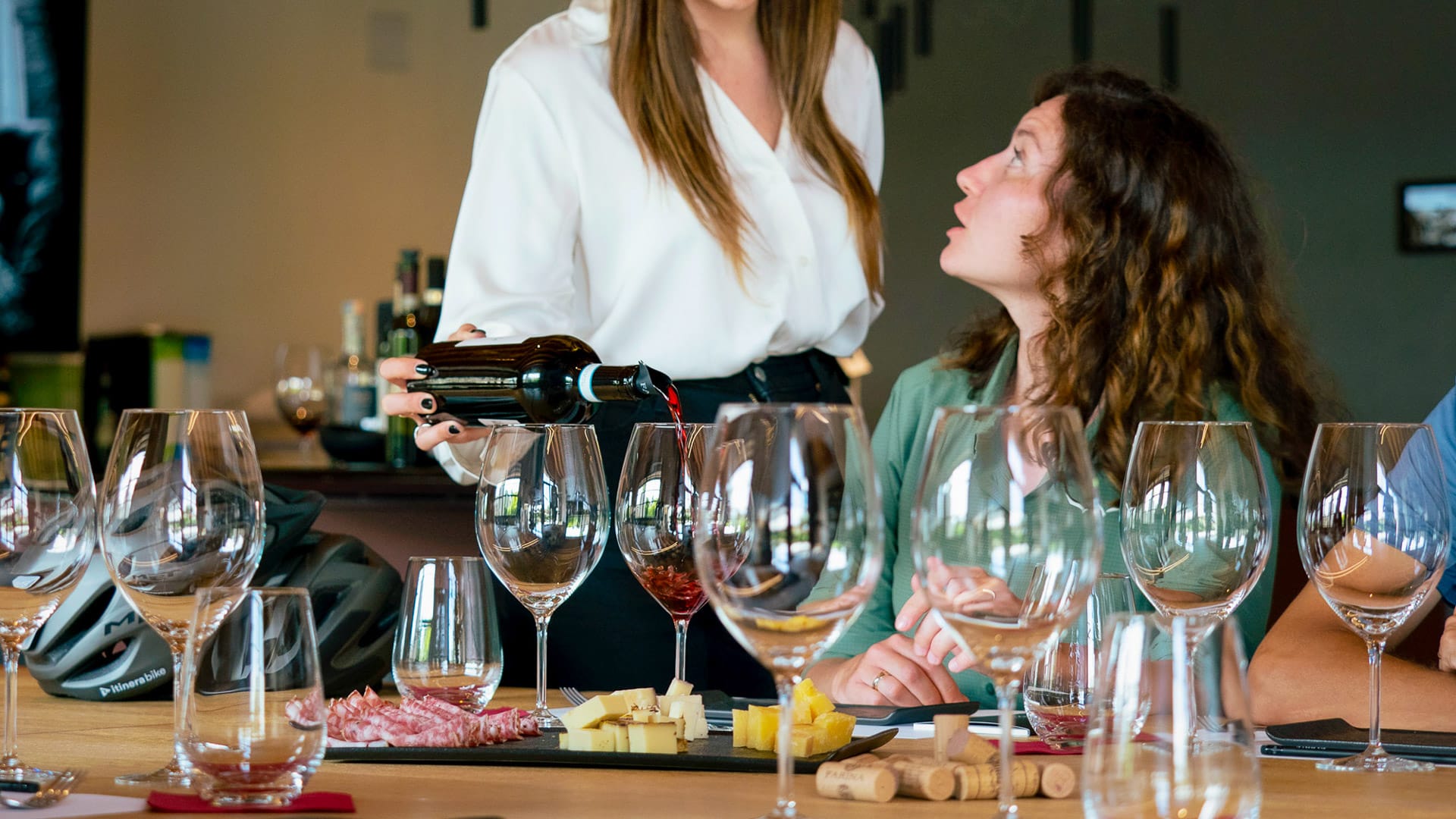
Food and wine tasting is all part of the experience in Verona (photo credit: Itinera Bike & Travel)
How do you get to Verona?
By air
The closest airport is Verona Valerio Catullo (VRN), located about 13 kilometres from the city centre, with a quick shuttle or taxi into Verona Porta Nuova.
Other big nearby airports include Venice Marco Polo, Bologna Marconi and Bergamo Caravaggio, all with straightforward rail links to Verona.
By train
Verona is very well connected, with direct services to Milan, Venice, Bologna and Rome arriving at Porta Nuova.
For cyclists, standard bikes are allowed on regional trains (look for the bike symbol); long-distance services usually require a packed or folded bike.
By road
Verona sits on major motorways, making it an easy drive from across northern Italy and the Alps.
If you’re hiring a car, choose accommodation with secure bike storage and check ZTL (limited-traffic) zones before you enter the historic centre.
Any highway code and travel information I should be aware of?
As ever, it’s a good idea to check current travel information before you book and travel. For UK visitors, the UK government travel information pages for Italy are here.
You should also read and follow Italy’s highway code, and ensure you have comprehensive travel insurance that covers all the activities you plan on undertaking.
Sponsor Message
Looking for Verona bike tours?
Itinera Bike & Travel have operated Verona bike tours for well over a decade and knows the city extremely well! Today their services include bike hire of e-bikes, gravel bikes and touring bikes. Head to the Itinera Bike & Travel website for further details.
Exclusive discount
Claim 10% off* all Itinera Bike & Travel services, including their Verona bike tours and bike hire, when you book directly with them before 31 October 2026. *T&Cs apply.
The post Planning a bike tour in Japan: 14 things you need to know appeared first on Epic Road Rides.
]]>However, Japanese culture and food can feel very different to what you might be used to at home. This is a huge part of the charm, but it’s good to be prepared.
The key is not only route planning. It is understanding how to move through the country respectfully and with as little friction as possible. The more prepared you are, the easier it becomes to enjoy the riding, the food, the scenery and the sense of discovery that makes a bike trip here feel so memorable.
We visited Japan in March 2026. Here are my top tips to help you have an amazing time.
Want to find out where we rode and get the lowdown? Read the rest of our articles on cycling in Japan, including our in-depth destination guide, 6-day itinerary and guide to planning a bike tour on the Shimanami Kaido cycling route.
Always check current travel information and advice. For visitors from the UK, the UK government travel information pages are here.
1. Respect and quiet matter
One of the most useful things to understand before a cycling trip in Japan is the value placed on quiet. In practical terms, that means keeping noise to a minimum and showing patience around other road users. If you come up behind pedestrians, do not assume you should ring your bell to move them aside. It is usually better to slow down, wait for space and pass calmly when it feels natural.
This quieter, more patient approach tends to fit local expectations well, especially when riding on shared spaces such as a bike path, cultural sites or sacred trails.
This may feel odd if you are used to a more assertive cycling culture. In Japan, a calm approach often goes a long way. Riding quietly, speaking softly and avoiding unnecessary fuss usually makes everyday interactions feel easier.

Passing a traditional shrine on a quiet road between Nikko and Ashikaga
2. Think carefully about bringing your own bike
Many riders instinctively want to bring their own bike, and sometimes that will be the right choice. But in Japan, it is worth thinking through the practicalities before committing to that plan – how much riding will you do? Is it easier to hire? Will you be able to get decent bike hire?
Train travel can be one of the main sticking points. On the Tokaido, Sanyo and Kyushu Shinkansen, baggage measuring more than 160 centimetres in total dimensions and up to 250 centimetres requires a reserved seat with oversized baggage space. Anything above 250 centimetres is not allowed on board. That is a strong reason to think carefully before assuming a standard bike case will be easy to manage.
However, bikes can often be sent within Japan using delivery services, and many railway companies also allow bicycles on trains only if the front wheel is removed and the whole bike is placed in a special bag (more on that below).
For some riders, bringing their own bike will still be worth it, but in Japan it is not automatically the easiest solution.
If you’re joining a guided tour, check what bikes the tour operator provides. Many offer high-quality rental bikes, which can be a simpler option than bringing your own. On our bike trip with Rindo Bike Tour Japan, we used their high quality Specialized bikes (more details in this article). On the Shimanami Kaido, we hired from Giant (more details in this article).

Giant bike rental in Onomichi (conveniently located inside Hotel U2 complex, where we stayed)
3. If you do bring your own bike, learn about rinkō bags
If you decide to bring your bike to Japan, a very Japan-specific tip is to understand rinkō. This is the practice of partially dismantling your bike, putting it in a dedicated bag and carrying it as luggage on public transport. It can make train travel much more manageable if your itinerary mixes riding with rail travel.
In practical terms, a rinkō bag can be far easier than trying to wrestle a large bike box through stations, gates and platforms or work out the logistics of luggage transfer. It also fits much better with the way many Japanese rail operators expect bikes to be carried.
4. Pack light
I am terrible at packing light, but Japan definitely rewards a lighter approach to packing.
You’re likely to find yourself using bullet trains, staying in compact hotels or inns, and moving between places more often than expected. A smaller load makes station transfers easier, reduces the hassle of stairs and platforms, and leaves more room for the things you really need on the bike. Packing only your most essential, top-quality gear also helps keep things simple and reliable on the road.
We found that many hotels we stayed in had laundry facilities, which also helps reduce the amount of kit you need.

Lake stop near Mount Akagi
5. You won’t go hungry…
Japan’s convenience stores are especially useful for riders. 7-Eleven, Family Mart and Lawson are widespread. Many are open all day and night, and they sell a broad range of meals, snacks and drinks. You’ll find them regularly along most cycling routes. There might be a bit of guessing when it comes to precise flavours, but Google Translate will help you! We developed a particularly soft spot for the fluffy pork buns. They also have microwaves and hot water in the shops, so you can even get a hot meal; amazing.
Convenience stores such as 7-Eleven often provide access to international ATMs, which can be a real help when you need more cash in smaller towns.
Japan is also home to over 5 million vending machines (source). Even in the middle of the countryside, you find them dotted along the road side! We found these were mostly full of drinks rather than snacks, but they’re great if you run low on energy and need a quick, sugary, pick me up. Some machines even vend both hot and cold drinks from the same machine.

Snack stop on the Nikko Lake Chuzenji cycling loop
6. …unless perhaps you’re vegan!
Vegetarians and vegans are not brilliantly catered for in Japan as it’s not common amongst locals. The main issue is that fish broth (dashi) gets hidden in many sauces and soups.
In large, futuristic cities like Tokyo and Kyoto, you should be able to find plenty of foods, but cycling in rural areas will be trickier. Book ahead with hotels and make sure you have your translation app on hand to check ingredients.
The good news is that tofu is widely available, miso is in many dishes and rice and noodles are common bases for dishes. You’ll still get a strong sense of local flavour and food culture, even if choices are slightly limited.

Some of the food we ate in Ashikaga
7. Be ready to carry your rubbish
One small surprise was the lack of public bins. Japan has relatively few public rubbish bins, and travellers are often expected to carry their rubbish with them until they can dispose of it properly, whether that is at a hotel, a station or a suitable convenience store.
For riders, a small zip bag for wrappers, empty bottles or snack packaging can be surprisingly useful. It is a tiny thing, but it can make a day on the bike much tidier and easier.
8. Carry cash and bring a coin purse
Japan is famous for its technological strengths, but on the ground we found it still felt surprisingly cash focused. A considerable number of ATMs do not accept cards issued outside Japan, and we found that cash was essential for smaller businesses and everyday purchases.
It is also worth carrying coins, not just notes. Small payments come up often, and a simple coin purse makes vending machines, convenience stores and quick local purchases much easier to manage.

Inside the Watanabe sake brewery
9. Prepare for language barriers
In large cities and major tourist centres, you may find some English support. In particular, it was a relief to find that train station names are written using the English alphabet as well as Japanese characters.
In the countryside of the Kita-Kanto region, north of Tokyo, we found that barely anyone spoke English. But we didn’t find it was a monumental problem. It just means you should make sure you have mobile data so you can use Google Translate when needed. You could also try downloading useful phrases in advance – and it’s a good idea to save accommodation details, route notes and booking confirmations on your phone in case you don’t have data at a critical moment.
Body language helps too. A smile, a pause and a respectful tone can smooth over a surprising amount! If you prefer a smoother experience, riding with a local guide can make communication and logistics much easier (more on our experience with Rindo Bike Tour Japan, here).
10. Learn a few social basics
Japan’s social customs are intricate, but fortunately the Japanese are forgiving of foreigners. That said, there are some basics you should know and try and incorporate in your interactions.
For example, bowing is more common than handshakes, especially in more formal situations. Tipping is generally not expected, so there is usually no need to add extra for service.
You should also be ready to remove your shoes indoors in certain places. Traditional accommodation (including onsen ryokans), some restaurants and other indoor spaces may expect this.
You do not need to get every detail perfect, but a little awareness helps you fit in more naturally and keep locals and tourists on the same side.
11. Try an onsen
After a day on the bike, an onsen can feel like one of the highlights of a trip. We found the warm water, quiet atmosphere and sense of ritual was deeply relaxing, especially after a long ride. Experiencing natural hot spring baths is a key part of a bike tour in Japan.
It helps to know what to expect: onsen bathing is done without clothes and segregated into men and women’s onsens. When you visit an onsen, the usual routine is simple once you know what to expect. First, leave your shoes at the entrance if required, then head to the changing area and undress fully, as people normally bathe naked. Take only a small towel with you. Before getting into the water, wash yourself thoroughly at the shower stations using the stool, shower and soap provided. This part matters, as the baths are for soaking, not washing. Once you are clean, step into the bath quietly and relax. Keep your towel out of the water, speak softly and take your time. Afterwards, dry off a little before returning to the changing room so you do not drip everywhere.
Tattoos can be an issue, with some onsens asking guests to cover them and others reserving the right to refuse entry if tattoos are visible. Policies vary, so if you have a tattoo, it is worth checking ahead rather than assuming.

Traditional onsens are a big part of the experience
12. Know the rules of the road
Before you start riding, make sure you understand the basics of road behaviour in Japan.
The starting point is that you ride on the left. It is also worth learning the Japanese stop sign so it stands out immediately when you see it – and you do actually need to stop at these.
There are quite a few rules to know and do familiarise yourself with these – the police here do issue fines for non compliance (source).
In better news, we found drivers respectful and patient, and the overall road culture can feel considerate. Even so, it is still important to stay alert, especially in unfamiliar places.

Climb to Lake Chuzenji, near Nikko
13. Remote forest roads need extra care
If your cycling route includes remote rindō forest roads, expect a more variable surface and a less polished cycling experience. These roads can be wonderful to ride, with a real sense of getting away from it all, but they are not always neat or predictable. They don’t get lots of traffic and so don’t expect them to be swept or for the asphalt to be uniformly perfect.
Debris such as leaves, twigs and small branches can be common, especially after bad weather or in quieter areas. That does not mean you should avoid these roads. It just means you should approach them with the right expectations and stay cautious on descents.

Rindo roads aren’t always perfectly swept
14. Be a little more self-sufficient than usual
You’ll find a cycling trip in Japan will be easier if you are able to solve small problems yourself – and if you are heading into rural areas, basic bike mechanic skills are especially useful. At the very least, you should be comfortable fixing a puncture and making minor adjustments.
As with a trip anywhere, the key thing is to reduce reliance on bike shops when you may be far from one. In Japan the added nuance is that the language barrier is also likely to make technical help harder to access quickly. A little mechanical confidence brings more freedom and makes it easier to keep the trip moving.

Scenic loop ride in Ashikaga
Final thoughts
We loved bike touring in Japan. The roads, landscapes, food and local experiences can make even an ordinary day feel memorable.
The key is to arrive with the right expectations. Travel light. Carry cash and a few coins. Be ready for limited English. Learn the road basics. Ride patiently and quietly. Know how trains handle bikes and oversized baggage. Bring enough mechanical confidence to handle the simple things. Do that, and many parts of the trip become much easier.
Whether you’re riding the Shimanami Kaido, exploring the Japanese Alps, visiting Mount Fuji or planning a self guided cycling tour itinerary through Nikko National Park, preparation makes all the difference.
Want to read more about cycling in Japan?
Check out these Epic Road Rides guides to help plan your adventure:
- Cycling Japan, our central hub page for the country
- Self guided cycling tours in Japan: what you need to know before you book
- Planning a Shimanami Kaido bike tour, for tips on riding Japan’s Setouchi Sea region
- Shimanami Kaido cycling route FAQs, with answers to common questions before you ride
- Shimanami Kaido cycling route, for tips on riding Japan’s most famous cycling route
- 8 of the best cycling holiday destinations in the world 2026 for more inspiration
- Cycling holidays in Autumn, for the best places to cycle September + October
Let us know in the comments if you’ve got tips to add or questions about planning your Japan cycling holiday. Read on and plan your next cycling adventure!
The post Planning a bike tour in Japan: 14 things you need to know appeared first on Epic Road Rides.
]]>The post Shimanami Kaido cycle route: 37 FAQs (answered!) appeared first on Epic Road Rides.
]]>Riding the Shimanami Kaido independently also meant I got to see the route beyond the polished images, from the practical logistics and small decisions on the ground to the details that can make the ride feel either seamless or stressful.
In this article, I share the tips that felt most useful from my trip, based on first-hand experience of finally riding the Shimanami Kaido, a route I had long wanted to see for myself.
I hope you find this useful!
Always check current travel information and advice. For visitors from the UK, the UK government travel information pages are here.
Table of contents
This article contains a lot of useful information. To help make it more digestible, we’ve broken it down into several parts:
- Part 1: Getting started
- Part 2: The route explained
- Part 3: Level of challenge
- Part 4: Planning your trip
- Part 5: Bikes and support
Part 1: What do you need to know before planning your Shimanami Kaido ride?
Start here: introduction to cycling the Shimanami Kaido – for a really useful overview of what you need to know and to help you decide if the Shimanami Kaido is for you.
Then read: planning a Shimanami Kaido bike tour– for our itinerary and thoughts on a self-guided bike tour versus a guided tour
And finally: read the below! For in-depth FAQs to help you plan your tour once you’ve decided you want to ride it.
Part 2: What is the Shimanami Kaido route like?
1. What were your highlights of riding the Shimanami Kaido?
- There are lots of bike-friendly hotels on the route. We loved the places we stayed (though they were pretty eclectic!).
- Giant bike stores in Onomichi and Imabari provide high quality road and e-bike alternatives to the more easily available city bike experience.
- If you’re more relaxed about the quality of what you ride, there are plenty of bike hire options; there are 10 bike hire terminals between Imabari and Onomichi.
- Road quality was excellent, as were the purpose built facilities around the bridges.
- Scenery was often spectacular, with views across the Seto Inland Sea, and the industrial edge providing an interesting counterpoint.
- Sagawa luggage transfer is brilliant and makes a DIY multi-day journey doable.
2. Do you have a map of the Shimanami Kaido route?
See below! Also check out this map the authorities have created. And our Shimanami Kaido bike tour article contains a GPS file.
3. Is the Shimanami Kaido signposted?
Yes, there are signposts and also road markings.
4. Is the Shimanami Kaido cycle route a segregated bike path?
This confused me too! The answer? No. There are bike (and pedestrian and scooter) paths up, down and over the bridges, but in between, you’re on the road.
Some of the time, especially on the main route, there are separated bike paths, but some of the time and especially off the main route, there aren’t. However, on the main route there is the constant presence of the “blue line” and we found that the vast majority of the roads were incredibly low traffic. More details in our Shimanami Kaido bike tour article.

Bike path on Omishima Island
5. Is the Shimanami Kaido just for cyclists?
No, the Shimanami Kaido Expressway is for vehicles. The Shimanami Kaido paths on bridges are also used by motorcycles and pedestrians.
6. Is the Shimanami Kaido all on bike paths?
No! Other than on bridges and alongside very busy sections of road, the Shimanami Kaido is mostly on road rather than bike paths. We found the roads very low-traffic and calm to ride.
7. Is the Shimanami Kaido all asphalt?
Yes!

Cycling on Oshima Island in Japan on day two of our Shimanami Kaido trip (note no blue line – we were off the main route)
8. Which is the best route to take on the Shimanami Kaido?
When referring to the Shimanami Kaido, most people think of the main 80km route between Imabari and Onomichi. However, the Shimanami Kaido isn’t just one route. The main route is the famous one, but the authorities have also signposted other route options, including the Island Explorer route.
There are plenty of alternative routes for riding the Shimanami Kaido. It all comes down to how many days you have and how much of the islands you want to see.
We loved getting off the main route – more thoughts on that in our Shimanami Kaido bike tour article.

Close up photo of the Shimanami Kaido route map at Innoshima Bridge 1
9. Which way to ride the Shimanami Kaido? Onomichi to Imabari or Imabari to Onomichi?
Most people ride the Shimanami Kaido between Onomichi and Imabari, and either direction works well. Your choice will usually come down to your wider travel plans.
We rode from Onomichi to Imabari over two days on a quieter “Rindo Route”, then returned from Imabari to Onomichi on the main “blue line” route. This worked really well, as it gave us a mix of peaceful backroads and the classic Shimanami Kaido experience. More details on that in our Shimanami Kaido bike tour article.
If you’re concerned about things like wind direction and uphill slopes, people suggest it’s easier to start from Imabari City.

Ferry back to Onomichi
Part 3: How difficult is the Shimanami Kaido?
10. Is the Shimanami Kaido suitable for beginners?
Yes, I think the Shimanami Kaido is suitable for beginners, especially compared with many of the other bucket-list rides people talk about. The gradients are generally manageable, the route is well signposted, and there is a reassuring sense that the cycling infrastructure is built with cyclists in mind. That said, “beginner-friendly” does not mean effortless. It is still worth being comfortable riding for multiple hours, handling and navigating shared spaces with other cyclists and pedestrians. For riders who are new to cycle touring or longer days in the saddle, the Shimanami Kaido can be a great first big ride, particularly if you keep your daily distance realistic, start early and allow time to stop and enjoy the islands along the way.
11. What makes the Shimanami Kaido accessible for cyclists?
There are lots of things that make the Shimanami Kaido accessible. For example,
- The blue line on the main route makes it hard to get lost, even if you don’t have a GPS file/aren’t used to following one.
- The route is relatively flat and the approach to the bridges have been designed with gentle slopes to make getting onto the bridges easier.
- Bicycle rental is easy – there are lots of portions and some allow one-way bike trips.
12. Is there much climbing on the Shimanami Kaido?
The main route is relatively manageable, but it is not completely flat. You climb up to each bridge, though the bridge approaches are designed with gentle gradients. Detours and island explorer routes can be much hillier, so check your route carefully if you’re not confident with climbs.
Check out our Shimanami Kaido bike tour article for Shimanami Kaido route profiles and GPS files.

Steep climb near Tanoura (again, no blue line – this was on day 2 of our ride when we weren’t on the main route)
13. Can you ride to the observatories on the Shimanami Kaido?
Yes, but some are much harder than they look on the map. We’ve heard Kirosan Observatory on Oshima, for example, involves a steep climb. Be especially careful descending from observatories, and avoid doing these climbs close to sunset.
14. Can you ride the Shimanami Kaido with kids?
We rode the route with our 10 and 13 year old. While you’d want to adjust the distances depending on your children’s fitness and cycling experience, there’s lots to like here given the terrain is easygoing and there are lots of places to refuel on the way. The variety of inexpensive accommodation also makes it an appealing option for families on a budget.
15. Can you ride the Shimanami Kaido in one day?
Yes, I’m told a lot of people ride the Shimanami Kaido main route in one day.
There’s about 600 metres of elevation gain across the 78 kilometre route from Onomichi to Imabari, so it depends if you feel that’s feasible in one day.
If you aren’t confident with that distance, you can always just ride a section. Or turn it into a multi- day adventure like we did. There’s plenty of accommodation along the route or you can get a bus or a ferry ride part of the way. Or perhaps even a support van if you’re on a guided tour – or book with WAKKA Hotel – details below.
Check out our three-day itinerary here.
If you are hiring a bike, note the times you need to return the bike by to avoid extra charges. These were correct at the time of writing but check in case there are any seasonal differences or changes:
- Giant’s hours are 9am to 6pm.
- The regular bike hire terminals are as follows: Onomichi, Itoyama and Imabari – until 7pm and Mukaishima, Innoshima, Ikuchijima Island (both), Omishima, Hakata and Oshima – until 5pm

Quiet break beneath cherry blossom on Omishima Island
Part 4: How should you plan your Shimanami Kaido trip?
16. Do you need an organised tour to ride the Shimanami Kaido?
No you don’t and there are lots of cycling friendly services on the Shimanami Kaido that help make it possible to DIY – see below. However, I think the benefit of a tour would be:
- Hassle free – for example not having to book individual hotels or worry about food resupply and hitting restaurant opening times
- Get off the beaten track – the two days we spent following a BTJ route took us away from the busier Shimanami Kaido blue route allowing us to get a sense of the islands beyond the main route
- Get under the skin of the islands’ history and heritage – a guide will explain what you’re seeing and opens up the story of the destination which it’s hard to get otherwise.
You can find out more about BTJ’s Shimanami Kaido tours in this article.
17. Can you suggest an itinerary for the Shimanami Kaido?
Check out our Shimanami Kaido bike tour article.

Cycling through the Lemon Valley on Ikuchi Island
18. Are there any rules of the road you need to be aware of when riding the Shimanami Kaido?
Helmet use is strongly recommended in Japan. Since April 2023, the law requires all cyclists to make an “effort obligation” to wear a helmet, but it is not strictly mandatory for adults.
As for rules of the road, the Shimanami Kaido follows standard Japanese cycling laws, as it is made up of public roads. Key things to know include:
- You must ride on the left-hand side of the road, the same as cars
- Bicycles are treated as vehicles, so you must obey all traffic lights and road signs
- At large junctions, a two-stage right turn is required rather than turning directly across traffic
- Do not ride side-by-side or against traffic, especially on narrow bridge paths
- Give way to pedestrians on shared paths and ride carefully in these areas
- Using a mobile phone while riding is illegal
- Riding under the influence of alcohol is treated seriously and can result in heavy fines or penalties

Riding on the roads of Oshima Island (blue line – riding the main route on day 3)
19. What should you do if it rains on the Shimanami Kaido?
The usual rules apply; always come ready for rain. However, if you’re new to cycling, it’s worth having a wet weather plan. Wet roads, white lines, manholes and downhill bends can be slippery in rain, so if the forecast is poor, allow extra time, ride cautiously or consider using buses, ferries or sightseeing stops instead. Convenience stores usually sell simple raincoats, but we’d suggest bringing proper waterproofs if you’re planning a multi-day ride.

Rainy ride along Mukaishima Island’s south coast (day 1 of our trip – no blue line so you can tell we’re off the main route)
20. Is there luggage transfer on the Shimanami Kaido?
Yes! We used Sagwa (more details below), which was great.
WAKKA Hotel also offers luggage transfer, which might be a good option for groups. We stayed at the hotel but didn’t use this.
21. What do you need to know about using Sagwa luggage transfer on the Shimanami Kaido?
- Your bag needs to have a L+W+H of no more than roughly 160cm and it needs to weigh less than 30kg.
- When we travelled, it cost 2,200 yen per bag per transfer.
- Remember to book your Sagwa the night before!
22. Are there cycling friendly hotels on the Shimanami Kaido?
Yes, though some are not so accessible for international visitors as they don’t have websites and staff may not speak English. Here are the ones we stayed at and considered.
- Hotel Cycle u2: A stylish, higher-end option in Onomichi with secure bike storage, located in a converted warehouse with an on-site restaurant that makes a great end point to a multi-day ride.
- WAKKA Hotel: A modern, cyclist-focused hotel near the water with a range of accommodation options, plus a café with views of the bridge and organised activities to explore the islands.
- Cyclo No Ie hostel: A small, budget-friendly hostel in Imabari designed specifically for cyclists, with a social atmosphere, bike storage, tools and useful route information.

Inside Hotel Cycle U2, one of the bike-friendly hotels we stayed at on our trip
23. Are there food shops along the way?
The main “blue route” felt well provisioned and even off route, there are lots of towns and villages so if you’re riding on the coast you’re generally not far from a shop or restaurants. We did have one section when riding on day 2 where we were desperate to reprovision and had to ride about 8km more than we’d have liked. But that was more due to our bad planning than a lack of shops!
Also bear in mind that we found that lunch places usually have limited opening hours – roughly 12-2pm.
24. Can you buy water on the Shimanami Kaido?
Yes. It is not difficult to buy drinking water, with vending machines, convenience stores and shops on the islands. That said, it’s still worth topping up whenever you can, especially in summer or when leaving the main blue route.

Coffee and fruit shop on Omishima Island with local produce
25. Can you shower after riding the Shimanami Kaido?
Yes. There are showers, public baths and onsen around Imabari, Onomichi and some of the islands. This is particularly useful if you finish riding before catching a train or continuing your trip.
26. What are the best days of the week to ride the route?
On Tuesdays, lots of businesses in the area are closed – make dinner reservations well in advance.
27. When is the best time of year to ride the Shimanami Kaido?
Cyclists ride the Shimanami Kaido year-round, but it’s worth thinking carefully about weather and daylight. Spring and autumn are popular times to ride, while summer can be hot and humid and the rainy season can make conditions less pleasant. Winter can still be rideable, but you’ll want to check sunset times and dress for colder conditions.

Cycling past cherry blossom on Oshima Island (not on the main route)
28. How do you get to Imabari or Onomichi?
Both cities are connected to Japan’s fantastic train network. We were arriving from Kyoto and were going back to Tokyo, and found it absolutely straightforward to get the Shinkansen to Fukuyama and the regional train on from there (it’s about 20 minutes on the train between Fukuyama and Onomichi).

Imabari Cycle Station beside the train station
29. Can you get the bus back to your starting point?
Bikes are allowed on buses, but it’s worth noting that they need to be in a bag and if the storage trunk is full then you might not be allowed onboard.
A sign at Imabari station stated “You will need to take two buses to Onomichi. Take the highway bus to Fukayama and get off at the Innoshima Ohasi bus stop. Transfer to a bus bound for Onomichi Station at the Innoshima Ohasi bus stop.”
Note that you will need cash to pay the bus.
30. Can you get the ferry?
A ferry runs from Setoda port to Onomichi. If you just want to ride 30 kilometres or so then get the ferry back from Setoda. Note that the Lazuli ferry has a bike rack but the Citrus ferry doesn’t and bikes can get scratched when stored outside. If using the Citrus, ask the member of staff to store the bike inside.

LazuLi ferry travelling between islands in Japan
31. Are there any routes to ride once you’ve done the Shimanami Kaido?
Yes! We haven’t done them, but here are a few suggestions:
- Sazanami Kaido between Onomishi and Kure – around 85km
- Tobishima Kaido between Akinada Bridge and Okamurajima – around 31km
- Takanawa Road between Imabari and Matsuyama – around 48km
- Ishizuchi Kaido between Imabari and Kan-only – around 90km
- Yumeshima Kaido – connecting the islands of Kamijima – around 50km
32. What is the history of the Shimanami Kaido cycling route?
Opened in 1999 to much excitement, the Shimanami Kaido (also known as the Setouchi Shimanami-Kaido) went through roughly a decade of stagnation between 1999 and late 2000s (source). Annual public rental cycle users fell below 30,000 in 2005. Fortunately, three turning points moved the dial toward cycle tourism:
- Municipal mergers around 2005-2006 consolidated ten municipalities into just two cities (Imabari City and Onomichi City), making coordinated policy much easier.
- Grassroots civic movements emerged – model cycling courses were developed around 2005, the Shimanami Slow Cycling Council was established in 2008, and NPO Cyclo-Tourisme Shimanami was founded the following year.
- Governor Tokihiro Nakamura of Ehime Prefecture took office in 2010 and actively championed cycling culture , creating a dedicated government office for bicycle promotion and co-hosting the international “Cycling Shimanami” event with Hiroshima Prefecture.
In October 2014, the Shimanami Kaido signed a sister cycling road agreement with Taiwan’s Sun Moon Lake cycling course, and the first international cycling event was held. That same year, CNN named the Shimanami Kaido as one of the world’s seven greatest cycling routes. In 2019, Japan’s Ministry of Land, Infrastructure, Transport and Tourism designated it as one of the country’s first National Cycle Routes.
Today, more than 300,000 bicycles travel the cycling route annually, and nearly half of all riders are first-time cycling travellers.

Information board about the Shimanami Kaido cycling route
Part 5: What do you need to know about bike hire and support?
33. What type of bike do you need for the Shimanami Kaido?
Whatever you are comfortable riding for several hours is the best choice. The route is all on asphalt, so road bikes are absolutely fine. Hybrid bikes, e-bikes and city bikes are also common, especially if you are riding at a more relaxed pace. The main thing is to choose a bike that fits you well and feels comfortable for the distance you plan to ride.
34. Can you hire bikes on the Shimanami Kaido?
Yes, we hired from Giant in Onomichi City. They also have a large shop in Imabari City. What I liked about Giant is that I was able to reserve a bike in advance (note their booking opens 60 days in advance and at peak periods it’s a really good idea to book in advance as they often sell out quickly). I thought the bikes we hired were good quality and suitable for European sizing – for example I am 180cm tall.
There are other hire options, indeed I understand that the public bike rental system has 10 bike hire outlets along the route. I understand they offer cross bikes, mountain bikes, city bikes, e-assist and even tandem bikes. I am sure things will develop over time, but I’ve seen plenty of reports that you can only get smaller bike sizes from such outlets. Also be aware that you can only reserve here up to 4 days in advance.

Hire bikes from Giant
35. Can you bring your own bike to the Shimanami Kaido?
Yes, but if you’re taking your bike on Japanese public transport, it needs to be packed in a proper bike bag. There are bike assembly spaces at both Imabari Station (served by JR Imabari Station) and Onomichi Station (served by JR Onomichi Station), which is useful if you’re arriving with your own bike rather than hiring.
36. What if you only want to cycle one way on the Shimanami Kaido?
One way bike hire is possible, but make sure you leave yourself enough riding time to get back before the store closes.
37. Is support available if cyclist or bike break down?
WAKKA Hotel has some fantastic cyclist support services including bike taxis, including a van that can transport up to 5 bikes and five passengers. This is particularly useful for group travel.
If you hire your bike from Giant they show you the following sign when you hire “When you go to Imabari, be sure to make a bike rental reservation for at least two days and return it by yourself, or get a drop-off reservation. Even if you have no choice but to drop off the bicycle at Imabari, we cannot accept it because another reservation has already been made at Onomichi. In that case, an emergency collection fee of 55,000 yen will be charged.”
If you hire your bike from the main bike terminals (rather than Giant) you can return your bike at any of the 10 terminals without having to tell them in advance. If your bike has problem, you can replace it at one of the terminals.

Giant bike store in Imabari
Final thoughts
The Shimanami Kaido is one of those rides that looks simple on the surface, but has a lot of small details that can shape your experience.
From choosing which direction to ride, to deciding how many days you need, to understanding how bike hire, luggage transfer and transport options work, there are plenty of decisions to make along the way. None of them are complicated, but getting them right can make the difference between a smooth trip and a stressful one.
That’s really what this FAQ is about. It’s not just whether you can ride the Shimanami Kaido, but how to make the most of it.
If you’re thinking about riding it yourself, you’ll find more help in our other articles:
- Shimanami Kaido cycling route, for tips on riding Japan’s most famous cycling route
- Planning a bike tour in Japan, 14 things you need to know
- Planning a Shimanami Kaido bike tour (itinerary and tips)
- Cycling Japan, our central hub page for the country
- Cycling Japan with Rindo Bike Tour Japan 2026: 6-day itinerary + review
- Self guided cycling tours in Japan: what you need to know before you book
Hopefully, this gives you everything you need to start planning your own trip.
The post Shimanami Kaido cycle route: 37 FAQs (answered!) appeared first on Epic Road Rides.
]]>The post Cycling Japan with Rindo Bike Tour Japan 2026: 6-day itinerary + review appeared first on Epic Road Rides.
]]>That curiosity only intensified when I worked with Rob and the team at Rindo Bike Tour Japan (Rindo, for short) on our guide to cycling in Japan. The more I learned, the more the country sounded almost impossibly appealing: networks of pristinely maintained roads, bullet trains, beautiful landscapes, extraordinary food and a cycling experience unlike anywhere else.
But planning a bike tour of Japan for four people feels difficult when you don’t speak Japanese and you’re limited on time.
So when Rindo suggested a press trip, I didn’t need asking twice.
Rindo offer a very tailored approach to self-guided cycling tours; the trip they created for us was based on their Nikko, Kiryu and Akagi self-guided itinerary but tweaked to add in some cultural stops. Our group comprised four cyclists: two very strong riders and two less strong riders, all up for a challenge and experiencing authentic, rural Japan.
Here’s how we got on.
Always check current travel information and advice. For visitors from the UK, the UK government travel information pages are here.
Overview of our trip with Rindo Bike Tour Japan
Length: 6 days, 5 nights in March/April 2026
Location: Nikko region in the Kita Kanto area, including Nikko, Ashikaga, Kiryu, in Gunma and Tochigi Prefectures, a couple of hours train ride north of Tokyo.
Distance: 332 kilometres
Climbing: 5,241 metres
Format: Self-guided tour
Accommodation: We stayed in traditional ryokans; two nights in two of the ryokans, one night in the final one. Rindo have asked us not to share the names of these ryokans, as they are key to their business and increased visitor numbers would adversely affect their ability to use the accommodation for their guests. Honestly, I was a bit skeptical about this request before I visited. Having been, I totally understand their concern and my lips are sealed!
Guests: 2 adults, 2 children (10 and 13, both experienced youth race-level cyclists)
What did we love about our trip with Rindo?
Our trip with Rindo gave us the confidence and means to explore a little-known part of Japan, far from the tourists. It gave us a truly authentic insight into Japan. The way Rindo create their trips offers a bridge between visitors such as us and the real, raw Japan that most people don’t get to see.
When so much of tourism, even cycling tourism, feels superficial and involves carbon copy trips, this felt like a rare privilege.
Here are the things we loved the most about cycling with Rindo:
The riding
Riding no name singletrack, moss-centred roads, through still, calm forest with nothing but birdsong and the ever-present rushing of a Japanese mountain stream. This was not a city-to-city tour, this was a tour where we felt immersed in the Japanese countryside – and it’s very different to the depiction I saw in Lost in Translation all those years ago!
These routes also felt much more local and untouched than the coastal rides around the Setouchi Sea, where we passed fishing harbours, citrus orchards and crossed dramatic suspension bridges. More details on our Shimanami Kaido bike tour article.
Experiencing Japan
There were some special moments on this trip that will stick with us. They were the unexpected, quiet moments that you don’t plan for. They were the times we felt we experienced religion and culture in practice: alone in the orange pre-dusk light, in pine forests surrounding an ancient shrine; witnessing a Buddhist ceremony, complete with chanting and conch shells, on a random Monday afternoon by the roadside; taking part in the rituals of sakura season.
It feels to me that everything in Japan has meaning. A lot is sacred. It’s a deeply complex and intriguing culture with a highly intricate degree of tradition and custom, far removed from the futuristic cities and neon lights many people associate with the country. We saw and felt more of this during our six days than during the rest of the time we spent in cities and more touristy parts of the country. It was incredible.
Traditional accommodation
We loved the deeply traditional hotels we stayed at, places that we never would have found ourselves. Each one felt a million miles from corporate chain, and we loved the kind, smiling service, even if there was little in the way of conversation due to language barriers.
The highlight was our final night, where we stayed in a quiet, owner run ryokan with just seven rooms (we were the only guests). The ryokan was located way up a winding forest road, with pine forests blanketing the valley sides and drifting into magnolia, cherry and chysantha blossoms alongside a babbling waterfall.
We loved finishing a ride, with legs burning, heading to the onsen, soaking aching muscles in the thermal waters, then dressing in a comfy, traditional yukata gowns (supplied by the hotel) for dinner.
Authentic food
Each night, we were served kaiseki: a multi-course seasonal feast of small, beautifully composed dishes designed to celebrate freshness, balance and the time of year. There might be sashimi, grilled fish, delicate soups and other impeccably presented plates, each arriving like a small work of art. It was a memorable experience, though not an entirely gentle one for unfamiliar palates; some of the flavours were unlike anything we had tasted before. Black soybean natto or pickled and spicy cod roe anyone?
Breakfast was cut from the same cloth. Sashimi and smoked fish are not what we would normally choose to start the day. It took a little while for us to adjust, but it certainly felt like an authentic introduction to Japanese food culture.
Meeting Japanese people
From the formal kaiseki dinners to the simple lunches in humble udon shops, from helpful servers in 7-Eleven stores to the group of grandmothers we met near Mt Agaki, the trip allowed us to meet people in a way you often don’t when travelling in a larger group or without a bike.
Despite the language barriers, I felt a warmth and kindness from people we met, who seemed intrigued to find a group of four lycra clad tourists in their village and keen to help. The sense of mutual interest and respect felt palpable.
Great bikes
The bikes Rindo provided us were all in excellent condition: two Specialized Vado e- road bikes and two Specialized Aethos regular road bikes. They came set up with Wahoo ELMNT ROAM bike computers and a nice-looking bike bag, plus the usual puncture repair kit you’d expect. A branded cycling jersey and buff (of a quality you’d actually want to wear again at home!) was also a nice touch.
Excellent support
I’d also say that the self-guided tour format offered by Rindo provided a level of service I haven’t experienced before with a self-guided format: the team met us at the train station, took time and care on our bike set up and were ever-present on the WhatsApp group. They checked in with us regularly and offered transfers on the odd day we encountered heavy rain. They were also on hand for questions, from route related questions to restaurant recommendations and reservations. When we had the odd bike issue like a shifter issue we couldn’t fix, they were swift to assist.
This level of service goes far beyond the kind of self-guided support I’ve experienced previously. It’s fair to say that kind of experience comes with a price tag, but credit goes to the RIndo Bike Tour Japan for executing their service so well.
Cherry blossom
Sakura season is undeniably beautiful, but it can also be unpredictable. The bloom shifts from year to year, so even a carefully timed visit can miss the moment. You’re also not guaranteed sunshine and warm temperatures at this time of year.
Had we not been tied to the school holidays, I might have been tempted to choose a slightly quieter time to visit – partly for the flight prices, but also to avoid some of the cherry-blossom chasing crowds we encountered in places like Kyoto and Tokyo.
In many ways, later spring appeals just as much: milder temperatures, fewer people and landscapes newly vivid with fresh green growth. Equally, I can imagine autumn being a magnificent time to ride, with the wooded rindo roads glowing in rich shades of red, gold and amber.

At the G7 Nikko sign at Lake Chuzenji
Is a self-guided bike tour with Rindo for you?
It’s worth asking yourself this question, because in truth, this kind of trip is not for everyone.
- You need to be happy navigating using a GPS device.
- The vast majority of people you’ll meet won’t speak English. This means you need to be confident relying on Google Translate (and energetic pointing/body language) if you don’t speak Japanese.
- Rindo set you up on your bike on day 1 and are there if you need them, but make sure you’re happy fixing a flat tyre, or make minor adjustments such as to saddle height, since you don’t have anyone riding with you.
- Rindo offer a wonderful range of rides for each day of your route, and will happily suggest the best route to pick, based on your riding level and interests. Just don’t over-estimate how demanding you want your ride to be that day, as you’ll be riding unsupported (though of course the team is there in case of breakdown).
- We didn’t see many bike paths in the Kita Kanto region, but nearly all the roads we were on were low traffic, or with a decent hard shoulder.
- If you stay in a ryokan that provides breakfast and dinner, you need to be prepared to try food you’re unlikely to have eaten before. Western options aren’t available and you’ll be eating a set menu. For us, this was a big part of what made the trip special, but if you aren’t willing to embrace the traditional Japanese cuisine, you will miss out on part of the experience.
- More generally, staying in these traditional ryokans requires a level of respect for local customs. Japanese people prize calm and quiet and the rules of the onsen are taken seriously. If you don’t want to flex to the local way of doing things, there may be better places to stay.
- Be aware that a bike tour in rural Japan can be tricky if you are a strict vegetarian (let alone a vegan!). I am a pescatarian and Rindo did a great job of making arrangements ahead of time. Dietary restrictions are an area it could definitely be difficult to navigate in Japan without this kind of support!
Compare guided versus self guided with Rindo
Guided
I haven’t experienced one of Rindo’s guided bike tours, but I’ve worked with Rob, the founder of the company for many years and I am confident that if any of the things above are concerns, most would be solved by opting for one of Rindo’s guided trip.
On these, you’ll always have someone on hand to assist, guide and explain. Organised food stops will mean you don’t need to rely on Google Translate so much and a travelling mechanic will mean there’s no concern if you have issues with the bike.
Self-guided
For us self-guided worked brilliantly because we were riding as a family unit, we are pretty experienced and like to go at our own pace.
Rindo’s version of self-guided also offered an unusually high level of support that might not be necessary in countries that are more accessible, but works really well in Japan. Being met from the train, being offered cultural stops and transfers for riders and bikes when the rain poured down, was perfect for us.
For me one of the downsides of a self-guided trip can be that you don’t get much feeling for the culture and authentic customs of a place; these things tend to pass over you. So it’s unusual that this wasn’t the case on Rindo’s trip. I think this was for a few reasons:
- their GPS routes are very helpful at including great suggestions for places to stop and eat;
- the premium ryokan experience allowed us to try out the onsens and the kaiseki menus pushed our food boundaries in a way we wouldn’t have experienced if left to our own devices; and
- Rindo are happy to incorporate cultural stops into their self-guided itineraries – you can find a list on this page of their website (i.e. these weren’t a “special exception” they offered us).
Yes, it was a self-guided trip but it incorporated many of the advantages of a guided trip that let us really experience Japan.
Our itinerary with Rindo
As mentioned, Rindo pride themselves on tailoring their trips to their clients. They also have a fantastic library of cycling routes available. This means that even once you’ve picked an itinerary, there are multiple route choices available each day so even if the weather doesn’t play ball or someone isn’t feeling up for the ride you selected at home, you’ll have options.
Here are the cycling routes we rode to give you a sample. Note that the routes don’t start and finish at the hotels we stayed at.
Day 1: Nikko loop
Warm up ride, punctuated by tall cedar trees and quiet shrines
Distance: 35.6 kilometres
Elevation gain: 563 metres
GPX DownloadTerms of use reminder
Route notes
We weren’t able to arrive in Nikko until mid afternoon, but we were met at the station by Elena from Rindo. She took us to the hotel and got us set up on our bikes, ably supported by her team mate, Taka.
We headed out on our bikes; this is a nice warm up ride, that took us south down to Nikko, looping through agricultural land and forest, past homes and peaceful shrines where we were the only visitors.
A short off-road section saw us cycling along the Nikko Kaido Cedar Avenue, registered by Guinness World Records as the world’s longest avenue of trees. More than 50,000 trees were planted, of which around 12,000 remain, over a period of 20 years starting in 1625. Cedar trees were chosen due to the ancient belief that the gods descend from the heavens down to earth through this species of tree. It was lovely to ride through, but we found the fallen pine needles and leaves had made the road a little too boggy for road bikes; the road was always there to bail out onto.
We crossed the Daiya River and then headed north again up a relatively busy road (but with decent hard shoulder) before turning off and escaping onto tiny single track rindo roads that weaved through dense forest, never far from the sound of tinkling water.
Tips
- The rindo roads are typically covered by a canopy of trees; this means they don’t get tons of sun and, even when it’s not riding, can be damp and strewn with tree debris. Care is needed on the winding descents.
- The Watanabe Sake Brewery is close to the route. I love a bit of history and culture on a bike trip, and I loved the short tour Rindo booked us with Mr Watanabe, the 7th generation owner of Watanabe Sake Brewery. A jovial soul, he shared his passion for the history of sake as well as the process of making it.
- Nikko is popular with day trippers from Tokyo, and this means that you won’t have it to yourself especially at busy times like cherry blossom season. Book your train a few weeks in advance especially if you want to arrive in the morning or at weekends.
Day 2: Lake Chuzenji loop
A day of climbing, descending and spectacular views
Distance: 55.4 kilometres
Elevation gain: 1,020 metres
GPX DownloadTerms of use reminder
Route notes
The climbing begins almost immediately; this route is in essence a long climb, followed by a tour around the lake, followed by a long descent.
The ride takes you out through villages and fields to the Irohazaka climb, an iconic series of switchbacks that leads you into the highlands.
The wonderful thing about this climb is that both the road up and the road down are one way but spread over two lanes. This means that there’s plenty of room for cars to pass cyclists with lots of room.
Lake Chuzenji is a dramatic spot within Nikko National Park, surrounded by towering mountains. It’s no surprise it’s a popular local attraction and a gaggle of little shops and local restaurants gather around the lakeside.
From the lake, you can decide whether to descend back home or keep riding.
To the observatory
We opted to head on up the switchbacks on a singletrack road, to Lake Chuzenji Observation Deck, where we enjoyed a gobsmacker of a view down over Lake Chuzenji and towards Mt Nantai.
Note: this isn’t marked on the GPS route above, but it’s easy to find, just take a look at the wiggly road to the southeast of Lake Chuzenji.
To the Ryuzu Falls
Back at the lake, you continue around the lakeside, through forest and past grand old homes built between 1870 and 1940 for ambassadors and dignitaries. Then it’s up a few switchbacks to the Ryuzu Falls. You come to the car park for the Falls first, but if you ignore that and continue to the road bridge, you find two distinct views of the Ryuzu Falls – to the north is a narrow valley with white water frothing down it; to the south are more gently cascading falls.
To Lake Yu
We turned around at the Ryuzu Falls, but if you’ve got more juice in your legs, continue on to the Yutak Falls observation deck for the 70m high Yudaki Cascades waterfall.
Tips
- Lake Chuzenji sits at around 1,300 metres above sea level and the observatory sits at around 1,800 metres, so it can get pretty cold. Dress accordingly.
- Note there is quite a long tunnel on the way up the climb. It’s lit but remember to switch on your lights!
- While in Nikko, you can’t miss the UNESCO-listed Toshogu Shrine complex, famous for its ornate carvings, rich history, and surrounding cedar forest. Take your time wandering through the intricate gates, halls, and moss-covered stone paths. We stumbled upon a prayer ceremony inside one of the pavilions, led by a priest whose chanting cut through the quiet morning with startling force. Rhythmic, powerful and deeply controlled, it gave the ritual an energy that felt urgent rather than serene. It felt like a small window into a living tradition continuing on its own terms.
Day 3: Nikko to (near) Ashikaga
A day of wide valley roads and steep, narrow forested climbs that take you from the highlands of Nikko down to Ashikaga. The Furumine Shrine is a highlight.
Distance: 96 kilometres
Elevation gain: 1,203 metres
GPX DownloadTerms of use reminder
Route notes
Nikko to Furumine Shrine
From Nikko, the route heads broadly downhill, though not without enough short, sharp ramps to keep you on your toes, as it winds deep into the Mae-Nikko Forest. It is a peaceful, rural-feeling ride, with long sections of forest and others tracing waterways through quiet countryside.
The day’s principal climb is the 8.4-kilometre ascent to Furumine Shrine. At an average gradient of around 4.5%, it is steady rather than ridiculous, although the steeper sections near the top verge on brutal.
The Shrine is known for its many tengu, long-nosed guardian figures believed to protect visitors. The Shrine has a deeply calm, authentically Japanese, ritual-like atmosphere. When we visited, there were barely any other people there, which only heightened the sense of tranquillity. There is also a water garden to explore, though it was closed during our visit. A few shops and vending machines just outside the Shrine make this a sensible place to stop for lunch.
Furumine Shrine to Ashikaga
We chose not to eat at the Furumine Shrine, which turned out to be slightly optimistic. Not long afterwards, we found ourselves diverting off-route, to Kamihinata in search of food. We settled on one of the local convenience stores, 7-Eleven, with the added bonus of excellent custard-filled choux buns from Hana patisserie (worth a stop if you pass!).
Back on the route, a short tunnel led us onto narrow forest roads, where startled deer scattered into the trees and the climbing resumed in earnest. For some distance, the road skirted a vast mine below. Then, just as we neared the top of the climb, an air-raid-like siren sounded, followed by an explosion that shook the ground beneath us. It was a somewhat startling reminder that this is a very active working landscape.
Tips
- The tunnel on this route was lit, but be aware that when riding in tunnels, vehicles can sound quite intimidating. Remember to remove your sunglasses and take lights!
- Plan your lunch stop carefully; there’s a lot of rural riding on this route and while you’ll find vending machines, have a careful think about where to eat.
Day 4: Ashikaga loop
Quiet forest roads and a dose of culture and history in Ashikaga
Distance: 64 kilometres
Elevation gain: 487 metres
GPX DownloadTerms of use reminder
Route notes
The ride began with a steady climb through the outskirts of Ashikaga. After leaving Route 201, we pedalled through small villages on smooth roads that climbed gradually north up the valley, before turning onto a narrow forest road that rose in a series of hairpins for the day’s main ascent. At the top, a short lit tunnel led us through to the descent: more sweeping hairpins on a broader road, this time dropping us back down the hillside towards Ashikaga.
Lunch was at Mahler’s Parlor, where a compact four-dish menu still managed to include a pasta option.
With the weather worsening, we cut the ride short and took up Rindo’s alternative sightseeing tour of Ashikaga instead. Rindo guides, Kate and Masashi, showed us around Bannaji Temple, a beautiful Buddhist temple built by Minamoto no Yoshiyasu, a powerful samurai and first generation of the Ashikaga family, from the 1100s onwards. We also took in Ashikaga Gakkō, widely regarded as Japan’s oldest school; and Orihime Shrine, a striking vermilion-lacquered shrine dedicated to the god of love. We capped the cultural extravaganza off with the excellent Ashikaga Flower Park, famed for its wisteria displays in April and May, but also a joy in cherry blossom season.
It was a pleasure to explore the city in the company of two thoughtful and generous Ashikaga locals, and to hear more about the history and ancient cultures of this under-touristed city.
Day 5: Ashikaga to Lake Umeda
Deep valleys, rushing rivers and narrow forest roads, plus a silk museum
Distance: 39.5 kilometres
Elevation gain: 670 metres
GPX DownloadTerms of use reminder
Route notes
Ashikaga to Kiryu
With three main climbs to tackle, there was a certain sense of foreboding from the outset – heightened, briefly, by an earthquake alert that flashed up on our phones. The locals seemed entirely unfazed, so we carried on riding and, in the end, felt nothing at all. It turned out the earthquake was far to the east.
After a final push through the forest, the road tipped down towards Kiryu.
Kiryu highlights
In Kiryu, we spent time at the Yukari Silk Museum, one of the day’s highlights, learning about the city’s long association with silk production. We loved the way the museum charts the evolution of the machinery, and even better, visitors can try some of the machines for themselves. Who knew that a single silkworm cocoon can yield more than 900 metres of thread?!
Lunch was at Garment District, where we were treated to an excellent western-style meal, complete with truly memorable pancakes and French toast – a welcome change for anyone beginning to crave a break from raw fish.
Kiryu to Lake Umeda
By the time we emerged, the rain was hammering down, and Rindo came to the rescue with the offer of a transfer up the valley to our hotel. This is not the kind of flexibility you would necessarily expect from a standard self-guided tour operator, but it says a great deal about the level of care that Rindo brings to the experience.
Tip
The road from Kiryu along Lake Umeda, and the river flowing into it, was so pretty. It would have been an idyllic, winding ride through the forest alongside the river with its moss-clad boulders, white water and, at the time we were there, clumps of bright yellow chysantha blossoms. Beyond the ryokan, the road continues and with hardly any traffic, so there would be scope to continue on for those with the energy.
Day 6: Mt Akagi
A testing climb up Mt Akagi, with caldera views and an incredible descent
Distance: 41.8 kilometres
Elevation gain: 1,298 metres
GPX DownloadTerms of use reminder
Route notes
Mt Akagi wasn’t on the door step of our hotel near Lake Umeda, but we were keen to ride this prized climb, so Rindo transferred us over to the start.
Miyosawa Akagi Shrine to summit
We left the stillness of Akagi Miyozawa Shrine, an atmospheric, pine-lined shrine at the foot of Mount Akagi, known for its sixteenth-century wooden gate and ancient cedar, and headed onto Route 16: an old, winding single-track road that climbed into dense forest.
This road is one for the mountain goats: a 13 kilometre squiggling line, with no less than 100 switchbacks to the summit! At around 11 kilometres, the road levels out into a section of false flat and a short descent before a final kick up to the summit of the Haccho Pass at over 1,500m above sea level. From Torii Pass, the views are spectacular, with the land dropping away in sweeping folds towards the Kanto Plain below.
A little further on, the road reaches Lake Onuma, the main caldera lake of Mt Akagi, where a small cluster of weather-beaten buildings sits by the shore. The eye is drawn immediately to the vermilion bridge leading across to Akagi Shrine on Kotorigajima, its bright red lacquer standing out vividly against the dark blue water and the forested slopes beyond.
The descent
The main descent is an incredible 15 kilometres long! We found the asphalt was great quality and there was barely a car on the road. There are some bumps designed to slow cars down but fortunately the way they are designed means they are barely noticeable on a bike. Be aware – you can build up some serious speed!
Even after you turn right off the main climb, the descent keeps going – barring a few small kick ups, you’re descending through farms (which you often smell before you see!) and agricultural properties all the way into Kiryu. The views are spectacular and you also get glimpses of the behemoth you’ve just ridden as it dominates the skyline.
We finished the ride at Cafe 1203; run by their club sandwiches, espresso and homemade ginger ale provided the perfect finish to a great ride.
Our final stop was the station, just five minutes away by car, and the train to Tokyo.
Tips
- It’s best to ride this loop the way we did it. Descending the well-maintained two lane road is a lot more fun than trying to descend the narrow climb we rode up.
- Cyclists from around Japan know of Mount Akagi for the Annual Hill Climb Race held each September up the main Route 4 road.
- The morning started cold and grey for us; we couldn’t see the summit and the top was significantly cold and windswept. Wrap up warm and pack good quality gloves; they are essential for the descent.
Final thoughts
Can you ride in Japan without support? Of course!
But would you have as good as an experience? I think it’s unlikely.
Yes, a tour frees you from logistical hassle, gives you route confidence and back up, but the real joy of the Rindo tour was the perspective it gave us on Japan, the experiences and the memories we wouldn’t otherwise have found or gathered. It was the tiny rindo roads snaking up a forgotten hillside, it was the cosy ryokans, the steaming onsens, the little stops at Buddhist shrines and udon shops. It was the insights into Japan that delighted, fascinated and intrigued.
So would I like to ride in Japan again? Yes please!
And would I recommend Rindo to a friend? I certainly would.
Find out more about Rindo Bike Tour Japan’s trips on their website.
Convinced you to ride in Japan? Here are some more articles and guides that will help you!
- Cycling Japan, our central hub page for the country
- Self guided cycling tours in Japan: what you need to know before you book
- Planning a bike tour in Japan, 14 thing you need to know
- Shimanami Kaido cycling route, for tips on riding Japan’s most famous cycling route
- Shimanami Kaido cycling route FAQs, with answers to common questions before you ride (coming soon!)
- Shimanami Kaido cycling route, for tips on riding Japan’s most famous cycling route
- 8 of the best cycling holiday destinations in the world 2026 for more inspiration
- Cycling holidays in Autumn: the best places to cycle September + October
The post Cycling Japan with Rindo Bike Tour Japan 2026: 6-day itinerary + review appeared first on Epic Road Rides.
]]>The post Planning a Shimanami Kaido bike tour: our 3 day itinerary (and firsthand tips) appeared first on Epic Road Rides.
]]>Why?
For me, the spectacular Seto Inland sea setting is alluring, the juxtaposition of heavy industry (shipbuilding) and beautiful island scenery is intriguing and the incredible infrastructure the Shimanami Kaido route offers reduces the overwhelm of organising your own bike tour in Japan.
In this article I share my experience of our three day Shimanami Kaido bike tour in 2026. I was with my husband and children aged 10 and 13 (both experienced cyclists). We organised it ourselves, but with help from Rindo Bike Tour Japan, who supplied the route. Big shout out to them for this, as the best parts of our tour were on their cycling route rather than the official route (and yes, GPS files are below!).
Here’s the in-depth take on our Shimanami Kaido tour, including itinerary and tips, to help you plan your own.
Looking for info on the practicalities of planning a cycling trip on the Shimanami Kaido? Read this: introduction article on planning a cycling holiday on the Shimanami Kaido and our Shimanami Kaido Cycling FAQs.
Always check current travel information and advice. For visitors from the UK, the UK government travel information pages are here.
The Shimanami Kaido cycle route
The main Shimanami Kaido route
The main Shimanami Kaido “blue route” is 76 kilometres long. It connects six islands, via six bridges, on the Seto Inland Sea, between Onomichi station (served by JR Onomichi Station) in Hiroshima Prefecture and Imabari station (served by JR Imabari Station) in Ehime Prefecture.
What to expect from a Shimanami Kaido bike tour
A few introductory points:
- The Shimanami Kaido is a well organised route. The signposting and cycling services around it are impressive, which simplifies organising a bike tour on the Shimanami Kaido. Just be aware that sticking to the Blue Route won’t necessarily let you see the most beautiful areas; consider investigating the “Island Explorer” routes marked by the authorities or speak to a tour operator if you want support in getting to the quieter, less-visited areas of the Seto Inland Sea.
- The Shimanami Kaido is pretty do-able, it’s relatively flat and while it might be 80 kilometres on the quickest route, you can easily break this up into sections.
- Is the Shimanami Kaido beautiful? As ever, it depends on your definition of beauty! Don’t come expecting classic, palm-fringed island vibes: you’re riding by the water for much of the time, but there aren’t many sun loungers and sandy beaches. Yes, you can find these, but it’s a much more “real” aesthetic. The region’s ship building heritage means that the islands are peppered with vast shipyards and tankers dot the horizon, not yachts. A Shimanami Kaido bike tour gives you a sense of the real Japan.
How we created our 3-day Shimanami Kaido bike tour itinerary
The conundrum
Our dilemma was this: I was in Japan with my husband and two children aged 10 and 13 (but experienced cyclists). We had three days to ride. We wanted to ride the Shimanami Kaido main route but also experience the islands’ quieter side all within 60-80km each day.
The solution
Our friends at Rindo Bike Tour Japan (“Rindo”) came to the rescue and proposed the following itinerary:
- ride two days Onomichi City to Imabari City on their route (we’ll refer to this as the “Rindo Route”) and
- one day back on the main route (we’ll refer to this as the “Blue Route” since it’s marked by blue signposting and a blue line).
This would give us a taster of the kind of riding Rindo incorporate on their eight day tour itinerary on and around the Shimanami Kaido route.
While their Shimanami Kaido tour (more on that below) sits at around 375 kilometres and takes in many more of the smaller islands off the Blue Route, this sample would let us see a little of what you get if you venture off the Blue Route.
Rindo Route versus the Blue Route
We really enjoyed both the Rindo Route and Blue Route, but spotted significant differences between the two.
- The Blue Route gives you “bang for buck” – it takes you over all six islands in a do-able 80 kilometres-ish of relatively flat riding. It’s doable in one day for many people.
- All the islands (but particularly while on the official route) seem to have embraced cycling tourism, with bike-friendly cafes, restaurants, and I think we counted eight bike service stations along the Blue Route (not including Imabari and Onomichi). There are also ferries along the Blue Route so that you can just ride part of the route and get a ferry back. More detail on that below.
- The downside of the Blue Route is that it felt like we were riding on busier roads for quite a bit of the time. There was typically a hard shoulder or bike lane to ride in, but it wasn’t overly relaxing especially through the towns.
- In comparison, the Rindo Route wound through tiny towns and villages on very quiet roads for most of the time. There were some incredible moments of natural beauty juxtaposed with plenty of memorable moments, such as when we turned a corner and it felt like we were about to ride into the mouth of a giant shipbuilding yard.
- We would have loved a little more time to experience the islands you need to get a ferry to, but which Rindo visit on their tour, such as Mt Sekizen Park on Iwagi Island, which is apparently a riot of colour with 3,000 cherry blossom trees in spring.

Bike path on Omishima Island
DIY Shimanami Kaido bike tour versus guided Shimanami Kaido bike tour
Even though the islands have embraced cycling tourism, there is still a lot to think about when organising a cycling holiday yourself. Especially in Japan, where English is not widely spoken. Booking the hotels, bike rentals, luggage transfer and thinking about food takes up quite a lot of energy and advance planning. Not everyone has the time or inclination for that.
The Rindo Route was really very quiet, with noticeably less in the way of support for cyclists or tourists generally. My takeaway? If you want to head off the Blue Route, make sure you’re confident being self-sufficient or opt for a guided tour.
We didn’t visit some of the cultural stops I later found out about because we rode right past them! I could have avoided this by doing a bit more planning in advance, but it was a reminder of the difference between DIY and having someone look after you.
There are also the things you can’t plan for like the weather. For example, on the first day it rained heavily all day. Luckily our kids are used to riding in miserable weather in the UK and we were properly dressed, but the advantage of being on a guide tour would have been that we could have chosen to hop into the support vehicle at some stage if we had wanted!
And then there are the easy mistakes to make. Like the fact I woke up at 4am on the final day with the cold realisation that I hadn’t booked our bags on to the luggage transfer for that day. Would I be able to get them on despite that? Would our whole trip be ruined as a result?! It all worked out, but these are the kinds of stresses you deal with when going DIY.

Checking route map at Hakata Bridge
Rindo’s guided Shimanami Kaido bike tour
In case you’re interested in what a guided tour could look like, Rindo offer an eight-day guided, fully supported cycling tour through Japan’s Setouchi Sea region, starting and ending in Onomichi. The main draw is riding the famous Shimanami Kaido, plus quieter island routes such as the Tobishima Kaido, with a mix of coastal roads, bridges, ferries, temples, Buddhist shrines, onsens and ryokan stays. The tour includes:
- a fully serviced road bike or hybrid bike, helmet and accessories
- all accommodation in premium ryokan hotels, with Japanese futon beds, kaiseki-style meals, hot-spring onsen baths and some extraordinary views
- all meals including snack and hydration stops on ride days
- cultural stops such as Senkoji Temple, Oyamazumi Shrine, Sankoji/Kosanji Temple complex
- luggage delivery
- support and gear vehicle
- expert local guides.
More information on their website, here.
Sponsor Message
Want help organising your Japan cycling tour?
We’ve been delivering self-guided cycling holidays since 2017 and would love to help you plan yours.
Get in touch and let's discuss the best holiday for you.
Head over to our website or get in touch so we can start helping you cycle in Japan.
Got a question for Rindo Bike Tour Japan?
Fill out this form and we will pass it to Rindo Bike Tour Japan who aim to reply (within 24 hours wherever they can!)
Our itinerary: day by day
Day 1 Shimanami Kaido bike tour: Onomichi to Kamiuracho Inokuchi
- Distance: 58km
- Elevation gain: 550m
- Ferries: 1
- Bridges: 3
- Islands: 3 (Mukaishima, Innoshima, Ikuchi)
Note: this GPS route is the route we rode, which starts at the Hotel U2 and finishes at the WAKKA Hotel.
GPX DownloadTerms of use reminder
Onomichi, Hiroshima Prefecture
Stormy clouds and heavy droplets of rain greeted us as we left the Giant Store Onomichi heading for a short ferry ride over to the start of the ride on Mukaishima island.
There are (at least) two ferries that run between Onomichi and Mukaishima island. We followed some other cyclists on to the ferry and in a few minutes were getting off the other side on Mukaishima island.
Mukaishima Island
The route skirts the eastern shore of the island and takes you past pretty yellow sand beaches and sleepy hamlets that didn’t look overly affluent despite their incredible outlook, staring out over calm waters of the Seto Inland Sea. We barely passed a shop on the entire route.
Crossing Innoshima Bridge is very impressive; it was the longest single arch bridge in Japan when it was built and has a very cool bike lane under the main road.
Innoshima Island
More quiet roads and tiny villages, with pockets of massive marine industry including a huge shipyard with what looked like a vast naval vessel and cruise ship in for repair. Quite a bizarre sight especially with the hybrid-position of the very ordinary town surrounding it.
It’s worth a pause at Mukunoura Rest Area for the spectacular views – though the low cloud made our views a bit murky! A little further on, a short tunnel came as a surprise, but thankfully it was lit and free from any other traffic when we road through.
In the lacklustre shipbuilding town of Innoshimahabucho, we chanced upon a tiny Italian resident, Tre Bambini. For less than £10 per person we feasted on a plate of appetisers followed by delicious pizza.
Then another vast suspension bridge, taking us across the glimmering sea, this time with bike path to the side.
Ikuchi Island
The flat, easygoing route again hugs the south and southeastern coasts of the island on calm roads, on the opposite side of the island to the Blue Route, all the way around to the third and final bridge of the day.
Just over the other side of the bridge on Omishima Island, is the fabulous WAKKA Hotel.
Where we stayed in Onomichi: Hotel Cycle
A wonderfully stylish hotel – all the details below!
Where we stayed in Imabari: WAKKA Hotel
The hotel opened in March 2020 and is built in a simple, natural, modern style. It occupies a wonderful site, with land right down to the water’s edge. A particular feature is the café, with huge windows that frame views back to Ikuchi Island’s mountains, as well as the bridge.
WAKKA is something of a travel agency, hotel and café combined and positions itself as a destination for cyclists. There’s a fantastic variety of accommodation, from awesome looking clear walled pods which must have fantastic views, to the 4-bed dorms we slept in. If you have some extra time, they offer lots of activities to help visitors explore the islands, from cruises to trekking, visits to citrus fields and traditional activities such as weaving, pottery and metal forging.
Day 2 Shimanami Kaido bike tour: Kamiuracho Inokuchi to Imabari
- Distance: 73 kilometres
- Elevation gain: 794 metres
- Ferries: 0
- Bridges: 3
- Islands: 3 (Omishima, Hakta, Oshima)
Note: this GPS route is the route we rode, which starts at WAKKA Hotel and finishes at the Family Mart just after you descend the bridge. We rode from here into Imabari to the Cyclo No Ie Hostel (details below).
GPX DownloadTerms of use reminder
A brighter start boded well and we loved eating a bento style breakfast on the WAKKA Hotel terrace, with picture-postcard views out over the Tatara bridge and Ikuchi Island.
The route today traces a back to front S shape, almost circumnavigating the beautiful, tranquil Omishima and Hakata Islands.
Omishima Island
We cut across the middle of the island and found a tiny café for coffee and orange juice. Oranges (and also lemons) were for sale across the island at both an industrial and home-grown level.
We must have had our eyes shut as we managed to miss the Oyamazumi Shrine, which is one of Japan’s oldest shinto shrines and home to some wonderful camphor trees; by all accounts worth a visit…
The route turned southwest and the impressive Toyo Ito Museum of Architecture appeared on the skyline, a striking museum with black lines and a jaw-dropping spot on the cliffs. We cycled the southern coastline, which was one of the most lovely parts of the route, with barely anyone around and views over towards Oshima Island.
This is one of the islands where you really get away from the Blue Route and you really sense the solitude.
Hakata Island
Historically known for salt production and as a maritime centre, today it is known for the shipbuilding industry.
Looping around diminutive Hakata Island also offered glorious riding, though almost ended in us all totally running out of fuel! The previous islands had lulled us into a sense of there being regular shops, but after about two hours of riding since the coffee stop on Omishima Island, we hadn’t found anywhere to stop.
Help came in the form of an ancient supermarket with limited stock but yet still the ubiquitous cabinet of steamed pork dumplings! And a few kilometres later, in Hakatachokinoura, we found a fantastic little pizzeria (Pizzeria da Isolani in Hakatachokinoura), where we sampled the joys of a lemon pizza (citrus is definitely a theme on these islands!).
The bridge over to Oshima offered typically wonderful views.
Oshima Island
We loved the ride around the northwest coast of Oshima island; it was beautifully quiet with spectacular views over to the other islands. The island is also known for being the home base of the Murakami Pirates, the most famous pirates in Japanese history; no sign of them today!
Be warned there’s a sharp stinging climb down the west coast of the island, around Tanoura with gradients hitting 8-10%. A few kilometres further on, you come to the behemoth I-S Shipyard; it feels like you’re going to be swallowed up by the vast buildings.
The final five kilometres to the bridge was gorgeous, with the road hugging the coast through quiet villages, fishing harbours, and the Kurushima Kaikyo Bridges on the horizon. The bridges are a feat of magnificent engineering; a series of three suspension bridges over four kilometres long, crossing the Kurushima Strait that is dotted with mountainous islands. What’s brilliant is that they’ve been built with cycling enthusiasts in mind and the infrastructure for the approach to get on to the bridge was quite something, with its looping entrance ramp that keeps gradients easy while winding up to bridge height.
We were feeling pretty exhausted so skipped a stop at Kurushima Strait Observatory, just the other side of the bridge. The views look wonderful so this would be a good place to add in to your route.
Imabari, Ehime Prefecture
Imabari is the second largest shipbuilding hub in Japan and also famous for its towel manufacture. It has been the top producer of towels in Japan for more than 120 years!
It didn’t seem an overly tourist town, but we found several things to love including
- Cyclo No Ie Hostel (details below).
- Dinner at Yorito, a Izakaya Japanese pub: the famous menu here is Imabari Yakitori, comprising chicken skin and fried chicken. Perfect washed down with a beer. The sashimi was also fantastic.
- On an after-dinner stroll came across the Imabari Castle flooded in dramatic lighting; it was also one of those moments you don’t forget quickly.
Where we stayed: Cyclo No Ie hostel
The hostel is totally focused on those cycling the Shimanami Kaido and while diminutive, manages to provide a community pace serving as café, bar and kitchen area, small library with information on the route and city plus a bike garage with room to store bikes, bike tools and washing machines and dryers.
While the accommodation is not luxurious (no ensuite rooms for example), the pricing reflects this and cyclists looking for information on the route are very well served.
Day 3 Shimanami Kaido bike tour: Imabari to Onomichi
- Distance: 78 kilometres
- Elevation gain: 564 metres
- Ferries: 1
- Bridges: 6
- Islands: 6 (Oshima, Hakata, Omishima, Ikuchi, Innoshima, Mukaishima)
GPX DownloadTerms of use reminder
Imabari, Ehime Prefecture
If you’re in need of baked goods, don’t miss the Little Mermaid bakery at Imabari station; it’s a mecca of delicious, very reasonably priced baked goods! The huge and impressive main bike rental set up is located just next door.
The main road back to the bridge is a gentle uphill drag that isn’t overly exciting, but work was ongoing for a segregated bike path, which would be a good addition.
Oshima Island
Rather than cornering the northwest coast, the Blue Route takes you 11.6 kilometres through the centre of the island. There’s a long gradual, two kilometre climb a few kilometres before the bridge (average gradient around 3.7%).
Hakata Island
The Blue Route only spends 3.3 kilometres on this island. But even here, the smallest of the six islands on the route, three ship building companies call this home. If you have time for a diversion, the island is home or the famous salt-producing company, Hakata-no-Shio, a household name in Japan.
Omishima Island
Again, the Blue Route only runs 5 kilometres through this island, just whipping you along the eastern shore before popping you over the Tatara bridge.
Ikuchi Island
One of the highlights of the 12 kilometres spent on Ikuchi Island is Lemon Valley, which you cycle through as you descend from Tatara bridge on to the Blue Route. Lemon Valley has been the home of Japan’s domestic lemon production for the last 116 years, since 1910.
Innoshima Island
The Blue Route runs 7.4 kilometres on Innoshima Island and it’s quite a different experience to the Rindo Route. A few kilometres after having turned off the bridge, there’s a busy urban section, so take care.
Mukaishima Island
The 9.1 kilometre Blue Route includes the northern stretch of this island which is very urban; it has become a base for those working in Onomichi. It makes quite a contrast with our experience on day 1 of the ride on the south coast of the island which felt very quiet and traditional. As with Innoshima, there were a few kilometres where we were riding with busy traffic and a segregated path would have been welcome.
From here we caught the small ferry back to Onomichi; there were more cyclists with bikes than cars, which was a pleasure to see.
Where we stayed: Hotel Cycle, Onomichi
In Onomichi, we stayed again at the Hotel U2, who had stored our bags for us. It’s significantly more luxurious (and expensive) than Cyclo No Ie hostel in Imabari the night before. Dinner in the restaurant housed in the same building provided a nice way to end three days of adventure on the Shimanami Kaido.
Final thoughts on planning a Shimanami Kaido bike tour
Cycling the Shimanami Kaido is a fabulous experience, with awe-inspiring scenery that can be enjoyed on a route suitable for beginners and less experienced Milford. There’s interesting history and industry to explore if that’s your thing, plus impressive cycling bridges and a great set up for cyclists.
The one day Shimanami Kaido Blue Route gives you a taste of the islands, but to immerse yourself, you need to take a bit longer. A guided bike tour of the Seto Inland Sea and Shimanami Kaido region can be a great way to do it to get you to the quieter areas and the special places that most people don’t see.
But if budget doesn’t run to a guided Shimanami Kaido bike tour and you’re someone confident in quiet places, I’d really suggest spending some time on studying the map and plotting a route that gets you off the beaten cycle track and into rural Japan. The people are kind, the roads are great and we found the drivers almost uniformly courteous.
Hopefully this article gives you a great starting point. So, go, explore!
Ready to ride in Japan? These additional articles and guides will help you plan your trip.
- Cycling Japan, our central hub page for the country
- Cycling Japan with Rindo Bike Tours, 6-day intinery and review
- Planning a bike tour in Japan, 14 things you need to know
- Shimanami Kaido cycling route, for tips on riding Japan’s most famous cycling route
- Self guided cycling tours in Japan: what you need to know before you book
- 8 of the best cycling holiday destinations in the world 2026 for more inspiration
- Cycling holidays in Autumn, for the best places to cycle in September + October
The post Planning a Shimanami Kaido bike tour: our 3 day itinerary (and firsthand tips) appeared first on Epic Road Rides.
]]>The post 5 of the best boat and bike tours in the Netherlands (+ how to pick the one for you) appeared first on Epic Road Rides.
]]>With its flat landscapes, world-class cycling infrastructure and network of canals, rivers and coastline, the Netherlands feels almost tailor-made for this kind of trip. One moment you’re riding through the heart of Amsterdam, the next you’re pedalling past windmills, meadows and quiet waterways.
But with so many different routes and itineraries available, choosing the right tour can feel a little overwhelming.
To help, we spoke to Judith Blanken, Head of Marketing at Boat Bike Tours. She has been with the company since 2018 and regularly joins trips, frequently in the Netherlands. In this guide, she shares five of their most popular Netherlands boat and bike tours:
- Northern Tour of Holland: Best for first-time visitors wanting an easy, varied introduction to the Netherlands.
- Southern Tour of Holland: Best for a mix of countryside riding and classic Dutch cities.
- 8-day Tulip Tour Premium: Best for spring cycling through tulip fields, with added comfort and guided support.
- Sail & Bike Wadden Sea: Best for a more adventurous trip combining easy cycling with sailing and island scenery.
- Amsterdam to Bruges Premium: Best for easy point-to-point cycling between two iconic cities, with cultural highlights throughout.
Judith also shares practical tips on how to choose the one that’s right for you.
Read on to find out more.
Always check current travel information and advice. For visitors from the UK, the UK government travel information pages are here.
Table of contents
To make this article more digestible, it is broken up into five parts:
- Part 1: Is a boat bike tour right for you?
- Part 2: Best boat and bike tours
- Part 3: How to pick the right boat and bike tour
- Part 4: Things to know before booking
- Part 5: About Boat Bike Tours
Sponsor Message
Looking for Netherlands bike and boat tours?
We have our roots in the Netherlands more than 40 years ago, starting with a small number of passenger ships before developing our dedicated boat-and-bike concept in the late 1990s.
Our Netherlands bike and boat tours explore some of the country’s most iconic cycling landscapes, from Amsterdam’s canals and historic cities like Utrecht and Haarlem to windmills, dunes, islands and quiet waterways. Each day brings a mix of countryside, coastline and harbour towns, with evenings spent relaxing on board. We would love you to join us.
Head over to our website and get in touch to discuss!
Got a question for Boat Bike Tours?
Fill out this form and we will pass it to Boat Bike Tours who aim to reply (within 24 hours wherever they can!)
Part 1: Is a boat and bike tour in the Netherlands right for you?
Why go on a boat and bike Netherlands tour?
One of the most natural ways to explore the Netherlands
The Netherlands is one of the best countries in the world for cycling. It offers excellent infrastructure and a strong everyday bike culture, with around 35,000 kilometres of dedicated cycle paths. As a result, more than 27% of all journeys in the country are made by bike (source).
Cycling is part of daily life here, and water is just as important: canals, rivers, lakes and the sea are everywhere. That makes a boat and bike tour one of the most natural and authentic ways to experience the country.
Flat landscapes, canals, dunes and historic towns
Although the Netherlands is a relatively small country, it is surprisingly varied. Guests are often surprised by how quickly the scenery changes – you can leave Amsterdam city centre and be among meadows and cows within 20 minutes.
The landscape never feels boring. You’ll find wide open fields, forests, dunes, waterways and historic harbour towns, often all within a single itinerary. Tulip season is one of the most popular times to visit, as it offers the chance to cycle through colourful flower fields.
Towns, culture and everyday Dutch life
Boat bike tours make it easy to explore the Netherlands’ beautiful cities beyond Amsterdam, including Leiden, Haarlem and Utrecht.
Guests enjoy the combination of famous highlights and smaller, more personal stops along the way. Memorable experiences can be very simple and local – such as having tea in a farmer’s garden or discovering a small private art gallery on the route.
Historic towns, local traditions and everyday Dutch life are all part of the experience.
What is cycling in the Netherlands really like?
Cycling in the Netherlands is generally easy and very comfortable.
The routes are mostly flat, and the cycling paths are excellent. In many places, you ride on dedicated bike paths that take you through meadows, forests or dunes, often with little or no car traffic.
This allows you to stay close to the landscape and ride in a relaxed way. The most difficult thing you’re likely to encounter is the occasional strong wind!
What type of boat to pick?
Water plays a central role in these trips, as much of the country is connected by rivers, canals, lakes and coastline.
On river cruise-style cycling tours, guests usually spend only a short time on the water during the day. The ship often sails while guests are cycling and meets them again at the next harbour.
On sail-and-bike tours, there are typically longer stretches on the water, so the boating experience becomes a bigger part of the journey.
In both cases, the combination of cycling and travelling by water offers two very different perspectives on the Netherlands.
Who is a boat and bike tour in the Netherlands best suited for?
Slow travellers who like active tourism
These tours are ideal for people who enjoy slow travel and want to experience a region in depth, rather than simply ticking off the main highlights.
They suit travellers who like being active during the day, but in a relaxed and comfortable way. There is a strong focus on combining nature, Dutch culture and local life, with the comfort of returning to the same boat each evening.
Many guests also appreciate that they don’t need to pack and unpack every day, while still seeing a wide variety of places.
Leisure cyclists
Boat and bike tours in the Netherlands are suitable for a wide range of cyclists, largely because the landscape is so flat.
“Gentle cycling” here typically means easy terrain, good cycle paths and no long climbs. Daily distances vary depending on the tour, but the riding is generally manageable for anyone with a reasonable basic level of fitness.
The main challenge is usually not the terrain, but the wind.
Varying fitness levels
These tours are designed to support a range of fitness levels.
E-bikes make the routes easier to manage for more people, and many tours offer both shorter and longer route options, so guests can choose what suits them best each day.
There is plenty of time to ride at a relaxed pace, with regular breaks and opportunities to stop for coffee, sightseeing or lunch. Guests don’t all need to ride in exactly the same way or at the same speed.
Depending on the tour, you can also choose between riding independently or cycling with a group and tour leader.
Looking for flexibility
One of the big advantages of a boat and bike holiday is flexibility.
These trips are well suited to guests who don’t want to cycle every day. If you feel like taking a break, you can usually stay on board and enjoy the sailing or cruising instead.
Depending on the itinerary, it’s often possible to rejoin the cycling group later in the day or again the next day. This allows you to make the trip more active or more relaxed, depending on how you feel.
Sponsor Message
Looking for Netherlands bike and boat tours?
We have our roots in the Netherlands more than 40 years ago, starting with a small number of passenger ships before developing our dedicated boat-and-bike concept in the late 1990s.
Our Netherlands bike and boat tours explore some of the country’s most iconic cycling landscapes, from Amsterdam’s canals and historic cities like Utrecht and Haarlem to windmills, dunes, islands and quiet waterways. Each day brings a mix of countryside, coastline and harbour towns, with evenings spent relaxing on board. We would love you to join us.
Head over to our website and get in touch to discuss!
Got a question for Boat Bike Tours?
Fill out this form and we will pass it to Boat Bike Tours who aim to reply (within 24 hours wherever they can!)
Part 2: Five of the best boat and bike tours in the Netherlands
There’s no single “best” bike and boat Netherlands tour – it really depends on what kind of experience you’re looking for.
Some itineraries focus on classic Dutch highlights like windmills, historic cities and canal landscapes. Others are centred around spring flowers, coastal scenery and islands, or longer journeys that extend beyond the Netherlands.
1. Northern Tour of Holland
Best for: First-time visitors wanting an easy, varied introduction to the Netherlands

Northern Tour of Holland route map (map credit: Boat Bike Tours)
Overview
One of the best bike and boat tours Netherlands can offer, this 8-day tour explores the classic landscapes of North Holland and Friesland, combining flat countryside, coastal scenery and historic harbour towns.
Starting and ending in Amsterdam, the route takes you through some of the most iconic and varied scenery in the Netherlands, with the boat moving between destinations while you cycle independently at your own pace.
Key information
- Region: North Holland and Friesland
- Start / finish: Amsterdam to Amsterdam
- Distance: Approximately 221–291 kilometres total
- Climbing: Very flat
- Terrain: Easy (Level 1)
- Surfaces: Mostly traffic-free and mostly paved cycle paths
What’s the riding like?
This is a classic Dutch cycling experience, with very flat terrain throughout.
The route follows a network of quiet cycle tracks that crisscross the region, often running along dykes, canals and through open polder landscapes. Much of the riding takes place on dedicated bike paths rather than roads, making it feel relaxed and accessible.
Because the landscape is so open, wind can sometimes be a factor – particularly along the coast, on dykes and near the IJsselmeer. The IJsselmeer is the Netherlands’ largest freshwater lake and one of the country’s defining geographical landmarks, known for its sailing, historic harbour towns and rich Dutch heritage.
What makes this tour special?
What makes this route stand out is the variety it packs into a very manageable itinerary.
Over the course of a week, you experience a wide cross-section of the Netherlands: classic polder landscapes, windmills and canals, North Sea beaches and dunes, the island of Texel and a series of historic harbour towns along the IJsselmeer.
It’s a great introduction to the country, especially for first-time visitors.
Highlights
- Zaanse Schans and its traditional windmills.
- The historic cheese town of Alkmaar.
- Cycling on the island of Texel.
- Harbour towns such as Medemblik, Hoorn and Enkhuizen.
- The historic villages of Volendam and Marken.
- Amsterdam at the start and end of the trip.
Tips before you book
This is a very approachable tour, but it’s worth being prepared for wind, especially in more exposed areas such as the coast and dykes.
Several days offer both shorter and longer route options, so you have options based on your energy levels.
As the cycling is independent, guests should make good use of the provided maps, route notes and GPS app. If you prefer a more relaxed day, you can always stay on board.
There is also a guided version, Boat Bike Tour North Holland: Highlights of the Journey, with a very similar itinerary on a smaller ship.
More information
Boat Bike Tours’ website to find out more.

Enkhuizen harbour (photo credit: Boat Bike Tours)
2. Southern Tour of Holland
Best for: A mix of countryside riding and classic Dutch cities

Southern Tour of Holland route map (map credit: Boat Bike Tours)
Overview
This 8-day bike and boat tour offers a classic introduction to the Netherlands, combining some of the country’s most famous cities with its rural heartland.
Starting and ending in Amsterdam, the route takes you through the “Green Heart” of Holland as well as major cultural highlights such as Utrecht, Rotterdam, Delft and Haarlem, with the boat travelling between destinations while you cycle at your own pace.
Key information
- Region: South Holland, North Holland and the Green Heart of Holland
- Start / finish: Amsterdam to Amsterdam
- Distance: Approximately 206–292 kilometres total
- Climbing: Very flat
- Terrain: Easy (Level 1)
- Surfaces: Mostly traffic-free and mostly paved
What’s the riding like?
This is a very classic Dutch cycling route, with flat terrain throughout.
You’ll ride through meadows, polders, canal landscapes, villages, dunes and coastal areas, using a mix of dedicated cycle lanes and quiet roads. As with most routes in the Netherlands, the main challenge is not climbing, but occasionally the wind – especially in open countryside or near the coast.
What makes this tour special?
What makes this route stand out is how complete a picture it gives of “typical” Holland in one week.
It combines iconic Dutch scenery – windmills, waterways and farmland – with some of the country’s most interesting cities, offering a balance of culture, history and relaxed countryside riding.
Highlights
- Amsterdam at the start and end of the trip.
- Utrecht, with its historic canals and old town.
- Rotterdam’s modern architecture.
- Delft and its famous ceramics.
- Haarlem’s historic centre.
- Gouda, known for its cheese.
- Kinderdijk’s UNESCO-listed windmills.
- The North Sea coast and dune landscapes.
- Zaanse Schans, a traditional village to see Dutch windmills and wooden houses.
Tips before you book
This is a great choice for anyone looking for easy cycling combined with a wide variety of experiences.
Because the route includes both major cities and quieter rural areas, it suits travellers who enjoy mixing cultural sightseeing with relaxed riding.
More information
Boat Bike Tours’ website to find out more.

Rotterdam Erasmus Bridge (photo credit: Boat Bike Tours)
Sponsor Message
Looking for Netherlands bike and boat tours?
We have our roots in the Netherlands more than 40 years ago, starting with a small number of passenger ships before developing our dedicated boat-and-bike concept in the late 1990s.
Our Netherlands bike and boat tours explore some of the country’s most iconic cycling landscapes, from Amsterdam’s canals and historic cities like Utrecht and Haarlem to windmills, dunes, islands and quiet waterways. Each day brings a mix of countryside, coastline and harbour towns, with evenings spent relaxing on board. We would love you to join us.
Head over to our website and get in touch to discuss!
Got a question for Boat Bike Tours?
Fill out this form and we will pass it to Boat Bike Tours who aim to reply (within 24 hours wherever they can!)
3. 8-day Tulip Tour Premium
Best for: Spring cycling through tulip fields, with added comfort and guided support

8-day Tulip Tour Premium route map (map credit: Boat Bike Tours)
Overview
This 8-day premium bike and boat Netherlands tour showcases the country at its most iconic, during the spring flower season.
Starting and ending in Amsterdam, the route combines classic Dutch cities with some of the country’s most famous flower-related highlights, including Keukenhof and the tulip fields, with the boat travelling between destinations while guests cycle.
Key information
- Region: North Holland and South Holland
- Start / finish: Amsterdam to Amsterdam
- Distance: Approximately 170–225 kilometres total
- Climbing: Very flat
- Terrain: Easy (Level 1)
- Surfaces: Mostly traffic-free and mostly paved
What’s the riding like?
Cycling takes place on well-developed Dutch cycle paths through flower-growing areas, rural landscapes, dunes and historic towns. The tour is fully guided, although guests can also choose to ride independently using the Ride With GPS app and provided route information.
What makes this tour special?
This tour is all about experiencing the Netherlands in spring, when the landscape is at its most colourful.
It brings together some of the country’s most iconic seasonal sights, including the world-famous Keukenhof gardens and vast fields of tulips, alongside historic cities and traditional Dutch landscapes.
The premium version also offers a higher level of onboard comfort, with more spacious, climate-controlled cabins and additional inclusions.
Highlights
- Keukenhof and its famous flower displays.
- The Aalsmeer flower auction.
- Cycling through tulip fields.
- Zaanse Schans and its windmills and wooden houses.
- A visit to a traditional Dutch cheese farm.
- The North Holland dune reserve.
- Historic towns such as Haarlem, Leiden, Gouda and Alkmaar.
Tips before you book
This is an excellent choice for anyone wanting an easy cycling holiday combined with a classic springtime experience in the Netherlands.
It’s worth noting that shorter route options may skip some highlights, so it’s worth checking the details depending on how much you want to see.
As with other cycling tours, there is flexibility built in, with shorter and longer cycling options on some days, and the option to stay on board if you prefer a more relaxed day.
More information
Boat Bike Tours’ website to find out more.

Keukenhof tulip gardens (photo credit: Boat Bike Tours)
Sponsor Message
Looking for Netherlands bike and boat tours?
We have our roots in the Netherlands more than 40 years ago, starting with a small number of passenger ships before developing our dedicated boat-and-bike concept in the late 1990s.
Our Netherlands bike and boat tours explore some of the country’s most iconic cycling landscapes, from Amsterdam’s canals and historic cities like Utrecht and Haarlem to windmills, dunes, islands and quiet waterways. Each day brings a mix of countryside, coastline and harbour towns, with evenings spent relaxing on board. We would love you to join us.
Head over to our website and get in touch to discuss!
Got a question for Boat Bike Tours?
Fill out this form and we will pass it to Boat Bike Tours who aim to reply (within 24 hours wherever they can!)
4. Sail & Bike Wadden Sea
Best for: A more adventurous trip combining easy cycling with sailing and island scenery

Sail & Bike Wadden Sea route map (map credit: Boat Bike Tours)
Overview
This 8-day sail-and-bike tour offers a more adventurous take on the Dutch boat and bike experience, combining cycling with longer stretches under sail.
Starting and ending in Enkhuizen, the route explores the IJsselmeer and the UNESCO-listed Wadden Sea, with visits to the islands of Texel and Terschelling as well as historic harbour towns along the coast.
Key information
- Region: North Holland, Friesland and the Wadden Islands
- Start / finish: Enkhuizen to Enkhuizen
- Distance: Approximately 150–200 kilometres total
- Climbing: Very flat
- Terrain: Easy (Level 1)
- Surfaces: Mostly traffic-free and mostly paved
What’s the riding like?
The cycling is gentle, with flat terrain throughout.
Routes follow quiet cycle paths and small roads across the mainland and the islands, taking you through harbour towns, beaches, dunes and open landscapes. As with other coastal routes in the Netherlands, wind can sometimes make sections feel more challenging – especially on exposed stretches near the sea.
What makes this tour special?
What sets this tour apart is the stronger sailing element.
Compared to more typical bike and boat trips, there is more time spent on the water, giving the journey a more maritime feel. Guests also have the option to get involved in sailing the ship, which adds a completely different dimension to the experience.
The setting is also unique, with the Wadden Sea being a UNESCO World Heritage biosphere reserve.
Highlights
- The UNESCO-listed Wadden Sea.
- The islands of Texel and Terschelling.
- Long sandy beaches and dune landscapes.
- Wildlife, including birdlife and seals.
- Historic harbour towns such as Enkhuizen, Stavoren, Harlingen and Franeker.
Tips before you book
This is a great option for travellers who like the idea of combining cycling with a more hands-on sailing experience.
It’s worth being prepared for wind and changing weather conditions, particularly on the islands and along the coast.
As the cycling is independent and the ship continues on to the next destination, it’s important to feel comfortable navigating using the provided route information and riding at your own pace. This tour is also available as a guided premium tour.
More information
Boat Bike Tours’ website to find out more.

Cycling on Terschelling with Brandaris lighthouse on the horizon (photo credit: Boat Bike Tours)
5. Amsterdam to Bruges Premium
Best for: Easy point-to-point cycling between two iconic cities, with cultural highlights throughout

Amsterdam to Bruges Premium route map (map credit: Boat Bike Tours)
Overview
This 8-day premium bike and boat tour links two of Europe’s most attractive cities, taking you from Amsterdam in the Netherlands to Bruges in Belgium (or vice versa).
Along the way, you cycle through Dutch waterways, Zeeland landscapes and into the Belgian region of Flanders, while the boat carries you between destinations.
Key information
- Region: North Holland, South Holland, Zeeland and Flanders (Belgium)
- Start / finish: Amsterdam to Bruges (one-way, also available in reverse)
- Distance: Approximately 200–280 kilometres total
- Climbing: Very flat
- Terrain: Easy (Level 1)
- Surfaces: Mostly traffic-free and mostly paved
What’s the riding like?
This is a comfortable route, with very flat terrain throughout.
Cycling takes place on well-maintained bike paths and quiet country roads, passing through villages, waterways and historic towns. Guests can choose to ride fully guided with a tour leader or independently using the Ride with GPS app and provided route information.
What makes this tour special?
What makes this route stand out is the sense of journey.
Rather than a loop, this is a true end-to-end trip, starting in Amsterdam and finishing in Bruges. It combines some of the best-known highlights of the Netherlands with the added cultural richness of Belgium.
It feels like a more expansive version of the Dutch boat and bike experience.
Highlights
- Amsterdam at the start of the trip.
- Kinderdijk’s UNESCO-listed windmills.
- Dordrecht, one of the oldest cities in the Netherlands.
- Antwerp and its historic centre.
- Ghent’s medieval architecture.
- Bruges as a picturesque finish.
Tips before you book
This is an excellent choice for travellers who want easy cycling combined with lots of cultural highlights and a sense of travelling from one place to another.
It’s particularly well suited to those who enjoy variety – from Dutch countryside and waterways to historic Belgian cities.
As with other tours, there is flexibility built in, and guests can stay on board for a day if they prefer a break from cycling.
More information
Boat Bike Tours’ website to find out more.

Dutch cheese shop (photo credit: Boat Bike Tours)
Sponsor Message
Looking for Netherlands bike and boat tours?
We have our roots in the Netherlands more than 40 years ago, starting with a small number of passenger ships before developing our dedicated boat-and-bike concept in the late 1990s.
Our Netherlands bike and boat tours explore some of the country’s most iconic cycling landscapes, from Amsterdam’s canals and historic cities like Utrecht and Haarlem to windmills, dunes, islands and quiet waterways. Each day brings a mix of countryside, coastline and harbour towns, with evenings spent relaxing on board. We would love you to join us.
Head over to our website and get in touch to discuss!
Got a question for Boat Bike Tours?
Fill out this form and we will pass it to Boat Bike Tours who aim to reply (within 24 hours wherever they can!)
Part 3: How to pick the right Netherlands boat and bike tour for you
What do all of these tours have in common?
All of Boat Bike Tours’ Netherlands itineraries share a similar core concept.
They combine easy, mostly flat cycling with the comfort of travelling on a floating hotel. Guests unpack once, then explore a new area each day by bike while the boat moves on to the next destination.
The routes are designed around what makes the Netherlands so enjoyable by bike: excellent cycling infrastructure, flat landscapes, historic towns and life on the water.
On board, guests can expect a comfortable, hotel-style stay, usually in double cabins with private bathrooms.
Another shared feature is the style of the trip: active cycling during the day, followed by a relaxed and sociable evening on board, often with a freshly prepared three-course dinner.
What are the biggest differences between the tours?
Route character
The biggest difference between the bike boat tours in the Netherlands is the character of the route.
Some focus on classic Dutch highlights, while others are centred around spring flowers, coastal and island scenery, or a longer journey that extends beyond the Netherlands into Belgium.
Ship style and comfort
Another key factor is the ship itself.
Each boat has its own atmosphere and style, which plays an important role in the overall experience. Premium ships tend to carry fewer guests and offer more space, comfort and a more exclusive feel.
Guided vs self-guided
Tour format is another important distinction.
Some tours are self-guided, where guests ride independently using maps, route notes and GPS. Others are fully guided, with a tour leader cycling with the group.
This choice can make a big difference depending on whether you prefer independence or a more structured group experience.
Price and overall experience
Price differences are influenced not only by the route, but also by the type of ship and level of comfort.
Premium tours are typically more expensive, but include a higher level of onboard comfort and additional features. Standard tours can offer excellent value, especially for guests who prioritise the route itself.
Which tour is best for…?
Classic Dutch highlights
The Southern Tour of Holland is one of the best all-rounders, combining cities, countryside, windmills and iconic Dutch sights.
Historic harbour towns and classic Holland scenery
The Northern Tour of Holland is a strong choice, with its mix of polders, dunes, Texel and traditional IJsselmeer towns.
Tulips and spring flowers
The 8-day Tulip Tour Premium is the obvious choice for a classic springtime experience, with Keukenhof, flower fields and historic cities.
Coast, wildlife and a more adventurous feel
The Sail & Bike Wadden Sea stands out for its island landscapes, beaches, dunes and stronger sailing element.
Culture and history
The Amsterdam to Bruges Premium tour is ideal for travellers interested in culture and history, combining Dutch highlights with Belgian cities such as Antwerp, Ghent and Bruges.
Food and drink
The Amsterdam to Bruges Premium tour also works particularly well for food lovers, as it combines Dutch cuisine with the culinary appeal of Belgium.
Nature-focused riding
The Northern Tour of Holland and Sail & Bike Wadden Sea are especially strong for nature, thanks to their open landscapes, coastal scenery, dunes and island environments.
How do price and duration compare?
All five tours follow a similar format, typically lasting 8 days, so duration is not the main differentiating factor.
Instead, price differences come down to the route, the ship and the level of comfort.
Premium tours sit at the higher end of the price range, offering more spacious cabins, a higher standard of onboard facilities and a more exclusive atmosphere.
Standard tours can offer very good value, particularly for guests who are more focused on the cycling experience and itinerary than on onboard luxury.
When comparing options, it’s worth looking not just at the route, but also at the type of ship and overall experience included.

Amsterdam to Bruges tour (photo credit: Boat Bike Tours)
Sponsor Message
Looking for Netherlands bike and boat tours?
We have our roots in the Netherlands more than 40 years ago, starting with a small number of passenger ships before developing our dedicated boat-and-bike concept in the late 1990s.
Our Netherlands bike and boat tours explore some of the country’s most iconic cycling landscapes, from Amsterdam’s canals and historic cities like Utrecht and Haarlem to windmills, dunes, islands and quiet waterways. Each day brings a mix of countryside, coastline and harbour towns, with evenings spent relaxing on board. We would love you to join us.
Head over to our website and get in touch to discuss!
Got a question for Boat Bike Tours?
Fill out this form and we will pass it to Boat Bike Tours who aim to reply (within 24 hours wherever they can!)
Part 4: What should you know before booking a boat and bike tour in the Netherlands?
What does a typical day look like on a Netherlands boat and bike tour?
A relaxed start to the day
The day usually begins in a relaxed way, with breakfast served on board between around 7:30 and 9:00.
Breakfast is typically fresh and hearty, European-style, with a selection of bread and pastries, cheese, cold meats and jams. There are also usually options such as yoghurt, cereals, fruit and eggs.
Guests often have time to prepare or pack a lunch for the day ahead.
Setting off for the ride
After breakfast, guests head out for the day’s cycling, either independently or with a tour leader.
The pace is generally relaxed, and there is plenty of freedom to stop and enjoy places along the route. Daily distances usually range from around 20 to 60 kilometres, with shorter and longer options often available.
Coffee stops, sightseeing and lunch
During the day, there are usually several natural stopping points, such as coffee breaks, lunch stops, short cultural visits or scenic viewpoints.
The day doesn’t feel overly structured, and guests can often ride at their own pace, stopping whenever something catches their attention.
Lunch is often a packed picnic prepared on board in the morning, although on some days there are opportunities to eat locally in a café.
Returning to the boat
By late afternoon, guests return to the boat, where there is time to relax, freshen up and enjoy the atmosphere on board or in the harbour town.
Evenings on board
In the evening, dinner is usually served on board as a three-course meal.
After dinner, guests might go for a walk in town, have a drink at the bar, chat with fellow travellers or simply relax on deck or in the salon.
A pace that works
One of the nicest aspects of this type of holiday is the balance it offers: active and outdoors during the day, followed by a comfortable and sociable evening on board.
You get to explore a new place each day without needing to pack and move between hotels, which helps the whole tour feel relaxed while still letting you see multiple destinations.

Traditional cheese market (photo credit: Boat Bike Tours)
When is the best time of year to go?
Spring for flowers and fresh landscapes
The Netherlands cycling season runs from spring through to early autumn, with April and May being especially popular thanks to the tulip season.
Spring brings fresh green landscapes and colourful flower fields, particularly around Keukenhof (open in 2026 from 19 March to 10 May). It’s a beautiful time to visit, although the weather can be changeable, with average daytime temperatures rising from around 9°C in March to 17°C in May.
Summer for long days and easy riding
Summer is often the easiest and most straightforward time to travel.
Days are long, temperatures are generally comfortable rather than extreme, and there is plenty of time for cycling, sightseeing and enjoying outdoor cafés in the evening. Coastal routes also feel more lively during this time.
Summer also brings festivals, including flower parades and events such as the North Sea Jazz Festival.
Early autumn for a quieter experience
Early autumn can be an excellent time to visit, with fewer crowds and a more relaxed atmosphere.
Temperatures are still good for cycling (around 18°C in September), and the softer light and quieter towns appeal to many travellers.
What weather should you expect?
Across the whole season, the main thing to prepare for is not heat or hills, but wind and occasional rain showers.
This is typical of the Netherlands, especially in open landscapes, along the coast and on dykes.

Tulip fields in bloom (photo credit: Boat Bike Tours)
How hard is cycling in the Netherlands?
Flat terrain
Cycling in the Netherlands is generally easy, with very flat terrain throughout.
The routes follow excellent cycling infrastructure, including around 35,000 kilometres of dedicated bike paths, many of which are separated from traffic.
Typical daily distances
Daily distances are usually between 25 and 60 kilometres, depending on the tour and the route option chosen that day.
This makes the tours a good option for leisure cyclists, rather than requiring a high level of fitness.
Wind, not hills, is the main challenge
As we’ve said before, the biggest challenge is usually the wind, particularly in open areas, on dykes or along the coast.
This can make otherwise easy routes feel more demanding on certain days.
Do you need to be fit?
You don’t need to be a highly trained cyclist, but you should be comfortable riding a bike for several hours at an easy pace.
A reasonable basic level of fitness and confidence on a bike is enough for most tours.
What bikes are used, and should you choose an e-bike?
Standard rental bikes
Bike rental is optional on Boat Bike Tours’ Netherlands trips, and guests can also bring their own bike if arranged in advance.
Standard rental bikes are designed for comfort, with lightweight aluminium frames, an upright riding position, around 7 gears, gel saddles, locks and puncture-resistant tyres.
What to know about e-bikes
E-bikes are available on many tours and make the routes more manageable for a wider range of riders.
They typically use a 400Wh battery with multiple levels of assistance.
It’s worth noting that an e-bike provides assistance, not a full motor – you still need to pedal. They are also heavier and accelerate faster, so some confidence in handling a bike is important.
If bringing your own e-bike, batteries cannot be charged in cabins for safety reasons – the crew will advise where charging is permitted.
Bringing your own bike or saddle
Guests can bring their own bike (or e-bike) on many ships, but only if space is available and arranged in advance.
While bringing your own pedals for a rental bike is not permitted, you can bring your own saddle. Rental bikes can be adjusted to suit your height and preferences, and the crew can help with setup.
What should you pack?
The key is to travel light and pack in layers.
Essentials include comfortable cycling clothing, a waterproof jacket, sunglasses, sunscreen and a windproof layer. Padded cycling shorts and gloves can also improve comfort on longer rides.
A waterproof jacket is particularly important, as rain is possible at any time of year in the Netherlands.
Guests who prefer to wear a helmet should bring their own, although helmets are often available to rent in advance (and included on some premium tours).
Rental bikes typically come with useful extras such as a waterproof pannier, a refillable water bottle and sometimes a phone holder for navigation.

Cycle touring bag with Boat Bike Tours logo (photo credit: Boat Bike Tours)
How can you get the most from your trip?
Cash or card?
Card payments are the norm in the Netherlands, including contactless payments and mobile wallets such as Apple Pay and Google Wallet.
It’s still worth carrying a small amount of cash for occasional purchases, but most places accept cards. Very large notes (€100 and above) may not be accepted in smaller businesses.
On board, drinks are often settled at the end of the week, usually in cash (though some ships also accept card).
Tipping is appreciated but not expected – rounding up or leaving a small extra amount for good service is typical.
Any tips for staying comfortable on the bike?
The key to comfort is preparing for wind and changeable weather.
Layered clothing, a windproof jacket and light rain gear make it easy to adapt throughout the day. Staying hydrated is also important – carrying a water bottle and a few snacks is a good idea, even on shorter rides.
A steady pace, regular breaks and not underestimating the wind all help make the experience more enjoyable.
Do you need to speak Dutch?
No – English is widely spoken throughout the Netherlands, particularly in cities and tourism settings.
Boat Bike Tours’ tour guides are multilingual, and all route notes, maps and GPS support are provided in English.
Cycling rules to be aware of?
The Netherlands is one of the safest countries in the world for cycling, with extensive bike infrastructure.
Basic rules include using cycle paths where available, riding predictably, signalling clearly and paying attention at junctions.
Bike lights are required in low visibility, with a white or yellow light at the front and a red light at the rear.
Helmets are not compulsory but it’s best to wear them.
As ever, it’s a good idea to check current travel information before you book and travel. For UK visitors, the UK government travel information pages for Netherlands are here.
You should also read and follow Netherlands’ highway code.
How Boat Bike Tours takes guest safety seriously?
Safety starts with route design, with most routes following quiet paths and manageable daily distances.
On guided and semi-guided tours, daily briefings cover the route, navigation and any important considerations. Tour leaders are available throughout the trip, and on guided tours they ride with the group (often with a second guide on larger departures).
Guests are also supported with maps, route notes and GPS navigation, making it easy to stay on track.

Passing through the Veerpoort gate in Schoonhoven (photo credit: Boat Bike Tours)
Sponsor Message
Looking for Netherlands bike and boat tours?
We have our roots in the Netherlands more than 40 years ago, starting with a small number of passenger ships before developing our dedicated boat-and-bike concept in the late 1990s.
Our Netherlands bike and boat tours explore some of the country’s most iconic cycling landscapes, from Amsterdam’s canals and historic cities like Utrecht and Haarlem to windmills, dunes, islands and quiet waterways. Each day brings a mix of countryside, coastline and harbour towns, with evenings spent relaxing on board. We would love you to join us.
Head over to our website and get in touch to discuss!
Got a question for Boat Bike Tours?
Fill out this form and we will pass it to Boat Bike Tours who aim to reply (within 24 hours wherever they can!)
Part 5: About Boat Bike Tours
How long has Boat Bike Tours been running tours in the Netherlands?
Boat Bike Tours has its roots in the Netherlands more than 40 years ago, when it started out with a small number of passenger ships.
The dedicated boat-and-bike concept developed later, in the late 1990s, and this is when the company evolved into the specialist operator it is today.
What’s Boat Bike Tours’ overall approach?
The overall approach is focused on relaxed, well-organised travel rather than mass tourism.
Boat Bike Tours describes its trips as a combination of movement and relaxation, nature and culture, and comfort and adventure. The aim is to allow guests to be active and explore a region in depth, while still travelling at a comfortable and manageable pace.
Small-group travel is an important part of this approach. Depending on the ship, group sizes typically range from around 12 to a maximum of 112 guests.

Posing for a photo in Willemstad in the Netherlands (photo credit: Boat Bike Tours)
What makes Boat Bike Tours different?
One of the key differences is the character of the ships.
Rather than offering a one-size-fits-all experience, each ship has its own atmosphere and style, which plays an important role in the overall feel of the trip.
Another difference is the balance between structure and flexibility. The itineraries are carefully planned, but still leave room for guests to explore at their own pace.
Guests can choose between independent, semi-guided and fully guided cycling formats:
- Independent: ride using maps, route notes and GPS
- Semi-guided: ride independently, with support and daily briefings from a tour leader
- Fully guided: cycle as a group with a tour leader (and often a second guide on larger trips)
Boat Bike Tours places strong emphasis on the quality of its tour leaders. The company works with more than 130 tour leaders, all of whom are experienced, multilingual and at least English-speaking.
The atmosphere on board is designed to feel personal and welcoming, with attentive crews and a pace that is enjoyable rather than rushed.
Sustainability is also part of the approach. Cycling-based travel is naturally lower impact, and the company continues to modernise its ships to conserve resources while working with local partners that share similar values.
Today, Boat Bike Tours operates more than 70 tours across 15 European countries and welcomes over 25,000 guests each year – while still maintaining its roots in the Dutch boat-and-bike tradition.
What’s included on Boat Bike Tours’ Netherlands trips?
Boat Bike Tours’ Netherlands itineraries are designed as all-in-one packages, combining accommodation, meals, cycling support and a range of practical extras to make the experience as smooth and comfortable as possible.
Accommodation on board
All tours include accommodation on board the ship, typically for 7 nights as part of an 8-day itinerary.
Guests stay in twin cabins, usually located on the lower deck, with private bathrooms and climate control. While cabin sizes vary depending on the ship, they are designed to be comfortable and practical, with features such as comfortable beds, storage space and en-suite facilities.
Onboard spaces typically include a dining area, lounge or saloon and an outdoor deck, creating a relaxed and sociable atmosphere throughout the trip.
Meals and refreshments
Meals are an important part of the experience, with most tours including:
- Daily breakfast on board
- Packed lunches for cycling days
- Multiple three-course dinners on board (often around 5–6 during the week)
- Coffee and tea on board
Breakfast is usually served buffet-style, while lunches are often prepared in the morning and taken on the ride. Evening meals are freshly prepared and served on board, creating a social end to the day.
A welcome drink is also typically included at the start of the trip.
Cycling and navigation support
Guests are well supported throughout the week, whether riding independently or with a guide.
Included elements typically include:
- Daily briefings about the route and day ahead
- GPS tracks and navigation support
- Boat Bike Tours cycling maps (usually one per cabin)
- Fully guided cycling (on guided tours, often with one or two tour leaders depending on group size)
Depending on the itinerary, some short walking tours or guided visits may also be included.
Equipment and practical extras
A range of useful cycling items are included to make riding more comfortable:
- Waterproof pannier bag
- Refillable (often biodegradable) water bottle
- Helmet use (included on some tours or available if requested)
Bed linen and towels are provided, and cabins are cleaned regularly during the trip.
Wi-Fi is also available on board on most ships.
Excursions and experiences
Many tours include selected entrance fees and local experiences, depending on the itinerary.
These might include:
- Visits to attractions such as Keukenhof or museums
- Entry to natural areas (for example dune reserves)
- Local experiences such as cheese farm visits or tastings
- Boat trips or guided city visits
Not all excursions are included, so it’s worth checking the details of each tour.
Travel and logistics
Boat Bike Tours also includes a number of logistical elements that make the trip seamless:
- Ferry crossings where required
- Daily route planning and organisation
- Luggage transport (your luggage stays on board throughout)
In addition, the company offsets the CO₂ emissions of its trips through environmental initiatives.
What’s usually not included
While the tours are comprehensive, a few things are typically not included:
- Bike or e-bike rental (usually available at an additional cost)
- Drinks on board
- Some meals (often 1 dinner during the week)
- Personal insurance
- Transfers to and from the start point
- Gratuities

Cycling across the Magere Brug in Amsterdam (photo credit: Boat Bike Tours)
What are the boats and onboard experience like?
Boat Bike Tours operates a range of ships across the fleet, grouped into four main categories: Comfort, Premium, Deluxe and Superior.
The tours featured in this guide typically take place on Premium or Deluxe ships, which offer a higher level of comfort and more spacious onboard environments.
In general, the higher the ship category, the more space, comfort and additional features you can expect – from larger cabins to upgraded shared areas and extra onboard amenities.
Cabins and accommodation
Accommodation is on board in private cabins, usually located on either the lower or upper deck.
Cabins typically include:
- Twin beds (often configurable as a double on request)
- En-suite bathroom with shower and toilet
- Climate control (heating and/or air conditioning)
- Storage space and practical features such as a safe or hairdryer
Higher-category ships may offer more spacious cabins or suites, sometimes with additional features such as larger windows or French balconies.
Onboard facilities and atmosphere
All ships are designed to offer a comfortable and sociable base for the week.
Typical onboard spaces include:
- A dining area or restaurant
- A lounge or saloon with seating and bar
- An outdoor deck or sun deck
On higher-category ships, you may also find more premium features such as larger deck areas, more refined interiors or additional facilities.
The overall atmosphere tends to be relaxed and informal, with a focus on small-group travel and a friendly, social feel among guests.
A floating hotel with character
One of the things that sets Boat Bike Tours apart is that each ship has its own character.
Many vessels are converted cargo boats that have been carefully redesigned as passenger ships, combining traditional charm with modern comfort.
This means that while facilities are consistent in standard, each ship offers a slightly different onboard experience.

Interior of a cruise ship (photo credit: Boat Bike Tours)
What support is available during the trip?
Boat Bike Tours’ Netherlands trips are designed to be flexible and low-stress, with support available throughout the week.
Before each day’s ride, guests receive a briefing covering the route, navigation and any key points to be aware of. Depending on the tour format, support varies slightly:
- Fully guided tours: a tour leader cycles with the group (often with a second guide on larger departures)
- Semi-guided tours: guests ride independently, but with a tour leader nearby and available if needed
- Self-guided tours: guests follow routes using maps, notes and GPS tracks
All guests are provided with route notes, maps and GPS navigation, making it easy to follow the route at their own pace.
There is also built-in flexibility throughout the week. If you don’t want to complete a full day’s ride, you can usually choose a shorter route or stay on board and rejoin the group later.
Overall, the focus is on giving guests the confidence to ride independently while knowing help is available if needed.
Who are these tours best for: solo travellers, groups and families?
Boat Bike Tours’ Netherlands trips are well suited to a wide range of travellers, particularly those looking for a relaxed, sociable and active holiday.
Solo travellers
These tours work well for solo travellers, thanks to the small-group format and shared onboard spaces.
There is a naturally social atmosphere, with guests coming together at dinner and spending time on board in the evenings. At the same time, the cycling itself offers plenty of independence during the day.
Single cabins may be available on some ships, or a supplement may apply – worth checking when booking.
Couples and small groups
Couples and friends travelling together are a particularly good fit for this style of trip.
The combination of shared experiences during the day and relaxed evenings on board creates an easy, sociable environment, while still allowing flexibility to ride at your own pace.
Families
Boat Bike Tours does offer family-friendly cycling holidays, but the Netherlands boat and bike tours featured here are generally not designed specifically for families with younger children.
The daily distances, group format and onboard setup tend to be better suited to adult travellers or older teenagers who are comfortable riding independently.
If you’re travelling with children, it’s worth looking at Boat Bike Tours’ dedicated family itineraries in other destinations such as Greece.
Flexibility to ride less
One of the advantages of this type of trip is the flexibility it offers.
Guests don’t need to cycle every day – it’s usually possible to stay on board, enjoy the sailing or cruising, and rejoin the cycling group later.
This makes the tours suitable for mixed-ability groups or travellers who want to balance activity with downtime.

River Lek boat scene (photo credit: Boat Bike Tours)
How can you find out more?
If you’re interested in a boat and bike tour in the Netherlands, the best next step is to head to the website to explore the available itineraries and check dates and availability.
From there, you can compare routes, ships and departure dates, and find the tour that best fits the kind of experience you’re looking for.
Sponsor Message
Looking for Netherlands bike and boat tours?
We have our roots in the Netherlands more than 40 years ago, starting with a small number of passenger ships before developing our dedicated boat-and-bike concept in the late 1990s.
Our Netherlands bike and boat tours explore some of the country’s most iconic cycling landscapes, from Amsterdam’s canals and historic cities like Utrecht and Haarlem to windmills, dunes, islands and quiet waterways. Each day brings a mix of countryside, coastline and harbour towns, with evenings spent relaxing on board. We would love you to join us.
Head over to our website and get in touch to discuss!
Got a question for Boat Bike Tours?
Fill out this form and we will pass it to Boat Bike Tours who aim to reply (within 24 hours wherever they can!)
What’s next?
Thanks to Judith and the team at Boat Bike Tours for sharing their insights into cycling holidays in the Netherlands.
If you’re looking for a relaxed and scenic cycling trip, a boat and bike tour is hard to beat – combining easy riding, beautiful landscapes and the unique experience of travelling by water.
For more inspiration, check out:
- Croatia bike and boat tours, a unique way to explore the Adriatic coastline.
- Turkey cycling tours, for tips, routes and things to consider.
- Boat and bike tours France, featuring the best regions, routes and tours.
- Bike and Barge tours in Europe, a fantastic way to discover some of Europe’s most scenic waterways.
- 10 useful tips for cycling holidays in the Netherlands, for anyone who loves exploring by bike
The post 5 of the best boat and bike tours in the Netherlands (+ how to pick the one for you) appeared first on Epic Road Rides.
]]>The post An insider’s guide to the best cycling in Romania: where to ride + what to expect appeared first on Epic Road Rides.
]]>Which is surprising when you come to think of it, given Romania has hosted multiple UCI calendar events in recent years, and has incredible mountains (much more on the famous Transfagarasan and Transalpina below), culture and history.
Epic Road Rides reader and passionate Romanian cyclist, Costin Davidescu, first helped us prepare this guide in 2020. Roll on to 2026 and we’ve been delighted to update this guide with the expert help of Ionut Maftei. Ionut is from Bucharest in Romania and set up Bike in Time in 2019 to help cyclists discover Romania by bike. Today he runs road, gravel and leisure trips all over Romania.
So, if you’ve ever fancied venturing beyond the confines of western Europe and the climbs made famous by the Grand Tours, this guide will make interesting reading. Read on!
Looking for help planning a cycling holiday in Romania? Don’t miss this article.
Always check current travel information and advice. For visitors from the UK, the UK government travel information pages are here.
Table of contents
This guide contains a lot of useful information. To help make it more digestible, we’ve broken it down into several parts:
- Part 1: Why cycle in Romania?
- Part 2: Best cycling routes
- Part 3: Where to stay
- Part 4: Bike shops/hire/rental
- Part 5: When to visit
- Part 6: Tips
Part 1: Why should cyclists visit Romania?
Cycling in Romania is amazing. It’s a fascinating country and many people say that visiting Romania’s countryside is as close as you will ever get to life in the Middle Ages (but with nicer hotels!). Even King Charles is a fan (he owns a guesthouse in Viscri).
Romania is a country of dramatic mountains, magnificent castles, baroque manor houses, terracotta tiled roofscapes, medieval towns, fortified churches, unfenced countryside and meadows of wildflowers. If you’re into ornithology, biodiversity or anything to do with the natural world to be honest, you’ll be in heaven.
One of the big advantages of a cycling holiday in Romania is that it is a European country but it is still inexpensive compared to most countries in Europe. The people will give you a warm welcome and most of them speak English.
In recent years, Romania’s cycling and road infrastructure has continued to improve so some incredible road rides have begun to appear on the map – for example the Transfagarasan Highway (made famous by Jeremy Clarkson/Top Gear) and the TransAlpina Road.
These two roads are probably Romania’s most famous cycling climbs, but they are just the tip of the iceberg when it comes to cycle holidays in Romania.
Part 2: What are the best cycling routes in Romania?
There are two very famous roads in Romania for cyclists, the Transfagarasan and Transalpina. These two awesome roads are the starting point for many people researching a cycling trip to Romania.
Below we discuss the Transfagarasan and Transalpina, as well as less famous but still very beautiful and demanding routes.
Carpathian Mountains climbs and routes
Transfagarasn and Transalpina
The Transfagarasn and Transalpina both cross the Carpathian Mountains and link two historical regions of Romania, Transylvania and Valachia. Fortunately, they’re also located quite close to each other, which makes conquering these two giants feasible in one trip.
Click through to the guides below to read more.
Rides
Valcan Pass
GPX DownloadTerms of use reminder
Ionut says “While the Transfagarasan is considered the most scenic climb in Romania, and the Transalpina is the highest, the Valcan Pass is considered the most difficult.
Not far from Transalpina, the Valcan Pass also crosses the Carpathians, connecting the town of Vulcan in Transylvania to Targu-Jiu in Valachia. Currently only the north side of the Valcan Pass is paved, but the plan is to pave the entire route. The following describes the whole route, despite the fact that the southern part is currently only suitable for gravel bikes due to the dirt roads.
For cyclists, the interesting part is from Vulcan to the village of Sambotin, which avoids the high traffic section from Sambotin to Targu-Jiu. The road is most beautiful for the first 11 kilometres, where the average gradient is 9.2%!
After the summit, the descent is not paved for the first 16 kilometres. Once you reach the village of Schela, the route is paved to the end.
Where to stay
The start/end points of the route are not tourist destinations, so there aren’t many options for accommodation and for meals. On the north side, you could stay in in Petrosani or Vulcan, but there are not too many options. On the south side, Targu-Jiu is the main city.
For more cycling friendly accommodations in Romania, you can also see a platform dedicated to „welcome cyclists” certification sites: www.velopopas.ro.
How Bike in Time can help
Read more about planning a Romania cycling holiday – or for a customised tour including this pass, get in touch.
Prislop Pass
GPX DownloadTerms of use reminder
This route connects two iconic regions of Romania: Maramures and Bucovina. The route includes Ciocanesti, which is often called “the most beautiful village of Romania”.
The starting point is Borsa, a winter resort in Maramures. Maramures has a lot to offer, mainly for cultural and outdoor trips. The village of Viseu has a narrow railway steam train which can take you in the middle of the woods, in a “back in time” trip. In Borsa you can have hiking trips in the mountains.
Once you’ve left Borsa, the climb to the top is 23 kilometres long, and on the way you have more options to stop for breaks. On top you have a nice view both over Maramures and Bucovina. It’s also home to Prislop Monastery, which is worth a short visit. The route has been renovated and improved, so the asphalt is quite good on most of the route.
The downhill is steep to start with (around 6-7 kilometres), while the rest is a relaxing descent through the forest, on the border of Maramures and Bucovina. The route ends in the village of Ciocanesti, which was awarded “the most beautiful village in Romania” for its decorated houses and for maintaining traditions, such as egg painting (there is a museum of painted eggs in the village).
Where to stay?
The starting point of the route is Borsa, a winter resort which offers lot of options for accommodation. On the way you can find a few inns and small hotels, and on top of the route there is a monastery and a few restaurants. We also like the town of Viseu, although its 20 kilometres from the start point of the climb.
The ending point is the beautiful village of Ciocanesti, where you can find one of the beautiful traditional guesthouses for accommodation and for meals. Also close by is Vatra Dornei.
The main town in Maramures is Baia Mare, and in Bucovina the main town is Suceava.
For more cycling friendly accommodations in Romania, you can also see a platform dedicated to „welcome cyclists” certification sites: www.velopopas.ro.
How Bike in Time can help
We’d love to share our tour of Bucovina, which includes the Prislop Pass.
Lepsa Pass
GPX DownloadTerms of use reminder
I love this 85 kilometre crossing from Vidra in Moldova to Targu-Secuiesc in Transylvania. It’s a beautiful, scenic road which connects the town of Focsani to Targu-Secuiesc. The interesting section for cycling starts from the village of Vidra. The first 20 kilometres is rolling hills, along Putna River, passing small, traditional villages. Then, the road starts to climb, up to 1,162 metres altitude. The descent is steep, but the asphalt is good enough for enjoying the ride. The last part of the route is almost flat, with a beautiful entrance in the Szekely Region of Transylvania.
Interesting points to note for the start/end of your trip:
- The starting point for the route is on the Moldavian side, close to the wineries area, and you can combine cycling with wine tasting in Odobesti, Jaristea, or Panciu.
- Targu-Secuiesc is one of the authentic Szecklar towns, with a Hungarian majority population. The traditional architecture and a few museums are available here.
Where to stay?
On the Moldavian side, the accommodation is mainly in the villages of Tulnici and Lepsa. Alternatively, Focsani is the main city in the region.
Targu-Secuiesc is a pleasant city where you can find enough accommodation options, with good quality services.
For more cycling friendly accommodations in Romania, you can also see a platform dedicated to „welcome cyclists” certification sites: www.velopopas.ro.
How Bike in Time can help
This route is contained within our Mineral Water route.
Cycling along the Danube to the Black Sea
GPX DownloadTerms of use reminder
If you want something a little different, with little climbing but lots of views, the Danube Route from Calarasi to the Black Sea is an attractive route.
The EuroVelo 6 is one choice, but I love our more direct route. Whereas the official EuroVelo 6 route follows the Danube River, including the Danube Delta, our alternative route to EuroVelo 6, is a lovely, quiet choice. The route has excellent surfaces and you can experience the wilderness of the Danube region, the “back in time” feeling of rural villages, and the beautiful landscapes of Dobrogea region. The villages are poor, but authentic, so you get a real sense of history. You’ll find carts pulled by donkeys, kids swimming in the river, sheep and goat herds crossing the villages, and agriculture done by hand.
The wildlife is very diverse, and it is all around. From turtles crossing the route to various coloured birds – you have a lot of opportunities for taking photos and to admire.
For the beauty of the experience, our route also includes the Danube crossing by ferry, after starting in Calarasi. You’re also riding very close to the Bulgarian border, so you can do a short trip into Bulgaria, if you have the time
Once you are on the southern part of the Danube, you’ll find quiet roads where traffic is minimal, and you have the time to enjoy the landscape on good, paved road. Despite the highest altitude being just 200 metres, along the 150+ kilometres route, you will have a total climb of 1,200+ metres, which means lot of short, but steep climbs between the villages. Don’t expect a flat and boring landscape, crossing an endless plain; there are canyons, riverbanks, small forests, and vineyards on the route.
The trip ends on the southern side of the Black Sea shore. From here, you can easily reach other Black Sea resorts such as Constanta.
Where to stay
Calarasi is a big city; you can choose between various hotels in the city or in the surrounding area.
If you want to spend the night on the way, we suggest the village of Adamclisi, very close to the proposed route. You can find here an old Roman castrum, as well as a renovated museum dedicated to the Roman emperor Traian. If you want to nip over to Bulgaria, you can also find in the villages near the Danube (Ostrov or Silistra, on the Bulgarian side).
The finish point is the city of Mangalia, where you can find a lot of options for accommodation, including in the low season.
For more cycling friendly options, you can use the dedicated platform for the “welcome cyclists” certified sites in Romania: www.velopopas.ro.
How Bike in Time can help
We would love to support you on this route: read more about planning a Romania cycling holiday – or ask us about this route here.
Looking to cycle the Danube in Germany, Austria, Slovakia and Hungary? Read this article on Danube bike and boat tours.
Cycling in/around Bucharest
The city
Bucharest is the capital of Romania. The history of Bucharest started with famous Vlad the Impaler (yes, you don’t have to travel to Transylvania if you are searching for vampires!). It then became an important city during the 19th century, when it was nicknamed “little Paris” due the architecture and the lifestyle, before being transformed again by Communism after the WWII. Still, today you can find great buildings, large green areas, and modern infrastructure, which make it suitable for living and for spending part of your Romanian holiday.
It’s a flat region, which makes it very suitable for cycling. While the cycling infrastructure is improving, it’s still not overly cycling friendly – unless you know what you’re doing of course!
Our dedicated cycling tour of Bucharest uses suitable cycling lanes to visit the main sites of the city centre in about 4 hours, including the historical sites, a few parks, and the old historical town. If you want to explore the wildlife, there is a natural protected reserve right in the city, which is unique in Europe: Vacaresti Natural Park, “the Delta of Bucharest”.
Our in-depth guide to Bucharest can be found here.
Dealu Mare
As Bucharest is in the middle of a huge plain, there are not too many options for cyclists that love to climb. However, if you drive about one hour to the north, you can find a proper area for climbing. “Dealu Mare” (The Big Hill) is a 70-kilometre region along the 45 degrees latitude, with a maximum 600-metre altitude. It’s also perfect for vineyards.
Many people compare this area with Burgundy in France or Tuscany in Italy. The slopes are very similar. There are about 40 wineries in the area, and the wine tourism is growing here. Various road and off-road cycling races are organised in the region, and some of the slopes get up to 30% gradients!
Our favourite climbs are those reaching the edge of the hill, so you can have a nice view both toward Bucharest, but also to the Carpathians. Here is one of them, about 10 kilometres long, leaving from a winery and finishing at a small church on top of the hill, with a nice view.
The RWGPS route is here.
Our guided cycling tour of the winery area includes this climb.
Sultan climb
One of the hidden gems that I love to ride is also one of the steepest roads in Romania! The climb is called Sultanu (the Sultan) and although it’s short, it averages 17%. At the top it’s even steeper! This is the Strava segment here.
It’s a very short climb, similar to the Flemish “walls”, but it can also be incorporated into longer tours. The climb is about two hours north from Bucharest.
The RWGPS route is here.
A longer route, which include the Sultan climb, is a 55-kilometre loop from the city of Pucioasa, with more climbs and beautiful views. The RWGPS route is here.
Alba Iulia
In the centre of the country, starting from the beautiful city of Alba Iulia, you can experience another great climbing, which we like for the dedicated cycling path. The “Mammut Hill” is a climb starting from the city of Alba Iulia (250-metre altitude) and reaches the altitude of 750 metres after 6 kilometres. The route can be done as a loop, and there is also an option for gravel/MTB.
The climb is quite constant, with an average grade of 8%.
The RWGPS route is here.
Sponsor Message
Want help organising your Romania cycling holiday?
Bike in Time have been planning bike tours in Romania since 2007 and would love to help plan yours.
Head over to Bike in Time's website to start crafting your perfect Romania cycling trip.
Exclusive offer: use the code below and get 10% discount* on any services that you book direct with Bike in Time before 30 March 2027. *T&Cs apply
Got a question for Bike in Time?
Fill out this form and we will pass it to Bike in Time who aim to reply (within 24 hours wherever they can!)
Part 3: Where to stay (for cyclists)
Romania remains relatively affordable for accommodation, meals, and transport. The conditions for cycling tourism are improving, but not all accommodation is yet ready to receive visitors with bicycles. It’s best to check in advance whether the accommodation you are looking at is cycling friendly.
Ionut says a “Welcome Cyclists” certification scheme has been established, and the platform continues to list cycling-friendly accommodations, restaurants, and touristic sites. You can check the platform at velopopas.ro.
We’ve set out suggestions for where to stay next to the routes mentioned above and summarised the places to stay that work well for the most famous climbs, below.
Transfagarasan
Curtea de Arges
Curtea de Arges is the main city on the southern part of the route is Curtea de Arges. It is one of the most visited cities in Romania, as the former royal family members of Romania are buried here. The main attraction is the Monastery Curtea de Arges, one of the most beautiful architectural churches in Romania. The city has more options for staying, and some of them are cycling friendly. You can follow velopopas.ro website to find out which one are cycling friendly.
Arefu
Arefu is the last village before starting the climb on Transfagarasan. You can find about 30 guesthouses, glamping, camping, and other types of accommodation in this village.
Vidraru Dam and Balea Lake
Both are on the climb. Vidraru Dam is a touristy area with a few hotels. Balea Lake is the popular name of the top of Transfagarasan. You can find three hotels and restaurants, in case you decide to spend more time here.
Cartisoara
Cartisoara is a village on the north side of Transfagarasan. It’s usually the starting point if you want to climb from the north. There are about 25 guesthouses within the village, but you can find even more in the nearby area, which is becoming more touristy.
Sibiu
Sibiu is 40 kilometres from Transfagarasan, but it’s a good point if you want a transition stop from Transfagarasan to Transalpina. Sibiu is the former European Cultural City (2007), so you can spend at least one day here for visiting their cultural attractions.
Transalpina
Sibiu
Sibiu is mentioned above for Transfagarasan; it is at the same distance from Transalpina (approximately 40 kilometres).
Saliste
Saliste is the village where officially Transalpina starts. It is also a good place to find suitable accommodation for cyclists. Some similar villages are Sibile, Tilisca, Rod, or Poiana Sibiului
Vidra Lake
Vidra Lake is the top area of Transalpina, where you can find about five hotels and a few restaurants.
Ranca
This is a ski resort on the Transalpina, with lot of options for accommodation, but we find it crowded.
Novaci
Novaci is the starting point of Transalpina on the southern part of the climb. The village developed as a touristy destination, so you can find accommodation here. Some of them are also cycling friendly, and they are mentioned on the velopopas.ro platform for cycling friendly points.
Targu-Jiu
Targu-Jiu is the main city close to Transalpina. It’s approximately 45 kilometres from the starting point.
Horezu
Horezu is another important tourist destination close to Transalpina. Horezu is an UNESCO World Heritage Site, 30 kilometres from the starting point of Transalpina, where you can find suitable accommodation and you can use it as a starting point.
Prislop Pass
Borsa and Viseu
These are the two cities where you can organise your start for Prislop Pass. Both villages are tourist destinations with lot of options for accommodation.
Ciocanesti
Ciocanesti at the other end of Prislop Pass is considered the most beautiful village in Romania, due to its decorated houses. There aren’t many options for accommodation, so it’s a good idea to book in advance.
Lepsa Pass
Lepsa and Tulnici
These are the two villages on the Moldova side of the climb – you can find suitable guesthouses, but if you want to visit the area at the weekend, it would be wise to book in advance
Targu-Secuiesc
This is one of the most beautiful cities in Romania, but it’s not very touristy. You can find suitable accommodation for cyclists, and there is not much tourism in the area.”
Sponsor Message
Want help organising your Romania cycling holiday?
Bike in Time have been planning bike tours in Romania since 2007 and would love to help plan yours.
Head over to Bike in Time's website to start crafting your perfect Romania cycling trip.
Exclusive offer: use the code below and get 10% discount* on any services that you book direct with Bike in Time before 30 March 2027. *T&Cs apply
Got a question for Bike in Time?
Fill out this form and we will pass it to Bike in Time who aim to reply (within 24 hours wherever they can!)
Part 4: Bike shops/hire/rental in Romania
Bike rental in Romania
Ionut says “If you are looking for bike rental in Romania, we suggest booking in advance. The rental market is still developing, though options have improved in recent years, so the providers are not offering the entire range of bikes. Especially if you are looking for road bikes, gravel bikes or e-bikes, you need to ask very specific questions about the components and condition of the bike.
In the main cities (Bucharest, Sibiu, Timisoara, Brasov, Cluj-Napoca, etc), you have a good chance to find suitable bicycles, and the rental shops can also ship them where you start the trip.
However, if you can, I would suggest you bring your own bike as it’s safer due to the possible issues of finding somewhere to rent you a bike, size availability, choice of gearing etc.”
Bike shops in Romania
There are plenty of bike shops in Romania, particularly in the main cities. It’s also worth knowing that there are Decathlon shops in main cities around Romania.
During high season, the shops get busy and it’s helpful to have an appointment. Before you journey in Romania, it is good to have a good research and find the closest bike repair shops along your routes. There’s a list of bike shops in Romania, here.
Sponsor Message
Want help organising your Romania cycling holiday?
Bike in Time have been planning bike tours in Romania since 2007 and would love to help plan yours.
Head over to Bike in Time's website to start crafting your perfect Romania cycling trip.
Exclusive offer: use the code below and get 10% discount* on any services that you book direct with Bike in Time before 30 March 2027. *T&Cs apply
Got a question for Bike in Time?
Fill out this form and we will pass it to Bike in Time who aim to reply (within 24 hours wherever they can!)
Part 5: When to visit Romania
I’d suggest you visit any time between April and late October. Probably May to end of June and September to October are best because the temperatures should be just right. In the mid-summer, we get about 32-35℃ in the city. On the mountains the temperature never really gets over 30℃ even between May and October. October also has beautiful colours in the countryside and the chance of rain is relatively low.
Transfagarasan and Transalpina should be rideable from early June until early November (but that might be subject to change – July to September is probably a safer bet and check before you head out there). This Facebook page has a lot of information on the conditions on Transfagarasan.
A good source for checking the roads status, including secondary roads, is here.
Part 6: Tips for cycling Romania
What should we know about bears and dogs in Romania?
Please be aware that Romania is home to more than 60% of all the wild brown bears in Europe (source). They are a particular issue on the Transfagarasan but may be found on many routes, especially those through forested areas. Of course, they are potentially very dangerous. It is also important to be aware of both stray dogs and sheep dogs in Romania. In some cases, they can be even more dangerous than the bears. Obviously cyclists are particularly vulnerable targets for both bears and dogs and you should be aware of these risks if planning a trip to Romania.
Ionut has been riding Romania’s roads since 2007. He says: “Meeting wildlife on the Romanian roads is very likewise, including bears!
Fortunately, although the bears you will meet on the roads are wild, they are begging bears, who are waiting for food from humans; I have never found them to be aggressive. However, wild animals are not predictable, so cycling with precautions it is recommended. Using cars as shields for bears is the best tip I can advise. After two or three meetings, you may even find yourself feeling used to them! But please do not stop when you see a bear and, even more important, do not feed the bears, or any other wild animal.
Even more likely than meeting a bear is meeting a shepherd dog. Most of them are not aggressive, but they will probably bark. Try not to be scared. If they are becoming aggressive and run towards you, I find it helps to stop, put your bike between you and them and talk with them.
Foxes, deer, and other small wild animals can also be seen along any road crossing a forest in Romania. Of course the wildlife is one of Romania’s attractions.”
Eating and drinking
Ionut says “Romanian gastronomy is a mix of Turkish, Russian, Hungarian, and Austrian cuisines. It is hard to give a specific national dish, but we like soups, polenta, cabbage rolls (“sarmale”), and the famous “papanasi” for dessert. Food is one of the strong points in Romania, and we always suggest our guests “eat local” as much as possible.
The local drink is “tuica”, a home made brandy similar to “slibovita” in Serbia, “rakia” in Bulgaria, or “palinka” in Hungary. It is traditionally made of plums, but it can be produced by any fermented fruit, so you might come across tuica that is made from apple, pear, quince, etc.
Romanian wine is getting better and better, and most of our visitors like sampling them. Most of the international grapes are produced here, and a few local grapes are also known. We recommend “Feteasca”, which can be white and red, and is becoming the national brand for the wines. We also suggest getting white wines produced in Transylvania and red wines produced in Dealu Mare area.”
What’s your advice for coffee/bar/café stops in Romania?
The big cities have amazing places to stop for a good coffee, but my advice is to enjoy the small local bars and restaurants in the village centres.
That will show you the real Romanians, the hard-working people that really enjoy a bottle of beer after a hard day in the field. Sharing a story with them will make your day. Local pubs are still a place to socialise in the rural areas.
Most of the pubs have espresso machines and the coffee in Romania is drunk strong and black. It might not be some hipster coffee shop, but the raw beauty will win you over for sure.
Meeting local people
Ionut says “One of the main “must dos” on a visit to Romania is the interaction with locals. Romania is home to more than 20 ethnic communities – one of the highest in Europe. All of them live peacefully with one another and most of them are willing to show their values. So, if you have the time, I really recommend you interact with anyone you come across.”
Do you need a guide for a cycling holiday in Romania?
Ionut comments “If you are cycling in Romania for the first time, you need to either be well prepared or get a local cycling guide.
The reason for this is that the sights are often not well marked and you can spend a lot of time finding the right places, visiting museums, or ordering food at the restaurants. A good guide will save your time and money, will take you to most suitable roads (avoiding the high traffic). And it is not expensive.
Cycling alone is possible, but be sure you are not ending on high traffic roads, and you are choosing cycling friendly hotels.”
What are your best tips for people cycling in Romania for the first time?
- Bring cash because the village bars and restaurants don’t use cards or have ATMs. So if you want to order that beer, it’s safer to have cash!
- One other tip would be don’t be afraid to explore. The cycling culture in Romania is booming and if you take a look on Strava, you will see lots of routes. They may seem odd choices, but have faith and you will find some amazing gems.
- Also, Romanians are very warm people and no matter what trouble you’re in, they will help you the best they can.
- In general, avoid roads marked DN; these are the country’s major highways. That said, the Transfagarasan is DN7C and Transalpina is DN67C, so you’ll have to use some discretion on that one!
A big thank you to Ionut and our reader Costin for sharing their insights. Read more from Ionut in this article about planning a cycling holiday in Romania. If you’ve been to Romania, we’d love to hear from you. Please comment below!
What’s next?
A huge thank you to Ionuț of Bike in Time for sharing all these insights around cycling in Romania!
Have you been on a cycling holiday in Romania before? We’d love to hear from you! Drop us a comment below.
Looking for more inspiration? Don’t miss:
- Cycling in France, our destination hub covering regions and routes
- Cycling Slovenia, featuring the Julian Alps,
Ljubljana (and surrounds), and the Vipava Valley - Cycling Austria, an overview of the country with key tips
- The best places to cycle in Europe, for a broader overview of top regions
- The best destinations you can drive to from the UK, for easy-access options
The post An insider’s guide to the best cycling in Romania: where to ride + what to expect appeared first on Epic Road Rides.
]]>The post 7 of the best ultra cycling events appeared first on Epic Road Rides.
]]>Community Contributor Geneviève Healey has plenty of perspective to help you navigate the options. She’s an experienced ultra cyclist who logs around 10,000 kilometres a year and has taken on events worldwide.
In this guide, she shares insights on three of her favourite ultra cycling events: BikingMan Corsica, Race Across Québec, and Desertus Bikus. She also shares four famous ultra cycling events on her wish list: Tour Divide, North Cape 4000, Log Driver’s Waltz and Across Andes – plus what she’s learned preparing for Bright Midnight 2026, a 1,100-kilometre self-supported mixed-terrain bikepacking challenge in Norway.
Read on to discover Geneviève’s top ultra cycling events (including those on her wishlist!), what makes each one worth doing, and practical tips to help you pick the right challenge for you.
Want to learn more about the basics of ultra cycling? Don’t miss Geneviève’s helpful beginner’s guide. Or if you already have an ultra cycling event booked and are looking for some training tips for endurance cycling, we think you’ll find this article useful.
Always check current travel information and advice. For visitors from the UK, the UK government travel information pages are here.
Part 1: Geneviève’s favourite ultra cycling events
1. BikingMan Corsica, France (May)
Best for riding through some of Europe’s most striking scenery
Key statistics
1,000 kilometres
18,000 metres of elevation gain
Start/ end
Bastia, France
What you loved about it
I rode BikingMan Corsica in 2024, mainly drawn by its reputation as one of the most beautiful ultra cycling routes in Europe. And it truly earns it. The landscapes are the main reward here.
Corsica is called the Island of Beauty for a reason, and riding across it feels immersive and timeless. Even when fatigue sets in, the scenery keeps pulling you forward. It is an event that reminds you why you ride long distances in the first place, not just to finish, but to experience a place slowly and fully. As part of the BikingMan series, it captures what draws many riders to ultra-endurance cycling and the appeal of big, self-managed bike races.
Tips
- Look up often; the scenery is part of the experience.
- Pack light to make climbing more enjoyable.
- Pace conservatively from the outset; the island sets its own rhythm.
- Before you go, decide your bike type early (road, all-road, or gravel) because Corsica’s surfaces can influence tyre choice and comfort, especially on rougher gravel sections. Since the event is entirely on paved roads, I opted for an endurance road bike with climbing-friendly gearing and 32 mm tyres to better absorb road imperfections.
2. Race Across Québec, Canada (August)
Best for an ultra cycling event with lots of distance options to suit your fitness
Key statistics
200 kilometres, 300 kilometres, 500 kilometres, 1,000 kilometres, and a new 2,500 kilometre distance announced for 2026
10,000 metres of elevation gain for the 1,000 kilometre route
Start/ end
Eastern Quebec, Canada (though this is subject to change)
What you loved about it
I rode the first edition of the Race Across Québec in 2024. What makes this ultra-distance cycling race stand out is how it turns familiar roads into a true ultra cycling challenge.
Unlike many European events, there are no long mountain passes here. Climbs are shorter, often steeper, and repeated constantly, which requires frequent changes in rhythm. You rarely settle into a long, steady effort, and fatigue accumulates quietly over time.
I loved how the landscapes felt both local and expansive, moving through forests, rivers, and small towns. With the addition of a 2,500 kilometre distance in 2026, Race Across Québec is clearly growing as one of the most compelling bike races, while maintaining a strong and distinctive Québec identity. You feel this in the character of the places you pass through, with many lakes and forests, and vast green spaces and waterways that define Québec.
Tips
- Train for repeated short and steep climbs.
- Expect constant changes in pace.
- Plan sleep carefully; fatigue builds faster than expected.
3. Desertus Bikus, Spain (April)
Best for ultra cyclists looking for more autonomy and flexibility
Key statistics
1,400 kilometres
15,000 metres of elevation gain
Start/ end
Hasparren, France / Almuñécar, Spain (though these have changed in previous editions)
What you loved about it
I rode Desertus Bikus in 2025, and what truly sets it apart is its format. No route is provided. Riders must design their own itinerary between mandatory checkpoints, choosing roads and terrain themselves. This adds a strong strategic element and often leads to long periods of solitude, as riders spread across different routes. The experience becomes deeply introspective, requiring constant decision making and self trust.
Combined with vast landscapes and unpredictable conditions, Desertus Bikus feels as much like a mental journey as a physical one. It’s a striking example of ultra distance cycling, built around independence and decision-making rather than the usual dynamics of bike races.
Tips
- Expect long stretches of solitude.
- Train for extreme temperature swings, including cold and snow at altitude.
- Dust is unavoidable, so protect your drivetrain and electronics.
Part 2: Famous ultra cycling races for the wish list
4. Tour Divide, Canada and USA (June)
Best for an informal ultra cycling event without the sense of competition
Key statistics
4,400 kilometres
60,000 metres of elevation gain
Start/ end
Banff (Alberta), Canada/ Antelope Wells (New Mexico), USA
What riders can expect
The Tour Divide is the reference point of off-road ultra cycling. It follows the Great Divide Mountain Bike Route from Banff to the Mexican border and is based on a grand départ format.
While a date is suggested each year so riders can gather and start together, participation remains fully open. Anyone can ride the route at any time, since the course is publicly available as a GPS track. With no entry fee and no formal organisation, the emphasis is on self-reliance, logistics, and long-term consistency rather than competition. It is less about racing others and more about managing yourself over weeks of riding.
It’s one of those bike races where the “result” matters less than how you manage yourself. It has shaped the global conversation around ultra endurance cycling, and it’s a clear cousin of iconic ultra events like the Transcontinental Race, which also built its reputation around autonomy, strategy, and long-form suffering.
5. North Cape 4000, Europe (July)
Best for a self-supported journey to the Arctic Circle
Key statistics
4,000 kilometres
30,000 metres of elevation gain
Start/ end
Rovereto, Italy/ North Cape, Norway
What riders can expect
North Cape 4000 is intentionally not a race. Riders are not allowed to finish before a set minimum time, which prevents any competitive approach. There is also a maximum time limit, but the emphasis is clearly on the journey rather than speed. This framework encourages sustainable pacing, proper rest, and deeper immersion in the route.
Crossing multiple countries (eight in total, including Italy, Austria, Germany, Poland and Sweden) and climates, often under the midnight sun, the event feels closer to a long expedition than a competition. It is well-suited to riders who value experience, autonomy, and consistency over performance.
6. Log Driver’s Waltz, Canada (August)
Best for beginners to ultra cycling events
Key statistics
800 kilometres
15,000 metres of elevation gain
Start/ end
Almonte (Ontario), Canada
What riders can expect
Log Driver’s Waltz is a Canadian bikepacking route rooted in history and landscape, passing through the Ottawa Valley and Outaouais regions in Eastern Canada.
Riders can expect quiet gravel roads, remote sections, and steady climbing. What makes it appealing is its accessibility, and its grand départ format. It offers real challenge without overwhelming scale, making it a strong option for riders stepping into longer self supported adventures.
Top tip! If you’re new to ultra distance cycling, this is the type of event that can function as a realistic stepping stone: a serious mileage challenge, but without the “deep-end” pressure of the longest ultra-distance cycling race formats.
7. Across Andes, Chile (November)
Best for a high altitude ultra cycling endurance event
Key statistics
800 to 1,100 kilometres
20,000 metres of elevation gain
Start/ end
Pucón, Chile
What riders can expect
Across the Andes takes riders deep into the dramatic Andes Mountains of Chile.
Long climbs, high altitude, and rapidly changing weather define the experience on this route. What makes it special is the combination of elevation and remoteness. Preparation and acclimatisation are essential. It is an ultra endurance cycling event that rewards respect for terrain as much as physical fitness.
Part 3: What are your top tips for choosing the right ultra cycling challenge?

SaintFlorent view in Corsica (photo credit: Geneviève Healey)
Look for local events
Choosing the right ultra cycling event often starts closer to home than you might think.
Opting for a local or regional event can significantly reduce logistical stress, such as flying with a bike, disassembly, transport risks, and added costs. These elements can quickly become an extra mental load before the race (and training for it) even begins.
For example, in the United Kingdom, you could build experience through events like Chase The Sun, Dunwich Dynamo, Norfolk 360, Norfolk 500 Bikepacking, Headstock 500 Bikepacking, or routes such as the Yorkshire Divide Headwaters Trail, and even bigger point-to-point ambitions like Land’s End to John o’Groats (or John o’Groats to Land’s End) and The Wild West Country.
Be realistic
It is also essential to choose a distance that realistically matches your current training and available time.
Knowing the terrain is just as important.
A flat-looking profile can hide repeated short climbs or rough surfaces that change the nature of the effort entirely.
Be curious
Follow previous editions through dot watching platforms, read race reports, and don’t hesitate to ask questions on social media.
Ultra cycling communities are generally generous with information. Looking at past finishers on Strava can provide valuable insight into pacing, sleep strategies, and daily distances.
Finally, exploring previous routes on GPS platforms can help you understand what kind of challenge you are truly signing up for, long before you clip in.
What’s next?
A huge thanks to Geneviève for sharing such thoughtful insight into what makes great ultra endurance cycling events, and how to choose one that fits your experience, time and appetite for adventure.
Have you taken part in an ultra cycling event before, or are you planning your first? We’d love to hear what you’re considering. Leave us a comment below.
Looking for more inspiration? Don’t miss:
-
- How to get into ultra cycling: an insider’s guide to ultra endurance cycling
- How to train for an ultra cycling endurance event
- Guide to the Midnight Sun Randonne
- Ride the Tour de France route: Q&A with Le Loop
- Our pick of the best cycling challenges in Europe
- Guide to Gran Fondos/ Sportives
- Guide to gravel cycling for beginners: what you need to know
The post 7 of the best ultra cycling events appeared first on Epic Road Rides.
]]>The post 5 of the best gravel bike holidays: Our top picks appeared first on Epic Road Rides.
]]>I love gravel riding (you can read about my most recent escapade in Slovenia here) and within the Epic Road Rides team, we have interviewed every tour operator featured below to get a better sense of what the experts think make a truly great gravel experience.
This is not an exhaustive list of gravel tour operators. Instead, it is a carefully curated selection of companies we would happily suggest to our friends, based on our conversations with their teams and their approach to gravel cycling holidays.
Our aim is to help you get a feel for the different styles of trips available, so you can find the right fit for your next off-road adventure!
We’ve worked with all of the bike tour operators featured in this article over the years (there are links to our interviews with them in the relevant section). We have chosen to include them in this article because the gravel cycling experiences they offer are ones we’d suggest to a friend, or book ourselves, if we were planning a gravel bike adventure.
Always check current travel information and advice. For visitors from the UK, the UK government travel information pages are here.
1. Mont Ventoux with GravelUp

Gravel route on Ventoux (photo credit: GravelUp)
The riding
Riding Mont Ventoux from Sault on a gravel cycling tour offers a fresh take on one of France’s most famous summits.
Step away from the famous road climb and you discover a quiet web of forest tracks, ridge lines and stony farm roads. This is Ventoux at its most peaceful. You ride through raw Provençal landscapes, far from the busy asphalt that draws thousands each summer.
Local expertise matters here. GravelUp runs small-group tours with certified guides, pre-scouted routes and smooth logistics. You are led to big viewpoints, remote cafés and welcoming overnight stays. The focus stays firmly on riding, scenery and adventure.
What we love
We love how this experience shows a completely different side of Ventoux.
You avoid busy road climbs and instead follow hidden gravel lines through forests, plateaus and forgotten mountain tracks. The riding feels remote and calm and the sense of adventure is very real.
There is also real depth to the experience. You are not just ticking off a famous climb. You are discovering quiet landscapes, small villages and local food stops that many other riders never see.
What else they offer
GravelUp runs small-group gravel cycling tours across France and beyond. As well as a point to point gravel tour of Mont Ventoux, they also offer a shorter 3-day centre-based tour exploring the trails around this iconic peak.
Their current destinations include the Basque Country, Brittany, Swiss Alps, Ventoux, Grands Causses, Champagne, Norway, Andalusia, Côte d’Azur, Provence, Pyrenees, Corsica, Vosges and Morvan.
Tours range from short, centre-based escapes to multi-day, place-to-place adventures. E-gravel bikes are available, making these trips suitable for mixed-ability groups.
More information
- Mont Ventoux from Sault, for an in-depth guide to this route based on an interview with GravelUp.
- Gravel cycling in France, for another in-depth from GravelUp.
- GravelUp’s website to find out more.
2. Sardinia with Saddle Skedaddle

Early morning gravel riding along the Cabras Lagoon on the Sinis Peninsula (photo credit: Lighttrapper Photography via Saddle Skedaddle)
The riding
Gravel riding in Sardinia is remote, varied and wonderfully quiet. The island is criss-crossed by farm tracks, forestry roads, old railway lines and rugged tracks that feel made for gravel bikes. Routes move away from busy coastal areas and into open plains, rolling farmland and low mountain terrain, where the riding becomes more adventurous and isolated.
You’ll encounter fast, hard-packed gravel, dusty limestone tracks and rougher, rock-strewn climbs, especially as you push inland. The riding balances long, flowing sections with short, punchy efforts and delivers big scenery without the crowds found in more famous European gravel destinations.
What we love
We love how this trip showcases how wild and untouched Sardinia is for gravel riding. It’s easy to ride for hours without seeing traffic or other cyclists, which makes every day feel like a real adventure.
The landscapes are constantly changing, from coastal lagoons such as the Cabras lagoon and bird-filled wetlands to oak forests, abandoned mining tracks and tiny rural villages such as Assolo and Mogorella. It feels authentic, quiet and deeply connected to local life.
What else they offer
Saddle Skedaddle runs guided and self-guided cycling holidays around the world, covering road, gravel, mountain biking, leisure and family-style trips. Their tours range from fully supported small-group adventures to independent, hotel-to-hotel rides with luggage transfers.
Beyond Sardinia, they operate trips across Europe, Africa, Asia and the Americas, creating carefully planned cycling experiences for riders of all abilities and travel styles.
More information
- Cycling Sardinia, for a detailed guide on riding in Sardinia including how Saddle Skedaddle can help.
- Saddle Skedaddle’s website, to find out more.
3. Heart of Puglia landscapes with Puglia Cycle Tours

Exploring the picturesque Itria Valley (photo credit: Puglia Cycle Tours)
The riding
Gravel riding in the heart of Puglia is gentle, scenic and full of character. You ride on pale limestone farm tracks, dirt roads and quiet rural lanes that wind through olive groves, vineyards and low rolling hills.
The riding is technically straightforward, with mostly hard-packed surfaces and occasional loose gravel or rougher patches. Routes link small stone villages, dry-stone walls and wide, open farmland, with stretches through wild parkland such as the Murge and Terra delle Gravine.
It is more about rhythm and scenery than technical difficulty, offering long, flowing days with a strong sense of place.
What we love
We love the contrast between landscapes here.
One minute you are pedalling through endless olive trees, the next you are skirting canyons, rock-cut settlements and vast open plateaus. The atmosphere feels calm and deeply rooted in tradition. It is a region that rewards slow travel and curious riders.
What else they offer
Puglia Cycle Tours delivers guided and self-guided cycling holidays across southern Italy. Their portfolio includes road, gravel and leisure tours, as well as centre-based and point-to-point itineraries.
They provide local support, bike hire, luggage transfers and tailored trips, with a strong focus on cultural experiences, regional food and small, characterful accommodation.
More information
- Cycling tours in Puglia, for more on cycling routes in Puglia and how Puglia Cycle Tours can help.
- Puglia Cycle Tours’ website, to find out more.
4. Cazorla National Park with Sierra Sports and Tours

Admiring the views of Cazorla National Park (photo credit: Sierra Sports & Tours)
The riding
Cazorla National Park is big, remote and heavy on mountains – making it one of the more iconic gravel bike routes. You ride a mix of hard-packed forestry tracks, limestone gravel and old four-wheel-drive roads that climb onto high plateaus and drop into deep valleys.
The surfaces vary from smooth white gravel to rougher, rock-strewn sections that keep the riding engaging without being overly technical.
Routes follow turquoise reservoirs, mountain streams and long ridgelines, with wide open views and long, steady climbing, including peaks like El Yelmo, rising up 1,800 metres. The riding feels adventurous and expansive, delivering a real sense of space.
What we love
We love the scale and silence of this landscape. The high plateaus feel almost otherworldly, with wide skies and empty tracks stretching to the horizon.
The wildlife encounters, especially soaring vultures, add to the raw, untouched feel. It’s a place where every ride feels like a proper expedition.
What else they offer
Sierra Sports and Tours delivers guided (and some self-guided) cycling holidays across southern Spain, covering both road and gravel.
They operate fully supported small-group tours with local guides, support vehicles and mechanical backup. They’re an owner-run company with high attention to detail and ensuring their guests have a fantastic experience.
Their wider portfolio includes road cycling trips around Granada and Andalucía, designed for riders who want challenging routes with expert local support.
More information
- Cycling Granada, for a detailed dive into the region and the bike holidays that Sierra Sports & Tours offers.
- Sierra Sports & Tours’ website, to find out more.
5. Carretera Austral with Cicloaustral

Heading towards General Carrera Lake (photo credit: Cicloaustral)
The riding
Riding the Carretera Austral is remote, rugged and demanding. You cover long distances between towns on a mix of rough gravel and sealed roads, with frequent rolling climbs and sustained ascents.
Surfaces range from hard-packed dirt to loose, corrugated sections that reward steady pacing and good bike handling. Expect some big elevation, with over 8,501 metres of elevation gain to conquer on the Southern Carretera Austral alone. There’s also fast-changing weather to contend with, and riders will experience a true sense of isolation as they cycle through sparsely populated regions.
The northern section combines smoother asphalt with stretches of gravel, while the southern section leans heavily towards off-road, with fewer services and longer gaps between resupply. It is point-to-point riding at its most raw.
What we love
We love the grandeur of the landscapes that this tour traverses and the sense it brings of riding through real wilderness.
Turquoise rivers, hanging glaciers and empty gravel roads make every day feel like a small expedition. The sense of achievement after each stage is hard to beat.
What else they offer
Cicloaustral runs guided and self-supported tours along the Carretera Austral. They offer gravel bike hire (plus other options to suit your needs), navigation support, luggage transfers and local guides.
Their team also creates tailor-made itineraries for riders who want a customised Patagonia cycling experience.
More information
- Guide to cycling the Carretera Austral, for a detailed look at the route and how Cicloaustral can help you tackle this Patagonian adventure.
- Cicloaustral’s website, to find out more.
What’s next?
Do you love the idea of gravel bike holidays? Perhaps you have been on a gravel bike tour already? Let us know in the comments below!
Or, if you’re looking for more inspiration, don’t miss:
- What is gravel bike touring, for a clear introduction to what gravel touring really involves.
- 9 best gravel bike adventures in Europe, for more inspiration on epic gravel bike trails to explore.
- Guide to gravel cycling in Austria, for alpine routes, forest tracks and mountain scenery.
- Gravel cycling Girona, to explore one of Europe’s most famous gravel riding hubs.
- Gravel cycling in the Algarve, for a look at coastal trails and quiet inland tracks.
- Trans Dinarica: Gravel bike touring in Slovenia, for a deep dive into one of Europe’s newest long-distance gravel routes.
The post 5 of the best gravel bike holidays: Our top picks appeared first on Epic Road Rides.
]]>The post 5 of the best places to go cycling in July appeared first on Epic Road Rides.
]]>July is prime time for many of Europe’s most iconic cycling regions. High mountain passes are usually fully accessible, alpine scenery is at its most dramatic and the long days give you the freedom to plan ambitious routes. In northern destinations, cooler temperatures and striking coastal or fjord scenery add a different dimension to mid-summer riding.
The Epic Road Rides team has spent time cycling in several of the places featured in this guide. That on-the-ground knowledge helps us understand what makes a July bike escape truly special, whether you are chasing big climbs, rolling countryside or quiet northern roads.
From Ireland’s rugged beauty to Austria’s mountain valleys, these are the destinations that come into their own in July.
Always check current travel information and advice. For visitors from the UK, the UK government travel information pages are here.
1. Ireland
Best for a mid-summer mix of greenway touring, coastal scenery and long-distance adventure.

Cycling the Great Western Greenway (photo credit: Tourism Ireland)
Why cycle in July
July is one of the most appealing months to cycle in Ireland, especially if you want the best chance of warm, relatively dry conditions for a longer trip. It is often the most settled point of the year, which makes it a strong month for everything from trying a multi-day challenge such as the Wild Atlantic Way or MizMal route to taking things more gently on the country’s excellent greenways.
With long daylight hours, you can cover a serious distance without feeling rushed, or build in plenty of café stops, castle visits and detours to beaches and small towns.
July also suits the variety that makes Ireland such a joy by bike. You can ride traffic-free greenways through river valleys, along old railway lines and canal paths, or head for the coast where the scenery feels bigger, wilder and more exposed.
Conditions can still change quickly, so a waterproof remains essential, but if you want Ireland at its most rideable and inviting, July is a very strong choice.
Other times to consider
Late April to June can be even better for riders who prioritise quieter routes and easier accommodation availability, with mild weather and fresh spring landscapes. August remains a good summer option, particularly for greenways and coastal touring, though roads and popular bases can be busier.
September is another excellent month, often with softer light, fewer visitors and pleasant temperatures for longer days in the saddle.
More information
- Cycling Ireland, our destination hub for the country.
- Ireland’s Greenways, a detailed look at the six greenways of the country.
- Cycling Ireland’s Wicklow Mountains, including routes and tips for the region.
- Cycling the Wild Atlantic Way and MizMal, Ireland, with everything you need to know for these iconic routes.
2. The Dolomites, Italy
Best for iconic alpine climbs and unforgettable July event atmosphere.

Looking at the view whilst cycling in the Dolomites, Italy
Why cycle in July
July cycling in the Dolomites is high season in every sense: big climbs, big atmosphere and big calendar moments. This is the month when the region truly feels like the beating heart of Italian road cycling. Prestigious events such as the Maratona dles Dolomites and the Giro delle Dolomiti take centre stage, drawing thousands of riders to test themselves on legendary passes including Passo Pordoi, Passo Sella and Passo Gardena. Even if you are not pinning on a number, the buzz is infectious.
Roads are generally clear of snow, lifts and mountain cafés are fully open, and long daylight hours make ambitious loops like the Sella Ronda achievable without rushing. Expect warm valley temperatures, cooler air at altitude and the occasional dramatic afternoon thunderstorm.
It is busy, and accommodation needs booking well in advance, but for riders who want iconic climbs, organised events and a truly alpine cycling atmosphere, July in the Dolomites is hard to beat.
Other times to consider
June offers similar access to the high passes with slightly quieter roads, particularly outside event weekends. September can be superb, with fewer tourists, cooler climbing temperatures and often stable, clear conditions.
Early autumn light adds a different character to the rock faces, though snowfall can return to the highest passes later in the month.
More information
- Cycling Italy, our hub page for the country.
- Cycling the Dolomites, your ultimate guide for planning your own Dolomites holiday.
- Maratona dles Dolomites, including route details and statistics for this event.
- Giro delle Dolomiti cycling event, an in-depth look at this route.
- Dolomites bike hotels, a look at accommodation options for cyclists in the region.
- 16 tips to ensure the perfect Dolomites cycling holidays, including packing tips, bike prep and more.
3. Austria
Best for gravel riders wanting a mix of terrains, smooth logistics and bike-friendly hotels.

Gliding past the Hintersee in Mittersill (Pinzgau) (photo credit: SalzburgerLand Tourismus)
Why cycle in July
July is one of the best months to explore the gravel routes of Austria. Snow has long cleared from higher tracks, forest roads are dry and fast-rolling, and long daylight hours make it easy to link valleys, lakes and alpine passes into satisfying full-day adventures. From the big mountain backdrops of Tyrol to the gentler vineyard and riverside trails further east, July opens up the full spectrum of Austria’s off-road network.
What makes Austria particularly appealing for gravel riders is the combination of different terrain and strong cycling infrastructure. Well-marked routes, quiet farm tracks and extensive cycle paths allow you to stitch together mixed-surface days with minimal traffic.
Add to that a culture of bike-friendly, well-equipped hotels – many with secure storage, workshops and knowledgeable hosts – and logistics feel refreshingly straightforward. Do be aware that popular alpine valleys can be busier in peak summer, and afternoon thunderstorms are always possible, so an early start and a light waterproof are wise additions.
Other times to consider
Late May and June are excellent if you prefer quieter trails and slightly cooler climbing temperatures, though some very high routes may only just be opening. September is another standout month, particularly in southern regions, with stable weather, harvest season colours and fewer visitors. Early spring and late autumn can work well in lower areas, but high alpine gravel routes may be limited by snow.
More information
- Cycling Austria, our overview of the country and your route options.
- Guide to gravel cycling in Austria, with a look at the various off-road options available to you.
- Cycling the Salzkammergut region, Austria, one of the lesser-known cycling routes in the country.
- Cycling holidays in summer, with various options including Austria, for a summer season cycling break.
4. Norway
Best for long summer days, cooler temperatures and quietly impressive riding.

Boats docked in Lillesand harbour (photo credit: Erik Duncan)
Why cycle in July
Cycling in Norway in July means riding beneath the lingering glow of the midnight sun, with long daylight hours that stretch well into the evening. It’s the month when the country feels fully open: mountain passes are clear, coastal ferries are running frequently, and rural cafés are in full swing.
In southern Norway, the lower mountains and coastal routes around Kristiansand offer a superb mix of sea views, white wooden harbours and rolling inland terrain. Further east, around Hamar, you’ll find long, undulating roads through farmland and forest, with quiet stretches skirting Lake Mjøsa. These landscapes feel expansive rather than extreme, making them ideal for steady mileage and multi-day touring.
Temperatures are typically far more comfortable than southern Europe in high summer, often sitting in the high teens or low twenties. You’ll still need a light waterproof and layers for cooler mornings, but July strikes a rare balance: dramatic scenery, manageable riding temperatures and daylight that makes every route feel bigger.
Other times to consider
August remains a strong option, with similar daylight and slightly warmer sea temperatures along the coast, though it can feel busier in popular holiday towns.
Late May and June bring quieter roads and fresh green landscapes, with cooler air that suits climbing. By September, colours begin to shift inland, but daylight hours shorten quickly, and weather becomes more changeable.
More information
- Cycling Norway, our central hub for the country.
- Cycling Kristiansand, Agder, a detailed guide to this southern region of Norway.
- Cycling Hamar, with information on this lakeside town and the surrounding cycle routes.
5. French Alps
Best for high-altitude riding, legendary climbs and July cycling spectacle.

Conquering Col du Glandon in the French Alps (photo credit: Sierra Sports & Tours)
Why cycle in July
July is prime time for cycling in the French Alps. High mountain passes are reliably open, snow has cleared from the upper slopes and, thanks to the altitude, temperatures are far more manageable than many lowland European destinations. While valleys can be warm, long climbs quickly bring cooler air, making big elevation days far more comfortable than you might expect.
It’s also the heart of the sportive and pro-race season. Major events animate the region, from high-profile amateur challenges to the spectacle of the Tour de France crossing Alpine giants. In 2026, the Col de la Loze event on 19th July offers riders the chance to test themselves on one of the Tour’s most demanding modern climbs, while July Tour stages bring closed roads, electric atmosphere and unforgettable roadside spectating.
In the Oisans, the Oisans Col Series runs through July (and into August), with selected climbs closed to motor vehicles on Tuesday mornings. Expect exclusive access to classics such as Alpe d’Huez’s 21 bends, Col d’Ornon, Col de Sarenne, the Cols du Glandon et de la Croix de Fer, Col du Sabot, Auris en Oisans and Villard Reculas. For altitude, atmosphere and access, July is hard to beat.
Other times to consider
June can be excellent if you prefer quieter roads, though some of the highest cols may only just be opening early in the month.
August offers similar access to July, including further Oisans Col Series dates, but is typically busier during peak holiday weeks. September is a strong alternative for stable weather and lighter traffic, though daylight shortens and occasional early snow can affect the very highest passes.
More information
- Cycling in the Alps, an overview of the region.
- Cycling Col de la Loze, with more detail on the climb.
- French Alps weather, with even more information on the best time(s) to cycle here.
- French Alps cycle tours, our pick of the best tours available.
- Tour de France cycling tours in 2026, with information on the sort of tours available and how to book.
- Watching the Tour de France in person, with tips on following the event.
- 10 iconic Tour de France climbs, and tips on how to ride them.
- Official Tour de France website for Stage 19, including Alpe d’Huez.
What’s next?
- June cycling holidays, with tips on destinations for an earlier summer break.
- Cycling holidays in summer, a look at eight regions to visit across Europe.
- Guided cycling holidays, with information on how they work compared to self-guided options.
- 9 of the best cycling holidays in Europe, including information on tour operators you can book with.
The post 5 of the best places to go cycling in July appeared first on Epic Road Rides.
]]>The post 5 of the best places to go cycling in August appeared first on Epic Road Rides.
]]>In some regions, that means heading into the mountains for cooler air and classic climbs. In others, it is about exploring more remote terrain where vast scenery and open roads define the experience. August is also a month that hosts a range of August cycling events, adding atmosphere and extra motivation for riders who enjoy being part of something bigger.
At Epic Road Rides, we have travelled to and ridden in many of the destinations included here, from the towering passes of the French Pyrenees to the striking terrain of Iceland and the dramatic landscapes of Ladakh. Our experience helps us identify where conditions tend to work best in late summer and which routes are worth the effort.
Whether you are considering far-flung August bike tours in Namibia or island-hopping in the Ionian Islands, these destinations offer memorable riding to round out the summer season.
Always check current travel information and advice. For visitors from the UK, the UK government travel information pages are here.
1. French Pyrenees

Switchback part of the way up the Col d’Aspin
Why cycle in August
August is one of the most exciting months to cycle in the French Pyrenees. The high mountain passes are typically fully open, snow has long cleared from the upper slopes and the full drama of the range is accessible from Atlantic to Mediterranean. Thanks to the altitude, temperatures are generally cooler and more manageable than many lowland European destinations, making long climbs far more comfortable than you might expect in peak summer.
The prestige of the Pyrenean cols is a huge draw. Legendary Tour de France climbs such as the Col du Tourmalet, Col d’Aspin and Col d’Aubisque offer that unmistakable sense of history, while coast-to-coast challenges across the range deliver serious elevation and serious satisfaction. August often coincides with Tour de France stages in the mountains, adding atmosphere and the chance to combine riding with roadside spectating.
Beyond the famous road climbs, the region also offers exceptional gravel and bikepacking terrain, with quiet border roads and remote passes linking small mountain villages. It is a month for big rides, big views and fully open horizons.
Other times to consider
Late June and July also provide excellent access to the high passes, with slightly longer daylight and major event atmosphere, though roads can feel busier around key climbs. September is a strong alternative for cooler temperatures and fewer visitors, but weather becomes more changeable and there is a greater risk of early snow on the highest cols later in the month.
More information
- Cycling Col du Tourmalet region, a look at the routes and events around this area of the French Pyrenees.
- Trans Pyrenees route, a full guide to this impressive route with expert tips from a leading tour operator in the region.
- Pyrenees cycling holidays (for gravel cyclists), offering information on the wider region, the gravel routes available and tour options.
2. Iceland

Dynjandi, the thunderous pearl of the Westfjords (Credit: Gusti Productions)
Why cycle in August
August is one of the best months to cycle Iceland, especially for gravel riders and bikepackers drawn to big landscapes and remote roads. By this point in the season, high routes and interior gravel tracks are typically clear of snow, opening up adventurous options that can be inaccessible earlier in the summer.
In regions such as the Westfjords, you can link quiet asphalt with long stretches of well-compacted gravel, riding between fjords, waterfalls and hot springs with relatively little traffic.
After the first weekend of August, conditions are often calmer but still reasonably mild. While the days are shorter than in June and July, there is still ample daylight for long rides, and the softer light can add an extra layer of drama to Iceland’s volcanic scenery.
Accommodation may also be easier to secure at shorter notice than during peak July. Toward the end of the month, there is even the possibility of glimpsing the northern lights, adding a memorable finish to a late-summer ride.
Other times to consider
June offers near-endless daylight and a lively event atmosphere around the Arna Westfjords Way Challenge, though some higher routes may not yet be fully open early in the month.
July is typically the warmest and most reliable for road access, but also the busiest. Early September can be beautifully quiet, though colder temperatures and a higher risk of storms or early snow require extra preparation.
More information
- Cycling Iceland, our destination hub page.
- Cycling Westfjords, a deeper look at cycling on this peninsula in the northern part of Iceland.
- 9 best gravel bike adventures in Europe, which has the Westfjords region amongst the options.
3. Ionian Islands, Greece

Riding on Paxos island, on the way back from Mongonisi Beach
Why cycle in August
August is a brilliant time to explore Greece’s Ionian Islands by bike and boat, especially if you want a summer holiday that combines cycling with swimming, sailing and island-hopping. The sea is gloriously warm, the days are long and settled, and life revolves around harbours, beaches and laid-back tavernas. For many riders, that mix of time on the bike and time in the water is exactly what makes the Ionian Islands such an appealing August destination.
Some riders may worry that the temperatures will be too high for enjoyable cycling. But when we rode the region in August (with kids, too), it proved far less of an issue than expected, thanks to sea breezes, shorter day rides and the cooling rhythm of regular swim stops.
That is one of the big advantages of this kind of trip: you are not grinding through all-day inland heat, but combining manageable rides with time afloat and plenty of chances to cool off. August also works well for both family-focused and adult-oriented bike and boat tours, making it a flexible option whether you are travelling with children or not.
Other times to consider
June and September are excellent alternatives if you want warm weather, quieter harbours and a slightly gentler feel overall. July offers similarly reliable sunshine and lively island atmosphere, though it can feel busier in popular ports.
Late spring and early autumn may suit riders who want more flexibility on accommodation and cooler temperatures for longer or more independent rides.
More information
- Cycling Greece, our main hub with links to all our Greece articles.
- Cycling the Greek islands, with more information on our own experiences of an August bike tour around the islands.
- 12 practical tips for cycling holidays in Greece, covering some things you might not have considered when planning your own trip.
- Greece island hopping (for cyclists), a look at choosing the right tour option for you.
4. Namibia

Khomas Hochland (photo credit: NatureFriend Safaris)
Why cycle in August
August is one of the best times to cycle in Namibia. Days are typically dry, sunny and comfortable for riding, especially compared with the intense heat of the southern hemisphere summer. That makes it a superb month for long gravel days, mixed-surface adventures and the kind of point-to-point, off-the-beaten-track riding that gives Namibia its appeal.
With cool mornings, clear skies and very little traffic, you can properly enjoy the country’s huge sense of space. Wildlife viewing is also excellent in the dry season, with animals gathering more predictably around water sources, so it is a particularly good time to combine cycling with safari experiences and the chance of seeing the Big Five.
Namibia’s growing profile on the international gravel scene adds another layer of appeal too: the Khomas100 near Windhoek is on the 2026 UCI Gravel World Series calendar for Saturday 22 August 2026, underlining the country’s rise as a serious gravel destination.
Other times to consider
May to July are also excellent, with similarly dry conditions and cooler temperatures that suit longer rides and safari-focused itineraries. September is another strong option, still dry and generally warm, though some areas can start to feel hotter later in the month.
December to February are the least attractive for most cyclists, with much higher temperatures and a greater chance of rain, even if riding remains possible with early starts and careful planning.
More information
- Cycling Namibia, our central hub for Namibia guides.
- How to plan a bike tour in Namibia, including practical tips and a look at tour options you can book.
- 3 of the world’s best bucket list bike rides, which includes the Trans Africa route through four African countries.
- The official UCI Gravel World Series website, with details on the Khomas100 stage.
5. Ladakh, India

Exploring Ladakh’s epic landscapes (photo credit: Pedal Nation)
Why cycle in August
August is one of the best months to cycle in Ladakh. This is when the high mountain roads and passes are most reliably open, giving riders access to one of the world’s great high-altitude cycling regions. In Ladakh, riding is never ordinary: routes regularly sit well above 3,500 metres and can climb beyond 5,000 metres, turning every day into a proper adventure.
August brings warmer daytime temperatures and a better chance of stable conditions, which makes this remote Himalayan landscape feel more achievable – and you’ll enjoy it more, too. The scenery is as dramatic as the altitude suggests, with barren mountains, vast valleys, Buddhist monasteries and long, quiet roads that feel completely removed from everyday life.
It is also a good month for riders who want support on the big climbs, as e-bikes are available on tours and can make the mountainous terrain more manageable without taking away the sense of achievement. For riders seeking a special high-altitude experience, August is a standout time to go.
Other times to consider
July and September are also strong options. July offers similarly open roads and pleasant riding temperatures, while September can bring clear skies and beautiful autumn light, though conditions begin to cool. Outside the summer window, snow and road closures can make high-altitude cycling in Ladakh difficult or impossible, so this is very much a short-season destination.
More information
- Cycling India, our overview of the country and its best regions for cyclists.
- Cycling in India, a detailed guide to the key regions including Ladakh, Rajasthan and Kerala.
- Altitude training for cyclists, with tips on the effects of training and how it works.
- 12 tips for cycling tours in India, including more information on the best times to travel.
What’s next?
- Cycling in September, with a look at six destinations and find out why September is one of the best months to ride.
- Cycling in July, our pick of the best destinations to cycle in the peak of summer.
- Cycling in June, if you want an early summer escape with slightly cooler temperatures
- 8 of the best cycling holiday destinations in the world 2026, with global inspiration for some amazing cycle tours.
- 6 of the world’s safest countries for 2025/2026, if you want the reassurance of travelling to country regarded as very secure for your cycle tour.
- 9 best gravel bike adventures in Europe, including a range of routes across Europe.
The post 5 of the best places to go cycling in August appeared first on Epic Road Rides.
]]>Got a question for Francesco Vaccaro from Itinera Bike & Travel?
Fill out this form and we will pass it to Itinera Bike & Travel who aim to reply (within 24 hours wherever they can!)
Part 5: Why book with Itinera Bike & Travel?
Itinera Bike & Travel is a Verona-based tour operator run by people who live to ride. The company began in 2010 as Simonetta Bike Tours, crafting original, food-focussed trips for Italian guests at home and abroad. In 2019 it became Itinera Bike & Travel and added a full Verona bike rental service.
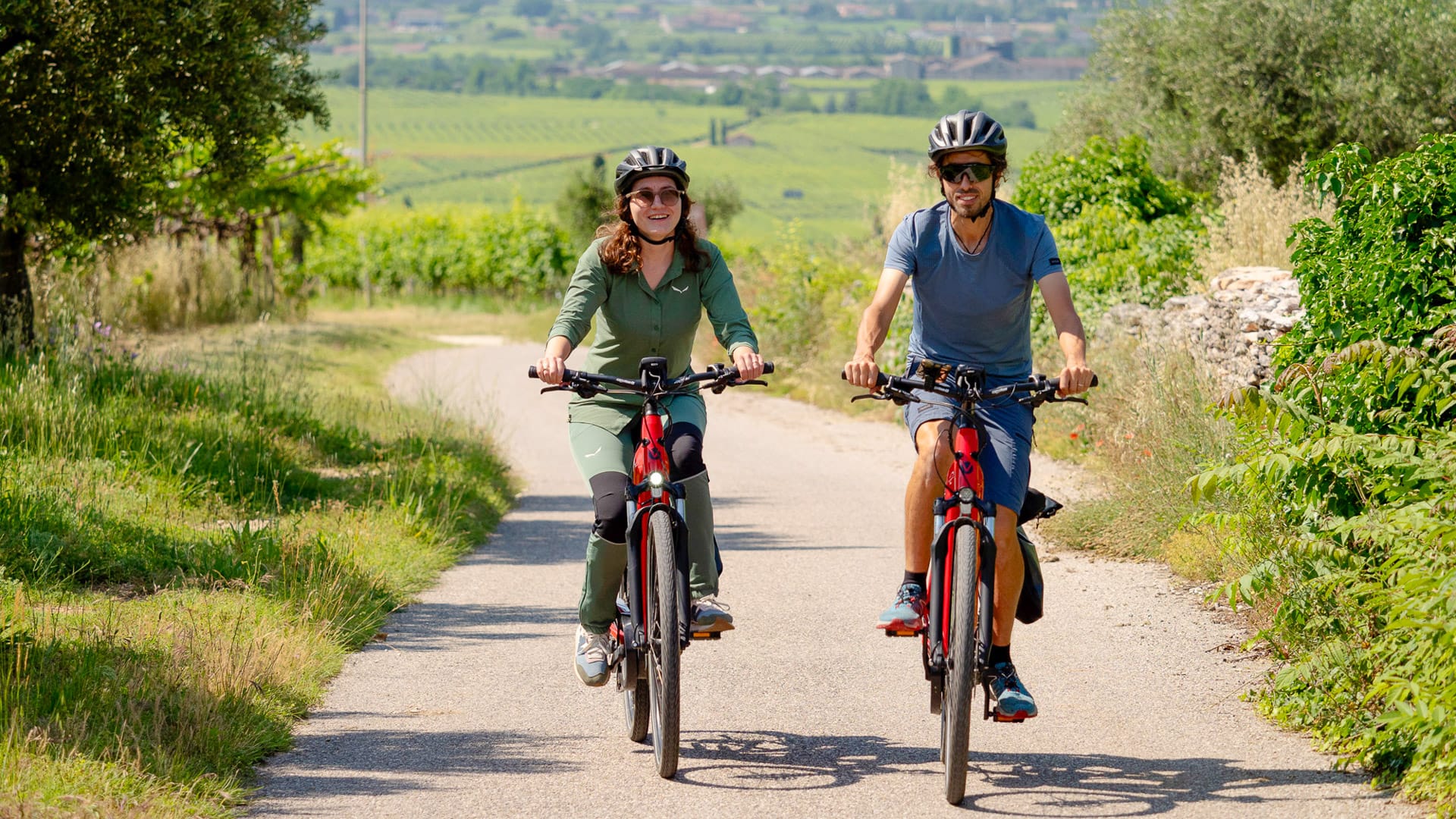
Tours to suit every cyclist
Cyclists can choose from self-guided day tours, private guided days, and custom day experiences for private groups and corporate experiences.
Planning a longer escape? Itinera Bike & Travel also offer self-guided multi-day tours or fully bespoke packages that include a tour leader, food & wine experiences, high-end hotels and more to match your style and budget. These are great options for cyclists looking for multi-day cycling tours in Northern Italy. Bestsellers include:
- Verona to Venice, self guided bike tour
- Strade Bianche: Garda, Valpolicella, Verona, self guided bike tour
- Garda Gravel Adventure, self guided bike tour
You can find out more here. Tours include:
- Accommodation in small selected hotels in city centres, with continental breakfast, air conditioning and wi-fi
- Well-studied safe routes in an app with easy navigation and nice information about the destination and food
- High-quality bikes and accessories: good disc brakes touring bikes, Bosch motor e-bikes, full carbon gravel bikes
- Luggage transfers
- Selected food and wine experiences: stops at local wineries and cafes to get the full taste of the region
Deep local expertise
From 2017, the team focused on tours starting in Verona and exploring north-east Italy for international travellers. They know the lanes, climbs and café stops because they ride them regularly, making it easy to design safe, scenic routes with a strong sense of place.
Quality bikes
On-the-ground support includes an in-house rental fleet of around 100 bikes: touring e-bikes, classic touring bikes and gravel bikes. Sizing, accessories and spares are handled on site, so you can travel light.
Award-winning wine experiences
As mentioned earlier in this article, Verona is a serious wine country and a number of our bike tours celebrate the locally produced vineyards and wines.
In 2025, Itinera was recognised by Great Wine Capitals for outstanding local wine tourism services, which include rides that weave in tastings and vineyard visits into your day (source).
Our bike tours with wine tastings include:
- Wine museum e-bike and wine
- Valpolicella classica e-bike and wine
- Soave valleys e-bike and wine
- Verona hills e-bike and picnic
- Amarone e-bike private guided tour
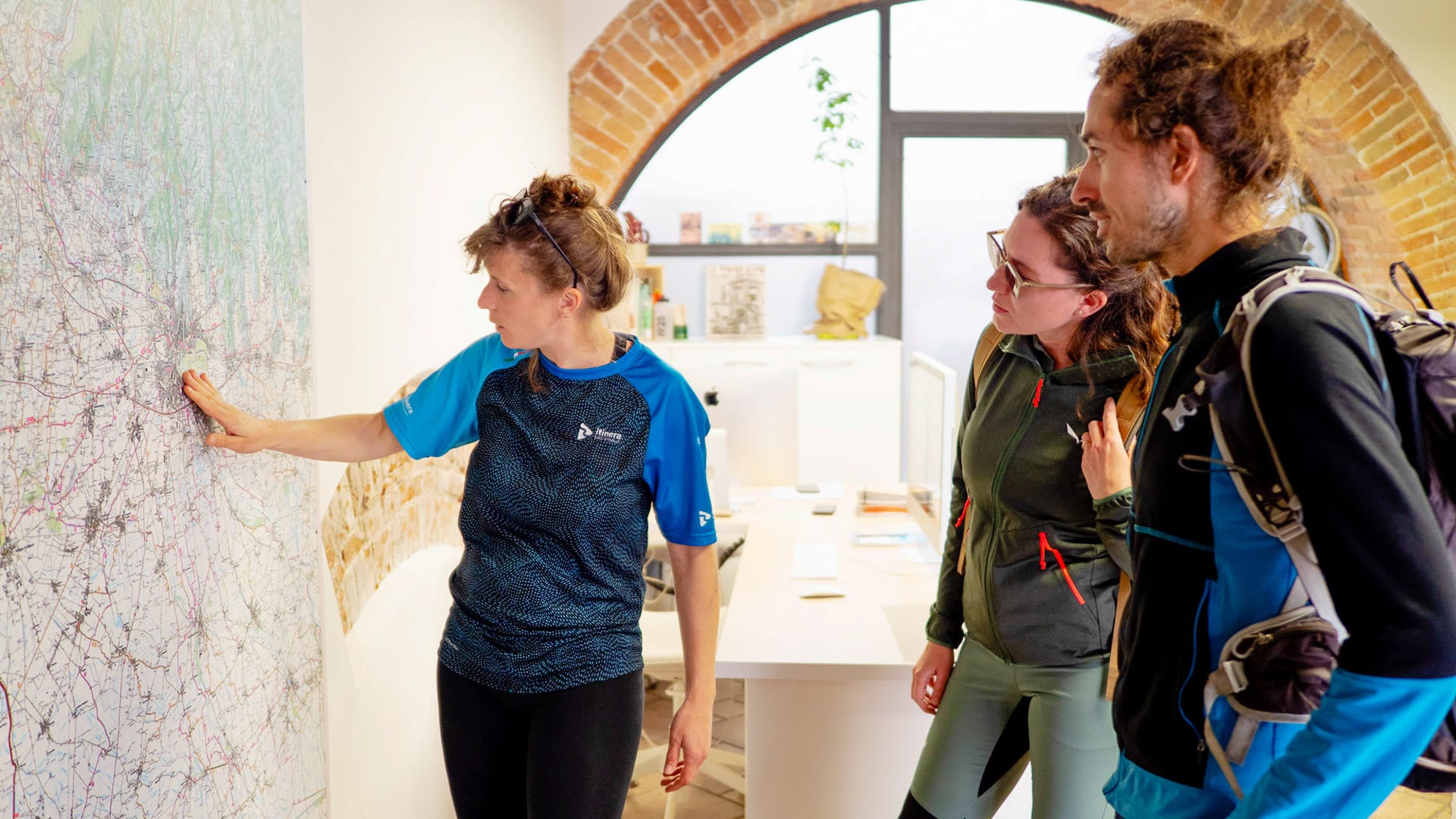
The Itinera Bike shop has large maps on the walls where we can talk you through suggested cycle routes (photo credit: Itinera Bike & Travel)
Where can you find out more about Itinera Bike & Travel’s services?
Head to the Itinera Bike & Travel website for further details about their services, including:
What’s next?
A huge thanks to Francesco for sharing these useful tips for cycling in Verona.
Have you been on a Verona bike tour? We’d love to hear from you! Let us know in the comments below.
Looking for more Italy cycling inspiration? Don’t miss:
- Cycling in Italy: best places to cycle, for a guide to the best regions
- Our pick of the best Italy bike hotels
- The Dolomites, for an in-depth guide to this mountainous Italian region.
- Italian Lakes, for an in-depth guide to this popular region
- Tuscany, for an in-depth guide to an Italian classic
- Sardinia, for an in-depth guide to an alluring Italian island
Got a question for Francesco?
Fill out this form and we will send it to Francesco. We aim to get you an answer within 24 hours where possible!First Published: 19 March 2026
This article includes details of products and/or services that we have used ourselves or which we would consider using. Some are paid features or include affiliate links or referral codes which we may earn commission from. As an Amazon Associate we earn from qualifying purchases. Please read our disclosure policy for further information.
The contents of this website are provided for general information purposes only. It is not intended to amount to advice and you should not rely on it. You should carry out your own due diligence and risk assessments and take professional advice. Views expressed by interviewees or other users of this website do not necessarily represent our views. We make no representations, warranties or guarantees, whether express or implied, that the content on our website is accurate, complete or up to date. If you use any information or content on this website, download from, or otherwise obtain content or services through our website, it is entirely at your own discretion and risk. Epic Road Rides Ltd disclaims all liability and responsibility arising from any reliance placed on the information and content on this website. Find out more here.
Sponsor Message
Looking for Verona bike tours?
Itinera Bike & Travel have operated Verona bike tours for well over a decade and knows the city extremely well! Today their services include bike hire of e-bikes, gravel bikes and touring bikes. Head to the Itinera Bike & Travel website for further details.
Exclusive discount
Claim 10% off* all Itinera Bike & Travel services, including their Verona bike tours and bike hire, when you book directly with them before 31 October 2026. *T&Cs apply.
The post Planning a bike tour in Japan: 14 things you need to know appeared first on Epic Road Rides.
]]>However, Japanese culture and food can feel very different to what you might be used to at home. This is a huge part of the charm, but it’s good to be prepared.
The key is not only route planning. It is understanding how to move through the country respectfully and with as little friction as possible. The more prepared you are, the easier it becomes to enjoy the riding, the food, the scenery and the sense of discovery that makes a bike trip here feel so memorable.
We visited Japan in March 2026. Here are my top tips to help you have an amazing time.
Want to find out where we rode and get the lowdown? Read the rest of our articles on cycling in Japan, including our in-depth destination guide, 6-day itinerary and guide to planning a bike tour on the Shimanami Kaido cycling route.
Always check current travel information and advice. For visitors from the UK, the UK government travel information pages are here.
1. Respect and quiet matter
One of the most useful things to understand before a cycling trip in Japan is the value placed on quiet. In practical terms, that means keeping noise to a minimum and showing patience around other road users. If you come up behind pedestrians, do not assume you should ring your bell to move them aside. It is usually better to slow down, wait for space and pass calmly when it feels natural.
This quieter, more patient approach tends to fit local expectations well, especially when riding on shared spaces such as a bike path, cultural sites or sacred trails.
This may feel odd if you are used to a more assertive cycling culture. In Japan, a calm approach often goes a long way. Riding quietly, speaking softly and avoiding unnecessary fuss usually makes everyday interactions feel easier.

Passing a traditional shrine on a quiet road between Nikko and Ashikaga
2. Think carefully about bringing your own bike
Many riders instinctively want to bring their own bike, and sometimes that will be the right choice. But in Japan, it is worth thinking through the practicalities before committing to that plan – how much riding will you do? Is it easier to hire? Will you be able to get decent bike hire?
Train travel can be one of the main sticking points. On the Tokaido, Sanyo and Kyushu Shinkansen, baggage measuring more than 160 centimetres in total dimensions and up to 250 centimetres requires a reserved seat with oversized baggage space. Anything above 250 centimetres is not allowed on board. That is a strong reason to think carefully before assuming a standard bike case will be easy to manage.
However, bikes can often be sent within Japan using delivery services, and many railway companies also allow bicycles on trains only if the front wheel is removed and the whole bike is placed in a special bag (more on that below).
For some riders, bringing their own bike will still be worth it, but in Japan it is not automatically the easiest solution.
If you’re joining a guided tour, check what bikes the tour operator provides. Many offer high-quality rental bikes, which can be a simpler option than bringing your own. On our bike trip with Rindo Bike Tour Japan, we used their high quality Specialized bikes (more details in this article). On the Shimanami Kaido, we hired from Giant (more details in this article).

Giant bike rental in Onomichi (conveniently located inside Hotel U2 complex, where we stayed)
3. If you do bring your own bike, learn about rinkō bags
If you decide to bring your bike to Japan, a very Japan-specific tip is to understand rinkō. This is the practice of partially dismantling your bike, putting it in a dedicated bag and carrying it as luggage on public transport. It can make train travel much more manageable if your itinerary mixes riding with rail travel.
In practical terms, a rinkō bag can be far easier than trying to wrestle a large bike box through stations, gates and platforms or work out the logistics of luggage transfer. It also fits much better with the way many Japanese rail operators expect bikes to be carried.
4. Pack light
I am terrible at packing light, but Japan definitely rewards a lighter approach to packing.
You’re likely to find yourself using bullet trains, staying in compact hotels or inns, and moving between places more often than expected. A smaller load makes station transfers easier, reduces the hassle of stairs and platforms, and leaves more room for the things you really need on the bike. Packing only your most essential, top-quality gear also helps keep things simple and reliable on the road.
We found that many hotels we stayed in had laundry facilities, which also helps reduce the amount of kit you need.

Lake stop near Mount Akagi
5. You won’t go hungry…
Japan’s convenience stores are especially useful for riders. 7-Eleven, Family Mart and Lawson are widespread. Many are open all day and night, and they sell a broad range of meals, snacks and drinks. You’ll find them regularly along most cycling routes. There might be a bit of guessing when it comes to precise flavours, but Google Translate will help you! We developed a particularly soft spot for the fluffy pork buns. They also have microwaves and hot water in the shops, so you can even get a hot meal; amazing.
Convenience stores such as 7-Eleven often provide access to international ATMs, which can be a real help when you need more cash in smaller towns.
Japan is also home to over 5 million vending machines (source). Even in the middle of the countryside, you find them dotted along the road side! We found these were mostly full of drinks rather than snacks, but they’re great if you run low on energy and need a quick, sugary, pick me up. Some machines even vend both hot and cold drinks from the same machine.

Snack stop on the Nikko Lake Chuzenji cycling loop
6. …unless perhaps you’re vegan!
Vegetarians and vegans are not brilliantly catered for in Japan as it’s not common amongst locals. The main issue is that fish broth (dashi) gets hidden in many sauces and soups.
In large, futuristic cities like Tokyo and Kyoto, you should be able to find plenty of foods, but cycling in rural areas will be trickier. Book ahead with hotels and make sure you have your translation app on hand to check ingredients.
The good news is that tofu is widely available, miso is in many dishes and rice and noodles are common bases for dishes. You’ll still get a strong sense of local flavour and food culture, even if choices are slightly limited.

Some of the food we ate in Ashikaga
7. Be ready to carry your rubbish
One small surprise was the lack of public bins. Japan has relatively few public rubbish bins, and travellers are often expected to carry their rubbish with them until they can dispose of it properly, whether that is at a hotel, a station or a suitable convenience store.
For riders, a small zip bag for wrappers, empty bottles or snack packaging can be surprisingly useful. It is a tiny thing, but it can make a day on the bike much tidier and easier.
8. Carry cash and bring a coin purse
Japan is famous for its technological strengths, but on the ground we found it still felt surprisingly cash focused. A considerable number of ATMs do not accept cards issued outside Japan, and we found that cash was essential for smaller businesses and everyday purchases.
It is also worth carrying coins, not just notes. Small payments come up often, and a simple coin purse makes vending machines, convenience stores and quick local purchases much easier to manage.

Inside the Watanabe sake brewery
9. Prepare for language barriers
In large cities and major tourist centres, you may find some English support. In particular, it was a relief to find that train station names are written using the English alphabet as well as Japanese characters.
In the countryside of the Kita-Kanto region, north of Tokyo, we found that barely anyone spoke English. But we didn’t find it was a monumental problem. It just means you should make sure you have mobile data so you can use Google Translate when needed. You could also try downloading useful phrases in advance – and it’s a good idea to save accommodation details, route notes and booking confirmations on your phone in case you don’t have data at a critical moment.
Body language helps too. A smile, a pause and a respectful tone can smooth over a surprising amount! If you prefer a smoother experience, riding with a local guide can make communication and logistics much easier (more on our experience with Rindo Bike Tour Japan, here).
10. Learn a few social basics
Japan’s social customs are intricate, but fortunately the Japanese are forgiving of foreigners. That said, there are some basics you should know and try and incorporate in your interactions.
For example, bowing is more common than handshakes, especially in more formal situations. Tipping is generally not expected, so there is usually no need to add extra for service.
You should also be ready to remove your shoes indoors in certain places. Traditional accommodation (including onsen ryokans), some restaurants and other indoor spaces may expect this.
You do not need to get every detail perfect, but a little awareness helps you fit in more naturally and keep locals and tourists on the same side.
11. Try an onsen
After a day on the bike, an onsen can feel like one of the highlights of a trip. We found the warm water, quiet atmosphere and sense of ritual was deeply relaxing, especially after a long ride. Experiencing natural hot spring baths is a key part of a bike tour in Japan.
It helps to know what to expect: onsen bathing is done without clothes and segregated into men and women’s onsens. When you visit an onsen, the usual routine is simple once you know what to expect. First, leave your shoes at the entrance if required, then head to the changing area and undress fully, as people normally bathe naked. Take only a small towel with you. Before getting into the water, wash yourself thoroughly at the shower stations using the stool, shower and soap provided. This part matters, as the baths are for soaking, not washing. Once you are clean, step into the bath quietly and relax. Keep your towel out of the water, speak softly and take your time. Afterwards, dry off a little before returning to the changing room so you do not drip everywhere.
Tattoos can be an issue, with some onsens asking guests to cover them and others reserving the right to refuse entry if tattoos are visible. Policies vary, so if you have a tattoo, it is worth checking ahead rather than assuming.

Traditional onsens are a big part of the experience
12. Know the rules of the road
Before you start riding, make sure you understand the basics of road behaviour in Japan.
The starting point is that you ride on the left. It is also worth learning the Japanese stop sign so it stands out immediately when you see it – and you do actually need to stop at these.
There are quite a few rules to know and do familiarise yourself with these – the police here do issue fines for non compliance (source).
In better news, we found drivers respectful and patient, and the overall road culture can feel considerate. Even so, it is still important to stay alert, especially in unfamiliar places.

Climb to Lake Chuzenji, near Nikko
13. Remote forest roads need extra care
If your cycling route includes remote rindō forest roads, expect a more variable surface and a less polished cycling experience. These roads can be wonderful to ride, with a real sense of getting away from it all, but they are not always neat or predictable. They don’t get lots of traffic and so don’t expect them to be swept or for the asphalt to be uniformly perfect.
Debris such as leaves, twigs and small branches can be common, especially after bad weather or in quieter areas. That does not mean you should avoid these roads. It just means you should approach them with the right expectations and stay cautious on descents.

Rindo roads aren’t always perfectly swept
14. Be a little more self-sufficient than usual
You’ll find a cycling trip in Japan will be easier if you are able to solve small problems yourself – and if you are heading into rural areas, basic bike mechanic skills are especially useful. At the very least, you should be comfortable fixing a puncture and making minor adjustments.
As with a trip anywhere, the key thing is to reduce reliance on bike shops when you may be far from one. In Japan the added nuance is that the language barrier is also likely to make technical help harder to access quickly. A little mechanical confidence brings more freedom and makes it easier to keep the trip moving.

Scenic loop ride in Ashikaga
Final thoughts
We loved bike touring in Japan. The roads, landscapes, food and local experiences can make even an ordinary day feel memorable.
The key is to arrive with the right expectations. Travel light. Carry cash and a few coins. Be ready for limited English. Learn the road basics. Ride patiently and quietly. Know how trains handle bikes and oversized baggage. Bring enough mechanical confidence to handle the simple things. Do that, and many parts of the trip become much easier.
Whether you’re riding the Shimanami Kaido, exploring the Japanese Alps, visiting Mount Fuji or planning a self guided cycling tour itinerary through Nikko National Park, preparation makes all the difference.
Want to read more about cycling in Japan?
Check out these Epic Road Rides guides to help plan your adventure:
- Cycling Japan, our central hub page for the country
- Self guided cycling tours in Japan: what you need to know before you book
- Planning a Shimanami Kaido bike tour, for tips on riding Japan’s Setouchi Sea region
- Shimanami Kaido cycling route FAQs, with answers to common questions before you ride
- Shimanami Kaido cycling route, for tips on riding Japan’s most famous cycling route
- 8 of the best cycling holiday destinations in the world 2026 for more inspiration
- Cycling holidays in Autumn, for the best places to cycle September + October
Let us know in the comments if you’ve got tips to add or questions about planning your Japan cycling holiday. Read on and plan your next cycling adventure!
The post Planning a bike tour in Japan: 14 things you need to know appeared first on Epic Road Rides.
]]>The post Shimanami Kaido cycle route: 37 FAQs (answered!) appeared first on Epic Road Rides.
]]>Riding the Shimanami Kaido independently also meant I got to see the route beyond the polished images, from the practical logistics and small decisions on the ground to the details that can make the ride feel either seamless or stressful.
In this article, I share the tips that felt most useful from my trip, based on first-hand experience of finally riding the Shimanami Kaido, a route I had long wanted to see for myself.
I hope you find this useful!
Always check current travel information and advice. For visitors from the UK, the UK government travel information pages are here.
Table of contents
This article contains a lot of useful information. To help make it more digestible, we’ve broken it down into several parts:
- Part 1: Getting started
- Part 2: The route explained
- Part 3: Level of challenge
- Part 4: Planning your trip
- Part 5: Bikes and support
Part 1: What do you need to know before planning your Shimanami Kaido ride?
Start here: introduction to cycling the Shimanami Kaido – for a really useful overview of what you need to know and to help you decide if the Shimanami Kaido is for you.
Then read: planning a Shimanami Kaido bike tour– for our itinerary and thoughts on a self-guided bike tour versus a guided tour
And finally: read the below! For in-depth FAQs to help you plan your tour once you’ve decided you want to ride it.
Part 2: What is the Shimanami Kaido route like?
1. What were your highlights of riding the Shimanami Kaido?
- There are lots of bike-friendly hotels on the route. We loved the places we stayed (though they were pretty eclectic!).
- Giant bike stores in Onomichi and Imabari provide high quality road and e-bike alternatives to the more easily available city bike experience.
- If you’re more relaxed about the quality of what you ride, there are plenty of bike hire options; there are 10 bike hire terminals between Imabari and Onomichi.
- Road quality was excellent, as were the purpose built facilities around the bridges.
- Scenery was often spectacular, with views across the Seto Inland Sea, and the industrial edge providing an interesting counterpoint.
- Sagawa luggage transfer is brilliant and makes a DIY multi-day journey doable.
2. Do you have a map of the Shimanami Kaido route?
See below! Also check out this map the authorities have created. And our Shimanami Kaido bike tour article contains a GPS file.
3. Is the Shimanami Kaido signposted?
Yes, there are signposts and also road markings.
4. Is the Shimanami Kaido cycle route a segregated bike path?
This confused me too! The answer? No. There are bike (and pedestrian and scooter) paths up, down and over the bridges, but in between, you’re on the road.
Some of the time, especially on the main route, there are separated bike paths, but some of the time and especially off the main route, there aren’t. However, on the main route there is the constant presence of the “blue line” and we found that the vast majority of the roads were incredibly low traffic. More details in our Shimanami Kaido bike tour article.

Bike path on Omishima Island
5. Is the Shimanami Kaido just for cyclists?
No, the Shimanami Kaido Expressway is for vehicles. The Shimanami Kaido paths on bridges are also used by motorcycles and pedestrians.
6. Is the Shimanami Kaido all on bike paths?
No! Other than on bridges and alongside very busy sections of road, the Shimanami Kaido is mostly on road rather than bike paths. We found the roads very low-traffic and calm to ride.
7. Is the Shimanami Kaido all asphalt?
Yes!

Cycling on Oshima Island in Japan on day two of our Shimanami Kaido trip (note no blue line – we were off the main route)
8. Which is the best route to take on the Shimanami Kaido?
When referring to the Shimanami Kaido, most people think of the main 80km route between Imabari and Onomichi. However, the Shimanami Kaido isn’t just one route. The main route is the famous one, but the authorities have also signposted other route options, including the Island Explorer route.
There are plenty of alternative routes for riding the Shimanami Kaido. It all comes down to how many days you have and how much of the islands you want to see.
We loved getting off the main route – more thoughts on that in our Shimanami Kaido bike tour article.

Close up photo of the Shimanami Kaido route map at Innoshima Bridge 1
9. Which way to ride the Shimanami Kaido? Onomichi to Imabari or Imabari to Onomichi?
Most people ride the Shimanami Kaido between Onomichi and Imabari, and either direction works well. Your choice will usually come down to your wider travel plans.
We rode from Onomichi to Imabari over two days on a quieter “Rindo Route”, then returned from Imabari to Onomichi on the main “blue line” route. This worked really well, as it gave us a mix of peaceful backroads and the classic Shimanami Kaido experience. More details on that in our Shimanami Kaido bike tour article.
If you’re concerned about things like wind direction and uphill slopes, people suggest it’s easier to start from Imabari City.

Ferry back to Onomichi
Part 3: How difficult is the Shimanami Kaido?
10. Is the Shimanami Kaido suitable for beginners?
Yes, I think the Shimanami Kaido is suitable for beginners, especially compared with many of the other bucket-list rides people talk about. The gradients are generally manageable, the route is well signposted, and there is a reassuring sense that the cycling infrastructure is built with cyclists in mind. That said, “beginner-friendly” does not mean effortless. It is still worth being comfortable riding for multiple hours, handling and navigating shared spaces with other cyclists and pedestrians. For riders who are new to cycle touring or longer days in the saddle, the Shimanami Kaido can be a great first big ride, particularly if you keep your daily distance realistic, start early and allow time to stop and enjoy the islands along the way.
11. What makes the Shimanami Kaido accessible for cyclists?
There are lots of things that make the Shimanami Kaido accessible. For example,
- The blue line on the main route makes it hard to get lost, even if you don’t have a GPS file/aren’t used to following one.
- The route is relatively flat and the approach to the bridges have been designed with gentle slopes to make getting onto the bridges easier.
- Bicycle rental is easy – there are lots of portions and some allow one-way bike trips.
12. Is there much climbing on the Shimanami Kaido?
The main route is relatively manageable, but it is not completely flat. You climb up to each bridge, though the bridge approaches are designed with gentle gradients. Detours and island explorer routes can be much hillier, so check your route carefully if you’re not confident with climbs.
Check out our Shimanami Kaido bike tour article for Shimanami Kaido route profiles and GPS files.

Steep climb near Tanoura (again, no blue line – this was on day 2 of our ride when we weren’t on the main route)
13. Can you ride to the observatories on the Shimanami Kaido?
Yes, but some are much harder than they look on the map. We’ve heard Kirosan Observatory on Oshima, for example, involves a steep climb. Be especially careful descending from observatories, and avoid doing these climbs close to sunset.
14. Can you ride the Shimanami Kaido with kids?
We rode the route with our 10 and 13 year old. While you’d want to adjust the distances depending on your children’s fitness and cycling experience, there’s lots to like here given the terrain is easygoing and there are lots of places to refuel on the way. The variety of inexpensive accommodation also makes it an appealing option for families on a budget.
15. Can you ride the Shimanami Kaido in one day?
Yes, I’m told a lot of people ride the Shimanami Kaido main route in one day.
There’s about 600 metres of elevation gain across the 78 kilometre route from Onomichi to Imabari, so it depends if you feel that’s feasible in one day.
If you aren’t confident with that distance, you can always just ride a section. Or turn it into a multi- day adventure like we did. There’s plenty of accommodation along the route or you can get a bus or a ferry ride part of the way. Or perhaps even a support van if you’re on a guided tour – or book with WAKKA Hotel – details below.
Check out our three-day itinerary here.
If you are hiring a bike, note the times you need to return the bike by to avoid extra charges. These were correct at the time of writing but check in case there are any seasonal differences or changes:
- Giant’s hours are 9am to 6pm.
- The regular bike hire terminals are as follows: Onomichi, Itoyama and Imabari – until 7pm and Mukaishima, Innoshima, Ikuchijima Island (both), Omishima, Hakata and Oshima – until 5pm

Quiet break beneath cherry blossom on Omishima Island
Part 4: How should you plan your Shimanami Kaido trip?
16. Do you need an organised tour to ride the Shimanami Kaido?
No you don’t and there are lots of cycling friendly services on the Shimanami Kaido that help make it possible to DIY – see below. However, I think the benefit of a tour would be:
- Hassle free – for example not having to book individual hotels or worry about food resupply and hitting restaurant opening times
- Get off the beaten track – the two days we spent following a BTJ route took us away from the busier Shimanami Kaido blue route allowing us to get a sense of the islands beyond the main route
- Get under the skin of the islands’ history and heritage – a guide will explain what you’re seeing and opens up the story of the destination which it’s hard to get otherwise.
You can find out more about BTJ’s Shimanami Kaido tours in this article.
17. Can you suggest an itinerary for the Shimanami Kaido?
Check out our Shimanami Kaido bike tour article.

Cycling through the Lemon Valley on Ikuchi Island
18. Are there any rules of the road you need to be aware of when riding the Shimanami Kaido?
Helmet use is strongly recommended in Japan. Since April 2023, the law requires all cyclists to make an “effort obligation” to wear a helmet, but it is not strictly mandatory for adults.
As for rules of the road, the Shimanami Kaido follows standard Japanese cycling laws, as it is made up of public roads. Key things to know include:
- You must ride on the left-hand side of the road, the same as cars
- Bicycles are treated as vehicles, so you must obey all traffic lights and road signs
- At large junctions, a two-stage right turn is required rather than turning directly across traffic
- Do not ride side-by-side or against traffic, especially on narrow bridge paths
- Give way to pedestrians on shared paths and ride carefully in these areas
- Using a mobile phone while riding is illegal
- Riding under the influence of alcohol is treated seriously and can result in heavy fines or penalties

Riding on the roads of Oshima Island (blue line – riding the main route on day 3)
19. What should you do if it rains on the Shimanami Kaido?
The usual rules apply; always come ready for rain. However, if you’re new to cycling, it’s worth having a wet weather plan. Wet roads, white lines, manholes and downhill bends can be slippery in rain, so if the forecast is poor, allow extra time, ride cautiously or consider using buses, ferries or sightseeing stops instead. Convenience stores usually sell simple raincoats, but we’d suggest bringing proper waterproofs if you’re planning a multi-day ride.

Rainy ride along Mukaishima Island’s south coast (day 1 of our trip – no blue line so you can tell we’re off the main route)
20. Is there luggage transfer on the Shimanami Kaido?
Yes! We used Sagwa (more details below), which was great.
WAKKA Hotel also offers luggage transfer, which might be a good option for groups. We stayed at the hotel but didn’t use this.
21. What do you need to know about using Sagwa luggage transfer on the Shimanami Kaido?
- Your bag needs to have a L+W+H of no more than roughly 160cm and it needs to weigh less than 30kg.
- When we travelled, it cost 2,200 yen per bag per transfer.
- Remember to book your Sagwa the night before!
22. Are there cycling friendly hotels on the Shimanami Kaido?
Yes, though some are not so accessible for international visitors as they don’t have websites and staff may not speak English. Here are the ones we stayed at and considered.
- Hotel Cycle u2: A stylish, higher-end option in Onomichi with secure bike storage, located in a converted warehouse with an on-site restaurant that makes a great end point to a multi-day ride.
- WAKKA Hotel: A modern, cyclist-focused hotel near the water with a range of accommodation options, plus a café with views of the bridge and organised activities to explore the islands.
- Cyclo No Ie hostel: A small, budget-friendly hostel in Imabari designed specifically for cyclists, with a social atmosphere, bike storage, tools and useful route information.

Inside Hotel Cycle U2, one of the bike-friendly hotels we stayed at on our trip
23. Are there food shops along the way?
The main “blue route” felt well provisioned and even off route, there are lots of towns and villages so if you’re riding on the coast you’re generally not far from a shop or restaurants. We did have one section when riding on day 2 where we were desperate to reprovision and had to ride about 8km more than we’d have liked. But that was more due to our bad planning than a lack of shops!
Also bear in mind that we found that lunch places usually have limited opening hours – roughly 12-2pm.
24. Can you buy water on the Shimanami Kaido?
Yes. It is not difficult to buy drinking water, with vending machines, convenience stores and shops on the islands. That said, it’s still worth topping up whenever you can, especially in summer or when leaving the main blue route.

Coffee and fruit shop on Omishima Island with local produce
25. Can you shower after riding the Shimanami Kaido?
Yes. There are showers, public baths and onsen around Imabari, Onomichi and some of the islands. This is particularly useful if you finish riding before catching a train or continuing your trip.
26. What are the best days of the week to ride the route?
On Tuesdays, lots of businesses in the area are closed – make dinner reservations well in advance.
27. When is the best time of year to ride the Shimanami Kaido?
Cyclists ride the Shimanami Kaido year-round, but it’s worth thinking carefully about weather and daylight. Spring and autumn are popular times to ride, while summer can be hot and humid and the rainy season can make conditions less pleasant. Winter can still be rideable, but you’ll want to check sunset times and dress for colder conditions.

Cycling past cherry blossom on Oshima Island (not on the main route)
28. How do you get to Imabari or Onomichi?
Both cities are connected to Japan’s fantastic train network. We were arriving from Kyoto and were going back to Tokyo, and found it absolutely straightforward to get the Shinkansen to Fukuyama and the regional train on from there (it’s about 20 minutes on the train between Fukuyama and Onomichi).

Imabari Cycle Station beside the train station
29. Can you get the bus back to your starting point?
Bikes are allowed on buses, but it’s worth noting that they need to be in a bag and if the storage trunk is full then you might not be allowed onboard.
A sign at Imabari station stated “You will need to take two buses to Onomichi. Take the highway bus to Fukayama and get off at the Innoshima Ohasi bus stop. Transfer to a bus bound for Onomichi Station at the Innoshima Ohasi bus stop.”
Note that you will need cash to pay the bus.
30. Can you get the ferry?
A ferry runs from Setoda port to Onomichi. If you just want to ride 30 kilometres or so then get the ferry back from Setoda. Note that the Lazuli ferry has a bike rack but the Citrus ferry doesn’t and bikes can get scratched when stored outside. If using the Citrus, ask the member of staff to store the bike inside.

LazuLi ferry travelling between islands in Japan
31. Are there any routes to ride once you’ve done the Shimanami Kaido?
Yes! We haven’t done them, but here are a few suggestions:
- Sazanami Kaido between Onomishi and Kure – around 85km
- Tobishima Kaido between Akinada Bridge and Okamurajima – around 31km
- Takanawa Road between Imabari and Matsuyama – around 48km
- Ishizuchi Kaido between Imabari and Kan-only – around 90km
- Yumeshima Kaido – connecting the islands of Kamijima – around 50km
32. What is the history of the Shimanami Kaido cycling route?
Opened in 1999 to much excitement, the Shimanami Kaido (also known as the Setouchi Shimanami-Kaido) went through roughly a decade of stagnation between 1999 and late 2000s (source). Annual public rental cycle users fell below 30,000 in 2005. Fortunately, three turning points moved the dial toward cycle tourism:
- Municipal mergers around 2005-2006 consolidated ten municipalities into just two cities (Imabari City and Onomichi City), making coordinated policy much easier.
- Grassroots civic movements emerged – model cycling courses were developed around 2005, the Shimanami Slow Cycling Council was established in 2008, and NPO Cyclo-Tourisme Shimanami was founded the following year.
- Governor Tokihiro Nakamura of Ehime Prefecture took office in 2010 and actively championed cycling culture , creating a dedicated government office for bicycle promotion and co-hosting the international “Cycling Shimanami” event with Hiroshima Prefecture.
In October 2014, the Shimanami Kaido signed a sister cycling road agreement with Taiwan’s Sun Moon Lake cycling course, and the first international cycling event was held. That same year, CNN named the Shimanami Kaido as one of the world’s seven greatest cycling routes. In 2019, Japan’s Ministry of Land, Infrastructure, Transport and Tourism designated it as one of the country’s first National Cycle Routes.
Today, more than 300,000 bicycles travel the cycling route annually, and nearly half of all riders are first-time cycling travellers.

Information board about the Shimanami Kaido cycling route
Part 5: What do you need to know about bike hire and support?
33. What type of bike do you need for the Shimanami Kaido?
Whatever you are comfortable riding for several hours is the best choice. The route is all on asphalt, so road bikes are absolutely fine. Hybrid bikes, e-bikes and city bikes are also common, especially if you are riding at a more relaxed pace. The main thing is to choose a bike that fits you well and feels comfortable for the distance you plan to ride.
34. Can you hire bikes on the Shimanami Kaido?
Yes, we hired from Giant in Onomichi City. They also have a large shop in Imabari City. What I liked about Giant is that I was able to reserve a bike in advance (note their booking opens 60 days in advance and at peak periods it’s a really good idea to book in advance as they often sell out quickly). I thought the bikes we hired were good quality and suitable for European sizing – for example I am 180cm tall.
There are other hire options, indeed I understand that the public bike rental system has 10 bike hire outlets along the route. I understand they offer cross bikes, mountain bikes, city bikes, e-assist and even tandem bikes. I am sure things will develop over time, but I’ve seen plenty of reports that you can only get smaller bike sizes from such outlets. Also be aware that you can only reserve here up to 4 days in advance.

Hire bikes from Giant
35. Can you bring your own bike to the Shimanami Kaido?
Yes, but if you’re taking your bike on Japanese public transport, it needs to be packed in a proper bike bag. There are bike assembly spaces at both Imabari Station (served by JR Imabari Station) and Onomichi Station (served by JR Onomichi Station), which is useful if you’re arriving with your own bike rather than hiring.
36. What if you only want to cycle one way on the Shimanami Kaido?
One way bike hire is possible, but make sure you leave yourself enough riding time to get back before the store closes.
37. Is support available if cyclist or bike break down?
WAKKA Hotel has some fantastic cyclist support services including bike taxis, including a van that can transport up to 5 bikes and five passengers. This is particularly useful for group travel.
If you hire your bike from Giant they show you the following sign when you hire “When you go to Imabari, be sure to make a bike rental reservation for at least two days and return it by yourself, or get a drop-off reservation. Even if you have no choice but to drop off the bicycle at Imabari, we cannot accept it because another reservation has already been made at Onomichi. In that case, an emergency collection fee of 55,000 yen will be charged.”
If you hire your bike from the main bike terminals (rather than Giant) you can return your bike at any of the 10 terminals without having to tell them in advance. If your bike has problem, you can replace it at one of the terminals.

Giant bike store in Imabari
Final thoughts
The Shimanami Kaido is one of those rides that looks simple on the surface, but has a lot of small details that can shape your experience.
From choosing which direction to ride, to deciding how many days you need, to understanding how bike hire, luggage transfer and transport options work, there are plenty of decisions to make along the way. None of them are complicated, but getting them right can make the difference between a smooth trip and a stressful one.
That’s really what this FAQ is about. It’s not just whether you can ride the Shimanami Kaido, but how to make the most of it.
If you’re thinking about riding it yourself, you’ll find more help in our other articles:
- Shimanami Kaido cycling route, for tips on riding Japan’s most famous cycling route
- Planning a bike tour in Japan, 14 things you need to know
- Planning a Shimanami Kaido bike tour (itinerary and tips)
- Cycling Japan, our central hub page for the country
- Cycling Japan with Rindo Bike Tour Japan 2026: 6-day itinerary + review
- Self guided cycling tours in Japan: what you need to know before you book
Hopefully, this gives you everything you need to start planning your own trip.
The post Shimanami Kaido cycle route: 37 FAQs (answered!) appeared first on Epic Road Rides.
]]>The post Cycling Japan with Rindo Bike Tour Japan 2026: 6-day itinerary + review appeared first on Epic Road Rides.
]]>That curiosity only intensified when I worked with Rob and the team at Rindo Bike Tour Japan (Rindo, for short) on our guide to cycling in Japan. The more I learned, the more the country sounded almost impossibly appealing: networks of pristinely maintained roads, bullet trains, beautiful landscapes, extraordinary food and a cycling experience unlike anywhere else.
But planning a bike tour of Japan for four people feels difficult when you don’t speak Japanese and you’re limited on time.
So when Rindo suggested a press trip, I didn’t need asking twice.
Rindo offer a very tailored approach to self-guided cycling tours; the trip they created for us was based on their Nikko, Kiryu and Akagi self-guided itinerary but tweaked to add in some cultural stops. Our group comprised four cyclists: two very strong riders and two less strong riders, all up for a challenge and experiencing authentic, rural Japan.
Here’s how we got on.
Always check current travel information and advice. For visitors from the UK, the UK government travel information pages are here.
Overview of our trip with Rindo Bike Tour Japan
Length: 6 days, 5 nights in March/April 2026
Location: Nikko region in the Kita Kanto area, including Nikko, Ashikaga, Kiryu, in Gunma and Tochigi Prefectures, a couple of hours train ride north of Tokyo.
Distance: 332 kilometres
Climbing: 5,241 metres
Format: Self-guided tour
Accommodation: We stayed in traditional ryokans; two nights in two of the ryokans, one night in the final one. Rindo have asked us not to share the names of these ryokans, as they are key to their business and increased visitor numbers would adversely affect their ability to use the accommodation for their guests. Honestly, I was a bit skeptical about this request before I visited. Having been, I totally understand their concern and my lips are sealed!
Guests: 2 adults, 2 children (10 and 13, both experienced youth race-level cyclists)
What did we love about our trip with Rindo?
Our trip with Rindo gave us the confidence and means to explore a little-known part of Japan, far from the tourists. It gave us a truly authentic insight into Japan. The way Rindo create their trips offers a bridge between visitors such as us and the real, raw Japan that most people don’t get to see.
When so much of tourism, even cycling tourism, feels superficial and involves carbon copy trips, this felt like a rare privilege.
Here are the things we loved the most about cycling with Rindo:
The riding
Riding no name singletrack, moss-centred roads, through still, calm forest with nothing but birdsong and the ever-present rushing of a Japanese mountain stream. This was not a city-to-city tour, this was a tour where we felt immersed in the Japanese countryside – and it’s very different to the depiction I saw in Lost in Translation all those years ago!
These routes also felt much more local and untouched than the coastal rides around the Setouchi Sea, where we passed fishing harbours, citrus orchards and crossed dramatic suspension bridges. More details on our Shimanami Kaido bike tour article.
Experiencing Japan
There were some special moments on this trip that will stick with us. They were the unexpected, quiet moments that you don’t plan for. They were the times we felt we experienced religion and culture in practice: alone in the orange pre-dusk light, in pine forests surrounding an ancient shrine; witnessing a Buddhist ceremony, complete with chanting and conch shells, on a random Monday afternoon by the roadside; taking part in the rituals of sakura season.
It feels to me that everything in Japan has meaning. A lot is sacred. It’s a deeply complex and intriguing culture with a highly intricate degree of tradition and custom, far removed from the futuristic cities and neon lights many people associate with the country. We saw and felt more of this during our six days than during the rest of the time we spent in cities and more touristy parts of the country. It was incredible.
Traditional accommodation
We loved the deeply traditional hotels we stayed at, places that we never would have found ourselves. Each one felt a million miles from corporate chain, and we loved the kind, smiling service, even if there was little in the way of conversation due to language barriers.
The highlight was our final night, where we stayed in a quiet, owner run ryokan with just seven rooms (we were the only guests). The ryokan was located way up a winding forest road, with pine forests blanketing the valley sides and drifting into magnolia, cherry and chysantha blossoms alongside a babbling waterfall.
We loved finishing a ride, with legs burning, heading to the onsen, soaking aching muscles in the thermal waters, then dressing in a comfy, traditional yukata gowns (supplied by the hotel) for dinner.
Authentic food
Each night, we were served kaiseki: a multi-course seasonal feast of small, beautifully composed dishes designed to celebrate freshness, balance and the time of year. There might be sashimi, grilled fish, delicate soups and other impeccably presented plates, each arriving like a small work of art. It was a memorable experience, though not an entirely gentle one for unfamiliar palates; some of the flavours were unlike anything we had tasted before. Black soybean natto or pickled and spicy cod roe anyone?
Breakfast was cut from the same cloth. Sashimi and smoked fish are not what we would normally choose to start the day. It took a little while for us to adjust, but it certainly felt like an authentic introduction to Japanese food culture.
Meeting Japanese people
From the formal kaiseki dinners to the simple lunches in humble udon shops, from helpful servers in 7-Eleven stores to the group of grandmothers we met near Mt Agaki, the trip allowed us to meet people in a way you often don’t when travelling in a larger group or without a bike.
Despite the language barriers, I felt a warmth and kindness from people we met, who seemed intrigued to find a group of four lycra clad tourists in their village and keen to help. The sense of mutual interest and respect felt palpable.
Great bikes
The bikes Rindo provided us were all in excellent condition: two Specialized Vado e- road bikes and two Specialized Aethos regular road bikes. They came set up with Wahoo ELMNT ROAM bike computers and a nice-looking bike bag, plus the usual puncture repair kit you’d expect. A branded cycling jersey and buff (of a quality you’d actually want to wear again at home!) was also a nice touch.
Excellent support
I’d also say that the self-guided tour format offered by Rindo provided a level of service I haven’t experienced before with a self-guided format: the team met us at the train station, took time and care on our bike set up and were ever-present on the WhatsApp group. They checked in with us regularly and offered transfers on the odd day we encountered heavy rain. They were also on hand for questions, from route related questions to restaurant recommendations and reservations. When we had the odd bike issue like a shifter issue we couldn’t fix, they were swift to assist.
This level of service goes far beyond the kind of self-guided support I’ve experienced previously. It’s fair to say that kind of experience comes with a price tag, but credit goes to the RIndo Bike Tour Japan for executing their service so well.
Cherry blossom
Sakura season is undeniably beautiful, but it can also be unpredictable. The bloom shifts from year to year, so even a carefully timed visit can miss the moment. You’re also not guaranteed sunshine and warm temperatures at this time of year.
Had we not been tied to the school holidays, I might have been tempted to choose a slightly quieter time to visit – partly for the flight prices, but also to avoid some of the cherry-blossom chasing crowds we encountered in places like Kyoto and Tokyo.
In many ways, later spring appeals just as much: milder temperatures, fewer people and landscapes newly vivid with fresh green growth. Equally, I can imagine autumn being a magnificent time to ride, with the wooded rindo roads glowing in rich shades of red, gold and amber.

At the G7 Nikko sign at Lake Chuzenji
Is a self-guided bike tour with Rindo for you?
It’s worth asking yourself this question, because in truth, this kind of trip is not for everyone.
- You need to be happy navigating using a GPS device.
- The vast majority of people you’ll meet won’t speak English. This means you need to be confident relying on Google Translate (and energetic pointing/body language) if you don’t speak Japanese.
- Rindo set you up on your bike on day 1 and are there if you need them, but make sure you’re happy fixing a flat tyre, or make minor adjustments such as to saddle height, since you don’t have anyone riding with you.
- Rindo offer a wonderful range of rides for each day of your route, and will happily suggest the best route to pick, based on your riding level and interests. Just don’t over-estimate how demanding you want your ride to be that day, as you’ll be riding unsupported (though of course the team is there in case of breakdown).
- We didn’t see many bike paths in the Kita Kanto region, but nearly all the roads we were on were low traffic, or with a decent hard shoulder.
- If you stay in a ryokan that provides breakfast and dinner, you need to be prepared to try food you’re unlikely to have eaten before. Western options aren’t available and you’ll be eating a set menu. For us, this was a big part of what made the trip special, but if you aren’t willing to embrace the traditional Japanese cuisine, you will miss out on part of the experience.
- More generally, staying in these traditional ryokans requires a level of respect for local customs. Japanese people prize calm and quiet and the rules of the onsen are taken seriously. If you don’t want to flex to the local way of doing things, there may be better places to stay.
- Be aware that a bike tour in rural Japan can be tricky if you are a strict vegetarian (let alone a vegan!). I am a pescatarian and Rindo did a great job of making arrangements ahead of time. Dietary restrictions are an area it could definitely be difficult to navigate in Japan without this kind of support!
Compare guided versus self guided with Rindo
Guided
I haven’t experienced one of Rindo’s guided bike tours, but I’ve worked with Rob, the founder of the company for many years and I am confident that if any of the things above are concerns, most would be solved by opting for one of Rindo’s guided trip.
On these, you’ll always have someone on hand to assist, guide and explain. Organised food stops will mean you don’t need to rely on Google Translate so much and a travelling mechanic will mean there’s no concern if you have issues with the bike.
Self-guided
For us self-guided worked brilliantly because we were riding as a family unit, we are pretty experienced and like to go at our own pace.
Rindo’s version of self-guided also offered an unusually high level of support that might not be necessary in countries that are more accessible, but works really well in Japan. Being met from the train, being offered cultural stops and transfers for riders and bikes when the rain poured down, was perfect for us.
For me one of the downsides of a self-guided trip can be that you don’t get much feeling for the culture and authentic customs of a place; these things tend to pass over you. So it’s unusual that this wasn’t the case on Rindo’s trip. I think this was for a few reasons:
- their GPS routes are very helpful at including great suggestions for places to stop and eat;
- the premium ryokan experience allowed us to try out the onsens and the kaiseki menus pushed our food boundaries in a way we wouldn’t have experienced if left to our own devices; and
- Rindo are happy to incorporate cultural stops into their self-guided itineraries – you can find a list on this page of their website (i.e. these weren’t a “special exception” they offered us).
Yes, it was a self-guided trip but it incorporated many of the advantages of a guided trip that let us really experience Japan.
Our itinerary with Rindo
As mentioned, Rindo pride themselves on tailoring their trips to their clients. They also have a fantastic library of cycling routes available. This means that even once you’ve picked an itinerary, there are multiple route choices available each day so even if the weather doesn’t play ball or someone isn’t feeling up for the ride you selected at home, you’ll have options.
Here are the cycling routes we rode to give you a sample. Note that the routes don’t start and finish at the hotels we stayed at.
Day 1: Nikko loop
Warm up ride, punctuated by tall cedar trees and quiet shrines
Distance: 35.6 kilometres
Elevation gain: 563 metres
GPX DownloadTerms of use reminder
Route notes
We weren’t able to arrive in Nikko until mid afternoon, but we were met at the station by Elena from Rindo. She took us to the hotel and got us set up on our bikes, ably supported by her team mate, Taka.
We headed out on our bikes; this is a nice warm up ride, that took us south down to Nikko, looping through agricultural land and forest, past homes and peaceful shrines where we were the only visitors.
A short off-road section saw us cycling along the Nikko Kaido Cedar Avenue, registered by Guinness World Records as the world’s longest avenue of trees. More than 50,000 trees were planted, of which around 12,000 remain, over a period of 20 years starting in 1625. Cedar trees were chosen due to the ancient belief that the gods descend from the heavens down to earth through this species of tree. It was lovely to ride through, but we found the fallen pine needles and leaves had made the road a little too boggy for road bikes; the road was always there to bail out onto.
We crossed the Daiya River and then headed north again up a relatively busy road (but with decent hard shoulder) before turning off and escaping onto tiny single track rindo roads that weaved through dense forest, never far from the sound of tinkling water.
Tips
- The rindo roads are typically covered by a canopy of trees; this means they don’t get tons of sun and, even when it’s not riding, can be damp and strewn with tree debris. Care is needed on the winding descents.
- The Watanabe Sake Brewery is close to the route. I love a bit of history and culture on a bike trip, and I loved the short tour Rindo booked us with Mr Watanabe, the 7th generation owner of Watanabe Sake Brewery. A jovial soul, he shared his passion for the history of sake as well as the process of making it.
- Nikko is popular with day trippers from Tokyo, and this means that you won’t have it to yourself especially at busy times like cherry blossom season. Book your train a few weeks in advance especially if you want to arrive in the morning or at weekends.
Day 2: Lake Chuzenji loop
A day of climbing, descending and spectacular views
Distance: 55.4 kilometres
Elevation gain: 1,020 metres
GPX DownloadTerms of use reminder
Route notes
The climbing begins almost immediately; this route is in essence a long climb, followed by a tour around the lake, followed by a long descent.
The ride takes you out through villages and fields to the Irohazaka climb, an iconic series of switchbacks that leads you into the highlands.
The wonderful thing about this climb is that both the road up and the road down are one way but spread over two lanes. This means that there’s plenty of room for cars to pass cyclists with lots of room.
Lake Chuzenji is a dramatic spot within Nikko National Park, surrounded by towering mountains. It’s no surprise it’s a popular local attraction and a gaggle of little shops and local restaurants gather around the lakeside.
From the lake, you can decide whether to descend back home or keep riding.
To the observatory
We opted to head on up the switchbacks on a singletrack road, to Lake Chuzenji Observation Deck, where we enjoyed a gobsmacker of a view down over Lake Chuzenji and towards Mt Nantai.
Note: this isn’t marked on the GPS route above, but it’s easy to find, just take a look at the wiggly road to the southeast of Lake Chuzenji.
To the Ryuzu Falls
Back at the lake, you continue around the lakeside, through forest and past grand old homes built between 1870 and 1940 for ambassadors and dignitaries. Then it’s up a few switchbacks to the Ryuzu Falls. You come to the car park for the Falls first, but if you ignore that and continue to the road bridge, you find two distinct views of the Ryuzu Falls – to the north is a narrow valley with white water frothing down it; to the south are more gently cascading falls.
To Lake Yu
We turned around at the Ryuzu Falls, but if you’ve got more juice in your legs, continue on to the Yutak Falls observation deck for the 70m high Yudaki Cascades waterfall.
Tips
- Lake Chuzenji sits at around 1,300 metres above sea level and the observatory sits at around 1,800 metres, so it can get pretty cold. Dress accordingly.
- Note there is quite a long tunnel on the way up the climb. It’s lit but remember to switch on your lights!
- While in Nikko, you can’t miss the UNESCO-listed Toshogu Shrine complex, famous for its ornate carvings, rich history, and surrounding cedar forest. Take your time wandering through the intricate gates, halls, and moss-covered stone paths. We stumbled upon a prayer ceremony inside one of the pavilions, led by a priest whose chanting cut through the quiet morning with startling force. Rhythmic, powerful and deeply controlled, it gave the ritual an energy that felt urgent rather than serene. It felt like a small window into a living tradition continuing on its own terms.
Day 3: Nikko to (near) Ashikaga
A day of wide valley roads and steep, narrow forested climbs that take you from the highlands of Nikko down to Ashikaga. The Furumine Shrine is a highlight.
Distance: 96 kilometres
Elevation gain: 1,203 metres
GPX DownloadTerms of use reminder
Route notes
Nikko to Furumine Shrine
From Nikko, the route heads broadly downhill, though not without enough short, sharp ramps to keep you on your toes, as it winds deep into the Mae-Nikko Forest. It is a peaceful, rural-feeling ride, with long sections of forest and others tracing waterways through quiet countryside.
The day’s principal climb is the 8.4-kilometre ascent to Furumine Shrine. At an average gradient of around 4.5%, it is steady rather than ridiculous, although the steeper sections near the top verge on brutal.
The Shrine is known for its many tengu, long-nosed guardian figures believed to protect visitors. The Shrine has a deeply calm, authentically Japanese, ritual-like atmosphere. When we visited, there were barely any other people there, which only heightened the sense of tranquillity. There is also a water garden to explore, though it was closed during our visit. A few shops and vending machines just outside the Shrine make this a sensible place to stop for lunch.
Furumine Shrine to Ashikaga
We chose not to eat at the Furumine Shrine, which turned out to be slightly optimistic. Not long afterwards, we found ourselves diverting off-route, to Kamihinata in search of food. We settled on one of the local convenience stores, 7-Eleven, with the added bonus of excellent custard-filled choux buns from Hana patisserie (worth a stop if you pass!).
Back on the route, a short tunnel led us onto narrow forest roads, where startled deer scattered into the trees and the climbing resumed in earnest. For some distance, the road skirted a vast mine below. Then, just as we neared the top of the climb, an air-raid-like siren sounded, followed by an explosion that shook the ground beneath us. It was a somewhat startling reminder that this is a very active working landscape.
Tips
- The tunnel on this route was lit, but be aware that when riding in tunnels, vehicles can sound quite intimidating. Remember to remove your sunglasses and take lights!
- Plan your lunch stop carefully; there’s a lot of rural riding on this route and while you’ll find vending machines, have a careful think about where to eat.
Day 4: Ashikaga loop
Quiet forest roads and a dose of culture and history in Ashikaga
Distance: 64 kilometres
Elevation gain: 487 metres
GPX DownloadTerms of use reminder
Route notes
The ride began with a steady climb through the outskirts of Ashikaga. After leaving Route 201, we pedalled through small villages on smooth roads that climbed gradually north up the valley, before turning onto a narrow forest road that rose in a series of hairpins for the day’s main ascent. At the top, a short lit tunnel led us through to the descent: more sweeping hairpins on a broader road, this time dropping us back down the hillside towards Ashikaga.
Lunch was at Mahler’s Parlor, where a compact four-dish menu still managed to include a pasta option.
With the weather worsening, we cut the ride short and took up Rindo’s alternative sightseeing tour of Ashikaga instead. Rindo guides, Kate and Masashi, showed us around Bannaji Temple, a beautiful Buddhist temple built by Minamoto no Yoshiyasu, a powerful samurai and first generation of the Ashikaga family, from the 1100s onwards. We also took in Ashikaga Gakkō, widely regarded as Japan’s oldest school; and Orihime Shrine, a striking vermilion-lacquered shrine dedicated to the god of love. We capped the cultural extravaganza off with the excellent Ashikaga Flower Park, famed for its wisteria displays in April and May, but also a joy in cherry blossom season.
It was a pleasure to explore the city in the company of two thoughtful and generous Ashikaga locals, and to hear more about the history and ancient cultures of this under-touristed city.
Day 5: Ashikaga to Lake Umeda
Deep valleys, rushing rivers and narrow forest roads, plus a silk museum
Distance: 39.5 kilometres
Elevation gain: 670 metres
GPX DownloadTerms of use reminder
Route notes
Ashikaga to Kiryu
With three main climbs to tackle, there was a certain sense of foreboding from the outset – heightened, briefly, by an earthquake alert that flashed up on our phones. The locals seemed entirely unfazed, so we carried on riding and, in the end, felt nothing at all. It turned out the earthquake was far to the east.
After a final push through the forest, the road tipped down towards Kiryu.
Kiryu highlights
In Kiryu, we spent time at the Yukari Silk Museum, one of the day’s highlights, learning about the city’s long association with silk production. We loved the way the museum charts the evolution of the machinery, and even better, visitors can try some of the machines for themselves. Who knew that a single silkworm cocoon can yield more than 900 metres of thread?!
Lunch was at Garment District, where we were treated to an excellent western-style meal, complete with truly memorable pancakes and French toast – a welcome change for anyone beginning to crave a break from raw fish.
Kiryu to Lake Umeda
By the time we emerged, the rain was hammering down, and Rindo came to the rescue with the offer of a transfer up the valley to our hotel. This is not the kind of flexibility you would necessarily expect from a standard self-guided tour operator, but it says a great deal about the level of care that Rindo brings to the experience.
Tip
The road from Kiryu along Lake Umeda, and the river flowing into it, was so pretty. It would have been an idyllic, winding ride through the forest alongside the river with its moss-clad boulders, white water and, at the time we were there, clumps of bright yellow chysantha blossoms. Beyond the ryokan, the road continues and with hardly any traffic, so there would be scope to continue on for those with the energy.
Day 6: Mt Akagi
A testing climb up Mt Akagi, with caldera views and an incredible descent
Distance: 41.8 kilometres
Elevation gain: 1,298 metres
GPX DownloadTerms of use reminder
Route notes
Mt Akagi wasn’t on the door step of our hotel near Lake Umeda, but we were keen to ride this prized climb, so Rindo transferred us over to the start.
Miyosawa Akagi Shrine to summit
We left the stillness of Akagi Miyozawa Shrine, an atmospheric, pine-lined shrine at the foot of Mount Akagi, known for its sixteenth-century wooden gate and ancient cedar, and headed onto Route 16: an old, winding single-track road that climbed into dense forest.
This road is one for the mountain goats: a 13 kilometre squiggling line, with no less than 100 switchbacks to the summit! At around 11 kilometres, the road levels out into a section of false flat and a short descent before a final kick up to the summit of the Haccho Pass at over 1,500m above sea level. From Torii Pass, the views are spectacular, with the land dropping away in sweeping folds towards the Kanto Plain below.
A little further on, the road reaches Lake Onuma, the main caldera lake of Mt Akagi, where a small cluster of weather-beaten buildings sits by the shore. The eye is drawn immediately to the vermilion bridge leading across to Akagi Shrine on Kotorigajima, its bright red lacquer standing out vividly against the dark blue water and the forested slopes beyond.
The descent
The main descent is an incredible 15 kilometres long! We found the asphalt was great quality and there was barely a car on the road. There are some bumps designed to slow cars down but fortunately the way they are designed means they are barely noticeable on a bike. Be aware – you can build up some serious speed!
Even after you turn right off the main climb, the descent keeps going – barring a few small kick ups, you’re descending through farms (which you often smell before you see!) and agricultural properties all the way into Kiryu. The views are spectacular and you also get glimpses of the behemoth you’ve just ridden as it dominates the skyline.
We finished the ride at Cafe 1203; run by their club sandwiches, espresso and homemade ginger ale provided the perfect finish to a great ride.
Our final stop was the station, just five minutes away by car, and the train to Tokyo.
Tips
- It’s best to ride this loop the way we did it. Descending the well-maintained two lane road is a lot more fun than trying to descend the narrow climb we rode up.
- Cyclists from around Japan know of Mount Akagi for the Annual Hill Climb Race held each September up the main Route 4 road.
- The morning started cold and grey for us; we couldn’t see the summit and the top was significantly cold and windswept. Wrap up warm and pack good quality gloves; they are essential for the descent.
Final thoughts
Can you ride in Japan without support? Of course!
But would you have as good as an experience? I think it’s unlikely.
Yes, a tour frees you from logistical hassle, gives you route confidence and back up, but the real joy of the Rindo tour was the perspective it gave us on Japan, the experiences and the memories we wouldn’t otherwise have found or gathered. It was the tiny rindo roads snaking up a forgotten hillside, it was the cosy ryokans, the steaming onsens, the little stops at Buddhist shrines and udon shops. It was the insights into Japan that delighted, fascinated and intrigued.
So would I like to ride in Japan again? Yes please!
And would I recommend Rindo to a friend? I certainly would.
Find out more about Rindo Bike Tour Japan’s trips on their website.
Convinced you to ride in Japan? Here are some more articles and guides that will help you!
- Cycling Japan, our central hub page for the country
- Self guided cycling tours in Japan: what you need to know before you book
- Planning a bike tour in Japan, 14 thing you need to know
- Shimanami Kaido cycling route, for tips on riding Japan’s most famous cycling route
- Shimanami Kaido cycling route FAQs, with answers to common questions before you ride (coming soon!)
- Shimanami Kaido cycling route, for tips on riding Japan’s most famous cycling route
- 8 of the best cycling holiday destinations in the world 2026 for more inspiration
- Cycling holidays in Autumn: the best places to cycle September + October
The post Cycling Japan with Rindo Bike Tour Japan 2026: 6-day itinerary + review appeared first on Epic Road Rides.
]]>The post Planning a Shimanami Kaido bike tour: our 3 day itinerary (and firsthand tips) appeared first on Epic Road Rides.
]]>Why?
For me, the spectacular Seto Inland sea setting is alluring, the juxtaposition of heavy industry (shipbuilding) and beautiful island scenery is intriguing and the incredible infrastructure the Shimanami Kaido route offers reduces the overwhelm of organising your own bike tour in Japan.
In this article I share my experience of our three day Shimanami Kaido bike tour in 2026. I was with my husband and children aged 10 and 13 (both experienced cyclists). We organised it ourselves, but with help from Rindo Bike Tour Japan, who supplied the route. Big shout out to them for this, as the best parts of our tour were on their cycling route rather than the official route (and yes, GPS files are below!).
Here’s the in-depth take on our Shimanami Kaido tour, including itinerary and tips, to help you plan your own.
Looking for info on the practicalities of planning a cycling trip on the Shimanami Kaido? Read this: introduction article on planning a cycling holiday on the Shimanami Kaido and our Shimanami Kaido Cycling FAQs.
Always check current travel information and advice. For visitors from the UK, the UK government travel information pages are here.
The Shimanami Kaido cycle route
The main Shimanami Kaido route
The main Shimanami Kaido “blue route” is 76 kilometres long. It connects six islands, via six bridges, on the Seto Inland Sea, between Onomichi station (served by JR Onomichi Station) in Hiroshima Prefecture and Imabari station (served by JR Imabari Station) in Ehime Prefecture.
What to expect from a Shimanami Kaido bike tour
A few introductory points:
- The Shimanami Kaido is a well organised route. The signposting and cycling services around it are impressive, which simplifies organising a bike tour on the Shimanami Kaido. Just be aware that sticking to the Blue Route won’t necessarily let you see the most beautiful areas; consider investigating the “Island Explorer” routes marked by the authorities or speak to a tour operator if you want support in getting to the quieter, less-visited areas of the Seto Inland Sea.
- The Shimanami Kaido is pretty do-able, it’s relatively flat and while it might be 80 kilometres on the quickest route, you can easily break this up into sections.
- Is the Shimanami Kaido beautiful? As ever, it depends on your definition of beauty! Don’t come expecting classic, palm-fringed island vibes: you’re riding by the water for much of the time, but there aren’t many sun loungers and sandy beaches. Yes, you can find these, but it’s a much more “real” aesthetic. The region’s ship building heritage means that the islands are peppered with vast shipyards and tankers dot the horizon, not yachts. A Shimanami Kaido bike tour gives you a sense of the real Japan.
How we created our 3-day Shimanami Kaido bike tour itinerary
The conundrum
Our dilemma was this: I was in Japan with my husband and two children aged 10 and 13 (but experienced cyclists). We had three days to ride. We wanted to ride the Shimanami Kaido main route but also experience the islands’ quieter side all within 60-80km each day.
The solution
Our friends at Rindo Bike Tour Japan (“Rindo”) came to the rescue and proposed the following itinerary:
- ride two days Onomichi City to Imabari City on their route (we’ll refer to this as the “Rindo Route”) and
- one day back on the main route (we’ll refer to this as the “Blue Route” since it’s marked by blue signposting and a blue line).
This would give us a taster of the kind of riding Rindo incorporate on their eight day tour itinerary on and around the Shimanami Kaido route.
While their Shimanami Kaido tour (more on that below) sits at around 375 kilometres and takes in many more of the smaller islands off the Blue Route, this sample would let us see a little of what you get if you venture off the Blue Route.
Rindo Route versus the Blue Route
We really enjoyed both the Rindo Route and Blue Route, but spotted significant differences between the two.
- The Blue Route gives you “bang for buck” – it takes you over all six islands in a do-able 80 kilometres-ish of relatively flat riding. It’s doable in one day for many people.
- All the islands (but particularly while on the official route) seem to have embraced cycling tourism, with bike-friendly cafes, restaurants, and I think we counted eight bike service stations along the Blue Route (not including Imabari and Onomichi). There are also ferries along the Blue Route so that you can just ride part of the route and get a ferry back. More detail on that below.
- The downside of the Blue Route is that it felt like we were riding on busier roads for quite a bit of the time. There was typically a hard shoulder or bike lane to ride in, but it wasn’t overly relaxing especially through the towns.
- In comparison, the Rindo Route wound through tiny towns and villages on very quiet roads for most of the time. There were some incredible moments of natural beauty juxtaposed with plenty of memorable moments, such as when we turned a corner and it felt like we were about to ride into the mouth of a giant shipbuilding yard.
- We would have loved a little more time to experience the islands you need to get a ferry to, but which Rindo visit on their tour, such as Mt Sekizen Park on Iwagi Island, which is apparently a riot of colour with 3,000 cherry blossom trees in spring.

Bike path on Omishima Island
DIY Shimanami Kaido bike tour versus guided Shimanami Kaido bike tour
Even though the islands have embraced cycling tourism, there is still a lot to think about when organising a cycling holiday yourself. Especially in Japan, where English is not widely spoken. Booking the hotels, bike rentals, luggage transfer and thinking about food takes up quite a lot of energy and advance planning. Not everyone has the time or inclination for that.
The Rindo Route was really very quiet, with noticeably less in the way of support for cyclists or tourists generally. My takeaway? If you want to head off the Blue Route, make sure you’re confident being self-sufficient or opt for a guided tour.
We didn’t visit some of the cultural stops I later found out about because we rode right past them! I could have avoided this by doing a bit more planning in advance, but it was a reminder of the difference between DIY and having someone look after you.
There are also the things you can’t plan for like the weather. For example, on the first day it rained heavily all day. Luckily our kids are used to riding in miserable weather in the UK and we were properly dressed, but the advantage of being on a guide tour would have been that we could have chosen to hop into the support vehicle at some stage if we had wanted!
And then there are the easy mistakes to make. Like the fact I woke up at 4am on the final day with the cold realisation that I hadn’t booked our bags on to the luggage transfer for that day. Would I be able to get them on despite that? Would our whole trip be ruined as a result?! It all worked out, but these are the kinds of stresses you deal with when going DIY.

Checking route map at Hakata Bridge
Rindo’s guided Shimanami Kaido bike tour
In case you’re interested in what a guided tour could look like, Rindo offer an eight-day guided, fully supported cycling tour through Japan’s Setouchi Sea region, starting and ending in Onomichi. The main draw is riding the famous Shimanami Kaido, plus quieter island routes such as the Tobishima Kaido, with a mix of coastal roads, bridges, ferries, temples, Buddhist shrines, onsens and ryokan stays. The tour includes:
- a fully serviced road bike or hybrid bike, helmet and accessories
- all accommodation in premium ryokan hotels, with Japanese futon beds, kaiseki-style meals, hot-spring onsen baths and some extraordinary views
- all meals including snack and hydration stops on ride days
- cultural stops such as Senkoji Temple, Oyamazumi Shrine, Sankoji/Kosanji Temple complex
- luggage delivery
- support and gear vehicle
- expert local guides.
More information on their website, here.
Sponsor Message
Want help organising your Japan cycling tour?
We’ve been delivering self-guided cycling holidays since 2017 and would love to help you plan yours.
Get in touch and let's discuss the best holiday for you.
Head over to our website or get in touch so we can start helping you cycle in Japan.
Got a question for Rindo Bike Tour Japan?
Fill out this form and we will pass it to Rindo Bike Tour Japan who aim to reply (within 24 hours wherever they can!)
Our itinerary: day by day
Day 1 Shimanami Kaido bike tour: Onomichi to Kamiuracho Inokuchi
- Distance: 58km
- Elevation gain: 550m
- Ferries: 1
- Bridges: 3
- Islands: 3 (Mukaishima, Innoshima, Ikuchi)
Note: this GPS route is the route we rode, which starts at the Hotel U2 and finishes at the WAKKA Hotel.
GPX DownloadTerms of use reminder
Onomichi, Hiroshima Prefecture
Stormy clouds and heavy droplets of rain greeted us as we left the Giant Store Onomichi heading for a short ferry ride over to the start of the ride on Mukaishima island.
There are (at least) two ferries that run between Onomichi and Mukaishima island. We followed some other cyclists on to the ferry and in a few minutes were getting off the other side on Mukaishima island.
Mukaishima Island
The route skirts the eastern shore of the island and takes you past pretty yellow sand beaches and sleepy hamlets that didn’t look overly affluent despite their incredible outlook, staring out over calm waters of the Seto Inland Sea. We barely passed a shop on the entire route.
Crossing Innoshima Bridge is very impressive; it was the longest single arch bridge in Japan when it was built and has a very cool bike lane under the main road.
Innoshima Island
More quiet roads and tiny villages, with pockets of massive marine industry including a huge shipyard with what looked like a vast naval vessel and cruise ship in for repair. Quite a bizarre sight especially with the hybrid-position of the very ordinary town surrounding it.
It’s worth a pause at Mukunoura Rest Area for the spectacular views – though the low cloud made our views a bit murky! A little further on, a short tunnel came as a surprise, but thankfully it was lit and free from any other traffic when we road through.
In the lacklustre shipbuilding town of Innoshimahabucho, we chanced upon a tiny Italian resident, Tre Bambini. For less than £10 per person we feasted on a plate of appetisers followed by delicious pizza.
Then another vast suspension bridge, taking us across the glimmering sea, this time with bike path to the side.
Ikuchi Island
The flat, easygoing route again hugs the south and southeastern coasts of the island on calm roads, on the opposite side of the island to the Blue Route, all the way around to the third and final bridge of the day.
Just over the other side of the bridge on Omishima Island, is the fabulous WAKKA Hotel.
Where we stayed in Onomichi: Hotel Cycle
A wonderfully stylish hotel – all the details below!
Where we stayed in Imabari: WAKKA Hotel
The hotel opened in March 2020 and is built in a simple, natural, modern style. It occupies a wonderful site, with land right down to the water’s edge. A particular feature is the café, with huge windows that frame views back to Ikuchi Island’s mountains, as well as the bridge.
WAKKA is something of a travel agency, hotel and café combined and positions itself as a destination for cyclists. There’s a fantastic variety of accommodation, from awesome looking clear walled pods which must have fantastic views, to the 4-bed dorms we slept in. If you have some extra time, they offer lots of activities to help visitors explore the islands, from cruises to trekking, visits to citrus fields and traditional activities such as weaving, pottery and metal forging.
Day 2 Shimanami Kaido bike tour: Kamiuracho Inokuchi to Imabari
- Distance: 73 kilometres
- Elevation gain: 794 metres
- Ferries: 0
- Bridges: 3
- Islands: 3 (Omishima, Hakta, Oshima)
Note: this GPS route is the route we rode, which starts at WAKKA Hotel and finishes at the Family Mart just after you descend the bridge. We rode from here into Imabari to the Cyclo No Ie Hostel (details below).
GPX DownloadTerms of use reminder
A brighter start boded well and we loved eating a bento style breakfast on the WAKKA Hotel terrace, with picture-postcard views out over the Tatara bridge and Ikuchi Island.
The route today traces a back to front S shape, almost circumnavigating the beautiful, tranquil Omishima and Hakata Islands.
Omishima Island
We cut across the middle of the island and found a tiny café for coffee and orange juice. Oranges (and also lemons) were for sale across the island at both an industrial and home-grown level.
We must have had our eyes shut as we managed to miss the Oyamazumi Shrine, which is one of Japan’s oldest shinto shrines and home to some wonderful camphor trees; by all accounts worth a visit…
The route turned southwest and the impressive Toyo Ito Museum of Architecture appeared on the skyline, a striking museum with black lines and a jaw-dropping spot on the cliffs. We cycled the southern coastline, which was one of the most lovely parts of the route, with barely anyone around and views over towards Oshima Island.
This is one of the islands where you really get away from the Blue Route and you really sense the solitude.
Hakata Island
Historically known for salt production and as a maritime centre, today it is known for the shipbuilding industry.
Looping around diminutive Hakata Island also offered glorious riding, though almost ended in us all totally running out of fuel! The previous islands had lulled us into a sense of there being regular shops, but after about two hours of riding since the coffee stop on Omishima Island, we hadn’t found anywhere to stop.
Help came in the form of an ancient supermarket with limited stock but yet still the ubiquitous cabinet of steamed pork dumplings! And a few kilometres later, in Hakatachokinoura, we found a fantastic little pizzeria (Pizzeria da Isolani in Hakatachokinoura), where we sampled the joys of a lemon pizza (citrus is definitely a theme on these islands!).
The bridge over to Oshima offered typically wonderful views.
Oshima Island
We loved the ride around the northwest coast of Oshima island; it was beautifully quiet with spectacular views over to the other islands. The island is also known for being the home base of the Murakami Pirates, the most famous pirates in Japanese history; no sign of them today!
Be warned there’s a sharp stinging climb down the west coast of the island, around Tanoura with gradients hitting 8-10%. A few kilometres further on, you come to the behemoth I-S Shipyard; it feels like you’re going to be swallowed up by the vast buildings.
The final five kilometres to the bridge was gorgeous, with the road hugging the coast through quiet villages, fishing harbours, and the Kurushima Kaikyo Bridges on the horizon. The bridges are a feat of magnificent engineering; a series of three suspension bridges over four kilometres long, crossing the Kurushima Strait that is dotted with mountainous islands. What’s brilliant is that they’ve been built with cycling enthusiasts in mind and the infrastructure for the approach to get on to the bridge was quite something, with its looping entrance ramp that keeps gradients easy while winding up to bridge height.
We were feeling pretty exhausted so skipped a stop at Kurushima Strait Observatory, just the other side of the bridge. The views look wonderful so this would be a good place to add in to your route.
Imabari, Ehime Prefecture
Imabari is the second largest shipbuilding hub in Japan and also famous for its towel manufacture. It has been the top producer of towels in Japan for more than 120 years!
It didn’t seem an overly tourist town, but we found several things to love including
- Cyclo No Ie Hostel (details below).
- Dinner at Yorito, a Izakaya Japanese pub: the famous menu here is Imabari Yakitori, comprising chicken skin and fried chicken. Perfect washed down with a beer. The sashimi was also fantastic.
- On an after-dinner stroll came across the Imabari Castle flooded in dramatic lighting; it was also one of those moments you don’t forget quickly.
Where we stayed: Cyclo No Ie hostel
The hostel is totally focused on those cycling the Shimanami Kaido and while diminutive, manages to provide a community pace serving as café, bar and kitchen area, small library with information on the route and city plus a bike garage with room to store bikes, bike tools and washing machines and dryers.
While the accommodation is not luxurious (no ensuite rooms for example), the pricing reflects this and cyclists looking for information on the route are very well served.
Day 3 Shimanami Kaido bike tour: Imabari to Onomichi
- Distance: 78 kilometres
- Elevation gain: 564 metres
- Ferries: 1
- Bridges: 6
- Islands: 6 (Oshima, Hakata, Omishima, Ikuchi, Innoshima, Mukaishima)
GPX DownloadTerms of use reminder
Imabari, Ehime Prefecture
If you’re in need of baked goods, don’t miss the Little Mermaid bakery at Imabari station; it’s a mecca of delicious, very reasonably priced baked goods! The huge and impressive main bike rental set up is located just next door.
The main road back to the bridge is a gentle uphill drag that isn’t overly exciting, but work was ongoing for a segregated bike path, which would be a good addition.
Oshima Island
Rather than cornering the northwest coast, the Blue Route takes you 11.6 kilometres through the centre of the island. There’s a long gradual, two kilometre climb a few kilometres before the bridge (average gradient around 3.7%).
Hakata Island
The Blue Route only spends 3.3 kilometres on this island. But even here, the smallest of the six islands on the route, three ship building companies call this home. If you have time for a diversion, the island is home or the famous salt-producing company, Hakata-no-Shio, a household name in Japan.
Omishima Island
Again, the Blue Route only runs 5 kilometres through this island, just whipping you along the eastern shore before popping you over the Tatara bridge.
Ikuchi Island
One of the highlights of the 12 kilometres spent on Ikuchi Island is Lemon Valley, which you cycle through as you descend from Tatara bridge on to the Blue Route. Lemon Valley has been the home of Japan’s domestic lemon production for the last 116 years, since 1910.
Innoshima Island
The Blue Route runs 7.4 kilometres on Innoshima Island and it’s quite a different experience to the Rindo Route. A few kilometres after having turned off the bridge, there’s a busy urban section, so take care.
Mukaishima Island
The 9.1 kilometre Blue Route includes the northern stretch of this island which is very urban; it has become a base for those working in Onomichi. It makes quite a contrast with our experience on day 1 of the ride on the south coast of the island which felt very quiet and traditional. As with Innoshima, there were a few kilometres where we were riding with busy traffic and a segregated path would have been welcome.
From here we caught the small ferry back to Onomichi; there were more cyclists with bikes than cars, which was a pleasure to see.
Where we stayed: Hotel Cycle, Onomichi
In Onomichi, we stayed again at the Hotel U2, who had stored our bags for us. It’s significantly more luxurious (and expensive) than Cyclo No Ie hostel in Imabari the night before. Dinner in the restaurant housed in the same building provided a nice way to end three days of adventure on the Shimanami Kaido.
Final thoughts on planning a Shimanami Kaido bike tour
Cycling the Shimanami Kaido is a fabulous experience, with awe-inspiring scenery that can be enjoyed on a route suitable for beginners and less experienced Milford. There’s interesting history and industry to explore if that’s your thing, plus impressive cycling bridges and a great set up for cyclists.
The one day Shimanami Kaido Blue Route gives you a taste of the islands, but to immerse yourself, you need to take a bit longer. A guided bike tour of the Seto Inland Sea and Shimanami Kaido region can be a great way to do it to get you to the quieter areas and the special places that most people don’t see.
But if budget doesn’t run to a guided Shimanami Kaido bike tour and you’re someone confident in quiet places, I’d really suggest spending some time on studying the map and plotting a route that gets you off the beaten cycle track and into rural Japan. The people are kind, the roads are great and we found the drivers almost uniformly courteous.
Hopefully this article gives you a great starting point. So, go, explore!
Ready to ride in Japan? These additional articles and guides will help you plan your trip.
- Cycling Japan, our central hub page for the country
- Cycling Japan with Rindo Bike Tours, 6-day intinery and review
- Planning a bike tour in Japan, 14 things you need to know
- Shimanami Kaido cycling route, for tips on riding Japan’s most famous cycling route
- Self guided cycling tours in Japan: what you need to know before you book
- 8 of the best cycling holiday destinations in the world 2026 for more inspiration
- Cycling holidays in Autumn, for the best places to cycle in September + October
The post Planning a Shimanami Kaido bike tour: our 3 day itinerary (and firsthand tips) appeared first on Epic Road Rides.
]]>The post 5 of the best boat and bike tours in the Netherlands (+ how to pick the one for you) appeared first on Epic Road Rides.
]]>With its flat landscapes, world-class cycling infrastructure and network of canals, rivers and coastline, the Netherlands feels almost tailor-made for this kind of trip. One moment you’re riding through the heart of Amsterdam, the next you’re pedalling past windmills, meadows and quiet waterways.
But with so many different routes and itineraries available, choosing the right tour can feel a little overwhelming.
To help, we spoke to Judith Blanken, Head of Marketing at Boat Bike Tours. She has been with the company since 2018 and regularly joins trips, frequently in the Netherlands. In this guide, she shares five of their most popular Netherlands boat and bike tours:
- Northern Tour of Holland: Best for first-time visitors wanting an easy, varied introduction to the Netherlands.
- Southern Tour of Holland: Best for a mix of countryside riding and classic Dutch cities.
- 8-day Tulip Tour Premium: Best for spring cycling through tulip fields, with added comfort and guided support.
- Sail & Bike Wadden Sea: Best for a more adventurous trip combining easy cycling with sailing and island scenery.
- Amsterdam to Bruges Premium: Best for easy point-to-point cycling between two iconic cities, with cultural highlights throughout.
Judith also shares practical tips on how to choose the one that’s right for you.
Read on to find out more.
Always check current travel information and advice. For visitors from the UK, the UK government travel information pages are here.
Table of contents
To make this article more digestible, it is broken up into five parts:
- Part 1: Is a boat bike tour right for you?
- Part 2: Best boat and bike tours
- Part 3: How to pick the right boat and bike tour
- Part 4: Things to know before booking
- Part 5: About Boat Bike Tours
Sponsor Message
Looking for Netherlands bike and boat tours?
We have our roots in the Netherlands more than 40 years ago, starting with a small number of passenger ships before developing our dedicated boat-and-bike concept in the late 1990s.
Our Netherlands bike and boat tours explore some of the country’s most iconic cycling landscapes, from Amsterdam’s canals and historic cities like Utrecht and Haarlem to windmills, dunes, islands and quiet waterways. Each day brings a mix of countryside, coastline and harbour towns, with evenings spent relaxing on board. We would love you to join us.
Head over to our website and get in touch to discuss!
Got a question for Boat Bike Tours?
Fill out this form and we will pass it to Boat Bike Tours who aim to reply (within 24 hours wherever they can!)
Part 1: Is a boat and bike tour in the Netherlands right for you?
Why go on a boat and bike Netherlands tour?
One of the most natural ways to explore the Netherlands
The Netherlands is one of the best countries in the world for cycling. It offers excellent infrastructure and a strong everyday bike culture, with around 35,000 kilometres of dedicated cycle paths. As a result, more than 27% of all journeys in the country are made by bike (source).
Cycling is part of daily life here, and water is just as important: canals, rivers, lakes and the sea are everywhere. That makes a boat and bike tour one of the most natural and authentic ways to experience the country.
Flat landscapes, canals, dunes and historic towns
Although the Netherlands is a relatively small country, it is surprisingly varied. Guests are often surprised by how quickly the scenery changes – you can leave Amsterdam city centre and be among meadows and cows within 20 minutes.
The landscape never feels boring. You’ll find wide open fields, forests, dunes, waterways and historic harbour towns, often all within a single itinerary. Tulip season is one of the most popular times to visit, as it offers the chance to cycle through colourful flower fields.
Towns, culture and everyday Dutch life
Boat bike tours make it easy to explore the Netherlands’ beautiful cities beyond Amsterdam, including Leiden, Haarlem and Utrecht.
Guests enjoy the combination of famous highlights and smaller, more personal stops along the way. Memorable experiences can be very simple and local – such as having tea in a farmer’s garden or discovering a small private art gallery on the route.
Historic towns, local traditions and everyday Dutch life are all part of the experience.
What is cycling in the Netherlands really like?
Cycling in the Netherlands is generally easy and very comfortable.
The routes are mostly flat, and the cycling paths are excellent. In many places, you ride on dedicated bike paths that take you through meadows, forests or dunes, often with little or no car traffic.
This allows you to stay close to the landscape and ride in a relaxed way. The most difficult thing you’re likely to encounter is the occasional strong wind!
What type of boat to pick?
Water plays a central role in these trips, as much of the country is connected by rivers, canals, lakes and coastline.
On river cruise-style cycling tours, guests usually spend only a short time on the water during the day. The ship often sails while guests are cycling and meets them again at the next harbour.
On sail-and-bike tours, there are typically longer stretches on the water, so the boating experience becomes a bigger part of the journey.
In both cases, the combination of cycling and travelling by water offers two very different perspectives on the Netherlands.
Who is a boat and bike tour in the Netherlands best suited for?
Slow travellers who like active tourism
These tours are ideal for people who enjoy slow travel and want to experience a region in depth, rather than simply ticking off the main highlights.
They suit travellers who like being active during the day, but in a relaxed and comfortable way. There is a strong focus on combining nature, Dutch culture and local life, with the comfort of returning to the same boat each evening.
Many guests also appreciate that they don’t need to pack and unpack every day, while still seeing a wide variety of places.
Leisure cyclists
Boat and bike tours in the Netherlands are suitable for a wide range of cyclists, largely because the landscape is so flat.
“Gentle cycling” here typically means easy terrain, good cycle paths and no long climbs. Daily distances vary depending on the tour, but the riding is generally manageable for anyone with a reasonable basic level of fitness.
The main challenge is usually not the terrain, but the wind.
Varying fitness levels
These tours are designed to support a range of fitness levels.
E-bikes make the routes easier to manage for more people, and many tours offer both shorter and longer route options, so guests can choose what suits them best each day.
There is plenty of time to ride at a relaxed pace, with regular breaks and opportunities to stop for coffee, sightseeing or lunch. Guests don’t all need to ride in exactly the same way or at the same speed.
Depending on the tour, you can also choose between riding independently or cycling with a group and tour leader.
Looking for flexibility
One of the big advantages of a boat and bike holiday is flexibility.
These trips are well suited to guests who don’t want to cycle every day. If you feel like taking a break, you can usually stay on board and enjoy the sailing or cruising instead.
Depending on the itinerary, it’s often possible to rejoin the cycling group later in the day or again the next day. This allows you to make the trip more active or more relaxed, depending on how you feel.
Sponsor Message
Looking for Netherlands bike and boat tours?
We have our roots in the Netherlands more than 40 years ago, starting with a small number of passenger ships before developing our dedicated boat-and-bike concept in the late 1990s.
Our Netherlands bike and boat tours explore some of the country’s most iconic cycling landscapes, from Amsterdam’s canals and historic cities like Utrecht and Haarlem to windmills, dunes, islands and quiet waterways. Each day brings a mix of countryside, coastline and harbour towns, with evenings spent relaxing on board. We would love you to join us.
Head over to our website and get in touch to discuss!
Got a question for Boat Bike Tours?
Fill out this form and we will pass it to Boat Bike Tours who aim to reply (within 24 hours wherever they can!)
Part 2: Five of the best boat and bike tours in the Netherlands
There’s no single “best” bike and boat Netherlands tour – it really depends on what kind of experience you’re looking for.
Some itineraries focus on classic Dutch highlights like windmills, historic cities and canal landscapes. Others are centred around spring flowers, coastal scenery and islands, or longer journeys that extend beyond the Netherlands.
1. Northern Tour of Holland
Best for: First-time visitors wanting an easy, varied introduction to the Netherlands

Northern Tour of Holland route map (map credit: Boat Bike Tours)
Overview
One of the best bike and boat tours Netherlands can offer, this 8-day tour explores the classic landscapes of North Holland and Friesland, combining flat countryside, coastal scenery and historic harbour towns.
Starting and ending in Amsterdam, the route takes you through some of the most iconic and varied scenery in the Netherlands, with the boat moving between destinations while you cycle independently at your own pace.
Key information
- Region: North Holland and Friesland
- Start / finish: Amsterdam to Amsterdam
- Distance: Approximately 221–291 kilometres total
- Climbing: Very flat
- Terrain: Easy (Level 1)
- Surfaces: Mostly traffic-free and mostly paved cycle paths
What’s the riding like?
This is a classic Dutch cycling experience, with very flat terrain throughout.
The route follows a network of quiet cycle tracks that crisscross the region, often running along dykes, canals and through open polder landscapes. Much of the riding takes place on dedicated bike paths rather than roads, making it feel relaxed and accessible.
Because the landscape is so open, wind can sometimes be a factor – particularly along the coast, on dykes and near the IJsselmeer. The IJsselmeer is the Netherlands’ largest freshwater lake and one of the country’s defining geographical landmarks, known for its sailing, historic harbour towns and rich Dutch heritage.
What makes this tour special?
What makes this route stand out is the variety it packs into a very manageable itinerary.
Over the course of a week, you experience a wide cross-section of the Netherlands: classic polder landscapes, windmills and canals, North Sea beaches and dunes, the island of Texel and a series of historic harbour towns along the IJsselmeer.
It’s a great introduction to the country, especially for first-time visitors.
Highlights
- Zaanse Schans and its traditional windmills.
- The historic cheese town of Alkmaar.
- Cycling on the island of Texel.
- Harbour towns such as Medemblik, Hoorn and Enkhuizen.
- The historic villages of Volendam and Marken.
- Amsterdam at the start and end of the trip.
Tips before you book
This is a very approachable tour, but it’s worth being prepared for wind, especially in more exposed areas such as the coast and dykes.
Several days offer both shorter and longer route options, so you have options based on your energy levels.
As the cycling is independent, guests should make good use of the provided maps, route notes and GPS app. If you prefer a more relaxed day, you can always stay on board.
There is also a guided version, Boat Bike Tour North Holland: Highlights of the Journey, with a very similar itinerary on a smaller ship.
More information
Boat Bike Tours’ website to find out more.

Enkhuizen harbour (photo credit: Boat Bike Tours)
2. Southern Tour of Holland
Best for: A mix of countryside riding and classic Dutch cities

Southern Tour of Holland route map (map credit: Boat Bike Tours)
Overview
This 8-day bike and boat tour offers a classic introduction to the Netherlands, combining some of the country’s most famous cities with its rural heartland.
Starting and ending in Amsterdam, the route takes you through the “Green Heart” of Holland as well as major cultural highlights such as Utrecht, Rotterdam, Delft and Haarlem, with the boat travelling between destinations while you cycle at your own pace.
Key information
- Region: South Holland, North Holland and the Green Heart of Holland
- Start / finish: Amsterdam to Amsterdam
- Distance: Approximately 206–292 kilometres total
- Climbing: Very flat
- Terrain: Easy (Level 1)
- Surfaces: Mostly traffic-free and mostly paved
What’s the riding like?
This is a very classic Dutch cycling route, with flat terrain throughout.
You’ll ride through meadows, polders, canal landscapes, villages, dunes and coastal areas, using a mix of dedicated cycle lanes and quiet roads. As with most routes in the Netherlands, the main challenge is not climbing, but occasionally the wind – especially in open countryside or near the coast.
What makes this tour special?
What makes this route stand out is how complete a picture it gives of “typical” Holland in one week.
It combines iconic Dutch scenery – windmills, waterways and farmland – with some of the country’s most interesting cities, offering a balance of culture, history and relaxed countryside riding.
Highlights
- Amsterdam at the start and end of the trip.
- Utrecht, with its historic canals and old town.
- Rotterdam’s modern architecture.
- Delft and its famous ceramics.
- Haarlem’s historic centre.
- Gouda, known for its cheese.
- Kinderdijk’s UNESCO-listed windmills.
- The North Sea coast and dune landscapes.
- Zaanse Schans, a traditional village to see Dutch windmills and wooden houses.
Tips before you book
This is a great choice for anyone looking for easy cycling combined with a wide variety of experiences.
Because the route includes both major cities and quieter rural areas, it suits travellers who enjoy mixing cultural sightseeing with relaxed riding.
More information
Boat Bike Tours’ website to find out more.

Rotterdam Erasmus Bridge (photo credit: Boat Bike Tours)
Sponsor Message
Looking for Netherlands bike and boat tours?
We have our roots in the Netherlands more than 40 years ago, starting with a small number of passenger ships before developing our dedicated boat-and-bike concept in the late 1990s.
Our Netherlands bike and boat tours explore some of the country’s most iconic cycling landscapes, from Amsterdam’s canals and historic cities like Utrecht and Haarlem to windmills, dunes, islands and quiet waterways. Each day brings a mix of countryside, coastline and harbour towns, with evenings spent relaxing on board. We would love you to join us.
Head over to our website and get in touch to discuss!
Got a question for Boat Bike Tours?
Fill out this form and we will pass it to Boat Bike Tours who aim to reply (within 24 hours wherever they can!)
3. 8-day Tulip Tour Premium
Best for: Spring cycling through tulip fields, with added comfort and guided support

8-day Tulip Tour Premium route map (map credit: Boat Bike Tours)
Overview
This 8-day premium bike and boat Netherlands tour showcases the country at its most iconic, during the spring flower season.
Starting and ending in Amsterdam, the route combines classic Dutch cities with some of the country’s most famous flower-related highlights, including Keukenhof and the tulip fields, with the boat travelling between destinations while guests cycle.
Key information
- Region: North Holland and South Holland
- Start / finish: Amsterdam to Amsterdam
- Distance: Approximately 170–225 kilometres total
- Climbing: Very flat
- Terrain: Easy (Level 1)
- Surfaces: Mostly traffic-free and mostly paved
What’s the riding like?
Cycling takes place on well-developed Dutch cycle paths through flower-growing areas, rural landscapes, dunes and historic towns. The tour is fully guided, although guests can also choose to ride independently using the Ride With GPS app and provided route information.
What makes this tour special?
This tour is all about experiencing the Netherlands in spring, when the landscape is at its most colourful.
It brings together some of the country’s most iconic seasonal sights, including the world-famous Keukenhof gardens and vast fields of tulips, alongside historic cities and traditional Dutch landscapes.
The premium version also offers a higher level of onboard comfort, with more spacious, climate-controlled cabins and additional inclusions.
Highlights
- Keukenhof and its famous flower displays.
- The Aalsmeer flower auction.
- Cycling through tulip fields.
- Zaanse Schans and its windmills and wooden houses.
- A visit to a traditional Dutch cheese farm.
- The North Holland dune reserve.
- Historic towns such as Haarlem, Leiden, Gouda and Alkmaar.
Tips before you book
This is an excellent choice for anyone wanting an easy cycling holiday combined with a classic springtime experience in the Netherlands.
It’s worth noting that shorter route options may skip some highlights, so it’s worth checking the details depending on how much you want to see.
As with other cycling tours, there is flexibility built in, with shorter and longer cycling options on some days, and the option to stay on board if you prefer a more relaxed day.
More information
Boat Bike Tours’ website to find out more.

Keukenhof tulip gardens (photo credit: Boat Bike Tours)
Sponsor Message
Looking for Netherlands bike and boat tours?
We have our roots in the Netherlands more than 40 years ago, starting with a small number of passenger ships before developing our dedicated boat-and-bike concept in the late 1990s.
Our Netherlands bike and boat tours explore some of the country’s most iconic cycling landscapes, from Amsterdam’s canals and historic cities like Utrecht and Haarlem to windmills, dunes, islands and quiet waterways. Each day brings a mix of countryside, coastline and harbour towns, with evenings spent relaxing on board. We would love you to join us.
Head over to our website and get in touch to discuss!
Got a question for Boat Bike Tours?
Fill out this form and we will pass it to Boat Bike Tours who aim to reply (within 24 hours wherever they can!)
4. Sail & Bike Wadden Sea
Best for: A more adventurous trip combining easy cycling with sailing and island scenery

Sail & Bike Wadden Sea route map (map credit: Boat Bike Tours)
Overview
This 8-day sail-and-bike tour offers a more adventurous take on the Dutch boat and bike experience, combining cycling with longer stretches under sail.
Starting and ending in Enkhuizen, the route explores the IJsselmeer and the UNESCO-listed Wadden Sea, with visits to the islands of Texel and Terschelling as well as historic harbour towns along the coast.
Key information
- Region: North Holland, Friesland and the Wadden Islands
- Start / finish: Enkhuizen to Enkhuizen
- Distance: Approximately 150–200 kilometres total
- Climbing: Very flat
- Terrain: Easy (Level 1)
- Surfaces: Mostly traffic-free and mostly paved
What’s the riding like?
The cycling is gentle, with flat terrain throughout.
Routes follow quiet cycle paths and small roads across the mainland and the islands, taking you through harbour towns, beaches, dunes and open landscapes. As with other coastal routes in the Netherlands, wind can sometimes make sections feel more challenging – especially on exposed stretches near the sea.
What makes this tour special?
What sets this tour apart is the stronger sailing element.
Compared to more typical bike and boat trips, there is more time spent on the water, giving the journey a more maritime feel. Guests also have the option to get involved in sailing the ship, which adds a completely different dimension to the experience.
The setting is also unique, with the Wadden Sea being a UNESCO World Heritage biosphere reserve.
Highlights
- The UNESCO-listed Wadden Sea.
- The islands of Texel and Terschelling.
- Long sandy beaches and dune landscapes.
- Wildlife, including birdlife and seals.
- Historic harbour towns such as Enkhuizen, Stavoren, Harlingen and Franeker.
Tips before you book
This is a great option for travellers who like the idea of combining cycling with a more hands-on sailing experience.
It’s worth being prepared for wind and changing weather conditions, particularly on the islands and along the coast.
As the cycling is independent and the ship continues on to the next destination, it’s important to feel comfortable navigating using the provided route information and riding at your own pace. This tour is also available as a guided premium tour.
More information
Boat Bike Tours’ website to find out more.

Cycling on Terschelling with Brandaris lighthouse on the horizon (photo credit: Boat Bike Tours)
5. Amsterdam to Bruges Premium
Best for: Easy point-to-point cycling between two iconic cities, with cultural highlights throughout

Amsterdam to Bruges Premium route map (map credit: Boat Bike Tours)
Overview
This 8-day premium bike and boat tour links two of Europe’s most attractive cities, taking you from Amsterdam in the Netherlands to Bruges in Belgium (or vice versa).
Along the way, you cycle through Dutch waterways, Zeeland landscapes and into the Belgian region of Flanders, while the boat carries you between destinations.
Key information
- Region: North Holland, South Holland, Zeeland and Flanders (Belgium)
- Start / finish: Amsterdam to Bruges (one-way, also available in reverse)
- Distance: Approximately 200–280 kilometres total
- Climbing: Very flat
- Terrain: Easy (Level 1)
- Surfaces: Mostly traffic-free and mostly paved
What’s the riding like?
This is a comfortable route, with very flat terrain throughout.
Cycling takes place on well-maintained bike paths and quiet country roads, passing through villages, waterways and historic towns. Guests can choose to ride fully guided with a tour leader or independently using the Ride with GPS app and provided route information.
What makes this tour special?
What makes this route stand out is the sense of journey.
Rather than a loop, this is a true end-to-end trip, starting in Amsterdam and finishing in Bruges. It combines some of the best-known highlights of the Netherlands with the added cultural richness of Belgium.
It feels like a more expansive version of the Dutch boat and bike experience.
Highlights
- Amsterdam at the start of the trip.
- Kinderdijk’s UNESCO-listed windmills.
- Dordrecht, one of the oldest cities in the Netherlands.
- Antwerp and its historic centre.
- Ghent’s medieval architecture.
- Bruges as a picturesque finish.
Tips before you book
This is an excellent choice for travellers who want easy cycling combined with lots of cultural highlights and a sense of travelling from one place to another.
It’s particularly well suited to those who enjoy variety – from Dutch countryside and waterways to historic Belgian cities.
As with other tours, there is flexibility built in, and guests can stay on board for a day if they prefer a break from cycling.
More information
Boat Bike Tours’ website to find out more.

Dutch cheese shop (photo credit: Boat Bike Tours)
Sponsor Message
Looking for Netherlands bike and boat tours?
We have our roots in the Netherlands more than 40 years ago, starting with a small number of passenger ships before developing our dedicated boat-and-bike concept in the late 1990s.
Our Netherlands bike and boat tours explore some of the country’s most iconic cycling landscapes, from Amsterdam’s canals and historic cities like Utrecht and Haarlem to windmills, dunes, islands and quiet waterways. Each day brings a mix of countryside, coastline and harbour towns, with evenings spent relaxing on board. We would love you to join us.
Head over to our website and get in touch to discuss!
Got a question for Boat Bike Tours?
Fill out this form and we will pass it to Boat Bike Tours who aim to reply (within 24 hours wherever they can!)
Part 3: How to pick the right Netherlands boat and bike tour for you
What do all of these tours have in common?
All of Boat Bike Tours’ Netherlands itineraries share a similar core concept.
They combine easy, mostly flat cycling with the comfort of travelling on a floating hotel. Guests unpack once, then explore a new area each day by bike while the boat moves on to the next destination.
The routes are designed around what makes the Netherlands so enjoyable by bike: excellent cycling infrastructure, flat landscapes, historic towns and life on the water.
On board, guests can expect a comfortable, hotel-style stay, usually in double cabins with private bathrooms.
Another shared feature is the style of the trip: active cycling during the day, followed by a relaxed and sociable evening on board, often with a freshly prepared three-course dinner.
What are the biggest differences between the tours?
Route character
The biggest difference between the bike boat tours in the Netherlands is the character of the route.
Some focus on classic Dutch highlights, while others are centred around spring flowers, coastal and island scenery, or a longer journey that extends beyond the Netherlands into Belgium.
Ship style and comfort
Another key factor is the ship itself.
Each boat has its own atmosphere and style, which plays an important role in the overall experience. Premium ships tend to carry fewer guests and offer more space, comfort and a more exclusive feel.
Guided vs self-guided
Tour format is another important distinction.
Some tours are self-guided, where guests ride independently using maps, route notes and GPS. Others are fully guided, with a tour leader cycling with the group.
This choice can make a big difference depending on whether you prefer independence or a more structured group experience.
Price and overall experience
Price differences are influenced not only by the route, but also by the type of ship and level of comfort.
Premium tours are typically more expensive, but include a higher level of onboard comfort and additional features. Standard tours can offer excellent value, especially for guests who prioritise the route itself.
Which tour is best for…?
Classic Dutch highlights
The Southern Tour of Holland is one of the best all-rounders, combining cities, countryside, windmills and iconic Dutch sights.
Historic harbour towns and classic Holland scenery
The Northern Tour of Holland is a strong choice, with its mix of polders, dunes, Texel and traditional IJsselmeer towns.
Tulips and spring flowers
The 8-day Tulip Tour Premium is the obvious choice for a classic springtime experience, with Keukenhof, flower fields and historic cities.
Coast, wildlife and a more adventurous feel
The Sail & Bike Wadden Sea stands out for its island landscapes, beaches, dunes and stronger sailing element.
Culture and history
The Amsterdam to Bruges Premium tour is ideal for travellers interested in culture and history, combining Dutch highlights with Belgian cities such as Antwerp, Ghent and Bruges.
Food and drink
The Amsterdam to Bruges Premium tour also works particularly well for food lovers, as it combines Dutch cuisine with the culinary appeal of Belgium.
Nature-focused riding
The Northern Tour of Holland and Sail & Bike Wadden Sea are especially strong for nature, thanks to their open landscapes, coastal scenery, dunes and island environments.
How do price and duration compare?
All five tours follow a similar format, typically lasting 8 days, so duration is not the main differentiating factor.
Instead, price differences come down to the route, the ship and the level of comfort.
Premium tours sit at the higher end of the price range, offering more spacious cabins, a higher standard of onboard facilities and a more exclusive atmosphere.
Standard tours can offer very good value, particularly for guests who are more focused on the cycling experience and itinerary than on onboard luxury.
When comparing options, it’s worth looking not just at the route, but also at the type of ship and overall experience included.

Amsterdam to Bruges tour (photo credit: Boat Bike Tours)
Sponsor Message
Looking for Netherlands bike and boat tours?
We have our roots in the Netherlands more than 40 years ago, starting with a small number of passenger ships before developing our dedicated boat-and-bike concept in the late 1990s.
Our Netherlands bike and boat tours explore some of the country’s most iconic cycling landscapes, from Amsterdam’s canals and historic cities like Utrecht and Haarlem to windmills, dunes, islands and quiet waterways. Each day brings a mix of countryside, coastline and harbour towns, with evenings spent relaxing on board. We would love you to join us.
Head over to our website and get in touch to discuss!
Got a question for Boat Bike Tours?
Fill out this form and we will pass it to Boat Bike Tours who aim to reply (within 24 hours wherever they can!)
Part 4: What should you know before booking a boat and bike tour in the Netherlands?
What does a typical day look like on a Netherlands boat and bike tour?
A relaxed start to the day
The day usually begins in a relaxed way, with breakfast served on board between around 7:30 and 9:00.
Breakfast is typically fresh and hearty, European-style, with a selection of bread and pastries, cheese, cold meats and jams. There are also usually options such as yoghurt, cereals, fruit and eggs.
Guests often have time to prepare or pack a lunch for the day ahead.
Setting off for the ride
After breakfast, guests head out for the day’s cycling, either independently or with a tour leader.
The pace is generally relaxed, and there is plenty of freedom to stop and enjoy places along the route. Daily distances usually range from around 20 to 60 kilometres, with shorter and longer options often available.
Coffee stops, sightseeing and lunch
During the day, there are usually several natural stopping points, such as coffee breaks, lunch stops, short cultural visits or scenic viewpoints.
The day doesn’t feel overly structured, and guests can often ride at their own pace, stopping whenever something catches their attention.
Lunch is often a packed picnic prepared on board in the morning, although on some days there are opportunities to eat locally in a café.
Returning to the boat
By late afternoon, guests return to the boat, where there is time to relax, freshen up and enjoy the atmosphere on board or in the harbour town.
Evenings on board
In the evening, dinner is usually served on board as a three-course meal.
After dinner, guests might go for a walk in town, have a drink at the bar, chat with fellow travellers or simply relax on deck or in the salon.
A pace that works
One of the nicest aspects of this type of holiday is the balance it offers: active and outdoors during the day, followed by a comfortable and sociable evening on board.
You get to explore a new place each day without needing to pack and move between hotels, which helps the whole tour feel relaxed while still letting you see multiple destinations.

Traditional cheese market (photo credit: Boat Bike Tours)
When is the best time of year to go?
Spring for flowers and fresh landscapes
The Netherlands cycling season runs from spring through to early autumn, with April and May being especially popular thanks to the tulip season.
Spring brings fresh green landscapes and colourful flower fields, particularly around Keukenhof (open in 2026 from 19 March to 10 May). It’s a beautiful time to visit, although the weather can be changeable, with average daytime temperatures rising from around 9°C in March to 17°C in May.
Summer for long days and easy riding
Summer is often the easiest and most straightforward time to travel.
Days are long, temperatures are generally comfortable rather than extreme, and there is plenty of time for cycling, sightseeing and enjoying outdoor cafés in the evening. Coastal routes also feel more lively during this time.
Summer also brings festivals, including flower parades and events such as the North Sea Jazz Festival.
Early autumn for a quieter experience
Early autumn can be an excellent time to visit, with fewer crowds and a more relaxed atmosphere.
Temperatures are still good for cycling (around 18°C in September), and the softer light and quieter towns appeal to many travellers.
What weather should you expect?
Across the whole season, the main thing to prepare for is not heat or hills, but wind and occasional rain showers.
This is typical of the Netherlands, especially in open landscapes, along the coast and on dykes.

Tulip fields in bloom (photo credit: Boat Bike Tours)
How hard is cycling in the Netherlands?
Flat terrain
Cycling in the Netherlands is generally easy, with very flat terrain throughout.
The routes follow excellent cycling infrastructure, including around 35,000 kilometres of dedicated bike paths, many of which are separated from traffic.
Typical daily distances
Daily distances are usually between 25 and 60 kilometres, depending on the tour and the route option chosen that day.
This makes the tours a good option for leisure cyclists, rather than requiring a high level of fitness.
Wind, not hills, is the main challenge
As we’ve said before, the biggest challenge is usually the wind, particularly in open areas, on dykes or along the coast.
This can make otherwise easy routes feel more demanding on certain days.
Do you need to be fit?
You don’t need to be a highly trained cyclist, but you should be comfortable riding a bike for several hours at an easy pace.
A reasonable basic level of fitness and confidence on a bike is enough for most tours.
What bikes are used, and should you choose an e-bike?
Standard rental bikes
Bike rental is optional on Boat Bike Tours’ Netherlands trips, and guests can also bring their own bike if arranged in advance.
Standard rental bikes are designed for comfort, with lightweight aluminium frames, an upright riding position, around 7 gears, gel saddles, locks and puncture-resistant tyres.
What to know about e-bikes
E-bikes are available on many tours and make the routes more manageable for a wider range of riders.
They typically use a 400Wh battery with multiple levels of assistance.
It’s worth noting that an e-bike provides assistance, not a full motor – you still need to pedal. They are also heavier and accelerate faster, so some confidence in handling a bike is important.
If bringing your own e-bike, batteries cannot be charged in cabins for safety reasons – the crew will advise where charging is permitted.
Bringing your own bike or saddle
Guests can bring their own bike (or e-bike) on many ships, but only if space is available and arranged in advance.
While bringing your own pedals for a rental bike is not permitted, you can bring your own saddle. Rental bikes can be adjusted to suit your height and preferences, and the crew can help with setup.
What should you pack?
The key is to travel light and pack in layers.
Essentials include comfortable cycling clothing, a waterproof jacket, sunglasses, sunscreen and a windproof layer. Padded cycling shorts and gloves can also improve comfort on longer rides.
A waterproof jacket is particularly important, as rain is possible at any time of year in the Netherlands.
Guests who prefer to wear a helmet should bring their own, although helmets are often available to rent in advance (and included on some premium tours).
Rental bikes typically come with useful extras such as a waterproof pannier, a refillable water bottle and sometimes a phone holder for navigation.

Cycle touring bag with Boat Bike Tours logo (photo credit: Boat Bike Tours)
How can you get the most from your trip?
Cash or card?
Card payments are the norm in the Netherlands, including contactless payments and mobile wallets such as Apple Pay and Google Wallet.
It’s still worth carrying a small amount of cash for occasional purchases, but most places accept cards. Very large notes (€100 and above) may not be accepted in smaller businesses.
On board, drinks are often settled at the end of the week, usually in cash (though some ships also accept card).
Tipping is appreciated but not expected – rounding up or leaving a small extra amount for good service is typical.
Any tips for staying comfortable on the bike?
The key to comfort is preparing for wind and changeable weather.
Layered clothing, a windproof jacket and light rain gear make it easy to adapt throughout the day. Staying hydrated is also important – carrying a water bottle and a few snacks is a good idea, even on shorter rides.
A steady pace, regular breaks and not underestimating the wind all help make the experience more enjoyable.
Do you need to speak Dutch?
No – English is widely spoken throughout the Netherlands, particularly in cities and tourism settings.
Boat Bike Tours’ tour guides are multilingual, and all route notes, maps and GPS support are provided in English.
Cycling rules to be aware of?
The Netherlands is one of the safest countries in the world for cycling, with extensive bike infrastructure.
Basic rules include using cycle paths where available, riding predictably, signalling clearly and paying attention at junctions.
Bike lights are required in low visibility, with a white or yellow light at the front and a red light at the rear.
Helmets are not compulsory but it’s best to wear them.
As ever, it’s a good idea to check current travel information before you book and travel. For UK visitors, the UK government travel information pages for Netherlands are here.
You should also read and follow Netherlands’ highway code.
How Boat Bike Tours takes guest safety seriously?
Safety starts with route design, with most routes following quiet paths and manageable daily distances.
On guided and semi-guided tours, daily briefings cover the route, navigation and any important considerations. Tour leaders are available throughout the trip, and on guided tours they ride with the group (often with a second guide on larger departures).
Guests are also supported with maps, route notes and GPS navigation, making it easy to stay on track.

Passing through the Veerpoort gate in Schoonhoven (photo credit: Boat Bike Tours)
Sponsor Message
Looking for Netherlands bike and boat tours?
We have our roots in the Netherlands more than 40 years ago, starting with a small number of passenger ships before developing our dedicated boat-and-bike concept in the late 1990s.
Our Netherlands bike and boat tours explore some of the country’s most iconic cycling landscapes, from Amsterdam’s canals and historic cities like Utrecht and Haarlem to windmills, dunes, islands and quiet waterways. Each day brings a mix of countryside, coastline and harbour towns, with evenings spent relaxing on board. We would love you to join us.
Head over to our website and get in touch to discuss!
Got a question for Boat Bike Tours?
Fill out this form and we will pass it to Boat Bike Tours who aim to reply (within 24 hours wherever they can!)
Part 5: About Boat Bike Tours
How long has Boat Bike Tours been running tours in the Netherlands?
Boat Bike Tours has its roots in the Netherlands more than 40 years ago, when it started out with a small number of passenger ships.
The dedicated boat-and-bike concept developed later, in the late 1990s, and this is when the company evolved into the specialist operator it is today.
What’s Boat Bike Tours’ overall approach?
The overall approach is focused on relaxed, well-organised travel rather than mass tourism.
Boat Bike Tours describes its trips as a combination of movement and relaxation, nature and culture, and comfort and adventure. The aim is to allow guests to be active and explore a region in depth, while still travelling at a comfortable and manageable pace.
Small-group travel is an important part of this approach. Depending on the ship, group sizes typically range from around 12 to a maximum of 112 guests.

Posing for a photo in Willemstad in the Netherlands (photo credit: Boat Bike Tours)
What makes Boat Bike Tours different?
One of the key differences is the character of the ships.
Rather than offering a one-size-fits-all experience, each ship has its own atmosphere and style, which plays an important role in the overall feel of the trip.
Another difference is the balance between structure and flexibility. The itineraries are carefully planned, but still leave room for guests to explore at their own pace.
Guests can choose between independent, semi-guided and fully guided cycling formats:
- Independent: ride using maps, route notes and GPS
- Semi-guided: ride independently, with support and daily briefings from a tour leader
- Fully guided: cycle as a group with a tour leader (and often a second guide on larger trips)
Boat Bike Tours places strong emphasis on the quality of its tour leaders. The company works with more than 130 tour leaders, all of whom are experienced, multilingual and at least English-speaking.
The atmosphere on board is designed to feel personal and welcoming, with attentive crews and a pace that is enjoyable rather than rushed.
Sustainability is also part of the approach. Cycling-based travel is naturally lower impact, and the company continues to modernise its ships to conserve resources while working with local partners that share similar values.
Today, Boat Bike Tours operates more than 70 tours across 15 European countries and welcomes over 25,000 guests each year – while still maintaining its roots in the Dutch boat-and-bike tradition.
What’s included on Boat Bike Tours’ Netherlands trips?
Boat Bike Tours’ Netherlands itineraries are designed as all-in-one packages, combining accommodation, meals, cycling support and a range of practical extras to make the experience as smooth and comfortable as possible.
Accommodation on board
All tours include accommodation on board the ship, typically for 7 nights as part of an 8-day itinerary.
Guests stay in twin cabins, usually located on the lower deck, with private bathrooms and climate control. While cabin sizes vary depending on the ship, they are designed to be comfortable and practical, with features such as comfortable beds, storage space and en-suite facilities.
Onboard spaces typically include a dining area, lounge or saloon and an outdoor deck, creating a relaxed and sociable atmosphere throughout the trip.
Meals and refreshments
Meals are an important part of the experience, with most tours including:
- Daily breakfast on board
- Packed lunches for cycling days
- Multiple three-course dinners on board (often around 5–6 during the week)
- Coffee and tea on board
Breakfast is usually served buffet-style, while lunches are often prepared in the morning and taken on the ride. Evening meals are freshly prepared and served on board, creating a social end to the day.
A welcome drink is also typically included at the start of the trip.
Cycling and navigation support
Guests are well supported throughout the week, whether riding independently or with a guide.
Included elements typically include:
- Daily briefings about the route and day ahead
- GPS tracks and navigation support
- Boat Bike Tours cycling maps (usually one per cabin)
- Fully guided cycling (on guided tours, often with one or two tour leaders depending on group size)
Depending on the itinerary, some short walking tours or guided visits may also be included.
Equipment and practical extras
A range of useful cycling items are included to make riding more comfortable:
- Waterproof pannier bag
- Refillable (often biodegradable) water bottle
- Helmet use (included on some tours or available if requested)
Bed linen and towels are provided, and cabins are cleaned regularly during the trip.
Wi-Fi is also available on board on most ships.
Excursions and experiences
Many tours include selected entrance fees and local experiences, depending on the itinerary.
These might include:
- Visits to attractions such as Keukenhof or museums
- Entry to natural areas (for example dune reserves)
- Local experiences such as cheese farm visits or tastings
- Boat trips or guided city visits
Not all excursions are included, so it’s worth checking the details of each tour.
Travel and logistics
Boat Bike Tours also includes a number of logistical elements that make the trip seamless:
- Ferry crossings where required
- Daily route planning and organisation
- Luggage transport (your luggage stays on board throughout)
In addition, the company offsets the CO₂ emissions of its trips through environmental initiatives.
What’s usually not included
While the tours are comprehensive, a few things are typically not included:
- Bike or e-bike rental (usually available at an additional cost)
- Drinks on board
- Some meals (often 1 dinner during the week)
- Personal insurance
- Transfers to and from the start point
- Gratuities

Cycling across the Magere Brug in Amsterdam (photo credit: Boat Bike Tours)
What are the boats and onboard experience like?
Boat Bike Tours operates a range of ships across the fleet, grouped into four main categories: Comfort, Premium, Deluxe and Superior.
The tours featured in this guide typically take place on Premium or Deluxe ships, which offer a higher level of comfort and more spacious onboard environments.
In general, the higher the ship category, the more space, comfort and additional features you can expect – from larger cabins to upgraded shared areas and extra onboard amenities.
Cabins and accommodation
Accommodation is on board in private cabins, usually located on either the lower or upper deck.
Cabins typically include:
- Twin beds (often configurable as a double on request)
- En-suite bathroom with shower and toilet
- Climate control (heating and/or air conditioning)
- Storage space and practical features such as a safe or hairdryer
Higher-category ships may offer more spacious cabins or suites, sometimes with additional features such as larger windows or French balconies.
Onboard facilities and atmosphere
All ships are designed to offer a comfortable and sociable base for the week.
Typical onboard spaces include:
- A dining area or restaurant
- A lounge or saloon with seating and bar
- An outdoor deck or sun deck
On higher-category ships, you may also find more premium features such as larger deck areas, more refined interiors or additional facilities.
The overall atmosphere tends to be relaxed and informal, with a focus on small-group travel and a friendly, social feel among guests.
A floating hotel with character
One of the things that sets Boat Bike Tours apart is that each ship has its own character.
Many vessels are converted cargo boats that have been carefully redesigned as passenger ships, combining traditional charm with modern comfort.
This means that while facilities are consistent in standard, each ship offers a slightly different onboard experience.

Interior of a cruise ship (photo credit: Boat Bike Tours)
What support is available during the trip?
Boat Bike Tours’ Netherlands trips are designed to be flexible and low-stress, with support available throughout the week.
Before each day’s ride, guests receive a briefing covering the route, navigation and any key points to be aware of. Depending on the tour format, support varies slightly:
- Fully guided tours: a tour leader cycles with the group (often with a second guide on larger departures)
- Semi-guided tours: guests ride independently, but with a tour leader nearby and available if needed
- Self-guided tours: guests follow routes using maps, notes and GPS tracks
All guests are provided with route notes, maps and GPS navigation, making it easy to follow the route at their own pace.
There is also built-in flexibility throughout the week. If you don’t want to complete a full day’s ride, you can usually choose a shorter route or stay on board and rejoin the group later.
Overall, the focus is on giving guests the confidence to ride independently while knowing help is available if needed.
Who are these tours best for: solo travellers, groups and families?
Boat Bike Tours’ Netherlands trips are well suited to a wide range of travellers, particularly those looking for a relaxed, sociable and active holiday.
Solo travellers
These tours work well for solo travellers, thanks to the small-group format and shared onboard spaces.
There is a naturally social atmosphere, with guests coming together at dinner and spending time on board in the evenings. At the same time, the cycling itself offers plenty of independence during the day.
Single cabins may be available on some ships, or a supplement may apply – worth checking when booking.
Couples and small groups
Couples and friends travelling together are a particularly good fit for this style of trip.
The combination of shared experiences during the day and relaxed evenings on board creates an easy, sociable environment, while still allowing flexibility to ride at your own pace.
Families
Boat Bike Tours does offer family-friendly cycling holidays, but the Netherlands boat and bike tours featured here are generally not designed specifically for families with younger children.
The daily distances, group format and onboard setup tend to be better suited to adult travellers or older teenagers who are comfortable riding independently.
If you’re travelling with children, it’s worth looking at Boat Bike Tours’ dedicated family itineraries in other destinations such as Greece.
Flexibility to ride less
One of the advantages of this type of trip is the flexibility it offers.
Guests don’t need to cycle every day – it’s usually possible to stay on board, enjoy the sailing or cruising, and rejoin the cycling group later.
This makes the tours suitable for mixed-ability groups or travellers who want to balance activity with downtime.

River Lek boat scene (photo credit: Boat Bike Tours)
How can you find out more?
If you’re interested in a boat and bike tour in the Netherlands, the best next step is to head to the website to explore the available itineraries and check dates and availability.
From there, you can compare routes, ships and departure dates, and find the tour that best fits the kind of experience you’re looking for.
Sponsor Message
Looking for Netherlands bike and boat tours?
We have our roots in the Netherlands more than 40 years ago, starting with a small number of passenger ships before developing our dedicated boat-and-bike concept in the late 1990s.
Our Netherlands bike and boat tours explore some of the country’s most iconic cycling landscapes, from Amsterdam’s canals and historic cities like Utrecht and Haarlem to windmills, dunes, islands and quiet waterways. Each day brings a mix of countryside, coastline and harbour towns, with evenings spent relaxing on board. We would love you to join us.
Head over to our website and get in touch to discuss!
Got a question for Boat Bike Tours?
Fill out this form and we will pass it to Boat Bike Tours who aim to reply (within 24 hours wherever they can!)
What’s next?
Thanks to Judith and the team at Boat Bike Tours for sharing their insights into cycling holidays in the Netherlands.
If you’re looking for a relaxed and scenic cycling trip, a boat and bike tour is hard to beat – combining easy riding, beautiful landscapes and the unique experience of travelling by water.
For more inspiration, check out:
- Croatia bike and boat tours, a unique way to explore the Adriatic coastline.
- Turkey cycling tours, for tips, routes and things to consider.
- Boat and bike tours France, featuring the best regions, routes and tours.
- Bike and Barge tours in Europe, a fantastic way to discover some of Europe’s most scenic waterways.
- 10 useful tips for cycling holidays in the Netherlands, for anyone who loves exploring by bike
The post 5 of the best boat and bike tours in the Netherlands (+ how to pick the one for you) appeared first on Epic Road Rides.
]]>The post An insider’s guide to the best cycling in Romania: where to ride + what to expect appeared first on Epic Road Rides.
]]>Which is surprising when you come to think of it, given Romania has hosted multiple UCI calendar events in recent years, and has incredible mountains (much more on the famous Transfagarasan and Transalpina below), culture and history.
Epic Road Rides reader and passionate Romanian cyclist, Costin Davidescu, first helped us prepare this guide in 2020. Roll on to 2026 and we’ve been delighted to update this guide with the expert help of Ionut Maftei. Ionut is from Bucharest in Romania and set up Bike in Time in 2019 to help cyclists discover Romania by bike. Today he runs road, gravel and leisure trips all over Romania.
So, if you’ve ever fancied venturing beyond the confines of western Europe and the climbs made famous by the Grand Tours, this guide will make interesting reading. Read on!
Looking for help planning a cycling holiday in Romania? Don’t miss this article.
Always check current travel information and advice. For visitors from the UK, the UK government travel information pages are here.
Table of contents
This guide contains a lot of useful information. To help make it more digestible, we’ve broken it down into several parts:
- Part 1: Why cycle in Romania?
- Part 2: Best cycling routes
- Part 3: Where to stay
- Part 4: Bike shops/hire/rental
- Part 5: When to visit
- Part 6: Tips
Part 1: Why should cyclists visit Romania?
Cycling in Romania is amazing. It’s a fascinating country and many people say that visiting Romania’s countryside is as close as you will ever get to life in the Middle Ages (but with nicer hotels!). Even King Charles is a fan (he owns a guesthouse in Viscri).
Romania is a country of dramatic mountains, magnificent castles, baroque manor houses, terracotta tiled roofscapes, medieval towns, fortified churches, unfenced countryside and meadows of wildflowers. If you’re into ornithology, biodiversity or anything to do with the natural world to be honest, you’ll be in heaven.
One of the big advantages of a cycling holiday in Romania is that it is a European country but it is still inexpensive compared to most countries in Europe. The people will give you a warm welcome and most of them speak English.
In recent years, Romania’s cycling and road infrastructure has continued to improve so some incredible road rides have begun to appear on the map – for example the Transfagarasan Highway (made famous by Jeremy Clarkson/Top Gear) and the TransAlpina Road.
These two roads are probably Romania’s most famous cycling climbs, but they are just the tip of the iceberg when it comes to cycle holidays in Romania.
Part 2: What are the best cycling routes in Romania?
There are two very famous roads in Romania for cyclists, the Transfagarasan and Transalpina. These two awesome roads are the starting point for many people researching a cycling trip to Romania.
Below we discuss the Transfagarasan and Transalpina, as well as less famous but still very beautiful and demanding routes.
Carpathian Mountains climbs and routes
Transfagarasn and Transalpina
The Transfagarasn and Transalpina both cross the Carpathian Mountains and link two historical regions of Romania, Transylvania and Valachia. Fortunately, they’re also located quite close to each other, which makes conquering these two giants feasible in one trip.
Click through to the guides below to read more.
Rides
Valcan Pass
GPX DownloadTerms of use reminder
Ionut says “While the Transfagarasan is considered the most scenic climb in Romania, and the Transalpina is the highest, the Valcan Pass is considered the most difficult.
Not far from Transalpina, the Valcan Pass also crosses the Carpathians, connecting the town of Vulcan in Transylvania to Targu-Jiu in Valachia. Currently only the north side of the Valcan Pass is paved, but the plan is to pave the entire route. The following describes the whole route, despite the fact that the southern part is currently only suitable for gravel bikes due to the dirt roads.
For cyclists, the interesting part is from Vulcan to the village of Sambotin, which avoids the high traffic section from Sambotin to Targu-Jiu. The road is most beautiful for the first 11 kilometres, where the average gradient is 9.2%!
After the summit, the descent is not paved for the first 16 kilometres. Once you reach the village of Schela, the route is paved to the end.
Where to stay
The start/end points of the route are not tourist destinations, so there aren’t many options for accommodation and for meals. On the north side, you could stay in in Petrosani or Vulcan, but there are not too many options. On the south side, Targu-Jiu is the main city.
For more cycling friendly accommodations in Romania, you can also see a platform dedicated to „welcome cyclists” certification sites: www.velopopas.ro.
How Bike in Time can help
Read more about planning a Romania cycling holiday – or for a customised tour including this pass, get in touch.
Prislop Pass
GPX DownloadTerms of use reminder
This route connects two iconic regions of Romania: Maramures and Bucovina. The route includes Ciocanesti, which is often called “the most beautiful village of Romania”.
The starting point is Borsa, a winter resort in Maramures. Maramures has a lot to offer, mainly for cultural and outdoor trips. The village of Viseu has a narrow railway steam train which can take you in the middle of the woods, in a “back in time” trip. In Borsa you can have hiking trips in the mountains.
Once you’ve left Borsa, the climb to the top is 23 kilometres long, and on the way you have more options to stop for breaks. On top you have a nice view both over Maramures and Bucovina. It’s also home to Prislop Monastery, which is worth a short visit. The route has been renovated and improved, so the asphalt is quite good on most of the route.
The downhill is steep to start with (around 6-7 kilometres), while the rest is a relaxing descent through the forest, on the border of Maramures and Bucovina. The route ends in the village of Ciocanesti, which was awarded “the most beautiful village in Romania” for its decorated houses and for maintaining traditions, such as egg painting (there is a museum of painted eggs in the village).
Where to stay?
The starting point of the route is Borsa, a winter resort which offers lot of options for accommodation. On the way you can find a few inns and small hotels, and on top of the route there is a monastery and a few restaurants. We also like the town of Viseu, although its 20 kilometres from the start point of the climb.
The ending point is the beautiful village of Ciocanesti, where you can find one of the beautiful traditional guesthouses for accommodation and for meals. Also close by is Vatra Dornei.
The main town in Maramures is Baia Mare, and in Bucovina the main town is Suceava.
For more cycling friendly accommodations in Romania, you can also see a platform dedicated to „welcome cyclists” certification sites: www.velopopas.ro.
How Bike in Time can help
We’d love to share our tour of Bucovina, which includes the Prislop Pass.
Lepsa Pass
GPX DownloadTerms of use reminder
I love this 85 kilometre crossing from Vidra in Moldova to Targu-Secuiesc in Transylvania. It’s a beautiful, scenic road which connects the town of Focsani to Targu-Secuiesc. The interesting section for cycling starts from the village of Vidra. The first 20 kilometres is rolling hills, along Putna River, passing small, traditional villages. Then, the road starts to climb, up to 1,162 metres altitude. The descent is steep, but the asphalt is good enough for enjoying the ride. The last part of the route is almost flat, with a beautiful entrance in the Szekely Region of Transylvania.
Interesting points to note for the start/end of your trip:
- The starting point for the route is on the Moldavian side, close to the wineries area, and you can combine cycling with wine tasting in Odobesti, Jaristea, or Panciu.
- Targu-Secuiesc is one of the authentic Szecklar towns, with a Hungarian majority population. The traditional architecture and a few museums are available here.
Where to stay?
On the Moldavian side, the accommodation is mainly in the villages of Tulnici and Lepsa. Alternatively, Focsani is the main city in the region.
Targu-Secuiesc is a pleasant city where you can find enough accommodation options, with good quality services.
For more cycling friendly accommodations in Romania, you can also see a platform dedicated to „welcome cyclists” certification sites: www.velopopas.ro.
How Bike in Time can help
This route is contained within our Mineral Water route.
Cycling along the Danube to the Black Sea
GPX DownloadTerms of use reminder
If you want something a little different, with little climbing but lots of views, the Danube Route from Calarasi to the Black Sea is an attractive route.
The EuroVelo 6 is one choice, but I love our more direct route. Whereas the official EuroVelo 6 route follows the Danube River, including the Danube Delta, our alternative route to EuroVelo 6, is a lovely, quiet choice. The route has excellent surfaces and you can experience the wilderness of the Danube region, the “back in time” feeling of rural villages, and the beautiful landscapes of Dobrogea region. The villages are poor, but authentic, so you get a real sense of history. You’ll find carts pulled by donkeys, kids swimming in the river, sheep and goat herds crossing the villages, and agriculture done by hand.
The wildlife is very diverse, and it is all around. From turtles crossing the route to various coloured birds – you have a lot of opportunities for taking photos and to admire.
For the beauty of the experience, our route also includes the Danube crossing by ferry, after starting in Calarasi. You’re also riding very close to the Bulgarian border, so you can do a short trip into Bulgaria, if you have the time
Once you are on the southern part of the Danube, you’ll find quiet roads where traffic is minimal, and you have the time to enjoy the landscape on good, paved road. Despite the highest altitude being just 200 metres, along the 150+ kilometres route, you will have a total climb of 1,200+ metres, which means lot of short, but steep climbs between the villages. Don’t expect a flat and boring landscape, crossing an endless plain; there are canyons, riverbanks, small forests, and vineyards on the route.
The trip ends on the southern side of the Black Sea shore. From here, you can easily reach other Black Sea resorts such as Constanta.
Where to stay
Calarasi is a big city; you can choose between various hotels in the city or in the surrounding area.
If you want to spend the night on the way, we suggest the village of Adamclisi, very close to the proposed route. You can find here an old Roman castrum, as well as a renovated museum dedicated to the Roman emperor Traian. If you want to nip over to Bulgaria, you can also find in the villages near the Danube (Ostrov or Silistra, on the Bulgarian side).
The finish point is the city of Mangalia, where you can find a lot of options for accommodation, including in the low season.
For more cycling friendly options, you can use the dedicated platform for the “welcome cyclists” certified sites in Romania: www.velopopas.ro.
How Bike in Time can help
We would love to support you on this route: read more about planning a Romania cycling holiday – or ask us about this route here.
Looking to cycle the Danube in Germany, Austria, Slovakia and Hungary? Read this article on Danube bike and boat tours.
Cycling in/around Bucharest
The city
Bucharest is the capital of Romania. The history of Bucharest started with famous Vlad the Impaler (yes, you don’t have to travel to Transylvania if you are searching for vampires!). It then became an important city during the 19th century, when it was nicknamed “little Paris” due the architecture and the lifestyle, before being transformed again by Communism after the WWII. Still, today you can find great buildings, large green areas, and modern infrastructure, which make it suitable for living and for spending part of your Romanian holiday.
It’s a flat region, which makes it very suitable for cycling. While the cycling infrastructure is improving, it’s still not overly cycling friendly – unless you know what you’re doing of course!
Our dedicated cycling tour of Bucharest uses suitable cycling lanes to visit the main sites of the city centre in about 4 hours, including the historical sites, a few parks, and the old historical town. If you want to explore the wildlife, there is a natural protected reserve right in the city, which is unique in Europe: Vacaresti Natural Park, “the Delta of Bucharest”.
Our in-depth guide to Bucharest can be found here.
Dealu Mare
As Bucharest is in the middle of a huge plain, there are not too many options for cyclists that love to climb. However, if you drive about one hour to the north, you can find a proper area for climbing. “Dealu Mare” (The Big Hill) is a 70-kilometre region along the 45 degrees latitude, with a maximum 600-metre altitude. It’s also perfect for vineyards.
Many people compare this area with Burgundy in France or Tuscany in Italy. The slopes are very similar. There are about 40 wineries in the area, and the wine tourism is growing here. Various road and off-road cycling races are organised in the region, and some of the slopes get up to 30% gradients!
Our favourite climbs are those reaching the edge of the hill, so you can have a nice view both toward Bucharest, but also to the Carpathians. Here is one of them, about 10 kilometres long, leaving from a winery and finishing at a small church on top of the hill, with a nice view.
The RWGPS route is here.
Our guided cycling tour of the winery area includes this climb.
Sultan climb
One of the hidden gems that I love to ride is also one of the steepest roads in Romania! The climb is called Sultanu (the Sultan) and although it’s short, it averages 17%. At the top it’s even steeper! This is the Strava segment here.
It’s a very short climb, similar to the Flemish “walls”, but it can also be incorporated into longer tours. The climb is about two hours north from Bucharest.
The RWGPS route is here.
A longer route, which include the Sultan climb, is a 55-kilometre loop from the city of Pucioasa, with more climbs and beautiful views. The RWGPS route is here.
Alba Iulia
In the centre of the country, starting from the beautiful city of Alba Iulia, you can experience another great climbing, which we like for the dedicated cycling path. The “Mammut Hill” is a climb starting from the city of Alba Iulia (250-metre altitude) and reaches the altitude of 750 metres after 6 kilometres. The route can be done as a loop, and there is also an option for gravel/MTB.
The climb is quite constant, with an average grade of 8%.
The RWGPS route is here.
Sponsor Message
Want help organising your Romania cycling holiday?
Bike in Time have been planning bike tours in Romania since 2007 and would love to help plan yours.
Head over to Bike in Time's website to start crafting your perfect Romania cycling trip.
Exclusive offer: use the code below and get 10% discount* on any services that you book direct with Bike in Time before 30 March 2027. *T&Cs apply
Got a question for Bike in Time?
Fill out this form and we will pass it to Bike in Time who aim to reply (within 24 hours wherever they can!)
Part 3: Where to stay (for cyclists)
Romania remains relatively affordable for accommodation, meals, and transport. The conditions for cycling tourism are improving, but not all accommodation is yet ready to receive visitors with bicycles. It’s best to check in advance whether the accommodation you are looking at is cycling friendly.
Ionut says a “Welcome Cyclists” certification scheme has been established, and the platform continues to list cycling-friendly accommodations, restaurants, and touristic sites. You can check the platform at velopopas.ro.
We’ve set out suggestions for where to stay next to the routes mentioned above and summarised the places to stay that work well for the most famous climbs, below.
Transfagarasan
Curtea de Arges
Curtea de Arges is the main city on the southern part of the route is Curtea de Arges. It is one of the most visited cities in Romania, as the former royal family members of Romania are buried here. The main attraction is the Monastery Curtea de Arges, one of the most beautiful architectural churches in Romania. The city has more options for staying, and some of them are cycling friendly. You can follow velopopas.ro website to find out which one are cycling friendly.
Arefu
Arefu is the last village before starting the climb on Transfagarasan. You can find about 30 guesthouses, glamping, camping, and other types of accommodation in this village.
Vidraru Dam and Balea Lake
Both are on the climb. Vidraru Dam is a touristy area with a few hotels. Balea Lake is the popular name of the top of Transfagarasan. You can find three hotels and restaurants, in case you decide to spend more time here.
Cartisoara
Cartisoara is a village on the north side of Transfagarasan. It’s usually the starting point if you want to climb from the north. There are about 25 guesthouses within the village, but you can find even more in the nearby area, which is becoming more touristy.
Sibiu
Sibiu is 40 kilometres from Transfagarasan, but it’s a good point if you want a transition stop from Transfagarasan to Transalpina. Sibiu is the former European Cultural City (2007), so you can spend at least one day here for visiting their cultural attractions.
Transalpina
Sibiu
Sibiu is mentioned above for Transfagarasan; it is at the same distance from Transalpina (approximately 40 kilometres).
Saliste
Saliste is the village where officially Transalpina starts. It is also a good place to find suitable accommodation for cyclists. Some similar villages are Sibile, Tilisca, Rod, or Poiana Sibiului
Vidra Lake
Vidra Lake is the top area of Transalpina, where you can find about five hotels and a few restaurants.
Ranca
This is a ski resort on the Transalpina, with lot of options for accommodation, but we find it crowded.
Novaci
Novaci is the starting point of Transalpina on the southern part of the climb. The village developed as a touristy destination, so you can find accommodation here. Some of them are also cycling friendly, and they are mentioned on the velopopas.ro platform for cycling friendly points.
Targu-Jiu
Targu-Jiu is the main city close to Transalpina. It’s approximately 45 kilometres from the starting point.
Horezu
Horezu is another important tourist destination close to Transalpina. Horezu is an UNESCO World Heritage Site, 30 kilometres from the starting point of Transalpina, where you can find suitable accommodation and you can use it as a starting point.
Prislop Pass
Borsa and Viseu
These are the two cities where you can organise your start for Prislop Pass. Both villages are tourist destinations with lot of options for accommodation.
Ciocanesti
Ciocanesti at the other end of Prislop Pass is considered the most beautiful village in Romania, due to its decorated houses. There aren’t many options for accommodation, so it’s a good idea to book in advance.
Lepsa Pass
Lepsa and Tulnici
These are the two villages on the Moldova side of the climb – you can find suitable guesthouses, but if you want to visit the area at the weekend, it would be wise to book in advance
Targu-Secuiesc
This is one of the most beautiful cities in Romania, but it’s not very touristy. You can find suitable accommodation for cyclists, and there is not much tourism in the area.”
Sponsor Message
Want help organising your Romania cycling holiday?
Bike in Time have been planning bike tours in Romania since 2007 and would love to help plan yours.
Head over to Bike in Time's website to start crafting your perfect Romania cycling trip.
Exclusive offer: use the code below and get 10% discount* on any services that you book direct with Bike in Time before 30 March 2027. *T&Cs apply
Got a question for Bike in Time?
Fill out this form and we will pass it to Bike in Time who aim to reply (within 24 hours wherever they can!)
Part 4: Bike shops/hire/rental in Romania
Bike rental in Romania
Ionut says “If you are looking for bike rental in Romania, we suggest booking in advance. The rental market is still developing, though options have improved in recent years, so the providers are not offering the entire range of bikes. Especially if you are looking for road bikes, gravel bikes or e-bikes, you need to ask very specific questions about the components and condition of the bike.
In the main cities (Bucharest, Sibiu, Timisoara, Brasov, Cluj-Napoca, etc), you have a good chance to find suitable bicycles, and the rental shops can also ship them where you start the trip.
However, if you can, I would suggest you bring your own bike as it’s safer due to the possible issues of finding somewhere to rent you a bike, size availability, choice of gearing etc.”
Bike shops in Romania
There are plenty of bike shops in Romania, particularly in the main cities. It’s also worth knowing that there are Decathlon shops in main cities around Romania.
During high season, the shops get busy and it’s helpful to have an appointment. Before you journey in Romania, it is good to have a good research and find the closest bike repair shops along your routes. There’s a list of bike shops in Romania, here.
Sponsor Message
Want help organising your Romania cycling holiday?
Bike in Time have been planning bike tours in Romania since 2007 and would love to help plan yours.
Head over to Bike in Time's website to start crafting your perfect Romania cycling trip.
Exclusive offer: use the code below and get 10% discount* on any services that you book direct with Bike in Time before 30 March 2027. *T&Cs apply
Got a question for Bike in Time?
Fill out this form and we will pass it to Bike in Time who aim to reply (within 24 hours wherever they can!)
Part 5: When to visit Romania
I’d suggest you visit any time between April and late October. Probably May to end of June and September to October are best because the temperatures should be just right. In the mid-summer, we get about 32-35℃ in the city. On the mountains the temperature never really gets over 30℃ even between May and October. October also has beautiful colours in the countryside and the chance of rain is relatively low.
Transfagarasan and Transalpina should be rideable from early June until early November (but that might be subject to change – July to September is probably a safer bet and check before you head out there). This Facebook page has a lot of information on the conditions on Transfagarasan.
A good source for checking the roads status, including secondary roads, is here.
Part 6: Tips for cycling Romania
What should we know about bears and dogs in Romania?
Please be aware that Romania is home to more than 60% of all the wild brown bears in Europe (source). They are a particular issue on the Transfagarasan but may be found on many routes, especially those through forested areas. Of course, they are potentially very dangerous. It is also important to be aware of both stray dogs and sheep dogs in Romania. In some cases, they can be even more dangerous than the bears. Obviously cyclists are particularly vulnerable targets for both bears and dogs and you should be aware of these risks if planning a trip to Romania.
Ionut has been riding Romania’s roads since 2007. He says: “Meeting wildlife on the Romanian roads is very likewise, including bears!
Fortunately, although the bears you will meet on the roads are wild, they are begging bears, who are waiting for food from humans; I have never found them to be aggressive. However, wild animals are not predictable, so cycling with precautions it is recommended. Using cars as shields for bears is the best tip I can advise. After two or three meetings, you may even find yourself feeling used to them! But please do not stop when you see a bear and, even more important, do not feed the bears, or any other wild animal.
Even more likely than meeting a bear is meeting a shepherd dog. Most of them are not aggressive, but they will probably bark. Try not to be scared. If they are becoming aggressive and run towards you, I find it helps to stop, put your bike between you and them and talk with them.
Foxes, deer, and other small wild animals can also be seen along any road crossing a forest in Romania. Of course the wildlife is one of Romania’s attractions.”
Eating and drinking
Ionut says “Romanian gastronomy is a mix of Turkish, Russian, Hungarian, and Austrian cuisines. It is hard to give a specific national dish, but we like soups, polenta, cabbage rolls (“sarmale”), and the famous “papanasi” for dessert. Food is one of the strong points in Romania, and we always suggest our guests “eat local” as much as possible.
The local drink is “tuica”, a home made brandy similar to “slibovita” in Serbia, “rakia” in Bulgaria, or “palinka” in Hungary. It is traditionally made of plums, but it can be produced by any fermented fruit, so you might come across tuica that is made from apple, pear, quince, etc.
Romanian wine is getting better and better, and most of our visitors like sampling them. Most of the international grapes are produced here, and a few local grapes are also known. We recommend “Feteasca”, which can be white and red, and is becoming the national brand for the wines. We also suggest getting white wines produced in Transylvania and red wines produced in Dealu Mare area.”
What’s your advice for coffee/bar/café stops in Romania?
The big cities have amazing places to stop for a good coffee, but my advice is to enjoy the small local bars and restaurants in the village centres.
That will show you the real Romanians, the hard-working people that really enjoy a bottle of beer after a hard day in the field. Sharing a story with them will make your day. Local pubs are still a place to socialise in the rural areas.
Most of the pubs have espresso machines and the coffee in Romania is drunk strong and black. It might not be some hipster coffee shop, but the raw beauty will win you over for sure.
Meeting local people
Ionut says “One of the main “must dos” on a visit to Romania is the interaction with locals. Romania is home to more than 20 ethnic communities – one of the highest in Europe. All of them live peacefully with one another and most of them are willing to show their values. So, if you have the time, I really recommend you interact with anyone you come across.”
Do you need a guide for a cycling holiday in Romania?
Ionut comments “If you are cycling in Romania for the first time, you need to either be well prepared or get a local cycling guide.
The reason for this is that the sights are often not well marked and you can spend a lot of time finding the right places, visiting museums, or ordering food at the restaurants. A good guide will save your time and money, will take you to most suitable roads (avoiding the high traffic). And it is not expensive.
Cycling alone is possible, but be sure you are not ending on high traffic roads, and you are choosing cycling friendly hotels.”
What are your best tips for people cycling in Romania for the first time?
- Bring cash because the village bars and restaurants don’t use cards or have ATMs. So if you want to order that beer, it’s safer to have cash!
- One other tip would be don’t be afraid to explore. The cycling culture in Romania is booming and if you take a look on Strava, you will see lots of routes. They may seem odd choices, but have faith and you will find some amazing gems.
- Also, Romanians are very warm people and no matter what trouble you’re in, they will help you the best they can.
- In general, avoid roads marked DN; these are the country’s major highways. That said, the Transfagarasan is DN7C and Transalpina is DN67C, so you’ll have to use some discretion on that one!
A big thank you to Ionut and our reader Costin for sharing their insights. Read more from Ionut in this article about planning a cycling holiday in Romania. If you’ve been to Romania, we’d love to hear from you. Please comment below!
What’s next?
A huge thank you to Ionuț of Bike in Time for sharing all these insights around cycling in Romania!
Have you been on a cycling holiday in Romania before? We’d love to hear from you! Drop us a comment below.
Looking for more inspiration? Don’t miss:
- Cycling in France, our destination hub covering regions and routes
- Cycling Slovenia, featuring the Julian Alps,
Ljubljana (and surrounds), and the Vipava Valley - Cycling Austria, an overview of the country with key tips
- The best places to cycle in Europe, for a broader overview of top regions
- The best destinations you can drive to from the UK, for easy-access options
The post An insider’s guide to the best cycling in Romania: where to ride + what to expect appeared first on Epic Road Rides.
]]>The post 7 of the best ultra cycling events appeared first on Epic Road Rides.
]]>Community Contributor Geneviève Healey has plenty of perspective to help you navigate the options. She’s an experienced ultra cyclist who logs around 10,000 kilometres a year and has taken on events worldwide.
In this guide, she shares insights on three of her favourite ultra cycling events: BikingMan Corsica, Race Across Québec, and Desertus Bikus. She also shares four famous ultra cycling events on her wish list: Tour Divide, North Cape 4000, Log Driver’s Waltz and Across Andes – plus what she’s learned preparing for Bright Midnight 2026, a 1,100-kilometre self-supported mixed-terrain bikepacking challenge in Norway.
Read on to discover Geneviève’s top ultra cycling events (including those on her wishlist!), what makes each one worth doing, and practical tips to help you pick the right challenge for you.
Want to learn more about the basics of ultra cycling? Don’t miss Geneviève’s helpful beginner’s guide. Or if you already have an ultra cycling event booked and are looking for some training tips for endurance cycling, we think you’ll find this article useful.
Always check current travel information and advice. For visitors from the UK, the UK government travel information pages are here.
Part 1: Geneviève’s favourite ultra cycling events
1. BikingMan Corsica, France (May)
Best for riding through some of Europe’s most striking scenery
Key statistics
1,000 kilometres
18,000 metres of elevation gain
Start/ end
Bastia, France
What you loved about it
I rode BikingMan Corsica in 2024, mainly drawn by its reputation as one of the most beautiful ultra cycling routes in Europe. And it truly earns it. The landscapes are the main reward here.
Corsica is called the Island of Beauty for a reason, and riding across it feels immersive and timeless. Even when fatigue sets in, the scenery keeps pulling you forward. It is an event that reminds you why you ride long distances in the first place, not just to finish, but to experience a place slowly and fully. As part of the BikingMan series, it captures what draws many riders to ultra-endurance cycling and the appeal of big, self-managed bike races.
Tips
- Look up often; the scenery is part of the experience.
- Pack light to make climbing more enjoyable.
- Pace conservatively from the outset; the island sets its own rhythm.
- Before you go, decide your bike type early (road, all-road, or gravel) because Corsica’s surfaces can influence tyre choice and comfort, especially on rougher gravel sections. Since the event is entirely on paved roads, I opted for an endurance road bike with climbing-friendly gearing and 32 mm tyres to better absorb road imperfections.
2. Race Across Québec, Canada (August)
Best for an ultra cycling event with lots of distance options to suit your fitness
Key statistics
200 kilometres, 300 kilometres, 500 kilometres, 1,000 kilometres, and a new 2,500 kilometre distance announced for 2026
10,000 metres of elevation gain for the 1,000 kilometre route
Start/ end
Eastern Quebec, Canada (though this is subject to change)
What you loved about it
I rode the first edition of the Race Across Québec in 2024. What makes this ultra-distance cycling race stand out is how it turns familiar roads into a true ultra cycling challenge.
Unlike many European events, there are no long mountain passes here. Climbs are shorter, often steeper, and repeated constantly, which requires frequent changes in rhythm. You rarely settle into a long, steady effort, and fatigue accumulates quietly over time.
I loved how the landscapes felt both local and expansive, moving through forests, rivers, and small towns. With the addition of a 2,500 kilometre distance in 2026, Race Across Québec is clearly growing as one of the most compelling bike races, while maintaining a strong and distinctive Québec identity. You feel this in the character of the places you pass through, with many lakes and forests, and vast green spaces and waterways that define Québec.
Tips
- Train for repeated short and steep climbs.
- Expect constant changes in pace.
- Plan sleep carefully; fatigue builds faster than expected.
3. Desertus Bikus, Spain (April)
Best for ultra cyclists looking for more autonomy and flexibility
Key statistics
1,400 kilometres
15,000 metres of elevation gain
Start/ end
Hasparren, France / Almuñécar, Spain (though these have changed in previous editions)
What you loved about it
I rode Desertus Bikus in 2025, and what truly sets it apart is its format. No route is provided. Riders must design their own itinerary between mandatory checkpoints, choosing roads and terrain themselves. This adds a strong strategic element and often leads to long periods of solitude, as riders spread across different routes. The experience becomes deeply introspective, requiring constant decision making and self trust.
Combined with vast landscapes and unpredictable conditions, Desertus Bikus feels as much like a mental journey as a physical one. It’s a striking example of ultra distance cycling, built around independence and decision-making rather than the usual dynamics of bike races.
Tips
- Expect long stretches of solitude.
- Train for extreme temperature swings, including cold and snow at altitude.
- Dust is unavoidable, so protect your drivetrain and electronics.
Part 2: Famous ultra cycling races for the wish list
4. Tour Divide, Canada and USA (June)
Best for an informal ultra cycling event without the sense of competition
Key statistics
4,400 kilometres
60,000 metres of elevation gain
Start/ end
Banff (Alberta), Canada/ Antelope Wells (New Mexico), USA
What riders can expect
The Tour Divide is the reference point of off-road ultra cycling. It follows the Great Divide Mountain Bike Route from Banff to the Mexican border and is based on a grand départ format.
While a date is suggested each year so riders can gather and start together, participation remains fully open. Anyone can ride the route at any time, since the course is publicly available as a GPS track. With no entry fee and no formal organisation, the emphasis is on self-reliance, logistics, and long-term consistency rather than competition. It is less about racing others and more about managing yourself over weeks of riding.
It’s one of those bike races where the “result” matters less than how you manage yourself. It has shaped the global conversation around ultra endurance cycling, and it’s a clear cousin of iconic ultra events like the Transcontinental Race, which also built its reputation around autonomy, strategy, and long-form suffering.
5. North Cape 4000, Europe (July)
Best for a self-supported journey to the Arctic Circle
Key statistics
4,000 kilometres
30,000 metres of elevation gain
Start/ end
Rovereto, Italy/ North Cape, Norway
What riders can expect
North Cape 4000 is intentionally not a race. Riders are not allowed to finish before a set minimum time, which prevents any competitive approach. There is also a maximum time limit, but the emphasis is clearly on the journey rather than speed. This framework encourages sustainable pacing, proper rest, and deeper immersion in the route.
Crossing multiple countries (eight in total, including Italy, Austria, Germany, Poland and Sweden) and climates, often under the midnight sun, the event feels closer to a long expedition than a competition. It is well-suited to riders who value experience, autonomy, and consistency over performance.
6. Log Driver’s Waltz, Canada (August)
Best for beginners to ultra cycling events
Key statistics
800 kilometres
15,000 metres of elevation gain
Start/ end
Almonte (Ontario), Canada
What riders can expect
Log Driver’s Waltz is a Canadian bikepacking route rooted in history and landscape, passing through the Ottawa Valley and Outaouais regions in Eastern Canada.
Riders can expect quiet gravel roads, remote sections, and steady climbing. What makes it appealing is its accessibility, and its grand départ format. It offers real challenge without overwhelming scale, making it a strong option for riders stepping into longer self supported adventures.
Top tip! If you’re new to ultra distance cycling, this is the type of event that can function as a realistic stepping stone: a serious mileage challenge, but without the “deep-end” pressure of the longest ultra-distance cycling race formats.
7. Across Andes, Chile (November)
Best for a high altitude ultra cycling endurance event
Key statistics
800 to 1,100 kilometres
20,000 metres of elevation gain
Start/ end
Pucón, Chile
What riders can expect
Across the Andes takes riders deep into the dramatic Andes Mountains of Chile.
Long climbs, high altitude, and rapidly changing weather define the experience on this route. What makes it special is the combination of elevation and remoteness. Preparation and acclimatisation are essential. It is an ultra endurance cycling event that rewards respect for terrain as much as physical fitness.
Part 3: What are your top tips for choosing the right ultra cycling challenge?

SaintFlorent view in Corsica (photo credit: Geneviève Healey)
Look for local events
Choosing the right ultra cycling event often starts closer to home than you might think.
Opting for a local or regional event can significantly reduce logistical stress, such as flying with a bike, disassembly, transport risks, and added costs. These elements can quickly become an extra mental load before the race (and training for it) even begins.
For example, in the United Kingdom, you could build experience through events like Chase The Sun, Dunwich Dynamo, Norfolk 360, Norfolk 500 Bikepacking, Headstock 500 Bikepacking, or routes such as the Yorkshire Divide Headwaters Trail, and even bigger point-to-point ambitions like Land’s End to John o’Groats (or John o’Groats to Land’s End) and The Wild West Country.
Be realistic
It is also essential to choose a distance that realistically matches your current training and available time.
Knowing the terrain is just as important.
A flat-looking profile can hide repeated short climbs or rough surfaces that change the nature of the effort entirely.
Be curious
Follow previous editions through dot watching platforms, read race reports, and don’t hesitate to ask questions on social media.
Ultra cycling communities are generally generous with information. Looking at past finishers on Strava can provide valuable insight into pacing, sleep strategies, and daily distances.
Finally, exploring previous routes on GPS platforms can help you understand what kind of challenge you are truly signing up for, long before you clip in.
What’s next?
A huge thanks to Geneviève for sharing such thoughtful insight into what makes great ultra endurance cycling events, and how to choose one that fits your experience, time and appetite for adventure.
Have you taken part in an ultra cycling event before, or are you planning your first? We’d love to hear what you’re considering. Leave us a comment below.
Looking for more inspiration? Don’t miss:
-
- How to get into ultra cycling: an insider’s guide to ultra endurance cycling
- How to train for an ultra cycling endurance event
- Guide to the Midnight Sun Randonne
- Ride the Tour de France route: Q&A with Le Loop
- Our pick of the best cycling challenges in Europe
- Guide to Gran Fondos/ Sportives
- Guide to gravel cycling for beginners: what you need to know
The post 7 of the best ultra cycling events appeared first on Epic Road Rides.
]]>The post 5 of the best gravel bike holidays: Our top picks appeared first on Epic Road Rides.
]]>I love gravel riding (you can read about my most recent escapade in Slovenia here) and within the Epic Road Rides team, we have interviewed every tour operator featured below to get a better sense of what the experts think make a truly great gravel experience.
This is not an exhaustive list of gravel tour operators. Instead, it is a carefully curated selection of companies we would happily suggest to our friends, based on our conversations with their teams and their approach to gravel cycling holidays.
Our aim is to help you get a feel for the different styles of trips available, so you can find the right fit for your next off-road adventure!
We’ve worked with all of the bike tour operators featured in this article over the years (there are links to our interviews with them in the relevant section). We have chosen to include them in this article because the gravel cycling experiences they offer are ones we’d suggest to a friend, or book ourselves, if we were planning a gravel bike adventure.
Always check current travel information and advice. For visitors from the UK, the UK government travel information pages are here.
1. Mont Ventoux with GravelUp

Gravel route on Ventoux (photo credit: GravelUp)
The riding
Riding Mont Ventoux from Sault on a gravel cycling tour offers a fresh take on one of France’s most famous summits.
Step away from the famous road climb and you discover a quiet web of forest tracks, ridge lines and stony farm roads. This is Ventoux at its most peaceful. You ride through raw Provençal landscapes, far from the busy asphalt that draws thousands each summer.
Local expertise matters here. GravelUp runs small-group tours with certified guides, pre-scouted routes and smooth logistics. You are led to big viewpoints, remote cafés and welcoming overnight stays. The focus stays firmly on riding, scenery and adventure.
What we love
We love how this experience shows a completely different side of Ventoux.
You avoid busy road climbs and instead follow hidden gravel lines through forests, plateaus and forgotten mountain tracks. The riding feels remote and calm and the sense of adventure is very real.
There is also real depth to the experience. You are not just ticking off a famous climb. You are discovering quiet landscapes, small villages and local food stops that many other riders never see.
What else they offer
GravelUp runs small-group gravel cycling tours across France and beyond. As well as a point to point gravel tour of Mont Ventoux, they also offer a shorter 3-day centre-based tour exploring the trails around this iconic peak.
Their current destinations include the Basque Country, Brittany, Swiss Alps, Ventoux, Grands Causses, Champagne, Norway, Andalusia, Côte d’Azur, Provence, Pyrenees, Corsica, Vosges and Morvan.
Tours range from short, centre-based escapes to multi-day, place-to-place adventures. E-gravel bikes are available, making these trips suitable for mixed-ability groups.
More information
- Mont Ventoux from Sault, for an in-depth guide to this route based on an interview with GravelUp.
- Gravel cycling in France, for another in-depth from GravelUp.
- GravelUp’s website to find out more.
2. Sardinia with Saddle Skedaddle

Early morning gravel riding along the Cabras Lagoon on the Sinis Peninsula (photo credit: Lighttrapper Photography via Saddle Skedaddle)
The riding
Gravel riding in Sardinia is remote, varied and wonderfully quiet. The island is criss-crossed by farm tracks, forestry roads, old railway lines and rugged tracks that feel made for gravel bikes. Routes move away from busy coastal areas and into open plains, rolling farmland and low mountain terrain, where the riding becomes more adventurous and isolated.
You’ll encounter fast, hard-packed gravel, dusty limestone tracks and rougher, rock-strewn climbs, especially as you push inland. The riding balances long, flowing sections with short, punchy efforts and delivers big scenery without the crowds found in more famous European gravel destinations.
What we love
We love how this trip showcases how wild and untouched Sardinia is for gravel riding. It’s easy to ride for hours without seeing traffic or other cyclists, which makes every day feel like a real adventure.
The landscapes are constantly changing, from coastal lagoons such as the Cabras lagoon and bird-filled wetlands to oak forests, abandoned mining tracks and tiny rural villages such as Assolo and Mogorella. It feels authentic, quiet and deeply connected to local life.
What else they offer
Saddle Skedaddle runs guided and self-guided cycling holidays around the world, covering road, gravel, mountain biking, leisure and family-style trips. Their tours range from fully supported small-group adventures to independent, hotel-to-hotel rides with luggage transfers.
Beyond Sardinia, they operate trips across Europe, Africa, Asia and the Americas, creating carefully planned cycling experiences for riders of all abilities and travel styles.
More information
- Cycling Sardinia, for a detailed guide on riding in Sardinia including how Saddle Skedaddle can help.
- Saddle Skedaddle’s website, to find out more.
3. Heart of Puglia landscapes with Puglia Cycle Tours

Exploring the picturesque Itria Valley (photo credit: Puglia Cycle Tours)
The riding
Gravel riding in the heart of Puglia is gentle, scenic and full of character. You ride on pale limestone farm tracks, dirt roads and quiet rural lanes that wind through olive groves, vineyards and low rolling hills.
The riding is technically straightforward, with mostly hard-packed surfaces and occasional loose gravel or rougher patches. Routes link small stone villages, dry-stone walls and wide, open farmland, with stretches through wild parkland such as the Murge and Terra delle Gravine.
It is more about rhythm and scenery than technical difficulty, offering long, flowing days with a strong sense of place.
What we love
We love the contrast between landscapes here.
One minute you are pedalling through endless olive trees, the next you are skirting canyons, rock-cut settlements and vast open plateaus. The atmosphere feels calm and deeply rooted in tradition. It is a region that rewards slow travel and curious riders.
What else they offer
Puglia Cycle Tours delivers guided and self-guided cycling holidays across southern Italy. Their portfolio includes road, gravel and leisure tours, as well as centre-based and point-to-point itineraries.
They provide local support, bike hire, luggage transfers and tailored trips, with a strong focus on cultural experiences, regional food and small, characterful accommodation.
More information
- Cycling tours in Puglia, for more on cycling routes in Puglia and how Puglia Cycle Tours can help.
- Puglia Cycle Tours’ website, to find out more.
4. Cazorla National Park with Sierra Sports and Tours

Admiring the views of Cazorla National Park (photo credit: Sierra Sports & Tours)
The riding
Cazorla National Park is big, remote and heavy on mountains – making it one of the more iconic gravel bike routes. You ride a mix of hard-packed forestry tracks, limestone gravel and old four-wheel-drive roads that climb onto high plateaus and drop into deep valleys.
The surfaces vary from smooth white gravel to rougher, rock-strewn sections that keep the riding engaging without being overly technical.
Routes follow turquoise reservoirs, mountain streams and long ridgelines, with wide open views and long, steady climbing, including peaks like El Yelmo, rising up 1,800 metres. The riding feels adventurous and expansive, delivering a real sense of space.
What we love
We love the scale and silence of this landscape. The high plateaus feel almost otherworldly, with wide skies and empty tracks stretching to the horizon.
The wildlife encounters, especially soaring vultures, add to the raw, untouched feel. It’s a place where every ride feels like a proper expedition.
What else they offer
Sierra Sports and Tours delivers guided (and some self-guided) cycling holidays across southern Spain, covering both road and gravel.
They operate fully supported small-group tours with local guides, support vehicles and mechanical backup. They’re an owner-run company with high attention to detail and ensuring their guests have a fantastic experience.
Their wider portfolio includes road cycling trips around Granada and Andalucía, designed for riders who want challenging routes with expert local support.
More information
- Cycling Granada, for a detailed dive into the region and the bike holidays that Sierra Sports & Tours offers.
- Sierra Sports & Tours’ website, to find out more.
5. Carretera Austral with Cicloaustral

Heading towards General Carrera Lake (photo credit: Cicloaustral)
The riding
Riding the Carretera Austral is remote, rugged and demanding. You cover long distances between towns on a mix of rough gravel and sealed roads, with frequent rolling climbs and sustained ascents.
Surfaces range from hard-packed dirt to loose, corrugated sections that reward steady pacing and good bike handling. Expect some big elevation, with over 8,501 metres of elevation gain to conquer on the Southern Carretera Austral alone. There’s also fast-changing weather to contend with, and riders will experience a true sense of isolation as they cycle through sparsely populated regions.
The northern section combines smoother asphalt with stretches of gravel, while the southern section leans heavily towards off-road, with fewer services and longer gaps between resupply. It is point-to-point riding at its most raw.
What we love
We love the grandeur of the landscapes that this tour traverses and the sense it brings of riding through real wilderness.
Turquoise rivers, hanging glaciers and empty gravel roads make every day feel like a small expedition. The sense of achievement after each stage is hard to beat.
What else they offer
Cicloaustral runs guided and self-supported tours along the Carretera Austral. They offer gravel bike hire (plus other options to suit your needs), navigation support, luggage transfers and local guides.
Their team also creates tailor-made itineraries for riders who want a customised Patagonia cycling experience.
More information
- Guide to cycling the Carretera Austral, for a detailed look at the route and how Cicloaustral can help you tackle this Patagonian adventure.
- Cicloaustral’s website, to find out more.
What’s next?
Do you love the idea of gravel bike holidays? Perhaps you have been on a gravel bike tour already? Let us know in the comments below!
Or, if you’re looking for more inspiration, don’t miss:
- What is gravel bike touring, for a clear introduction to what gravel touring really involves.
- 9 best gravel bike adventures in Europe, for more inspiration on epic gravel bike trails to explore.
- Guide to gravel cycling in Austria, for alpine routes, forest tracks and mountain scenery.
- Gravel cycling Girona, to explore one of Europe’s most famous gravel riding hubs.
- Gravel cycling in the Algarve, for a look at coastal trails and quiet inland tracks.
- Trans Dinarica: Gravel bike touring in Slovenia, for a deep dive into one of Europe’s newest long-distance gravel routes.
The post 5 of the best gravel bike holidays: Our top picks appeared first on Epic Road Rides.
]]>The post 5 of the best places to go cycling in July appeared first on Epic Road Rides.
]]>July is prime time for many of Europe’s most iconic cycling regions. High mountain passes are usually fully accessible, alpine scenery is at its most dramatic and the long days give you the freedom to plan ambitious routes. In northern destinations, cooler temperatures and striking coastal or fjord scenery add a different dimension to mid-summer riding.
The Epic Road Rides team has spent time cycling in several of the places featured in this guide. That on-the-ground knowledge helps us understand what makes a July bike escape truly special, whether you are chasing big climbs, rolling countryside or quiet northern roads.
From Ireland’s rugged beauty to Austria’s mountain valleys, these are the destinations that come into their own in July.
Always check current travel information and advice. For visitors from the UK, the UK government travel information pages are here.
1. Ireland
Best for a mid-summer mix of greenway touring, coastal scenery and long-distance adventure.

Cycling the Great Western Greenway (photo credit: Tourism Ireland)
Why cycle in July
July is one of the most appealing months to cycle in Ireland, especially if you want the best chance of warm, relatively dry conditions for a longer trip. It is often the most settled point of the year, which makes it a strong month for everything from trying a multi-day challenge such as the Wild Atlantic Way or MizMal route to taking things more gently on the country’s excellent greenways.
With long daylight hours, you can cover a serious distance without feeling rushed, or build in plenty of café stops, castle visits and detours to beaches and small towns.
July also suits the variety that makes Ireland such a joy by bike. You can ride traffic-free greenways through river valleys, along old railway lines and canal paths, or head for the coast where the scenery feels bigger, wilder and more exposed.
Conditions can still change quickly, so a waterproof remains essential, but if you want Ireland at its most rideable and inviting, July is a very strong choice.
Other times to consider
Late April to June can be even better for riders who prioritise quieter routes and easier accommodation availability, with mild weather and fresh spring landscapes. August remains a good summer option, particularly for greenways and coastal touring, though roads and popular bases can be busier.
September is another excellent month, often with softer light, fewer visitors and pleasant temperatures for longer days in the saddle.
More information
- Cycling Ireland, our destination hub for the country.
- Ireland’s Greenways, a detailed look at the six greenways of the country.
- Cycling Ireland’s Wicklow Mountains, including routes and tips for the region.
- Cycling the Wild Atlantic Way and MizMal, Ireland, with everything you need to know for these iconic routes.
2. The Dolomites, Italy
Best for iconic alpine climbs and unforgettable July event atmosphere.

Looking at the view whilst cycling in the Dolomites, Italy
Why cycle in July
July cycling in the Dolomites is high season in every sense: big climbs, big atmosphere and big calendar moments. This is the month when the region truly feels like the beating heart of Italian road cycling. Prestigious events such as the Maratona dles Dolomites and the Giro delle Dolomiti take centre stage, drawing thousands of riders to test themselves on legendary passes including Passo Pordoi, Passo Sella and Passo Gardena. Even if you are not pinning on a number, the buzz is infectious.
Roads are generally clear of snow, lifts and mountain cafés are fully open, and long daylight hours make ambitious loops like the Sella Ronda achievable without rushing. Expect warm valley temperatures, cooler air at altitude and the occasional dramatic afternoon thunderstorm.
It is busy, and accommodation needs booking well in advance, but for riders who want iconic climbs, organised events and a truly alpine cycling atmosphere, July in the Dolomites is hard to beat.
Other times to consider
June offers similar access to the high passes with slightly quieter roads, particularly outside event weekends. September can be superb, with fewer tourists, cooler climbing temperatures and often stable, clear conditions.
Early autumn light adds a different character to the rock faces, though snowfall can return to the highest passes later in the month.
More information
- Cycling Italy, our hub page for the country.
- Cycling the Dolomites, your ultimate guide for planning your own Dolomites holiday.
- Maratona dles Dolomites, including route details and statistics for this event.
- Giro delle Dolomiti cycling event, an in-depth look at this route.
- Dolomites bike hotels, a look at accommodation options for cyclists in the region.
- 16 tips to ensure the perfect Dolomites cycling holidays, including packing tips, bike prep and more.
3. Austria
Best for gravel riders wanting a mix of terrains, smooth logistics and bike-friendly hotels.

Gliding past the Hintersee in Mittersill (Pinzgau) (photo credit: SalzburgerLand Tourismus)
Why cycle in July
July is one of the best months to explore the gravel routes of Austria. Snow has long cleared from higher tracks, forest roads are dry and fast-rolling, and long daylight hours make it easy to link valleys, lakes and alpine passes into satisfying full-day adventures. From the big mountain backdrops of Tyrol to the gentler vineyard and riverside trails further east, July opens up the full spectrum of Austria’s off-road network.
What makes Austria particularly appealing for gravel riders is the combination of different terrain and strong cycling infrastructure. Well-marked routes, quiet farm tracks and extensive cycle paths allow you to stitch together mixed-surface days with minimal traffic.
Add to that a culture of bike-friendly, well-equipped hotels – many with secure storage, workshops and knowledgeable hosts – and logistics feel refreshingly straightforward. Do be aware that popular alpine valleys can be busier in peak summer, and afternoon thunderstorms are always possible, so an early start and a light waterproof are wise additions.
Other times to consider
Late May and June are excellent if you prefer quieter trails and slightly cooler climbing temperatures, though some very high routes may only just be opening. September is another standout month, particularly in southern regions, with stable weather, harvest season colours and fewer visitors. Early spring and late autumn can work well in lower areas, but high alpine gravel routes may be limited by snow.
More information
- Cycling Austria, our overview of the country and your route options.
- Guide to gravel cycling in Austria, with a look at the various off-road options available to you.
- Cycling the Salzkammergut region, Austria, one of the lesser-known cycling routes in the country.
- Cycling holidays in summer, with various options including Austria, for a summer season cycling break.
4. Norway
Best for long summer days, cooler temperatures and quietly impressive riding.

Boats docked in Lillesand harbour (photo credit: Erik Duncan)
Why cycle in July
Cycling in Norway in July means riding beneath the lingering glow of the midnight sun, with long daylight hours that stretch well into the evening. It’s the month when the country feels fully open: mountain passes are clear, coastal ferries are running frequently, and rural cafés are in full swing.
In southern Norway, the lower mountains and coastal routes around Kristiansand offer a superb mix of sea views, white wooden harbours and rolling inland terrain. Further east, around Hamar, you’ll find long, undulating roads through farmland and forest, with quiet stretches skirting Lake Mjøsa. These landscapes feel expansive rather than extreme, making them ideal for steady mileage and multi-day touring.
Temperatures are typically far more comfortable than southern Europe in high summer, often sitting in the high teens or low twenties. You’ll still need a light waterproof and layers for cooler mornings, but July strikes a rare balance: dramatic scenery, manageable riding temperatures and daylight that makes every route feel bigger.
Other times to consider
August remains a strong option, with similar daylight and slightly warmer sea temperatures along the coast, though it can feel busier in popular holiday towns.
Late May and June bring quieter roads and fresh green landscapes, with cooler air that suits climbing. By September, colours begin to shift inland, but daylight hours shorten quickly, and weather becomes more changeable.
More information
- Cycling Norway, our central hub for the country.
- Cycling Kristiansand, Agder, a detailed guide to this southern region of Norway.
- Cycling Hamar, with information on this lakeside town and the surrounding cycle routes.
5. French Alps
Best for high-altitude riding, legendary climbs and July cycling spectacle.

Conquering Col du Glandon in the French Alps (photo credit: Sierra Sports & Tours)
Why cycle in July
July is prime time for cycling in the French Alps. High mountain passes are reliably open, snow has cleared from the upper slopes and, thanks to the altitude, temperatures are far more manageable than many lowland European destinations. While valleys can be warm, long climbs quickly bring cooler air, making big elevation days far more comfortable than you might expect.
It’s also the heart of the sportive and pro-race season. Major events animate the region, from high-profile amateur challenges to the spectacle of the Tour de France crossing Alpine giants. In 2026, the Col de la Loze event on 19th July offers riders the chance to test themselves on one of the Tour’s most demanding modern climbs, while July Tour stages bring closed roads, electric atmosphere and unforgettable roadside spectating.
In the Oisans, the Oisans Col Series runs through July (and into August), with selected climbs closed to motor vehicles on Tuesday mornings. Expect exclusive access to classics such as Alpe d’Huez’s 21 bends, Col d’Ornon, Col de Sarenne, the Cols du Glandon et de la Croix de Fer, Col du Sabot, Auris en Oisans and Villard Reculas. For altitude, atmosphere and access, July is hard to beat.
Other times to consider
June can be excellent if you prefer quieter roads, though some of the highest cols may only just be opening early in the month.
August offers similar access to July, including further Oisans Col Series dates, but is typically busier during peak holiday weeks. September is a strong alternative for stable weather and lighter traffic, though daylight shortens and occasional early snow can affect the very highest passes.
More information
- Cycling in the Alps, an overview of the region.
- Cycling Col de la Loze, with more detail on the climb.
- French Alps weather, with even more information on the best time(s) to cycle here.
- French Alps cycle tours, our pick of the best tours available.
- Tour de France cycling tours in 2026, with information on the sort of tours available and how to book.
- Watching the Tour de France in person, with tips on following the event.
- 10 iconic Tour de France climbs, and tips on how to ride them.
- Official Tour de France website for Stage 19, including Alpe d’Huez.
What’s next?
- June cycling holidays, with tips on destinations for an earlier summer break.
- Cycling holidays in summer, a look at eight regions to visit across Europe.
- Guided cycling holidays, with information on how they work compared to self-guided options.
- 9 of the best cycling holidays in Europe, including information on tour operators you can book with.
The post 5 of the best places to go cycling in July appeared first on Epic Road Rides.
]]>The post 5 of the best places to go cycling in August appeared first on Epic Road Rides.
]]>In some regions, that means heading into the mountains for cooler air and classic climbs. In others, it is about exploring more remote terrain where vast scenery and open roads define the experience. August is also a month that hosts a range of August cycling events, adding atmosphere and extra motivation for riders who enjoy being part of something bigger.
At Epic Road Rides, we have travelled to and ridden in many of the destinations included here, from the towering passes of the French Pyrenees to the striking terrain of Iceland and the dramatic landscapes of Ladakh. Our experience helps us identify where conditions tend to work best in late summer and which routes are worth the effort.
Whether you are considering far-flung August bike tours in Namibia or island-hopping in the Ionian Islands, these destinations offer memorable riding to round out the summer season.
Always check current travel information and advice. For visitors from the UK, the UK government travel information pages are here.
1. French Pyrenees

Switchback part of the way up the Col d’Aspin
Why cycle in August
August is one of the most exciting months to cycle in the French Pyrenees. The high mountain passes are typically fully open, snow has long cleared from the upper slopes and the full drama of the range is accessible from Atlantic to Mediterranean. Thanks to the altitude, temperatures are generally cooler and more manageable than many lowland European destinations, making long climbs far more comfortable than you might expect in peak summer.
The prestige of the Pyrenean cols is a huge draw. Legendary Tour de France climbs such as the Col du Tourmalet, Col d’Aspin and Col d’Aubisque offer that unmistakable sense of history, while coast-to-coast challenges across the range deliver serious elevation and serious satisfaction. August often coincides with Tour de France stages in the mountains, adding atmosphere and the chance to combine riding with roadside spectating.
Beyond the famous road climbs, the region also offers exceptional gravel and bikepacking terrain, with quiet border roads and remote passes linking small mountain villages. It is a month for big rides, big views and fully open horizons.
Other times to consider
Late June and July also provide excellent access to the high passes, with slightly longer daylight and major event atmosphere, though roads can feel busier around key climbs. September is a strong alternative for cooler temperatures and fewer visitors, but weather becomes more changeable and there is a greater risk of early snow on the highest cols later in the month.
More information
- Cycling Col du Tourmalet region, a look at the routes and events around this area of the French Pyrenees.
- Trans Pyrenees route, a full guide to this impressive route with expert tips from a leading tour operator in the region.
- Pyrenees cycling holidays (for gravel cyclists), offering information on the wider region, the gravel routes available and tour options.
2. Iceland

Dynjandi, the thunderous pearl of the Westfjords (Credit: Gusti Productions)
Why cycle in August
August is one of the best months to cycle Iceland, especially for gravel riders and bikepackers drawn to big landscapes and remote roads. By this point in the season, high routes and interior gravel tracks are typically clear of snow, opening up adventurous options that can be inaccessible earlier in the summer.
In regions such as the Westfjords, you can link quiet asphalt with long stretches of well-compacted gravel, riding between fjords, waterfalls and hot springs with relatively little traffic.
After the first weekend of August, conditions are often calmer but still reasonably mild. While the days are shorter than in June and July, there is still ample daylight for long rides, and the softer light can add an extra layer of drama to Iceland’s volcanic scenery.
Accommodation may also be easier to secure at shorter notice than during peak July. Toward the end of the month, there is even the possibility of glimpsing the northern lights, adding a memorable finish to a late-summer ride.
Other times to consider
June offers near-endless daylight and a lively event atmosphere around the Arna Westfjords Way Challenge, though some higher routes may not yet be fully open early in the month.
July is typically the warmest and most reliable for road access, but also the busiest. Early September can be beautifully quiet, though colder temperatures and a higher risk of storms or early snow require extra preparation.
More information
- Cycling Iceland, our destination hub page.
- Cycling Westfjords, a deeper look at cycling on this peninsula in the northern part of Iceland.
- 9 best gravel bike adventures in Europe, which has the Westfjords region amongst the options.
3. Ionian Islands, Greece

Riding on Paxos island, on the way back from Mongonisi Beach
Why cycle in August
August is a brilliant time to explore Greece’s Ionian Islands by bike and boat, especially if you want a summer holiday that combines cycling with swimming, sailing and island-hopping. The sea is gloriously warm, the days are long and settled, and life revolves around harbours, beaches and laid-back tavernas. For many riders, that mix of time on the bike and time in the water is exactly what makes the Ionian Islands such an appealing August destination.
Some riders may worry that the temperatures will be too high for enjoyable cycling. But when we rode the region in August (with kids, too), it proved far less of an issue than expected, thanks to sea breezes, shorter day rides and the cooling rhythm of regular swim stops.
That is one of the big advantages of this kind of trip: you are not grinding through all-day inland heat, but combining manageable rides with time afloat and plenty of chances to cool off. August also works well for both family-focused and adult-oriented bike and boat tours, making it a flexible option whether you are travelling with children or not.
Other times to consider
June and September are excellent alternatives if you want warm weather, quieter harbours and a slightly gentler feel overall. July offers similarly reliable sunshine and lively island atmosphere, though it can feel busier in popular ports.
Late spring and early autumn may suit riders who want more flexibility on accommodation and cooler temperatures for longer or more independent rides.
More information
- Cycling Greece, our main hub with links to all our Greece articles.
- Cycling the Greek islands, with more information on our own experiences of an August bike tour around the islands.
- 12 practical tips for cycling holidays in Greece, covering some things you might not have considered when planning your own trip.
- Greece island hopping (for cyclists), a look at choosing the right tour option for you.
4. Namibia

Khomas Hochland (photo credit: NatureFriend Safaris)
Why cycle in August
August is one of the best times to cycle in Namibia. Days are typically dry, sunny and comfortable for riding, especially compared with the intense heat of the southern hemisphere summer. That makes it a superb month for long gravel days, mixed-surface adventures and the kind of point-to-point, off-the-beaten-track riding that gives Namibia its appeal.
With cool mornings, clear skies and very little traffic, you can properly enjoy the country’s huge sense of space. Wildlife viewing is also excellent in the dry season, with animals gathering more predictably around water sources, so it is a particularly good time to combine cycling with safari experiences and the chance of seeing the Big Five.
Namibia’s growing profile on the international gravel scene adds another layer of appeal too: the Khomas100 near Windhoek is on the 2026 UCI Gravel World Series calendar for Saturday 22 August 2026, underlining the country’s rise as a serious gravel destination.
Other times to consider
May to July are also excellent, with similarly dry conditions and cooler temperatures that suit longer rides and safari-focused itineraries. September is another strong option, still dry and generally warm, though some areas can start to feel hotter later in the month.
December to February are the least attractive for most cyclists, with much higher temperatures and a greater chance of rain, even if riding remains possible with early starts and careful planning.
More information
- Cycling Namibia, our central hub for Namibia guides.
- How to plan a bike tour in Namibia, including practical tips and a look at tour options you can book.
- 3 of the world’s best bucket list bike rides, which includes the Trans Africa route through four African countries.
- The official UCI Gravel World Series website, with details on the Khomas100 stage.
5. Ladakh, India

Exploring Ladakh’s epic landscapes (photo credit: Pedal Nation)
Why cycle in August
August is one of the best months to cycle in Ladakh. This is when the high mountain roads and passes are most reliably open, giving riders access to one of the world’s great high-altitude cycling regions. In Ladakh, riding is never ordinary: routes regularly sit well above 3,500 metres and can climb beyond 5,000 metres, turning every day into a proper adventure.
August brings warmer daytime temperatures and a better chance of stable conditions, which makes this remote Himalayan landscape feel more achievable – and you’ll enjoy it more, too. The scenery is as dramatic as the altitude suggests, with barren mountains, vast valleys, Buddhist monasteries and long, quiet roads that feel completely removed from everyday life.
It is also a good month for riders who want support on the big climbs, as e-bikes are available on tours and can make the mountainous terrain more manageable without taking away the sense of achievement. For riders seeking a special high-altitude experience, August is a standout time to go.
Other times to consider
July and September are also strong options. July offers similarly open roads and pleasant riding temperatures, while September can bring clear skies and beautiful autumn light, though conditions begin to cool. Outside the summer window, snow and road closures can make high-altitude cycling in Ladakh difficult or impossible, so this is very much a short-season destination.
More information
- Cycling India, our overview of the country and its best regions for cyclists.
- Cycling in India, a detailed guide to the key regions including Ladakh, Rajasthan and Kerala.
- Altitude training for cyclists, with tips on the effects of training and how it works.
- 12 tips for cycling tours in India, including more information on the best times to travel.
What’s next?
- Cycling in September, with a look at six destinations and find out why September is one of the best months to ride.
- Cycling in July, our pick of the best destinations to cycle in the peak of summer.
- Cycling in June, if you want an early summer escape with slightly cooler temperatures
- 8 of the best cycling holiday destinations in the world 2026, with global inspiration for some amazing cycle tours.
- 6 of the world’s safest countries for 2025/2026, if you want the reassurance of travelling to country regarded as very secure for your cycle tour.
- 9 best gravel bike adventures in Europe, including a range of routes across Europe.
The post 5 of the best places to go cycling in August appeared first on Epic Road Rides.
]]>Got a question for Francesco Vaccaro from Itinera Bike & Travel?
Fill out this form and we will pass it to Itinera Bike & Travel who aim to reply (within 24 hours wherever they can!)