
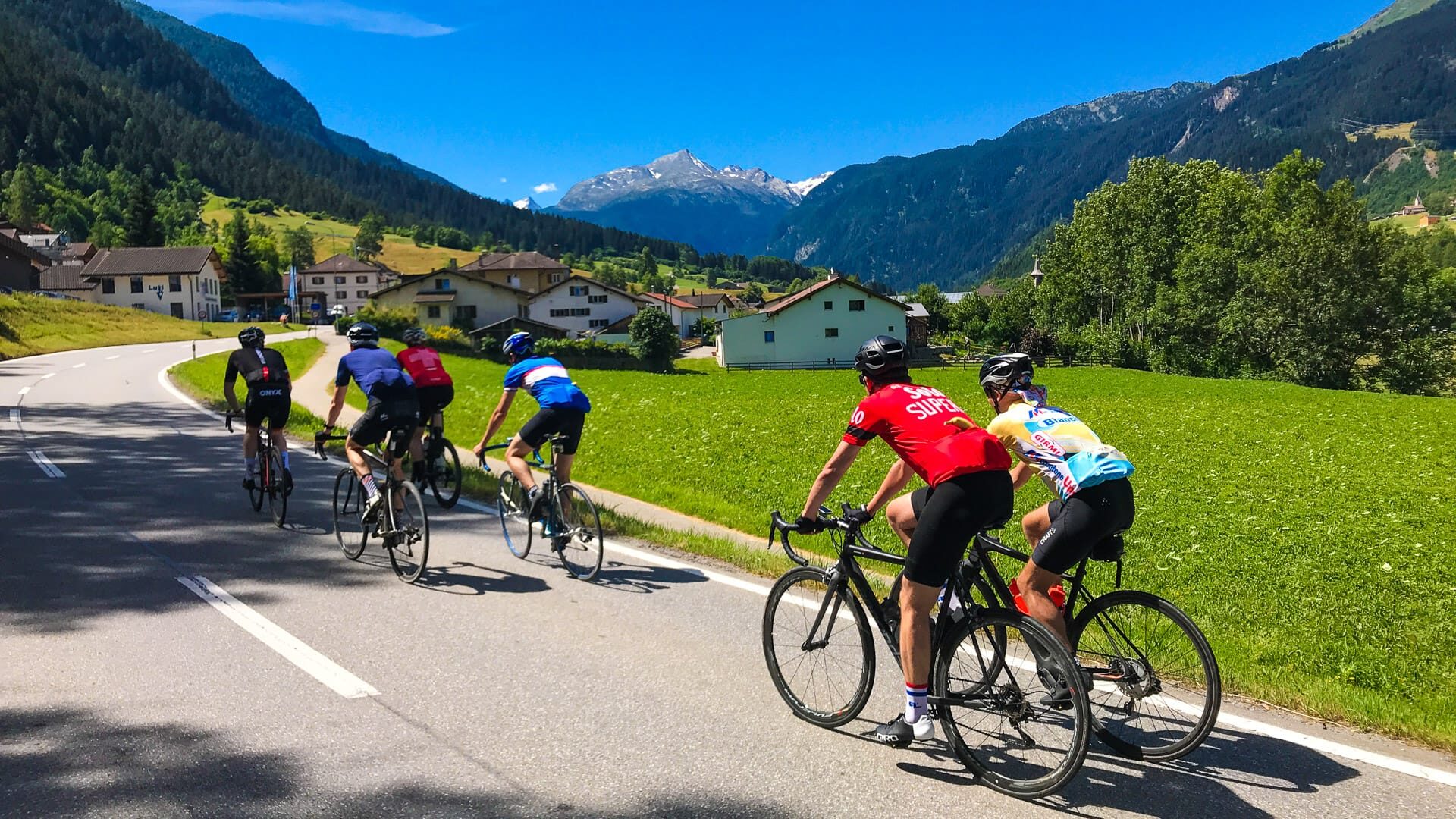
We work with many organisations who are making the case for bicycle tourism within their marketing strategies.
We are passionate about cycling holidays – because they are fun but also because they have the potential for huge good.
We have created this page to share various reports, resources and statistics on cycling tourism. We hope it will be useful to those making the case for cyclists and bike tourism within marketing, active and sustainable travel strategies.
If you’d like to sign up for our industry email newsletter, which shares more of these kinds of resources, please get in touch.
What is cycling tourism?
Different national organisations define cycling tourism in different ways. However, at its core, bicycle tourism is any travel-related activity for leisure purposes, incorporating a bicycle. Most types of bike tourism fall under these overlapping categories.
- Destination: Rides centred around a particular destination or attraction. Examples here.
- Touring: multi-day bicycle tours. Examples here.
- Events: Organised rides, sportives and races. Examples here.
- City day rides: usually a day, or half a day of riding, focused on local attractions. Example here.
All of these types of ride can be done on a variety of bikes, including road/race bikes, gravel bikes, mountain bikes, hybrids, city bikes (and electric versions of these too!).
How does cycling tourism fit within sports tourism?
A January 2026 report by Grand View Research shares that the global sports tourism market size was valued at USD 803.9 billion in 2025 and is projected to grow from USD 927.9 billion in 2026 to USD 2,776.7 billion by 2033. The report explains that the global market is expanding rapidly due to the increasing consumer shift toward experiential and activity-based travel. Cycling and cycling tours are specifically mentioned as being part of this trend.
How does cycling tourism fit within active tourism?
Cycling tourism is a very important part of the wider active tourism market, which as at September 2025 was estimated to be worth more than $1 trillion: ATTA report: Adventure Travel Market Sizing.
For many it is a standalone focus for their holiday, but increasingly cycling is also being incorporated into itineraries as an alternative mode of transport, for example as day or half day tour around a city, or as part of multi-activity adventure holidays.
The 2025 ATTA report found that the definition of “adventure traveller” is now broader than it used to be. One of the key findings in the report notes “Motivation is no longer tied to a single activity like cycling or birdwatching. Instead, many travelers incorporate an adventure element into broader itineraries focused on culture, leisure, and personal transformation.”
Meanwhile, the 2024 Adventure Travel Industry Snapshot report mentioned below found that 3 of the 10 top-trending activities were cycling.
Who is the average cycling tourist?
While there will be some differences from country to country, Cycling UK’s Report: Economic Benefits of Cycle Tourism (2020) identifies the characteristics below:
- 45-55 years old
- Above average educational and professional status
- 60% male, 40% female
- 50% cycle in couples or pairs, 20% alone, 20% in groups of 3-5 and 10% in larger groups
As a side note on the age referred to above, we frequently receive emails from cyclists looking for cycling holidays who fall well outside either end of this age range, particularly with regards the upper end of the spectrum.
We share details of individual country’s reports on cycling trends below.
Why invest in cycling tourism?
This report from the European Cycling Federaetion contains detailed information on the benefits of cycling generally: European Cycling Federation: The benefits of Cycling (2018). In the context of cycling tourism, these are some of the most important themes:
Economic impact
Cyclists spend more than other kinds of visitor. More on that below.
Sustainability
Cycling is a sustainable form of transport. This is especially the case, when cycling routes are combined with public transport. This means that cycling tourism has the potential to reduce the carbon footprint of the tourism sector.
Bikes allow people to access natural areas with much less impact than other forms of transport. This means bicycle tourism has the capacity to support the regeneration of ecosystems and it is aligned with regenerative travel principles.
Reduces overtourism
Cyclists tend to seek out quieter, natural areas, away from other people. This helps to disperse tourism flows.
Cyclists are also often happy to travel outside peak seasons, when weather is cooler, extending the holiday season for destinations.
Rural development
Cycling tourism can be a catalyst for repurposing disused infrastructure, improving rural connectivity and bringing people into remote corners of a country.
The fact that cycling is a slow form of travel means that cyclists also tend to spend extended periods of time in such areas, which are also often the places that are most in need of the economic benefits that cycling also brings. More on that below.
Health and wellness
Cycling offers physical benefits but it also promotes overall wellbeing by providing freedom, connecting us with nature, and enabling life-changing adventures. These all contribute to better social, physical, and psychological health.
What is the economic impact of cycling tourism?
Cycling Tourism in Australia (2025)
In 2024, visitors whose trips included cycling spent $6 billion AUD in Australia.
4.6 million trips involved a cycling experience and, very interestingly, the average spend per trip by international visitors including cycling activities was $9,223 compared with $4,311 by overall travellers.
Traveling by Bike 2025, by ISNART and Legambiente
In 2024, the economic impact of cycle tourism in Italy was €9.8 billion and accounted for over 10% of all tourism in Italy.
Economic and Health Impacts of Bicycling and Trails in Iowa (2025)
Cycling and trail use in Iowa contribute an estimated $1.4 billion annually in economic activity for the state, with the impact from cyclin g tourism at around $13 million.
Active Travel England: The Economic Impacts of Active Travel (2024)
Summarises findings from a number of studies, including Sustrans’ 2021 Walking and Cycling Index. This calculated “that walking, wheeling, and cycling created £6.5 billion in economic benefit for individuals and society across the 18 UK Index cities included in the modelling. Extrapolating these figures to the whole of the UK, assuming similar activity levels, equates to an overall annual benefit of approx. £36.5
billion.”
2024 ADFC Bicycle Travel Analysis
Estimated total spending by German cycling tourists in 2023:
- €14–15 billion spent on day trips
- €2–3 billion spent on short cycling trips
- €6–7 billion spent on cycling trips with 3+ nights.
Adventure Travel Association (2024)
- Approximately 65% of the money spent on adventure travel remains in country.
- This compares with approximately 14% of money spent on mass tourism.
Cycling UK’s Report: Economic Benefits of Cycle Tourism (2020)
- £520m total cycle tourism spend from people cycling in the UK per year.
- Cycle tourists spend 9% more than the average visitor.
- 1.23m overnight cycle trips in the UK per year.
- £4m per year of health benefits in Scotland, according to Transport Scotland
- 35,788 jobs generated by the UK’s cycle leisure and tourism sector.
The European Cycle Route Network EuroVelo (2012)
- 2.3 billion cycle tourism trips per year in the EU with a total economic value of 44bn euros
- In comparison, the cruise tourism industry provided an economic value of 38bn EUR in 2012 (CLIA Europe Economic Contribution Report, 2013)
ATOUT FRANCE, 2009: Spécial économie du vélo
- Cycle tourists spend almost 20% more than the average for all tourists
What do guests want from their holiday?
State of the Cycling Tour Operators Industry (2024)
- Where do clients come from? 29% of respondents have the majority of their clients coming from the USA, followed by Germany (16%) and the UK (13%).
- Are clients looking for guided or self-guided tours? It depends if you’re in Europe or not: 64% of Europe-based operators reported that a majority of their clients opted for non-guided tours. 78% of operators based outside Europe reported that their clients preferred guided tours.
- Is cycling tourism growing? Yes! 88% of respondents expected the same or more clients and 86% expected the same or higher revenue in 2024 compared with 2023.
Adventure Travel Industry Snapshot (2024)
- 3 of the 10 top-trending activities were cycling (the three categories were electric bikes, non-paved and paved categories).
Which countries have national cycling strategies?
The ECF’s State of National Cycling Strategies report (2023) notes that of the 54 European countries covered by the report:
- 14 countries have a national cycling strategy in place.
- 7 countries have a strategy similar to a national cycling strategy in place.
- 4 countries used to have a national cycling strategy but it has expired and needs updating.
- 8 countries are developing a first national cycling strategy.
From a cycling tourism perspective, such national strategies are important because they usually include a priority for investment in cycling tourism with the objective “to boost the tourism sector or divert tourism away from overcrowded areas to lesser-known ones.”
France made headlines by declaring in its 2024 National bicycle tourism strategy that it aims to be the world’s number 1 cycling tourism destination by 2030.
Other cycling strategies:
- Quebec, Canada published a strategy on cycling tourism for 2025-2030 (there’s an article on it in English, here).
More data on cycling tourism
Cycling tourism statistics (Europe)
- EuroVelo cycling counts (2025)
- EuroVelo cycling counts (2024)
- EuroVelo route development (2025)
- EuroVelo route development (2024)
- EuroVelo route usage (2025)
- EuroVelo route usage (2024)
Cycling tourism statistics (country by country)
- Australia – cycling tourism insights (2025)
- France – gravel cycling (2024)
- Germany – trends and data (2024)
- Italy – cycling tourism insights (2023)
- Scotland – cycling tourism insights (2023)
The value of major cycling events
Can we help?
We work with tourist boards and tour operators seeking to market their destination to cyclists looking for cycling holidays.
We’d love to discuss how we can help. These articles may be useful:
Or head over to our Work with Us page, or get in touch!
Last Reviewed: 26 June 2026
First Published: 09 November 2024