
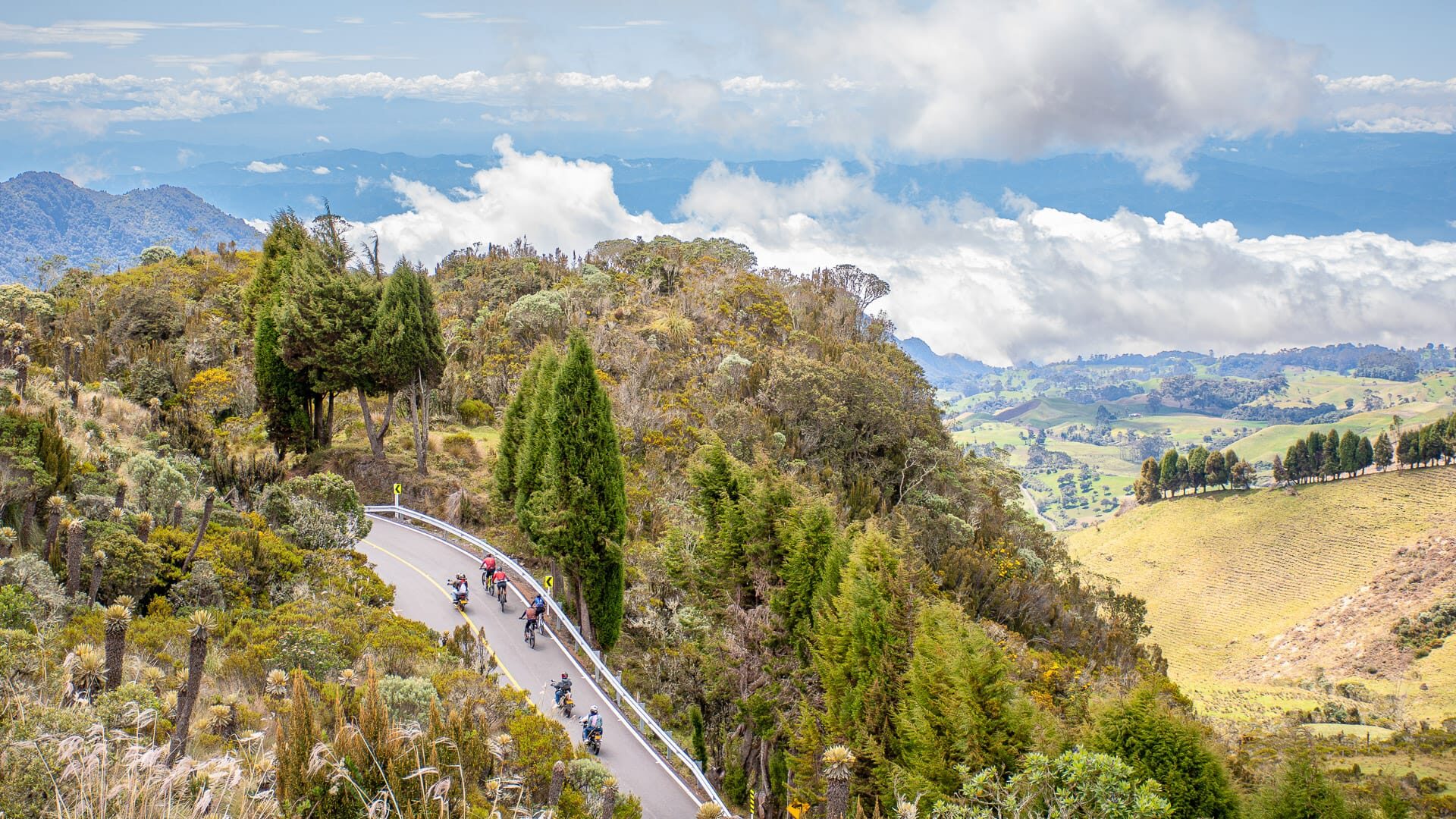

The Alto de Letras region combines some of Colombia’s longest climbs with tropical valleys, coffee-growing hills and high-altitude páramo. The high-altitude páramo is a rare Andean ecosystem and one of Colombia’s most distinctive landscapes, where grasslands and wetlands replace forests.
Alto de Letras region sits between the historic town of Mariquita and Manizales, the capital city of Caldas, a department in the Coffee Region. It offers several distinct riding areas and routes.
- The classic Alto de Letras climb is the region’s headline challenge. It climbs for around 80 kilometres from the heat of Mariquita to a pass more than 3,600 metres above sea level. However, it is only one part of the cycling available here.
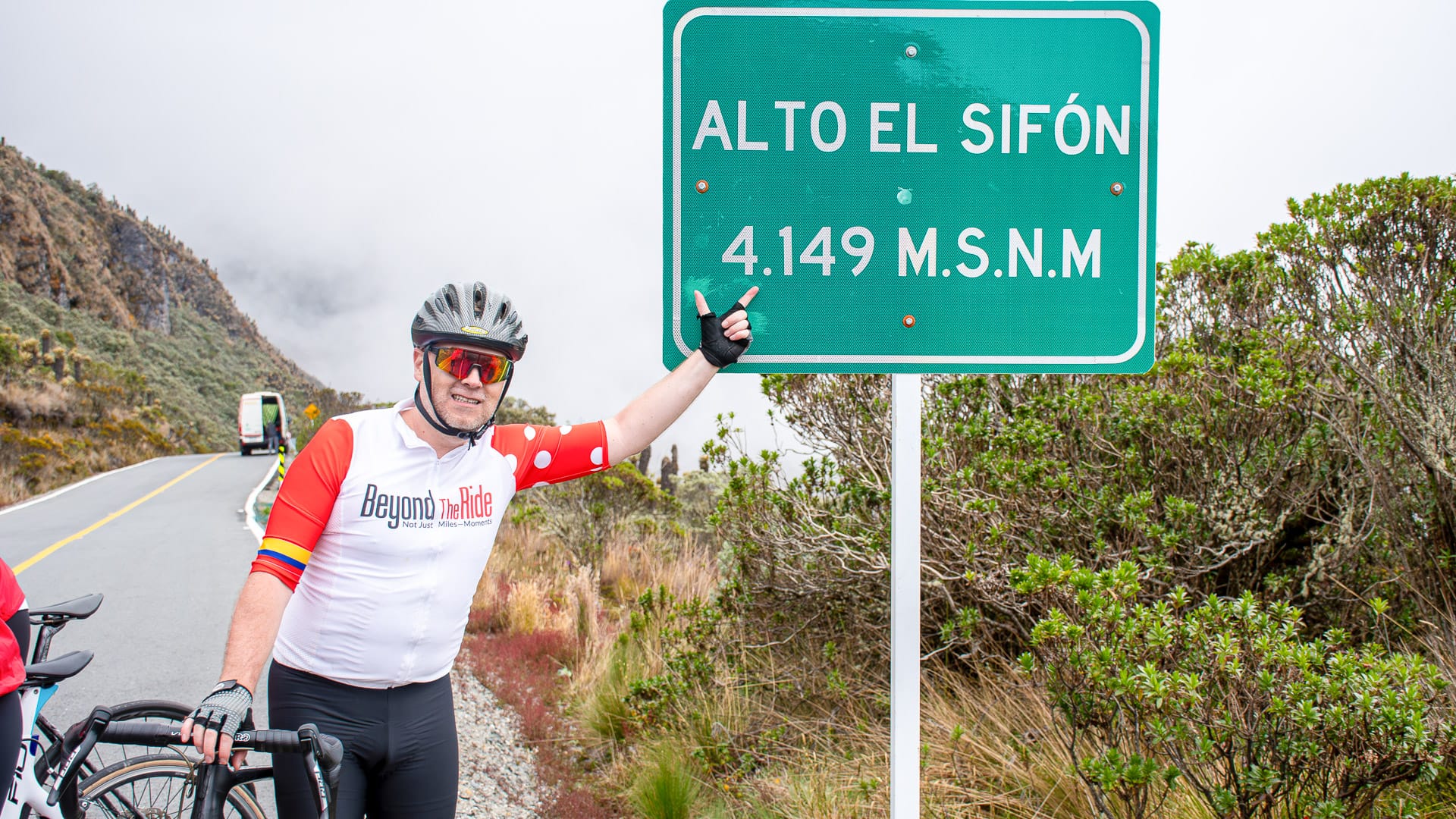
- You can also tackle the quieter high-altitude route via Alto del Sifón, explore the coffee-growing roads around Líbano, enjoy gentler recovery rides near Mariquita and continue west towards Manizales and Colombia’s Coffee Region, known as the Eje Cafetero. This region includes Caldas, Risaralda and Quindío.
- Bogotá provides a useful gateway and acclimatisation base, while the towns of Honda, Falan and nearby coffee heartlands add cultural and nature-based options away from the bike.
In this guide, we speak with David Giraldo, the co-founder of Beyond The Ride. David’s family has owned Casa de Campo La Giralda in Mariquita for three generations, and together they have spent five years hosting and supporting cyclists across the region.
David shares what cycling in the Alto de Letras region is like, which routes to ride, where to stay and how to prepare for its altitude, weather and long mountain roads.
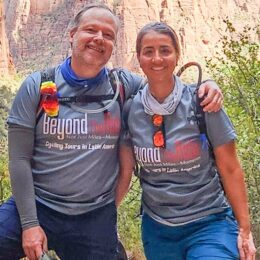
David is the co-founder of Beyond The Ride, alongside his wife, Luisa, Director of Operations. They run premium, all-inclusive cycling tours across Latin America, built specifically to remove the barriers that stop international cyclists from riding there safely and comfortably - things such as language gaps, unreliable route information, safety concerns, and a near-total lack of cycling-specific infrastructure in the region.
David is sharing this guide because his family has owned Casa de Campo La Giralda in Mariquita, right at the base of Alto de Letras, for three generations. When his mother passed away and his sisters wanted nothing to do with the property, he listed it on Airbnb just to keep it alive. Cyclists from around the world started booking almost immediately, and every one of them told him the same things: there was nowhere reliable to stay, no English-speaking hosts and no support built for serious riders. That is the gap Beyond The Ride exists to close. David had lived all his life next to Alto de Letras without realising it was one of the most legendary climbs in the world.
Luisa, Director of Operations, has been the one turning that gap into a real operation. She personally manages every detail for every guest and trip they run, which has earned them Superhost status for four years running and made Casa de Campo La Giralda the top-rated stay in Mariquita for cyclists and families alike. Between the estate and Beyond The Ride, they have been hosting and guiding cyclists on Alto de Letras for five years - long enough to know the climb’s every gradient shift, weather pattern and rest point.
They work with a wide range of riders: solo cyclists, cycling groups chasing a bucket-list climb, women cyclists who want to share the experience with their fellow cycling team in comfort and without pressure, and, increasingly, couples or families where one partner rides and the other wants a cultural experience alongside it.
What they all share is that they want the climb without the guesswork: reliable logistics, real support on the road and someone who actually understands what cyclists need.

We love to introduce our community to cycling businesses, destinations and ideas that we think are genuinely interesting. Beyond The Ride caught our attention because of its focus on these topics, which felt like a natural fit for Epic Road Rides and our readers. We were therefore pleased to work with the Beyond The Ride team on this article.
Beyond The Ride paid for this advertisement feature. Our decision to collaborate reflects our view that the brand is relevant to our readers; it is not a formal approval, audit or guarantee of its services. Unless we expressly say otherwise, we have not personally taken the trip described or independently verified information supplied by Beyond The Ride.
As with any travel purchase, please check the latest trip details, terms and customer protections directly with Beyond The Ride before booking. Any booking is made with Beyond The Ride, not Epic Road Rides.
Always check current travel information and advice. For visitors from the UK, the UK government travel information pages are here.
Table of contents
This guide contains a lot of useful information. To help make it more digestible, we’ve broken it down into several parts:
- Part 1: Why cycle the Alto de Letras?
- Part 2: The climb
- Part 3: The region
- Part 4: Where to stay and routes
- Part 5: Practicalities
- Part 6: Tips
- Part 7: Beyond The Ride
Sponsor Message
Considering cycling Alto de Letras?
Beyond The Ride draws on decades of experience in cycling tourism and deep local expertise in Latin America to create guided and self-guided cycling holidays in the Alto de Letras region.
Their tours combine challenging rides with seamless logistics, cultural experiences, recovery support and carefully planned activities for non-cycling companions.
Head to their website to find out more.
Got a question for Beyond The Ride?
Fill out this form and we will pass it to Beyond The Ride who aim to reply (within 24 hours wherever they can!)
Short on time? Start with the at-a-glance table below for the key things to know about cycling the Alto de Letras region.
Alto de Letras region at a glance
| Alto de Letras region | |
|---|---|
| Location | Central Cordillera |
| Area covered in this guide | Mariquita, Líbano, Murillo, Alto de Letras and Manizales |
| Main cycling base | Mariquita |
| Main gateway | Bogotá |
| Headline ride | Classic Alto de Letras from Mariquita |
| Featured ride distances | Around 56 to 145 kilometres |
| Terrain | Tropical lowlands, coffee-growing hills, Andean forest, high mountains and páramo |
| Elevation | Maximum of 3,600 metres |
| Riding | Long mountain climbs and high-altitude riding |
| Surface | Asphalt |
| Best time to visit | December to March and June to August are generally drier |
| Typical trip length | Around three days for a shorter trip; seven to nine days for a wider regional experience |
Planning an Alto de Letras cycling trip? Beyond The Ride runs supported cycling trips taking care of bikes, transfers, accommodation and on-road support find out more below.
Sponsor Message
Considering cycling Alto de Letras?
Beyond The Ride draws on decades of experience in cycling tourism and deep local expertise in Latin America to create guided and self-guided cycling holidays in the Alto de Letras region.
Their tours combine challenging rides with seamless logistics, cultural experiences, recovery support and carefully planned activities for non-cycling companions.
Head to their website to find out more.
Got a question for Beyond The Ride?
Fill out this form and we will pass it to Beyond The Ride who aim to reply (within 24 hours wherever they can!)
Part 1: Why should cyclists visit the Alto de Letras region?
(Very) long mountain climbs
The Andes divide into three mountain ranges in Colombia: the Western, Central and Eastern Cordilleras. Between them lie hot valleys crossed by major rivers.
Many of Colombia’s towns and cities sit high in the mountains. Travelling between them often means descending into a warm valley before climbing back towards cooler elevations.
For cyclists, this creates long mountain roads in almost every direction.
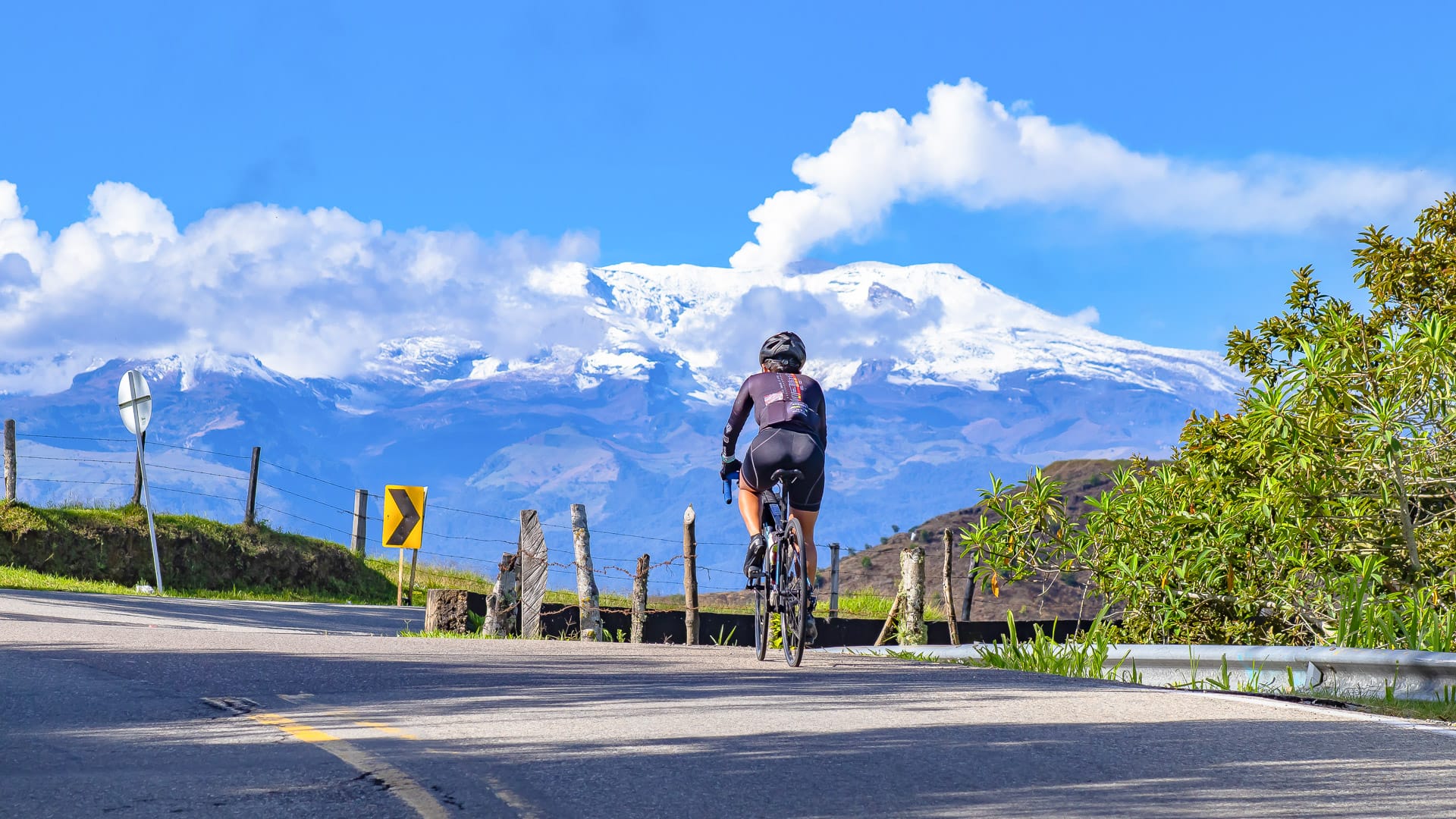
Alto de Letras lies in the Central Cordillera, on the slopes of the Nevado del Ruiz volcano. The classic road rises from Mariquita in the Magdalena Valley towards the mountains between Tolima and Caldas.
- Few road rides deliver such marked contrasts in a single day. Tropical vegetation, fruit farms and mango trees give way to coffee plants, guadua bamboo, Andean forest and cattle pasture.
- The final kilometres cross the open páramo. Temperatures can start around 28°C in Mariquita and fall to approximately 5°C near the pass.
- The upper mountain is home to frailejones, plants adapted to the exposed conditions of the northern Andes.
- Stay on the road, avoid disturbing the vegetation. Take all rubbish away with you.
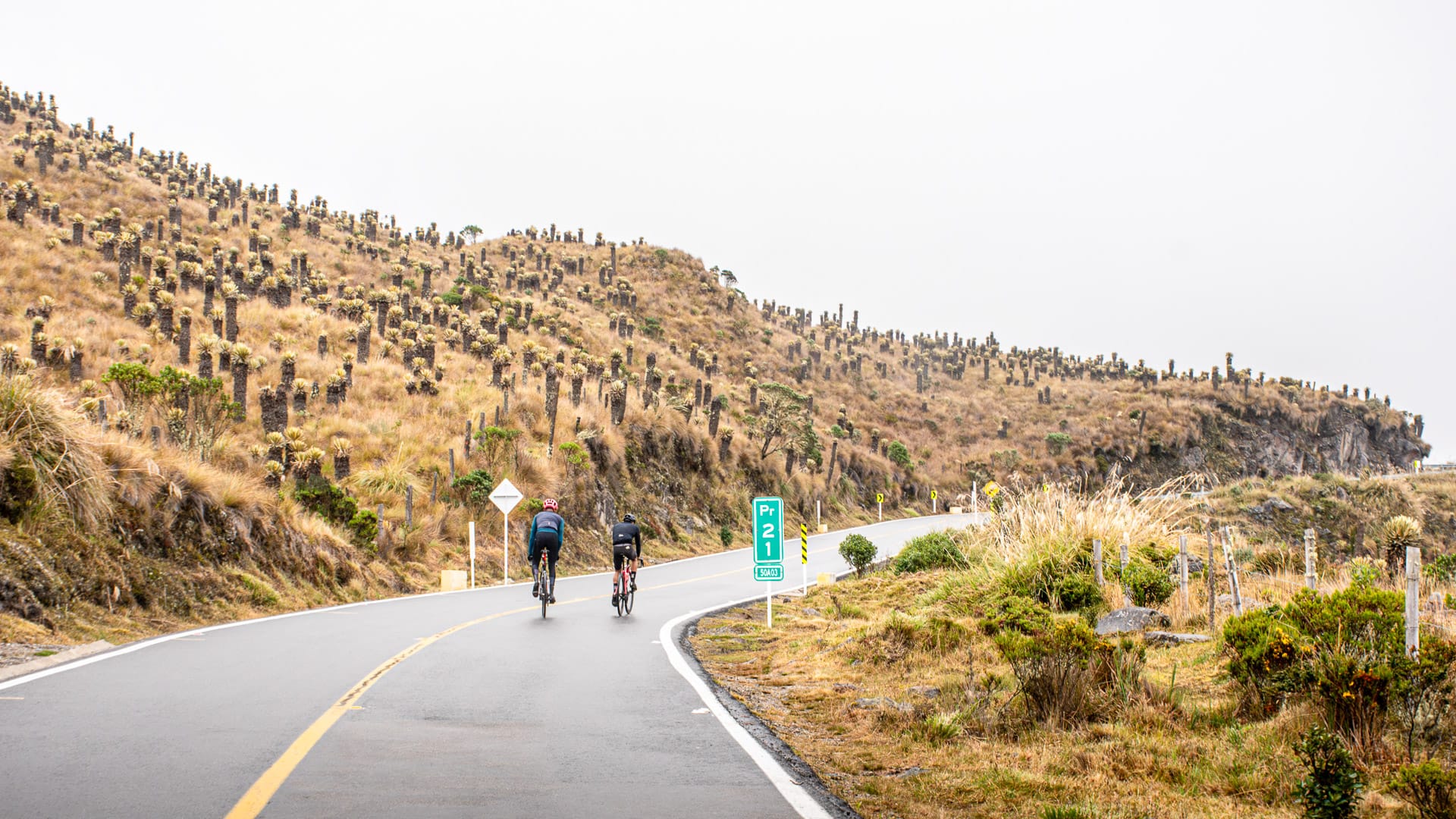
You ride through Los Nevados National Park – at 3500 masl, paramos and unique frailejon forests take the center stage. (Photo credit: Fotografo Alto de Letras)
The fame of Alto de Letras
How did the climb get its name?
The pass was historically used by arrieros, or mule drivers, carrying coffee, animals and other goods between Mariquita and Manizales. Its name is said to come from a sign containing written letters at the pass. Mule drivers who could not read referred to the location as Alto de las Letras, or the pass of the letters.
Aerial cables were later used to move goods and passengers across the mountains. Traces of this infrastructure can still be found around Mariquita and Manizales.
Is Alto de Letras the world’s longest road climb?
Alto de Letras is one of the world’s longest paved cycling climbs and Colombia’s most famous amateur climbing challenge.
The challenge comes from the combination of distance, more than 4,000 metres of climbing, the altitude at the summit of 3,663 metres and changing weather.
How does Alto de Letras compare with famous European climbs?
Alpe d’Huez is around 14 kilometres long. The Col du Tourmalet is approximately 17 kilometres from its usual eastern approach.
Both are steeper overall than Alto de Letras, but they are far shorter.
In total climbing terms, Alto de Letras is often compared with riding Alpe d’Huez almost three times. It is not one relentless wall. You need to manage six to eight hours of effort with repeated changes in gradient, short descents, falling temperatures and thinner air at altitude.
For more information on supported trips that include the classic Alto de Letras climb, visit the Beyond The Ride website.
Why is the climb important in Colombian cycling?
The road gained cycling status after appearing in the first Vuelta a Colombia in 1951.
To experience Colombia’s cycling culture as part of a supported trip, visit the Beyond The Ride website to explore our Alto de Letras cycling tours.
Cycling is a core pillar of the national identity
Cycling is probably Colombia’s second most popular sport, after football. It’s a national passion and cultural tradition.
Since the first Vuelta a Colombia, the country has produced generations of successful professional cyclists. They include Luis Herrera, Fabio Parra, Santiago Botero, Nairo Quintana, Rigoberto Urán and Egan Bernal. You can read more about this on Beyond the Ride’s blog.
Colombian climbing specialists are known as escarabajos, or beetles. The nickname reflects their ability to keep moving upwards across the country’s long mountain roads.
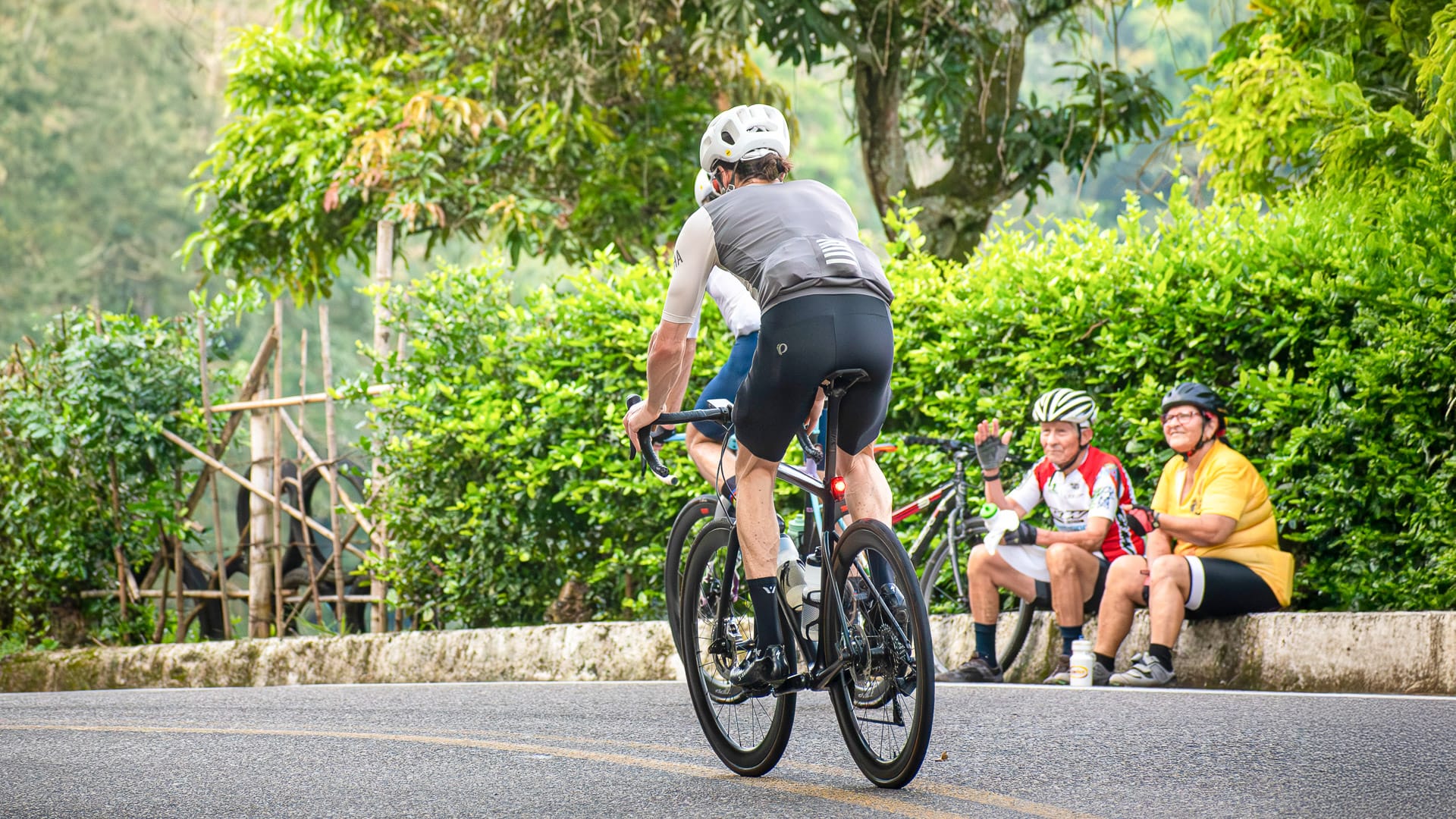
This Colombian cycling heritage remains visible on the road. You may meet young riders, experienced clubs, women-only groups and older cyclists on the same climb.
Our guests often tell us they remember the warmth of local people as much as the ride itself.
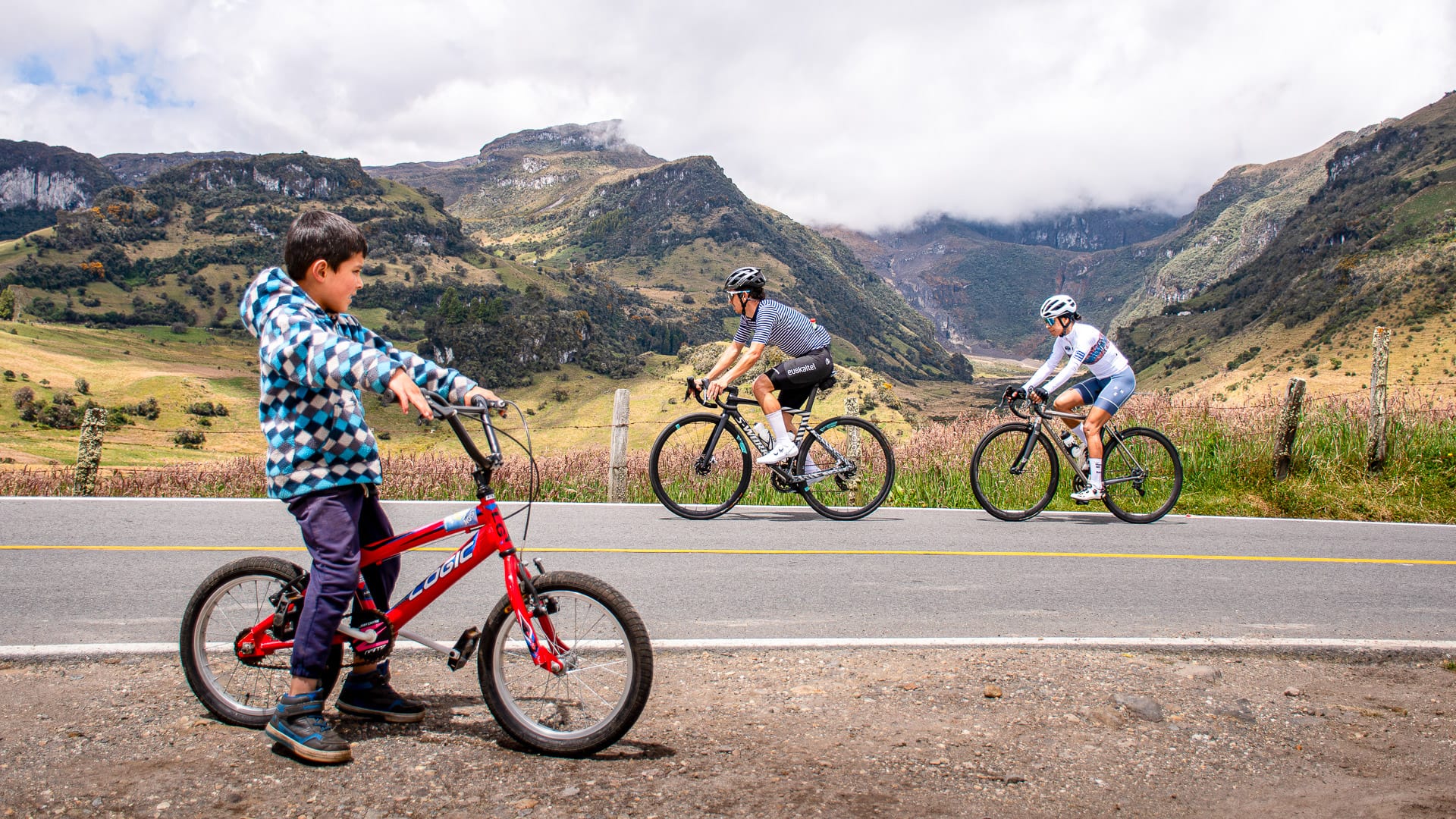
Kids in Colombia start riding bikes at young ages, watching Colombian cyclists become Tour de France and Vuelta a España champions. (Photo credit: Fotografo Alto de Letras)
Would class cycling opportunities
Alto de Letras
A short three-day trip can focus on the classic climb.
Beyond The Ride offers a three-day supported Alto de Letras Express tour for cyclists who want to focus on the classic climb without committing to a longer itinerary.
Longer road cycling tours
Longer trips of seven to nine days allows time for a complete experience including an introductory ride, Alto de Letras, a recovery day, Alto del Sifón and cultural visits.
Popular climbs in and around Bogotá include Alto de la Tribuna, Alto del Vino, Patios, La Calera, Alto La Cuchilla and El Verjón.
- Routes around Bogotá commonly range from around 50 to 90 kilometres. Many begin near 2,600 metres and rise towards 3,500 metres.
- Longer rides such as Alto de la Tribuna and Alto del Vino may cover around 80 to 140 kilometres, depending on the chosen start and finish.
- Vehicle support is useful on the longer point-to-point versions.
For more information on longer supported cycling trips around Alto de Letras, visit the Beyond The Ride website.
Gravel and MTB
The wider region also has gravel and mountain bike routes on secondary roads. We currently focus on road cycling because suitable cyclist-friendly accommodation is harder to find on the more remote off-road itineraries.
Sponsor Message
Considering cycling Alto de Letras?
Beyond The Ride draws on decades of experience in cycling tourism and deep local expertise in Latin America to create guided and self-guided cycling holidays in the Alto de Letras region.
Their tours combine challenging rides with seamless logistics, cultural experiences, recovery support and carefully planned activities for non-cycling companions.
Head to their website to find out more.
Got a question for Beyond The Ride?
Fill out this form and we will pass it to Beyond The Ride who aim to reply (within 24 hours wherever they can!)
Part 2: What is cycling the Alto de Letras climb like?
Alto de Letras climb at a glance
| Classic Alto de Letras climb | |
| Start | Mariquita |
| Finish | Alto de Letras |
| Distance | Around 80 kilometres |
| Total elevation gain | Around 4,156 metres |
| Total elevation loss | Around 962 metres |
| Starting elevation | Around 468 metres |
| Summit elevation | Around 3,663 metres |
| Published average gradient | Around 4% |
| Typical riding time | Six to eight hours |
| Surface | Asphalt |
| Key resupply points | Fresno, Petaqueros, Padua and Mesones |
| Cycling base | Mariquita |
| Support vehicle | Strongly suggested |
Where is Alto de Letras?
Alto de Letras is a mountain pass rather than a formally defined tourism region.
It lies between Mariquita in Tolima and Manizales in Caldas, in the Central Cordillera and close to Los Nevados National Natural Park. The park is a protected high-mountain area that includes Nevado del Ruiz and the surrounding páramo and volcanic landscapes.
For this guide to the Alto de Letras region, we refer to the wider riding area linking Mariquita, the pass and Manizales. We cover the classic eastern ascent and the alternative route via Alto del Sifón.
What is the terrain like?
From Mariquita, the Cordillera Central rises sharply. The classic climb is broken by flatter ground and several short descents.
Despite the scale of the climb, it is not a continuous uphill gradient. Flatter sections and several short descents interrupt the climb, so you repeatedly lose and regain elevation on the way to the summit.
The lower slopes are warm and tropical, before the road moves through coffee-growing land, Andean forest and cattle pasture. The final kilometres are much more exposed, crossing the high-altitude páramo towards Alto de Letras.
What are the roads like?
The Alto de Letras classic route follows a working intercity road with one lane in each direction, open to buses, lorries, motorcycles and agricultural traffic. It generally has medium to low levels of traffic, with vehicles travelling at moderate to low speeds, averaging around 35 kilometres per hour. It is normal to see cyclists on this road, especially at weekends, and drivers are used to sharing the road with bikes. Signs alerting motorists to cyclists are also common along the route.
Mornings are usually the best time to ride in Colombia, as rain is common in the afternoons and can sometimes be heavy. Keep right, use the shoulder where it is safe and ride predictably. It is always good practice to ride defensively, particularly when it is raining or during the night.
People, dogs, cattle and other animals may be on the road. Cattle crossings are particularly common on the higher rural sections.
In better news, in our experience, the asphalt is generally in good condition. If riding before dawn or after dusk, bike lights are required by law. Always follow local traffic laws, including stopping at traffic lights and obeying traffic signs, and always wear a helmet.
Rain can bring debris, roadworks or landslide risk. Fog may reduce visibility quickly on the upper mountain.
The Alto de Letras via El Sifón route has very low levels of traffic. Beyond Murillo, large vehicles and buses are not permitted making the road quiet for cycling.
It is worth checking current conditions before setting out. See the INVÍAS Sistema de Información Vial for current incidents and route information.
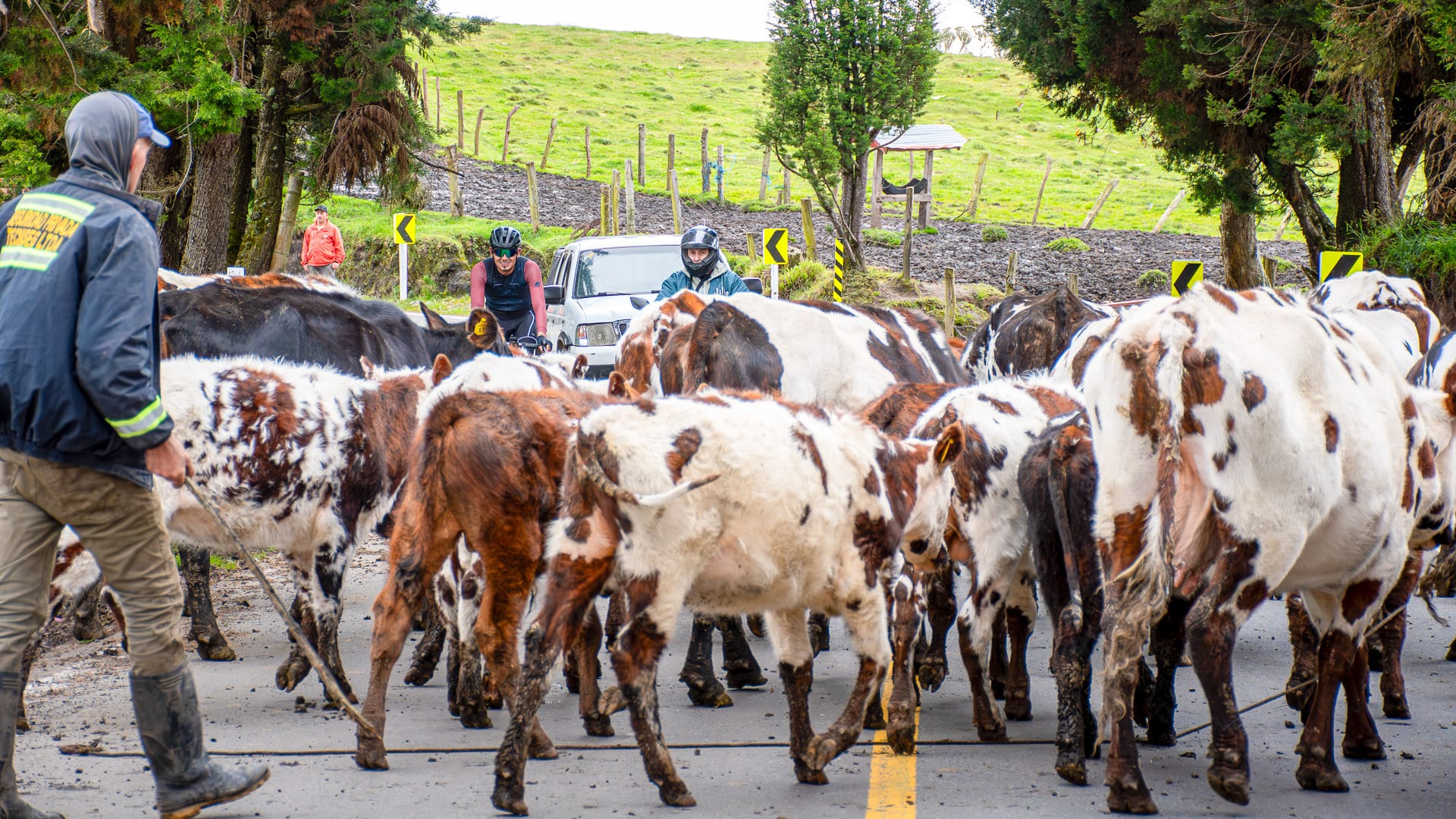
You will ride on public roads: expect to find all kind of vehicles, people, animals, and obstacles. Always ride defensively. (Photo credit: Fotografo Alto de Letras)
What are the descents like?
The classic route includes several descending sections before the summit. They offer a short break from climbing.
Control your speed on wet asphalt and expect vehicles, animals or people around bends.
We do not suggest descending the entire classic road back to Mariquita after reaching the summit as you are likely to be tired and cold. Most cyclists arrange collection at the summit.
This is standard on a Beyond The Ride tour, we collect you with fresh clothing in the vehicle. You can then return to Mariquita for post-ride relaxation or continue by road towards Manizales and the Coffee Region.
If you are riding independently, do not rely on arriving in Mariquita the day before and finding a support vehicle at short notice. Instead, arrange ground transport at least a week in advance. This can be organised from Bogotá, Medellín, Mariquita or Manizales. Make sure the vehicle you hire has a bike rack so it can safely carry your bike.
We can not provide support outside of yours however, you are also welcome to ask us for help finding transport. We can refer you to a couple of providers who may be able to assist.
What kind of cyclist is Alto de Letras for?
The full climb suits experienced road cyclists who already ride two or three times per week. You should also be comfortable spending six to eight hours in the saddle.
You do not need to race. Patience, suitable gearing and consistent fuelling matter more than short-term power.
On Beyond the Ride tours, we are happy to start our guests higher up the mountain if you do not want to ride the full 80 kilometres. On our Senior Riders 55+ trips, we may start riders around kilometre 40 or 50. This retains the high-altitude sections while reducing the overall distance.
The Alto de Letras road is not suitable for families riding with young children. However, the wider holiday works well for families and non-cycling Partners. Walking activities, including Falan and Valle del Cocora, town, museum and coffee-farm visits are included for non-cyclists and are a core value of our tours.
If you are travelling with non-cycling companions, visit the Beyond The Ride website to find out more about our parallel companion programmes and supported trips.
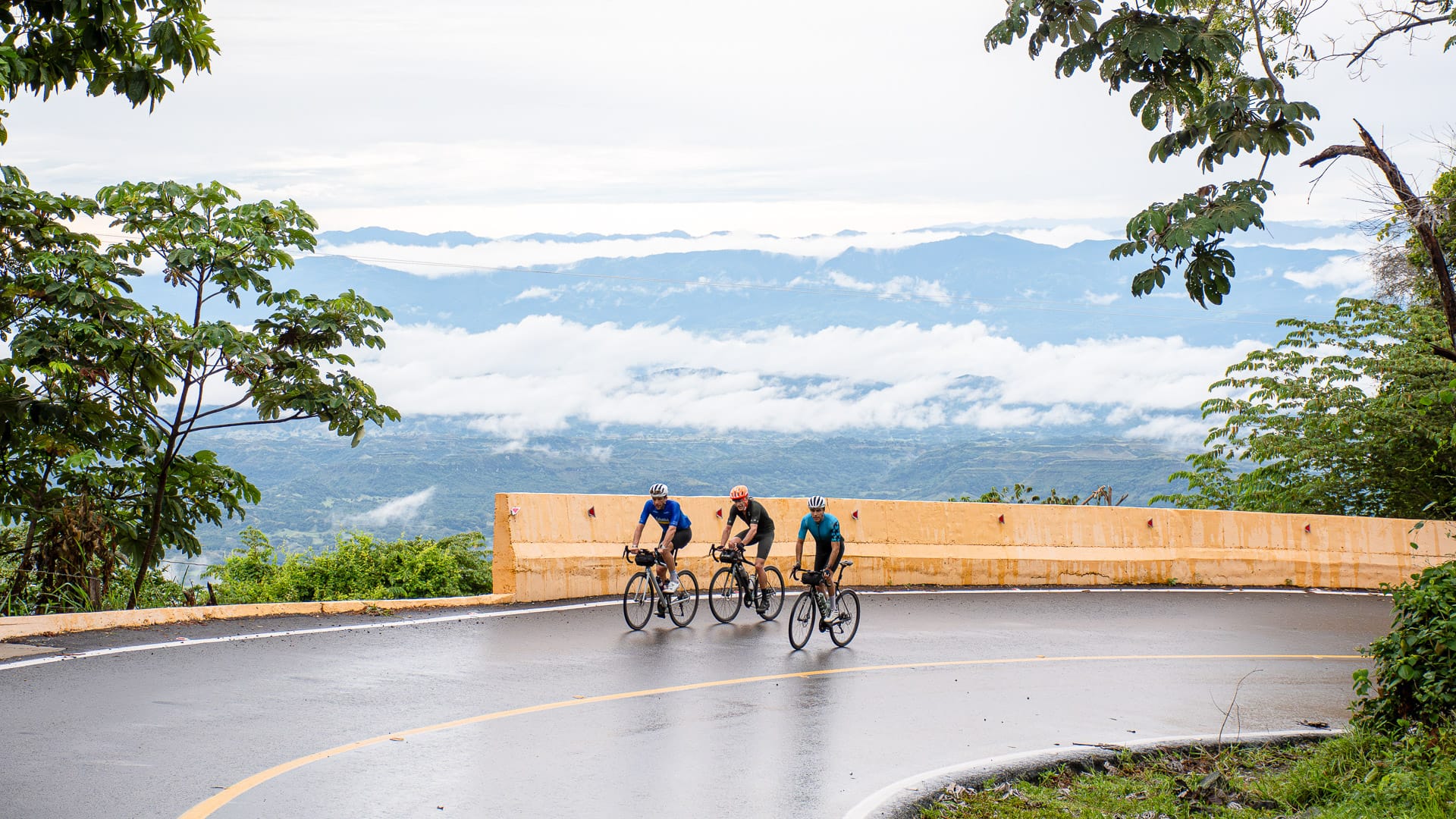
Stunning views of the Magdalena river valley and surrounding tropical rainforest below (photo credit: Fotografo Alto de Letras)
Do cyclists need a guided tour?
Independent riding is possible, but the route requires more planning than simply following a GPS file.
You need to arrange bike transport, food, water, mechanical support, weather checks and collection from the summit. Spanish is useful in rural areas, while small providers may require cash or advance payment.
A supported trip adds a vehicle, bilingual help, food, hydration, dry clothing and mechanical assistance.
At Beyond on the Ride our supported trips include food and bathroom stops. We can shorten the route if weather, illness or fatigue becomes a problem.
Sponsor Message
Considering cycling Alto de Letras?
Beyond The Ride draws on decades of experience in cycling tourism and deep local expertise in Latin America to create guided and self-guided cycling holidays in the Alto de Letras region.
Their tours combine challenging rides with seamless logistics, cultural experiences, recovery support and carefully planned activities for non-cycling companions.
Head to their website to find out more.
Got a question for Beyond The Ride?
Fill out this form and we will pass it to Beyond The Ride who aim to reply (within 24 hours wherever they can!)
Part 3: What is cycling in the wider Alto de Letras region like?
What is the terrain like?
The terrain changes considerably across the wider region.
The lowlands around Mariquita and Honda are hot and comparatively flat. These roads work well for introductory or recovery rides.
Around Líbano, steep coffee-growing hills lead towards Murillo and Alto del Sifón. The terrain becomes increasingly mountainous, with much of the later riding taking place above 3,000 metres and continuing through high-altitude páramo.
West of Alto de Letras, the road drops towards Manizales and the Coffee Region. The terrain remains hilly, but with shorter climbs and more rolling riding than the full ascent from Mariquita.
The highlands outside Bogotá provide another contrast. The Alto de la Tribuna to Cambao route begins at around 2,200 metres before dropping towards the much hotter Magdalena Valley, with a substantial climb included along the way.
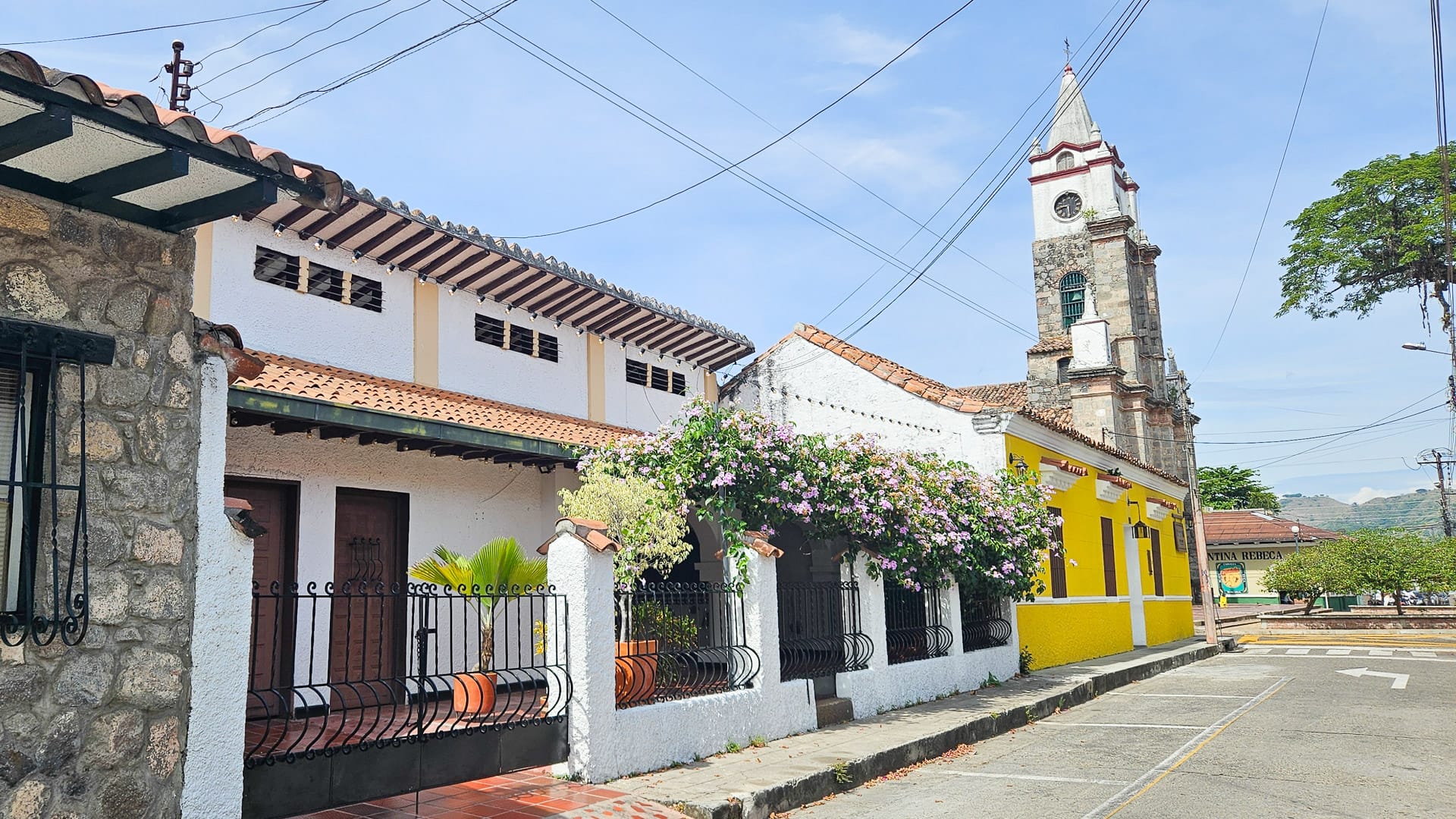
Honda, a colonial town close to Mariquita which non-cyclists visit while riders are on the road (photo credit: Beyond The Ride)
What are the roads like?
The featured routes in this guide are on asphalt, but road character and traffic vary across the region.
The classic Alto de Letras route follows a working intercity road with moderate traffic. By contrast, the Alto del Sifón route through Líbano and Murillo is generally quieter, although cyclists should still expect local vehicles, people, animals and cattle crossings.
The Alto de la Tribuna to Cambao route also uses asphalt roads and has moderate traffic.
Weather can affect roads across the mountain areas. Rain may bring debris, roadworks or landslide risk, while fog can reduce visibility at higher elevations.
The wider region also has gravel and mountain bike routes on secondary roads, although this guide focuses primarily on road cycling.
What are the descents like?
Descents vary depending on where you ride.
The classic Alto de Letras route contains several descents before the summit. On the Alto del Sifón route, riders descend for around 18 kilometres after Alto del Sifón before climbing again towards Alto de Letras.
The Alto de la Tribuna to Cambao route is predominantly descending, dropping from cool highland conditions towards the tropical lowlands, although it also includes a climb of around 15 kilometres.
What kind of cyclist is the Alto de Letras region for?
The wider region offers a broader range of riding than the classic Alto de Letras climb alone.
Experienced road cyclists can tackle the full Alto de Letras and Alto del Sifón routes, both of which involve substantial climbing, long distances and high altitude. Strong riders can extend the challenge further with the longer route through Mariquita, Líbano, Murillo and Alto del Sifón.
There are easier options too. The Mariquita recovery loop covers around 56 kilometres with around 400 metres of elevation gain, while the Alto de la Tribuna to Cambao route is predominantly descending.
Cyclists who do not want to complete the full Alto de Letras climb can also start higher up the mountain, reducing the overall distance while retaining some of the high-altitude riding.
The wider trip can work well for cyclists travelling with non-riding companions, with activities around Honda, Falan, coffee farms and the Coffee Region.
Do cyclists need a guided tour?
Independent riding is possible across the region, but the amount of planning required varies by route.
Long mountain and point-to-point rides may require arrangements for food, hydration, mechanical support, weather checks, transport and collection. Services also become limited on some higher routes. For example, there are no dependable supplies after Murillo on the Alto del Sifón route.
A support vehicle is particularly useful on the major climbs and longer point-to-point rides. It can carry food, water, tools, dry clothing and bikes, as well as provide transport if a cyclist cannot continue.
Spanish is also useful in rural areas, where smaller providers may not speak English.
If you would rather have these logistics organised for you, visit the Beyond The Ride website to find out more about our supported cycling tours in the region.
Sponsor Message
Considering cycling Alto de Letras?
Beyond The Ride draws on decades of experience in cycling tourism and deep local expertise in Latin America to create guided and self-guided cycling holidays in the Alto de Letras region.
Their tours combine challenging rides with seamless logistics, cultural experiences, recovery support and carefully planned activities for non-cycling companions.
Head to their website to find out more.
Got a question for Beyond The Ride?
Fill out this form and we will pass it to Beyond The Ride who aim to reply (within 24 hours wherever they can!)
Part 4: Where should cyclists stay and what routes should they ride in the Alto de Letras region?
The best place to stay depends on which part of the region you want to ride.
- Mariquita is the natural base for the classic Alto de Letras climb and also works for easier lowland recovery riding.
- Líbano works well for riding Alto del Sifón and the high-altitude roads towards Murillo, rather than the classic Alto de Letras climb from Mariquita.
- Manizales provides access to the western side of the pass and the Coffee Region.
- Bogotá is primarily an arrival and acclimatisation base. It is not a base for riding Alto de Letras itself, although we also use the highlands outside Bogotá as the starting point for the Alto de la Tribuna to Cambao introductory stage.
| Base | Best for | Featured rides |
| Mariquita | The classic Alto de Letras climb and lowland recovery riding |
Classic Alto de Letras Mariquita recovery loop |
| Líbano | Alto del Sifón and quieter high-altitude riding | Alto del Sifón from Líbano |
| Manizales | The western side of the Alto de Letras pass and the Coffee Region | Western Alto de Letras approach |
| Bogotá | Arrival, acclimatisation and an introductory point-to-point ride | Alto de la Tribuna to Cambao |
Mariquita
Mariquita is the natural base for the classic Alto de Letras ascent because it is effectively kilometre zero.
The town lies at around 468 metres and is known locally for fruit production. It also has links with the Royal Botanical Expedition led by José Celestino Mutis.
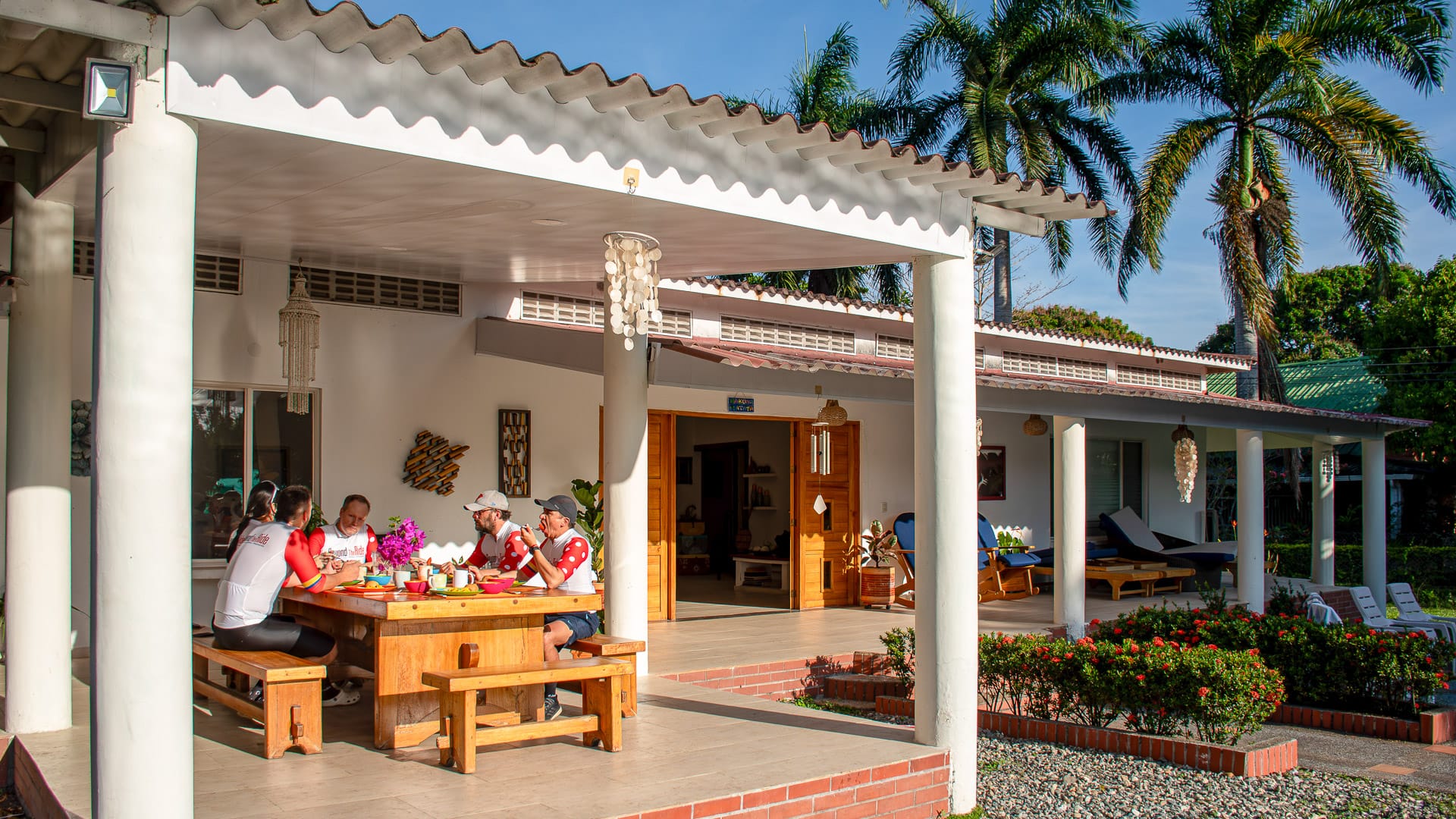
Our preferred cycling base is Casa de Campo La Giralda. It has spacious rooms, secure bike storage, maintenance space, laundry, pools, gardens and communal areas. Its outdoor spaces provide plenty of room for post-ride relaxation. They also encourage cyclists to spend time together rather than returning straight to their rooms.
Other cyclist-focused options include La Casa del Ciclista and Cerro Dorado.
There is no formal cyclist-friendly accommodation scheme in Colombia, so it is worth checking that your chosen accommodation offers the facilities you need before booking.
We would not suggest primitive camping for this trip. Glamping is becoming increasingly popular in Colombia, but these facilities often lack services that cyclists need, such as secure bike storage.
We suggest booking at least two months ahead during busy periods.
Classic Alto de Letras from Mariquita
GPX DownloadTerms of use reminder
Route summary
This is the headline climb of the region and the route most international cyclists travel to Colombia to ride.
The road rises from the tropical heat of Mariquita to the exposed páramo at Alto de Letras. Along the way, you pass fruit farms, coffee-growing land, Andean forest, cattle pasture and high-altitude frailejones.
| Start | Mariquita |
| Finish | Alto de Letras |
| Distance | Around 80 kilometres |
| Total elevation gain | Around 4,156 metres |
| Typical riding time | Six to eight hours |
| Support vehicle | Strongly suggested |
Mariquita to Fresno: The road begins climbing almost immediately. Conditions are warm and tropical, with views opening across the Magdalena Valley as the road gains height.
Coffee plants begin to appear after roughly 20 kilometres. Fresno, near kilometre 25, is the first substantial place to buy food and refill bottles.
Keep the pace controlled. Riding too hard here is one of the easiest ways to struggle later.
Fresno to Padua: The route continues through farms, coffee-growing land and Andean forest.
Petaqueros, near kilometre 36, and Padua, around kilometre 40, provide further opportunities for food and drink.
The changes go beyond the vegetation. Houses look different, clothing becomes warmer, settlements become smaller and local accents begin to change.
Padua to Delgaditas: The gradient becomes less consistent, with climbing interrupted by several descents.
Coffee plantations gradually give way to pasture and dairy farming. Temperatures fall as the route rises above 2,500 metres.
Fog, damp air and rain become more likely. The descending metres can also be difficult mentally, as every loss in height must be regained before the summit.
Delgaditas to Alto de Letras: The final section enters exposed high-mountain country.
You are already several hours into the day. The thinner air and falling temperature make a familiar level of effort feel harder.
Mesones, around kilometre 62, is the final useful place for a substantial meal or hot drink. We like to stop for agua de panela con queso, a warm panela drink served with cheese.
Services become limited during the final 15 kilometres. A steady cadence, regular fuelling and warm clothing matter more than speed.
At the summit, most cyclists allow time for photographs before changing into dry layers. A support vehicle can then return you to Mariquita or continue towards Manizales and the Coffee Region.
Tips
We normally wake at around 4:30am, eat breakfast and start riding by 5:30am. This makes the most of the daylight and reduces the likelihood of being high on the mountain during afternoon fog or rain.
The lower slopes may feel manageable, but the altitude, weather and accumulated climbing make the final 20 kilometres a different challenge.
The published average gradient of around 4% includes flatter and descending sections. Many of the climbing stretches sit between 6% and 9%.
More information
Visit our website for more details on the Alto de Letras Challenge, Alto de Letras Express, Alto de Letras Essential, Women Riders Only and Senior Riders 55+ tours, which feature the classic Alto de Letras climb.
Mariquita recovery ride
GPX DownloadTerms of use reminder
Route summary
This easier ride is designed to loosen the legs after Alto de Letras rather than provide another demanding training day. It is an almost flat out-and-back ride, with gradients below 1%, taking you across a tropical valley filled with fruit and corn plantations.
The turnaround point is Armero, a stark reminder that you are riding on the slopes of an active volcano. Once a thriving city during the 1970s and 1980s, Armero was destroyed in 1985 following an eruption of the Nevado del Ruiz volcano. Along the roadside, you can still see ruins of the hospital and other buildings.
From Armero, retrace the route back to Mariquita before continuing to Ciudad Perdida de Falan (Falan’s Lost City) for a more tropical and wet adventure. This old colonial settlement was home to a gold mine and refinery established by English settlers during the 17th and 18th centuries. During your visit, you can explore the remains of the complex and hike through lush vegetation, crossing streams and passing small cascades and natural pools. The experience also includes the chance to try a typical dish from the region.
| Start | Mariquita |
| Finish | Mariquita |
| Distance | Around 56 kilometres |
| Total Elevation gain | Around 400 metres |
| Typical riding time | Less than two hours |
| Support vehicle | Not needed |
Tips
Keep the effort light throughout.
The day can continue with a visit to Ciudad Perdida de Falan. Paths pass former mining ruins, tropical forest, waterfalls and natural pools.
Activities in the wider area may include walking, canyoning, rappelling and zip-lining.
More information
Visit our website for more details on the Alto de Letras Challenge and Alto de Letras Women Riders Only tours, which include this recovery ride.
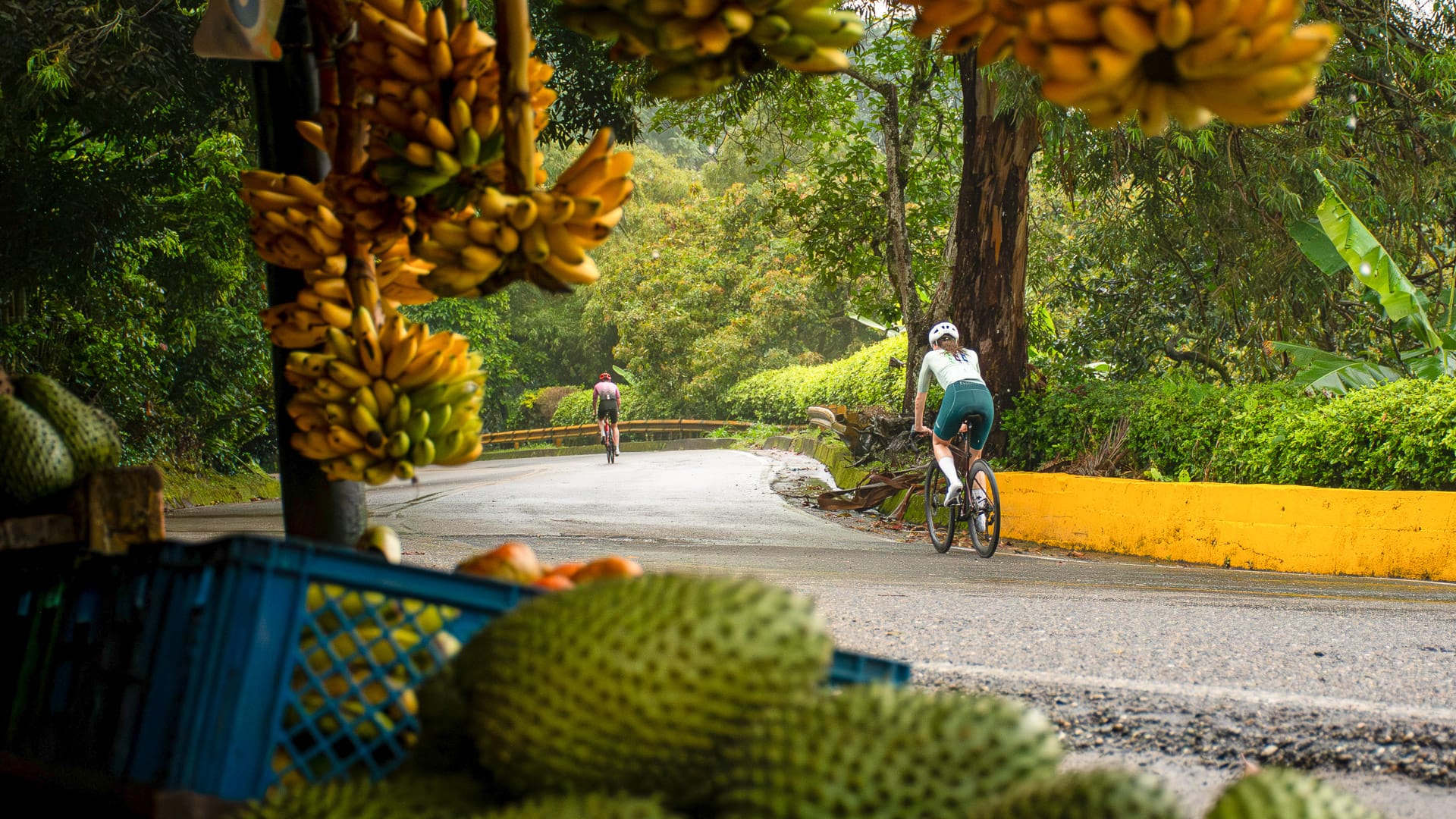
Mariquita is known as the “Fruit Capital” of Colombia. You may try fruits that you won’t find anywhere else in the world. (Photo credit: Fotografo Alto de Letras)
Líbano
We use Líbano as the starting point for our supported Alto del Sifón route.
However, in our experience, cyclists generally stay in Mariquita even when the ride starts from Líbano. Líbano is a much smaller town with fewer things to do, while Mariquita offers a wider choice of places to stay and eat, as well as more activities and places to visit. We are not currently aware of accommodation in Líbano that we would suggest specifically for cyclists.
While cyclists continue towards Murillo, non-cycling companions visit a working coffee farm.
Alto del Sifón from Líbano
GPX DownloadTerms of use reminder
Route summary
This is the shorter supported version we use on our principal Alto del Sifón itineraries.
It removes the flatter opening kilometres from Mariquita and begins with the sustained climb from Líbano towards Murillo.
Visitors have called this “the most beautiful road in Colombia”, and it is easy to understand why. On clear mornings, you may have views of the three snow-capped mountains that give Los Nevados National Park its name: Nevado del Ruiz volcano, Nevado del Tolima and Nevado de Santa Isabel.
Beyond Murillo, you enter high mountain terrain and ride within Los Nevados National Park. Keep an eye out for the wildlife found here. You may even be lucky enough to spot a condor or the elusive Andean bear.
| Start | Líbano |
| Finish | Alto de Letras |
| Distance | Around 84 to 88 kilometres |
| Total elevation gain | Around 4,200 metres |
| Typical riding time | six to eight hours |
| Support vehicle | Strongly suggested |
Líbano to Murillo
The first section from Líbano to Murillo is the steepest sustained part of the day.
El Agrado provides a possible resupply point. Murillo, at around 3,000 metres, is the final dependable place for food, water and coffee. After Murillo, there are no reliable shops before Alto de Letras. Mobile reception also becomes limited.
Murillo to Alto del Sifón to Alto de Letras
The paved road continues through páramo and frailejón country towards Alto del Sifón.
After Alto del Sifón, you descend for around 18 kilometres before climbing again towards Alto de Letras. Full-finger gloves and a windproof layer are useful on this section.
Tips
Traffic is generally light, although you should expect local vehicles, people, animals and cattle crossings.
Cold, wind, fog and rain are possible throughout the year.
We find this route at least as memorable as the classic ascent. It spends longer at high altitude and can offer close views towards Nevado del Ruiz in clear weather.
Vehicle restrictions can change on the road between Murillo and Manizales. Check current access before arranging support.
More information
Visit our website for more details on the Alto de Letras Challenge and Alto de Letras Women Riders Only tours, which feature Alto del Sifón.
Gran Fondo Alto de Letras via Alto del Sifón
Route summary
Strong riders looking for a considerably longer challenge can begin in Mariquita rather than Líbano. This creates a 145 kilometre route through Armero, Líbano, Murillo and Alto del Sifón before finishing at Alto de Letras.
Allow around eight to ten hours to complete the ride.
| Start | Mariquita |
| Finish | Alto de Letras |
| Distance | Around 145 kilometres |
| Total elevation gain | Around 4,860 metres |
| Typical riding time | eight to ten hours |
| Support vehicle | Essential for most riders |
Tips
Strong riders looking for a considerably longer challenge can begin in Mariquita rather than Líbano. This creates a 145-kilometre route through Armero, Líbano, Murillo and Alto del Sifón before finishing at Alto de Letras.
We do not normally use the complete 145-kilometre route on our shorter bike tours. Our supported itineraries generally begin in Líbano. This retains the principal Alto del Sifón climbing sections while reducing the total distance.
More information
Our supported Alto del Sifón trips generally begin in Líbano rather than following the complete 145-kilometre Gran Fondo route.
Visit our website for more details on the Alto de Letras Challenge and Alto de Letras Women Riders Only tours.
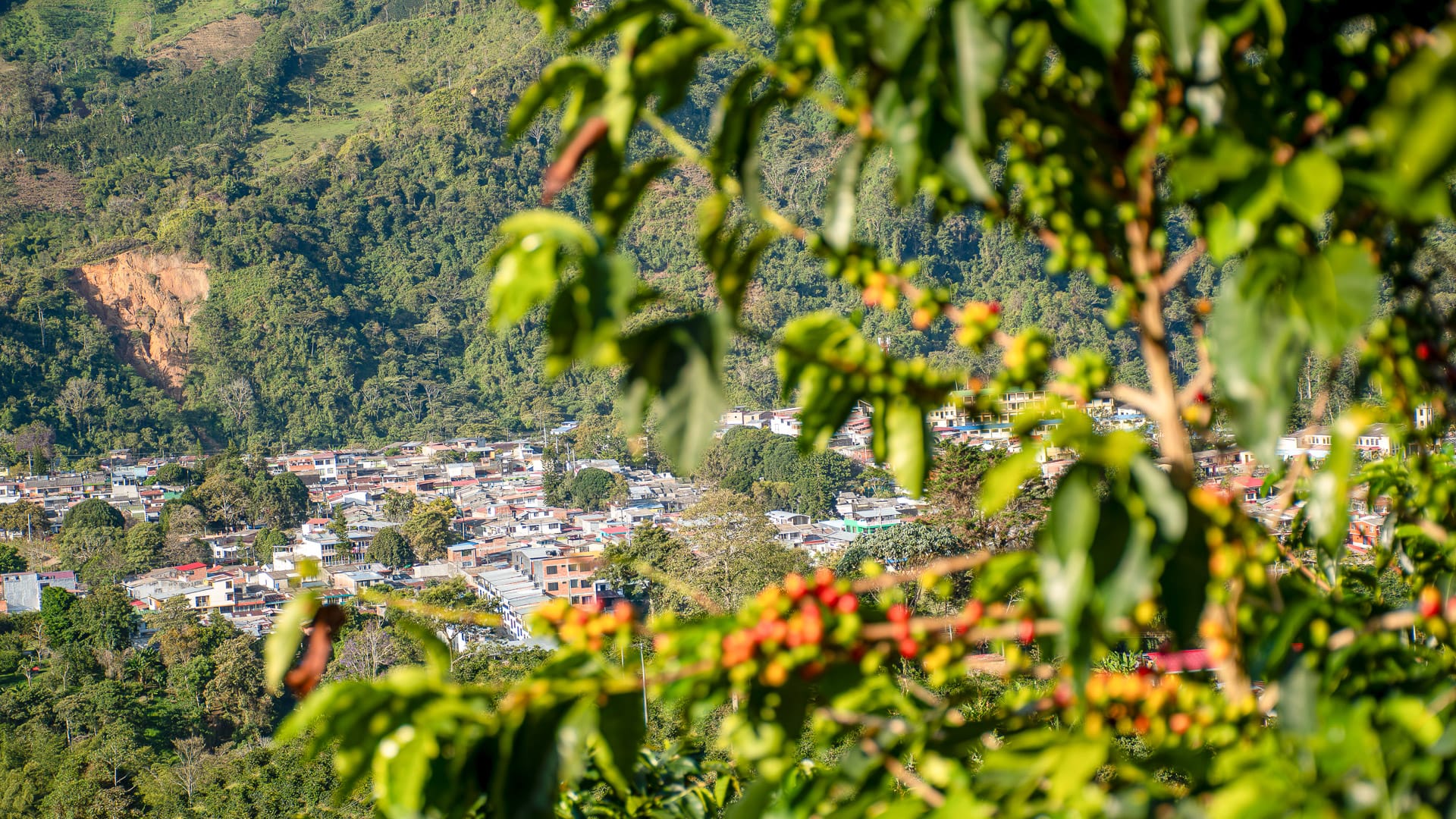
Learn about the coffee culture in guided visits to working coffee farms. (Photo credit: Beyond The Ride)
Manizales
Manizales is the largest city close to the western side of Alto de Letras.
It has a wider selection of hotels, restaurants, mechanics and bike shops than Mariquita or Líbano. It also provides access to the Coffee Region.
Manizales can be a very good cycling base for exploring the Coffee Region and riding the western Alto de Letras climb. However, it sits on the eastern edge of the Coffee Region, so it is not necessarily the most central base if you plan to explore the wider area.
There are plenty of places to stay, ranging from traditional hotels to boutique properties and villas. We particularly suggest Termales del Otoño, a volcanic hot spring resort near Manizales. Cyclists can also find useful services in and around the city, including bike rental, bike shops, maintenance and ride support.
The western ascent of Alto de Letras is much shorter than the route from Mariquita, but it still involves serious climbing.
Alto de Letras from Manizales
GPX DownloadTerms of use reminder
Route summary
Climbing Alto de Letras from Manizales is demanding but manageable for many cyclists. The route starts at around 2,300 metres above sea level, with the first few kilometres mostly downhill. From there, you tackle a continuous 23 kilometre climb averaging almost 6% before reaching Alto de Letras. It is enough to make your legs work, but considerably less punishing than the classic ascent from Mariquita.
The return to Manizales is almost entirely downhill, so take care to control your speed on the descent.
We particularly like this version for senior riders. It still provides a hard challenge in the saddle, but without the much greater demands of the classic Alto de Letras route.
| Start | Manizales |
| Finish | Manizales, out-and-back |
| Cycling distance | 65 kilometres |
| Total elevation gain | 1,988 metres |
| Typical riding time | three to four hours |
| Support vehicle | Not necessary |
Bogotá
Bogotá is the arrival point for most international visitors rather than a base for the Alto de Letras climb itself.
The city sits at around 2,600 metres. Spending one or two days here gives you time to recover from the flight, complete a bike fit and begin adjusting to the altitude.
We also use the highlands outside Bogotá as the starting point for an introductory point-to-point ride towards the Magdalena Valley.
Alto de la Tribuna to Cambao
GPX DownloadTerms of use reminder
Route summary
This ride introduces you to Colombia’s long descents and changing climate before you attempt Alto de Letras.
It begins in cool highland conditions and finishes in tropical heat near Cambao.
The route is mainly downhill but includes a climb of around 15 kilometres near kilometre 20.
The road passes through cloud forest, Andean forest and dry lowland landscapes.
| Start | Alto de La Tribuna (Facatativá) |
| Finish | Cambao (San Juan de Rioseco) |
| Cycling distance | Around 76 kilometres |
| Total elevation loss | 1,985 metres |
| Typical riding time | three hours |
| Support vehicle | Not necessary |
Tips
Temperatures may rise from around 10°C at the start to more than 30°C near Cambao.
Control your speed on the longer descents, particularly when the asphalt is wet.
You could also arrange a visit to the Armero memorial site before continuing to Mariquita.
More information
Visit our website for more details on the Alto de Letras Challenge, Alto de Letras Women Riders Only and Alto de Letras Express tours, which feature this route.
Sponsor Message
Considering cycling Alto de Letras?
Beyond The Ride draws on decades of experience in cycling tourism and deep local expertise in Latin America to create guided and self-guided cycling holidays in the Alto de Letras region.
Their tours combine challenging rides with seamless logistics, cultural experiences, recovery support and carefully planned activities for non-cycling companions.
Head to their website to find out more.
Got a question for Beyond The Ride?
Fill out this form and we will pass it to Beyond The Ride who aim to reply (within 24 hours wherever they can!)
Part 5: What should cyclists know before visiting Alto de Letras?
When should cyclists visit?
Cycling is possible throughout the year in the Alto de Letras region.
December to March and June to August are generally drier in the Alto de Letras region. However, rain should always be expected, even during the drier months. Colombia’s position between the Andes, the Pacific and Atlantic Oceans and the Amazon contributes to very high rainfall. Even in the wettest months, particularly April and October, mornings are often sunny, with storms and heavier downpours more likely after around 2:00 pm.
Temperatures do not vary greatly between seasons. In the Coffee Region, daytime temperatures are generally around 18°C to 24°C. Mariquita has a warm, humid tropical climate throughout the year, with temperatures typically around 29°C to 32°C. Bogotá is much cooler because of its altitude, with daytime temperatures around 17°C and night-time temperatures falling to around 7°C or below.
April to June and September to November tend to bring heavier rain, often in afternoon downpours.
Altitude affects the weather more than the month you visit. Mariquita can be hot and humid while the summit is cold and wet on the same day.
We use early starts throughout the year to make the most of (typically) clearer morning conditions. For Alto de Letras from Mariquita, on either route, we aim to start riding by 6:00 am at the latest. For the Alto de La Tribuna to Cambao route, we usually start at around 9:30 am. In the Coffee Region, where rides are generally shorter and less steep, we typically start between 7:00 and 8:00 am, largely because cultural activities are often scheduled later in the day.
Visit the official Colombian weather information page for more insights.
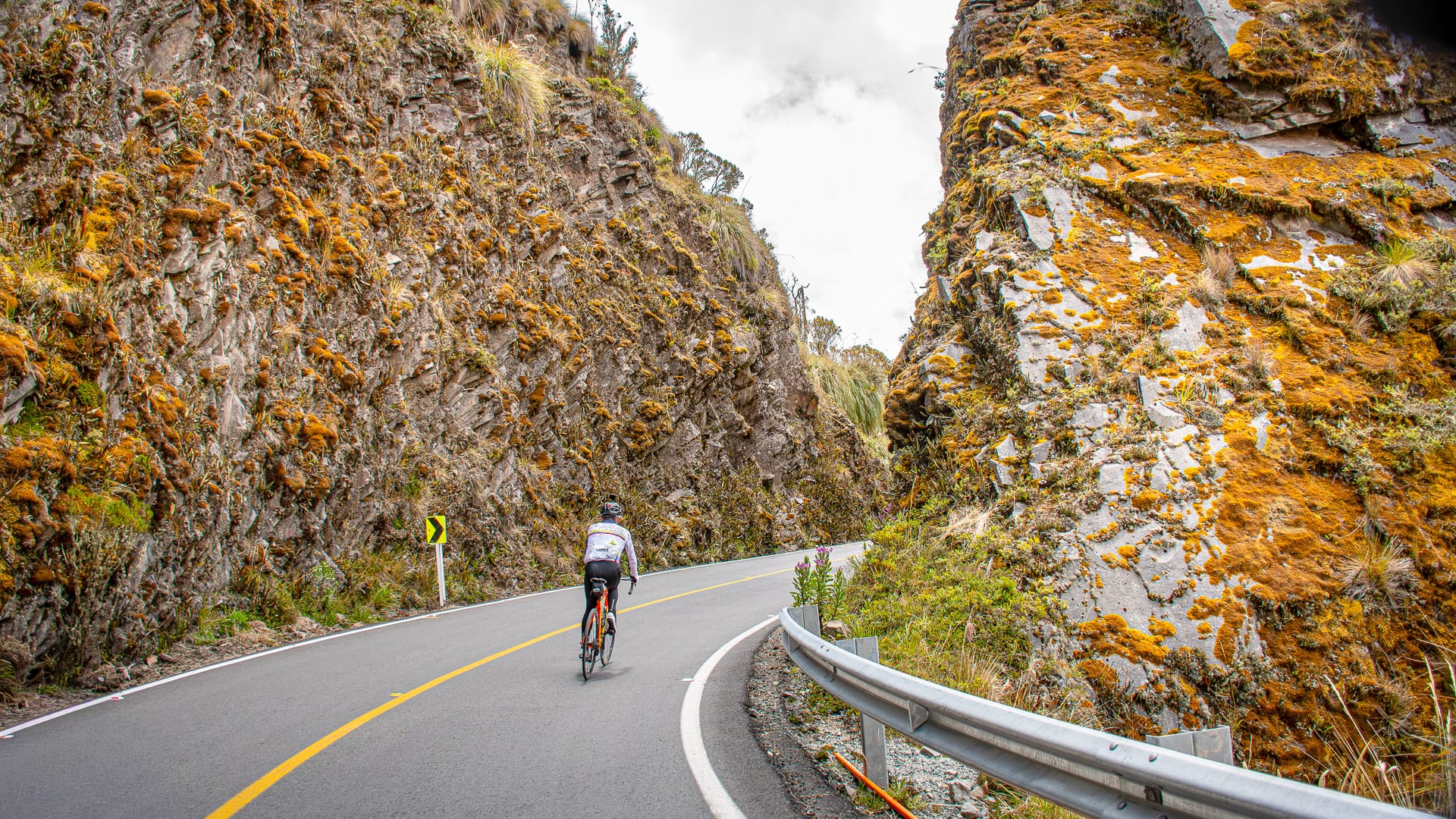
Experience the ‘Lunar landscape’ above 4000 masl, an ecosystem where only very resilient forms of life thrive. (Photo credit: Fotografo Alto de Letras)
Which cycling events take place nearby?
The Reto Alto de Letras and Tour de Caldas are usually held in September.
Gran Fondo Quindío also takes place in the Coffee Region, typically in August.
August is also when the Vuelta a Colombia is usually held. This multi-stage race travels through different regions of the country. Other popular one-day events include El Giro de Rigo, organised by former professional cyclist Rigoberto Urán, and Gran Fondo Nairo Quintana, organised by Giro d’Italia and Vuelta a España winner Nairo Quintana. Their locations and dates vary from year to year.
For a longer-format experience, Entre Valles y Montañas is a multi-day ride in Colombia’s Pacific region.
Be aware that these events can increase demand for accommodation and transport.
Can cyclists hire a road bike?
High-end road bike hire is limited around Mariquita. Bikes generally need to be booked and delivered from a larger city like.
Bikes can be delivered to Bogotá, Medellín, Manizales, Cali, Pereira, Armenia, Mariquita or Cartagena. Our main bike hire provider is Colombian Road Heights.
At Beyond The Ride, our fleet includes models from Canyon, Pinarello, Specialized, Colnago, Trek, Giant and Cervélo. Bikes are adjusted using your measurements. You should bring your own shoes, pedals, helmet and gloves.
Top tip: bring a familiar saddle as this may also help on a long ride. If you bring your own bicycle on one of our tours, we can reduce the trip price. You still receive mechanical support from the team.
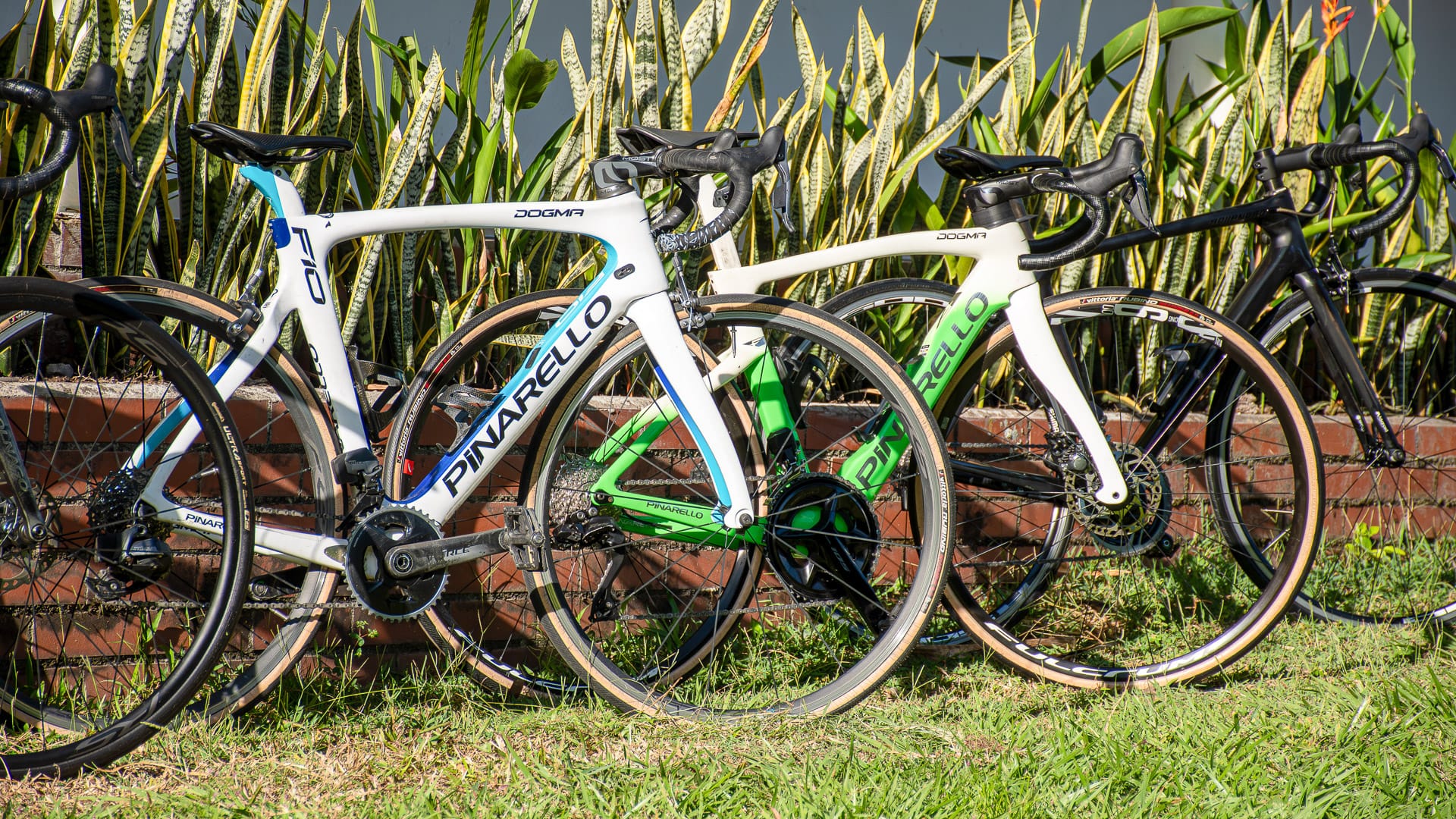
We ride Pinarello, Specialized, Cervelo and similar brands. (Photo Credit: Beyond The Ride)
Are there bike shops nearby?
On our tours, we handle mechanical support ourselves.
Mariquita has a small number of workshops, but high-end parts may be difficult to find.
Manizales and Bogotá have a wider choice of independent mechanics and brand dealers. In Manizales, cyclists can find shops and workshops for Specialized, Trek and other well-known brands. One option is Cíclica, which offers specialist bike servicing.
Consider packing hard-to-replace items such as charging cables, a derailleur hanger, brake pads and preferred cleats.
How do cyclists get to Alto de Letras region?
Most international visitors arrive through Bogotá’s El Dorado International Airport.
Mariquita is around 170 kilometres away by road, and the journey takes several hours.
Public buses are not ideal for large bike boxes. A private transfer gives you more control over bikes and luggage. It is sensible to use an app-booked or official airport taxi rather than hailing an unidentified vehicle from the street.
If you are travelling with Beyond The Ride, all ground transportation is included in the price of the tour. We do not arrange transport for independent travellers.
We suggest arriving one or two days before you ride. This gives you time to recover from the flight and begin adjusting to Bogotá’s altitude.
Is it worth spending time in Bogotá?
Bogotá is the capital of Colombia and sits at around 2,600 metres. If you have some time to explore the city, there are several sights and neighbourhoods worth considering.
Places to visit in Bogotá
Monserrate
Monserrate sits at 3,152 metres and is home to the Santuario de Monserrate. You can travel up the mountain for wide views over Bogotá, as well as visit the church and surrounding walking areas.
La Candelaria
La Candelaria is Bogotá’s historic centre and one of the best places to get a sense of the city’s history. Its streets are home to colonial-era buildings, museums, cafés and some of Bogotá’s most important civic and religious landmarks.
Plaza de Bolívar
Plaza de Bolívar is Bogotá’s main historic square. The National Capitol, Palace of Justice, Bogotá City Hall and Primatial Cathedral all face onto the square, making it a useful place to understand the political and historic centre of the Colombian capital.
Museo del Oro and Museo Botero
The Museo del Oro (Gold Museum) houses archaeological collections including pre-Columbian metalwork, ceramics and other objects, offering an introduction to Colombia’s Indigenous cultures and their use of gold. The nearby Museo Botero was founded following Fernando Botero’s donation of 208 works, including 123 of his own pieces alongside works by international artists.
Bogotá city tour
An organised Bogotá city tour is an easy way to see more of the capital. Our tours include a Bogotá city tour on the final day.
Day trips from Bogotá
If you want to explore further, a popular day trip from Bogotá heads north to Zipaquirá, where you can visit the underground Salt Cathedral, built around 180 metres below ground within a salt mine.
Another option is to hike to Lake Guatavita, a sacred lake associated with the legend of El Dorado.
Places to eat in Bogotá
There are also several good areas to head to for food and an evening out.
Zona T
Zona T is a modern dining and nightlife area in the north of the city, with international restaurants, bars and shopping around its pedestrianised streets. It tends to suit visitors looking for a livelier, more upmarket evening out.
Usaquén
Usaquén has a different feel, centred on its historic main square and surrounding streets. There is a strong choice of restaurants and gastro-bars serving Colombian and international food, as well as the well-known Usaquén flea market.
Is Bogotá safe for cyclists?
Bogotá is generally considered safe for visitors, and millions of international travellers visit the city each year. However, visitors should still take sensible precautions. UK government travel advice highlights pickpocketing, mugging and armed robbery in major Colombian cities, including Bogotá, and notes that robberies have occurred in La Candelaria. Keep phones, cameras and other valuables out of sight when they are not needed, avoid carrying large amounts of cash or wearing expensive jewellery, and take extra care after dark or when walking alone.
Bogotá also has an extensive network of cycleways, and cycling is a major part of everyday transport in the city. If you want to cycle through Bogotá, we suggest riding in a group.
There are also plenty of road and gravel routes around Bogotá. For greater ease and security, we suggest arranging a support vehicle or motorised support. We can help organise this for riders who would like additional support.
What can non-cycling companions do?
The area has many options for non-cycling partners, such as historic towns, coffee farms, natural attractions and cultural sites.
These include:
- Mariquita is a historic town known for tropical fruit and its links to José Celestino Mutis and the Royal Botanical Expedition.
- Honda is a historic riverside town with colourful streets, traditional architecture and views across the Magdalena River.
- Falan is a small town surrounded by tropical forest, waterfalls and the remains of its historic mining settlement.
- Parque Hacienda Nápoles is a large family attraction with wildlife areas, water attractions and amusement rides.
- Coffee farms near Líbano offer the chance to see how Colombian coffee is grown and processed, as well as sample locally produced coffee.
- The Armero memorial site marks the former town of Armero, which was destroyed following the 1985 eruption of Nevado del Ruiz.
These experiences form part of the non-cycling companion programme on our Alto de Letras Challenge tour, alongside a Bogotá city tour. Falan is included as standard, while Parque Hacienda Nápoles can be chosen as an alternative for an additional cost. Cyclists join companions for the Falan, Armero and Bogotá city tours.
Further west, the Coffee Region offers more options for non-cycling companions.
- Manizales is a mountain city known for its coffee culture, steep streets and setting in the Colombian Andes.
- Salento is a colourful traditional town with cafés, craft shops and easy access to Valle del Cocora.
- Filandia is a smaller Coffee Region town known for its colourful architecture, traditional balconies and surrounding countryside.
- Valle del Cocora is a mountain valley known for its towering wax palms and popular walking trails.
- Parque del Café is a coffee-themed attraction combining cultural exhibits, shows, walking trails and family-friendly rides.
These places are included in the non-cycling companion programme on our Land of Coffee tour, along with Pereira and a Bogotá city tour. Cyclists join companions for all of these visits except the Manizales city tour. Our Land of Coffee tour is aimed at more casual cyclists and families. It combines shorter rides with a stronger food and cultural element.
At Beyond The Ride we run parallel programmes for cyclists and companions. While riders are on the road, companions follow a cultural or nature-based itinerary, sometimes with their own guide. Both groups then meet again at the accommodation or over dinner.
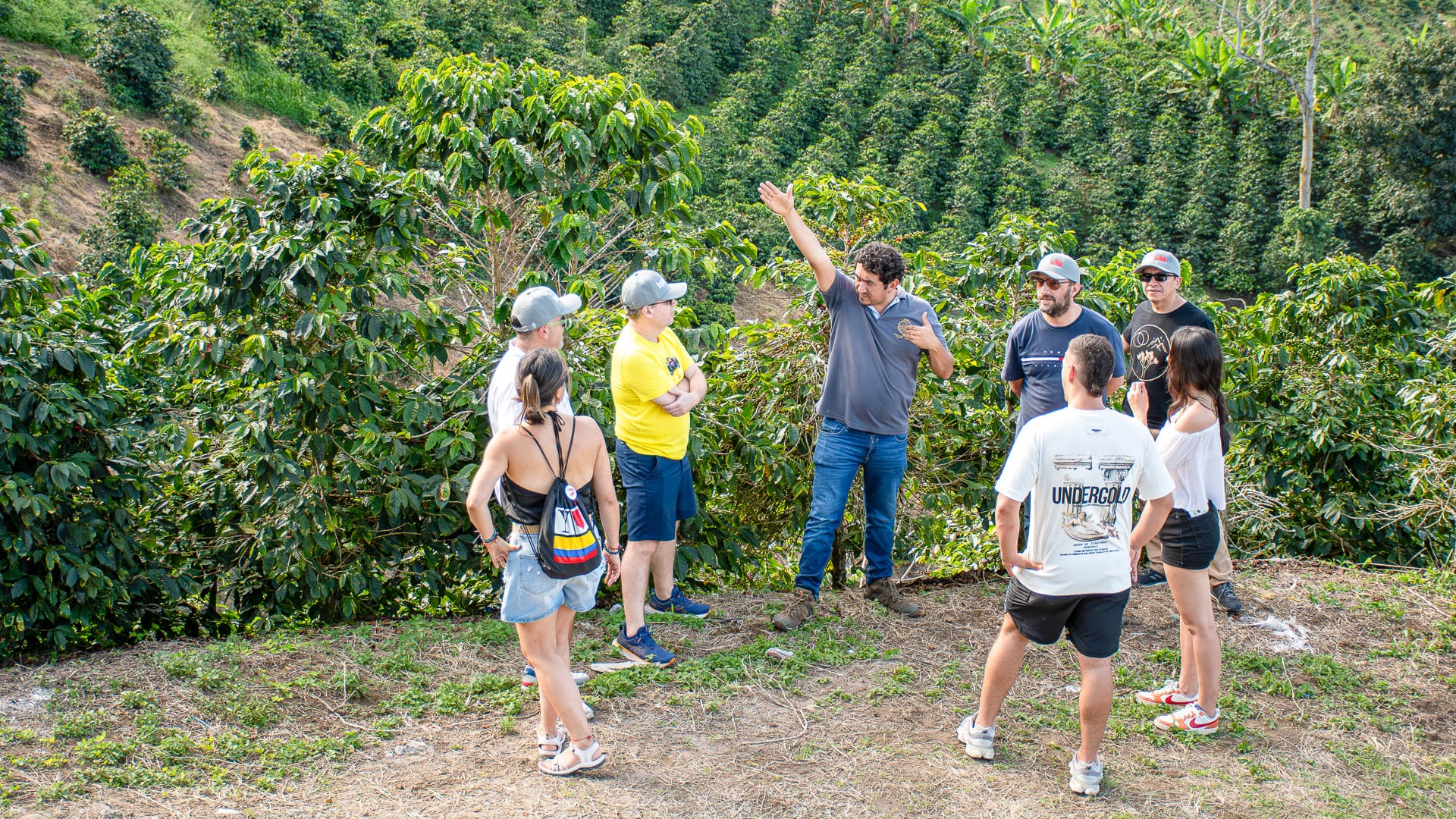
Non-cyclists visit a coffee farm in the Colombian Coffee Region and learn about coffee growing and processing. (Photo credit: Beyond The Ride)
Sponsor Message
Considering cycling Alto de Letras?
Beyond The Ride draws on decades of experience in cycling tourism and deep local expertise in Latin America to create guided and self-guided cycling holidays in the Alto de Letras region.
Their tours combine challenging rides with seamless logistics, cultural experiences, recovery support and carefully planned activities for non-cycling companions.
Head to their website to find out more.
Got a question for Beyond The Ride?
Fill out this form and we will pass it to Beyond The Ride who aim to reply (within 24 hours wherever they can!)
Part 6: What tips help cyclists prepare for Alto de Letras?
How should cyclists prepare for the altitude?
Fitness does not prevent altitude illness. Risk depends on elevation, speed of ascent and individual susceptibility.
Keep your early efforts controlled, drink regularly, eat enough carbohydrate and limit alcohol.
Headache, nausea, dizziness and unusual fatigue can indicate altitude illness. Do not continue higher if symptoms worsen.
Anyone with a relevant medical condition should speak to a clinician familiar with altitude before travelling.
For more information on altitude check out our guide to altitude training!
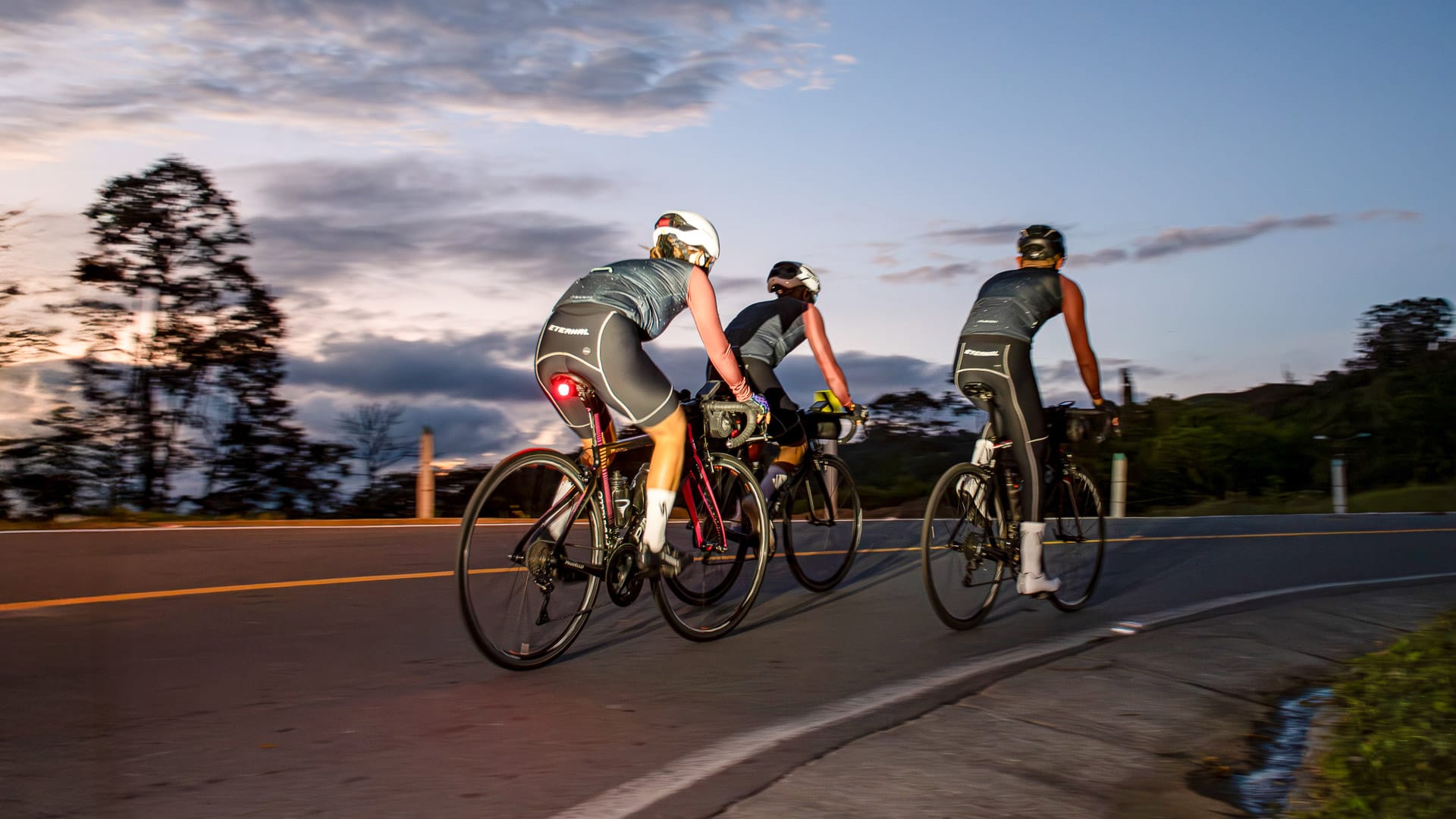
We start riding early to make the most of the sunlight and avoid the afternoon rainfall. (Photo Credit: Fotografo Alto de Letras)
How fit do cyclists need to be?
We suggest our guests allow at least eight weeks of specific preparation.
We think it’s a good idea to build aerobic endurance, include one long weekly ride and practise climbing at a steady pace.
Useful sessions include:
- Low-cadence hill repetitions.
- Longer threshold efforts.
- Over-under intervals.
- Consecutive riding days.
- Practising eating and drinking during long rides.
Before departure for a Beyond The Ride tour, we ask about your recent cycling and fitness. On our women-only tour, we also consider pace compatibility to reduce large differences within the group.
For riders who would benefit from a little more flexibility, our Senior 55+ tours can be adapted by changing the starting point of the routes. E-bikes are also available.
How should cyclists pace and fuel the Alto de Letras climb?
Here are my tips!
- Start below the effort that feels possible.
- The lower half is warm and comparatively forgiving. This makes it easy to ride too hard.
- Break the climb into its four sections. Eat before you are hungry and add clothing before you become cold.
- Food and water are available in Fresno, Petaqueros, Padua and Mesones. It is worth carrying cash.
- There are few services during the final 15 kilometres of the classic climb. There are no dependable supplies after Murillo on the Sifón route.
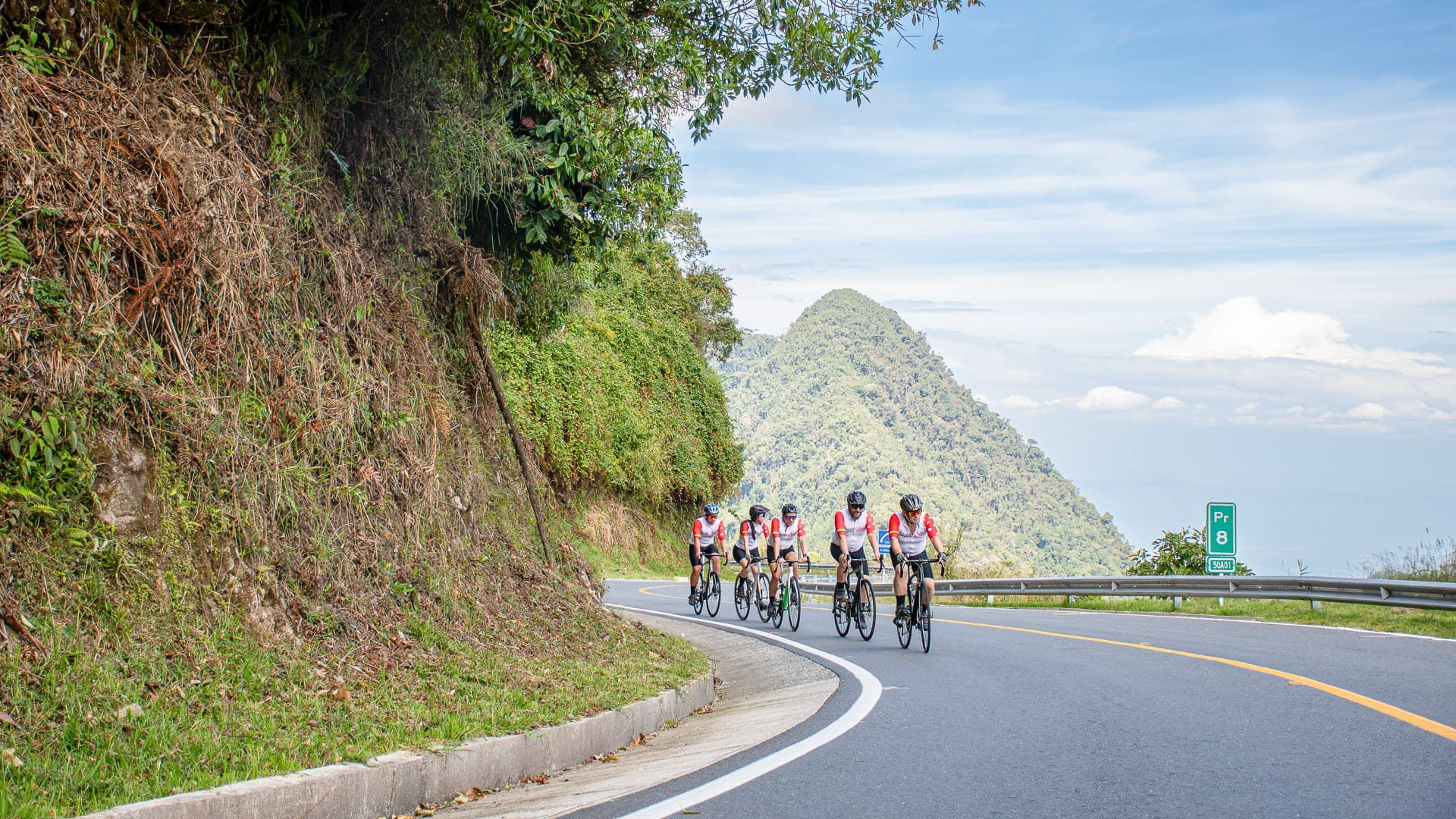
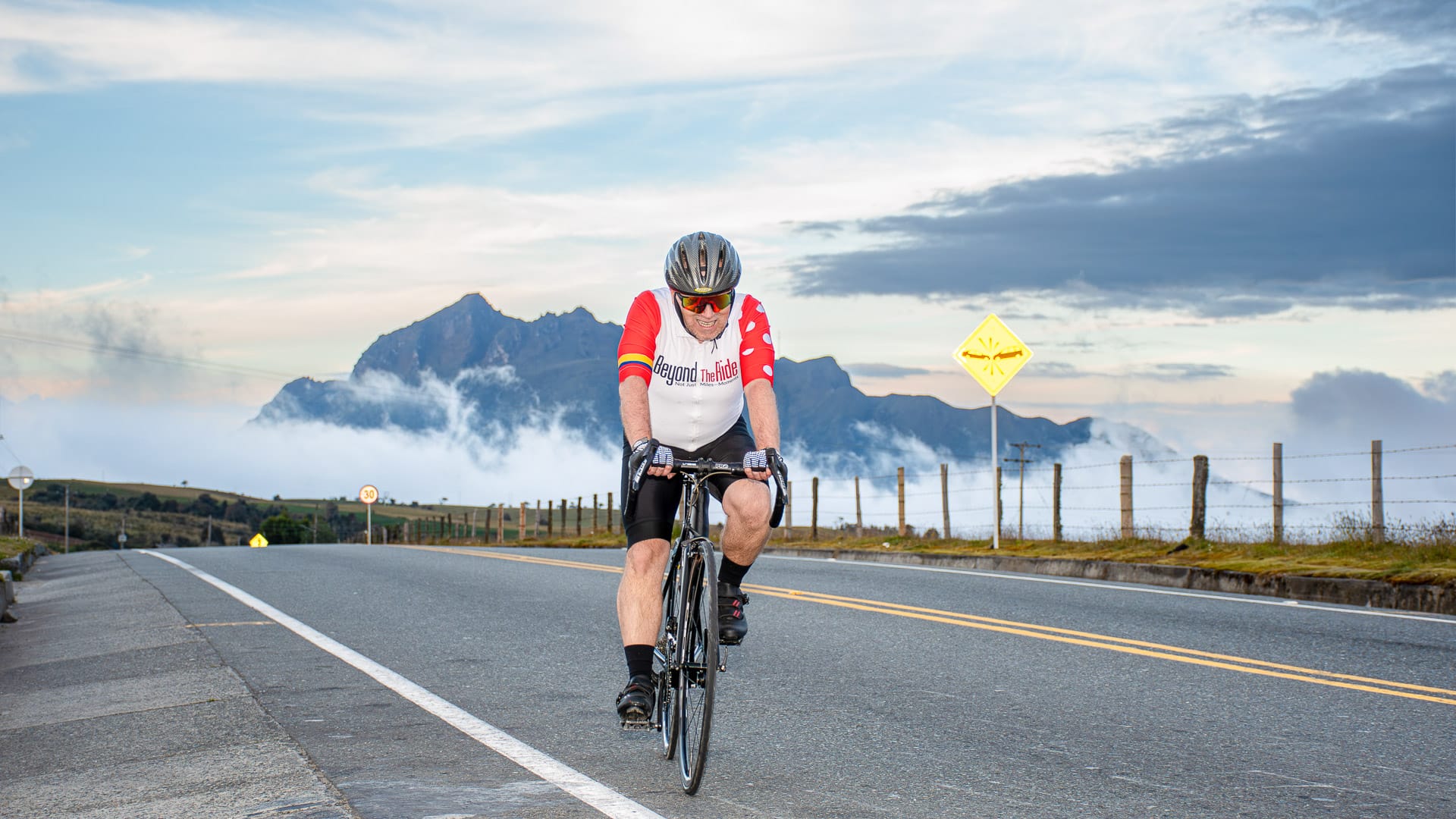
It’s not about speed or power but cadence and patience. Find a pace that works for the group and stick to it. (Photo credit: Beyond The Ride)
What should cyclists know about mobile reception and payments?
Mobile reception is available along much of the classic route but has gaps. Signal becomes less reliable on the Alto del Sifón side after Murillo.
It is also worth carrying Colombian pesos, as small shops and local service providers may not accept cards.
Several eSIM providers work well in Colombia, including Simovo, Saily, Airalo, Holafly, Jetpac and 4S eSIM. For trips of seven days or less, 4S eSIM can be a good option, while Saily may suit longer stays. If you are travelling through other countries in South America, Simovo can be useful for more seamless regional coverage.
What kit should cyclists bring?
Pack for several climates:
- Helmet
- Sunglasses
- Short-finger and full-finger gloves
- Windproof or water-resistant jacket
- Lightweight warm layer
- Front and rear lights
- Sunscreen
- Puncture repair kit
- Pump or inflator
- Familiar shoes and pedals
- Dry summit clothing in the support vehicle
Jeans or trousers and a sweater are useful in Bogotá and Manizales. Shorts and swimwear suit the heat around Mariquita.
We strongly suggest bringing your own cycling shoes and pedals. Familiar footwear is particularly important on a seven-day tour, when trying new shoes could lead to discomfort over long days in the saddle. Hiking shoes are useful for Falan and Valle del Cocora.
For more information on packing, check out our ultimate cycling holiday packing list article.
How safe is cycling in the region?
Ride defensively and aim to complete intercity stages in daylight. Traffic can be unpredictable, and longer rides are best finished before dark. Reduced visibility, heavy commercial traffic and poorly lit rural roads all increase the risks at night, particularly outside towns and cities.
Cyclists are a common sight on Colombian roads, and cycling culture is very strong across the country. Even so, it is important to stay alert and ride predictably around other traffic.
Build some margin into each day rather than planning around a tight arrival time. Weather, roadworks, traffic and mountain terrain can all slow progress, and heavy rain can affect road conditions quickly. In the Andes, landslides and flooding are possible after prolonged rain, so check local conditions before setting off.
Keep your bike and valuables secure and discreet. Store expensive bicycles indoors or in secure accommodation wherever possible, particularly overnight. Avoid displaying phones, cameras, jewellery or other valuables unnecessarily, especially in busy urban areas.
Colombians often describe this common-sense approach as “no dar papaya”, in other words, don’t make yourself an easy target. There is no need to be overly cautious, but a little awareness goes a long way.
Take extra care in remote areas. Security conditions vary considerably across Colombia, so stick to established routes and check the latest advice before riding through more isolated regions. Avoid improvised shortcuts or unfamiliar tracks in areas where there may be security concerns, and ask locally if you are unsure about a particular road.
For longer or more remote rides, let someone know your planned route and expected arrival time. Mobile coverage can also be limited in rural areas, so do not assume you will always be able to make a call or use online navigation.
Follow Colombian traffic law and ride predictably. Obey signs and signals, use lights in poor visibility, signal clearly and avoid using a phone or headphones while moving. Wearing a helmet is mandatory, and cyclists may receive a traffic fine for riding without one. Even when you have priority, assume other road users may not have seen you and be prepared to slow down or give way.
On our tours, riders are accompanied by a SAG (Sport and Gear) vehicle and support motorcycles. The motorcycles escort the group and help protect cyclists from vehicles approaching from behind, while the SAG vehicle stays close by to collect riders if needed and assist with punctures, chain changes and other minor mechanical problems.
Food and hydration are also carried in both the SAG vehicle and on the support motorcycles. At set intervals, the SAG vehicle stops so riders can refuel and top up their hydration during the ride.
Top tips: ride in daylight, stick to sensible routes, stay visible in traffic and keep expensive kit discreet.
Make sure to check the current travel advice before travelling, and take a look at UK government travel advice for more information on safety in Colombia.
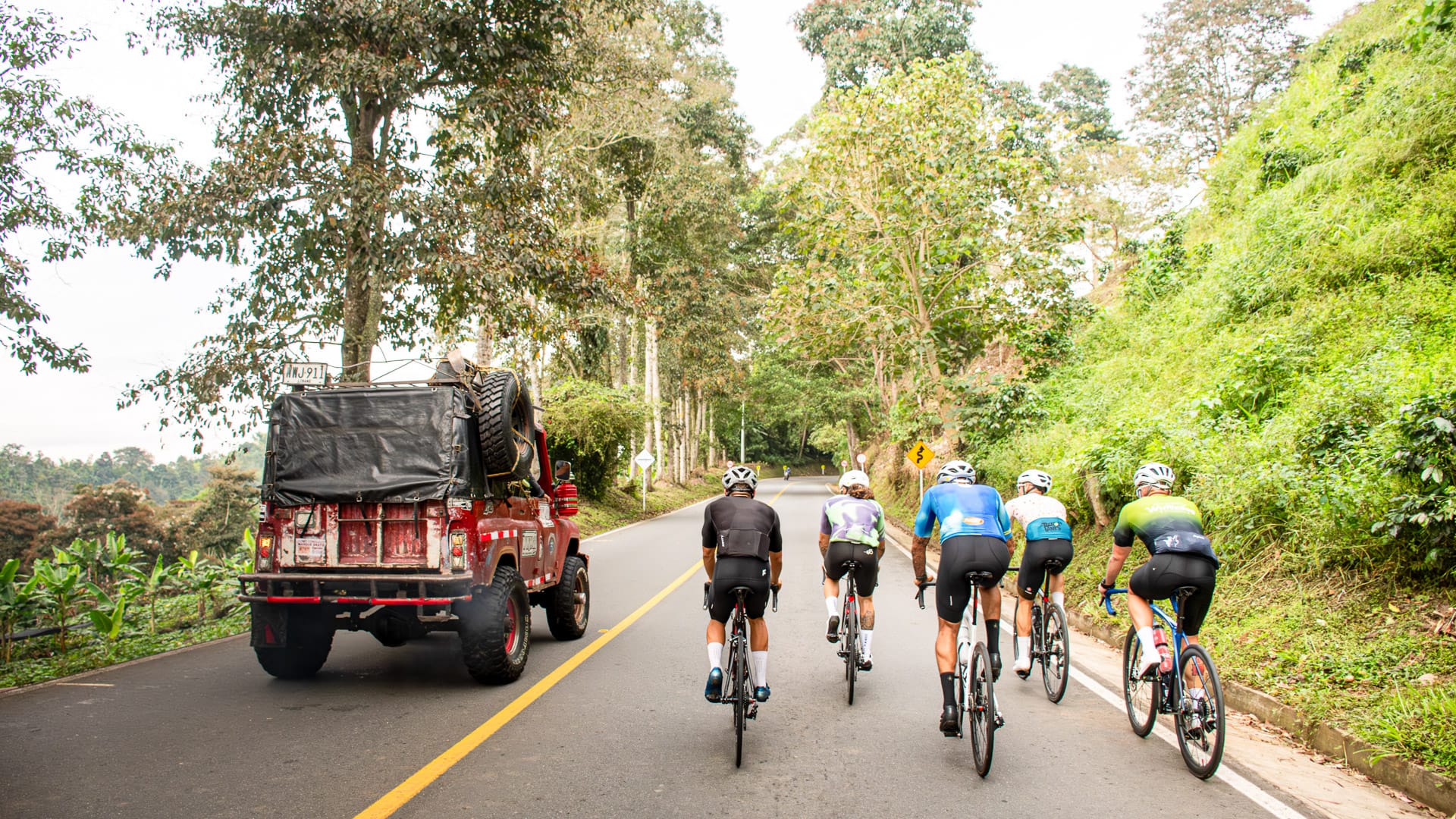
Motorists are used to share the road with cyclists. Always follow the rules and ride defensively. (Photo credit: Fotografo Alto de Letras)
Do cyclists need a support vehicle?
I’d say that a suitable vehicle is close to essential on the major climbs. These are very significant climbs at high altitude and things can go wrong. Having a support vehicle gives you support – it can carry things like:
- Food and water
- Tools and spare equipment
- Dry clothing
- Spare e-road bike batteries
- Luggage
- A cyclist who cannot continue
- Bikes after the summit
A support vehicle also solves the problem of returning from the pass.
Public transport is not designed around carrying bikes, and ordinary ride-share cars may not have enough space.
What food should cyclists try?
In Bogotá, look for ajiaco santafereño, a chicken, potato and corn soup.
Tolima specialities include lechona and tamal tolimense. Mariquita is also a good place to sample tropical fruit and fresh juice.
On the Alto de Letras mountain, try agua de panela con queso.
Arepas, bread and coffee are useful roadside fuel. Cholado, made with shaved ice, fruit and condensed milk, makes a good post-ride treat.
In the Coffee Region, look for sancocho and cazuela de frijoles.
Roadside stops are part of the experience. They also provide a chance to see how the food, farming and local culture change as the road rises.
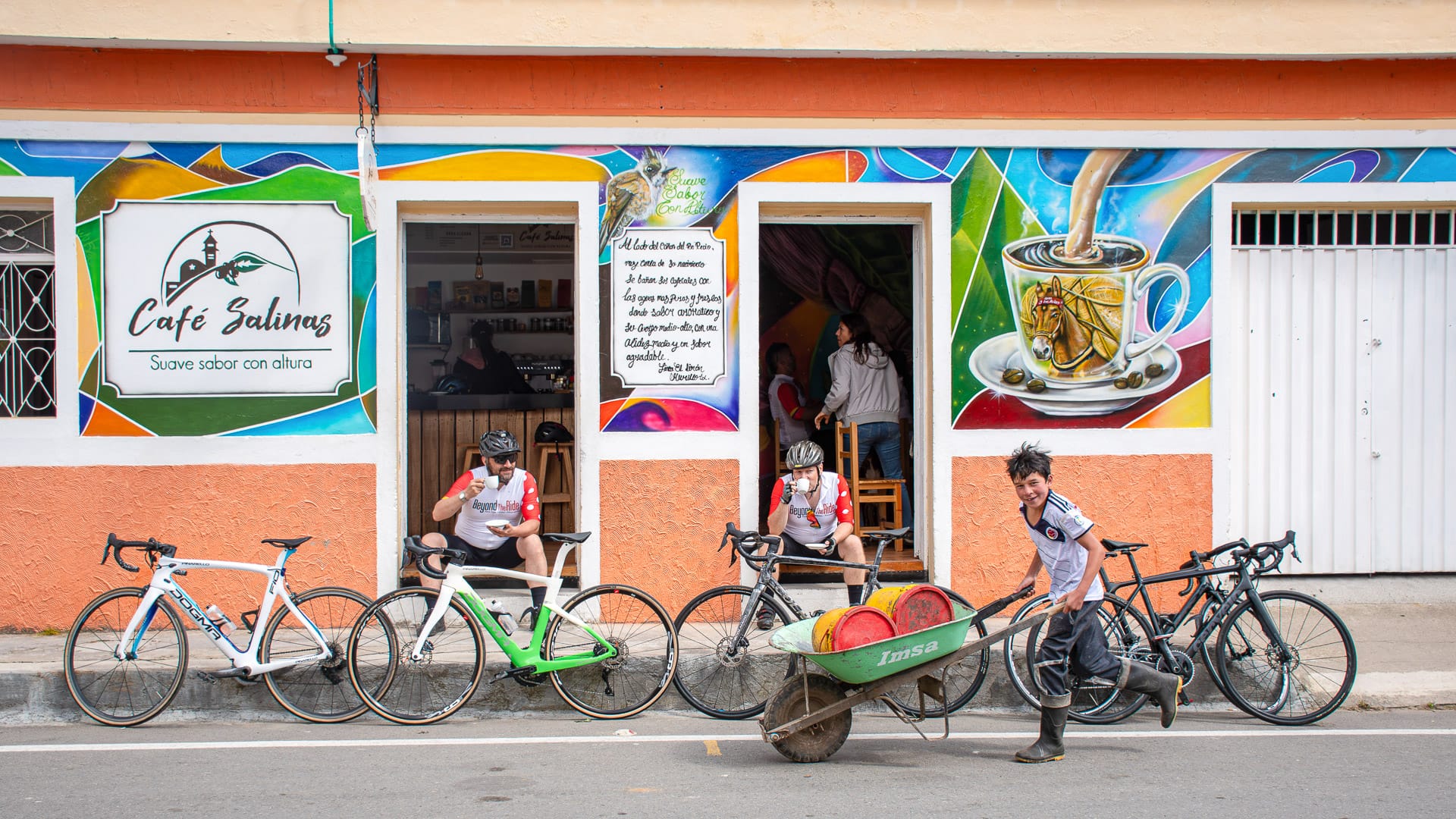
Murillo (Tolima), included in the UNESCO-recognized Coffee Cultural Landscape of Colombia, exemplifies the region’s living agricultural heritage. This is the last refuelling place before entering high mountain terrain. (Photo credit: Beyond The Ride)
Do cyclists need to speak Spanish?
Do not expect people to speak English outside larger hotels.
Useful Spanish phrases include:
- Hello: Hola
- Please: Por favor
- Thank you: Gracias
- Water: Agua
- Bathroom: Baño
- I need help: Necesito ayuda
- I feel unwell: Me siento mal
- Call a doctor: Llame a un médico
- Puncture: Llanta pinchada
It is worth downloading an offline translation pack before travelling!
Sponsor Message
Considering cycling Alto de Letras?
Beyond The Ride draws on decades of experience in cycling tourism and deep local expertise in Latin America to create guided and self-guided cycling holidays in the Alto de Letras region.
Their tours combine challenging rides with seamless logistics, cultural experiences, recovery support and carefully planned activities for non-cycling companions.
Head to their website to find out more.
Got a question for Beyond The Ride?
Fill out this form and we will pass it to Beyond The Ride who aim to reply (within 24 hours wherever they can!)
Part 7: What does Beyond The Ride offer?
Guided cycling holidays in Colombia
My wife, Luisa, and I created Beyond The Ride with the experience we gained from own outdoor trips have included hiking in Grand Teton and Zion National Parks, skiing in Colorado and gravel cycling in Texas. These experiences helped shape the type of supported outdoor holiday we wanted to offer in Colombia.
Beyond The Ride developed from welcoming guests through Airbnb as a way to keep the family property. Cyclists soon started booking before attempting Alto de Letras.
They repeatedly raised the same problems. There was little dependable cycling accommodation, limited information in English and almost no support designed around international road cyclists. We decided to create a company to help these international road cyclists.
We now support solo cyclists, clubs, women’s groups, older riders and families where one person rides and the others want a cultural holiday.
What we offer?
Our “Not Just Miles-Moments” approach combines supported riding with culture, recovery and a parallel programme for companions.
We usually limit guided groups to six to eight cyclists. This helps our guides understand each rider’s pace and adjust the day where necessary.
Our guided packages include:
- Premium road bike
- Cycling kit
- Premium villas and boutique hotels rated four stars or above
- Airport and ground transfers
- All breakfasts and lunches, plus dinners on all days except days 1 and 6
- On-road food and hydration
- Spanish- and English-speaking bilingual guide
- Support vehicle
- Mechanical assistance
- Entrance fees
- Sports massage
- Companion programme
Meals focus on typical Colombian cuisine. For cyclists, they are prepared with performance and recovery in mind. Snacks and soft drinks during the day are also included, while alcohol is not included.
Day 6 is reserved for the farewell or celebration dinner, which is not included in the package price.
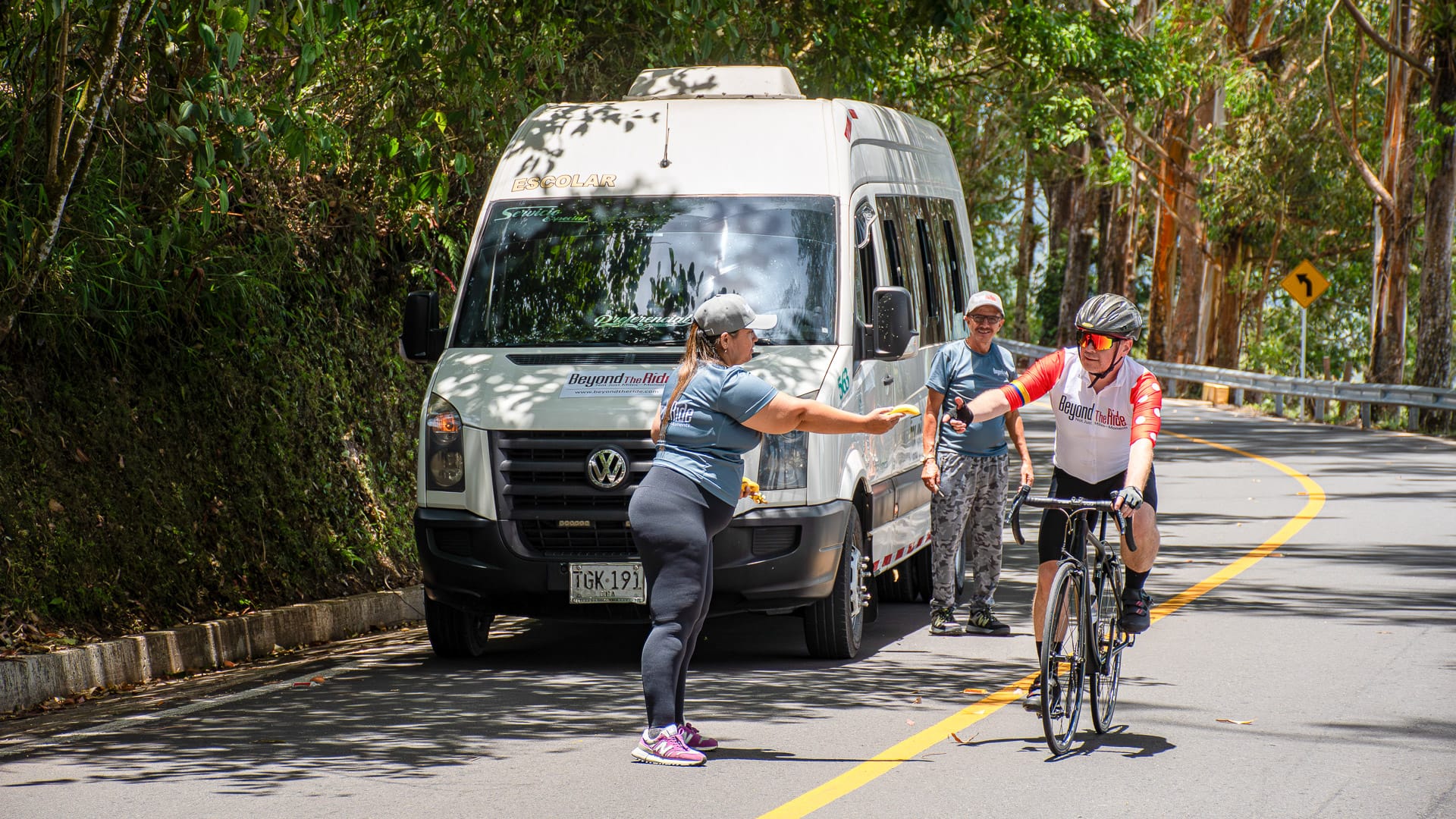
Adequate logistics en route make all the difference in long climbs, like Alto de Letras o Alto El Sifon. (Photo credit: Beyond The Ride)
Which Alto de Letras bike tours are available?
| Tour | Format | Who it suits |
| Alto de Letras Challenge | Seven days, guided, four riding days, maximum eight cyclists | Experienced riders wanting both major climbs and cultural activities |
| Alto de Letras Express | Three days, guided and supported, maximum eight cyclists | Riders with limited time who want the classic climb and introductory stage |
| Alto de Letras Essential | Three days, private and largely self-guided | Established groups wanting accommodation and vehicle support without the full guided package |
| Women Riders Only | Seven days, guided, maximum eight cyclists | Women wanting pace-matched groups, flexible starts and an e-road bike option |
| Senior Riders 55+ | Seven days, guided, maximum eight cyclists | Older regular cyclists wanting flexible pacing, extra recovery and optional shortened starts |
| Land of Coffee | Longer cultural cycling holiday | Leisure and intermediate cyclists travelling with family or companions |
On our Senior Riders 55+ tour, there is no minimum speed.
You ride at your own pace between agreed meeting points. The support vehicle remains with cyclists towards the back.
We can adjust private departures around your dates, start and finish cities, trip length, accommodation, food, cultural programme and preferred level of route support.
We require all guests to have travel medical insurance with at least US$100,000 of medical and emergency evacuation cover. The policy must include cycling and hiking. Please check the current wording before booking.
Can cyclists use e-road bikes?
We offer Specialized Turbo Creo e-road bikes, subject to tour, size and availability.
Battery range varies with rider weight, assistance level, temperature and gradient. We estimate around 30 kilometres of assistance from one battery, or approximately 45 kilometres with additional capacity.
You must still be able to pedal throughout. Do not assume the assistance will last to the summit.
Our women-only and Senior Riders 55+ tours currently include an e-road bike option.
What makes our trips different?
What sets our trips apart is the amount of organisation we handle before and during the holiday.
You do not need to arrange separate transfers, bike delivery, summit collection or luggage movement.
Our support vehicle carries food, tools, dry clothing and spare equipment.
We do not leave non-riding partners with an empty day. Their programme might include coffee farms, historic towns, nature walks or cultural visits before everyone meets again later. We understand everyone is important on our trip.
Our small-group format also allows us to adjust pacing, starting points and daily plans.
This means you can concentrate on the ride. We remove much of the uncertainty, while the physical challenge remains firmly in your own legs.
For us, Beyond The Ride is about making the experience around the cycling as memorable as the riding itself. We take care of the logistics and support so you can focus on the challenge, enjoy Colombia and share the experience with the people you are travelling with. Whether Alto de Letras is your main goal or one part of a wider Colombian adventure, we want you to leave with much more than kilometres in your legs.
Get in touch via our website; we’d love to hear from you!
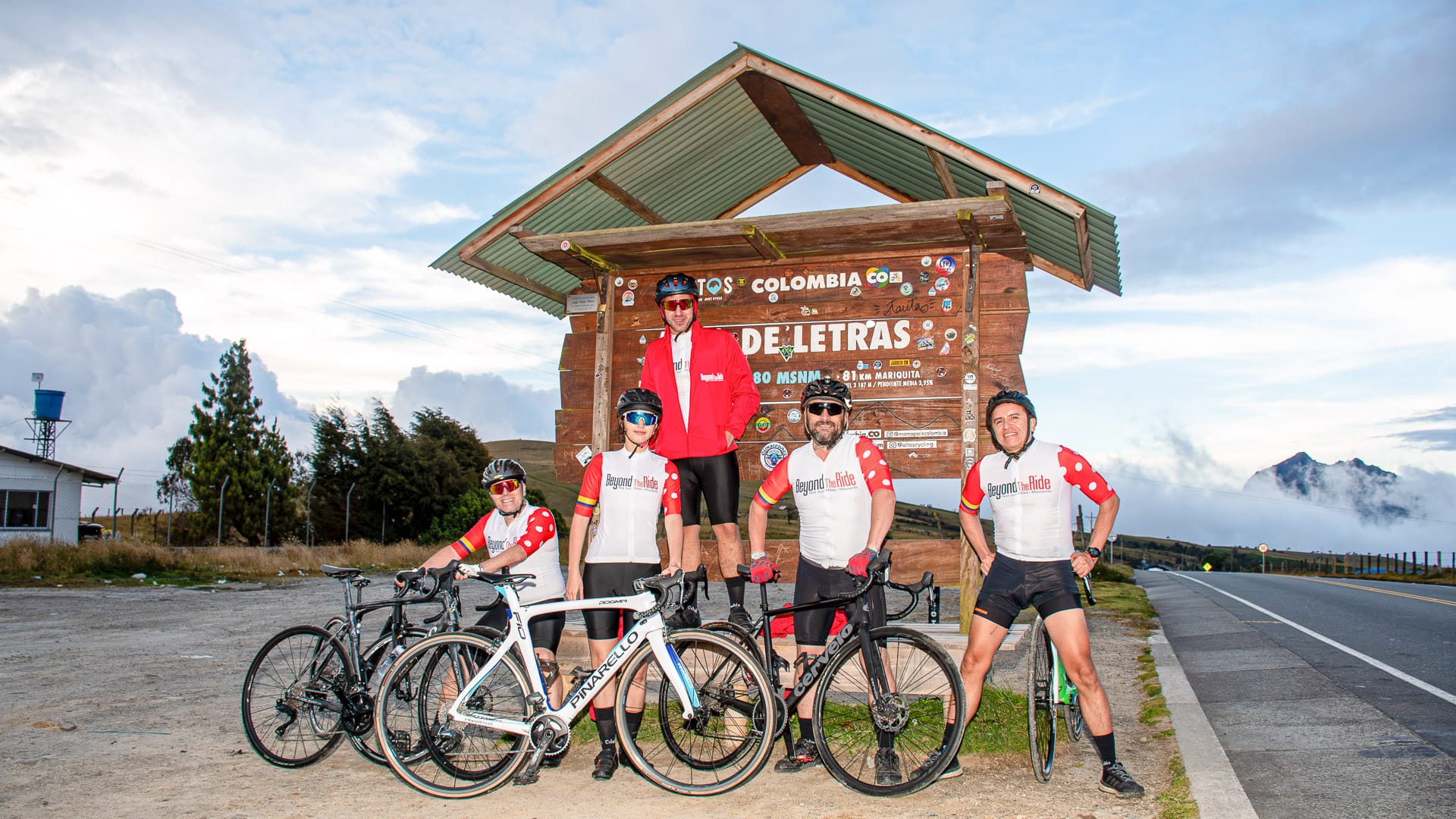
This is the mythical Alto de Letras! A testament to your effort and determination. Congratulations! (Photo credit: Beyond The Ride)
What’s next?
Thanks to David Giraldo for sharing these insights on cycling the Alto de Letras region in Colombia.
Have you been on a bicycle tour of Colombia before? We’d love to hear from you! Drop us a comment below.
Looking for more exciting cycling content? Don’t miss:
- Cycling Northern Vietnam
- How to plan a Chile cycling tour
- Cycling South America
- World’s best long distance cycling routes
- Ultimate cycling challenges
Got a question for Beyond The Ride?
Fill out this form and we will pass it to Beyond The Ride who aim to reply (within 24 hours wherever they can!)
Got a question for David?
Fill out this form and we will send it to David. We aim to get you an answer within 24 hours where possible!David is the co-founder of Beyond The Ride, alongside his wife, Luisa, Director of Operations. They run premium, all-inclusive cycling tours across Latin America, built specifically to remove the barriers that stop international cyclists from riding there safely and comfortably - things such as language gaps, unreliable route information, safety concerns, and a near-total lack of cycling-specific infrastructure in the region.
David is sharing this guide because his family has owned Casa de Campo La Giralda in Mariquita, right at the base of Alto de Letras, for three generations. When his mother passed away and his sisters wanted nothing to do with the property, he listed it on Airbnb just to keep it alive. Cyclists from around the world started booking almost immediately, and every one of them told him the same things: there was nowhere reliable to stay, no English-speaking hosts and no support built for serious riders. That is the gap Beyond The Ride exists to close. David had lived all his life next to Alto de Letras without realising it was one of the most legendary climbs in the world.
Luisa, Director of Operations, has been the one turning that gap into a real operation. She personally manages every detail for every guest and trip they run, which has earned them Superhost status for four years running and made Casa de Campo La Giralda the top-rated stay in Mariquita for cyclists and families alike. Between the estate and Beyond The Ride, they have been hosting and guiding cyclists on Alto de Letras for five years - long enough to know the climb’s every gradient shift, weather pattern and rest point.
They work with a wide range of riders: solo cyclists, cycling groups chasing a bucket-list climb, women cyclists who want to share the experience with their fellow cycling team in comfort and without pressure, and, increasingly, couples or families where one partner rides and the other wants a cultural experience alongside it.
What they all share is that they want the climb without the guesswork: reliable logistics, real support on the road and someone who actually understands what cyclists need.
First Published: 02 September 2026
The contents of this website are provided for general information purposes only. It is not intended to amount to advice and you should not rely on it. You should carry out your own due diligence and risk assessments and take professional advice. Views expressed by interviewees or other users of this website do not necessarily represent our views. We make no representations, warranties or guarantees, whether express or implied, that the content on our website is accurate, complete or up to date. If you use any information or content on this website, download from, or otherwise obtain content or services through our website, it is entirely at your own discretion and risk. Epic Road Rides Ltd disclaims all liability and responsibility arising from any reliance placed on the information and content on this website. Find out more here.
Sponsor Message
Considering cycling Alto de Letras?
Beyond The Ride draws on decades of experience in cycling tourism and deep local expertise in Latin America to create guided and self-guided cycling holidays in the Alto de Letras region.
Their tours combine challenging rides with seamless logistics, cultural experiences, recovery support and carefully planned activities for non-cycling companions.
Head to their website to find out more.
Got a question for Beyond The Ride?
Fill out this form and we will pass it to Beyond The Ride who aim to reply (within 24 hours wherever they can!)