
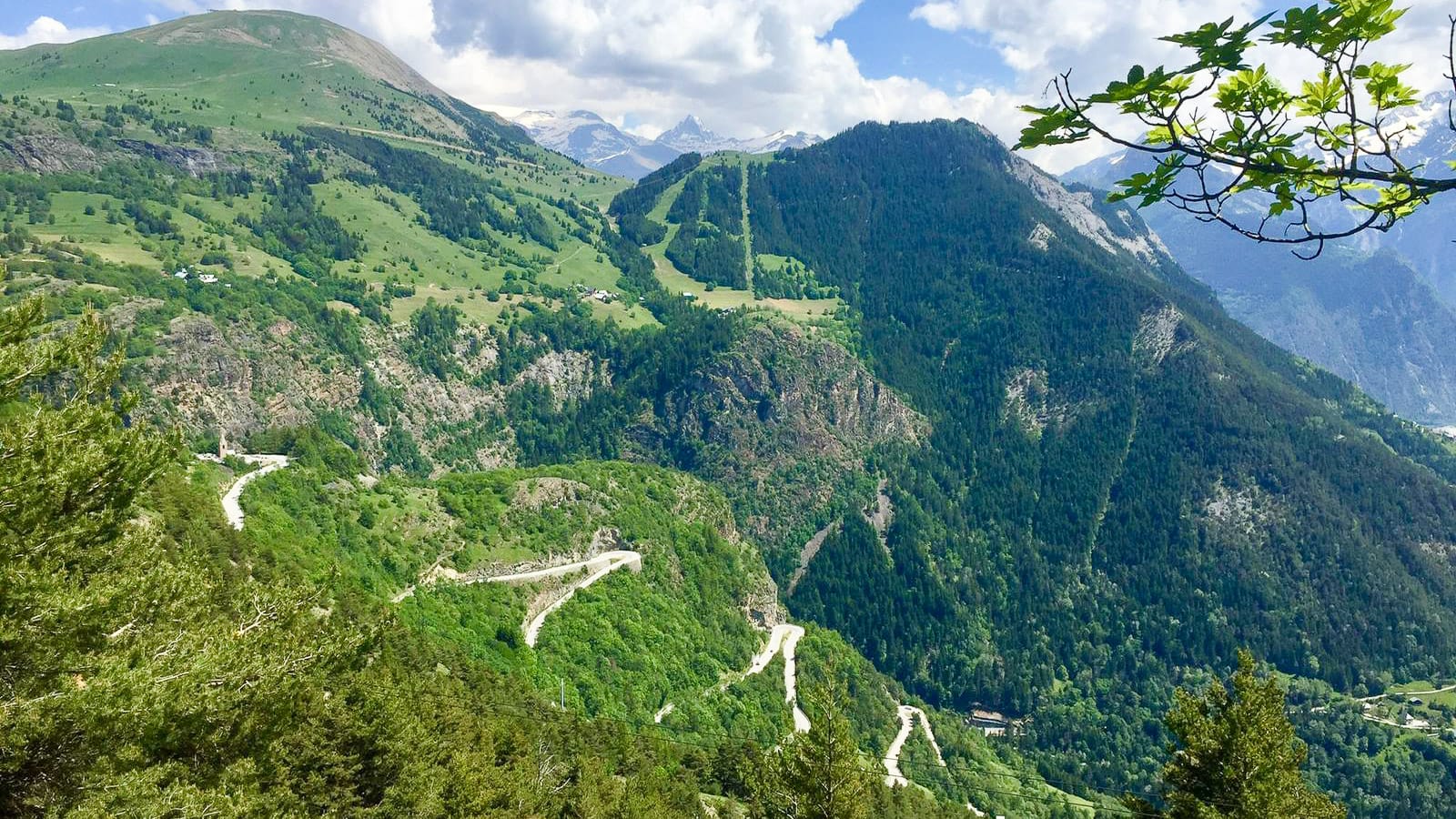
La Marmotte Granfondo Alpes (or cyclosportive if you’re French) needs no introduction. It’s the doyenne of the Marmotte Granfondo series and probably the most famous cycling event on the granfondo/sportive calendar.
The 2026 Marmotte route was 177 kilometres long, with 5,000 metres of climbing. It took riders over the Col du Glandon, Col du Télégraphe and Col du Galibier before the final climb to Alpe d’Huez.
We caught up with Simon Worsley who had completed the Marmotte seven times when we first spoke to him in 2021. He has continued to return to the event since then and rode the 2026 edition. He has now shared his tips and tactics for completing this notoriously tough event; you’ll find his Marmotte course tips, GPX, info on kit, nutrition and Marmotte training. Enjoy!
Don’t miss our more recent article on preparing for La Marmotte!
Always check current travel information and advice. For visitors from the UK, the UK government travel information pages are here.
1. Tell us about the Marmotte Granfondo Alpes
The Marmotte is the oldest and one of the toughest cycle sportives in the world. The first edition was held in 1982.
When I first wrote this article, I described the route as having remained the same for around 20 years.
The core format is still familiar. The event starts in Bourg d’Oisans and finishes at Alpe d’Huez. However, the precise distance and route details can change between editions, so riders should check the current course rather than relying on an older GPX. In 2026, the official route was 177 kilometres with 5,000 metres of climbing.
The event is so renowned due to the notoriety of its route and the fact that it takes in so many famous and tough climbs of the Tour de France.
I first found out about the event in 2008 when staying in the Alps and thought it sounded ridiculous in difficulty level. Four years later, I finished the event for the first time. I had completed it seven times in 2021. I’ve continued to return since then, including riding the 2026 event.
When I first wrote this article, I also noted how popular the event was with northern European cyclists, particularly riders from the Netherlands, Denmark and the UK. In particular, the event is seen as a rite of passage for Dutch cyclists who have an affinity with Alpe d’Huez due to the number of Tour stage winners on the Alpe by Dutch pro riders.
The event continues to attract a large international field. There were 7,500 registrations for the 2026 event, with 80% of entrants coming from outside France (source).
Previous edition winners of the event include Laurent Brochard and former professional rider Laurens Ten Dam. More recently, Baptiste Lombardi won the 2026 edition in 5:07:10. Whilst it is a sportive, it is most definitely a race for the fastest riders, who include many of the best amateur cyclists in Europe.
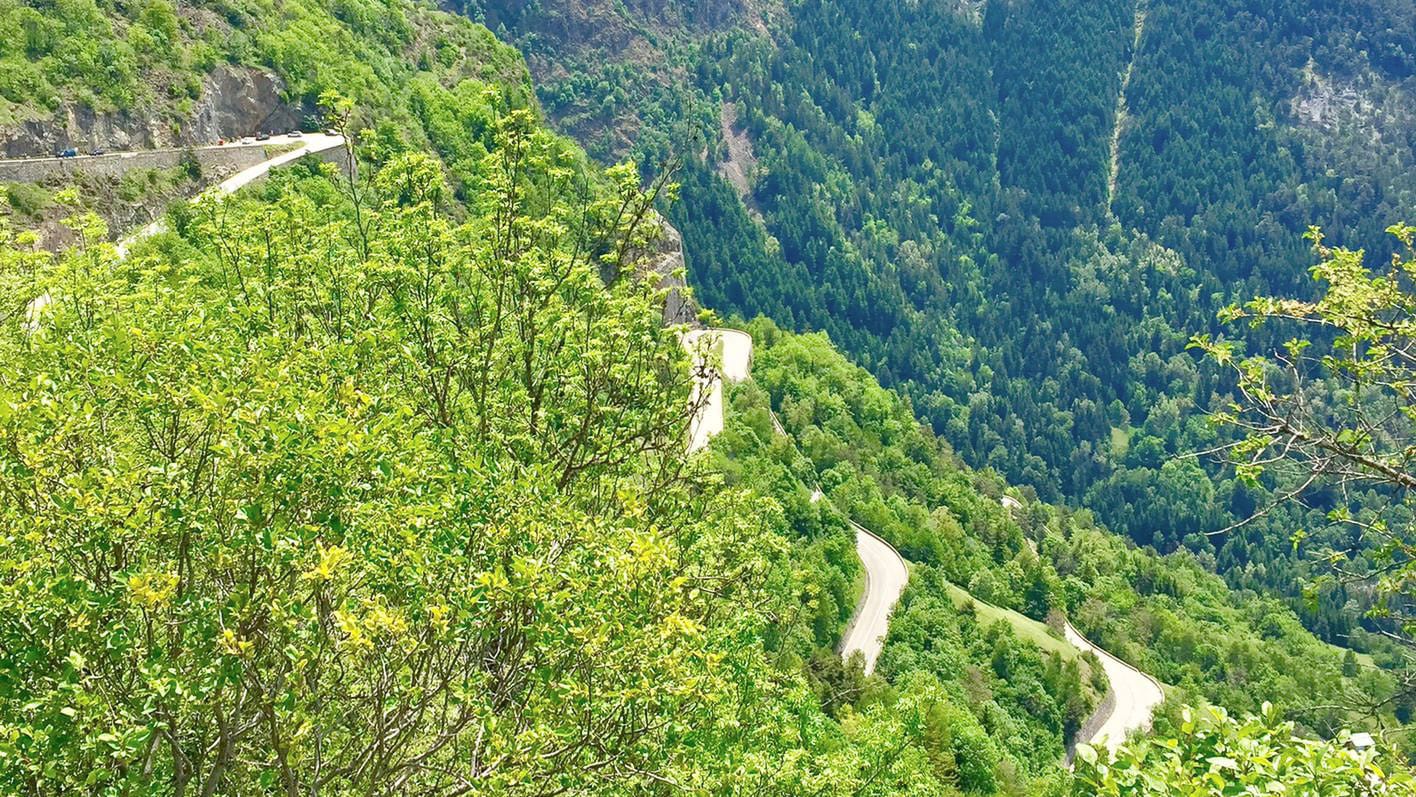
Alpe d’Huez, the last climb on the notorious Marmotte course. The top two switchbacks are 11 and 9. You can see how steep it is between bends 10 and 9! (Photo credit: Von Rees)
2. Describe the La Marmotte profile and route
The 2026 course was 177 kilometres long with 5,000 metres of climbing.
The event starts in Bourg d’Oisans. After an initial flatter section, riders head towards the Col du Glandon. From the Barrage du Verney there are around 24 kilometres to the summit, although short descents break up the climbing.
The Glandon descent is neutralised for safety, with timing paused for this section. Riders then head through the Maurienne valley towards the Col du Télégraphe. The Télégraphe and Galibier section accounts for around 35 kilometres and 2,000 metres of climbing.
There is a short descent from the Télégraphe to Valloire before the Col du Galibier. The north side of the Galibier is around 17 kilometres long. The final kilometres are steep, exposed and above 2,000 metres.
From the Galibier, there is a long descent via the Col du Lautaret towards Bourg d’Oisans. It is around 45 kilometres before the final section of the route. Riders then face the 21 bends of Alpe d’Huez to reach the finish.
Finish times vary considerably. As the Glandon descent is neutralised, the time spent on this section is excluded from a rider’s official time. Timing arrangements can change between editions, so check the current event information before taking part.
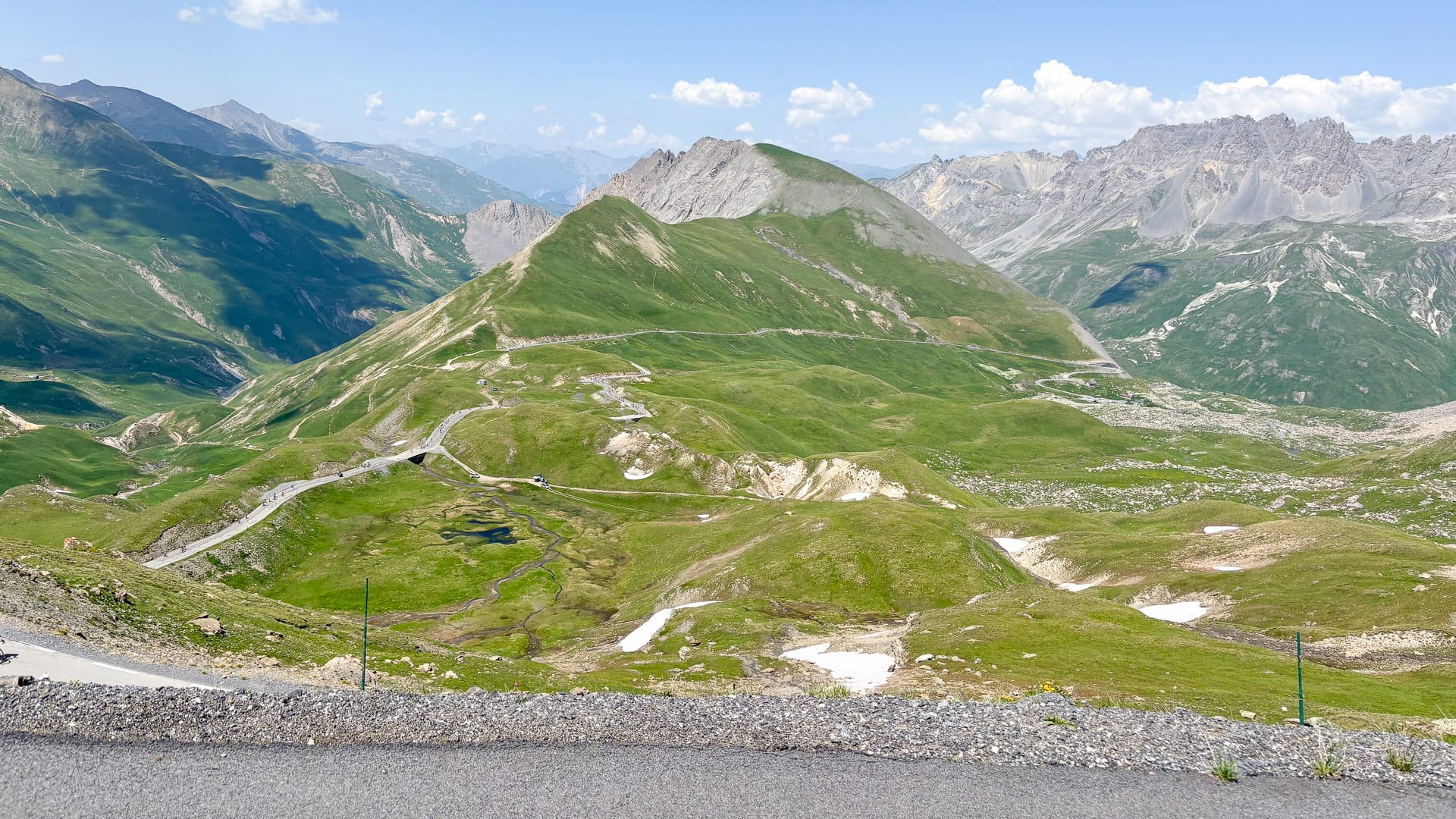
View across the mountains near the top of the Col du Galibier (photo credit: Simon Worsley)
3. What do you love about the event?
I love the toughness of the route, the fact that it takes in climbs with a long Tour de France history, including the Col du Glandon, Col du Télégraphe, Col du Galibier and Alpe d’Huez. It’s very much following in the footsteps of the pros.
Whilst the Etape du Tour is the event that many non-cyclists know about, the Marmotte is one of the amateur events that has the biggest reputation among fellow cyclists.
There is something addictive about that part of the French Alps and the scenery and scale of the climbs and the atmosphere of the event itself, that gets a lot of participants, including me, coming back year after year for another go.
4. What are the highlights of the Marmotte route?
There are a number of highlights. The fast mass start out of Bourg d’Oisans down to the foot of the Glandon is always a lot of fun.
The descent of the Glandon is twisty and technical. It is neutralised for safety reasons, but it comes early in the day and brings together lots of riders on a narrow and twisty descent, with different levels of experience. The official event information confirms that the timing is frozen for this section.
The valley road between the Glandon and Télégraphe is quite busy and open to traffic. The Télégraphe and Galibier climbs can also be busy with vehicles, particularly motorbikes. Finding a good group for the valley road is key. It is slightly uphill and around 20 kilometres long.
The last 8 kilometres of the Galibier are exposed and memorable as you see nothing but cyclists both below you and above you in the distance. It’s like being part of a swarming army of cyclists for the day.
The long descent of the Galibier and Lautaret is around 45 kilometres. In my experience this year, traffic was prevented from travelling against riders on this section. The road is wide and not too technical. For me, it is by far the most enjoyable part of the route.
There were also temporary road closures around the Galibier and Lautaret during the 2026 event, including restrictions on the D902 and D1091.
There then follows the iconic finish climb to Alpe d’Huez. Once you can see the town from around bend 7 at Dutch corner, you know then that you will make the finish line. Of course, the finish is another highlight, as you get cheered on as you pass the various bars, entering the village in the last kilometre.
Overall, it is a very well organised event and I can’t fault the organisation.
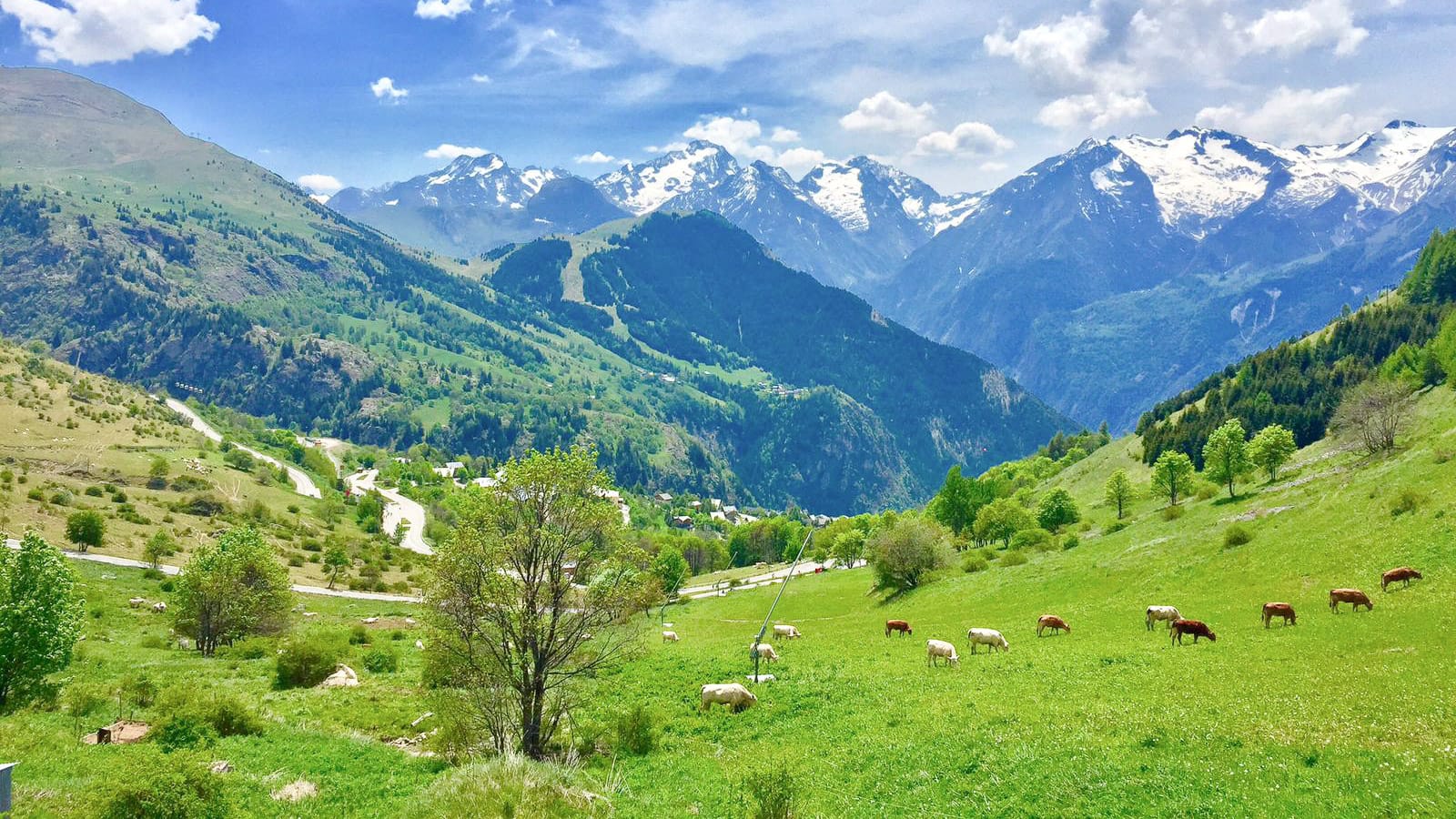
View from bend 2, just before you get into Alpe d’Huez village, loolking down to Huez Village around bends 7-5. (Photo credit: Von Rees)
5. What are the hardest things about taking part in the Marmotte gran fondo?
The amount of climbing involved – at 5,000 metres of vertical ascent!
The climbs are long and difficult to replicate in the UK.
The last part of the Galibier is at over 2,000 metres of altitude, where the air gets thinner. It is also steep and exposed.
Heat is another major part of the challenge. You can’t underestimate how different a challenge the Marmotte becomes when the temperature reaches the mid-30s.
When I first wrote this article, I mentioned the 2013 and 2015 editions, which were run in exceptionally hot conditions. I also remember 2017 being very different, with cold and windy conditions on the Glandon and Galibier, followed by much warmer conditions on Alpe d’Huez.
The cooler editions I remember, including 2024, 2021, 2017 and 2016, were completely different experiences. They felt much more manageable, particularly on the finish climb to Alpe d’Huez.
Four of the last five editions I have ridden have been scorching. The heat really takes its toll, particularly on Northern European riders who aren’t regularly used to riding in those conditions.
This year, I felt I had never been in better shape. I had taken on plenty of electrolytes and carbohydrates, with salt tablets early in the ride. However, my power dropped off on the Télégraphe when the temperature climbed from the low 20s into the low 30s. This is something I still need to work on.
I had been on track for a finish of around 8 hours 30 minutes. I eventually finished in 9 hours 13 minutes. That was 13 minutes outside the gold time target I was chasing for my 50s age group.
The event is very tough both physically and mentally for the above reasons and a serious undertaking for the amateur cyclist.
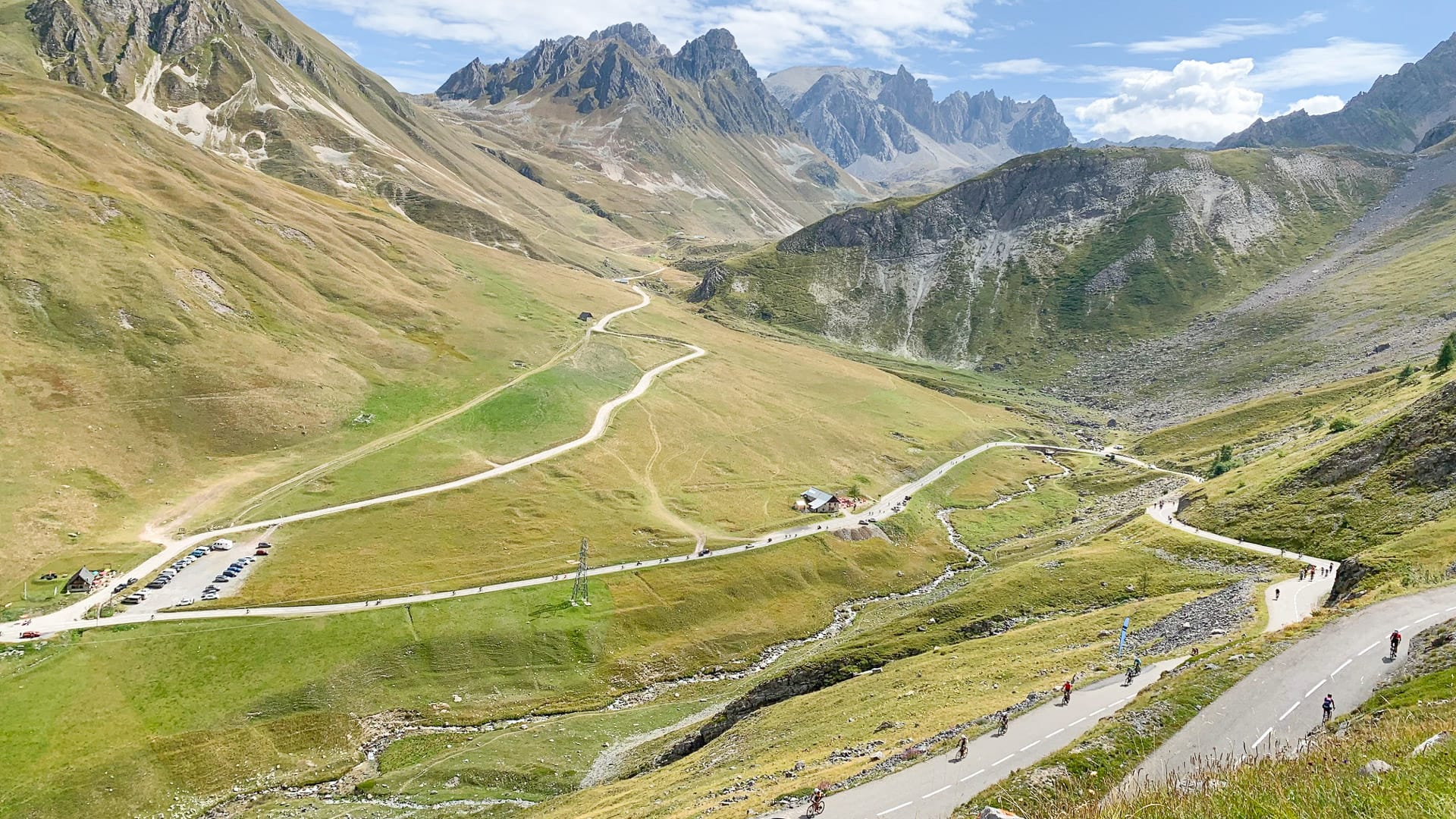
Col du Galibier from Plan Lachat as the road begins to steepen (photo credit: Simon Worsley)
6. Training for the Marmotte: what would you recommend?
Training and nutrition are probably the areas where my approach has changed most in recent years.
How you prepare also depends on your goal. Racing for a high placing, chasing a particular time and simply trying to finish are different challenges.
If I’m chasing a reasonable finish time, I expect to spend much of the ride in high zone 2 or low zone 3. I need to fuel accordingly.
I also find that around 120 to 200 miles per week training is good, including some regular longer rides of 70 to 80 miles. You don’t have to be out smashing a hilly century ride every week.
A training camp is always useful but not essential.
I personally find getting out to the Alps a few days earlier and getting acclimatised helps getting the legs used to Alpine roads again.
Incorporating plenty of hills into the training is helpful given the amount of climbing in the event. Having said that, the style of UK climbs of 1 to 2 kilometres and 8 to 10% gradient in the Cotswolds where I live, is very different to tackling Alpine climbs which tend to be around 6 or 7% average gradient. It all helps though.
I have also spent the last few years training myself to take in around 90 to 100 grams of carbohydrate per hour on tough rides such as the Marmotte.
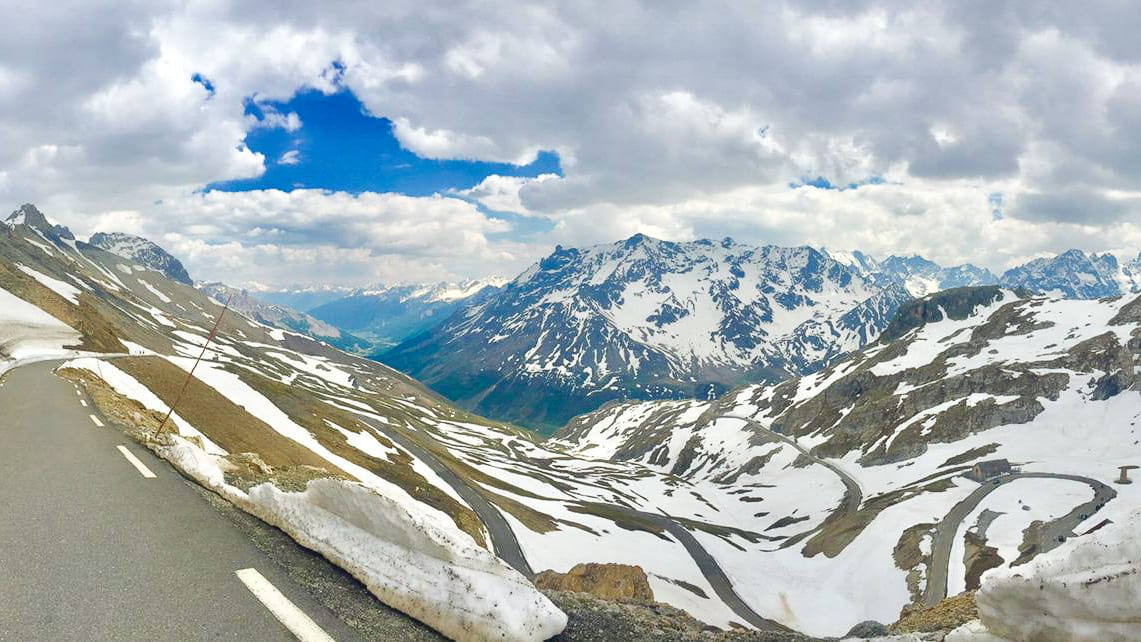
View from the top of the Galibier looking over the climb – there should be less snow around than this for the Marmotte in July!(Photo credit: Von Rees)
7. How do you plan your nutrition for the event?
Nutrition is one of the areas where my approach has changed most since we first wrote this article.
My old strategy was relatively simple. I took a one-litre bottle, started with energy drink and often switched mainly to water later in the event. I carried four or five bars or packs of food and concentrated on eating and drinking little and often.
I still believe in eating and drinking regularly, but over the last few years I’ve focused much more closely on carbohydrates per hour. On tough rides like the Marmotte, I now try to take in around 90 to 100 grams of carbohydrate per hour.
However, this can be easier said than done when the temperature climbs into the 30s by late morning. Trying to absorb enough food and drink while also focusing on the climbing becomes harder as the ride goes on.
In 2026, I fuelled with plenty of electrolytes and carbohydrates and took salt tablets early in the ride. Even so, my power dropped off on the Télégraphe when the temperature rose from the low 20s into the low 30s. It is something I am still trying to improve.
I also now tend to bring my own food and try to keep moving. I mainly rely on the official feed stations for water and energy drink top-ups. In my experience, the quality of the feed stops has declined since Covid.
For the 2026 event, there were four official feed stations:
- Col du Glandon summit at kilometre 36
- Valloire at kilometre 98
- Col du Galibier summit at kilometre 115
- Bourg d’Oisans at kilometre 162
There were also additional water points:
- Saint-Michel-de-Maurienne at kilometre 79
- the Col du Télégraphe at kilometre 92
- Plan Lachat at kilometre 107
- La Garde at kilometre 165
- Huez at kilometre 170
These extra water points can be particularly useful when it is hot.
In earlier editions, I sometimes used the Glandon neutralised section for a longer stop because of the timing arrangement. I also used it to sort out clothing and bottles before crossing the lower timing mat.
The Glandon descent remained neutralised in 2026, with the timing system frozen for this section. However, riders should check the current event information for exactly how the neutralised zone and timing arrangements work before relying on it when planning stops.
8. What do you wear for the event?
As a typical Brit, I tend not to feel the cold too much but do suffer in extreme heat.
I tend to wear normal bib shorts and summer jersey and take arm warmers and gilet (ideally water resistant just in case) for the descents. I do check the forecast for the event carefully, particularly the likely temperature at the top of the climbs.
Even if it’s cold at the top, you’ll descend to warmer temperatures quickly so there’s no need to overdress for the event.
There is also mandatory safety equipment to consider. For the 2026 Marmotte, front and rear lighting were mandatory due to poorly lit tunnels, and riders were also required to wear a visibility waistcoat. Check the current rules before travelling because equipment requirements can change.
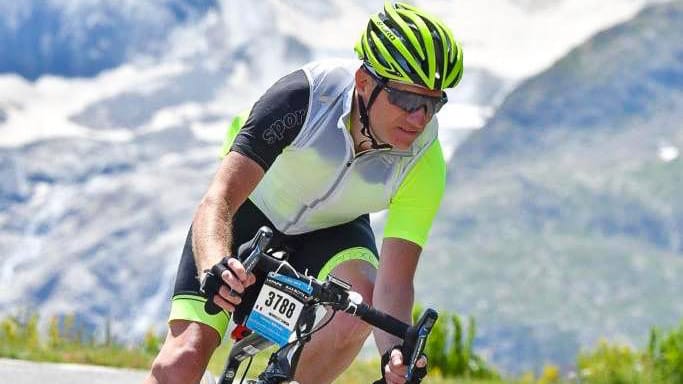
Simon on the descent of the Galibier (credit: Photo Breton)
9. Where do most people stay to ride the Marmotte?
Generally in Alpe d’Huez by the finish, or in Bourg d’Oisans. I’ve tended to stay in Bourg rather than the Alpe as it avoids a cold descent to the start on the morning of the event.
I’ve stayed a number of times with Morethan21bends who have plenty of accommodation in Bourg and also with Cycling Ascents who have accommodation on the edge of town. They both specifically cater for cyclists.
Tour operators tend to have accommodation based on top of the Alpe by the finish. Wherever you choose, check the exact location because staying in Bourg and staying on the Alpe create different logistics before and after the event.
10. What are your top tips for anyone taking part in the Marmotte?
Make sure you know what you are letting yourself in for.
It is a seriously tough event and not one for cycling beginners.
The route is well marshalled, but I’m not sure the Marmotte is suitable for riders who are quite new to cycling. There are long Alpine climbs, fast descents and thousands of other riders to deal with.
Make sure you have enough time to train for the event properly.
When I first wrote this article, I said to “lose as much weight as you can”, because power-to-weight makes a big difference on a route with this much climbing. I would phrase that differently now. Power-to-weight still matters, but the priority should be arriving healthy, properly trained and well fuelled.
How you train should also reflect your goal. Preparing to race for a placing, chase a particular time or simply finish are different things.
Use the feed stops but don’t hang around too long at each one.
Before, my focus was mainly on eating little and often and not spending too long at the feed stations. I still agree with that, but I now pay much more attention to carbohydrates per hour.
I tend to bring my own food and use the feeds mainly to top up water and energy drink. In 2026 there were four official feed stations and five additional water points. See the info above for more on this.
Have your wits about you.
You are riding with thousands of others of varying skills and awareness levels.
The Glandon descent is neutralised, but it is still narrow, twisty and busy. Riders have different levels of descending ability and, in my experience, accidents happen there every year. Try to relax, remain aware of riders around you and keep to the right if you are a steadier descender.
Do not assume the whole course is closed to traffic. Current organiser information says the cyclosportive takes place on roads that are not entirely closed, and riders must obey the highway code and adapt their speed to the road, traffic and weather conditions.
There were temporary road closures for the 2026 event, but these applied to particular roads and times rather than turning the entire course into a closed circuit.
Remember that parts of the route remain open to traffic.
The event takes place on open public roads, although temporary closures and restrictions apply to some sections. The official rules require riders to obey the highway code, ride on the right and adapt their speed to the conditions.
The valley road between the Glandon and Télégraphe can be particularly busy. The Télégraphe and Galibier can also have traffic, including motorbikes.
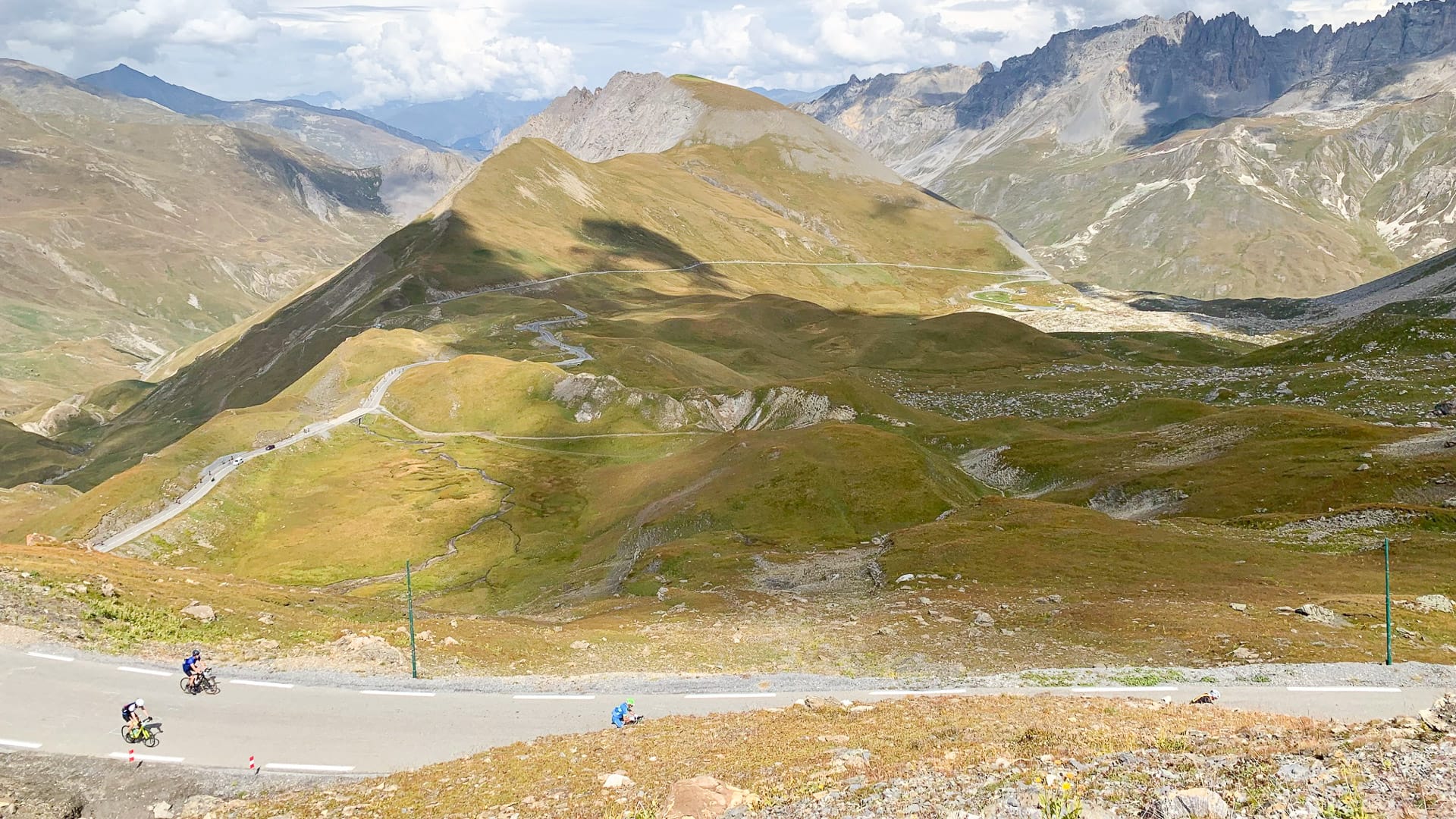
Approaching the top of the Col du Galibier (Photo credit: Simon Worsley)
Make sure your bike and brakes are ready for Alpine descents.
When I first wrote this article, one of my tips was to avoid carbon wheels. At the time, I had seen riders on the roadside after tyre problems and overheating on long descents. That advice mainly reflected the carbon rim-brake equipment that was common at the time.
I would not give a blanket instruction to avoid carbon wheels now. If you are using carbon rim-brake wheels, make sure you have the correct pads and avoid continually dragging the brakes on long descents, as this can cause heat to build up. Follow the wheel manufacturer’s instructions and make sure your tyres, wheels and braking system are in good condition before the event.
Check your start time and start pen.
For the 2026 event, riders started in three waves. Green and yellow numbers started at 06:30, blue numbers at 06:50 and red numbers at 07:10.
Start pens are allocated automatically based on previous results from the organiser’s events. If you have suitable previous results, you can request a different pen before the event, subject to availability. However, you cannot change start pens on the morning of the Marmotte.
An earlier start can mean cooler conditions and less congestion on the opening sections, so check your allocated start time carefully before event day.
In earlier years, I also rode the Trophée de l’Oisans events and found that this could help with my Marmotte start position. That included events such as the Vaujany Granfondo and shorter midweek rides. I would treat that as historical experience rather than a way of securing a particular start pen now, because the current published process is based on previous results and the organiser’s allocation system.
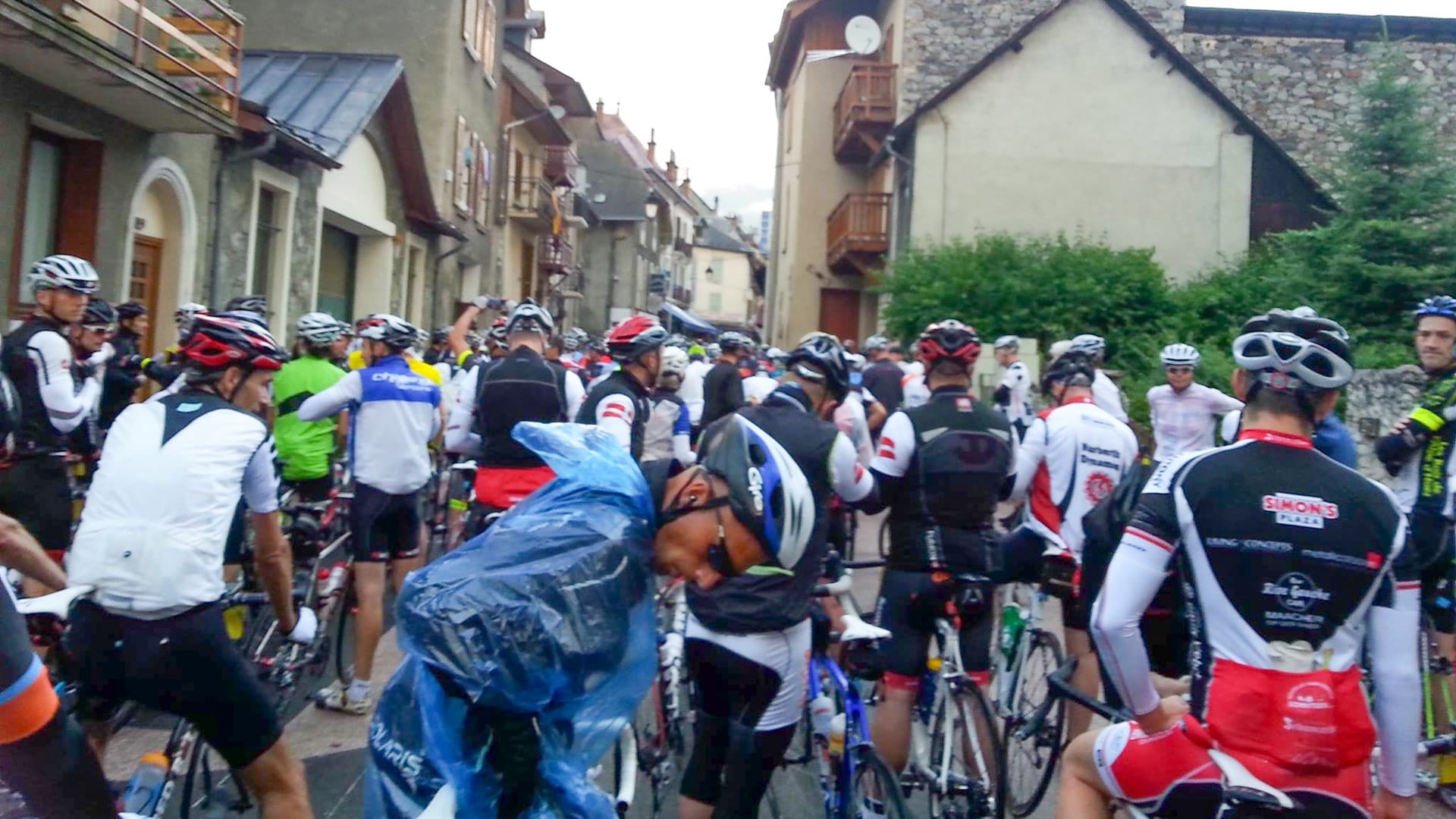
At the start of the Marmotte Gran Fondo (photo credit: Von Rees)
Watch out for the cut-off times
In earlier editions, I remember the cut-off at the bottom of Alpe d’Huez being the only cut-off on the course. The published time varied between editions, sometimes falling at around 6pm or 7pm. In those editions, riders who missed the cut-off could have their timing chip removed but could still continue up Alpe d’Huez for an unofficial finish.
The arrangements were different for the 2026 Marmotte. There were two official time barriers: riders had to reach the summit of the Galibier by 15:30 and the foot of Alpe d’Huez by 17:45. Riders who did not reach these points within the required time were considered out of the event.
There is also a broom wagon on the course. In previous editions, I remember it following the last rider remaining in the timed event.
In 2013, it was really hot and I was definitely in the last 200 riders on the road as I didn’t finish until after 8pm. I was about 400th from last officially. That was also the only year I had the later 7.50am start, and I didn’t get to the bottom of the Alpe until nearly 6pm. It is not an experience I want to repeat.
Cut-off times and procedures can change between editions, so check the information for the year you are entering rather than relying on arrangements from previous years.
There are time targets for different age groups.
When we first spoke, I was chasing the gold time for my age group, which was 8 hours 39 minutes. I got within 13 minutes of it, which was one of the reasons I wanted to return.
In 2026, I was in the M50 age group and was chasing a 9-hour gold time. I had been on track for around 8 hours 30 minutes, but eventually finished in 9 hours 13 minutes.
If you are chasing a particular time, getting as fit as possible and managing your time at the feed stops can make a difference. Time spent stationary soon adds up.
However, your approach will depend on what you want from the event. Racing for a high placing, chasing a particular time or simply trying to finish are different challenges and will affect how you prepare and pace the day.
Be prepared for the heat.
The weather has always been one of the major challenges of the Marmotte. In earlier editions, I experienced some extremely hot days. The 2013 and 2015 events were particularly hot, while the 2017 edition was much cooler on the Glandon and Galibier.
You can’t underestimate how different a challenge the Marmotte becomes when the temperature reaches the mid-30s.
The cooler editions I remember, including 2024, 2021, 2017 and 2016, were completely different experiences and much more manageable, particularly on the finish climb to Alpe d’Huez. Four of the last five editions I have ridden have been scorching.
In 2026, I felt I had never been in better shape and had fuelled with plenty of electrolytes and carbohydrates, as well as salt tablets early in the ride. However, my power dropped off on the Télégraphe when the temperature climbed from the low 20s into the low 30s.
I went from being on track for around 8 hours 30 minutes to finishing in 9 hours 13 minutes. The heat really took its toll.
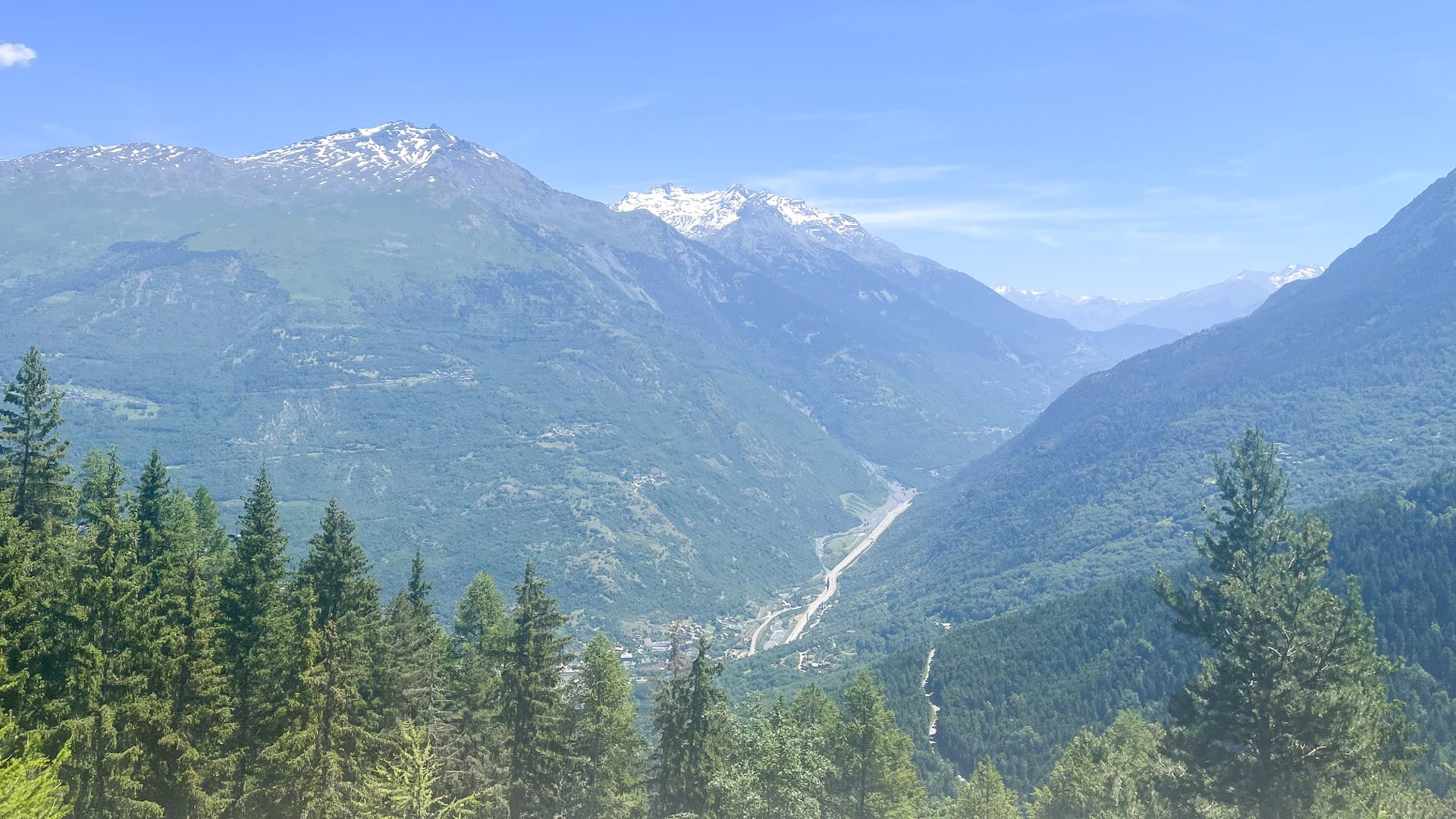
View from the top of the Col du Télégraphe (photo credit: Simon Worsley)
Be aware of later traffic on Alpe d’Huez.
Road restrictions on Alpe d’Huez have always been important for riders, but they do not necessarily remain in place until everyone has finished.
For the 2026 Marmotte, the D211 from Alpe d’Huez towards Bourg d’Oisans was closed to descending traffic until 17:30.
When we rode back down at around 18:00, after finishing the event at around 16:00, there were still hundreds of later finishers working their way up. Traffic was moving on the road again by then.
For me, it felt as though the extra traffic added to the heat and stress for those riders. The temperature at that time almost felt hotter than it had in the early afternoon.
The event is something every keen amateur cyclist should try at least once if they have the experience and preparation for it. I’ve persuaded a number of my club mates to enter, and some of them have ended up coming back more than once for another go.
Final notes: the original article noted that Marmotte participation was capped at 7,500 and that entries could sell out quickly after opening. The 2026 Marmotte also had 7,500 registered riders. Registration dates, availability and arrangements can change between editions, so check the official event website for the year you plan to enter.
What next?!
A huge thank you to Simon for taking the time to share his Marmotte tips and for updating us following the 2026 event. Have you done the Marmotte Granfondo Alps or are you doing it in 2022? Anything you’d like us to ask Simon or other insights you’d like to share? Please get in touch and add your comments below!
If you’re doing La Marmotte Sportive, you may well want to turn it into a holiday and have a few days at the start/end of your trip. Check out:
- Road cycling safety: practical tips for mountain gran fondos with Simon (Coming soon!)
- Cycling Alpe d’Huez (and surrounds): your ultimate guide
- Club des Cinglés du Ventoux: Q&A with Ben Davies
Looking for more granfondo inspiration? Don’t miss:
- 12 of the best UK sportives 2026
- 21 of the best cycling challenges in Europe 2026: sportives, gran fondos and more!
- Ultimate cycling challenges 2026: 12 of the world’s best cycling events for your road cycling bucket list
No excuses not to feel inspired and set yourself an exciting goal for the year ahead!
Please support Epic Road Rides
A huge amount of time and effort goes into the article you’ve just read, all with the aim of helping you!
If you found what you’ve read useful, I’d really appreciate it if you dropped something in the tip jar here.
It’s a way you can say thank you and help us carry on creating top quality content with no annoying ads and no pay wall.
Looking for an organised cycling trip?
If you want someone to help you plan and book your cycling holiday, fill out this form. We aren’t a tour operator/agent but we work with lots of people who are and will do our best to put you in touch with someone that can help (within 24 hours where possible)!Last Reviewed: 23 September 2026
First Published: 02 March 2020
The contents of this website are provided for general information purposes only. It is not intended to amount to advice and you should not rely on it. You should carry out your own due diligence and risk assessments and take professional advice. Views expressed by interviewees or other users of this website do not necessarily represent our views. We make no representations, warranties or guarantees, whether express or implied, that the content on our website is accurate, complete or up to date. If you use any information or content on this website, download from, or otherwise obtain content or services through our website, it is entirely at your own discretion and risk. Epic Road Rides Ltd disclaims all liability and responsibility arising from any reliance placed on the information and content on this website. Find out more here.
Comments