
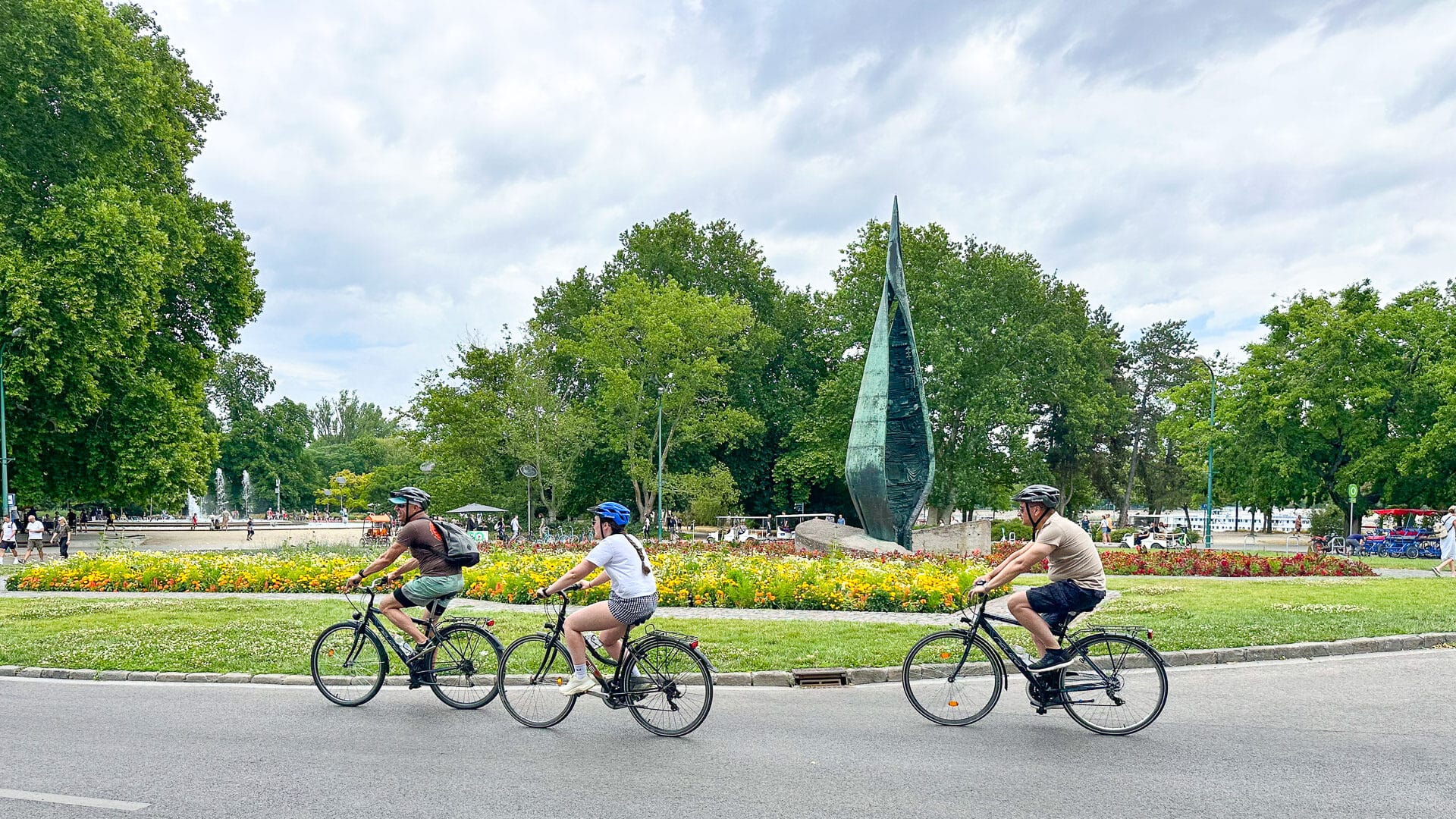

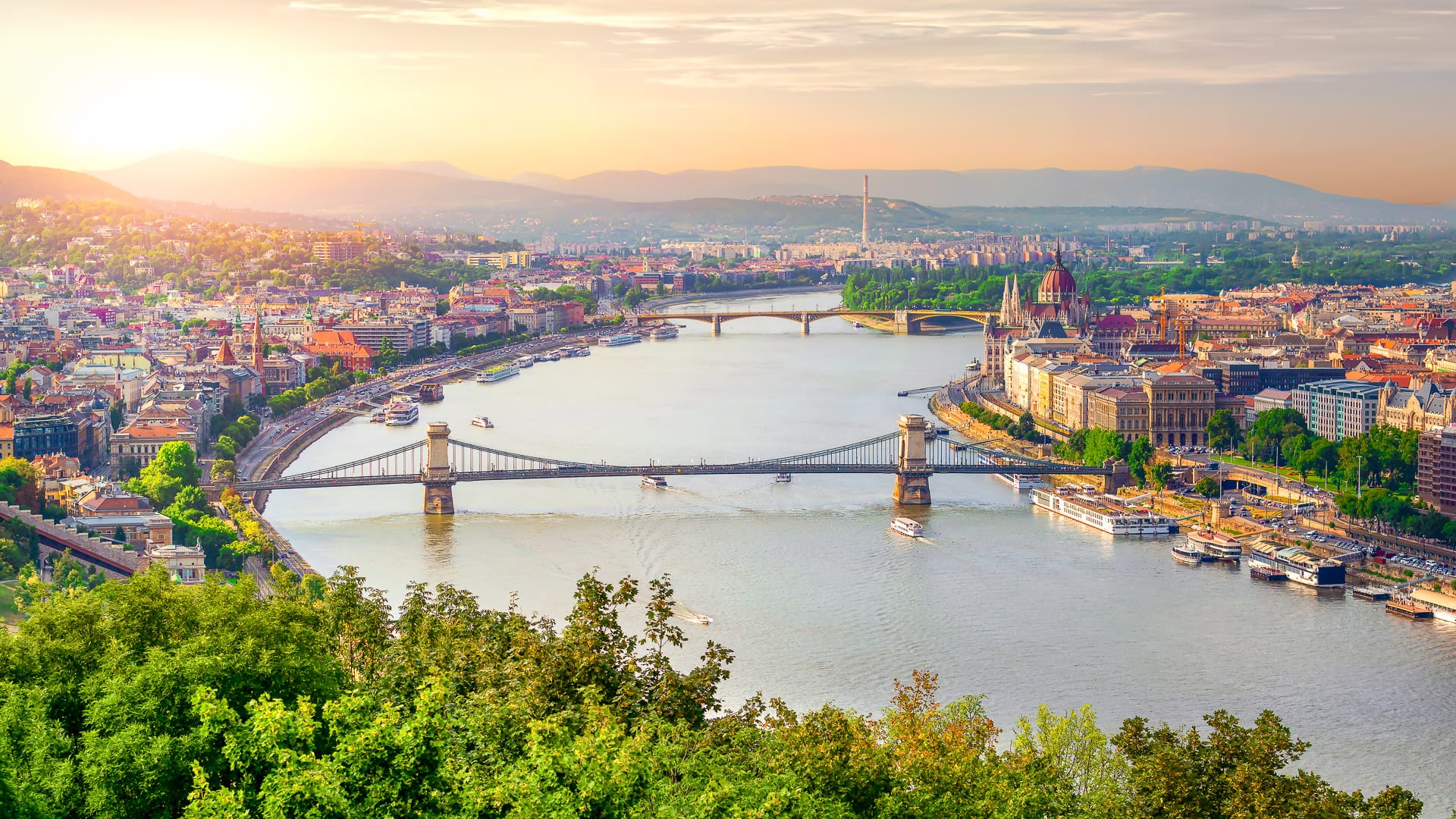
Budapest is well known for its grand architecture, thermal baths and setting on the Danube. But exploring the city by bike gives you a different perspective and makes it easier to connect many of its best-known sights.
You can follow riverside paths between Parliament, Margaret Island and Buda Castle. Head into the Buda Hills for forest roads, gravel tracks and longer climbs. The cycling infrastructure is not always seamless, but choose the right route, and there is a surprising variety of riding close to the centre.
There is also plenty to explore beyond Budapest. Szentendre, the Danube Bend and the vineyards of Etyek are all possible day rides, while the Visegrád Mountains offer quieter roads and more demanding terrain.
To learn more about cycling in Budapest, we spoke with Peter Illés from Wiredonkey Cycling Tours. Peter was born in Transylvania and now lives in the city. Wiredonkey has been offering guided rides and fully supported cycling holidays in Hungary since 2023. You can find out more about its tours below.
In this guide, Peter shares his favourite routes in and around Budapest, what the roads and cycle paths are like, when to visit and what cyclists should know before planning a trip.

Peter Illés was born in Transylvania, Romania, and is now based in Budapest. Before starting Wiredonkey Cycling Tours, he built an IT consulting firm but found himself wanting to spend more time away from screens and out on the road.
Travel planning and cycling have long been two of Peter’s biggest interests. On trips with friends and family, he was often the person planning the places to visit, the food to try and the experiences worth making time for.
Wiredonkey Cycling Tours brings those interests together: cycling, local travel, food and sharing Hungary and Romania from the saddle.
The name Wiredonkey comes from “drótszamár”, a playful Hungarian word for bicycle.

We love to introduce our community to cycling businesses, destinations and ideas that we think are genuinely interesting. Wiredonkey Cycling Tours caught our attention because of its focus on cycling in Hungary, which was a topic we hadn't previously covered. We were therefore pleased to work with the Wiredonkey Cycling Tours team on this article.
Wiredonkey Cycling Tours paid for this advertisement feature. Our decision to collaborate reflects our view that the brand is relevant to our readers; it is not a formal approval, audit or guarantee of its services. Unless we expressly say otherwise, we have not personally taken the trip described or independently verified information supplied by Wiredonkey Cycling Tours.
As with any travel purchase, please check the latest trip details, terms and customer protections directly with Wiredonkey Cycling Tours before booking. Any booking is made with Wiredonkey Cycling Tours, not Epic Road Rides.
Always check current travel information and advice. For visitors from the UK, the UK government travel information pages are here.
Table of contents
- Part 1: Why visit?
- Part 2: Overview
- Part 3: Cycling routes
- Part 4: Practicalities
- Part 5: Tips
- Part 6: Wiredonkey Cycling Tours
Sponsor Message
Considering a cycling holiday in Budapest?
Wiredonkey Cycling Tours have been offering fully supported, small-group cycling holidays in Hungary since 2023. In Budapest, they offer guided day rides to Szentendre and the Etyek wine region, as well as custom tours.
Head to their website to find out more.
Got a question for Peter Illés from Wiredonkey Cycling Tours?
Fill out this form and we will pass it to Wiredonkey Cycling Tours who aim to reply (within 24 hours wherever they can!)
Part 1: What’s great about cycling in Budapest?
Is Budapest good for cycling?
Cycling in Budapest is a great option for visitors who want to combine riding with food, history and culture. It’s especially well suited to sightseeing rides, riverside routes and day trips beyond the centre. Road, gravel, and mountain bike riders can also find more demanding terrain in the hills to the north and west of the city.
That said, Budapest is not comparable with the Amsterdams and Copenhagens of this world. Cycle routes are not always continuous and some busy sections require confidence, so nervous riders may prefer an easy riverside route or a guided ride. Careful route choice opens up a much wider range of cycling than many visitors expect.
Budapest also works well as part of a wider cycling holiday. The Danube Bend, Etyek, Lake Velence and the Visegrád Mountains are within reach of the capital, while rail connections make several one-way rides possible without hiring a car.
Budapest also makes a great city-break destination. Alongside the riding, visitors can explore thermal baths, green spaces, historic neighbourhoods and a strong food scene. Hungarian hospitality and good transport links add to its appeal, while the city can offer better value than many western European capitals.
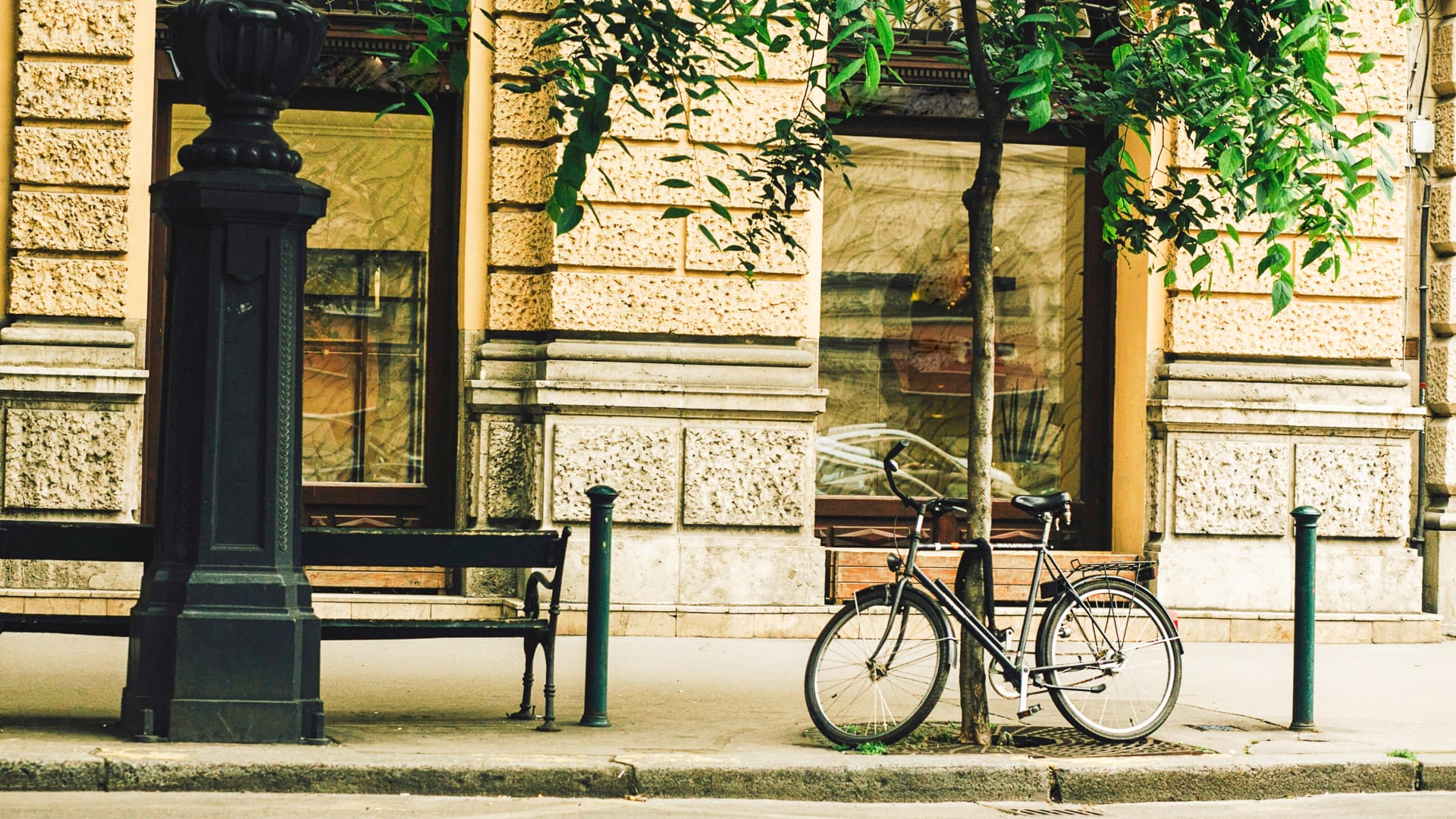
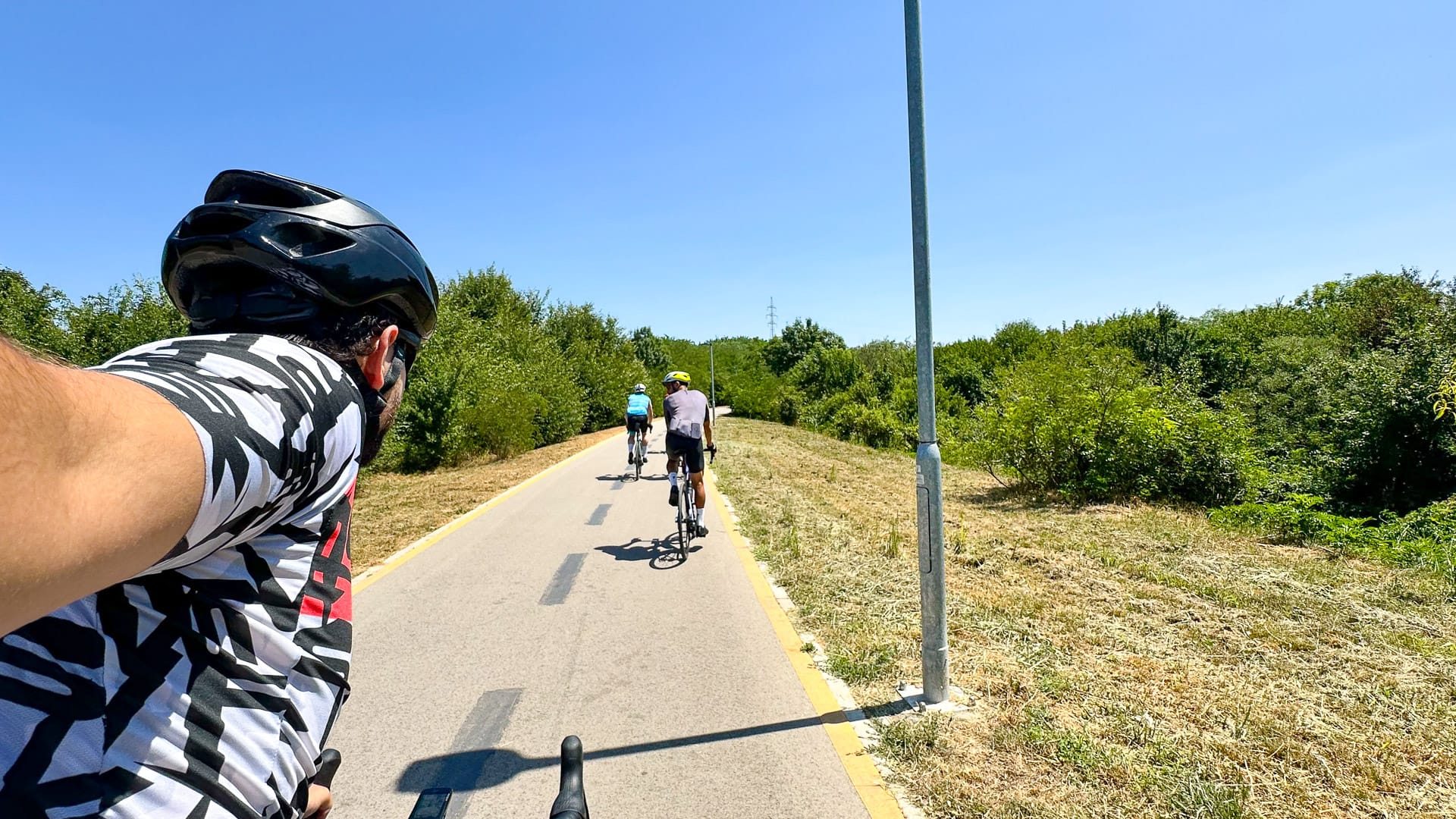
Cycling Budapest at a glance
| Best for | Sightseeing, road climbing, mixed-surface riding and day trips |
| Terrain | Mostly flat in Pest; hilly in Buda and the surrounding hills |
| Best months | April, May, September and October |
| Main riding areas | Danube riverfront, Buda Hills, Szentendre, Danube Bend, Visegrád Mountains and Etyek |
| Best bike | City bike or hybrid for easy routes; road, gravel, mountain bike or e-bike for specialist rides |
| Infrastructure | Useful but inconsistent; some junctions and connections require confidence |
| Public transport | Helpful for reaching the hills and completing one-way rides; service-specific bike rules apply |
| Car needed? | Not for most routes in this guide |
| Local support | Guided day rides and custom trips are available through Wiredonkey Cycling Tours |
A city made for exploring by bike
Budapest’s main attractions are spread across both sides of the Danube. A bike makes it easier to move between the Parliament building, Margaret Island, Buda Castle, the thermal baths and the city’s parks without spending much of the day underground or in traffic.
Riding also allows you to feel how the grand boulevards of Pest connect with the Danube river and how quickly the streets begin to climb on the Buda side.
Cycling works particularly well for reaching:
- Parliament and the Danube riverfront: One of Budapest’s most impressive urban settings, combining the monumental Parliament building with elegant promenades and wide views across the Danube.
- Margaret Island: A peaceful, car-free green oasis with gardens, fountains, historic ruins and recreational spaces.
- Buda Castle and Castle Hill: Budapest’s historic royal quarter, with palace courtyards, atmospheric streets, architectural landmarks and sweeping views over Pest.
- Gellért Hill and the thermal baths: A combination of panoramic viewpoints, wooded paths and Budapest’s famous historic bathing culture.
- City Park and central Pest: A varied area of grand avenues, major museums, historic monuments, cafés and spacious parkland.
- Római-part and northern Budapest: A relaxed stretch of the Danube known for leafy cycling paths, casual riverside eateries and a local summer atmosphere.
- Kopaszi-gát and the southern riverfront: A modern waterfront area with landscaped parks, contemporary architecture and relaxed riverside restaurants. There are no cycling restrictions on the approach, but a ‘no vehicles’ sign on the peninsula itself also applies to bicycles. Cyclists should therefore dismount and walk, moving carefully and giving pedestrians plenty of space.
From flat riverside paths to forested climbs
The Danube divides Budapest into two noticeably different cycling environments. Pest is mostly flat and better served by bike lanes, while Buda climbs sharply away from the river.
This contrast creates an unusual range of riding within one city. A relaxed riverside ride can be followed by forest roads, steady road climbs, gravel tracks or mountain bike trails in the Buda Hills.
Margaret Island and the Danube Promenade suit easier riding. Normafa, János Hill and Hármashatár Hill give stronger riders climbs creating a more demanding experience without travelling far from the centre. See below for more information.
Fun Fact! János Hill is Budapest’s highest point.
Easy day rides beyond the city
Some of Budapest’s strongest cycling begins beyond the centre. Szentendre is connected to the city by a largely riverside route, while the opposite bank of the Danube leads towards the towns of Vác, Nagymaros, Zebegény and Szob.
West of Budapest, the BuBa cycle route heads towards the vineyards of Etyek, Lake Velence and eventually Lake Balaton. Stronger riders can also use Szentendre as a gateway to the forest roads and climbs of the Visegrád Mountains. See below for more information.
The combination of cycling and rail makes these day rides more manageable. Several routes can be ridden in one direction before returning to Budapest by train, although bike capacity can be limited.
What is Budapest’s bike culture like?
Budapest has an established everyday and recreational cycling scene. Commuters use the flatter Pest side and the river corridors, while local road and off-road riders head towards the Buda Hills, Visegrád and the Pilis Mountains at weekends.
The city also has a sociable and international cycling community. Local groups such as Cycling is Better Together and Budapest Expat Ride include members from a range of countries, helping residents and visitors connect with other cyclists.
For visitors, this means cycling is visible and there are shops, hire options and local guides available. However, the city’s infrastructure has developed unevenly, so local popularity does not mean every route is simple to follow.
Sponsor Message
Considering a cycling holiday in Budapest?
Wiredonkey Cycling Tours have been offering fully supported, small-group cycling holidays in Hungary since 2023. In Budapest, they offer guided day rides to Szentendre and the Etyek wine region, as well as custom tours.
Head to their website to find out more.
Got a question for Peter Illés from Wiredonkey Cycling Tours?
Fill out this form and we will pass it to Wiredonkey Cycling Tours who aim to reply (within 24 hours wherever they can!)
Part 2: An overview of Budapest from a cyclist’s perspective
Where is Budapest?
Budapest is the capital city and lies in north-central Hungary, on both banks of the Danube. Buda occupies the hillier western side of the river, while Pest spreads across the flatter eastern side.
The city is well placed for rides along the Danube and into the hills north and west of the capital. It also sits on EuroVelo 6, the long-distance route that follows major European rivers between the Atlantic and Black Sea.
Is Budapest flat or hilly?
Pest is largely flat and has the stronger cycling network. There are dedicated lanes, shared paths and one-way streets that cyclists can use in both directions.
For cyclists, it is more useful to think in terms of several riding areas rather than only Buda and Pest. The riverfront, Castle Hill, Buda Hills and northern districts each offer a different experience.
Buda is much hillier. Its urban streets are narrower and the cycling infrastructure is less consistent. However, once riders reach the Buda Hills, quieter forest roads and off-road trails provide some of the city’s strongest riding.
| Area | Best for |
| Central Pest | Sightseeing, leisure rides and first-time visitors |
| Danube riverfront and Margaret Island | Easy spins, families and landmark-focused rides |
| Central Buda and Castle Hill | Historic sights and short climbing challenges |
| Óbuda and northern Budapest | Római-part and routes towards Szentendre |
| Buda Hills | Road climbing, gravel and mountain biking |
Cyclists who want to avoid the initial urban climb can use tram 60, the Cog Railway, to reach the hills. Information about taking bikes on public transport is available on the BKK website. The required tickets can be purchased from ticket machines at tram stops or through the BudapestGO app.
What are Budapest’s roads and bike paths like?
Cycle infrastructure is strongest in central Pest and beside parts of the Danube. It includes segregated tracks, painted lanes and paths shared with pedestrians.
The network is not seamless. Lanes can end at busy junctions and routes become less consistent farther from the centre. Check the complete journey (see link to BKK’s cycling page below), especially the connections between riverside paths, bridges, stations and the Buda Hills.
Drivers are generally accustomed to seeing cyclists, but traffic volumes and road behaviour vary. Surfaces also change quickly: central routes can include painted lanes, paving, cobbles and tram tracks, while the hills bring rough forest asphalt, gravel and trails that may become muddy after rain.
Be aware! Shared paths beside the Danube and on Margaret Island can be busy with walkers, runners and visitors. Keep speeds low and expect people to change direction without warning.
For Budapest cycling maps and journey planning tools, visit BKK’s cycling page.
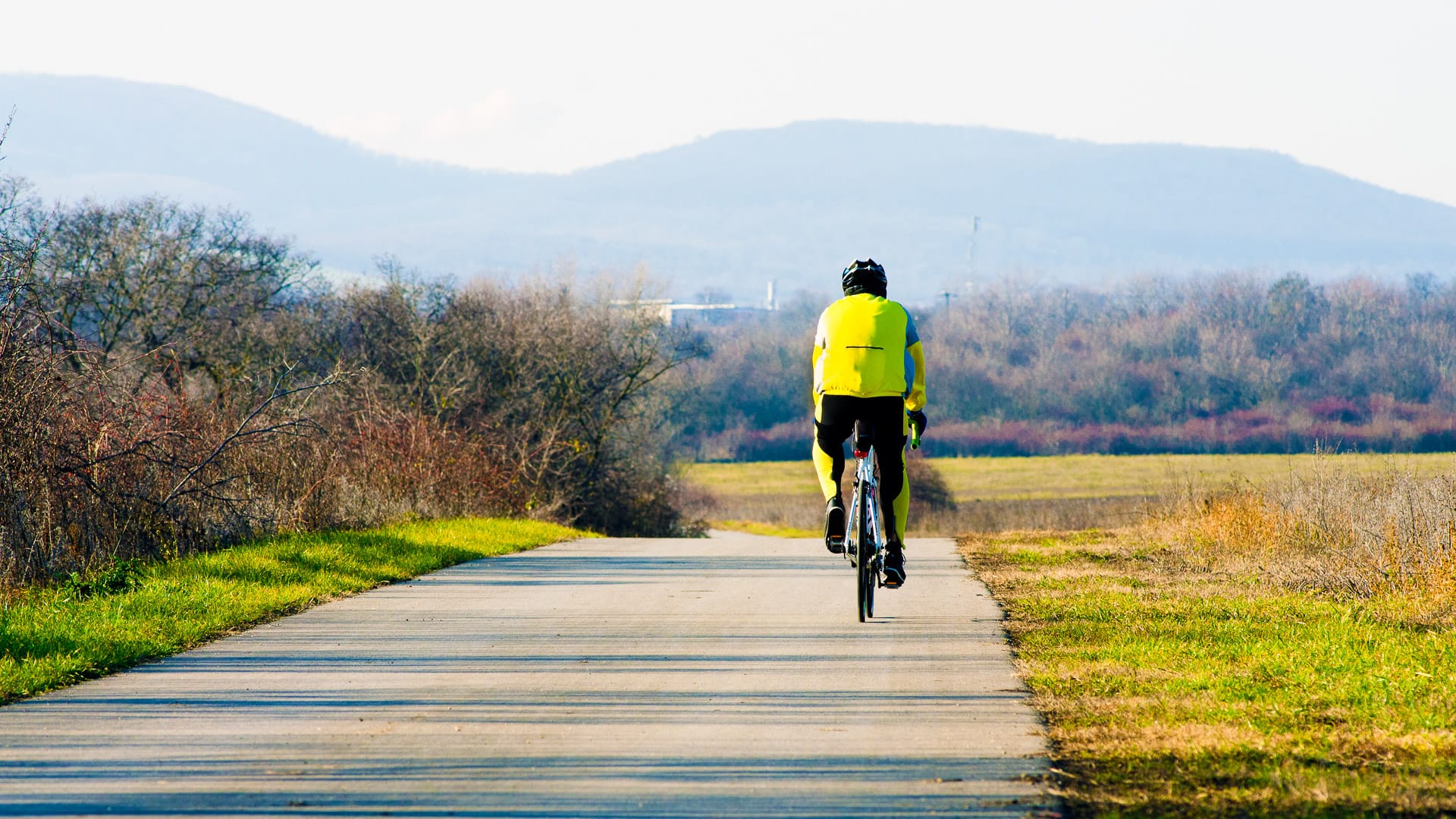
The Budapest–Balaton bike path just outside Budapest (photo credit: Wiredonkey Cycling Tours)
What kind of cyclist is Budapest best for?
Leisure cyclists
Flat routes in Pest, Margaret Island and the Danube riverfront suit riders who want frequent stops and modest distances.
Families
Margaret Island and carefully chosen sections of the Danube riverfront offer the simplest riding. The route towards Szentendre may also suit families and recreational cyclists, but suitability depends on the starting point, weekend path traffic and the age and confidence of the riders. Confirm child-bike, trailer and child-seat availability before booking.
Road cyclists
The Buda Hills and Visegrád Mountains offer forest roads, sustained climbs and loops that can be adapted to different distances. The Visegrád forest-road network can be used to create rides from around 30 to 100 kilometres. Stronger riders can choose to accumulate close to 2,000 metres of elevation gain in a day.
Gravel and mountain bike riders: The Buda Hills, Visegrád and Pilis Mountains contain forest tracks and singletrack. Mountain bikers can also find established downhill trails surprisingly close to the city centre. Some routes require good handling skills and careful navigation.
Other local gravel areas include the climb towards Prédikálószék, tracks around the Csergezán Pál lookout tower and routes in the Pilis Mountains and Börzsöny hills.
Touring cyclists
Touring cyclists may pass through Budapest on EuroVelo 6 or use the city as a stopping point between Vienna and the lower Danube. Route conditions and signage can vary, so current navigation information is important.
Stronger riders can also continue west on the BuBa route towards Lake Balaton. The full ride is expected to be around 110 kilometres, with a train return providing an alternative to riding back to Budapest.
E-bike riders
E-bikes work well for sightseeing and Buda’s hills. Check battery range before committing to a longer route beyond the city.
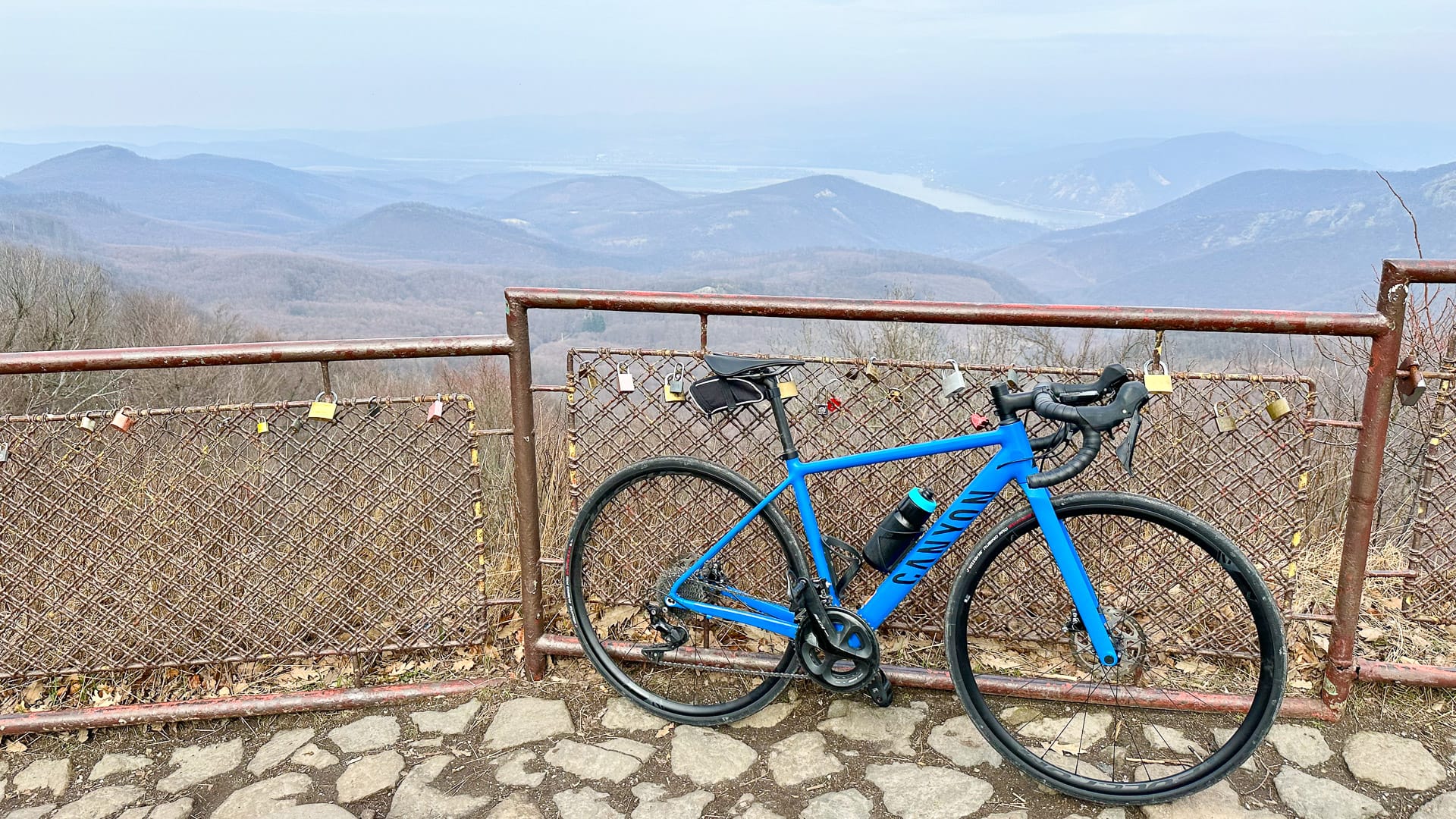
The Pilis Mountains and Danube Bend are a favourite getaway for Budapesters (photo credit: Wiredonkey Cycling Tours)
Is a guided bike tour of Budapest worth it?
A guided tour can be useful for first-time visits to Budapest or those who are short on time.
Wiredonkey is increasingly seeing this among river-cruise passengers and city-break visitors. Many are already in Budapest when they decide to swap a conventional walking tour for a day exploring the city or surrounding countryside by bike. We are happy to help!
A local guide can also add context to the city’s history and help link major landmarks with quieter streets, riverside paths and local food stops. This is particularly useful for visitors with limited time or riders who do not want to bring their own bike.
We at Wiredonkey are one local operator offering city rides and day trips from Budapest, including routes towards Szentendre and Etyek.
A guided ride may be useful if you:
- Have limited time
- Do not want to navigate busy junctions
- Need a bike included
- Want cultural context as well as a route
- Are visiting from a river cruise
- Want a longer ride adapted to your fitness
The choice is less about whether one option is universally better and more about your confidence, available time and the type of ride you want.
| Independent cycling may suit you if… | A guided ride may suit you if… |
| You are confident navigating city traffic and discontinuous lanes. | You want help linking the quieter and more pleasant sections. |
| You have time to research transport rules and route surfaces. | You have limited time or do not want to manage the logistics. |
| You can carry tools and deal with minor mechanical problems. | You want a bike, helmet and assistance included. |
| You prefer complete flexibility over pace and stops. | You want historical, cultural or food context during the ride. |
| You already have a suitable bike. | You are arriving without a bike or from a river cruise. |
Sponsor Message
Considering a cycling holiday in Budapest?
Wiredonkey Cycling Tours have been offering fully supported, small-group cycling holidays in Hungary since 2023. In Budapest, they offer guided day rides to Szentendre and the Etyek wine region, as well as custom tours.
Head to their website to find out more.
Got a question for Peter Illés from Wiredonkey Cycling Tours?
Fill out this form and we will pass it to Wiredonkey Cycling Tours who aim to reply (within 24 hours wherever they can!)
Part 3: The best cycling routes in and around Budapest
The routes below range from relaxed city sightseeing to long, hilly rides through the forests north of Budapest. The routes have been arranged by location, starting in Budapest and then heading to the north and ending with routes in the west of Budapest.
| Route | Distance (kilometres) | Difficulty |
| In Budapest: | ||
| – Danube Promenade | 13 | Easy |
| – Budapest’s iconic lookout points | 55 | Challenging |
| North of Budapest: | ||
| – Budapest to Szentendre | 20 | Easy to moderate |
| – The Danube Bend | 65 | Moderate |
| – Visegrád Mountains loop | 72 | Challenging |
| West of Budapest: | ||
| – Etyek vineyard loop | 55 | Moderate |
| – Etyek to Lake Velence | 59 | Moderate to challenging |
Quick choices:
- Danube Promenade for a first city ride,
- Szentendre for the easiest day trip
- Visegrád loop for climbing
- Etyek for food and wine
- Lake Velence for a longer point-to-point ride
We can also arrange any of these routes as a custom tour, tailored to your interests, available time and preferred level of difficulty.
Cycling routes in Budapest
Danube Promenade
GPX DownloadTerms of use reminder
Key statistics
- Distance: 12.7 kilometres
- Elevation gain: 34 metres
- Difficulty: Easy to moderate
- Best bike: City bike, hybrid or e-bike
- Surface: Mainly asphalt and paved bike paths
- Format: City loop
This classic Budapest route links several of the city’s principal sights, including St Stephen’s Basilica, Parliament, Margaret Island, Buda Castle, Chain Bridge and the thermal baths. Much of the ride follows the Danube, whose central riverfront forms part of Budapest’s UNESCO-listed cityscape, with frequent opportunities to stop.
VAJ on Sas Street provides a convenient breakfast stop near the beginning of the route. St Stephen’s Basilica is only a short distance away. Riders with enough time can visit the dome, which provides a panoramic view over central Budapest. From there, ride past St Stephen’s Basilica and Parliament before joining the bike path towards Margaret Island. On certain weekends, parts of the Pest embankment are closed to motorised traffic. In summer, parts of the Pest embankment are open from Friday evening to Sunday night. The mayor usually posts updates on his Facebook page.
Margaret Island is a useful place for a picnic or a relaxed lap, but its bike paths can be busy.
Cross Margaret Bridge to the Buda side and ride south. Batthyány Square gives a clear view of Parliament across the river. The route continues beneath Chain Bridge, with an optional climb or funicular journey to Buda Castle.
Margaret Island also offers several places to stop, including its musical fountain and Japanese garden. The island also contains the ruins of a medieval Dominican convent, adding an unexpected historical stop to an otherwise relaxed riverside section.
Gellért Baths is currently closed for renovation, with reopening planned for 2028.
Palack near Gellért Square makes a useful post-ride stop. Alternatively, cross Liberty Bridge towards Bálna, meaning “The Whale”. This former customs warehouse is now wrapped in a modern glass extension and contains several bars and terraces overlooking the Danube. Cyclists carrying valuable bikes should confirm secure parking before combining a ride with a longer bath or museum visit.
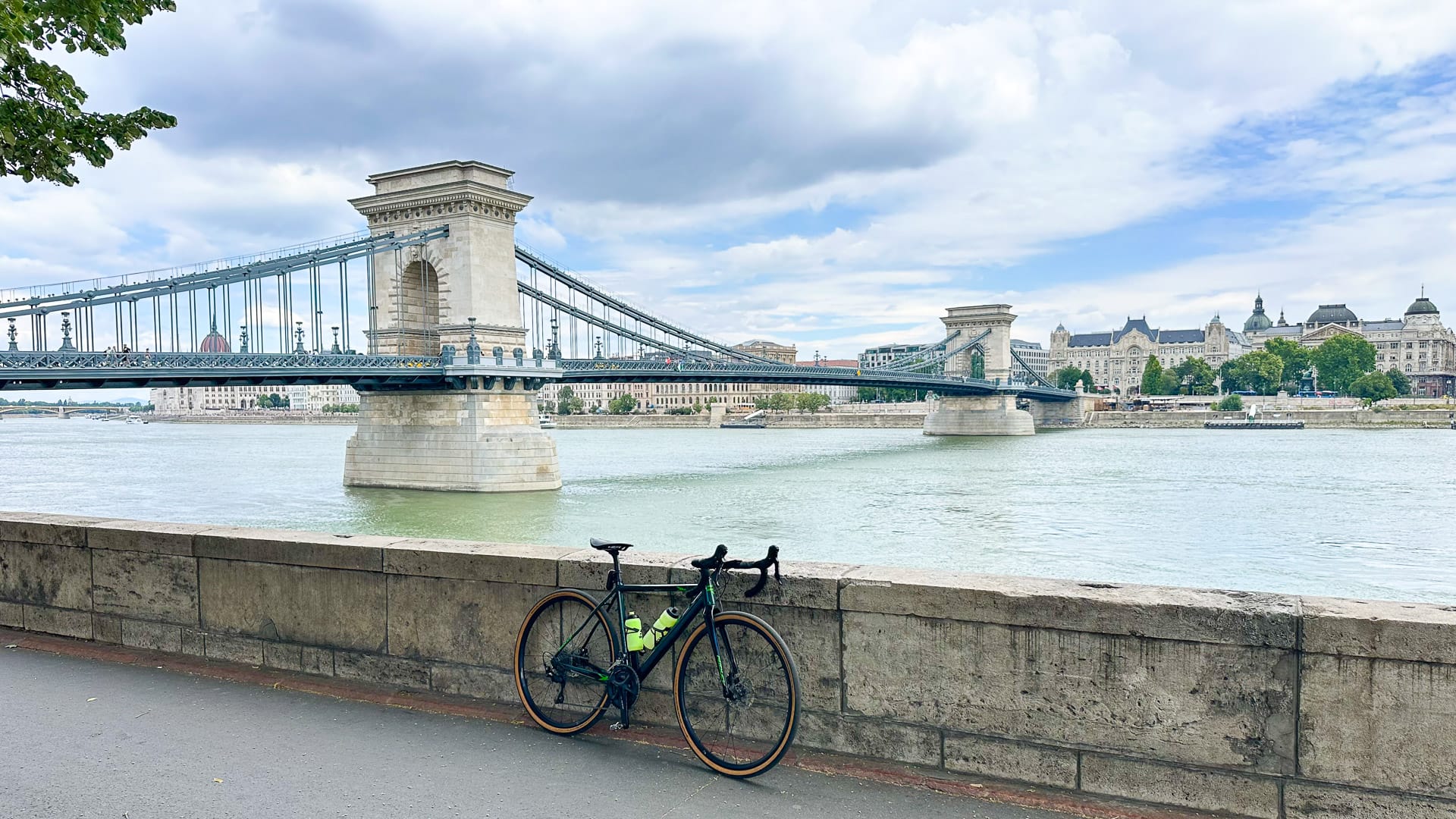
The Chain Bridge in Budapest (photo credit: Wiredonkey Cycling Tours)
Budapest’s iconic lookout points
GPX DownloadTerms of use reminder
Key statistics
- Distance: 33.3 kilometres
- Elevation gain: 880 metres
- Difficulty: Challenging
- Best bike: Road bike with wider tyres or a gravel bike
- Surface: Asphalt with optional gravel
- Format: Hilly city loop
This is not a sightseeing route, it is a route about the climbs. It links Gellért Hill, Castle Hill, János Hill and Hármashatár Hill, with sustained climbing, traffic and a rough forest-road descent.
Start at Gellért Square and climb towards the Citadel, with views over the Danube between Elizabeth Bridge and Liberty Bridge. Continue to Castle Hill and its cobbled streets. Both areas are busy with visitors, so an early start makes the riding simpler and may also provide softer morning light at the viewpoints.
The route then uses quieter side streets where possible to reach János Hill, Budapest’s highest point. Some traffic is unavoidable on the middle part of the climb, but the final section follows a forest road closed to general through traffic.
The descent uses the same forest road and the surface can be rough. Gravel riders can add Hárs Hill before continuing to Hármashatár Hill on the northern side of the city.
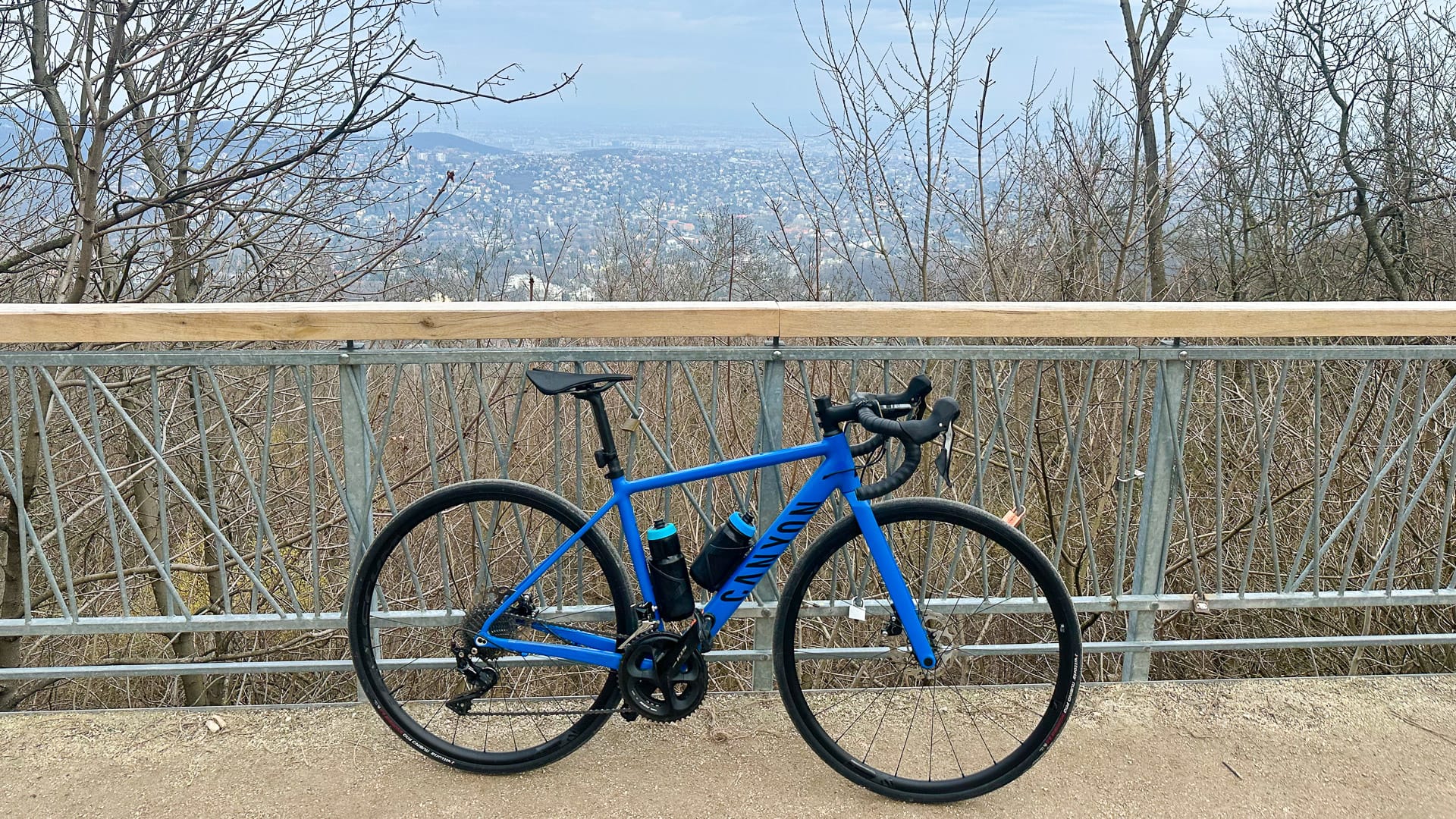
Views of Budapest from János Hill (photo credit: Wiredonkey Cycling Tours)
Cycling routes north of Budapest
Budapest to Szentendre
GPX DownloadTerms of use reminder
Key statistics
- Distance: 55.2 kilometres
- Elevation gain: 187 metres
- Difficulty: Easy to moderate
- Best bike: Hybrid, touring bike or e-bike
- Surface: Mainly paved path
- Format: One way or out and back
Szentendre is one of the most straightforward day rides from Budapest. The route follows the Danube north for much of the journey and passes Római-part before reaching the town’s historic centre.
Római-part is known for its retro boathouses, informal food stands and riverside bars. It makes a useful midway stop, although the path can be busy during warm weekends.
Szentendre’s galleries, pastel-coloured houses and cobbled streets reflect its history as an artists’ colony. The Skanzen open-air museum sits outside the centre and showcases traditional Hungarian buildings and crafts. Live demonstrations may include weaving, pottery and blacksmithing, but visiting the museum will add distance and time to the ride.
Of the activities mentioned above, only weaving is a permanent activity. See Skanzen’s permanent activities page for further details. Skanzen is practical to combine with the guided ride in one day, although visiting the museum will add distance and time to the ride.
Riders can return to Budapest by bike or use the HÉV suburban railway. Bikes require a separate ticket, and a regular BKK ticket can be used for the bike for the full 30-kilometre train ride. Passengers travelling outside Budapest’s city limits require a different ticket. Check the BKK website for further information.
Wiredonkey offers a guided version of this day trip, combining the principal sights with a few lesser-known places that visitors may otherwise miss. These places are included along the GPS route, but can be easy to ride past if you do not know they are there.
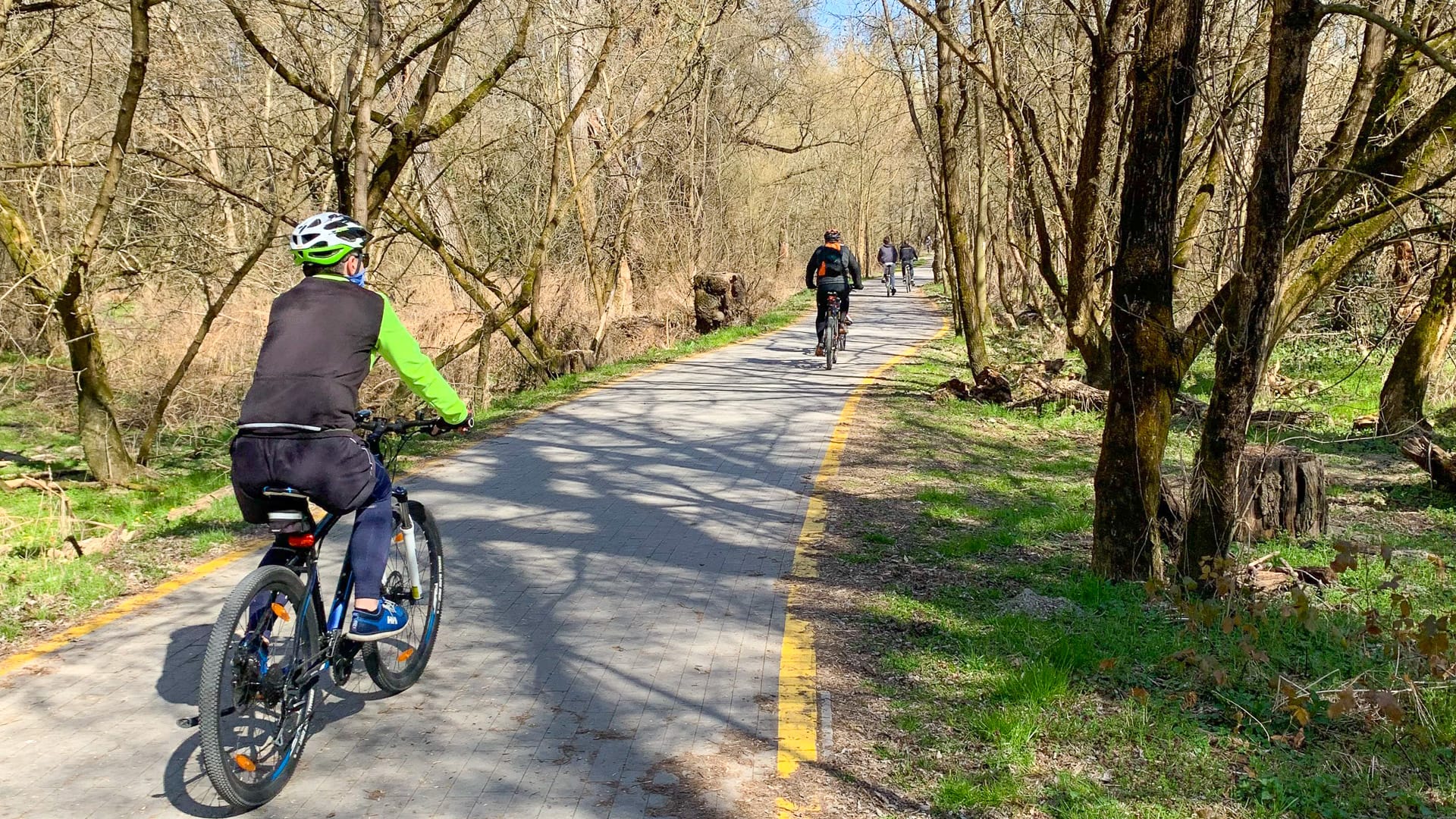
Group of cyclists heading to Szentendre (photo credit: Wiredonkey Cycling Tours)
The Danube Bend
GPX DownloadTerms of use reminder
Key statistics
- Distance: Approximately 65.1 kilometres
- Elevation gain: 134 metres
- Difficulty: Moderate
- Best bike: Hybrid, touring or road bike
- Surface: Mainly paved
- Format: One way with a train return
The eastern bank of the Danube gives cyclists a long, largely riverside route towards Szob, close to the Slovakian border. The ride becomes quieter as it moves away from Budapest and passes former fishing villages that later developed into riverside resorts.
Vác has a Baroque centre and Hungary’s only triumphal arch. According to a local legend, two people who walk beneath it together will remain in love. The route then continues through Verőce and Kismaros to Nagymaros. These riverside towns provide cafés and ice cream stops, while Nagymaros looks across the Danube to Visegrád Castle.
Zebegény has an artistic character and a compact centre, while Szob sits where the Ipoly meets the Danube. A train return avoids retracing the route, but bike places may need to be reserved and can fill on busy days. The easiest way to buy tickets is through the MÁV app.
Parts of this ride overlap with the EuroVelo 6 corridor. Navigation should still be downloaded because route conditions and signage can vary.
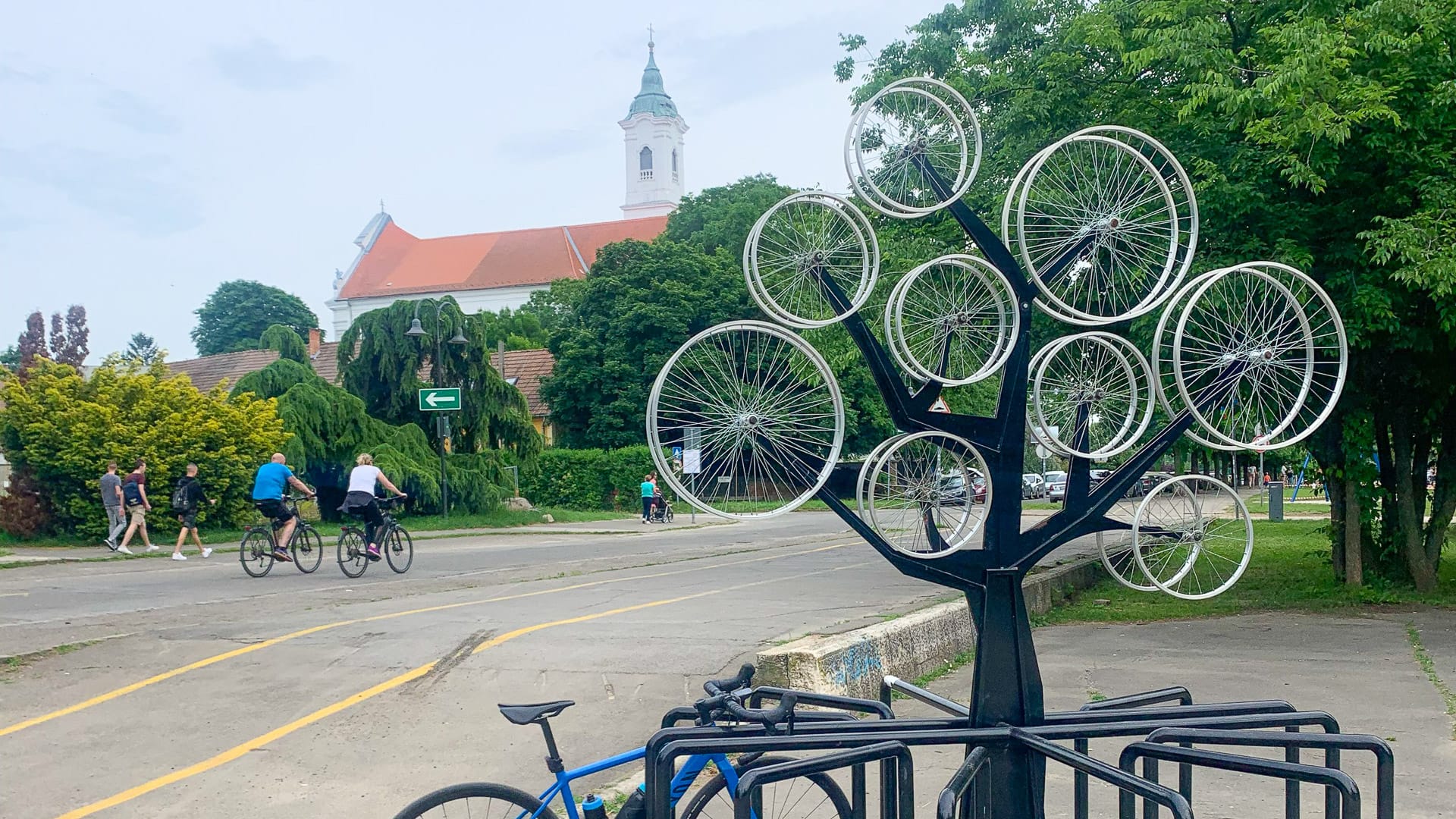
Quick stop in Vác at the Danube Bend (photo credit: Wiredonkey Cycling Tours)
Visegrád Mountains loop
GPX DownloadTerms of use reminder
Key statistics
- Distance: 72.1 kilometres
- Elevation gain: 1,118 metres
- Difficulty: Challenging
- Best bike: Road bike or e-road bike
- Surface: Mainly asphalt forest roads
- Format: Loop from Szentendre
The Visegrád and Pilis Mountains begin just north of Budapest and provide some of the region’s strongest road cycling. This is a popular weekend riding area for local cyclists. Szentendre is a practical starting point, with several paved forest roads leading away from the busier Danube corridor. Some are closed to general motor traffic, creating long sections of quieter riding that are especially popular with local cyclists.
This loop climbs through Dömörkapu to Dobogókő, the highest point in the immediate area. It then descends towards Pilismarót before following the Danube to Visegrád.
An optional climb reaches Visegrád Castle before the route returns to Szentendre via Pap-rét. Several roads in the area were resurfaced around the 2022 Giro d’Italia stage, although current surfaces and access conditions should be checked.
Carry enough food and water for the forest sections. Services are less frequent than on the Danube-side routes, and some climbs are sustained.
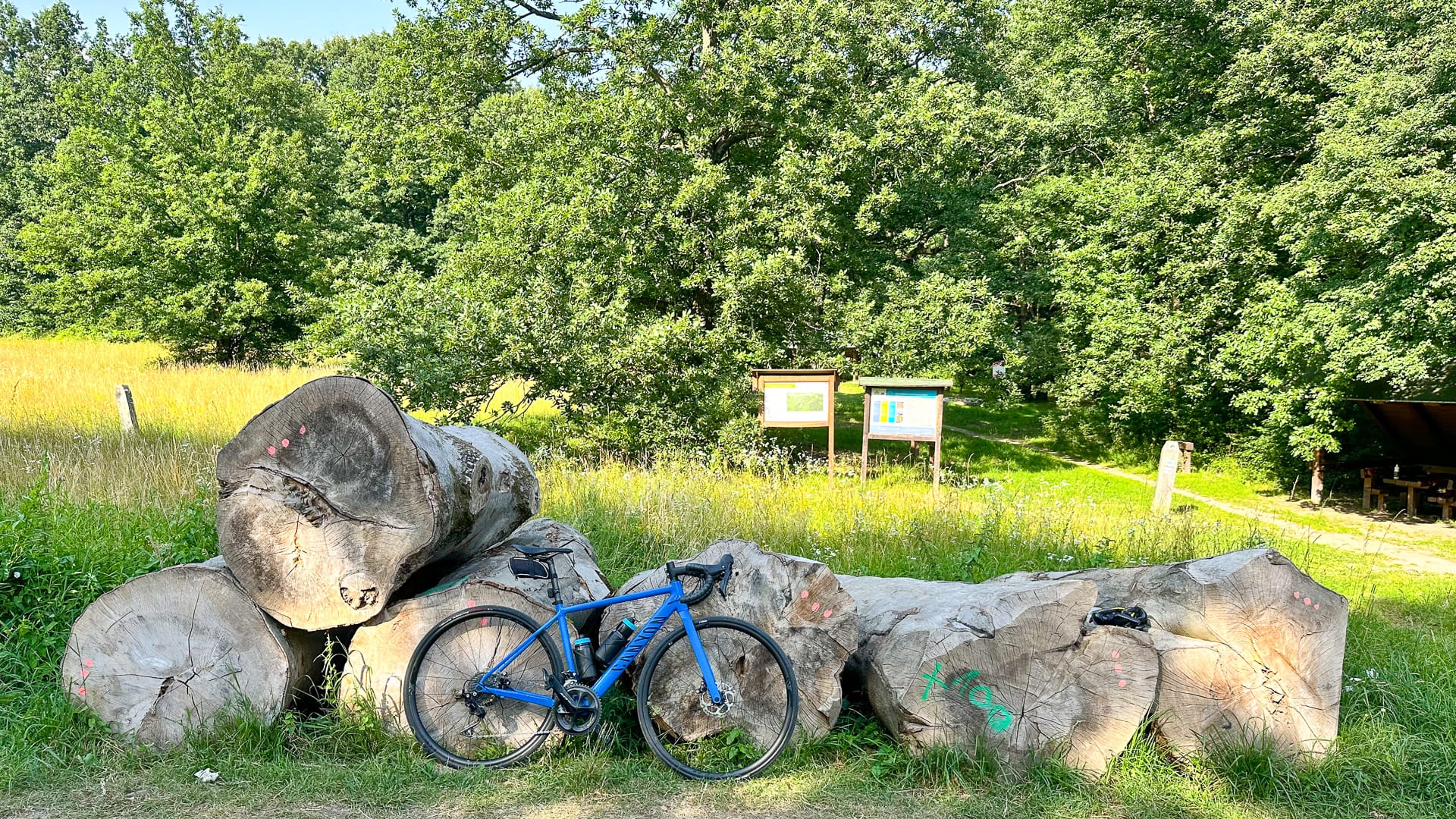
Cyclists love the mountains north of Budapest for their traffic-free forest roads (photo credit: Wiredonkey Cycling Tours)
Cycling routes west of Budapest
Etyek and Lake Velence: two route options
Both routes begin near Kamaraerdő forest and initially follow the BuBa cycle route towards Lake Balaton. Tram 41 can help riders avoid the busier urban approach. Riders can take bikes on Tram 41 to avoid the busier urban approach. As this is a regular urban tram service, no advance booking is required.
The route crosses the former railway viaduct at Biatorbágy before reaching Etyek, a wine-producing village often described as Budapest’s vineyard. The viaduct was also the location of a deadly railway bombing in 1931. Etyek is particularly associated with crisp white wines, and its cellar rows and small producers make it a natural lunch or tasting stop.
Option 1: Etyek vineyard loop
GPX DownloadTerms of use reminder
Key statistics
- Distance: 55.8 kilometres
- Elevation gain: 283 metres
- Difficulty: Moderate
- Best bike: Hybrid, road bike or e-bike
- Surface: Mainly asphalt
- Format: Loop
The shorter option turns back from Etyek via Háromrózsa Ranch and a service road towards Biatorbágy. It works well for riders who want time for lunch or a cellar visit without continuing to the lake.
A wine tasting should be planned carefully. Eat beforehand, allow enough time. Hungary’s traffic code does not specify a blood alcohol limit for cyclists, but it prohibits cycling if you are drunk or unable to ride safely.
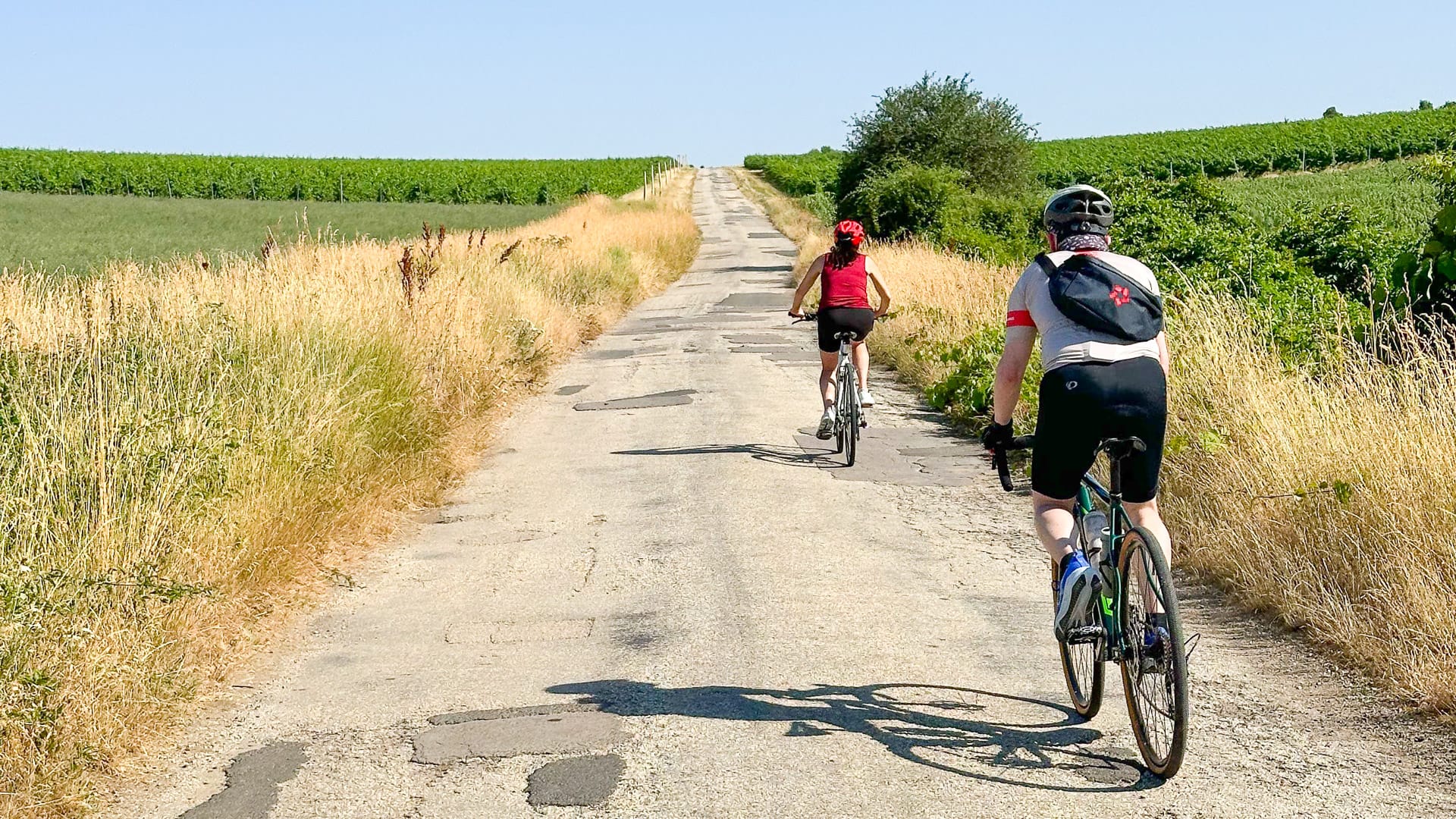
Beautiful vineyards above Etyek (photo credit: Wiredonkey Cycling Tours)
Option 2: Etyek to Lake Velence
GPX DownloadTerms of use reminder
Key statistics
- Distance: 59.4 kilometres
- Elevation gain: 439 metres
- Difficulty: Moderate to challenging
- Best bike: Road bike, hybrid or e-bike
- Surface: Mainly asphalt
- Format: One way with a train return
The longer route continues from Etyek over a succession of short, rolling hills to Lake Velence. The lake gives riders a clear destination, with time for a lakeside stop or gelato before taking the train back to Budapest.
Weekend trains can be busy with cyclists, and bike capacity is limited. There is no option to pre-book a bike space. A useful alternative is to continue riding to Agárd or Gárdony and board the train there. These stops come before Velence, where most cyclists get on, so it is usually easier to find space for a bike.
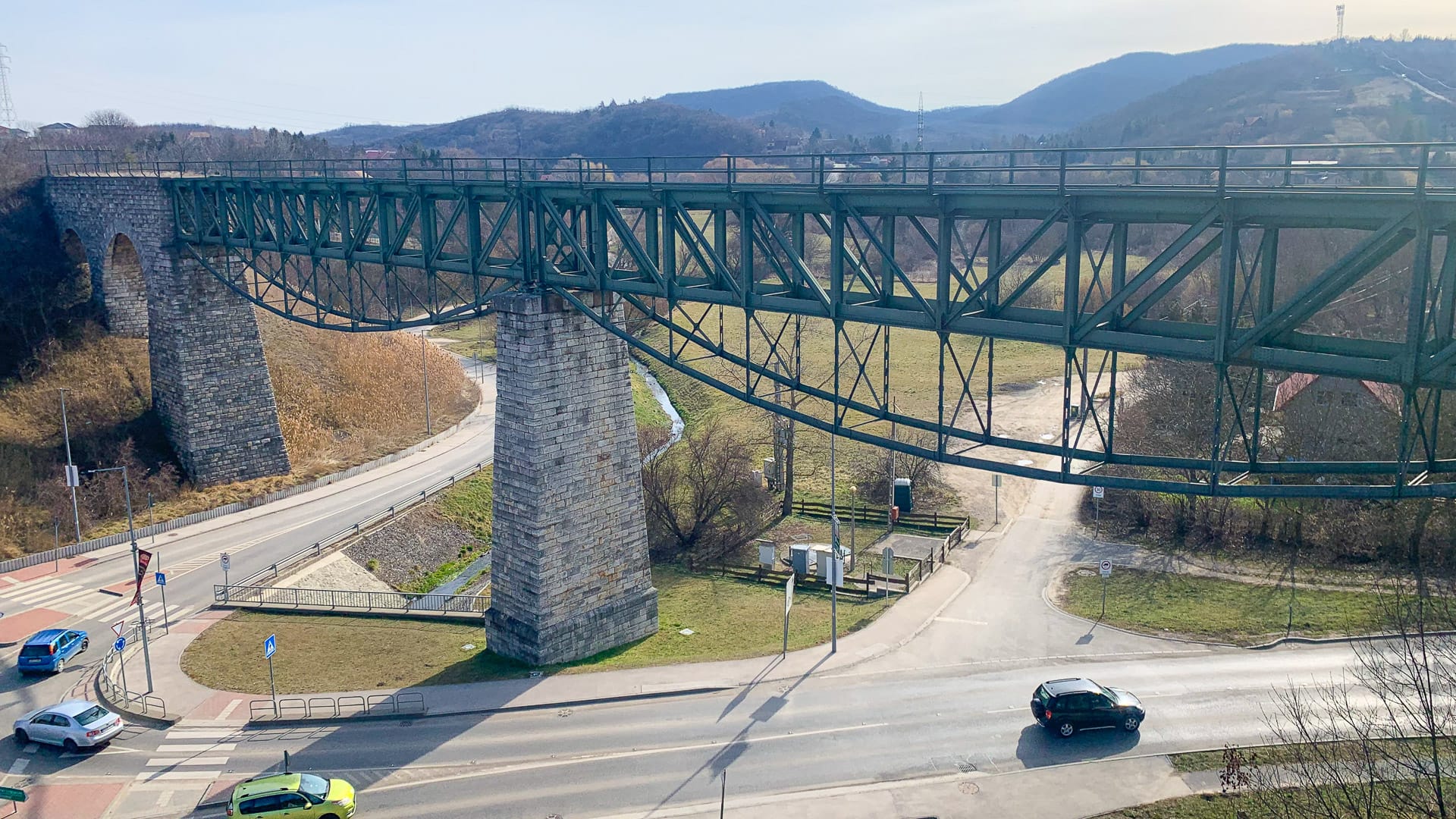
The road to Etyek takes you over an old railway viaduct (photo credit: Wiredonkey Cycling Tours)
Sponsor Message
Considering a cycling holiday in Budapest?
Wiredonkey Cycling Tours have been offering fully supported, small-group cycling holidays in Hungary since 2023. In Budapest, they offer guided day rides to Szentendre and the Etyek wine region, as well as custom tours.
Head to their website to find out more.
Got a question for Peter Illés from Wiredonkey Cycling Tours?
Fill out this form and we will pass it to Wiredonkey Cycling Tours who aim to reply (within 24 hours wherever they can!)
Part 4: Things to know before visiting Budapest
Where should cyclists stay in Budapest?
Finding genuinely bike-friendly accommodation in Budapest is not always straightforward. Many central hotels have limited storage, so cyclists should confirm in advance whether full-sized bikes are accepted and where they will be kept.
Hungary has a recognised cycling-friendly accommodation scheme, which is mentioned in our Hungary guide. Cyclists can also use the Kerékpárosbarát app to find further information.
Central Pest: Useful for the Danube Promenade, main landmarks and public transport. It is less convenient for riders who want to reach the Buda Hills without crossing the city. Most visitors choose to stay in downtown Pest.
Óbuda and northern Budapest: Well placed for Római-part and the route towards Szentendre. This area may suit riders who expect to spend more time north of the centre. However, it is far from many of Budapest’s major sights and is not a common choice for tourists.
Buda: Closer to the hills, but the streets are steeper and the cycling network is less consistent. Choose the exact location carefully. A smaller number of visitors choose to stay in Buda.
At Wiredonkey Cycling Tours, we can also help cyclists find bike-friendly accommodation when booking a tour.
Where can you hire a bike in Budapest?
Bike hire is readily available for city sightseeing, but specialist road and gravel bikes may need to be reserved in advance. The right choice depends on whether you are making short urban journeys or riding into the surrounding hills.
MOL Bubi: Budapest’s public bike-sharing scheme, offers conventional bikes and e-bikes for short journeys around the city. Best suited to short city journeys and sightseeing. Check the current fleet, pricing and usage rules directly with BKK.
Hybrid or trekking bike: A practical option for Szentendre, the Danube Bend and mixed sightseeing days.
Road bike: More suitable for the Visegrád Mountains and longer rides where weight, fit and gearing matter.
Gravel or mountain bike: Needed for forest tracks, singletrack and route extensions in the Buda Hills.
E-bike: Useful for sightseeing, Buda’s climbs and riders who want to manage effort across a longer day.
Wiredonkey: Offers bike hire on tours. See below for more information.
Potential rental providers include Bringaland, Merida Concept Store, Appsolute Sport and selected Decathlon branches.
The central Decathlon branch may not offer suitable rental options, so check availability with the individual store before travelling.
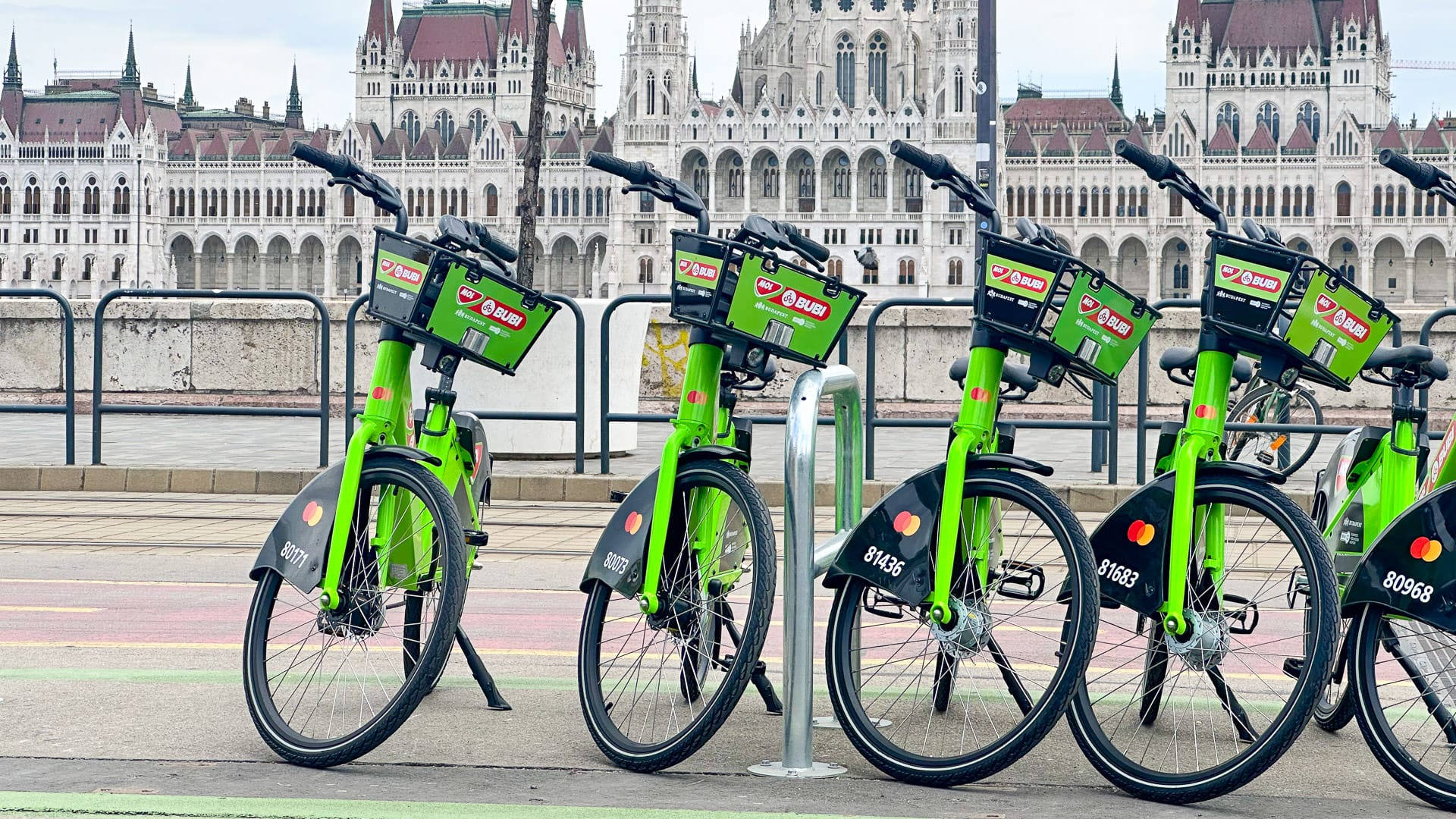
Bubi is Budapest’s revamped bike-sharing network (photo credit: Wiredonkey Cycling Tours)
What kit should you bring for cycling in Budapest?
The kit you need depends on whether you are taking a short city ride or heading into the surrounding hills. Even on a hired bike, check what is included rather than assuming tools and accessories are supplied.
For Wiredonkey Cycling Tours, you only need to bring suitable cycling clothes and let us know your pedal preferences in advance. We provide everything else.
For independent rides, consider carrying the following essential kit:
- Helmet and front and rear lights.
- A spare tube, tyre levers, pump and basic multi-tool.
- A chain quick link for longer independent rides.
- Offline navigation or a bike computer.
- A lightweight waterproof and an extra layer for cooler descents.
- Sun protection and enough water for hot weather.
- A strong lock for city stops.
For more information of packing, check out our in-depth guide.
Do you need to train for cycling in Budapest?
You do not need specialist fitness for a relaxed sightseeing ride, Margaret Island or a shorter riverside route. You should still be comfortable starting and stopping around other path users and riding for the planned distance.
The lookout-points route and Visegrád Mountains are a different proposition. Prepare for sustained climbing, gravel surfaces and several hours in the saddle. Longer road and gravel riders should also practise eating, drinking and managing minor mechanical problems on the move.
When is the best time to cycle in Budapest?
March to May: Landscapes become greener and temperatures are generally comfortable for cycling, although conditions can change quickly. April and May usually offer the best spring riding.
June to August: Long daylight hours allow plenty of time to ride, but Budapest can be hot and busy. Shared paths are often crowded, so start early where possible.
September to November: September and October are often excellent for road cycling, with cooler temperatures and autumn colours in the surrounding hills. Conditions become less predictable later in November.
December to February: Cycling in the city remains possible, but cold temperatures and shorter days make longer rides less appealing. Forest roads and trails may also be wet, muddy, icy or otherwise unpredictable.
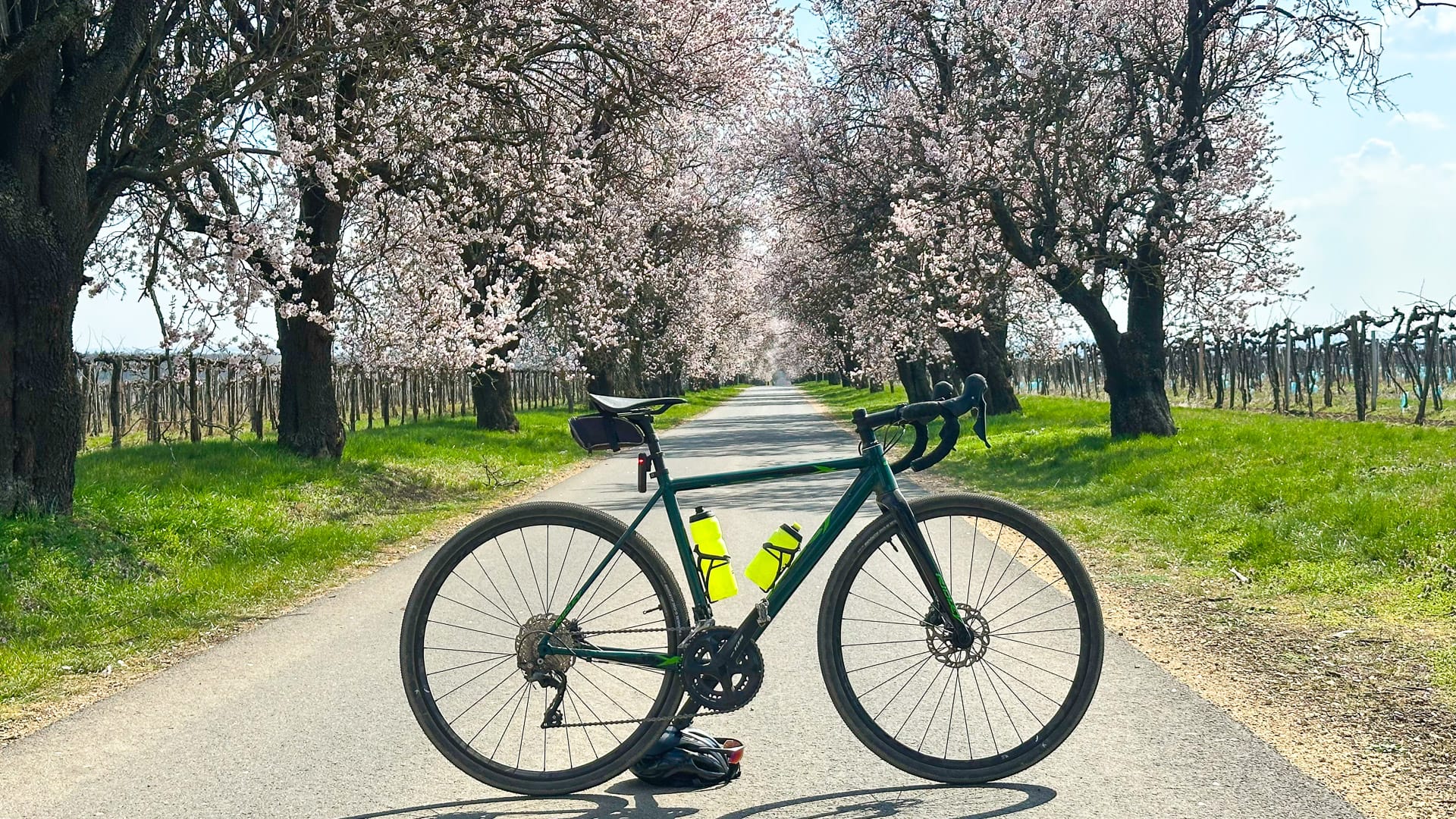
One of the highlights of the tour in April is the blossoming of the apricot trees (photo credit: Wiredonkey Cycling Tours)
Are there any cycling events in Budapest?
One of Budapest’s most distinctive amateur events is Előzd meg a fogaskerekűt, commonly translated as “Beat the Cog Railway”.
Around 100 amateur riders tackle a four-kilometre climb with approximately 325 metres of elevation gain while attempting to reach the top before the adjacent Cog Railway. Only a small number usually manage it, and the challenge became harder after track renovations shortened the train journey by roughly two minutes.
The event has traditionally been held in early May.
At Wiredonkey Cycling Tours we can also help visitors enter the event.
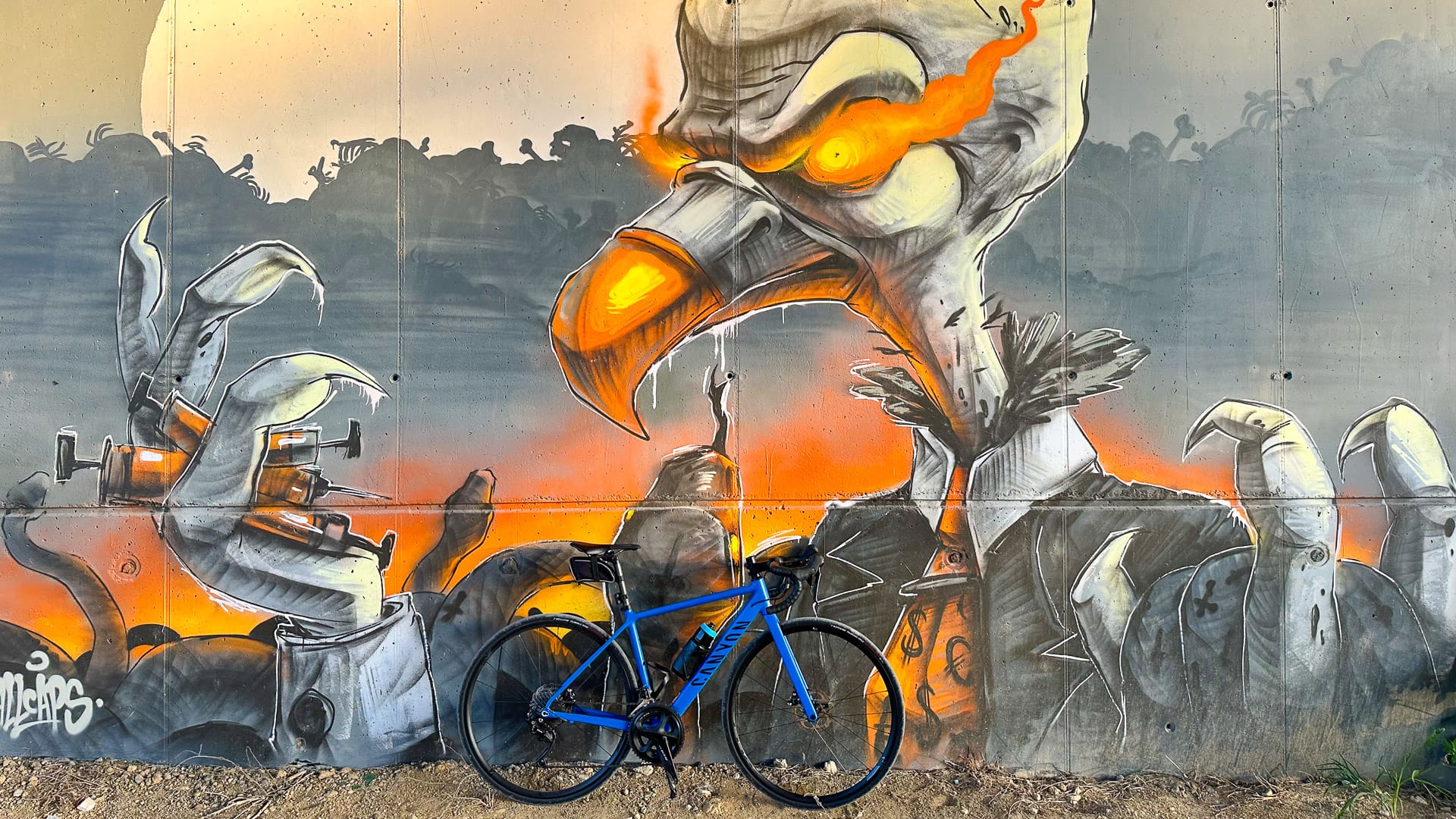
Urban gravel adventure in Budapest (photo credit: Wiredonkey Cycling Tours)
How do you get to Budapest with a bike?
Budapest Airport has connections across Europe and farther afield. There is no direct rail link between the terminals and the city centre, which makes arrival with a large bike box less straightforward.
A pre-booked minivan or suitable taxi may be the simplest option. MOL Limo is also an option, as its fleet includes larger vehicles such as the Opel Combo and Opel Movano.
At Wiredonkey Cycling Tours we only offer airport transfers to guests joining one of our week-long tours.
Budapest also has international rail links with cities including Vienna, Salzburg, Munich, Prague and Zürich. Bike carriage varies by train, and reservations may be required. Check the specific service rather than assuming a bike can be added on the day.
For domestic rides, Hungary’s rail network makes it possible to return from places such as Szob, Lake Velence and Lake Balaton. Bike places are limited on some trains, especially at weekends.
Do you need a car for a Budapest cycling trip?
A car is not necessary for most of the routes in this guide. Budapest’s trains, HÉV services, trams and Cog Railway can help riders reach route starts, avoid some urban approaches and complete one-way rides.
A pre-booked transfer may still be useful when travelling with a large bike box, carrying several bikes or starting a more remote custom route.
Sponsor Message
Considering a cycling holiday in Budapest?
Wiredonkey Cycling Tours have been offering fully supported, small-group cycling holidays in Hungary since 2023. In Budapest, they offer guided day rides to Szentendre and the Etyek wine region, as well as custom tours.
Head to their website to find out more.
Got a question for Peter Illés from Wiredonkey Cycling Tours?
Fill out this form and we will pass it to Wiredonkey Cycling Tours who aim to reply (within 24 hours wherever they can!)
Part 5: Tips for cycling in Budapest
Can you take bikes on public transport in Budapest?
For information on taking bikes on public transport in Budapest, visit BKK’s Bikes on Board page.
- Bikes are permitted on selected Budapest public transport services, but not on every vehicle or route. Eligible vehicles and boarding areas are marked, and space is limited.
- BKK currently permits bikes on designated boats, the Cog Railway and selected bus and tram services.
- The HÉV suburban railway also has marked bike areas.
- Full-sized bikes are not normally permitted on Budapest’s metro. Folding bikes may be treated as luggage when fully folded, but rules and fares differ by service and ticket type, so check current guidance before travelling.
- On the Cog Railway, the bike area is near the rear door of the carriage facing uphill. On HÉV trains, use the designated area and look for the bicycle symbol on the platform. Drivers may refuse a bike when the vehicle is crowded or it cannot be secured safely.
Before travelling:
- Check that the exact service permits bikes.
- Look for the bicycle symbol.
- Buy the correct ticket or reservation.
- Avoid peak periods where possible.
- Do not rely on the last service of the day.
- Have an alternative route if the bike area is full.
How should you plan your route?
I would also suggest downloading the route before setting off. Mobile coverage is generally available, but an offline route is useful in forested areas and where several tracks meet.
Do not assume that a marked cycle lane will continue for the whole journey. Check the complete route, including how you will leave central Budapest, cross busy junctions and reach a station at the end of a one-way ride.
Public transport can make several rides easier. Tram 41 may reduce the urban approach to Etyek, while the Cog Railway helps riders reach the Buda Hills. Trains allow one-way routes from Szob, Lake Velence and other destinations, subject to bike capacity.
If you’re looking for help planning a route that suits your experience, fitness and interests, Wiredonkey Cycling Tours would love to create a guided ride for you around Budapest or the surrounding countryside.
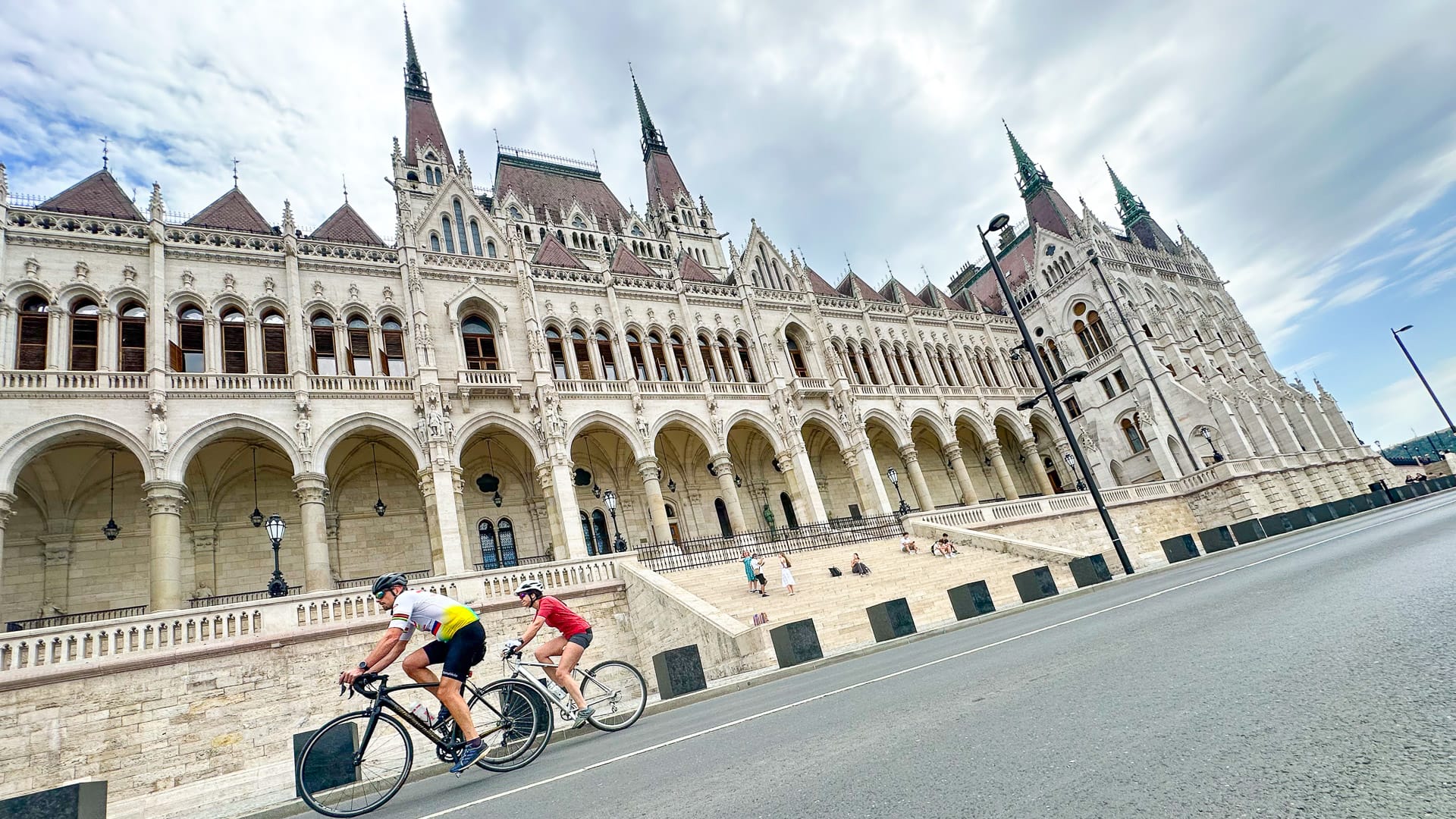
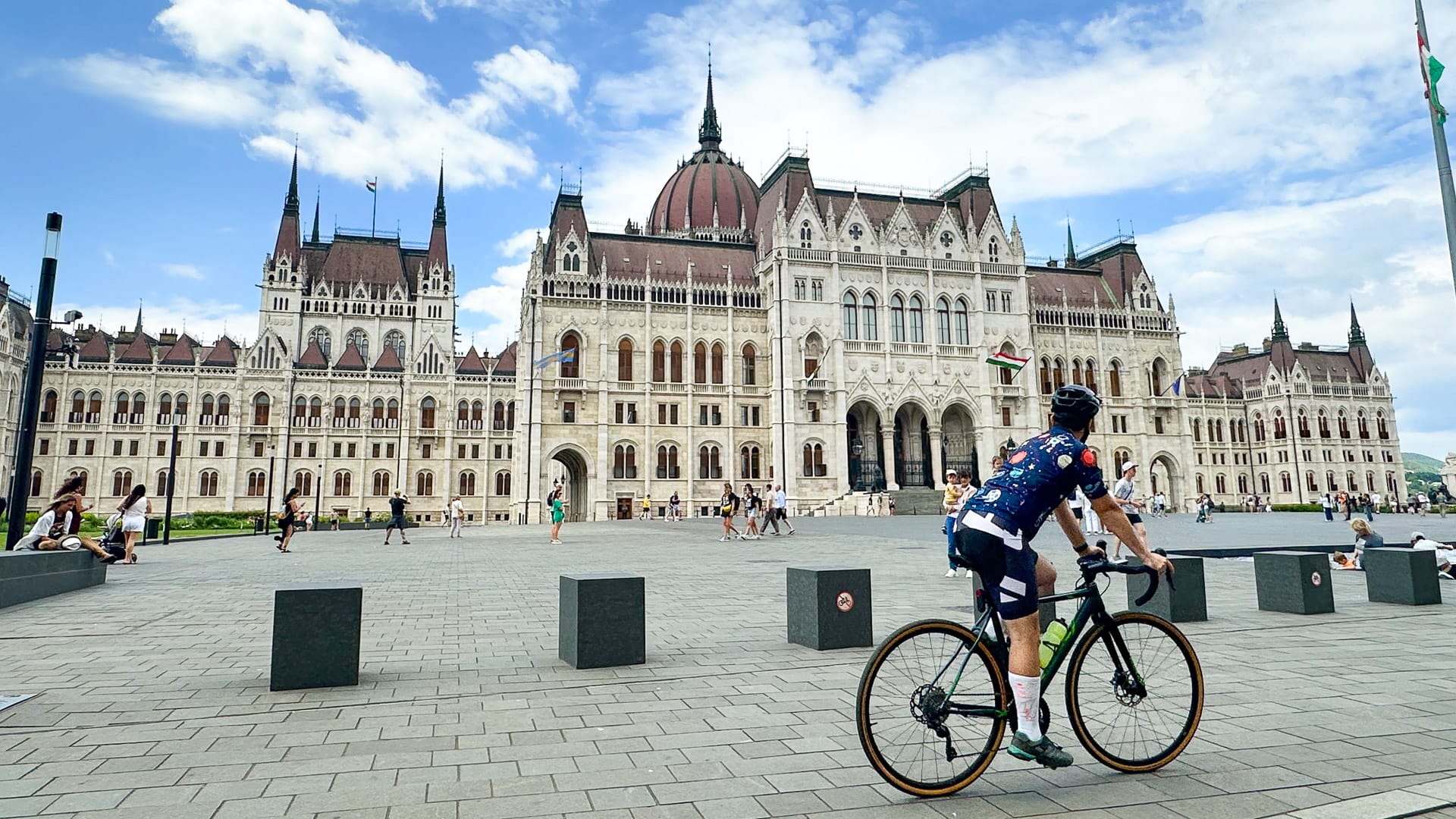
Cyclists in front of the Parliament Building (photo credit: Wiredonkey Cycling Tours)
Is cycling in Budapest safe?
Cycling in Budapest can be enjoyable with careful route choice. Most drivers are familiar with cyclists, but traffic volumes and inconsistent infrastructure mean some sections are better suited to confident riders.
The quietest-looking route on a map is not always the safest or simplest. Use established cycle routes where possible and take extra care at junctions, tram tracks and places where cycle lanes end.
Shared paths require a different kind of caution. Keep speeds low around walkers and runners, especially beside the Danube, on Margaret Island and at popular weekend destinations.
Practical safety points include:
- Use front and rear lights in poor visibility.
- Cross tram tracks as close to a right angle as possible.
- Keep speeds low on shared paths.
- Use a strong lock.
- Do not leave removable accessories on the bike.
- Carry identification and travel-insurance details.
- Call 112 in an emergency.
If you’re looking for help navigating Budapest’s traffic, junctions and less obvious route connections, Wiredonkey Cycling Tours can help by providing guided rides led by local cyclists. Just drop us a line.
How should you secure your bike in Budapest?
As in many cities, it’s not a good idea to leave an expensive bike unattended (even if locked up) especially for long periods, like while visiting baths, museums or other attractions! Use a U-lock to secure the frame to a fixed stand, and make sure both wheels are also locked. Other types of lock can be cut within seconds, while unsecured wheels may be stolen separately. Remove lights and computers, and choose indoor storage overnight.
For a sightseeing day with frequent stops, a public hire bike may be more practical than leaving a high-value road or gravel bike outside.
What cycling rules should visitors know?
Hungarian cycling rules have a few quirks. Bikes must have front and rear lights, wheel reflectors and a bell. A small bell is the simplest option, although some riders use the bell function on a bike computer in practice.
Helmets are not compulsory unless you are riding above 40 kilometres per hour. Even so, wearing a helmet is a sensible precaution.
Hungary’s traffic code does not specify a blood alcohol limit for cyclists. However, it is prohibited to ride a bike if you are drunk or unable to cycle safely. Make sure you also carry the required bike kit.
Are there useful Hungarian words for cyclists?
A few useful Hungarian cycling words include:
- Kerékpár (KEH-rayk-paar): bicycle
- Bringa: bicycle, informally
- Jegy (YED-y): ticket
- Kerékpárút (KEH-rayk-paar-oot): cycle path
- Kerékpárszerviz (KEH-rayk-paar-sehr-veez): bike service
- Víz (veez): water
Is it easy to find food and water while cycling in Budapest?
Food and drink are easy to find in central Budapest and in the larger riverside towns. Services are less frequent on forest roads and some longer hill routes, so check the route before setting off and carry enough water to reach the next confirmed stop.
Tap water is safe to drink in Hungary, as is the water from public drinking fountains. Cafés will also generally refill water bottles.
Public toilets can be difficult to find in Budapest, with shopping centres often the best option. Card payments are usually available, although small shops outside Budapest are generally closed on Sundays.
What should cyclists eat and drink in Budapest?
Food is one of the pleasures of a Budapest cycling trip. Hungarian classics to look out for include chicken paprikash, goulash, fish soup, plum dumplings and lángos. Stand25 is one option for modern Hungarian cooking, while Dobrumba focuses on Middle Eastern flavours. Check current opening hours and booking requirements before visiting. WeLoveBudapest is also useful for current restaurant news and openings.
Markets, bakeries and cafés can also provide practical ride fuel, while Etyek adds a strong wine-country angle.
Portions can be substantial, which is welcome after a longer ride but less appealing immediately before a steep climb! A lighter bakery or café stop may work better during the ride, with a traditional meal saved for afterwards.
Typical Hungarian bakery items include pogácsa, small savoury scones commonly made with cheese, potato or pork crackling; kakaós csiga, a spiral pastry filled with cocoa and sugar; túrós batyu, filled with sweetened curd cheese and raisins; lekváros bukta, a soft bun filled with apricot or plum jam; and rétes, a thin strudel with fillings such as apple, sour cherry, poppy seed or curd cheese.
Popular cakes include krémes, Dobos torta, Zserbó and Eszterházy torta. Somlói galuska combines sponge cake, chocolate sauce, walnuts, raisins and whipped cream, and is best saved for after the ride.
On longer routes, plan café and water stops before leaving. There are plenty of cafés in the riverside villages along the Danube Bend. Before riding into the Visegrád Mountains, top up on supplies in Szentendre, as there are no shops along the way. Restaurants are available at the peak of Dobogókő.
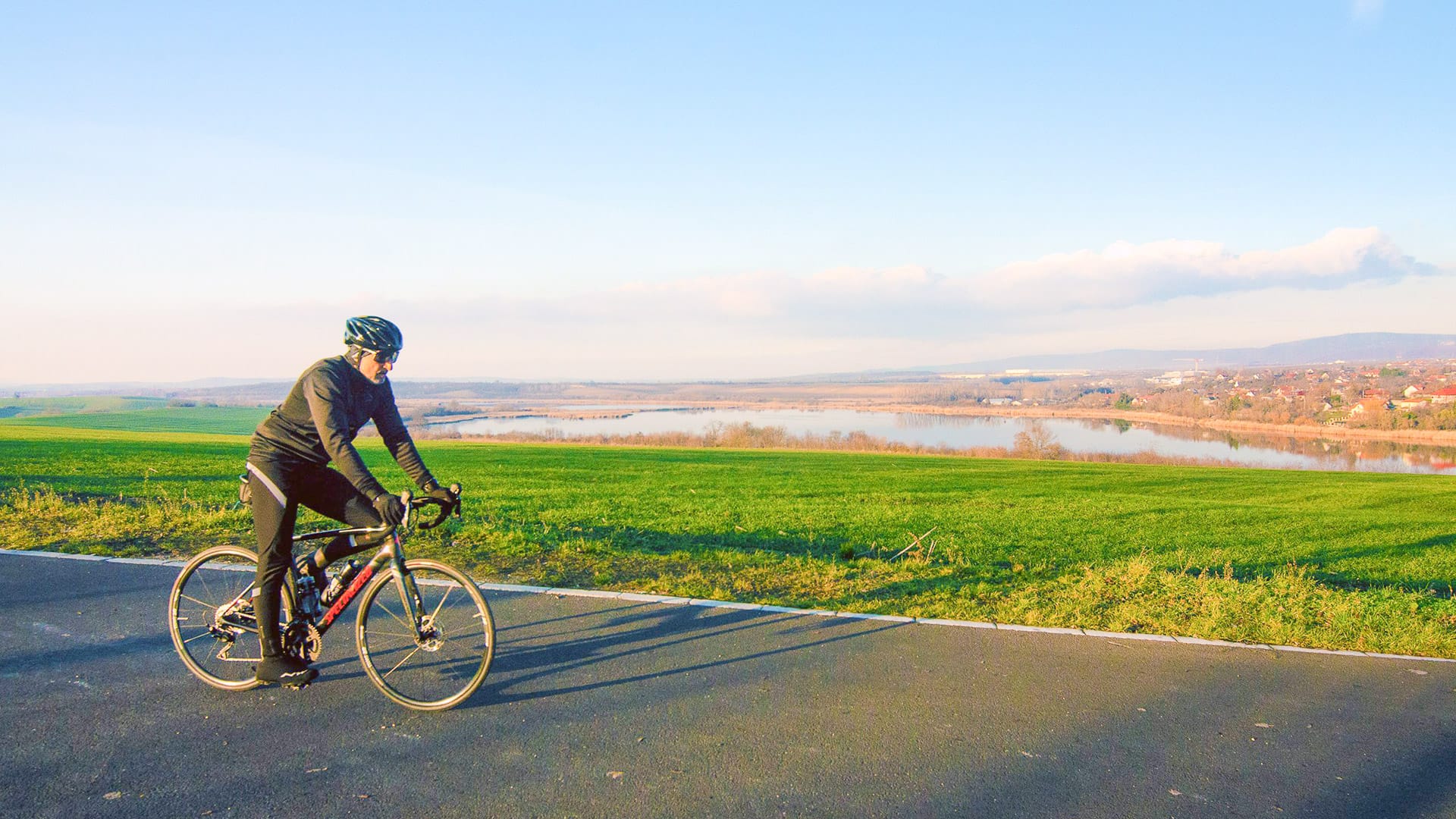
Cyclist heading towards Budapest from Etyek (photo credit: Wiredonkey Cycling Tours)
Sponsor Message
Considering a cycling holiday in Budapest?
Wiredonkey Cycling Tours have been offering fully supported, small-group cycling holidays in Hungary since 2023. In Budapest, they offer guided day rides to Szentendre and the Etyek wine region, as well as custom tours.
Head to their website to find out more.
Got a question for Peter Illés from Wiredonkey Cycling Tours?
Fill out this form and we will pass it to Wiredonkey Cycling Tours who aim to reply (within 24 hours wherever they can!)
Part 6: Wiredonkey Cycling Tours
At Wiredonkey Cycling Tours, we offer guided rides for visitors who want help with route choice, bike hire and logistics in and around Budapest. Our small local team includes guides and drivers with first-hand knowledge of the roads, public transport and cycling routes around the Hungarian capital.
We check and ride all our routes before we use them with our guests.
Budapest cycling day tours
Our one-day rides are designed for visitors who want to explore beyond central Budapest without organising the route, bike hire and logistics themselves.
Our two main day trips from Budapest are:
Szentendre cycling day trip
Our Szentendre day trip follows the Danube north towards one of the area’s most popular riverside towns. It is the easier of the two rides and is likely to suit leisure cyclists, couples and visitors who prefer flatter riding.
The route combines riverside cycling with time to explore Szentendre’s galleries, cobbled streets and historic centre.
Visit the Wiredonkey Cycling Tours’ website for more information on our Szentendre cycling day trip from Budapest.
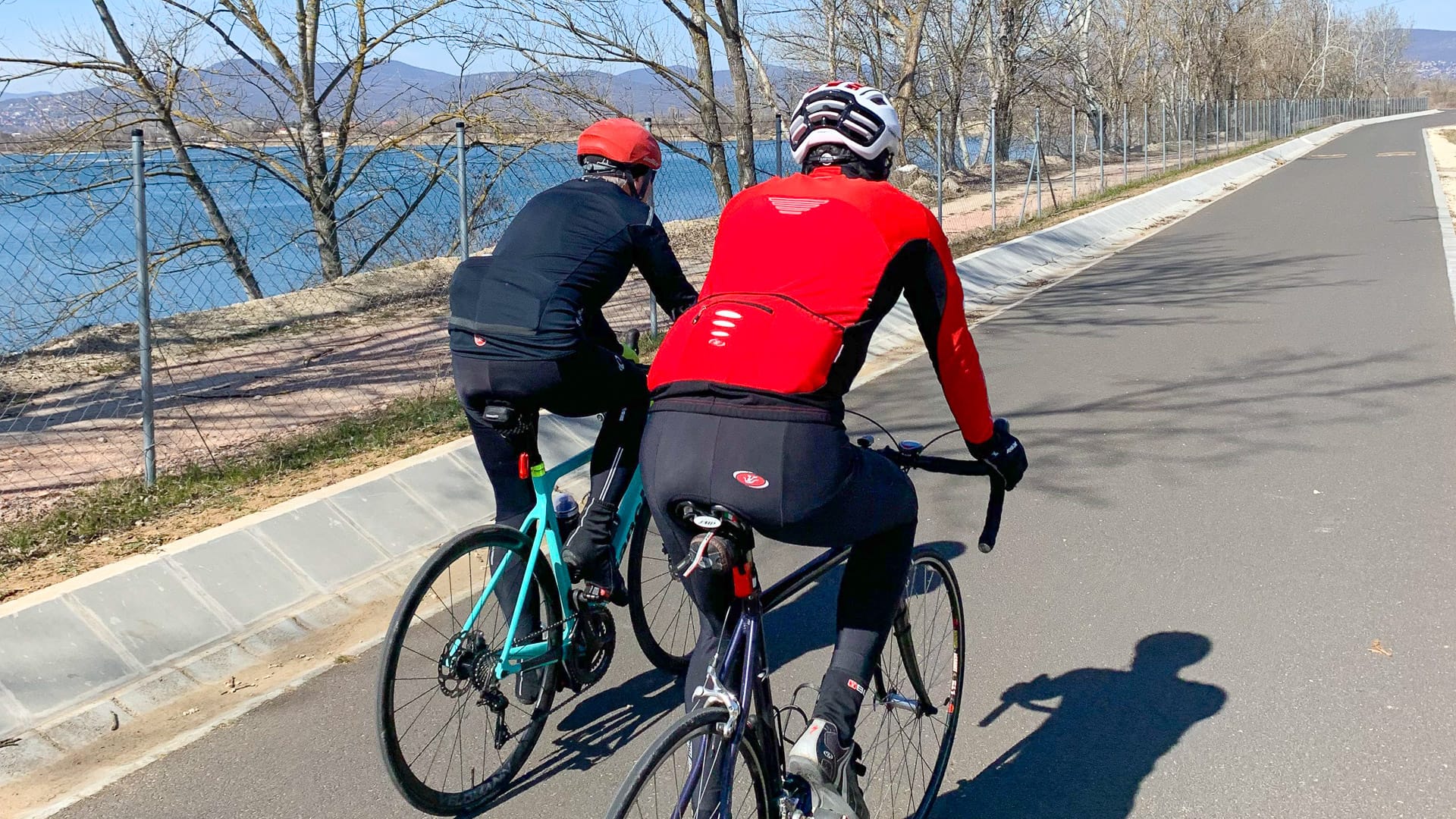
Cyclists heading to Szentendre (photo credit: Wiredonkey Cycling Tours)
Etyek wine region cycling day trip
Our Etyek trip heads west from Budapest into rolling countryside and one of Hungary’s wine-producing areas. It involves more climbing than our Szentendre ride and is better suited to cyclists who want a hillier day with Hungarian cuisine and wine included.
The route visits the Etyek wine region and includes a wine tasting as part of the trip.
Visit the Wiredonkey Cycling Tours’ website for more information on our Etyek wine cycling day trip from Budapest.
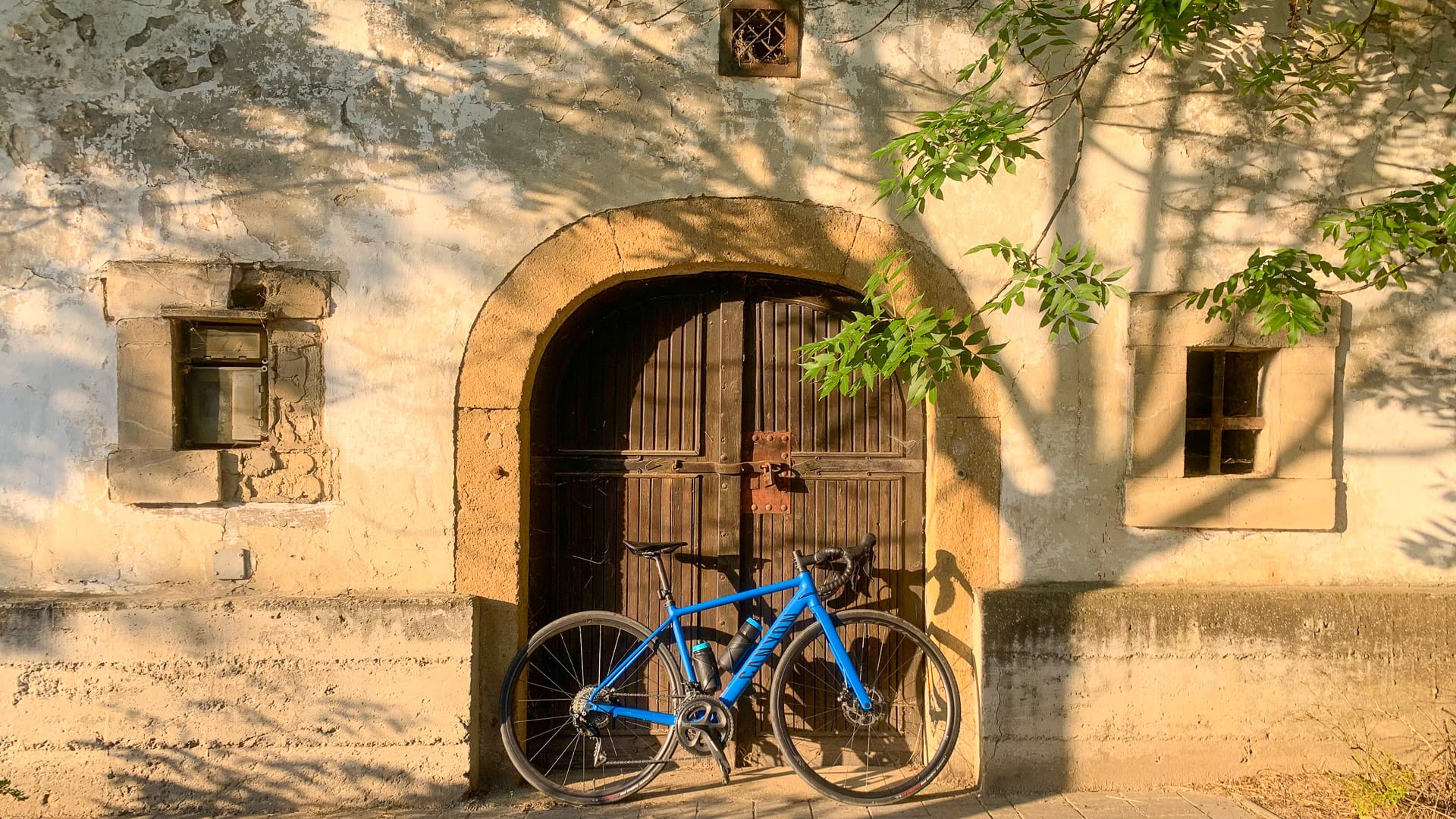
Wine cellar in Etyek (photo credit: Wiredonkey Cycling Tours)
What do the Budapest day tours include?
Both of our day trips include:
- Bike hire
- Helmet
- Local guide
- Lunch
- Transfers
- Entrance fees where relevant
Wine tasting is also included in our Etyek tour.
A support vehicle does not follow the group during our one-day rides. However, the guide can call for assistance if a mechanical problem or another issue arises.
Who are the day tours for?
Our rides can work well for:
- Visitors spending a short break in Budapest
- River-cruise passengers
- Cyclists travelling with non-riding companions
- Riders who want one supported cycling day before or after a longer holiday
- Private groups, families or groups of friends
- Visitors who do not want to bring their own bikes
We can run both rides for a single guest, and bookings may usually be made up to 48 hours before departure, subject to availability.
We also arrange Budapest rides for private groups, cycling clubs and corporate teams. We can adapt the distance, pace and route around the group’s riding experience and interests.
Group sizes and guiding
At Wiredonkey we work with a maximum of eight riders per guide. We can offer rides in English, Hungarian, Romanian and German.
Our guide leads the route, manages the group’s pace and helps with navigation. They can also provide local and cultural context, translate at stops and assist with minor mechanical problems.
Our private tours and scheduled group departures may be available, depending on the trip and date.
Bikes and equipment
Bike hire is available as part of a Wiredonkey guided or custom tour. We do not offer bike rental as a standalone rental service.
The bikes we can provide depend on the route and type of riding including:
- Mid- to high-end road bikes, such as the Scott Addict or a similar model.
- Gravel bikes, such as the Scott Speedster Gravel or a similar model.
- Scott e-bikes, with the exact model depending on the route and availability. E-bikes are available on request for an additional charge.
Helmets and lights are included with rental bikes.
Please contact us before travelling if you need a particular pedal system, saddle, pannier, phone mount or other equipment.
Booking a Budapest cycling tour
One-day tours may be available at relatively short notice, but booking ahead provides a better choice of bikes and dates.
During April, May, September and October, we suggest booking at least one week in advance.
Find out more
If you are thinking about a cycling trip to Budapest get in touch, and we would love to help you plan a trip that suits you. Visit the Wiredonkey Cycling Tours website for our current tour details, prices and availability.
What’s next?
Big thanks to Peter Illés of Wiredonkey Cycling Tours for sharing these insights into cycling in Budapest.
Looking for more exciting content on cycling in Budapest? Don’t miss:
- Cycling Hungary, our hub page for the country
- Cycling Hungary: the inside guide, for the best regions and routes
- Danube bike and boat tours, for the best way to cycle the Danube
- 11 of the best bike tours across Europe, featuring the Danube Cycle Path
- River cycling, for our pick of the 8 of the most beautiful river cycling routes
- 9 most bike friendly cities, for cycling holidays and city breaks
Got a question for Wiredonkey Cycling Tours?
Fill out this form and we will pass it to Wiredonkey Cycling Tours who aim to reply (within 24 hours wherever they can!)
Got a question for Peter?
Fill out this form and we will send it to Peter. We aim to get you an answer within 24 hours where possible!Peter Illés was born in Transylvania, Romania, and is now based in Budapest. Before starting Wiredonkey Cycling Tours, he built an IT consulting firm but found himself wanting to spend more time away from screens and out on the road.
Travel planning and cycling have long been two of Peter’s biggest interests. On trips with friends and family, he was often the person planning the places to visit, the food to try and the experiences worth making time for.
Wiredonkey Cycling Tours brings those interests together: cycling, local travel, food and sharing Hungary and Romania from the saddle.
The name Wiredonkey comes from “drótszamár”, a playful Hungarian word for bicycle.
First Published: 02 September 2026
The contents of this website are provided for general information purposes only. It is not intended to amount to advice and you should not rely on it. You should carry out your own due diligence and risk assessments and take professional advice. Views expressed by interviewees or other users of this website do not necessarily represent our views. We make no representations, warranties or guarantees, whether express or implied, that the content on our website is accurate, complete or up to date. If you use any information or content on this website, download from, or otherwise obtain content or services through our website, it is entirely at your own discretion and risk. Epic Road Rides Ltd disclaims all liability and responsibility arising from any reliance placed on the information and content on this website. Find out more here.
Sponsor Message
Considering a cycling holiday in Budapest?
Wiredonkey Cycling Tours have been offering fully supported, small-group cycling holidays in Hungary since 2023. In Budapest, they offer guided day rides to Szentendre and the Etyek wine region, as well as custom tours.
Head to their website to find out more.
Got a question for Peter Illés from Wiredonkey Cycling Tours?
Fill out this form and we will pass it to Wiredonkey Cycling Tours who aim to reply (within 24 hours wherever they can!)