
Boat Bike Tours believes its Egypt trip to be the first organised bike and boat tour on the River Nile.
The tour offers a very different way to experience the Nile Valley as compared with the usual boat and coach tours. Boat Bike Tours trip combines guided e-bike rides with a Nile cruise and visits to many of the country’s best-known historical sites.
Guests cycle through parts of rural and urban Egypt between the main cultural highlights. The itinerary includes seven days of guided cycling tours covering 239 kilometres, alongside time in El Gouna, Luxor, Aswan and Cairo.
To understand how the trip works, we spoke to Laurens Winkel, CEO of Boat Bike Tours. Laurens has worked with the company since 2007 and was closely involved in developing and testing its 13-day Egypt & The Nile – A Journey to Ancient Wonders tour.
Developing new tours and improving existing journeys is a major part of Laurens’ role. He describes the Egypt itinerary as one of the boldest projects Boat Bike Tours has developed. During the planning process, Laurens returned to Egypt several times. He developed the itinerary with Baher from Sakkara Travel, whose family has welcomed visitors to Egypt for generations, and Maged’s team of licensed Egyptologists. Together, they tested the routes and shaped how the cycling, cultural visits and local logistics would work.
The team cycled through sugarcane fields near Luxor, listened to traders in the souks and watched feluccas (traditional wooden sailing boats) drifting along the Nile at dawn. They also worked with local guides to test the routes and understand how the riding could operate safely and comfortably.
In this guide, Laurens shares who the tour is for, what the cycling is really like and what to expect from each day.

Laurens Winkel is the CEO of Boat Bike Tours and has been with the company since 2007.
What he enjoys most about his work is creating new products, tours and ships, improving existing journeys, and building the team. Egypt is a perfect example: one of the boldest and most exciting journeys Boat Bike Tours has developed.
During the months of preparation, Laurens returned to Egypt again and again. He cycled through sugarcane fields near Luxor, listened to traders in the souks, and stood by the Nile at dawn as feluccas drifted past. Each time, he felt the same thing: this place has magic.
However, the team also knew that cycling in Egypt had to be approached with great care. They partnered with experts who live and breathe the country: Baher from Sakkara Travel, whose family has welcomed guests for generations, and Maged and his team of Egyptologists, who share Egypt’s stories not just from a textbook, but as companions on the road.
Together, they tested the routes and shaped an itinerary that combines comfort, safety and wonder. Carefully selected rural roads, e-bikes, support vans, local guidance and traffic management where needed help make the cycling accessible, while temple visits, boat rides through bird sanctuaries and evenings on the Nile make the journey unforgettable.
We love to introduce our community to cycling businesses, destinations and ideas that we think are genuinely interesting. Boat Bike Tours caught our attention because of its focus on cycling in Egypt, which felt like a natural fit for Epic Road Rides and our readers. We were therefore pleased to work with the Boat Bike Tours team on this article.
Boat Bike Tours paid for this advertisement feature. Our decision to collaborate reflects our view that the brand is relevant to our readers; it is not a formal approval, audit or guarantee of its services. Unless we expressly say otherwise, we have not personally taken the trip described or independently verified information supplied by Boat Bike Tours.
As with any travel purchase, please check the latest trip details, terms and customer protections directly with Boat Bike Tours before booking. Any booking is made with Boat Bike Tours, not Epic Road Rides.
Always check current travel information and advice. For visitors from the UK, the UK government travel information pages are here.
To get a feel for what the Egypt & The Nile tour is like, take a look at this short video showcasing the route, scenery and experience:
 There's a Youtube video here!
I'm fine with Youtube cookies
Table of contents
This article contains a lot of useful information. To help make it more digestible, we’ve broken it down into several parts:
- Part 1: Is a boat bike tour right for you?
- Part 2: What is the cycling like?
- Part 3: Egypt & The Nile tour
- Part 4: Typical day on the tour
- Part 5: Things to know before booking
- Part 6: Boat Bike Tours
Sponsor Message
Looking for an Egypt bike and boat tour?
Discover Egypt by e-bike on our 13-day Egypt & The Nile – A Journey to Ancient Wonders tour.
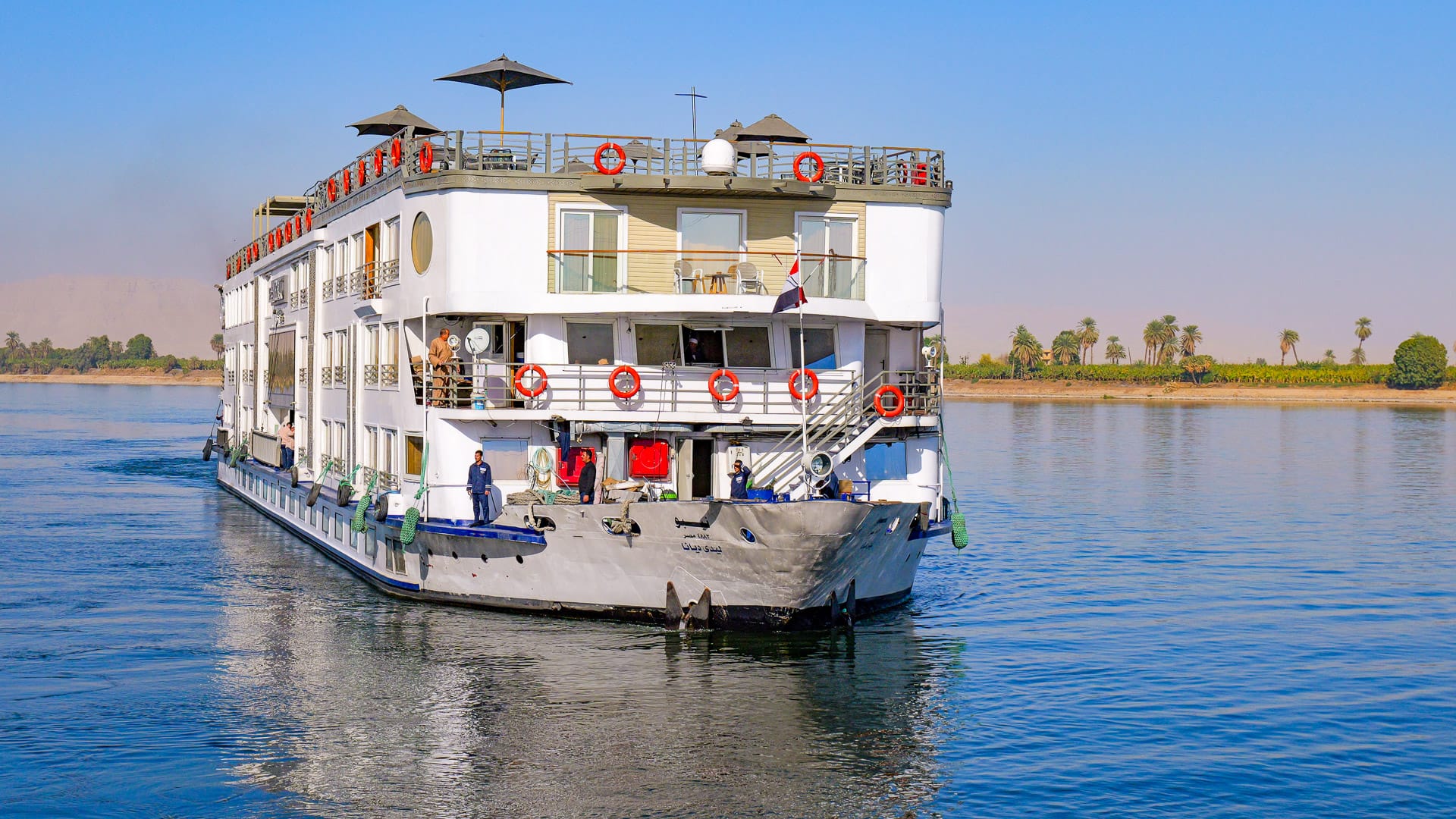
We’ve been running bike and boat holidays since 2002, and this premium guided tour combines seven days of cycling with seven nights aboard the superior-class H/S Nebu and stays in carefully selected hotels.
Ride through the Nile Valley, visit some of Egypt’s most important ancient sites and experience rural communities and everyday life away from the usual tourist routes. Expert guides, e-bikes and on-route support are included throughout.
Interested in joining the trip? View the full itinerary, dates and availability on our website or complete the form below to discuss your plans.
Got a question for Boat Bike Tours?
Fill out this form and we will pass it to Boat Bike Tours who aim to reply (within 24 hours wherever they can!)
Egypt boat and bike tour at a glance
| Key fact | Detail |
| Tour | Egypt & The Nile – A Journey to Ancient Wonders |
| Duration | 13 days and 12 nights |
| Cycling days | 7 |
| Total cycling distance | 239 kilometres |
| Longest ride | 51 kilometres |
| Difficulty | Level 3 out of 3 (requires a higher level of exertion, medium hilly terrain) |
| Tour format | Fully guided group riding |
| Riding arrangements | Guests ride together as one group, with police and ambulance escort where required |
| Bike and equipment | All-terrain rental e-bike, helmet and pannier included as standard. Guests may also bring their own bike or e-bike by prior arrangement, subject to available storage and a parking fee. |
| Start | Hurghada Airport and El Gouna |
| Finish | Cairo |
| Accommodation | Five hotel nights and seven nights aboard H/S Nebu: two hotel nights in El Gouna, seven nights on the ship and three hotel nights in Cairo |
| Best time | Late October to March |
| Best suited to | Active travellers interested in cycling, history and culture |
Interested in the trip?
Check the latest itinerary, departure dates, prices and availability for Boat Bike Tours’ Egypt & The Nile – A Journey to Ancient Wonders tour.
Part 1: Is a boat and bike tour in Egypt right for you?
What is a boat and bike tour in Egypt?
A boat and bike tour combines cycling with accommodation and travel by boat.
On this Egypt itinerary, guests spend five nights split between hotels in El Gouna and Cairo, with seven nights aboard H/S Nebu during the Nile Valley section.
Alongside this, there are seven guided e-bike rides, cultural visits and several transfers by coach, plane and smaller boats.
Unlike many European bike and boat holidays, the cycling is not self-guided. The group rides together with tour leaders, local guides and support vehicles, and the organised format is central to how the routes are managed.
Police and ambulance escorts may also accompany the group, depending on local requirements and the route being ridden.
Guests do not have to cycle every day and can choose to remain aboard the ship instead. However, there is no option to join the cycling group later in the day by support vehicle.
A support van travels with the group during the rides, carrying water and snacks. The number of cycling guides depends on the size of the group; for one large group, there are normally two guides. Additional Egyptologists also join the group to provide insight during the cultural parts of the tour.
Why experience Egypt by bike and boat?
There are several “normal” ways to travel through Egypt. Visitors can take a Nile cruise, join a coach tour or travel between the main sites by road and air.
A boat and bike tour adds a more active perspective.
- The bike takes guests beyond the main visitor sites and into parts of the Nile Valley that are easy to zip by without noticing from a coach.
- Bikes allow you to ride past fields, villages, date palms, small shops and farmers at work. You move slowly enough to notice the details, but quickly enough to see the landscape change around you.
- You might pass children waving from the roadside, adding to the sense of moving through everyday life rather than simply travelling between major sights.
- The Egyptologists that accompany the tour help guests understand the beliefs behind the sites. Rather than seeing only columns, tombs and carvings, you learn more about the pharaohs, gods, rituals and symbols that shaped ancient Egyptian life.
The Nile also gives the itinerary a natural geographical route. For thousands of years, settlements, agriculture and trade have developed around the river. Travelling by bike and boat allows guests to follow that line through the country.
After riding and sightseeing, the ship provides a comfortable base. Guests can cool down, eat together and watch the Nile from the deck before the next day.
During the Nile Valley section of the tour, the ship also provides continuity. Guests can unpack and settle in while the boat carries them between different parts of the route. Some of the quieter moments come after the ride, when guests can sit on deck and watch the light change across the Nile.
Unlike a conventional bike-and-barge tour, guests do not sleep aboard the ship for the entire holiday. The tour begins with two hotel nights in El Gouna. Guests then travel to Luxor, where they join H/S Nebu for the seven-night Nile Valley section.
From Luxor, the ship sails to the next destination while guests cycle, continuing in this way until it reaches Aswan. It remains in Aswan for one day before sailing back towards Luxor while guests continue exploring by bike.
After returning to Luxor, the tour finishes with three hotel nights in Cairo, where guests travel around the city by bus.
How does the tour compare with a traditional Nile cruise?
| Egypt boat and bike tour | Traditional Nile cruise | |
| Daily activity | Guided e-bike rides and sightseeing | Mainly guided sightseeing |
| Cycling | Seven rides totalling 239 kilometres | Usually none |
| Access | Rural roads, villages and agricultural areas | Ports, coach transfers and organised excursions |
| Independence | Group rides together | Guests normally follow the excursion programme |
| Accommodation | Boat on the Nile and hotels | Mainly cruise ship, sometimes with hotel stays |
| Best suited to | Active cultural travellers | Travellers who want a less active itinerary |
Both formats provide access to Egypt’s major ancient sites. The main difference is how much of the journey guests experience from the bike.
The bike and boat itinerary is likely to suit travellers who want the history and comfort of a Nile cruise but also want cycling to form a meaningful part of the holiday.
Boat and bike tour or traditional Nile cruise?
A traditional Nile cruise places greater emphasis on sightseeing from the ship and travelling to sites by coach. A boat and bike tour uses many of the same cultural highlights but adds structured riding through the landscapes between them.
The bike and boat format is more active and asks for greater flexibility from guests, who must be comfortable with group riding and full days. In return, they see more of the agricultural roads, villages and local activity that sit beyond the main visitor entrances.
A conventional cruise may be the better choice for travellers who want less physical activity, more time aboard and fewer concerns about traffic or bike handling.
The boat-and-bike itinerary is better suited to those who want cycling to be a meaningful part of the holiday rather than an occasional optional excursion.
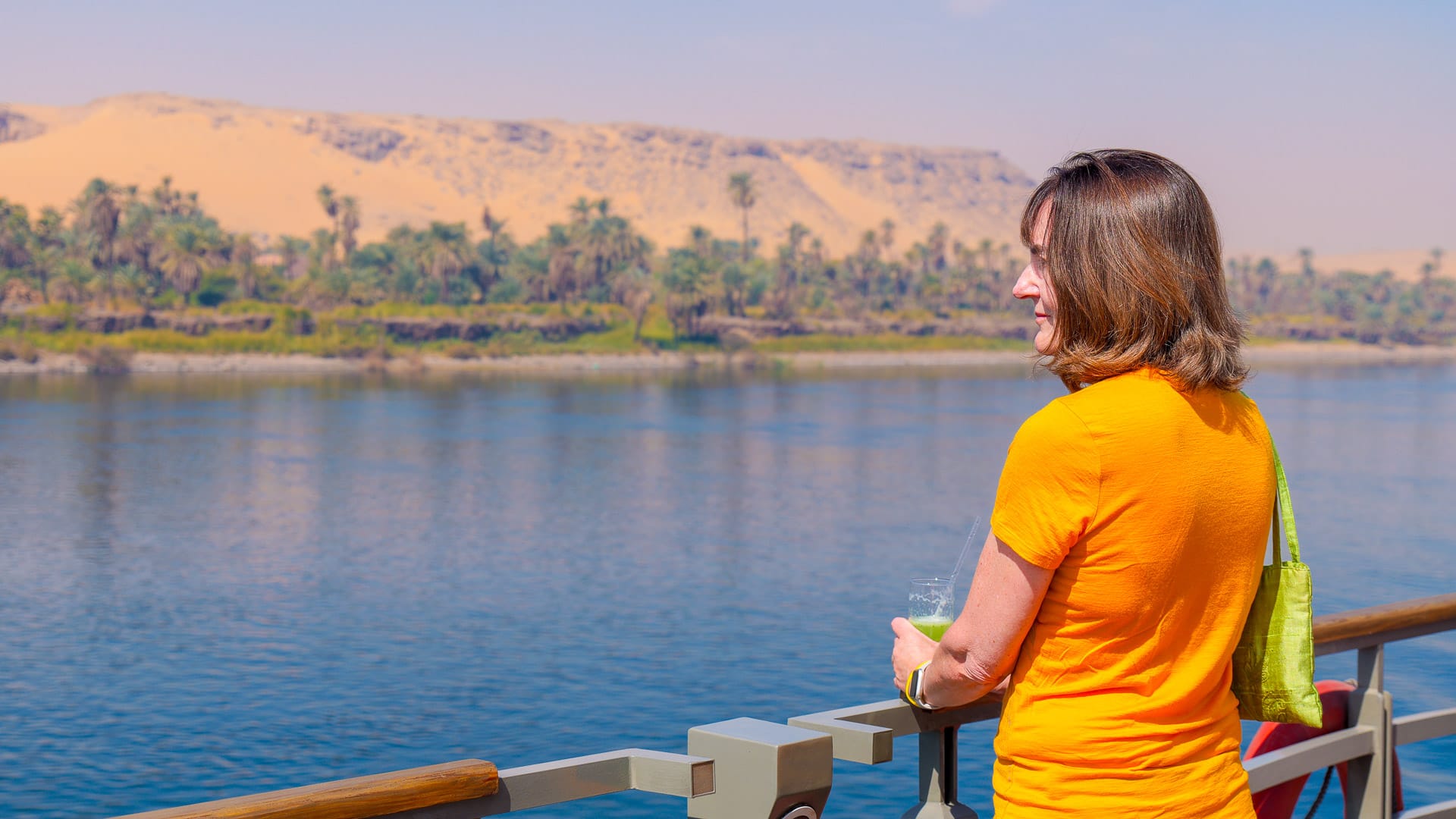
Views over the Nile (photo credit: Michael de Boer via Boat Bike Tours)
Who is an Egypt boat and bike tour best suited to?
The tour is best suited to active travellers with a strong interest in history, archaeology, religion, local culture and everyday life along the Nile.
It may appeal to couples, friends and solo travellers who enjoy the social side of a group tour but also value having a private cabin and time to relax on board.
Guests do not need to be experienced road cyclists. The e-bikes included in the tour make the distances more manageable, but riders should be confident starting, stopping and handling a bike around other people and traffic.
The tour is likely to suit you if you want cycling to form part of a wider cultural holiday, are comfortable riding an e-bike in a guided group and value strong local support and organised logistics.
The programme is full. Cycling days also include sightseeing, transfers and guided visits, so guests should be prepared for several consecutive active days.
You may prefer another trip if you want to ride independently, expect traffic-free cycle paths, are looking for a high-mileage performance cycling holiday or prefer large amounts of free time and a flexible daily schedule.
Who might prefer another type of holiday?
This tour is unlikely to suit riders who primarily want independent or self-guided cycling.
The group rides together and follows instructions from the guides. Guests cannot normally ride ahead, take a separate route or stop independently whenever they choose.
It may also be less suitable for travellers looking for separated cycle paths, high-mileage performance riding or large amounts of unstructured free time.
It is also unlikely to suit travellers primarily looking for a quiet Red Sea resort holiday. El Gouna provides a gentle introduction, but the wider itinerary is active and culturally intensive.
Egypt can feel busy and intense. Traffic, heat, vendors and crowded visitor sites are part of the experience.
Could this style of trip suit you?
The live tour page includes current dates, accommodation details, photos and the latest information about the cycling programme.
Sponsor Message
Looking for an Egypt bike and boat tour?
Discover Egypt by e-bike on our 13-day Egypt & The Nile – A Journey to Ancient Wonders tour.
We’ve been running bike and boat holidays since 2002, and this premium guided tour combines seven days of cycling with seven nights aboard the superior-class H/S Nebu and stays in carefully selected hotels.
Ride through the Nile Valley, visit some of Egypt’s most important ancient sites and experience rural communities and everyday life away from the usual tourist routes. Expert guides, e-bikes and on-route support are included throughout.
Interested in joining the trip? View the full itinerary, dates and availability on our website or complete the form below to discuss your plans.
Got a question for Boat Bike Tours?
Fill out this form and we will pass it to Boat Bike Tours who aim to reply (within 24 hours wherever they can!)
Part 2: What is cycling in Egypt really like?
Which parts of Egypt does the tour explore?
El Gouna and the Red Sea
El Gouna provides a gentle introduction to Egypt. Its lagoons, marina, palm-lined roads and resort infrastructure feel very different from the busier streets and agricultural landscapes found later in the journey. The first ride also gives guests time to adjust their e-bikes and acclimatise to warmer conditions.
Luxor and the Nile countryside
Luxor is the historical and cycling heart of the itinerary. The East Bank combines the modern city with Karnak and Luxor Temple. Across the river, the West Bank contains tombs, mortuary temples, villages and agricultural roads beneath the Theban Hills.
Outside the main monuments, the surrounding countryside introduces riders to sugarcane fields, date palms, irrigation, small shops and village life. This is where the difference between travelling by bike and travelling only by coach is often most apparent.
Esna, Edfu and Kom Ombo
The smaller towns between Luxor and Aswan show how ancient sites sit alongside everyday life. Temples may be reached through local streets, markets or farming areas rather than isolated visitor zones. This part of the route also gives the ship and bike format its rhythm, with cycling and sightseeing followed by further sailing south.
Aswan and Nubian Egypt
Aswan has a different landscape from Luxor. The river widens around rocky islands and granite outcrops, while feluccas and smaller motorboats remain an important part of local transport.
Nubian history and culture add another layer to the journey. The itinerary also includes Philae Temple, an ancient temple complex dedicated to the goddess Isis, and the Aswan High Dam, a major twentieth-century engineering project that transformed the Nile and led to the creation of Lake Nasser.
For more background, see UNESCO’s page on the campaign to save Philae and other Nubian monuments from the rising waters created by the Aswan High Dam.
Cairo, Saqqara and Giza
The final section is less focused on cycling. Cairo brings together Coptic, Islamic and modern Egyptian history, while time in Saqqara and Giza traces the development of royal tombs and pyramid building. The Grand Egyptian Museum then brings many of the objects and stories encountered during the journey into one setting.
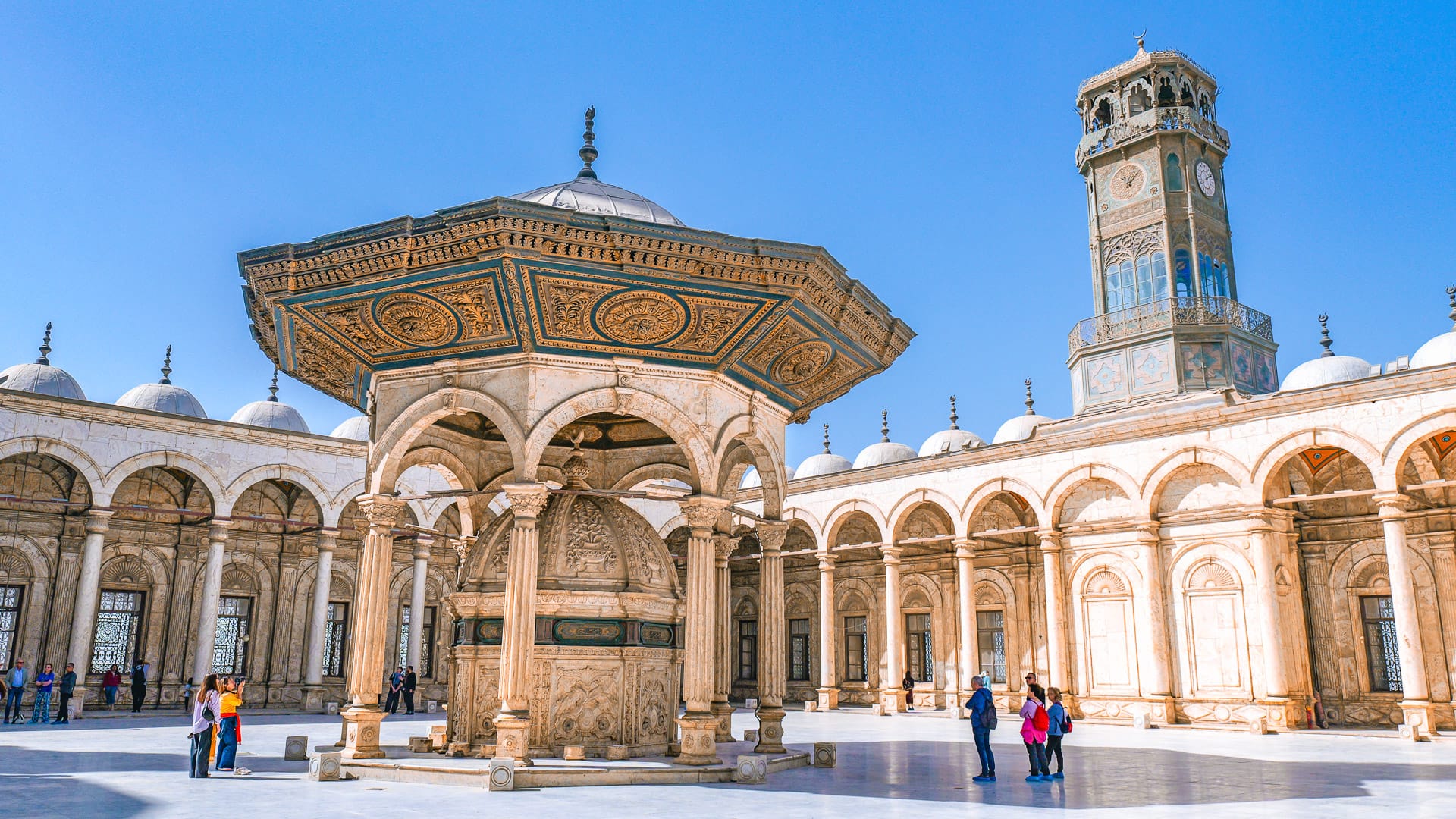
Muhammad Ali Mosque courtyard (photo credit: Michael de Boer via Boat Bike Tours)
What is the Nile Valley like for cycling?
The Nile Valley creates one of the most distinctive cycling landscapes in the world. Away from the river, much of the surrounding country is desert. Close to the water, irrigation supports fields, date palms, settlements and busy local roads.
This creates sharp changes in colour and atmosphere. A ride may move from green agricultural land to dry desert-edge scenery within a short distance. The river is not always directly beside the road, but it shapes the farming, communities and movement found throughout the route.
The tour takes place mainly in Upper Egypt. Despite its name, Upper Egypt is in the south of the country because it lies upriver, closer to the source of the Nile. Lower Egypt is farther north, where the river flows towards Cairo, the delta and the Mediterranean.
The largely flat valley floor helps make the area suitable for e-bike touring. However, the difficulty comes from more than the terrain. Heat, traffic, road surfaces, village activity and the need to remain within a guided group all influence how demanding a ride feels.
What does cycling beside the Nile really feel like?
The most memorable riding is not always connected with a famous monument. Some stages pass through fields and villages where farmers are working, children wave from the roadside and animals move between homes, fields and local roads.
Planned stops vary from day to day and may include local cafés, statues, churches, temples and other points of interest. On at least one stage, there was also a small shop nearby where guests could buy a sandwich.
Riders should expect a lively environment rather than empty country lanes. Motorbikes, tuk-tuks, agricultural vehicles, pedestrians, animals and roadside vendors may all be part of the scene. The pace is relaxed, but guests need to pay attention and follow the road position set by the guides.
There are also quieter stretches where the landscape opens out and the contrast between green cultivation and the dry desert becomes clear. The e-bike allows guests to look around and absorb these changes without every ride becoming a test of fitness.
How difficult is the cycling?
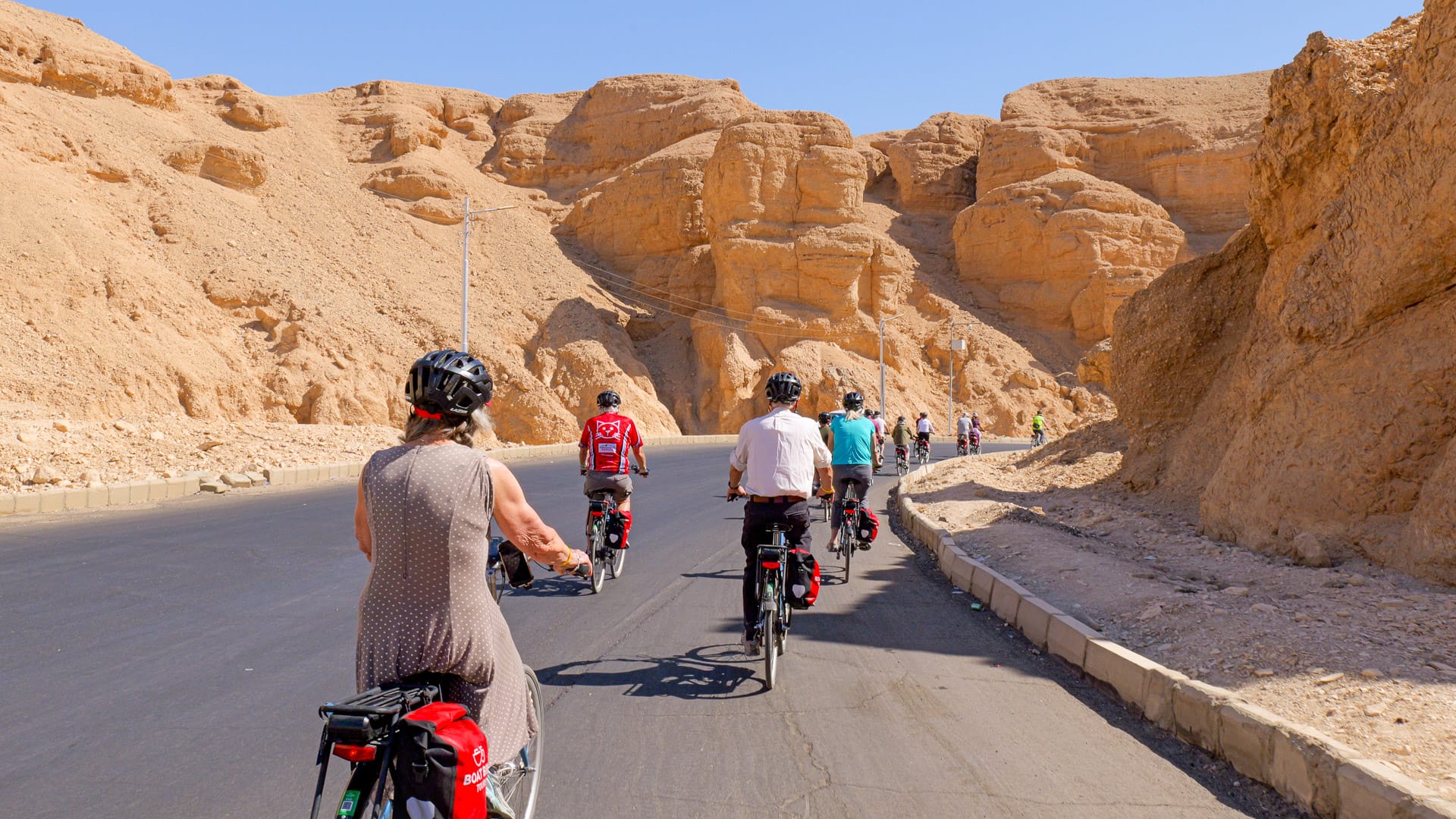
The itinerary includes seven rides totalling 239 kilometres. Daily distances range from 21 to 51 kilometres.
The difficulty of the tour is rated level three, which means riders should expect a higher level of exertion and moderately hilly terrain. The routes are not mountainous, and the all-road e-bikes help with distance, heat and wind. However, the difficulty is not determined by distance and climbing alone.
Riders also need to manage warm temperatures, traffic, changing road surfaces and full days that combine cycling with sightseeing. The pace is relaxed, but guests need to remain alert and comfortable within a group.
Most cycling days run from around 09:00 to 16:00, although timings vary. On some days, guests may start earlier or return to the ship as late as 18:00. These timings include stops and other activities, rather than representing continuous riding time.
Guests should have a reasonable level of fitness and feel confident riding a bike before joining the tour. Some previous experience of riding in traffic and on rough or uneven roads will also be useful, as Egyptian towns and cities can be busy and certain sections may involve cycling alongside vehicles on main roads.
There is relatively little climbing overall, although riders may encounter some short, steep inclines. The long days and warm temperatures can also add to the challenge, so completing regular rides before departure should help guests feel more comfortable. E-bikes are suggested for this tour.
What are the roads and surfaces like?
The riding uses a mix of rural roads, agricultural roads and streets through towns and villages.
Some sections are quieter, particularly in farming areas around the Nile. Other sections include local traffic, motorbikes, pedestrians, animals and roadside activity. Riders should also be prepared for rough road surfaces and some sections on busy main roads alongside other vehicles.
The tourism police accompany the cycling group in a role similar to a police escort. They often help manage traffic to improve safety, keep the group moving and reduce delays, rather than the roads necessarily being fully closed. This support is particularly important when the group enters busier destinations, including Luxor and El Gouna on the second cycling day.
This is not a tour based on separated cycle paths. Riders should expect changing road conditions and stay alert throughout each stage. The local guides set the pace and road position, while support vehicles remain available where required.
Check the current Egypt & The Nile – A Journey to Ancient Wonders itinerary for the latest cycling stages and arrangements.
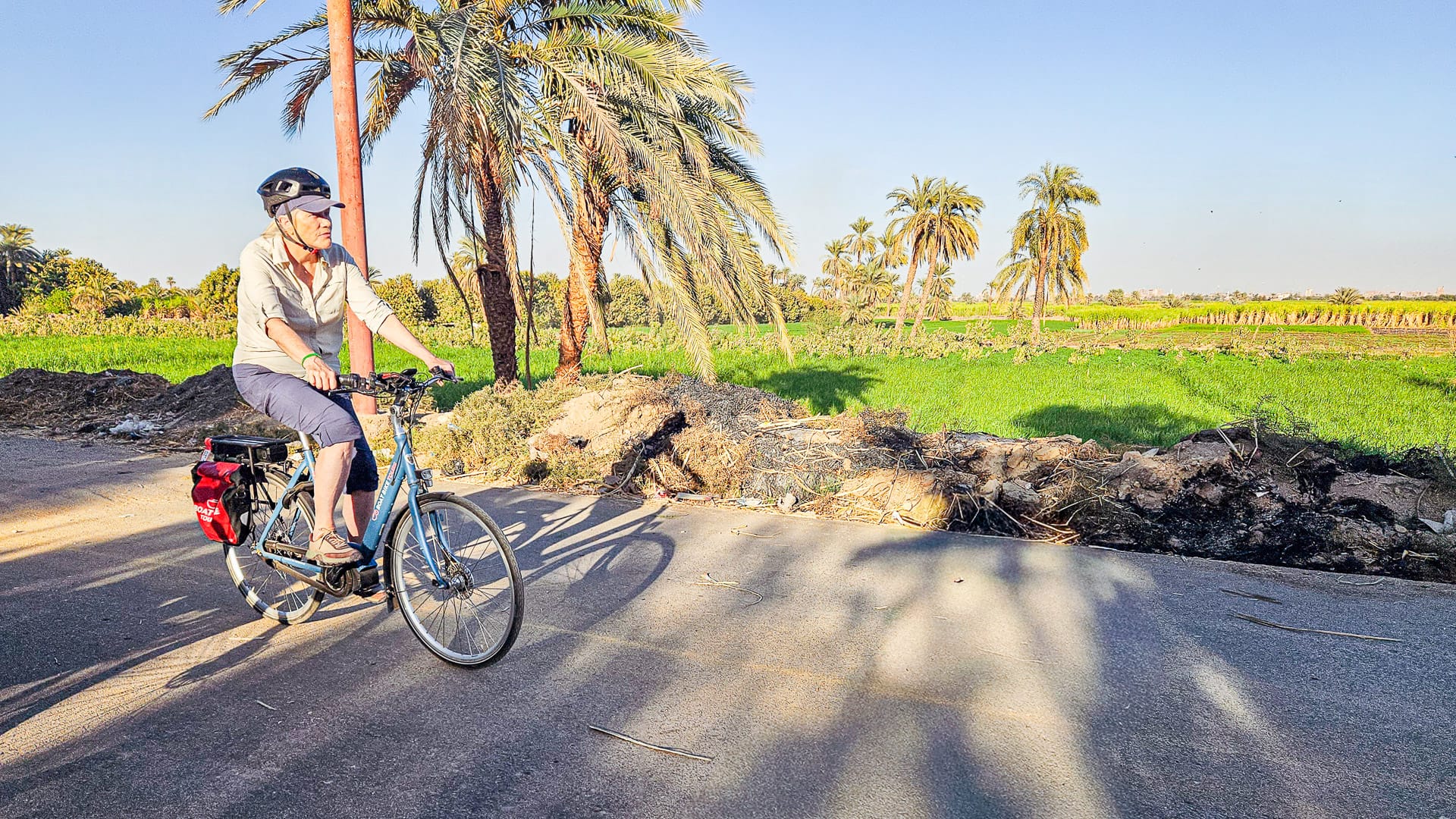
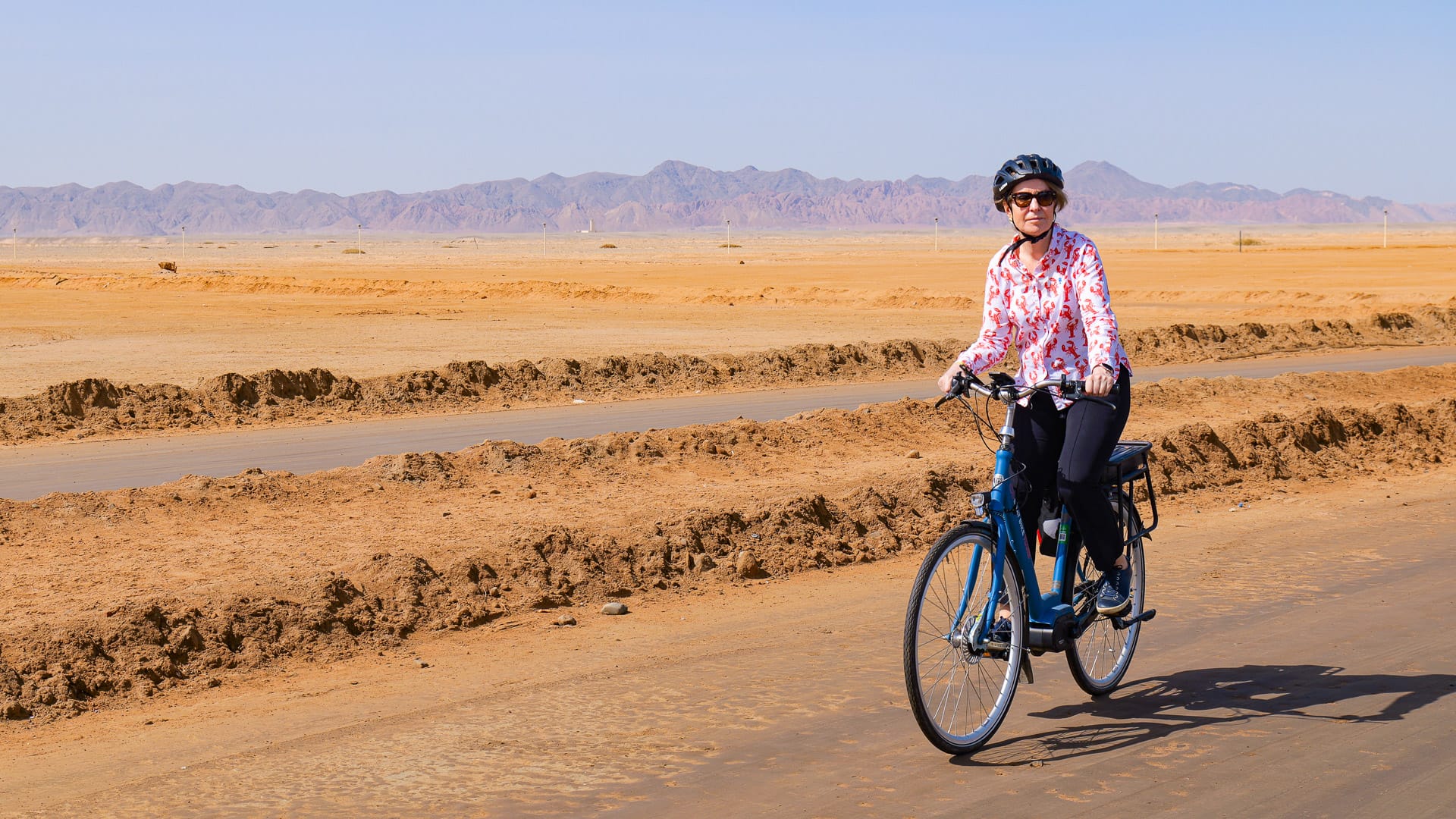
Cycling past palm trees (photo credit: Michael de Boer via Boat Bike Tours)
Do you ride independently or as a group?
All cycling is guided and the group rides together.
This is an important difference from many European bike and boat tours, where guests may follow route notes independently or divide into smaller groups.
In Egypt, the guides coordinate the pace, road position, stops and traffic arrangements. Cyclists should follow their instructions and avoid leaving the group.
Depending on local requirements, police and ambulance escorts may accompany the group. Police may also manage traffic at busy junctions or through congested sections. These arrangements provide additional support, but they can limit your ability to change pace or split into smaller groups.
Routes may pass through rural areas, agricultural roads, villages and busy streets. You should therefore listen carefully during the morning briefing, follow the guides’ instructions and be confident starting, stopping and controlling an e-bike around other cyclists and traffic.
Some guests compare the experience with riding in an organised cycling event. This is not because of the speed, but because of the support and coordination around the group.
You can find more information about the guided cycling programme in Egypt on the Boat Bike Tours website.
What support is available?
The tour operates as a fully guided group ride, with local guides, a support vehicle, planned water stops and medical support on standby during cycling days.
The practical details of route management, heat, mechanical help and medical support are covered together below.
What bikes are used, and why are they suitable for Egypt?
Modern all-road e-bikes are included in the tour price, together with a helmet and pannier.
The electric assistance helps riders manage the daily distances, wind and warm conditions. The wider tyres and all-road set-up should also be better suited to mixed road surfaces than a conventional road bike.
Guests should still be comfortable controlling a heavier e-bike, particularly when starting, stopping and riding in a group.
Trying an e-bike before departure would be useful for anyone who has not previously ridden one.

Bike parked beside the Nile, with H/S Nebu in the background in Luxor (photo credit: Michael de Boer via Boat Bike Tours)
Sponsor Message
Looking for an Egypt bike and boat tour?
Discover Egypt by e-bike on our 13-day Egypt & The Nile – A Journey to Ancient Wonders tour.
We’ve been running bike and boat holidays since 2002, and this premium guided tour combines seven days of cycling with seven nights aboard the superior-class H/S Nebu and stays in carefully selected hotels.
Ride through the Nile Valley, visit some of Egypt’s most important ancient sites and experience rural communities and everyday life away from the usual tourist routes. Expert guides, e-bikes and on-route support are included throughout.
Interested in joining the trip? View the full itinerary, dates and availability on our website or complete the form below to discuss your plans.
Got a question for Boat Bike Tours?
Fill out this form and we will pass it to Boat Bike Tours who aim to reply (within 24 hours wherever they can!)
Part 3: The Egypt tour: day by day
Boat Bike Tours’ Egypt & The Nile – A Journey to Ancient Wonders tour lasts 13 days and includes seven cycling stages.
The itinerary begins beside the Red Sea in El Gouna. It then follows the Nile through Luxor, Esna, Kom Ombo, Aswan and Edfu before finishing with three nights in Cairo.
Cycling forms the main active element between El Gouna, Luxor, Esna, Aswan and Edfu. The final Cairo section focuses on sightseeing at Saqqara, Coptic Cairo, Giza and the Grand Egyptian Museum.
The order of visits and cycling arrangements may change according to local permissions and operating conditions.
Day-to-day itinerary
This day-to-day itinerary gives you a closer look at what to expect on our Egypt bike and boat tour.
Day 1: Arrival in Hurghada – El Gouna
The tour begins at Hurghada Airport. Guests transfer to El Gouna, where they spend the first two nights in a deluxe hotel.
The first evening includes a welcome dinner and an opportunity to meet the tour team and other guests.
For many guests, El Gouna provides an immediate change of scene, with warm weather, desert light and palm-lined streets beside the Red Sea.
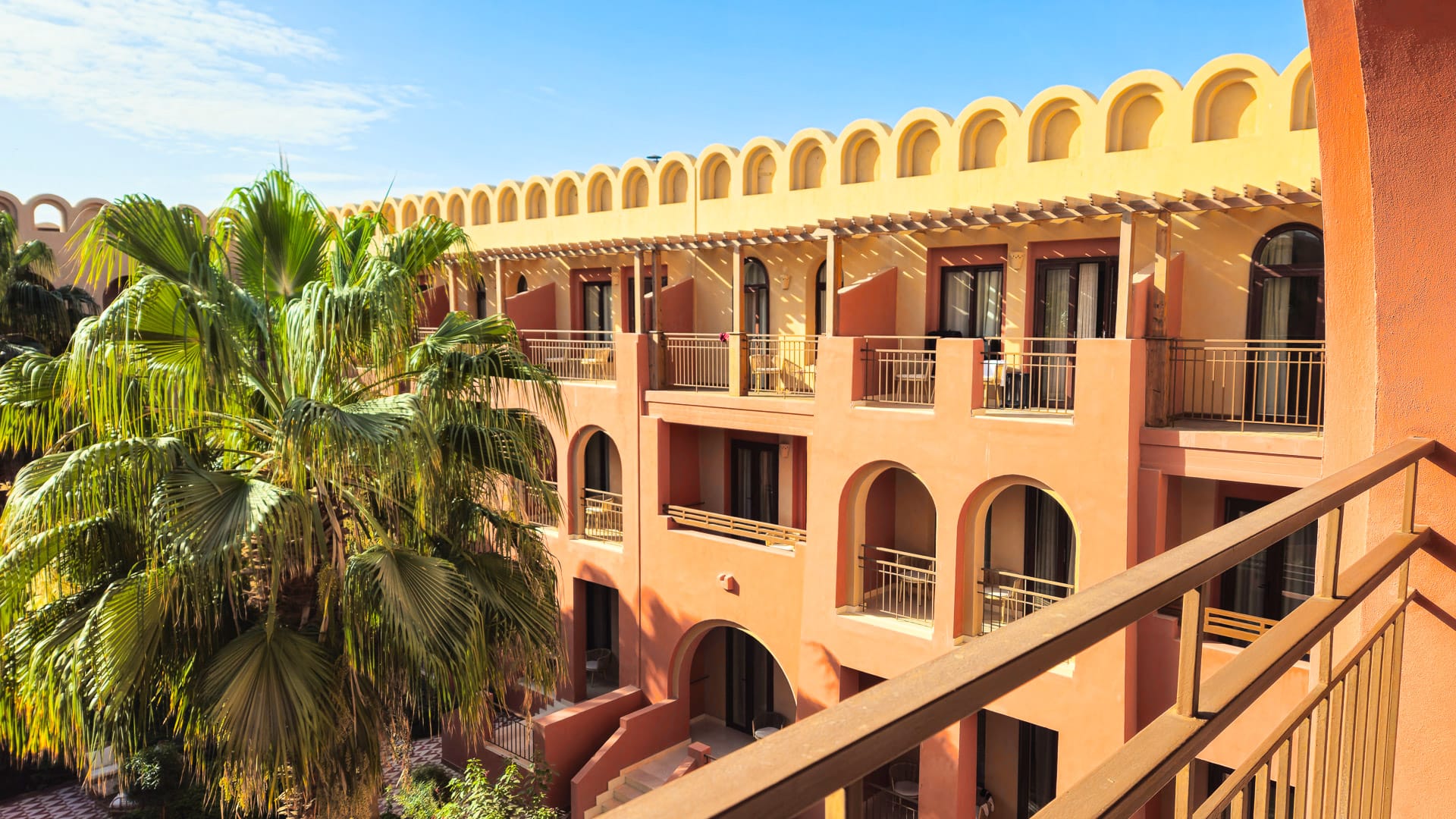
Hotel in El Gouna (photo credit: Michael de Boer via Boat Bike Tours)
Day 2: El Gouna cycling and Red Sea leisure
- Cycling distance: 29 kilometres
- Accommodation: Hotel in El Gouna
The first ride follows roads around El Gouna’s lagoons, canals and marina.
This is a relatively controlled introduction to the trip. Guests receive their e-bikes, adjust their riding position and become familiar with riding as one guided group.
It also provides an opportunity to acclimatise to the temperature before the journey moves inland.
The afternoon is free for activities such as swimming or snorkelling, or time at the hotel.
Day 3: El Gouna – Dendera – Luxor
- Accommodation: H/S Nebu
The group leaves the Red Sea by coach and travels inland towards the Nile Valley.
The journey includes a visit to Dendera Temple before continuing to Luxor and boarding H/S Nebu.
Dendera is often the first major temple visit of the journey. Its detailed carvings, surviving colours and religious symbolism provide an impressive introduction to ancient Egypt.
The transfer inland also brings one of the journey’s most striking contrasts. The desert can feel empty and vast before the green Nile Valley appears, helping the geography and history of the trip begin to make sense.
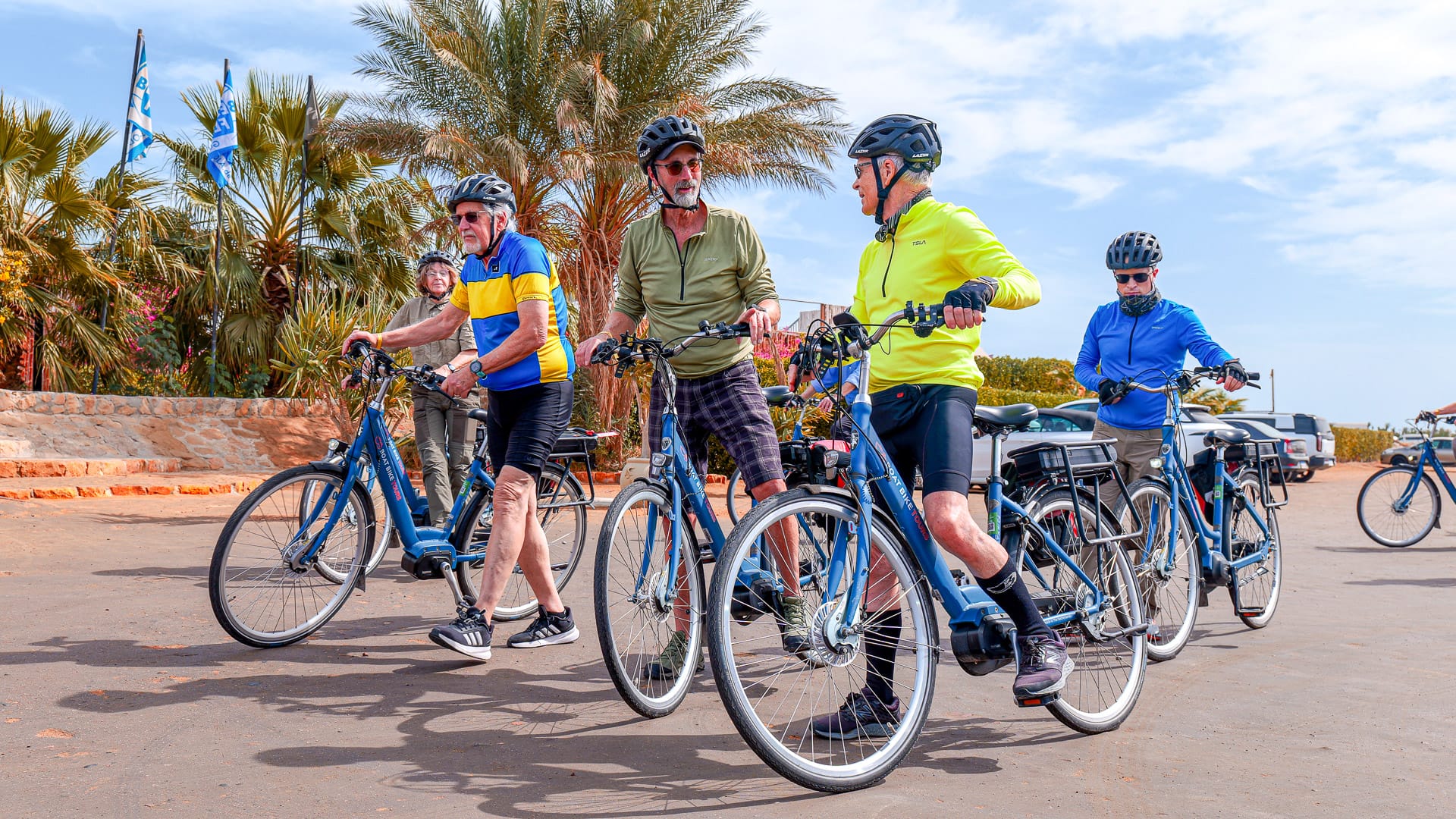
Cycling in El Gouna (photo credit: Michael de Boer via Boat Bike Tours)
Day 4: Luxor East Bank
- Cycling distance: 26 kilometres
- Accommodation: H/S Nebu
The first Nile Valley ride explores Luxor’s East Bank and includes visits to Karnak and Luxor Temple.
This is urban cycling. Riders should expect cars, motorbikes, pedestrians, animals and activity around shops and junctions.
Cycling towards Karnak is one of Laurens’ standout memories from the route. Approaching the temple in the morning light builds anticipation and makes the monument feel part of the journey, rather than simply another stop after stepping off a coach.
Luxor Temple provides another striking contrast, with the ancient site sitting at the heart of the modern city.

Group at Karnak Temple (photo credit: Michael de Boer via Boat Bike Tours)
Day 5: Luxor – Esna
- Cycling distance: 51 kilometres
- Accommodation: H/S Nebu
This is the longest ride of the tour.
The route heads through the Nile countryside towards Esna, passing villages, agricultural land, date palms and sugarcane fields.
The interest lies as much in the journey as the destination. Riders see farming, roadside shops and everyday village activity between the major historical sites.
The Nile is rarely far away, appearing between fields, settlements and stretches of everyday roadside activity.
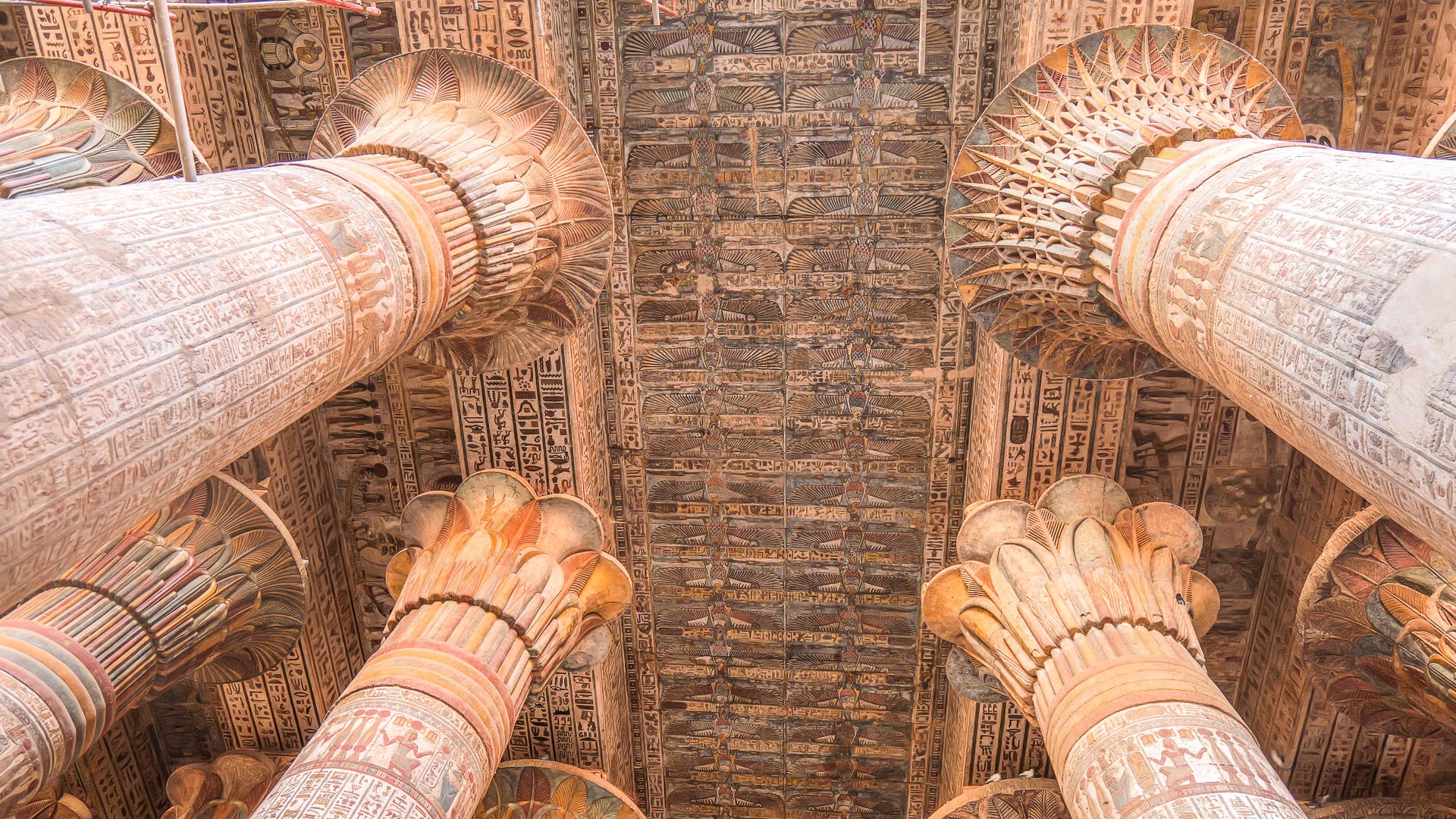
Esna Temple (photo credit: Michael de Boer via Boat Bike Tours)
Day 6: Kom Ombo and Aswan
- Cycling distance: 31 kilometres
- Accommodation: H/S Nebu
The day combines cycling with a visit to Kom Ombo and the journey south to Aswan.
Kom Ombo Temple stands beside the Nile and is unusual because it was dedicated to two deities: Sobek and Horus. The nearby Crocodile Museum provides additional context.
Subject to confirmation of the current itinerary, the day may also include Esna, where the temple sits close to busy streets, shops and vendors. The transition from everyday local life into a richly decorated ancient site is part of what makes the visit memorable.
Day 7: Aswan and Philae Temple
- Cycling distance: 35 kilometres
- Accommodation: H/S Nebu
Aswan has a noticeably different landscape from Luxor, with a wider river, rocky islands and a stronger Nubian influence.
The Aswan section may also include a Nubian village, with brightly coloured houses, sandy streets, community visits and a felucca journey across the Nile.
The day includes cycling in the Aswan area and a visit to Philae Temple. The temple was moved stone by stone to Agilkia Island after the construction of the Aswan High Dam threatened its original location.
Its relocation also illustrates Egypt’s changing relationship with the Nile, bringing ancient religion, modern engineering and international conservation into the same story.
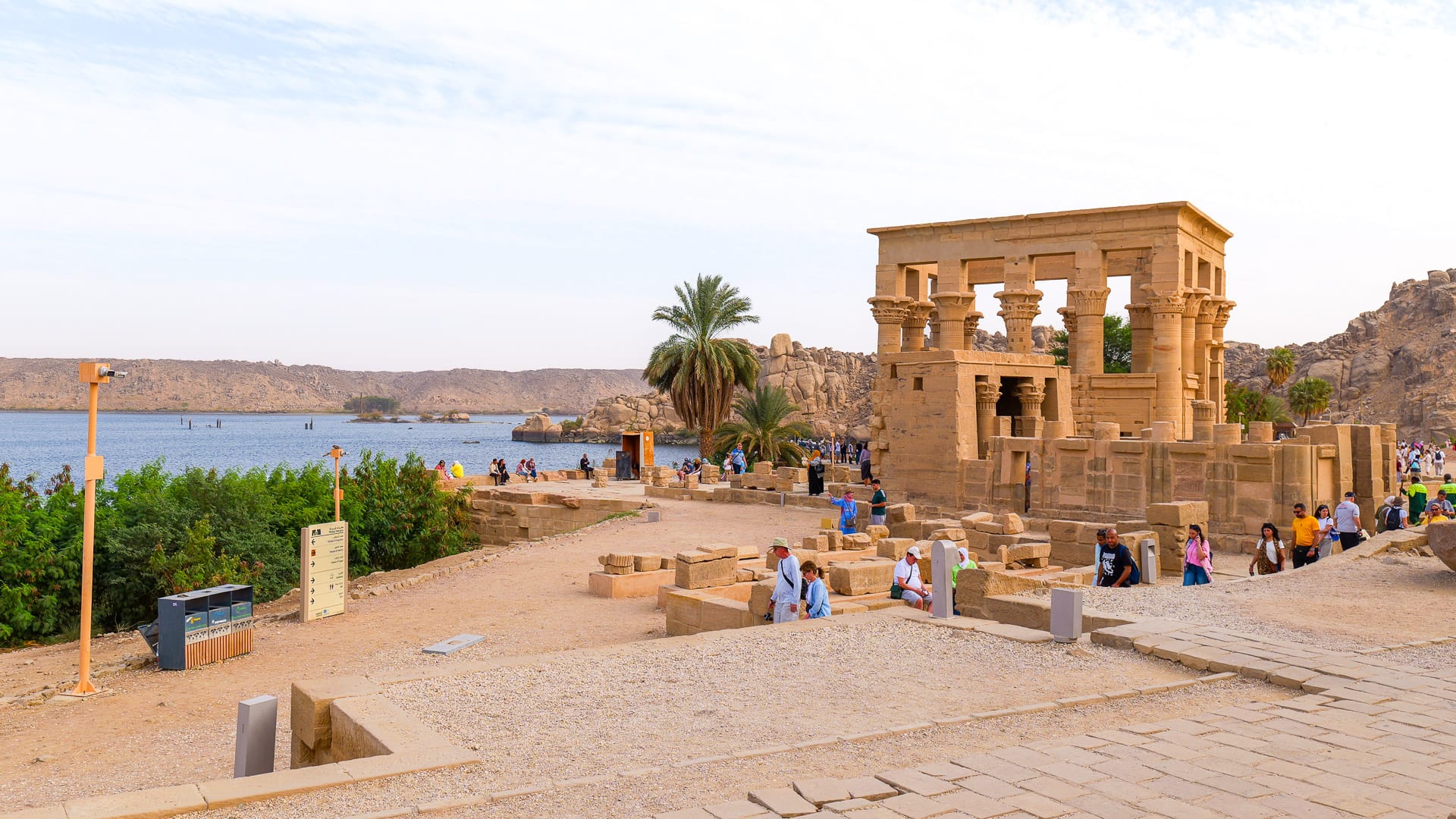
Philae Temple (photo credit: Michael de Boer via Boat Bike Tours)
Day 8: Edfu and monastic heritage
- Cycling distance: 21 kilometres
- Accommodation: H/S Nebu
Edfu is home to the Temple of Horus, one of Egypt’s best-preserved ancient temples.
The day also introduces Egypt’s Coptic Christian history through a visit connected with St Bakhamious Monastery.
This adds another period of Egyptian history to a journey often dominated by the pharaohs.
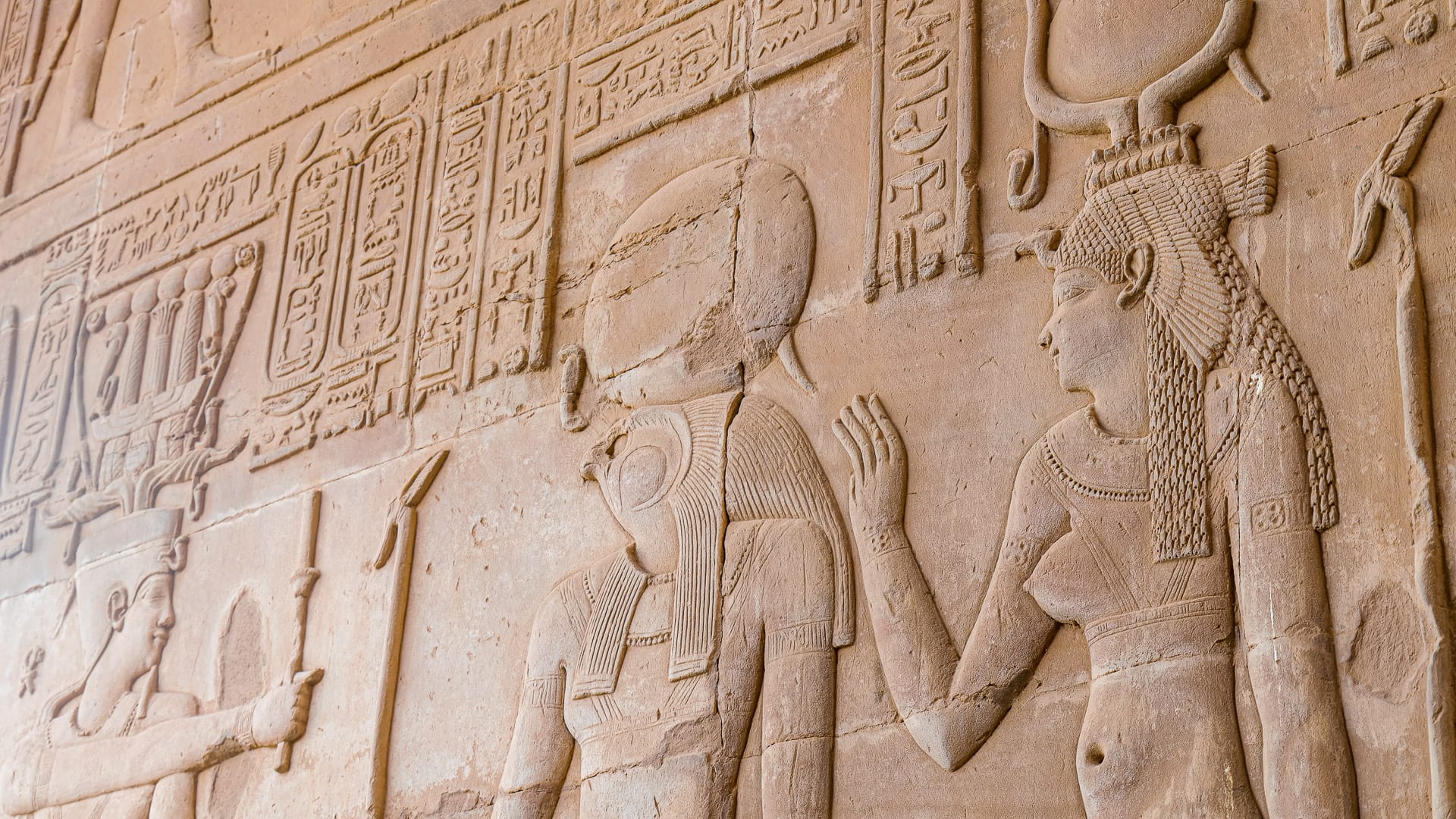
Hieroglyphs at Edfu Temple (photo credit: Michael de Boer via Boat Bike Tours)
Day 9: Luxor West Bank
- Cycling distance: 46 kilometres
- Accommodation: H/S Nebu
The final main cycling stage explores Luxor’s West Bank.
The programme includes the Valley of the Kings and the Temple of Hatshepsut. The wider area combines agricultural roads near the Nile with the dry landscape beneath the Theban hills.
The Temple of Hatshepsut rises in terraces beneath the cliffs, creating one of the most dramatic architectural settings on the itinerary.
The royal tombs lie within a stark desert landscape beneath a pyramid-shaped mountain. Travellers are often struck by the intensity of the colours inside one of the tombs. Despite their age, sections of the painted walls remained remarkably vivid.
The schedule may be adapted around temperature and visitor conditions. Some sections may be completed by coach before the cycling begins.
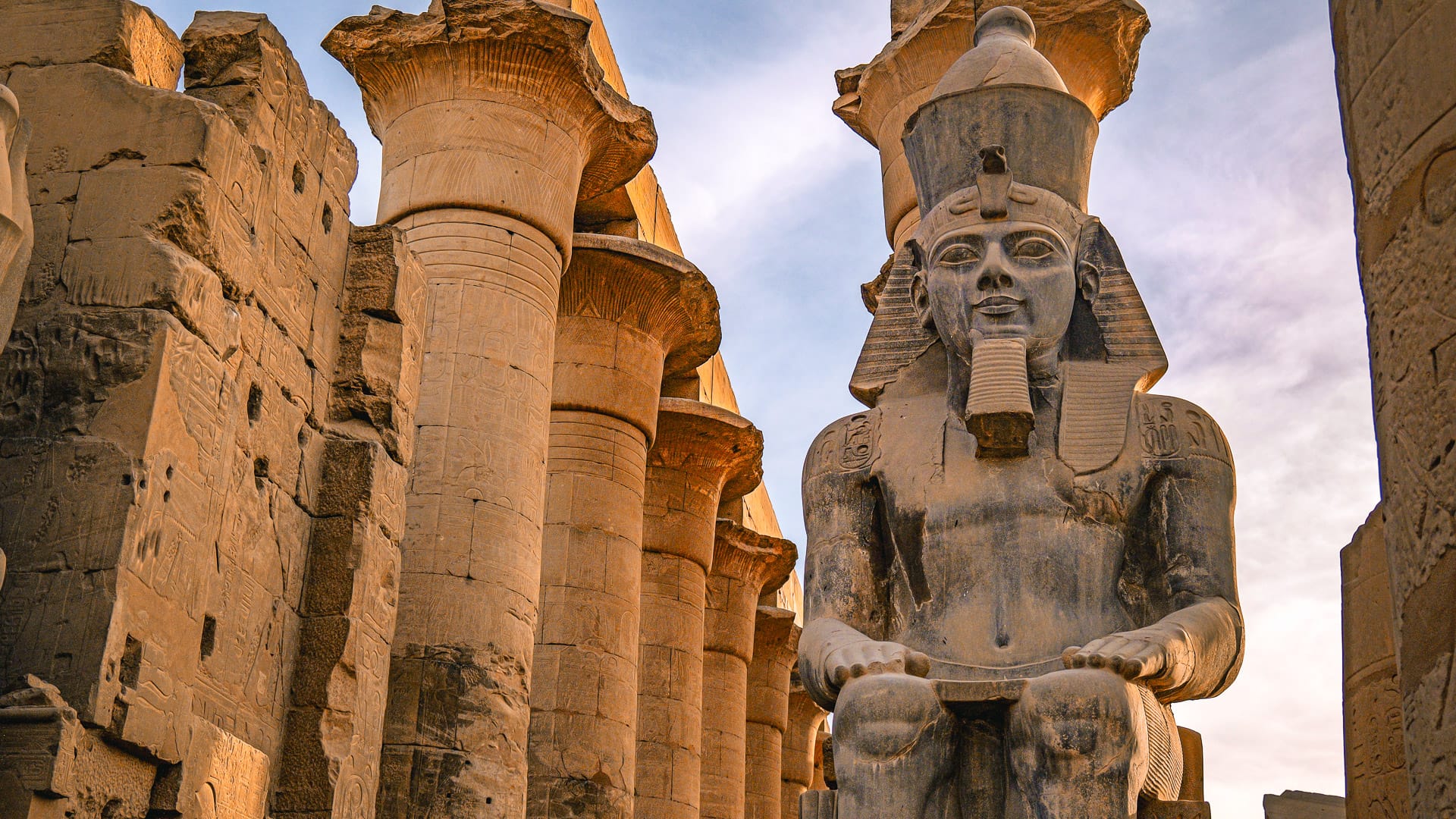
Ramesses II at Luxor Temple (photo credit: Michael de Boer via Boat Bike Tours)
Day 10: Luxor – Cairo
- Accommodation: hotel in Cairo
Guests disembark in Luxor and take the included domestic flight to Cairo.
The final three nights are spent at a five-star hotel in Cairo. There is no scheduled cycling on this day.
Cairo changes the pace of the journey. After the Nile Valley, guests encounter a much larger and busier city where Islamic, Coptic and modern Egyptian history sit alongside one another.
Day 11: Saqqara and Coptic Cairo
- Accommodation: hotel in Cairo
The day explores the Step Pyramid and wider archaeological landscape at Saqqara before continuing to Coptic Cairo.
Saqqara introduces an earlier chapter in Egypt’s pyramid-building history before the journey continues to the more familiar monuments at Giza.
This broadens the historical story beyond the New Kingdom monuments seen around Luxor.
Day 12: The pyramids of the Giza Plateau and the Grand Egyptian Museum
- Accommodation: hotel in Cairo
The final full day includes the Giza Plateau and the Grand Egyptian Museum.
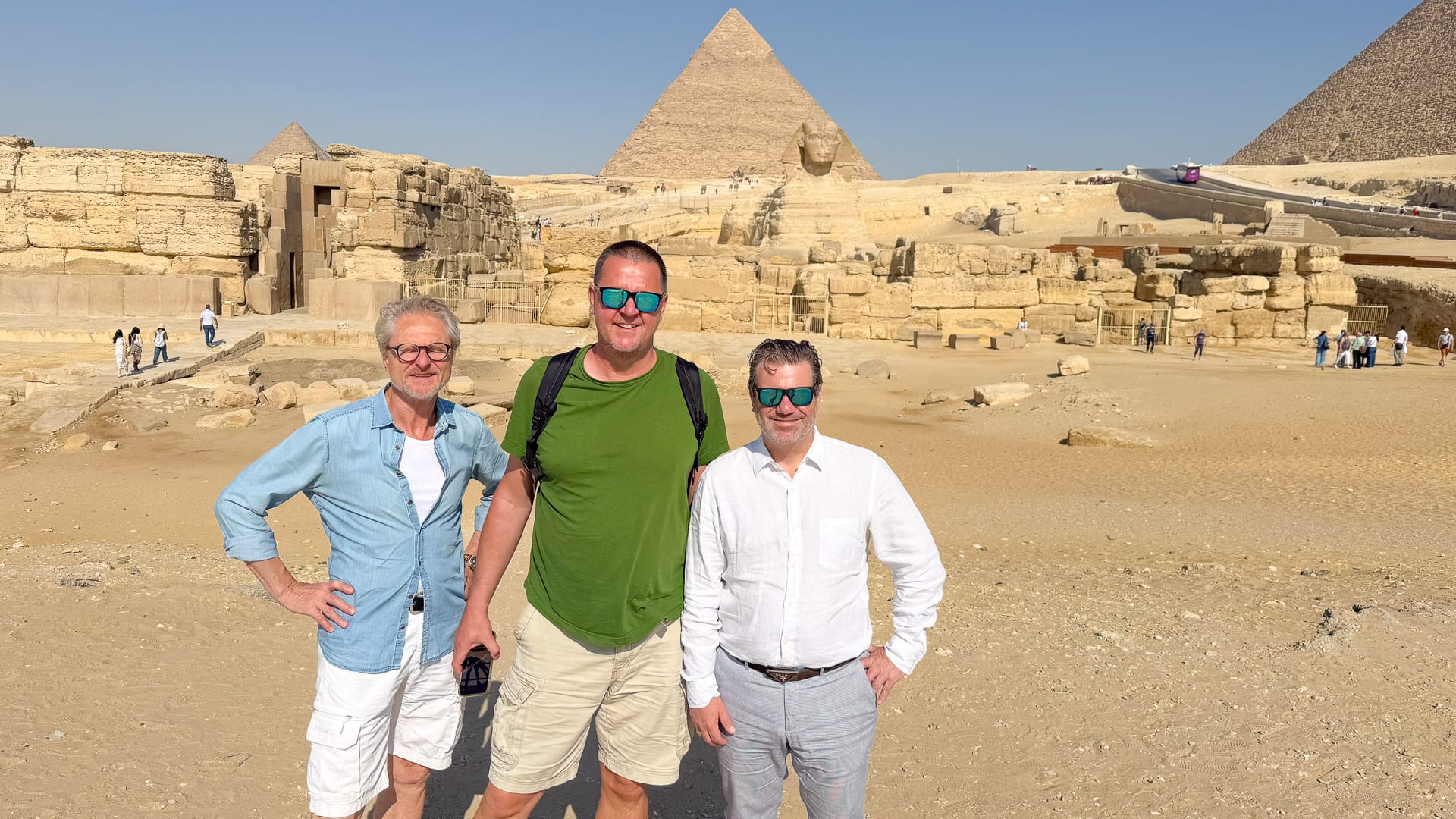
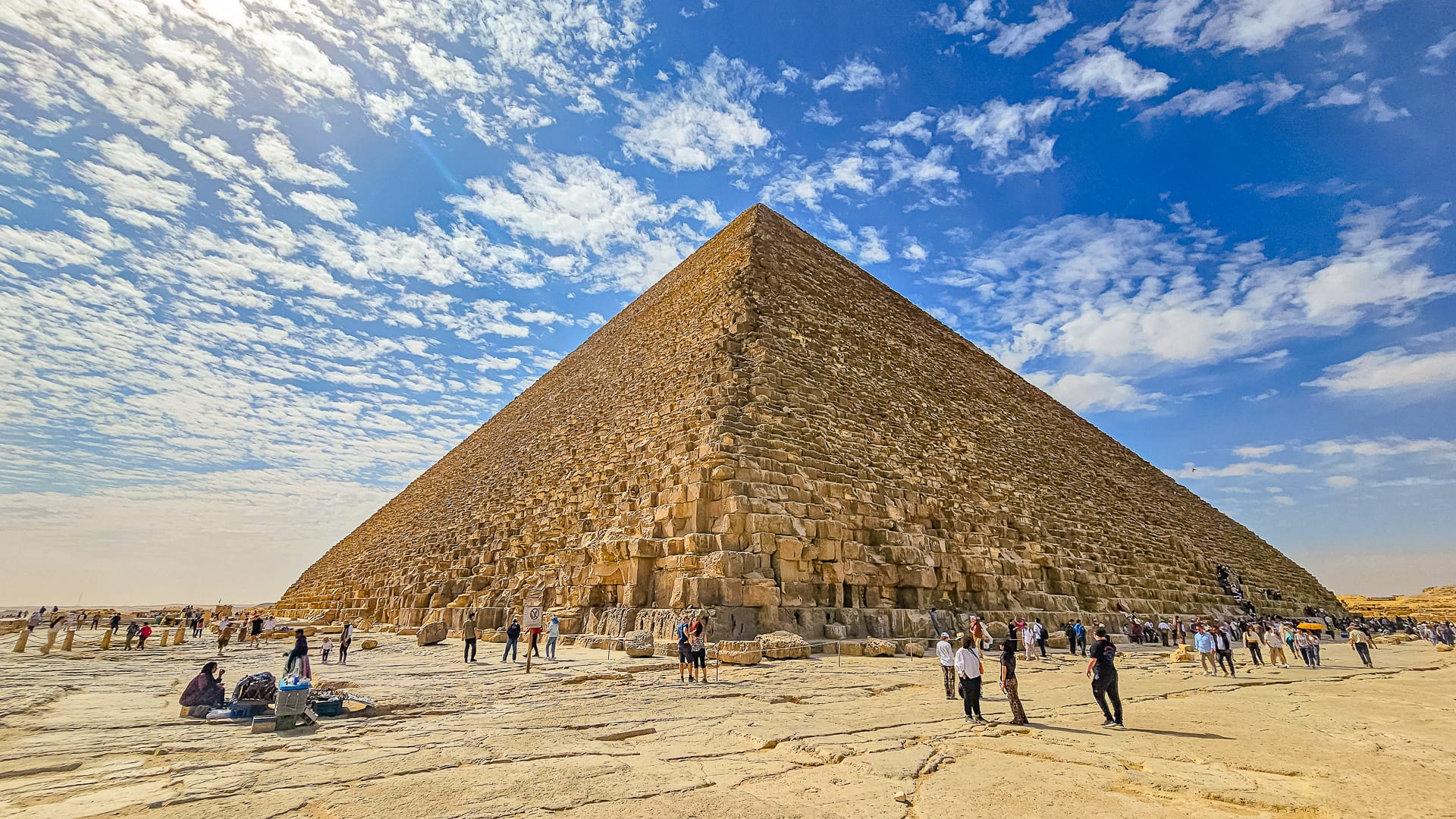
Giza is the image almost everyone has carried in their mind before coming to Egypt. My personal highlight of the trip was the extraordinary moment of riding across the Giza Plateau, with the pyramids rising in front of me. It was a perfect finale to a great journey.
The exact cycling arrangements around Giza should be confirmed for each departure, as access and permissions can depend on local conditions.
After visiting temples, tombs and archaeological landscapes along the Nile, the Grand Egyptian Museum helps bring many of the objects and stories together. Depending on the guided visit, you may also have the chance to see treasures from the Tutankhamun collection.
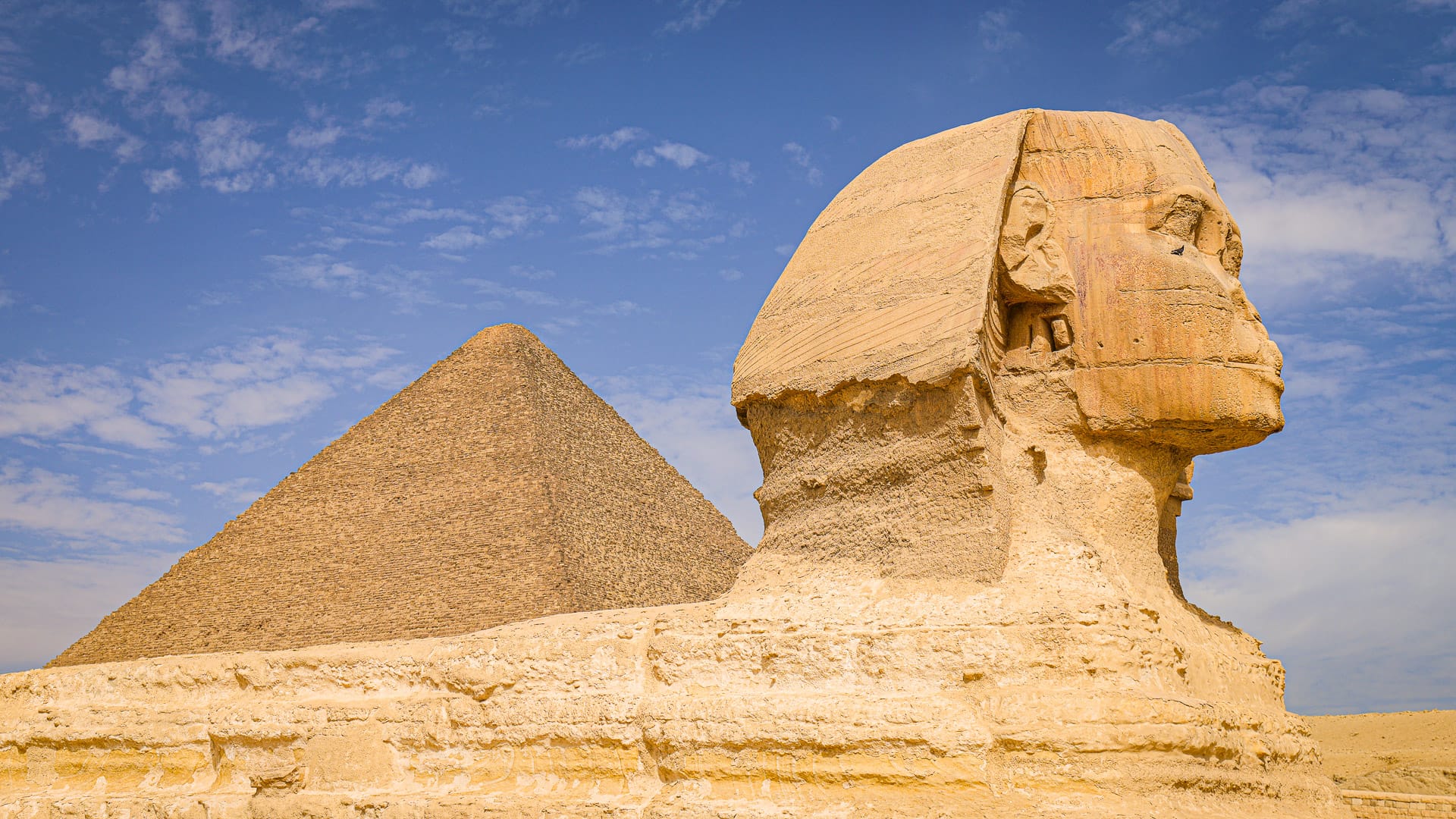
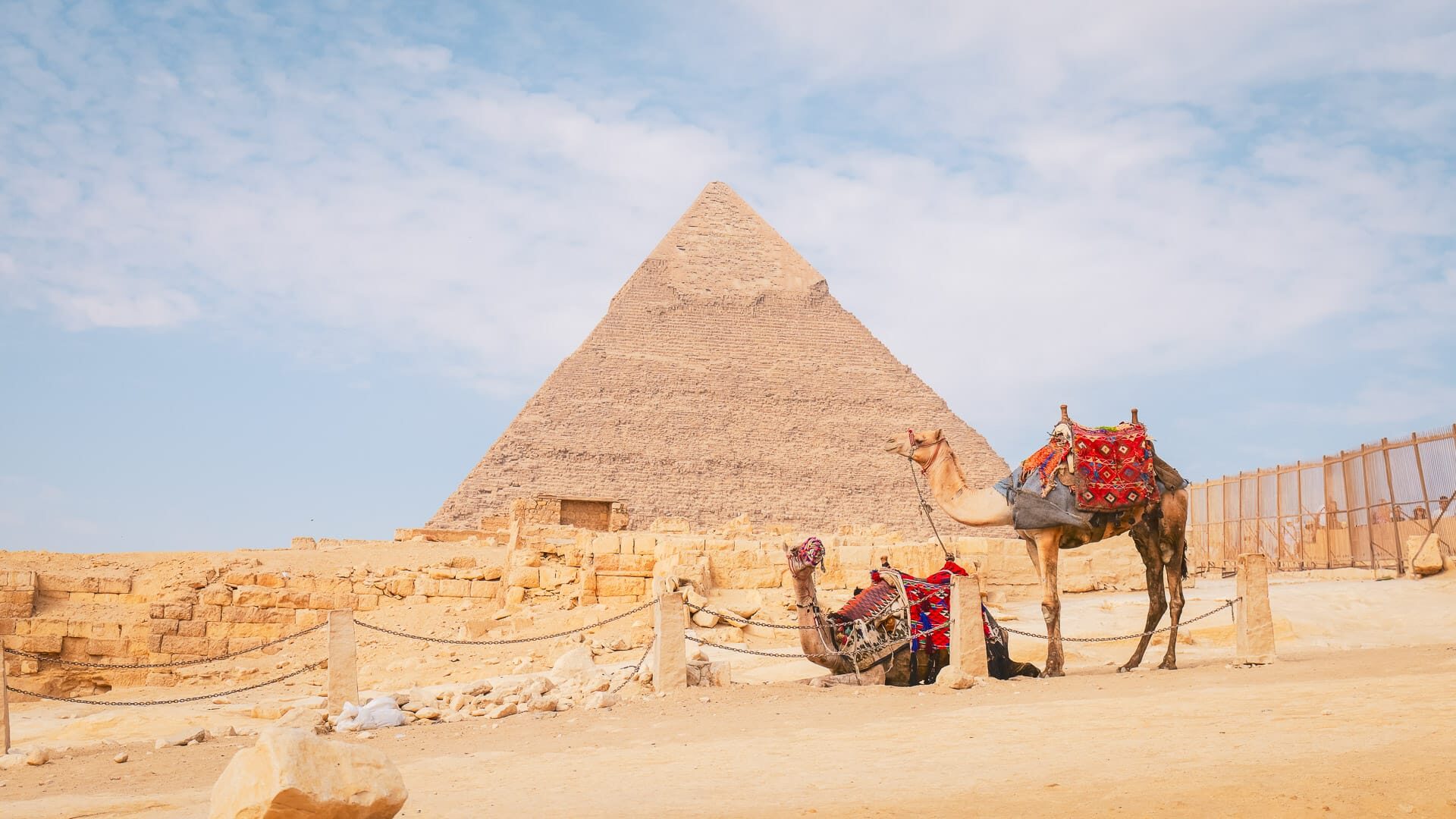
Sphinx and pyramid at Giza (photo credit: Michael de Boer via Boat Bike Tours)
Day 13: Cairo – departure
The tour ends after breakfast with a transfer to Cairo Airport.
Could this itinerary suit you?
Visit Boat Bike Tours to check current departures, prices and cabin availability for Egypt & The Nile – A Journey to Ancient Wonders.
The history behind the route: a simple timeline
The itinerary covers several thousand years of Egyptian history, so it helps to understand the broad sequence before looking at each day of the itinerary.
Saqqara belongs to the early story of pyramid building. Its Step Pyramid was created during the Old Kingdom, centuries before the New Kingdom rulers buried in the Valley of the Kings.
Luxor stands on the site of ancient Thebes, which became particularly important during the Middle and New Kingdoms. Karnak, Luxor Temple, the Valley of the Kings and the Temple of Hatshepsut are closely connected with this period.
Several temples farther south, including Dendera, Edfu, Kom Ombo and Philae, were developed or substantially rebuilt during the later Ptolemaic and Roman periods. Their inscriptions and reliefs preserve religious traditions that had developed over much earlier centuries.
The route also includes Coptic Christian heritage, Nubian history, Islamic Cairo and the modern transformation of the Nile associated with the Aswan dams.
The journey is therefore not only about the pharaohs.
Luxor’s East Bank and West Bank: what is the difference?
Modern Luxor and its largest temple complexes sit mainly on the East Bank of the Nile. Karnak and Luxor Temple formed part of the religious centre of ancient Thebes, and the modern city has grown around them. You explore this side of Luxor on Day 4, cycling through the city towards Karnak Temple before returning to Luxor Temple later in the day.
The West Bank is associated with the Theban necropolis. The Valley of the Kings, the Valley of the Queens and the mortuary temples lie beneath the desert hills, while villages and cultivated land sit closer to the river. The tour returns to the West Bank on Day 9, with visits to the Valley of the Kings and Temple of Hatshepsut followed by riding past alabaster workshops and farmland.
The contrast is important to the tour. Cycling on the East Bank feels more urban, with heavier traffic and city activity. The West Bank combines archaeological sites with quieter agricultural roads and a stark transition from green fields to desert.
Nubian culture around Aswan
Nubia is a historic region extending through southern Egypt and northern Sudan. Around Aswan, Nubian identity remains visible through language, music, food, architecture and community traditions.
Nubian culture forms a particularly important part of Day 6. After arriving in Aswan, guests cycle along the West Bank to a Nubian village, where they can meet local residents and visit a community school. The group returns across the river by traditional felucca, before a Nubian show aboard H/S Nebu that evening.
Many Nubian communities were displaced during twentieth-century dam construction and the creation of Lake Nasser. This makes the subject more complex than the brightly painted houses often shown in tourism photographs.
A well-managed community visit should be based on respect and local participation. Guests should follow guidance on photography, avoid treating homes or schools as attractions and understand how hosts benefit from the visit.
Wildlife and landscapes along the Nile
The river corridor supports a much greener environment than the surrounding desert. Date palms, cultivated fields, reeds, islands and shallow channels create habitat for resident and migratory birds.
Around Aswan, the scenery becomes rockier and the river divides around islands. On Day 7, guests experience this part of the Nile from a motorboat through the Aswan Nature Reserve, passing riverbanks with birdlife and views of Elephantine Island. From a nearby village, the journey continues by bike, followed by a bus transfer to visit the High Dam and ancient granite quarries.
Later in the day, guests have a Nubian lunch and visit Philae Temple, adding cultural and historical context to this part of the journey.

Camels in a Nubian village (photo credit: Michael de Boer via Boat Bike Tours)
What is a felucca?
A felucca is a traditional sailing boat commonly seen on the Nile. Unlike a motorboat, it relies on the wind and usually carries a relatively small number of passengers.
Guests travel by traditional felucca on Day 6, returning across the river after visiting a Nubian village on Aswan’s West Bank.
Felucca trips are particularly associated with Aswan, where the river flows around islands and granite outcrops. The quieter pace gives guests a different perspective from the larger cruise ship and provides time to experience the river at water level.
Sponsor Message
Looking for an Egypt bike and boat tour?
Discover Egypt by e-bike on our 13-day Egypt & The Nile – A Journey to Ancient Wonders tour.
We’ve been running bike and boat holidays since 2002, and this premium guided tour combines seven days of cycling with seven nights aboard the superior-class H/S Nebu and stays in carefully selected hotels.
Ride through the Nile Valley, visit some of Egypt’s most important ancient sites and experience rural communities and everyday life away from the usual tourist routes. Expert guides, e-bikes and on-route support are included throughout.
Interested in joining the trip? View the full itinerary, dates and availability on our website or complete the form below to discuss your plans.
Got a question for Boat Bike Tours?
Fill out this form and we will pass it to Boat Bike Tours who aim to reply (within 24 hours wherever they can!)
Part 4: What does a typical cycling day look like?
Morning briefing and bike preparation
A cycling day normally begins with breakfast on board or at the hotel.
Before setting out, our guides give a short briefing covering the key points riders need to know for the day ahead. More detailed route information, road conditions, cultural visits and other practical points are usually discussed during the evening briefing on board. Guests then prepare their bikes and join the group, ready for the day’s ride.
Riding and sightseeing
The group will ride together with our guides and support vehicles.
The ride may pass through Luxor’s streets, agricultural areas, villages or desert-edge landscapes. Many rides lead directly to temples, monasteries, markets or river crossings.
Sightseeing is a main point of the tour and shapes the itinerary rather than an addition to the cycling. At the main sites, licensed Egyptologists explain the people, beliefs and events behind the walls, columns and carvings.

Exploring Kom Ombo Temple (photo credit: Michael de Boer via Boat Bike Tours)
Lunch, water and support
Lunch may be served aboard the ship, in a local restaurant or during a cultural visit, depending on the day.
Shade and hydration are important. Water and assistance is always available through our support team during cycling days.
Returning to the ship
The afternoon may include further cycling, sightseeing, a smaller boat transfer or time sailing on the Nile.
After returning to the ship, guests have time to shower, rest and spend time on deck.
Evenings on board
Dinner is normally social and informal, and there is no dress code, so guests can wear comfortable clothing. Guests can discuss the day and prepare for the following morning.
Evenings also include onboard entertainment, bringing the group together after a full day of cycling and sightseeing.
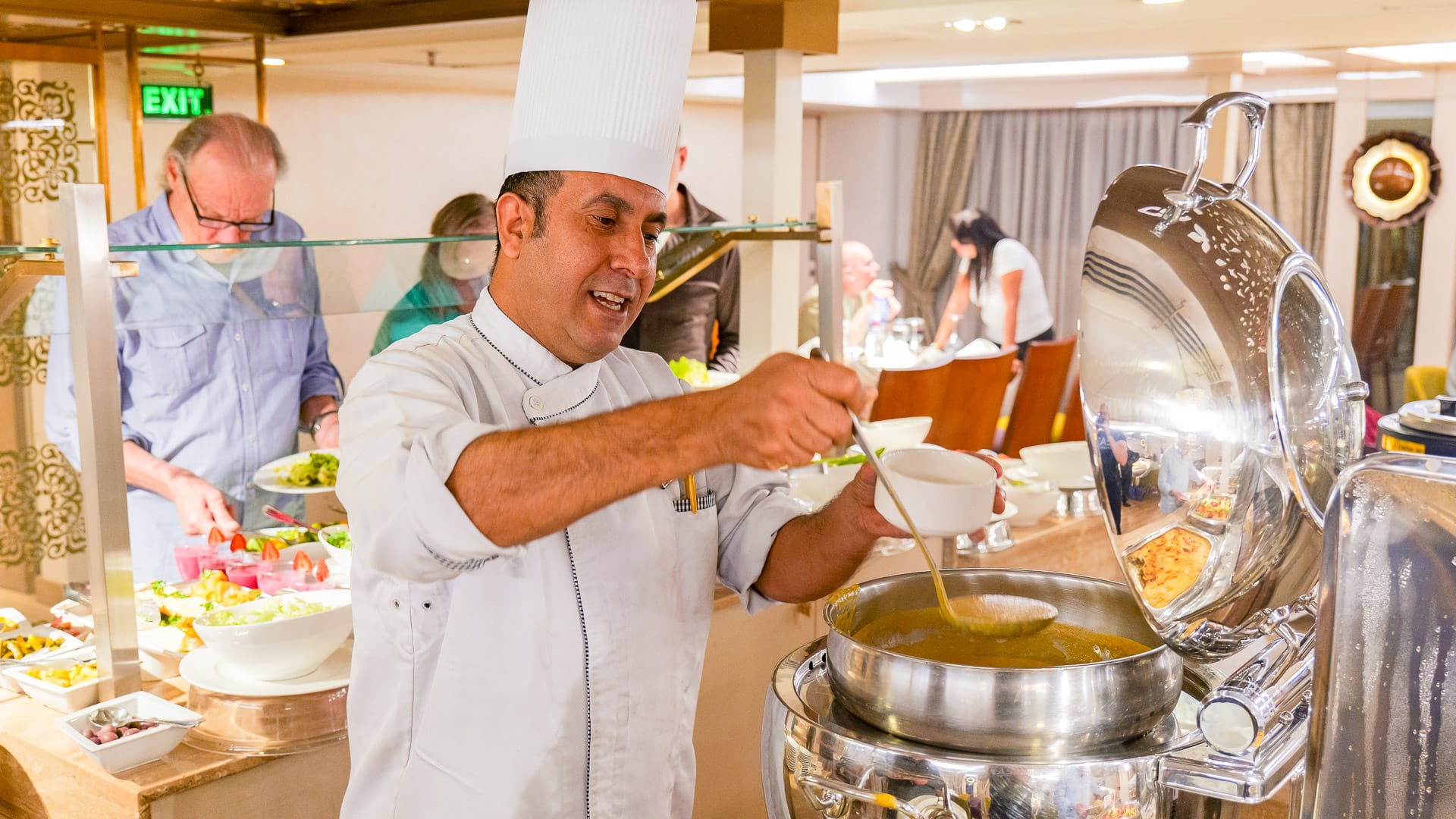
Dinner on board the H/S Nebu ship (photo credit: Michael de Boer via Boat Bike Tours)
What is life aboard H/S Nebu like?
The ship is more than transport between the cycling stages. For seven nights, it becomes the group’s base for meals, rest and time together between rides and cultural visits.
A typical afternoon may include showering after the ride, sitting on deck, watching the riverbanks pass and preparing for the next day. The amount of sailing time and free time varies according to the itinerary.
River ships sometimes berth alongside other vessels, which can mean walking through another ship to reach the shore. Noise levels, sailing times and accessibility may also vary between moorings.
Boat and accommodation
The itinerary includes two nights in El Gouna, seven nights aboard H/S Nebu, which we like to call our superior-class Nile ship, and three nights in Cairo.
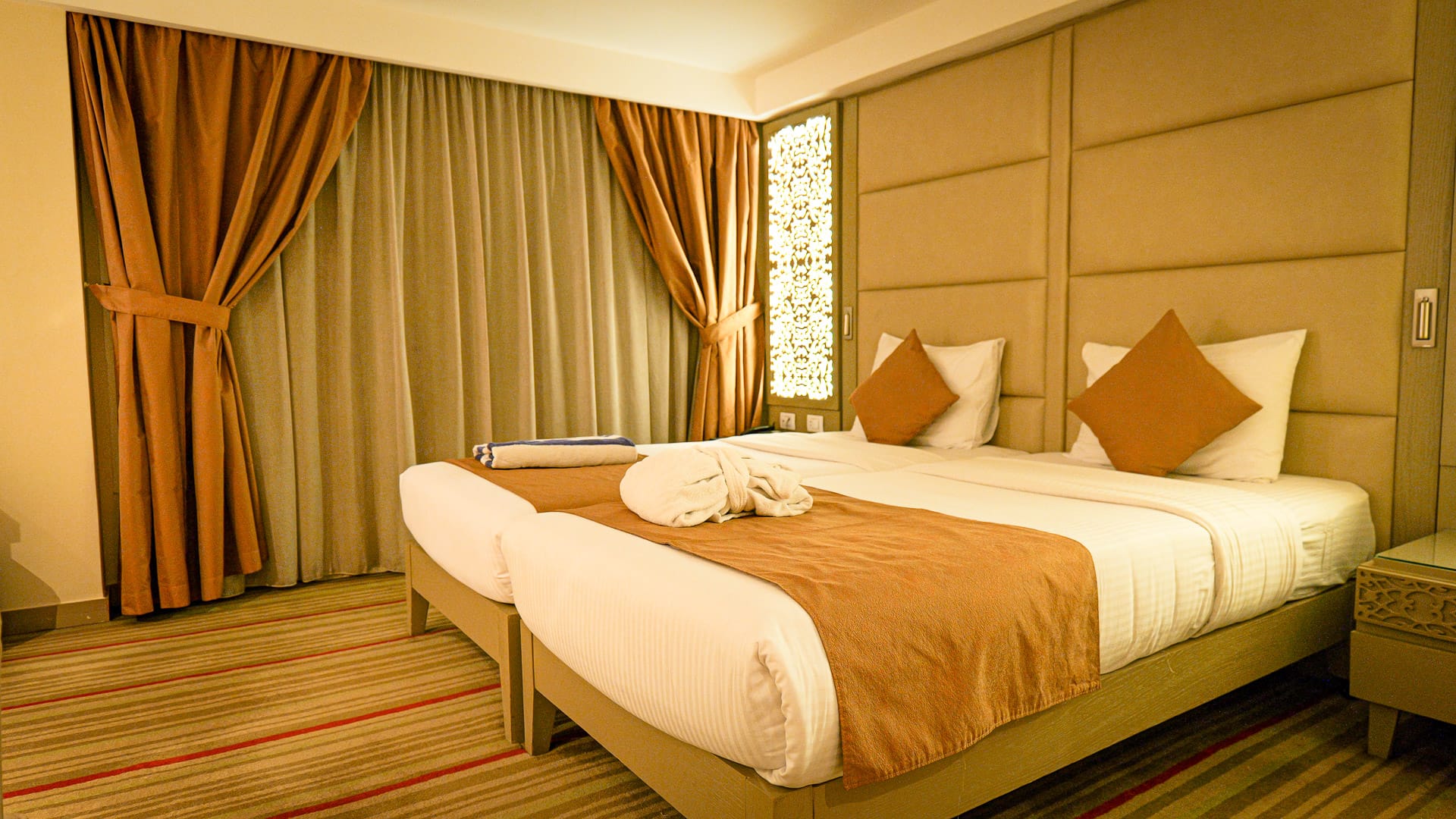
Double bed inside a cabin on board the H/S Nebu (photo credit: Michael de Boer via Boat Bike Tours)
Sponsor Message
Looking for an Egypt bike and boat tour?
Discover Egypt by e-bike on our 13-day Egypt & The Nile – A Journey to Ancient Wonders tour.
We’ve been running bike and boat holidays since 2002, and this premium guided tour combines seven days of cycling with seven nights aboard the superior-class H/S Nebu and stays in carefully selected hotels.
Ride through the Nile Valley, visit some of Egypt’s most important ancient sites and experience rural communities and everyday life away from the usual tourist routes. Expert guides, e-bikes and on-route support are included throughout.
Interested in joining the trip? View the full itinerary, dates and availability on our website or complete the form below to discuss your plans.
Got a question for Boat Bike Tours?
Fill out this form and we will pass it to Boat Bike Tours who aim to reply (within 24 hours wherever they can!)
Part 5: What should you know before booking?
When is the best time for a boat and bike tour in Egypt?
The tour operates from late October to March, avoiding Egypt’s hottest summer months.
Conditions can still feel warm and dry, particularly in Upper Egypt. Guests should be prepared for strong sun and significant differences between daytime and evening temperatures. Conditions can also vary from year to year. For example, temperatures during the February 2026 departure reached approximately 32°C due to a heatwave, compared with the expected temperature of around 25°C.
A typical cycling day begins at around 09:00, although some stages start earlier and may involve breakfast before sunrise. Sunset is generally around 16:00 to 16:30 during the tour season, and daylight can fade quickly. March typically has slightly more daylight than October, although the difference is only around 30 minutes. The daily schedule is therefore planned around the available daylight.
Exact dates and availability should be checked on the tour page.
How fit do you need to be?
Guests do not need racing-level fitness, but they should cycle before departure.
It helps to be accustomed to:
- Spending several hours in the saddle.
- Riding on consecutive days.
- Starting and stopping within a group.
- Responding to instructions while riding.
- Remaining alert around traffic and pedestrians.
- Handling an e-bike confidently.
Preparing to ride an e-bike in Egypt
The electric assistance makes the daily distances more accessible, but an e-bike is heavier than a conventional bicycle. Riders still need to start, stop, brake and steer confidently around other cyclists, traffic and pedestrians.
Before travelling, practise mounting and dismounting, controlled braking, changing assistance levels and setting off smoothly. It is also helpful to ride for several consecutive days so that time in the saddle does not come as a surprise.
Guests should not rely on the motor to compensate for limited bike-handling skills. The guided format requires everyone to respond promptly to instructions and maintain a predictable position within the group.
What should you pack?
Cycling
- Breathable cycling jerseys and shorts
- Cycling gloves
- Sunglasses
- Refillable water bottle
- Closed cycling shoes or trainers
- Light windproof layer
Sun and heat
- High-factor sunscreen
- Sunhat for sightseeing
- Lip protection
- Lightweight long-sleeved clothing
Cultural visits
- Clothing that covers shoulders and knees
- Comfortable walking shoes
- Small day bag
Other useful items
- Evening layers
- Personal medication
- Camera or phone with sufficient storage
- Power bank and travel adaptor
For more help deciding what to bring, check out our cycling holiday packing list.
Can you skip a cycling day?
The itinerary is designed around guided group cycling, but some guests may want to miss a ride because of tiredness, heat or a temporary health concern. The options will depend on where the ship is sailing and how the day’s sightseeing is organised.
Guests can choose to remain aboard the ship instead of cycling. However, the cycling stages are closely linked to the sightseeing programme, so anyone who skips a ride will also miss the main cultural visits and highlights planned for that day.
The ship sails to a new location on almost every cycling day, with Aswan being the main exception. This means a non-rider can remain comfortably on board, but cannot generally rejoin the group later for the sightseeing programme.
If this is likely to be an issue for you, get in touch with us before booking, to ask whether you can remain aboard, travel with the support team or join the group only for the cultural visits.
Tips for getting to the start, visas and luggage?
The tour starts near Hurghada and finishes in Cairo, so you will likely want to book an open-jaw flight itinerary rather than returning from the same airport. Airport transfers are included as stated in the programme, but transfer windows should be checked before booking flights.
Boat Bike Tours assist you with arranging an Egyptian visitor visa on arrival. Eligibility, passport validity and the treatment of the visa fee may depend on nationality, so guests need to check these before booking the tour.
What about food and dietary requirements?
Meals are served aboard the ship, in the hotels and at selected restaurants or cultural stops. The tour includes 12 breakfasts, 10 lunches and 10 dinners, but the exact style of meals varies by day.
Egyptian food commonly draws on beans, vegetables, rice, bread, herbs and grilled dishes. Guests may encounter foods such as ful medames, ta’ameya, koshari, mezze, grilled meat or fish, stuffed vegetables, dates and seasonal fruit. These dishes may be served during the tour, but they are not guaranteed and menus will vary.
Food around Aswan may also introduce Nubian influences. A local meal can add valuable cultural context, particularly when the setting and hosts are explained rather than presented simply as an included lunch stop.
If you have allergies or dietary requirements, please let us know when you book.
Are there any cultural nuances to be aware of?
Traffic, markets and vendors
Egypt’s streets and visitor sites can feel lively and busy.
Traffic may include cars, motorbikes, pedestrians, animals and agricultural vehicles. Riders should follow the guides and ride predictably.
Vendors can be persistent around markets and temple entrances. A calm and polite refusal is normally the simplest response when you do not wish to buy anything.
When visiting mosques, churches and other religious sites, guests should behave quietly and respectfully. Shoes often need to be removed before entering, and photography may not be permitted, so always check with the guide before taking pictures.
Tip: Approach Egypt on its own terms
Egypt can feel very different from familiar European cycling destinations. It is ancient and modern, calm and chaotic, with busy streets sitting close to temples, villages and agricultural land.
Try not to judge every part of the experience against what you would expect at home. Travellers who are comfortable with these contrasts are likely to find the journey much richer.
Visiting villages and markets respectfully
The cycling passes through places where people live and work rather than purpose-built visitor areas. A friendly greeting and calm manner go a long way, but guests should remember that local residents are not part of the scenery.
Bargaining may be expected in some markets, but it should remain good-humoured. If you do not want to buy, a polite and firm refusal is usually more effective than entering a long conversation.
Photography in Egypt
Ask before photographing people, homes, shops or children. Follow the guides’ instructions and take extra care during community, school and religious visits, and dress modestly where requested.
Photography rules can vary between archaeological sites and may change. Some tombs, museum galleries or monuments may restrict photography or charge a separate fee, while tripods and professional equipment may require additional permission.
Guests should never photograph military or security sites and should follow local guidance around government buildings, transport infrastructure, dams and checkpoints. Drones should not be brought or used without confirming the current legal requirements and permissions.
Language and local guidance
The trip is led by our Boat Bike Tours’ tour leaders and local certified Egyptologists who speak English.
The local team will try to help guests communicate during visits and interactions.
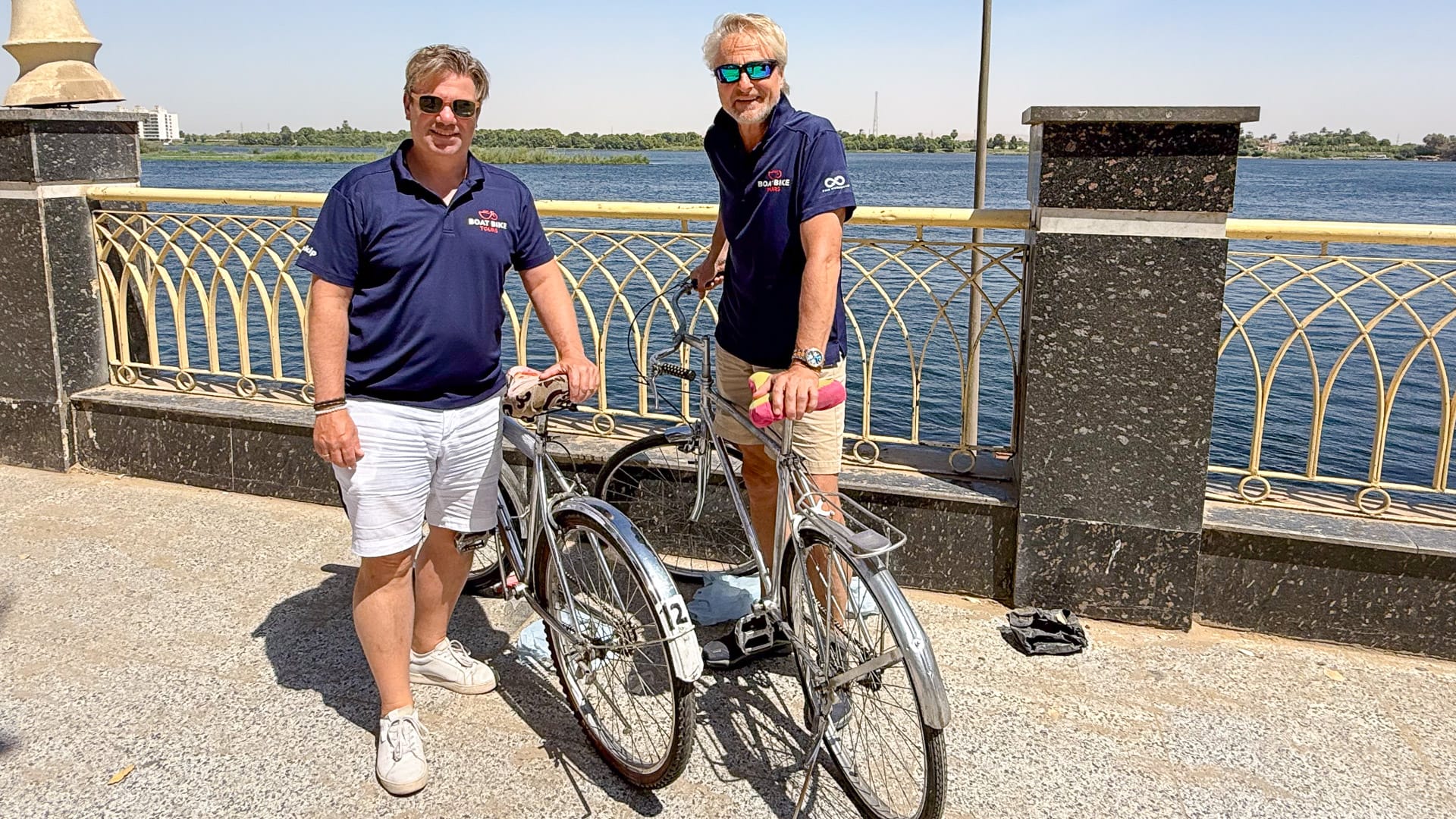
Rudi and Laurens in Edfu (photo credit: Michael de Boer via Boat Bike Tours)
How is safety managed on an Egypt bike and boat tour?
Cycling in Egypt requires more support and coordination than many European bike and boat holidays. This is not a trip where guests are given a route and left to ride independently.
We run our Egypt cycling programme with local partners, including Sakkara Travel and a team of licensed Egyptologists. Guests ride e-bikes with local guides, support vehicles and traffic management where required.
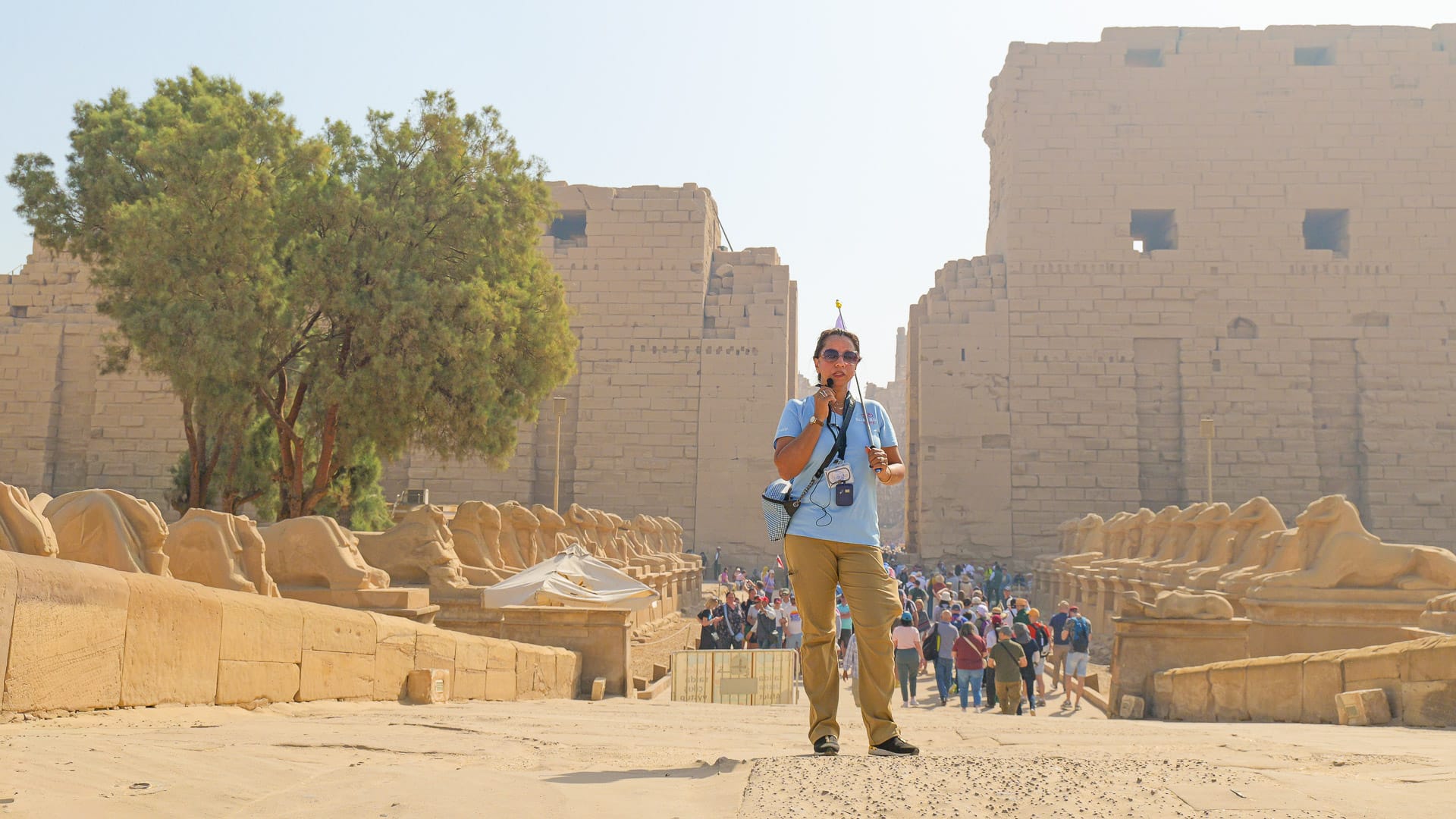
Egyptologist at Karnak Temple (photo credit: Michael de Boer via Boat Bike Tours)
Route selection and traffic management
The cycling routes are selected and coordinated with local experts. A tourism police vehicle accompanies the group on every cycling day. The tourism police may help manage traffic at busy points and support the group as it moves through congested areas. An ambulance escort may also form part of the support arrangements.
Local regulations may require the cyclists to remain together as one group rather than divide into smaller groups according to pace or ability. The exact traffic-management and ambulance-support arrangements may vary between routes and departures.
Support vehicles and help during a ride
A support vehicle is available whilst cycling, providing water and assistance to the group. It stays with the cyclists throughout each stage, rather than only meeting them at planned stops. This vehicle support is an important part of how the tour operates rather than an optional extra.
However, guests should understand exactly what support is available before booking.
Heat and hydration
Heat is one of the main factors riders need to consider, even during the winter season. The e-bikes reduce the effort needed, but they do not remove the effects of high temperatures, dry conditions and strong sun.
Riders should drink regularly rather than waiting until they feel thirsty. Water stops and support from the accompanying team form part of the cycling programme.
The itinerary may also need to remain flexible. On particularly warm or busy days, part of a journey may be completed by coach and the cycling moved to a more suitable time.
Medical support
Boat Bike Tours makes sure that a doctor and ambulance are on standby throughout the cycling days. This provides additional reassurance in a destination where heat, traffic and unfamiliar conditions can affect riders.
What guests need to do
The support arrangements do not remove the need for riders to take responsibility for their own preparation and behaviour.
Before booking, guests should be honest about their cycling experience, fitness, health and confidence handling an e-bike. It is also important to complete some cycling before the trip and, where possible, try an e-bike in advance.
- Stay with the group.
- Listen to the guides.
- Ride predictably.
- Remain alert around vehicles and pedestrians.
- Drink regularly.
- Tell the team promptly if you feel unwell or unable to continue.
Guests should also arrange suitable travel insurance that covers the planned cycling and use of an e-bike.
Safety away from the bike
At markets, transport hubs and busy visitor sites, guests should keep personal belongings secure and follow guidance from the local team.
The guides can also help guests understand local customs, manage interactions with persistent vendors and communicate where English is not widely spoken.
Travel information and local road rules
As ever, it is a good idea to check current travel information before you book and again before you travel. UK visitors should read the UK government travel information for Egypt, including regional warnings, entry requirements, local laws and guidance on insurance.
Cyclists should follow Egyptian traffic laws and the instructions of the local guides throughout the tour. Because the riding takes place as a coordinated group, the guides will explain the required road position, traffic arrangements and expected behaviour before each stage.
What is included in the tour?
| Included | Detail |
| El Gouna accommodation | Two nights in a deluxe Red Sea hotel |
| Nile accommodation | Seven nights aboard H/S Nebu |
| Cairo accommodation | Three nights in a five-star hotel |
| Domestic travel | Flight from Luxor to Cairo |
| Transfers | Airport and itinerary transfers stated in the programme |
| Visa | Egyptian visitor visa arranged on arrival (subject to eligibility) |
| Bike | All-road e-bike, helmet and pannier |
| Guiding | Boat Bike Tours leaders and licensed Egyptologists |
| Cycling support | Support van, water stops and medical standby |
| Historical visits | Entrance fees to archaeological sites listed in the itinerary |
| Other activities | Felucca trip, motorboat trip and cultural visits |
| Meals | 12 breakfasts, 10 lunches and 10 dinners |
| Entertainment | Onboard entertainment |
| Other | CO2 offsetting stated by Boat Bike Tours |
Note: Guests who prefer to ride their own bike or e-bike may be able to bring it by prior arrangement. Parking costs €10 per week for a regular bike or €25 per week for an e-bike, subject to available storage on the ship.
The tour includes most meals, accommodation, guiding, internal travel and the listed entrance fees. Guests should still budget for drinks, a small number of meals, gratuities, optional activities and personal purchases.
Cash may be useful for smaller purchases and tips, particularly away from larger hotels. Cash payments should be made in Egyptian pounds. Cash machines are available in cities and can also be found near some ports and markets, including in the Nubian village in Aswan.
Gratuities for the ship are normally given at the end of the stay. Guests place the tip in an envelope and leave it at reception, with gratuities paid in Egyptian pounds.
Can the itinerary change?
The itinerary, order of visits and cycling arrangements may change according to local permissions, traffic management and operating conditions.
Guests should check the current tour page before booking and review any final itinerary information supplied before departure.
This is particularly important for cycling arrangements around Giza and any roads that require advance permission or traffic coordination.
Because some cycling stages depend on local permissions and traffic arrangements, guests should check the live itinerary before booking.
View the latest Egypt tour itinerary, dates and inclusions on the Boat Bike Tours website.
When does the Egypt boat and bike tour run?
Departures are offered between late October and March. At the time of writing, Boat Bike Tours lists departures in October, November and December 2026, with further dates planned for January, February and March 2027. Current dates, prices and cabin availability should always be checked on the live tour page.
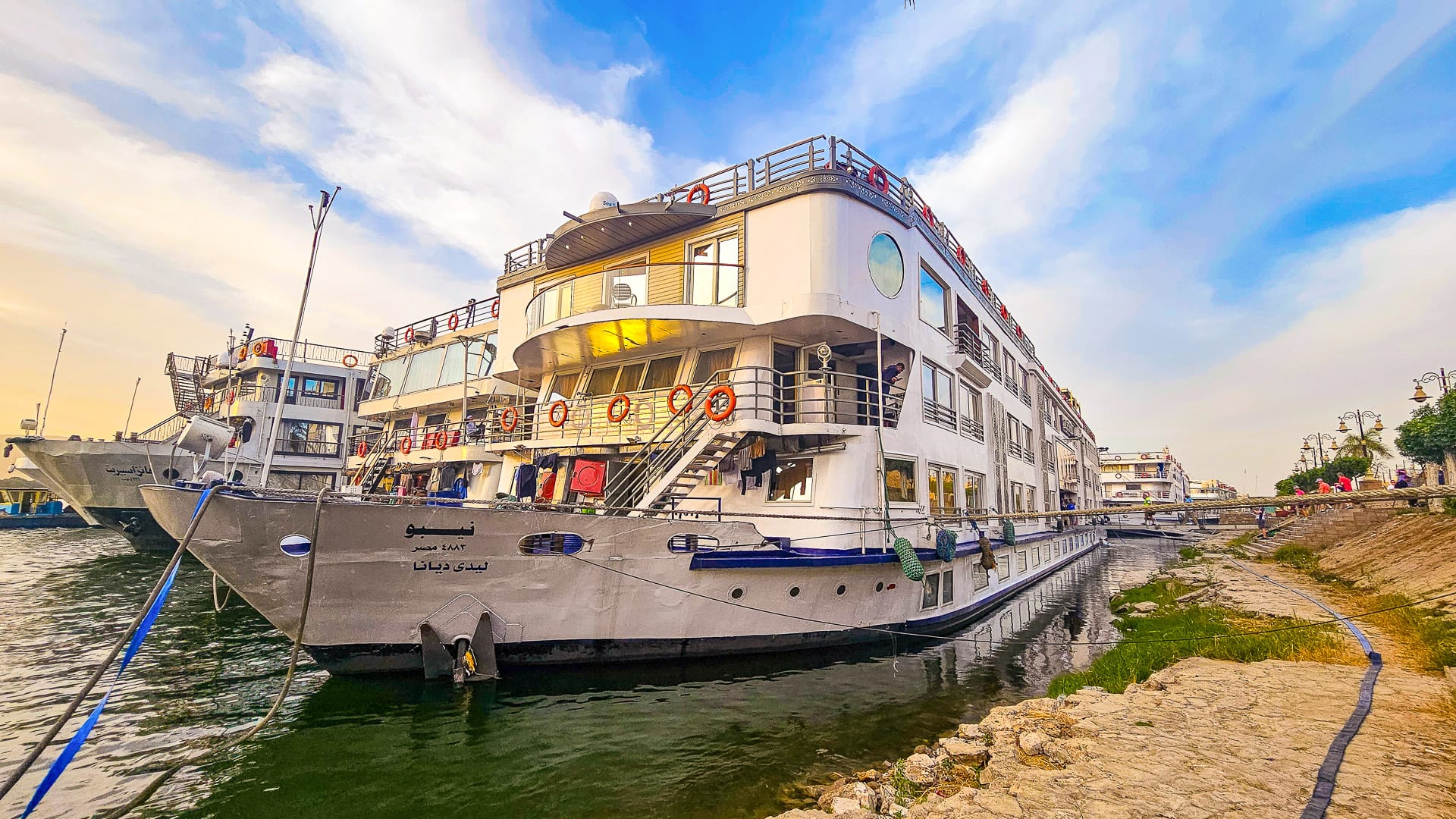
H/S Nebu docked in Luxor (photo credit: Michael de Boer via Boat Bike Tours)
Sponsor Message
Looking for an Egypt bike and boat tour?
Discover Egypt by e-bike on our 13-day Egypt & The Nile – A Journey to Ancient Wonders tour.
We’ve been running bike and boat holidays since 2002, and this premium guided tour combines seven days of cycling with seven nights aboard the superior-class H/S Nebu and stays in carefully selected hotels.
Ride through the Nile Valley, visit some of Egypt’s most important ancient sites and experience rural communities and everyday life away from the usual tourist routes. Expert guides, e-bikes and on-route support are included throughout.
Interested in joining the trip? View the full itinerary, dates and availability on our website or complete the form below to discuss your plans.
Got a question for Boat Bike Tours?
Fill out this form and we will pass it to Boat Bike Tours who aim to reply (within 24 hours wherever they can!)
Part 6: How can you find out more or book?
On the Boat Bike Tours website, you can check the latest itinerary, departures and availability, view photographs and videos, read guest reviews and request a quote.
Ready to experience Egypt by bike and boat? Our team can help you choose the right cabin, talk through the riding and e-bikes, and answer any questions before you book.
Got a question for Boat Bike Tours?
Fill out this form and we will pass it to Boat Bike Tours who aim to reply (within 24 hours wherever they can!)
Got a question for Laurens?
Fill out this form and we will send it to Laurens. We aim to get you an answer within 24 hours where possible!Laurens Winkel is the CEO of Boat Bike Tours and has been with the company since 2007.
What he enjoys most about his work is creating new products, tours and ships, improving existing journeys, and building the team. Egypt is a perfect example: one of the boldest and most exciting journeys Boat Bike Tours has developed.
During the months of preparation, Laurens returned to Egypt again and again. He cycled through sugarcane fields near Luxor, listened to traders in the souks, and stood by the Nile at dawn as feluccas drifted past. Each time, he felt the same thing: this place has magic.
However, the team also knew that cycling in Egypt had to be approached with great care. They partnered with experts who live and breathe the country: Baher from Sakkara Travel, whose family has welcomed guests for generations, and Maged and his team of Egyptologists, who share Egypt’s stories not just from a textbook, but as companions on the road.
Together, they tested the routes and shaped an itinerary that combines comfort, safety and wonder. Carefully selected rural roads, e-bikes, support vans, local guidance and traffic management where needed help make the cycling accessible, while temple visits, boat rides through bird sanctuaries and evenings on the Nile make the journey unforgettable.
First Published: 27 August 2026
The contents of this website are provided for general information purposes only. It is not intended to amount to advice and you should not rely on it. You should carry out your own due diligence and risk assessments and take professional advice. Views expressed by interviewees or other users of this website do not necessarily represent our views. We make no representations, warranties or guarantees, whether express or implied, that the content on our website is accurate, complete or up to date. If you use any information or content on this website, download from, or otherwise obtain content or services through our website, it is entirely at your own discretion and risk. Epic Road Rides Ltd disclaims all liability and responsibility arising from any reliance placed on the information and content on this website. Find out more here.
Sponsor Message
Looking for an Egypt bike and boat tour?
Discover Egypt by e-bike on our 13-day Egypt & The Nile – A Journey to Ancient Wonders tour.
We’ve been running bike and boat holidays since 2002, and this premium guided tour combines seven days of cycling with seven nights aboard the superior-class H/S Nebu and stays in carefully selected hotels.
Ride through the Nile Valley, visit some of Egypt’s most important ancient sites and experience rural communities and everyday life away from the usual tourist routes. Expert guides, e-bikes and on-route support are included throughout.
Interested in joining the trip? View the full itinerary, dates and availability on our website or complete the form below to discuss your plans.
Got a question for Boat Bike Tours?
Fill out this form and we will pass it to Boat Bike Tours who aim to reply (within 24 hours wherever they can!)
Comments