
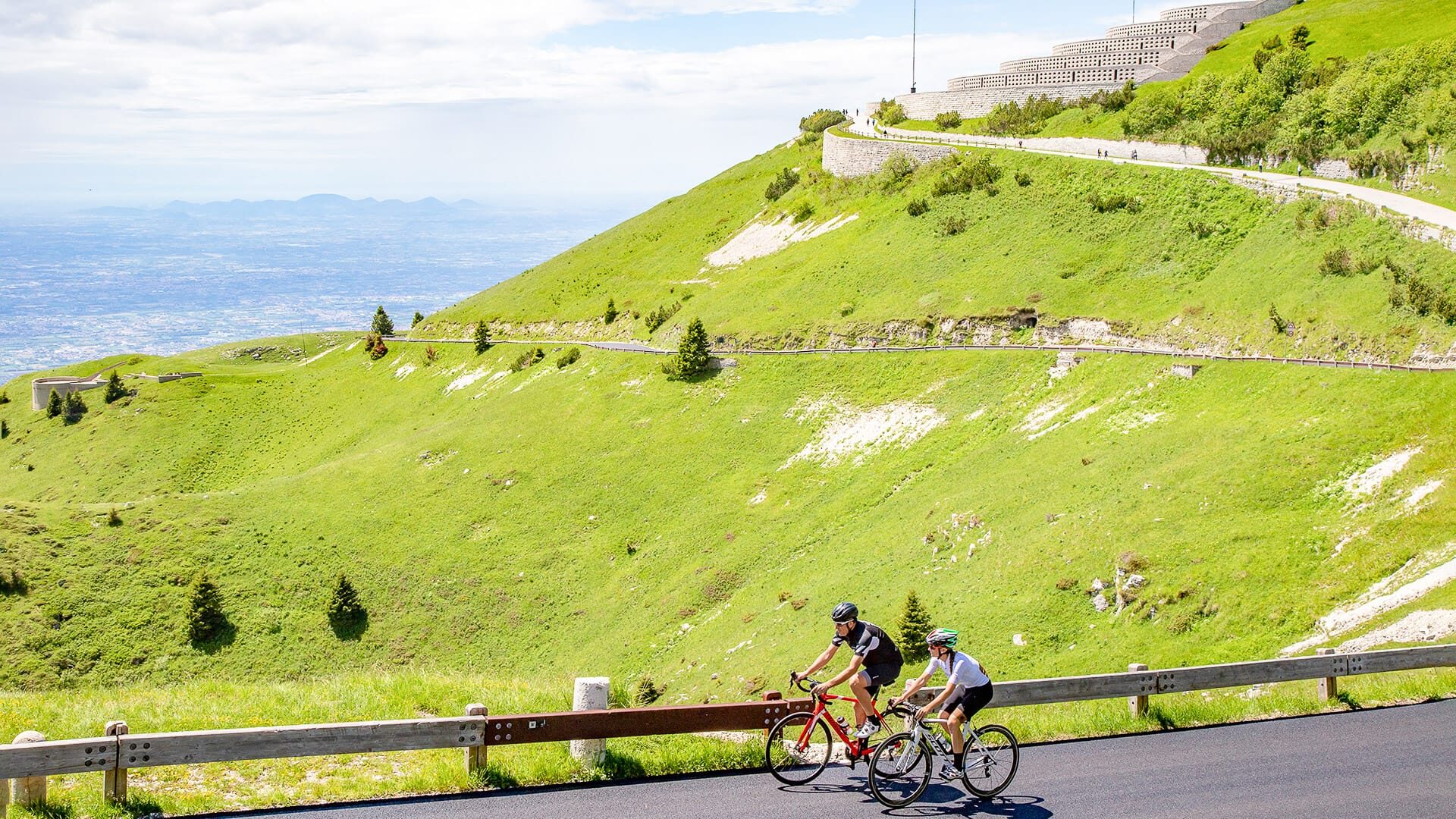

A cyclist looking at a map of Italy’s Prosecco Hills will only see part of the story. While many visitors arrive planning to ride Monte Grappa or explore the famous vineyard roads, some of the region’s most memorable cycling happens on quieter lanes, gravel tracks, hilltop ridges and local roads that rarely feature in traditional guidebooks.
That’s something Massimo Cavalli understands well. Raised in Pederobba, between Monte Grappa and the Prosecco Hills, Massimo founded Vagabond Bike in 2020 to help cyclists experience the region through local knowledge rather than simply following the obvious routes.
In this guide, Massimo shares his perspective on where to ride, where to stay, when to visit and how different parts of the region suit different types of cyclist. Whether you’re looking for vineyard-lined roads, challenging mountain climbs, gravel adventures or a mix of cycling, food and culture, his insights offer a practical introduction to one of northern Italy’s most varied cycling destinations.
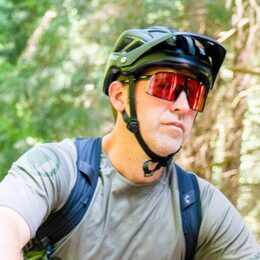
Massimo Cavalli is the founder of Vagabond Bike. Born in Pederobba, between the Prosecco Hills and Monte Grappa, he spent his twenties and thirties in Venice, coaching youth basketball. He came back to Pederobba at 40, having never stopped running in these hills, and started Vagabond in 2020 as a small bike rental business.
Massimo quickly realised that guests had no idea where to ride, and that the back roads, hidden cellars and small trattorie of the region were the real value he could share. From there, Vagabond shifted: today the team designs cycling experiences, from a self-guided day in the Prosecco Hills to fully built five-day trips, for guests from across Europe, North America and beyond. The company is small on purpose, with a deep love for the territory, and works to human rhythms. Massimo says, "I kept stats when I was coaching basketball; on the bike I've never wanted to. Here it's about discovery, not numbers."
Massimo coordinates the company alongside Elena (itineraries), Angelo (lead guide), Corrado (operations) and Riccardo (website and marketing).
Photo credit: Vagabond Bike
Always check current travel information and advice. For visitors from the UK, the UK government travel information pages are here.
Prosecco Hills cycling at a glance
Table of contents
This guide contains a lot of useful information. To help make it more digestible, we’ve broken it down into several parts:
- Part 1: Why visit the Prosecco Hills?
- Part 2: What is the riding like?
- Part 3: Best bases and routes
- Part 4: Cycling events
- Part 5: Best time to visit
- Part 6: Tips
- Part 7: About Vagabond
Sponsor Message
Considering cycling in the Prosecco Hills?
Vagabond has been helping cyclists explore Italy's Prosecco Hills since 2020.
They offer bike hire, self-guided and guided cycling tours, as well as bespoke multi-day cycling trips tailored to your interests and riding style.
Interested? Head to the Vagabond website to find out more, including dates and prices.
Got a question for Massimo Cavalli from Vagabond Bike?
Fill out this form and we will pass it to Vagabond Bike who aim to reply (within 24 hours wherever they can!)
Short on time? Here’s a quick overview of the Prosecco Hills.
| Topic | Details |
| Best for | Road cycling, gravel cycling and e-bike riding |
| Signature climb | Monte Grappa |
| UNESCO status | Yes |
| Typical trip length | 3-5 days |
| Best months | May and October |
| Nearest airport | Treviso Airport |
| Suitable for beginners | Yes, particularly on an e-bike or flatter river route |
| Bike choice | Gravel bike offers the most flexibility |
Part 1: Why should cyclists visit the Prosecco Hills?
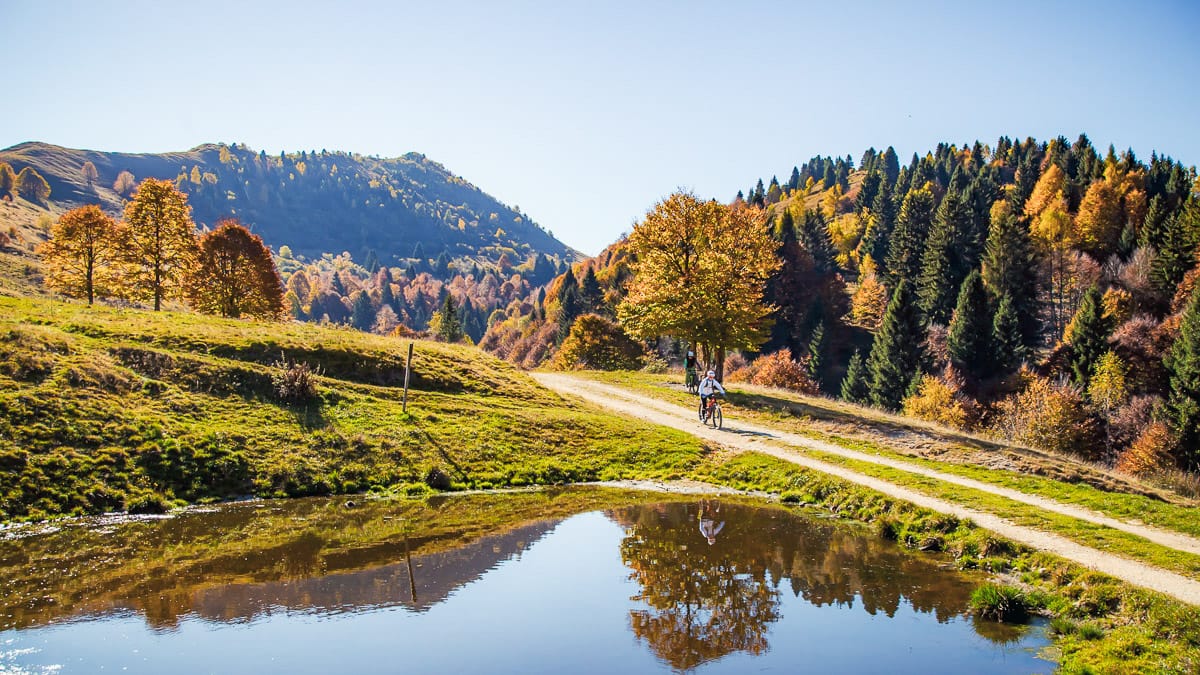
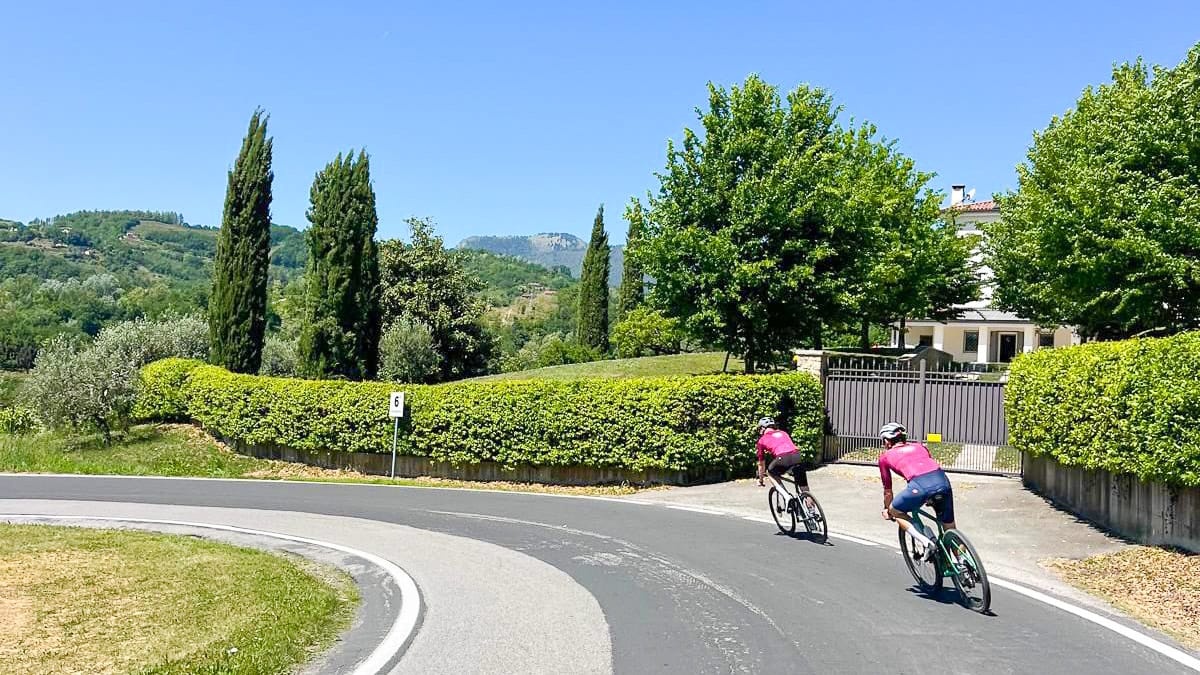
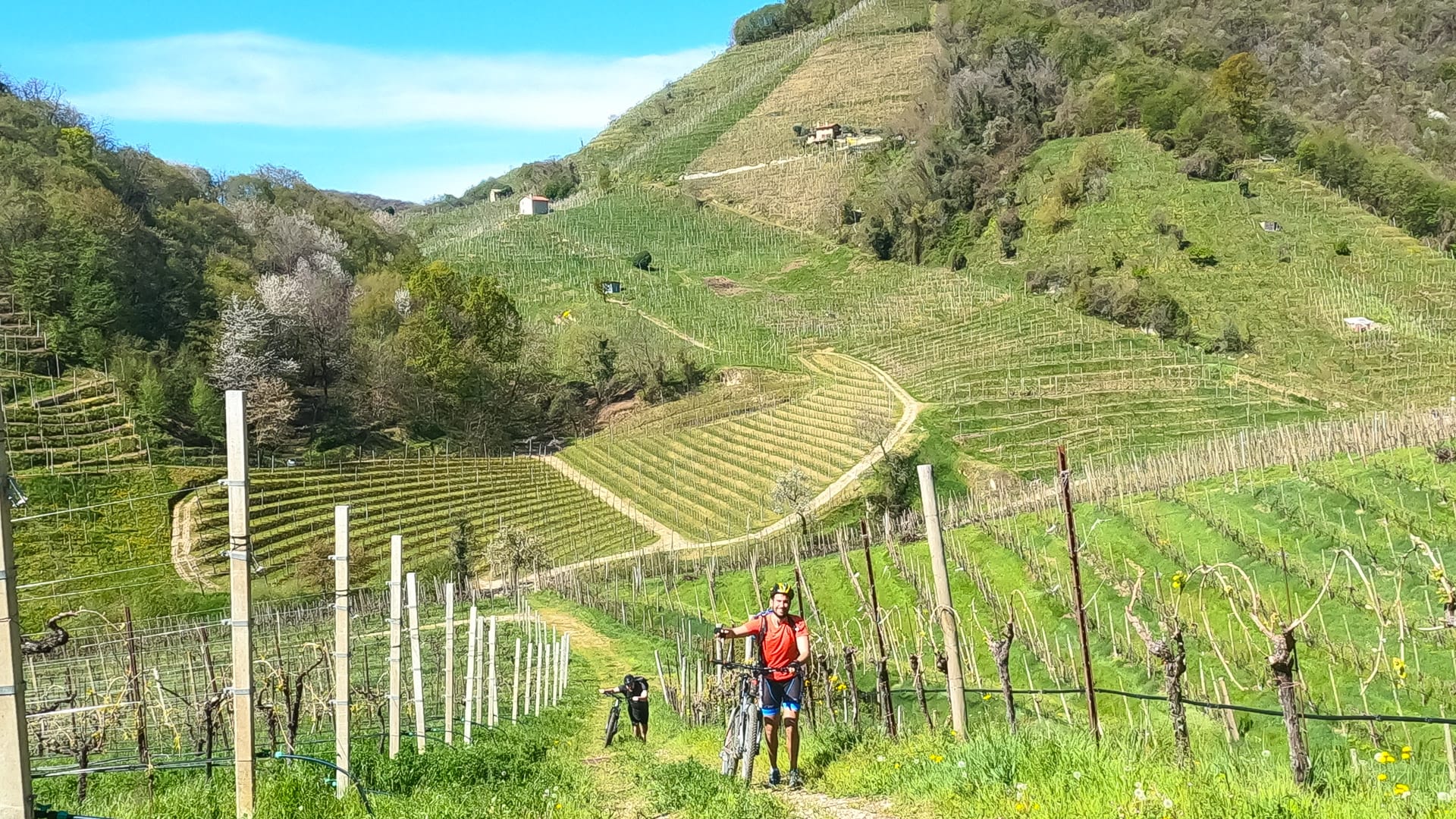
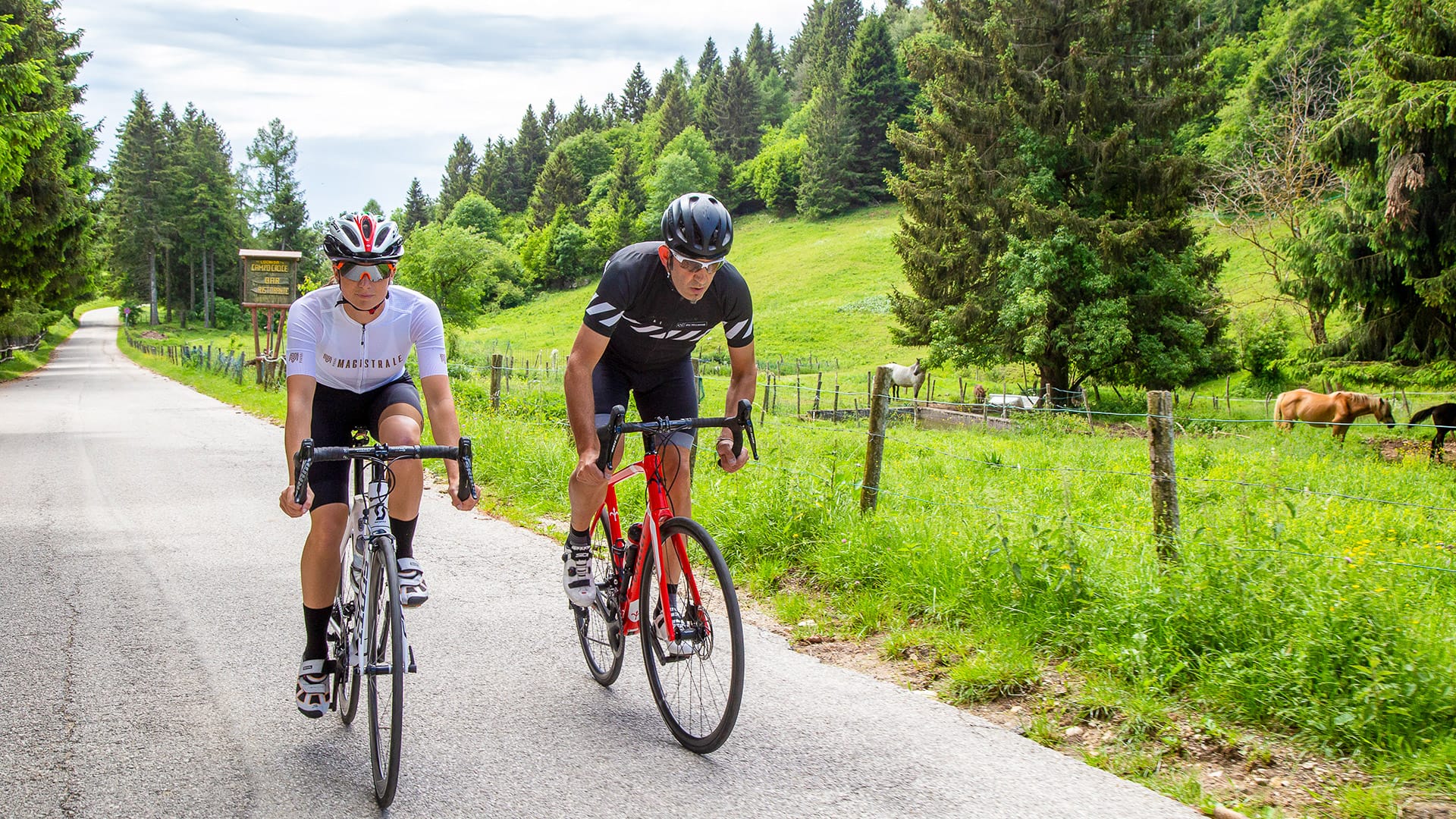
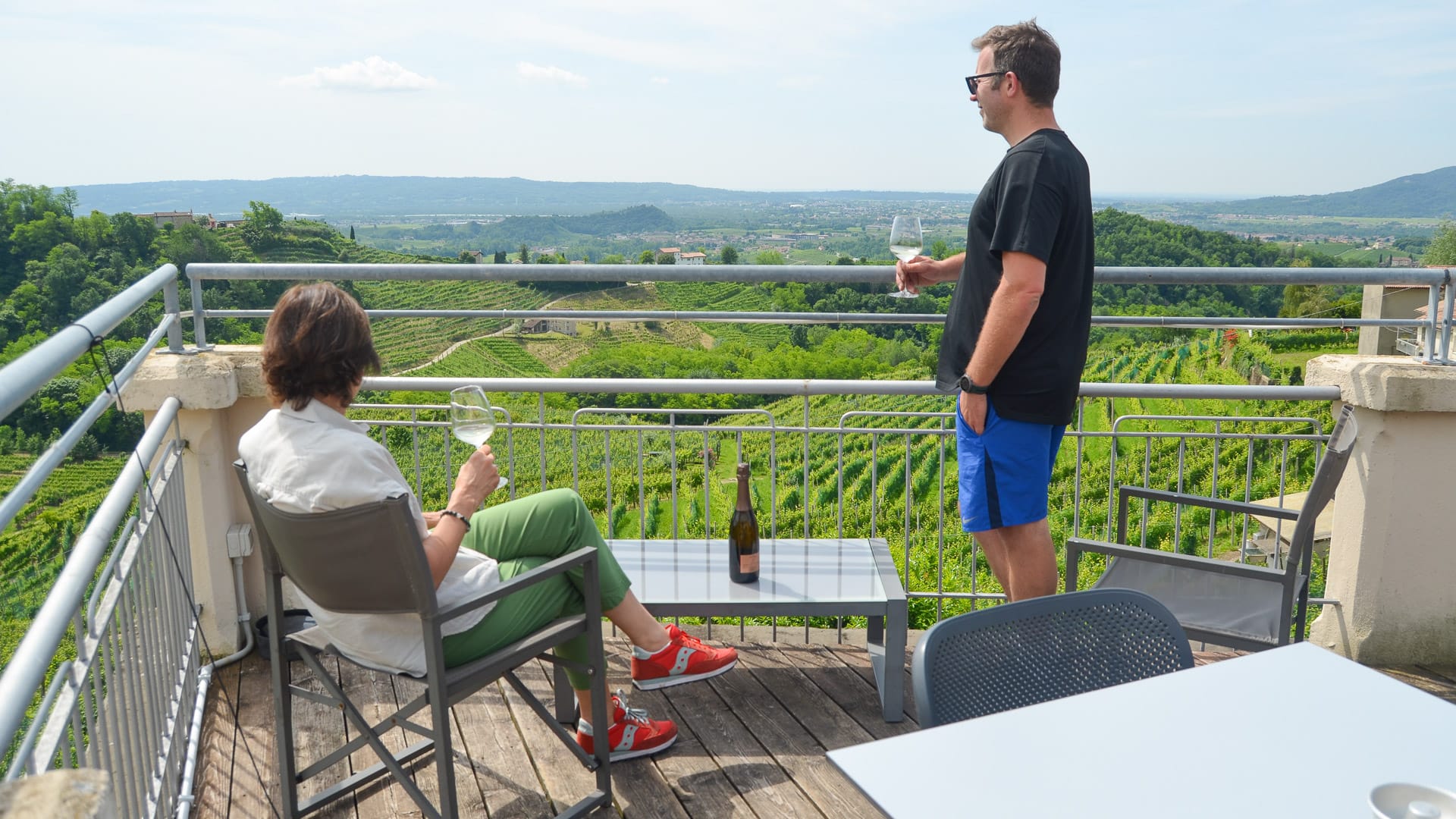
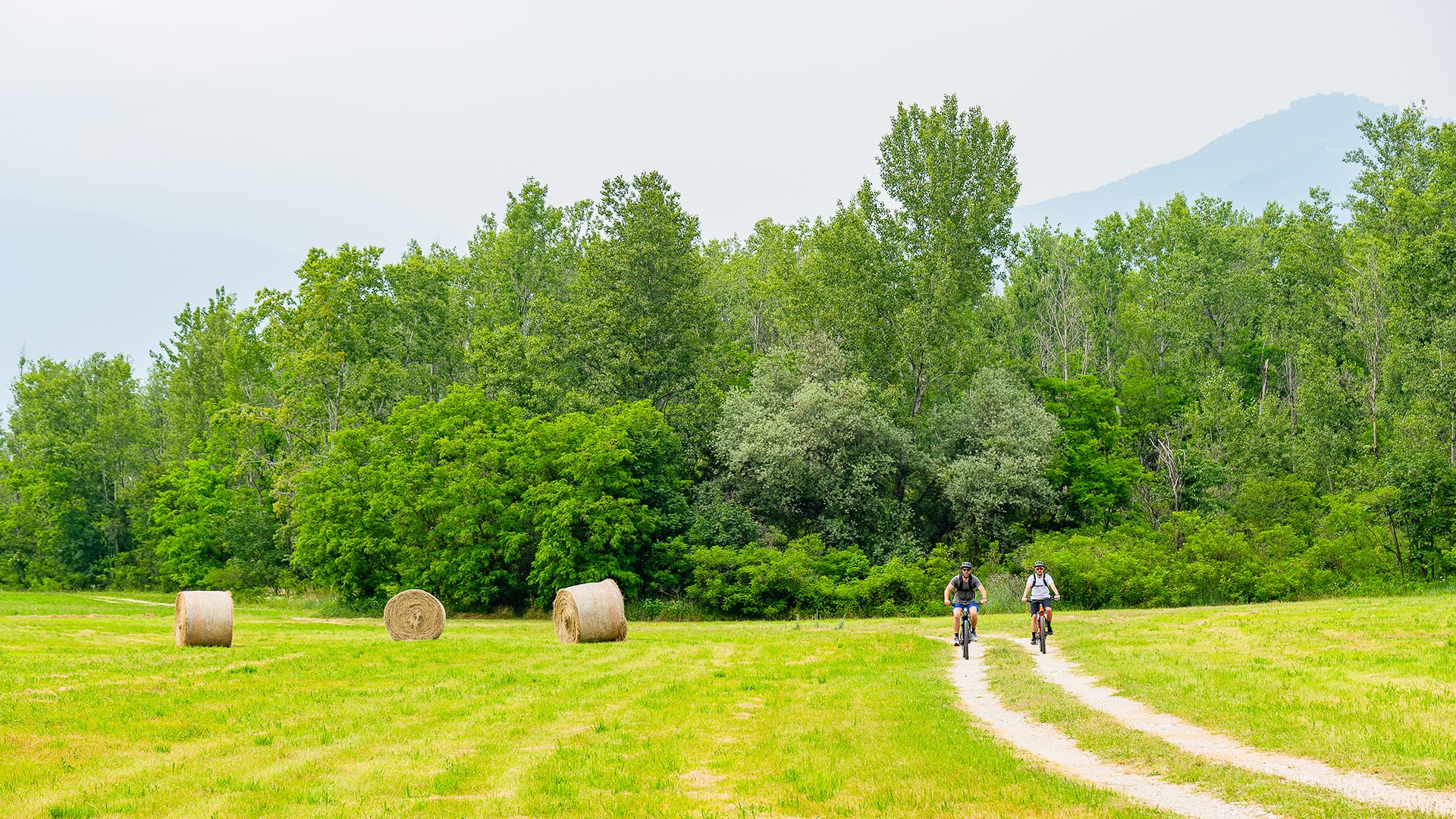
Variety of landscapes
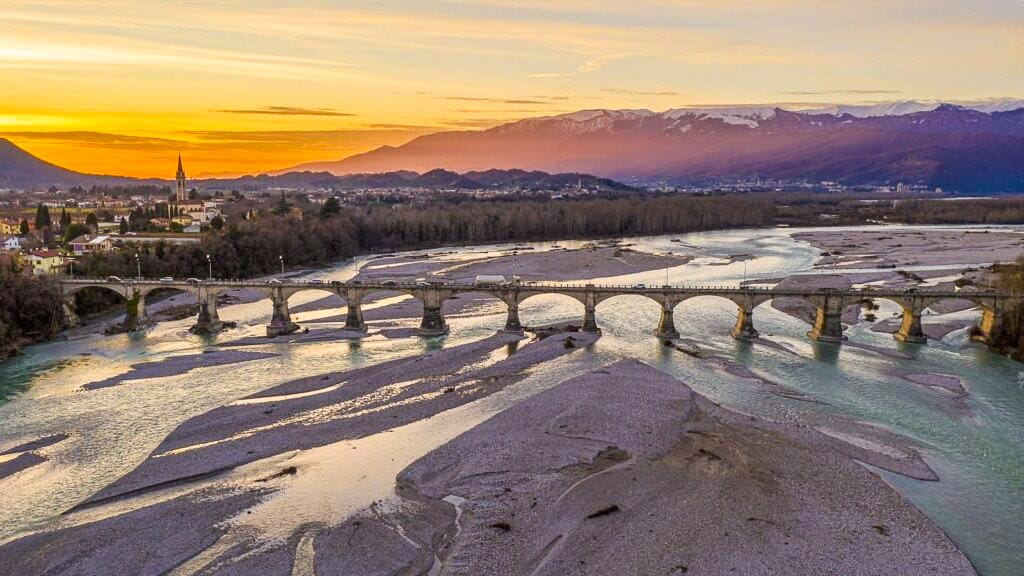
There is a beautiful description of Asolo, the small hill town a few kilometres from Pederobba. It is known as the city of a hundred horizons. I think that captures this area perfectly.
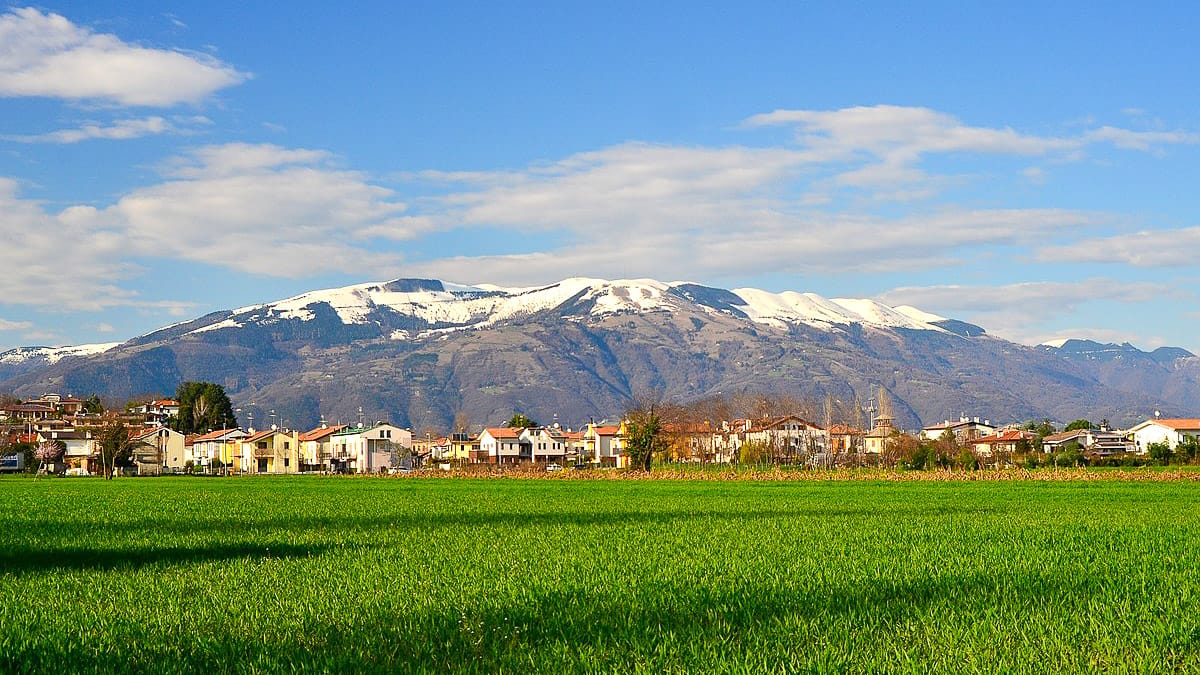
We sit where the foothills of Monte Grappa meet the Prosecco Hills. Behind us are the Dolomites. Below us are the rivers and plains that stretch towards Venice. On the bike, that means one ride rarely looks like the next.
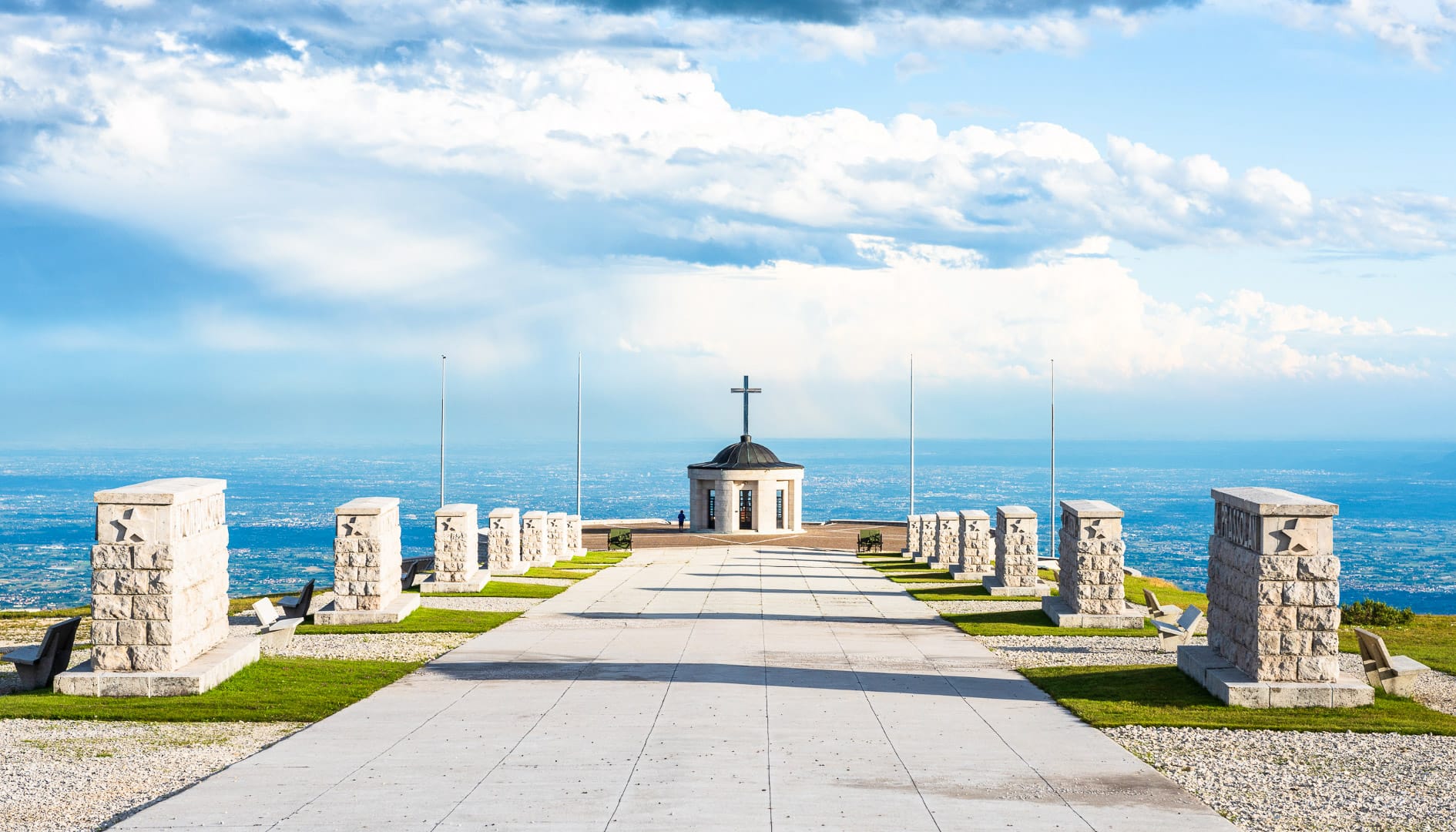
In a ride of three to four hours, you can pedal through the UNESCO-listed Prosecco vineyards, climb into the foothills of the Alps, ride beside the Piave River and visit historic towns such as Asolo and Bassano del Grappa. On exceptionally clear days, riders may be able to see as far as Venice and its lagoon from the heights of Monte Grappa.
For cyclists that love to climb
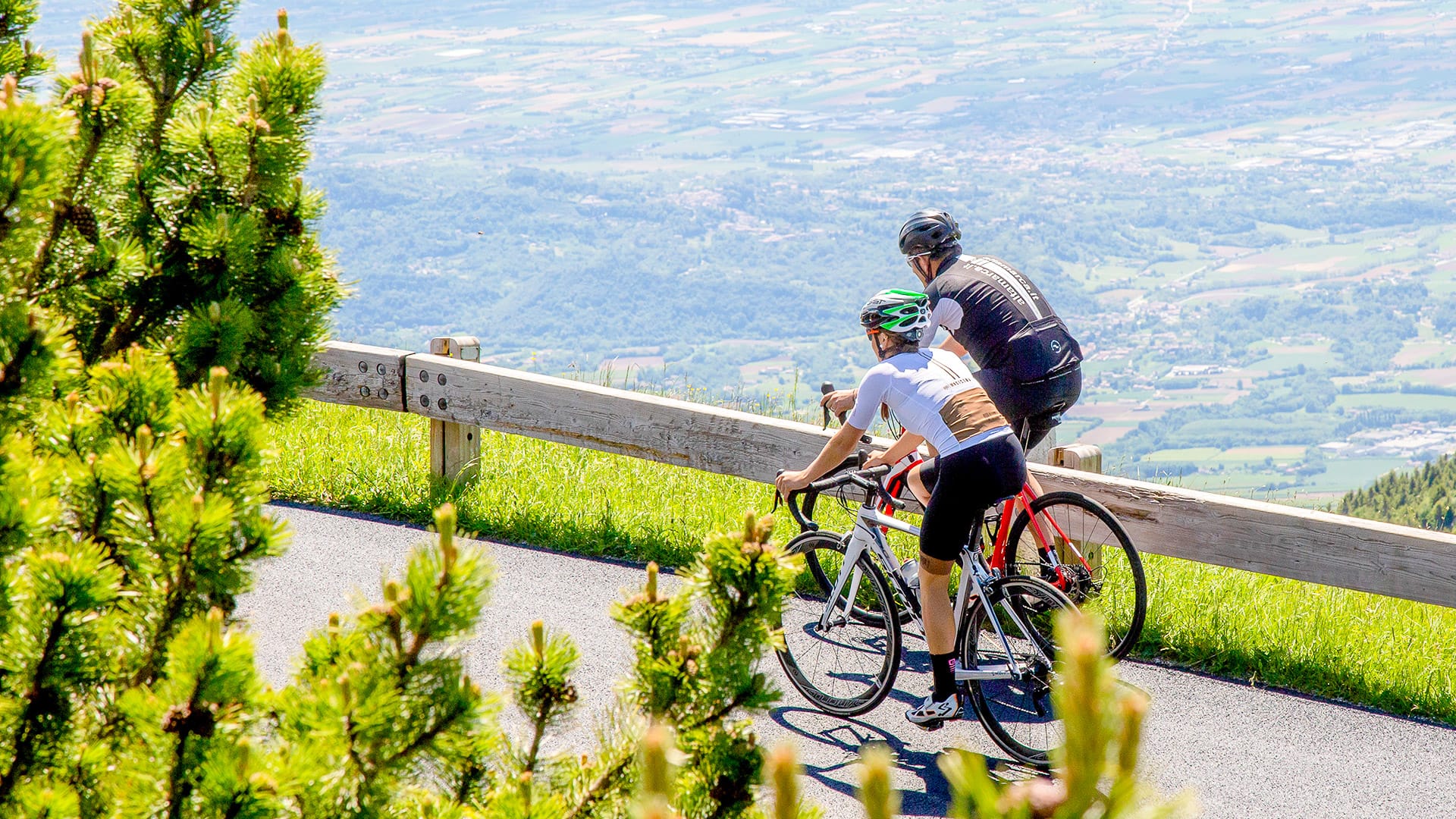
Monte Grappa is one of Italy’s great climbs and a regular feature of the Giro d’Italia. From the valley floor, you can see the summit almost the entire way up. It always looks close, but it takes longer to reach than you expect.
The mountain can be explored by road bike, gravel bike or mountain bike. If you prefer something shorter, the Montello offers a completely different experience. Hidden beneath its woodland are twenty short and steep climbs known locally as prese. None are particularly long, but all have their own character.
The Asolo hills provide another contrast. Here the gradients are generally gentler, the roads quieter and the pace a little slower. It is easy to combine a morning ride with a long lunch in a local trattoria or osteria.
Whether you want a ride with more than 1,500 metres of climbing or a shorter outing through the vineyards, there is plenty of choice.
Road, gravel, mountain biking and e-bikes
I often tell visitors that this region is defined by its connections.
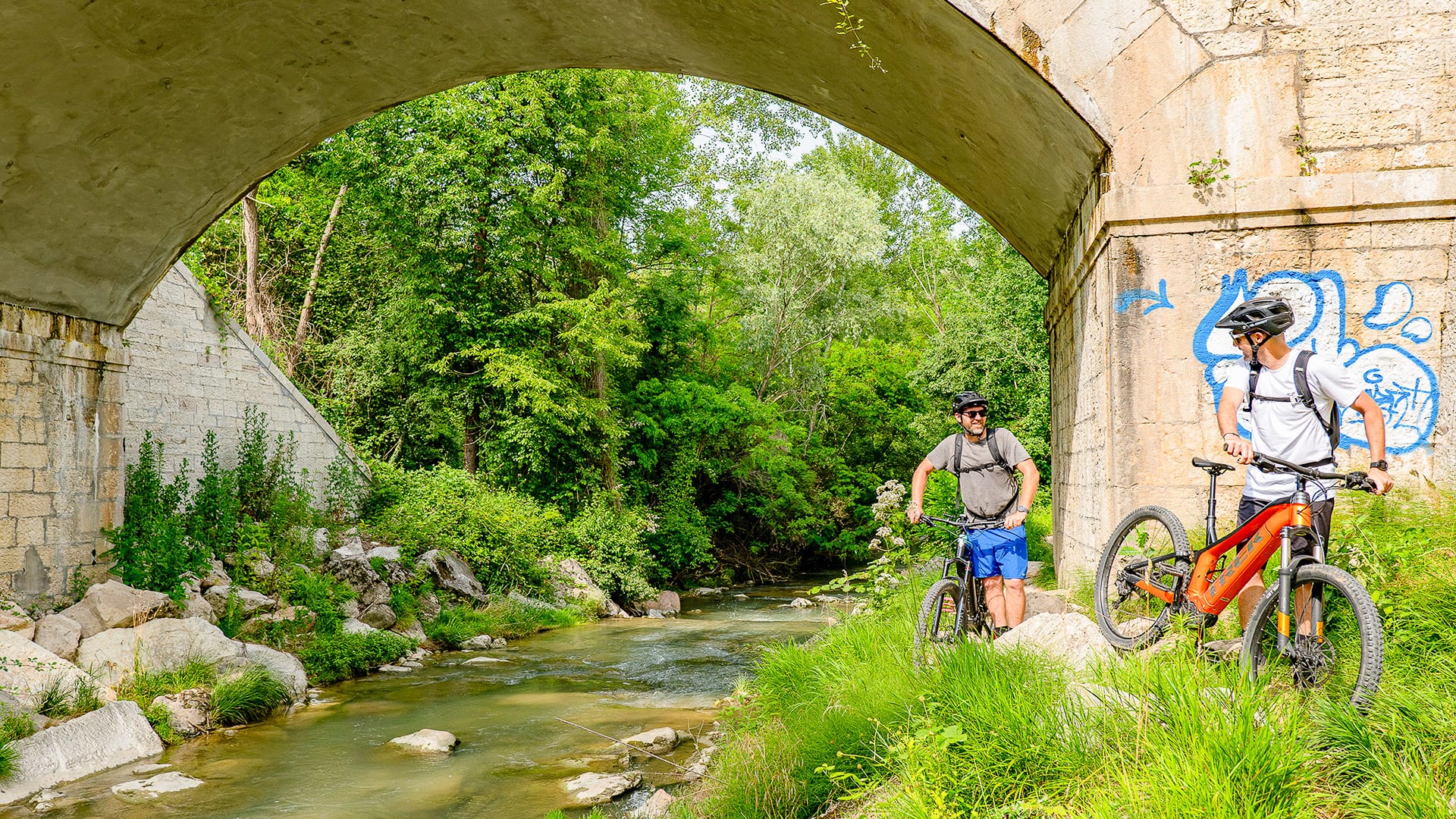
The vineyard roads link to woodland tracks. The woodland tracks connect to mountain roads. The mountain roads drop back into villages, vineyards and river valleys. That means cyclists are not limited to a single riding style.
Road cyclists have access to famous climbs such as Monte Grappa and a network of quieter secondary roads. Gravel riders can explore vineyard tracks, woodland routes and ridge-top roads. Mountain bikers have extensive trail networks on Monte Grappa, the Montello and the Asolo hills.
The area also works very well for e-bikes. The climbs here are significant, but an e-bike makes it possible for riders of different fitness levels to explore together and cover more of the region in a day.
Culture of cycling and hospitality
That breadth of riding was highlighted when the region hosted the 2023 UCI Gravel World Championships. It is also why so many visitors arrive expecting a wine region and leave talking about the riding.
The Giro d’Italia comes through regularly. Nova Eroica Prosecco Hills is the cousin of the legendary Eroica in Tuscany, riding the white roads of the UNESCO vineyards. Sportful, Prosecco Cycling, the Monte Grappa Bike Day and the Granfondo Pinarello are other local fixtures that pull serious crowds.
The hospitality is a little wry, a little deferential, very practical – there’s no performance of welcome. When you walk into a small agriturismo or a country trattoria, the host doesn’t fuss; they just feed you well, point you toward the next interesting thing, and take your curiosity as a fair trade.
Here’s a small example. Three days ago we ran a tour in what can only be called a biblical downpour. We debated whether to cancel and then decided to head out anyway. The group was made up of Australians and Canadians. When we walked into our first cellar stop, soaked through – two opposite ends of the world meeting in a small Prosecco cantina – the woman running the osteria looked at us, laughing, and said: “was it really necessary to ride through all that water?” That’s the moment that captures it: two parts of the world meeting over a glass of wine, in a small valley, on a rainy day – united by the same desire to discover. This is the side of the Prosecco hills our guests come back for – and the side that gets lost the moment a trip becomes a checklist.
History and tradition
This region has a deep cultural layer.
The influence of the Republic of Venice is visible, from the architecture to the culture of the small towns and villages.
Asolo was home to Eleonora Duse and has long attracted writers and travellers. Possagno is the birthplace of Antonio Canova. His Temple and the Gipsoteca are both worth time off the bike.
Bassano del Grappa adds another side of the region. Its wooden bridge was designed by Palladio, and the town is also known for ceramics and the historic Nardini distillery.
A few kilometres away, Villa Barbaro at Maser is one of Palladio’s most important villas. Inside are frescoes by Paolo Veronese.
The First World War is also present throughout the landscape. Trenches and bunkers remain in the woods around Monte Grappa. At the summit, the Sacrario del Monte Grappa is one of the most moving places in the region.
Sponsor Message
Considering cycling in the Prosecco Hills?
Vagabond has been helping cyclists explore Italy's Prosecco Hills since 2020.
They offer bike hire, self-guided and guided cycling tours, as well as bespoke multi-day cycling trips tailored to your interests and riding style.
Interested? Head to the Vagabond website to find out more, including dates and prices.
Got a question for Massimo Cavalli from Vagabond Bike?
Fill out this form and we will pass it to Vagabond Bike who aim to reply (within 24 hours wherever they can!)
Part 2: What can you expect from the Prosecco Hills (from a cyclist’s perspective)?
Where is the Prosecco Hills region located?
The Prosecco Hills are in north-eastern Italy, around 50 kilometres north of Venice, between Treviso and Belluno. The area sits where the eastern pre-Alps meet the Venetian plain, with the Dolomites rising behind.
The Piave river runs through the region and helps divide the landscape. To the east are the Prosecco Hills, including Valdobbiadene and Conegliano. To the west are the Colli Asolani and Monte Grappa. Between them are wooded ridges, valleys, hills and plains, which makes the area especially varied for cycling.
Pederobba, where Vagabond is based, sits close to the middle of this wider cycling region, with Valdobbiadene just across the river. Bassano del Grappa lies to the west and Conegliano to the east.
In this guide, when we refer to the “Prosecco Hills”, we mean this broader area around Valdobbiadene, Conegliano, Pederobba, the Colli Asolani and Monte Grappa. This wider definition better reflects what cycling here is actually like: a mix of wine hills, quiet valleys, riverside roads, forested ridges and mountain climbs.
The nearest major airport is Venice Marco Polo, with Treviso Airport even closer for some low-cost flights. Verona Airport is another option from the west.
What is the terrain like?
The Prosecco Hills region offers a wide variety of terrain in a relatively small area. In one ride, you can move from flat roads beside the Piave River to the gentle hills of Montello and Asolo, then into the steeper vineyard roads around Valdobbiadene and Conegliano. For stronger riders, Monte Grappa adds a serious mountain challenge, rising to 1,775 metres.
Good bases for a cycling trip include Pederobba, Asolo, Valdobbiadene, Bassano del Grappa and Conegliano.
Pederobba is a practical central base, close to both the river and the hills. Asolo, around 10 kilometres to the west, is a beautiful medieval hill town with good accommodation and excellent riding in several directions. Valdobbiadene is a great choice for riders who want to stay among the Prosecco vineyards. Bassano del Grappa works well for access to Monte Grappa and the western side of the region, while Conegliano is a useful eastern gateway to the Prosecco Hills.
The good news is that the whole area is compact. Wherever you stay, many of the best rides are within easy reach, and some routes naturally link more than one of these bases.
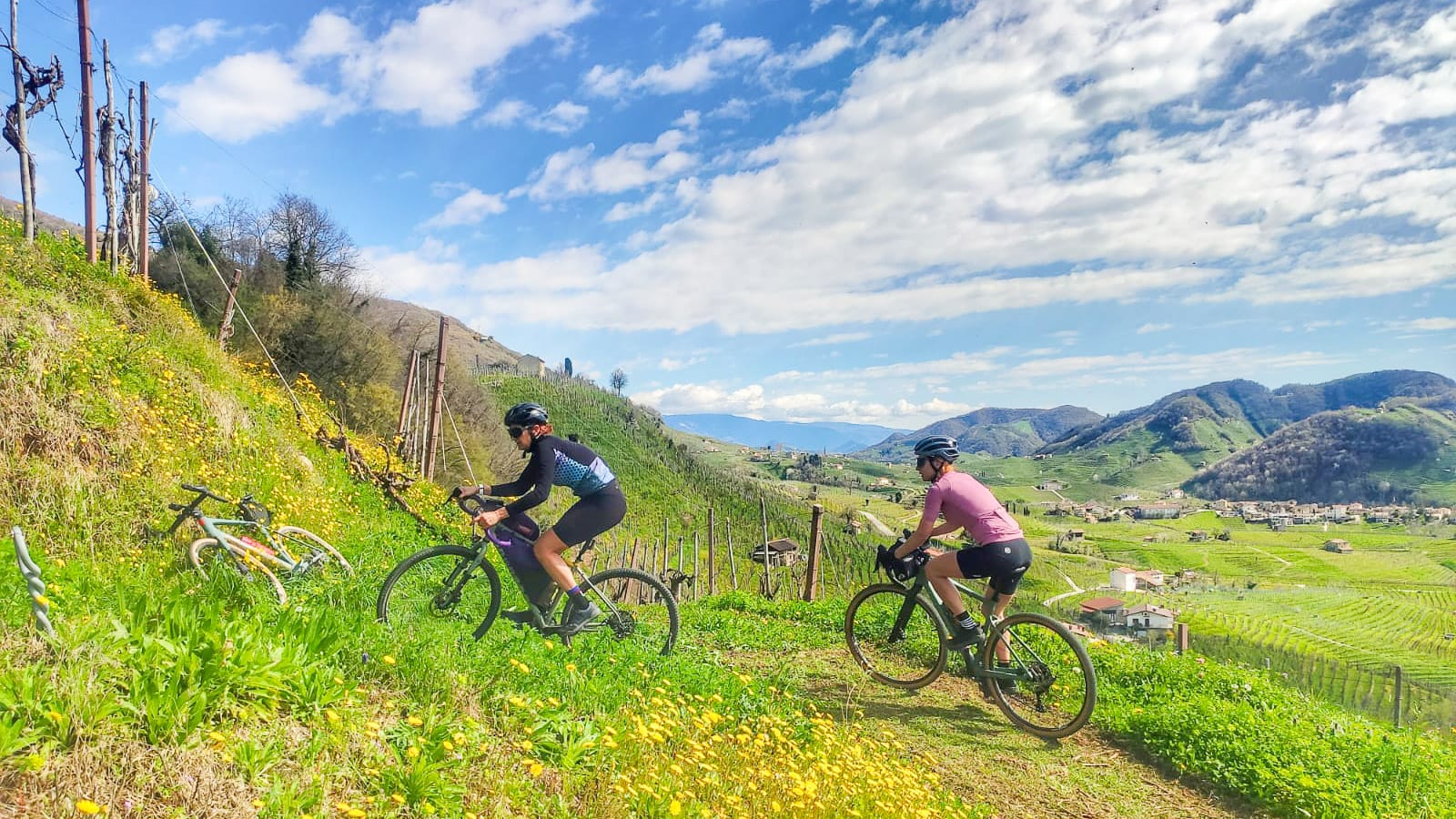
Gravel descending through Prosecco vineyards (photo credit: Vagabond Bike)
What is the riding like in the Prosecco Hills?
The main roads linking larger towns can be busy, especially around commuting times. However, most visiting cyclists spend very little time on these roads. This is exactly how we ride the Prosecco Hills and how we describe the area to visitors. The back roads are genuinely quiet, provided you choose the right routes.
The real appeal is the network below that layer: secondary roads, vineyard lanes, woodland routes, farm tracks and gravel sections that link villages throughout the region.
Road surfaces are generally good on the routes cyclists are most likely to use. Vineyard roads can be narrow and steep, and some agricultural lanes include short concrete ramps that feel harder than they look on a map.
For gravel riders, conditions can change after heavy rain. Good GPX files and local route knowledge are useful, particularly in spring and autumn.
Our practical suggestion: don’t plan the routes yourself from a generic map, and don’t follow the Google Maps “bicycle” layer here. Get good tracks – from a local operator who’s ridden them, ideally – and you’ll be on quiet, beautiful roads almost the whole time. It’s the single biggest piece of advice we can give a visiting cyclist.
At Vagabond Bike, we deliberately avoid the busier and faster provincial and state roads, including the SR348 “Feltrina”, SP26, SP248, SP1bis, SP34, SP32 and SS13. We also don’t publish open GPX tracks or generic maps, because these can be misleading in this region. Instead, we point guests towards our own vetted route packs, which are designed around the roads we know work best for cycling here. You can find out more about our self-guided route packs here.
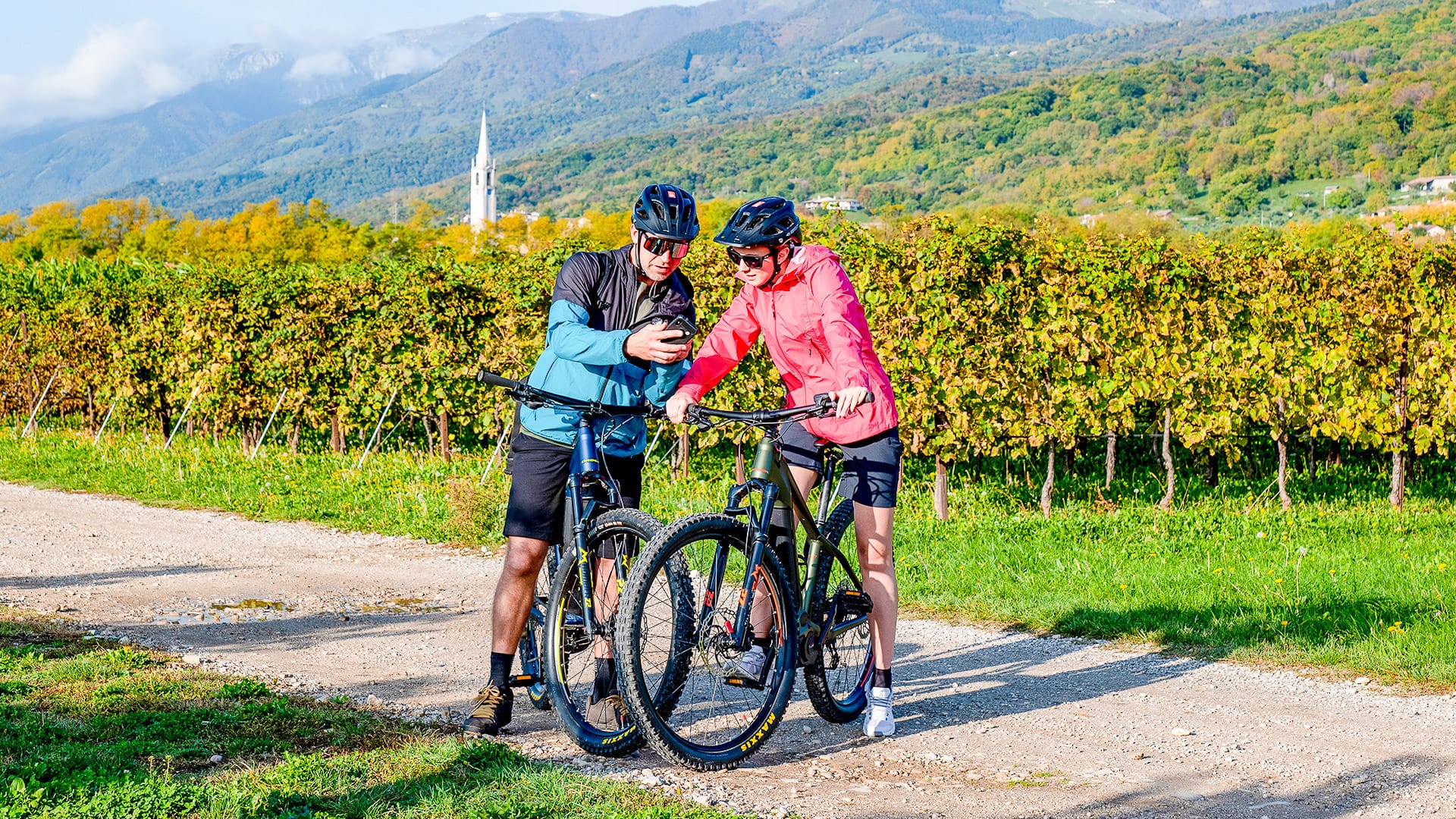
Checking the route map while riding (photo credit: Vagabond Bike)
Cycling events and local culture
The event calendar reflects the diversity of the cycling on offer.
The Giro d’Italia passes through regularly, when the route visits this part of the Veneto. The Monte Grappa has been featured in the Giro d’Italia nine times since its first appearance in 1968 and most recently in 2024.
The region is also home to events such as Prosecco Cycling, Nova Eroica Prosecco Hills, the Monte Grappa Bike Day and the Sportful Dolomiti Race.
Alongside the larger events, there is also a strong local cycling culture. One example is our Lunedì Gravel ride, a social Monday ride organised with friends. It is not a race, and it is not a tour. It is simply a chance to spend time on the quieter roads and tracks that make this area special. Visitors are very welcome to join when they are in the area. Please coordinate with us in advance. You do not need to speak Italian, as we are used to riding with international cyclists and speak English.
That local side of cycling is one of the things I value most about the Prosecco Hills. The bike gives you access to vineyards, villages, mountain roads, cafés, cellars and conversations that you would otherwise miss. For me, that is what makes this such an interesting place to ride.
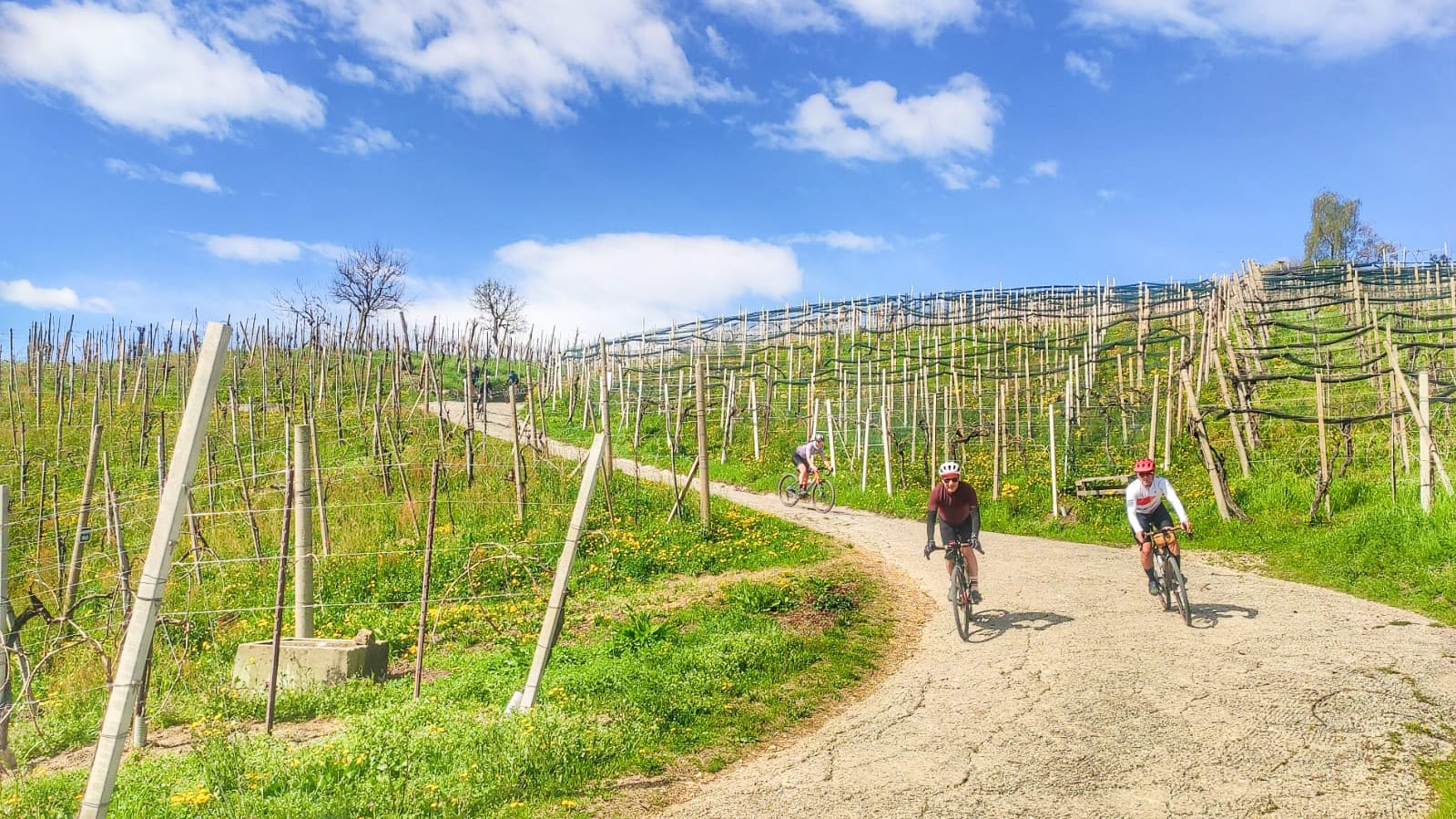
Gravel section between vine rows (photo credit: Vagabond Bike)
Do you need a cycling tour of the Prosecco Hills?
Not necessarily.
Many cyclists explore the region independently using GPX routes, local maps and a rented or personal bike. The advantage of independent riding is flexibility. You can decide how far to ride, where to stop and how to adapt your plans according to the weather.
That said, the region often reveals itself most clearly through local knowledge. Some of the vineyard roads, quieter gravel connections and small family-run wineries are not always obvious from a map. Local guidance can also help with accommodation choices, transfers and route planning.
The difference between a good ride here and a forgettable one is almost entirely about which back road you pick, which cellar you stop at, which trattoria has the polenta on the fire that day. That’s hard to extract from a guidebook or a TripAdvisor list.
What we offer is a small ladder of options, designed exactly around how much local knowledge you want plugged in:
- Self-guided: (our most popular product): we plan the whole experience around you – routes, lunch stops, cellar tastings, transfers, accommodation – but you ride on your own pace, with GPX files and our phone number.
- Guided tours: with Angelo or one of our other guides, who seem to know every farm dog by name. Best for riders who want the curated stops, the running commentary, and the freedom to not plan.
- Multi-day trips: full design, single or multi-base, often for small groups or for tour operators. This is where we’ve spent years refining the craft.
In every one of these formats, the work that matters happens before the ride – in the conversation we have with you about what you actually want, how much you want to climb, what kind of food and wine moods you’re in, whether you’d rather end the day at a small vignaiolo’s kitchen table or at a Michelin-starred restaurant. The itinerary follows from that. If you take only one piece of advice from this whole guide, take this one: the bike is the tool, the conversation is where the journey begins.
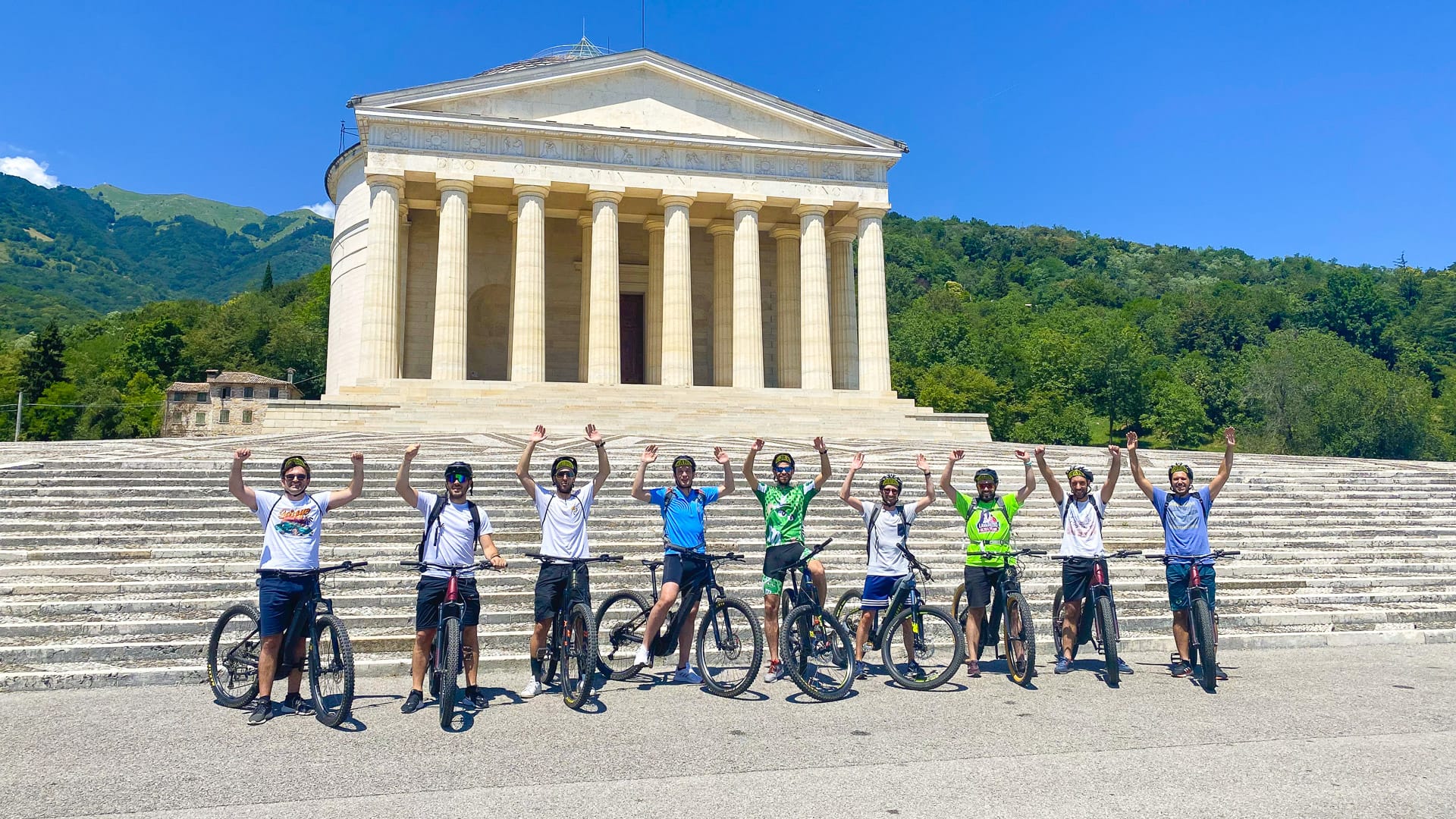
Cyclists at the Tempio of Canova, Possagno (photo credit: Vagabond Bike)
Sponsor Message
Considering cycling in the Prosecco Hills?
Vagabond has been helping cyclists explore Italy's Prosecco Hills since 2020.
They offer bike hire, self-guided and guided cycling tours, as well as bespoke multi-day cycling trips tailored to your interests and riding style.
Interested? Head to the Vagabond website to find out more, including dates and prices.
Got a question for Massimo Cavalli from Vagabond Bike?
Fill out this form and we will pass it to Vagabond Bike who aim to reply (within 24 hours wherever they can!)
Part 3: Where should you stay (and what routes should you ride) in the Prosecco Hills?
One of the things I like most about this region is that there is no single “right” base.
Each part of the region offers a different experience. Some visitors want to wake up among the vineyards. Others are here for Monte Grappa. Some prefer a historic town with restaurants and cafés within walking distance, while others want quiet villages and country roads.
The good news is that distances are relatively short. Even if you choose one base, much of the region remains within easy reach.
Which base is right for you?
Each base offers a different version of the region.
| Base | Best for | Atmosphere |
| Prosecco DOCG area | Vineyards and wine | Scenic and rural |
| Asolo | Culture and rolling roads | Historic and relaxed |
| Pedemontana cluster | Variety and local life | Quiet and authentic |
| Bassano del Grappa | Monte Grappa riding | Lively town base |
The good thing is that none of these choices limits you to one type of riding. The region is compact enough that you can explore several areas during the same trip. The decision is really about how you want your days to begin and end.
Prosecco DOCG cluster
(This includes Valdobbiadene, Follina and Cison di Valmarino)
For cyclists who want to stay among the vineyards
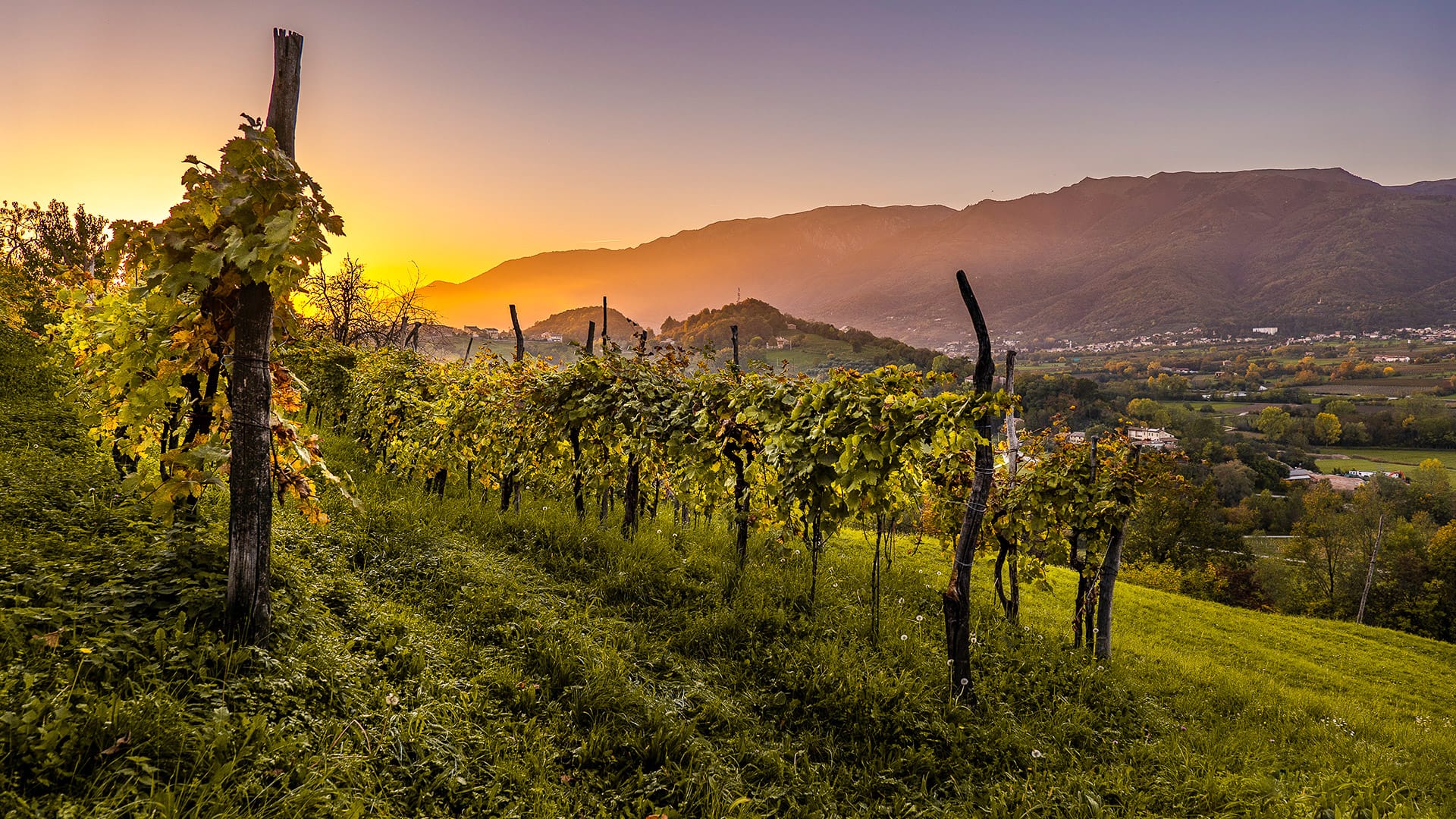
Glera vineyards of the UNESCO Conegliano, Valdobbiadene Prosecco DOCG (photo credit: Vagabond Bike)
If the vineyards are the reason for your trip, this is the obvious place to start.
Valdobbiadene sits at the western edge of the UNESCO-listed Prosecco Hills, but for many cyclists it feels like the heart of the region. The roads weave between steep vineyard slopes, ridge-top villages and small valleys, creating rides that constantly change direction and perspective.
This area suits cyclists who enjoy shorter climbs, frequent changes in scenery and the opportunity to combine riding with visits to wineries, villages and local restaurants.
Many of our wine partners are based here, and it is common for rides to begin or end at a cellar.
Places to stay
Options include:
- Locanda Sandi
- Borgo Taurino
- Bortolomiol – Casa Artista
- Agriturismo Vedova
- Casa Oltraval
- Duca di Dolle
- Hotel Villa Soligo (Farra di Soligo)
- Antica Abbazia (Follina)
Our top three for cyclists:
- Locanda Sandi (Valdobbiadene): Locanda Sandi offers air-conditioned rooms with private bathrooms, garden views and free WiFi. Guests can also use the free bicycles, garden, terrace, restaurant and bar, with breakfast options including continental, buffet, Italian and vegetarian selections.
- Borgo Taurino (this is the lodging of “Fasol & Menin): Borgo Taurino offers air-conditioned rooms with private bathrooms, free WiFi and garden or inner courtyard views. Facilities include an outdoor swimming pool, sun terrace, garden, restaurant, bar, coffee shop and free on-site private parking.
- Agriturismo Vedova (Valdobbiadene, San Pietro): Agriturismo Vedova offers air-conditioned rooms with private bathrooms, free WiFi and, in some rooms, vineyard views. There is also a restaurant serving homemade dishes, cold meats and wines produced in the local vineyards around the property.
Featured ride: Le Meraviglie del Prosecco
Route summary
| Distance | Elevation | Bike |
| 40 kilometres | 880 metres | Gravel, e-bike or road bike |
Route notes
A scenic itinerary in the heart of the Conegliano Valdobbiadene DOCG Prosecco hills, designed for those who want to grasp its variety and its iconic places. The route reaches the Sanctuary of Collagù, set among chestnut woods and vineyard rows, then continues toward Rolle, one of the most representative villages of the Strada del Prosecco. The second half takes in Cison di Valmarino and the Abbazia di Follina, alternating paved stretches and off-road segments typical of the Tenade and the Serre. It’s a varied and dynamic ride, ideal for those who love continuous changes of scenery and a panoramic experience rich in detail. The ride also includes a stop at the Osteria senz’oste (“Inn without an innkeeper”), a simple and genuine place – a must of this experience.
More information
Visit the Vagabond website for more details on the Le Meraviglie del Prosecco tour.
Asolo
For cyclists who want riding and culture
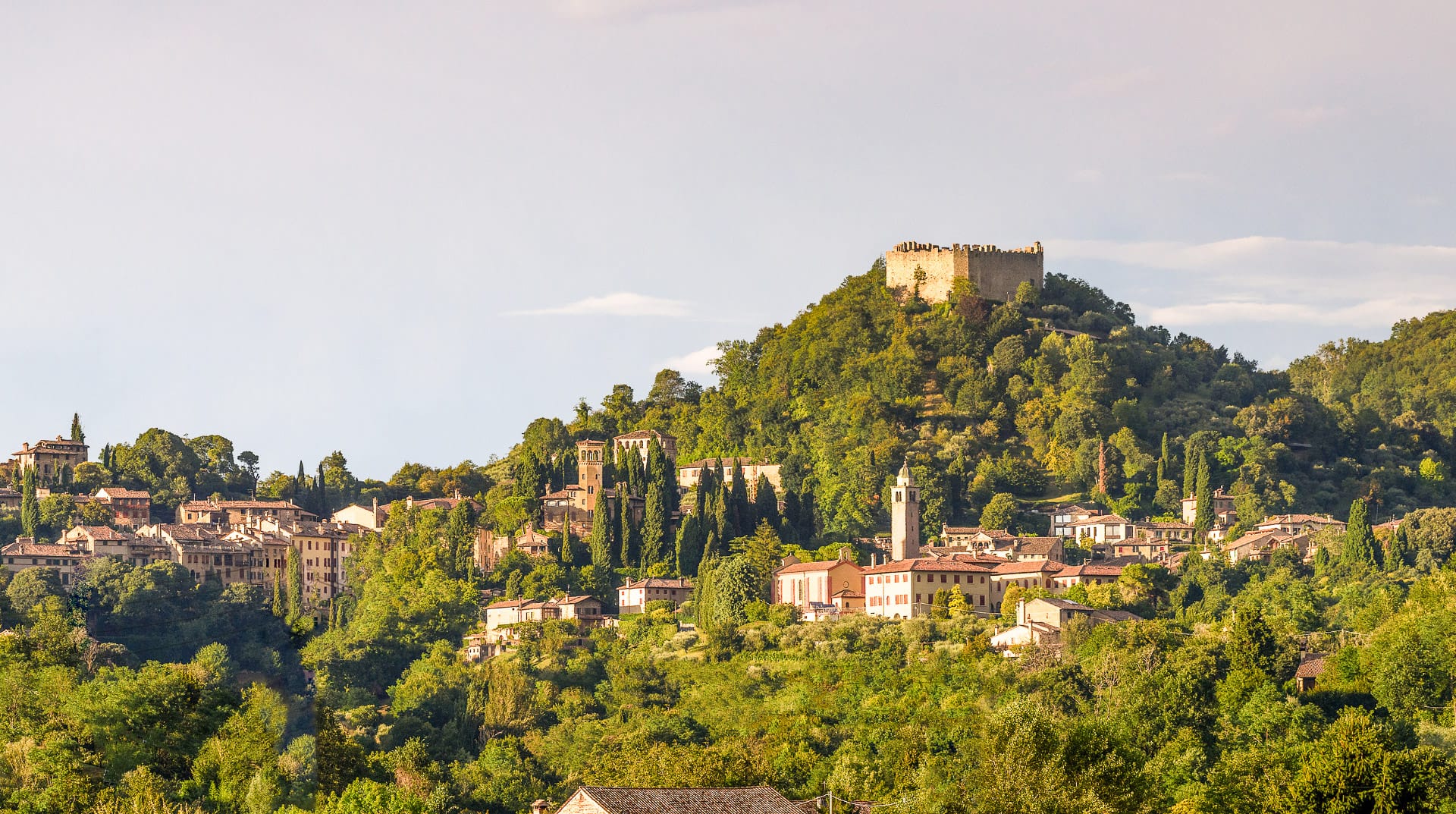
The Rocca of Asolo perched above the hill town, with the Asolan hills rolling south (photo credit: Vagabond Bike)
Asolo offers a different experience from the vineyard-focused bases.
The town has attracted writers, artists and travellers for centuries. Today it provides a good base for cyclists looking to combine riding with history, architecture and time spent exploring one of the region’s most attractive hill towns.
The surrounding roads roll through vineyards, villages and countryside before climbing towards Monte Grappa. The gradients are generally less demanding than in parts of the Prosecco Hills, making the area particularly appealing for cyclists who enjoy longer days in the saddle without constantly tackling steep climbs.
Places to stay
Options include:
Our top three for cyclists:
- Hotel Villa Cipriani: Hotel Villa Cipriani offers elegant rooms with high ceilings, antique furniture and views of the Alps and surrounding countryside. It is a peaceful base in the hills around Asolo, with a private garden, panoramic pool, sauna, fitness centre and restaurant, while the centre of Asolo is around five minutes away on foot.
- Albergo Al Sole: Albergo Al Sole sits in the main square of the medieval village of Asolo, with spacious rooms, period furniture, air conditioning and free WiFi. Guests can dine at La Terrazza bar and restaurant, use the free mountain bikes and enjoy free parking in the heart of the historic centre.
- Ida Boutique: Ida Boutique Hotel offers air-conditioned rooms with private bathrooms, free WiFi and mountain views. Facilities include an infinity swimming pool, wellness centre, sauna, hot tub, steam room and free on-site private parking, with hiking and cycling available nearby.
Featured ride: Tour dell’Arte
Route summary
| Distance | Elevation | Bike |
| 43 kilometres | 870 metres | Gravel, e-bike or road bike |
Route notes
An itinerary that brings together art, historic villages and back roads at the foot of Monte Grappa. The ride starts in Possagno, the hometown of Antonio Canova, pedalling through hills and rural lanes to reach Asolo, one of the most charming borgos in the region. After Asolo, the route continues to Villa Barbaro at Maser, a Palladian masterpiece set in the rolling landscape. From here the ride becomes more varied and dynamic, alternating quiet roads, woodland stretches and off-road segments, with optional detours linked to local producers. The final stretch tackles the Forcella Mostacin, an iconic and demanding climb, before reaching the ruins of the castle of Castelcies and the small church of San Martino, looking out over the valley. A rich and layered ride, where art and landscape unfold as you pedal.
More information
Visit the Vagabond Bike website for more details on the Tour dell’Arte.
Pedemontana cluster
(This includes Pederobba, Possagno and Monfumo)
For cyclists who want maximum variety
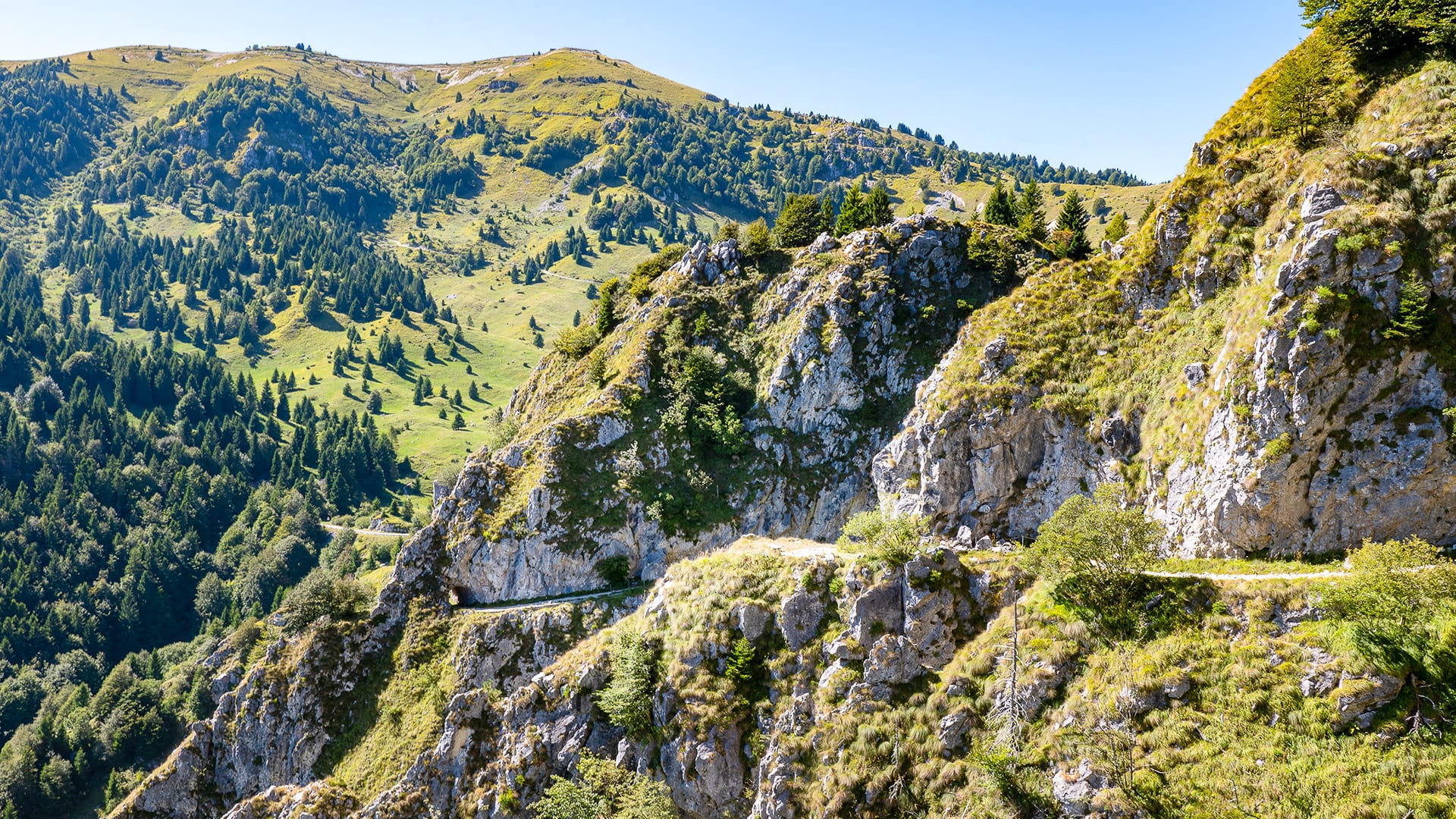
MTB trail on Monte Grappa, the Meatte line (photo credit: Vagabond Bike)
I am biased because this is home, but I genuinely think this is the most versatile base in the region.
From here, you can ride towards the Prosecco Hills, Monte Grappa, the Piave, the Montello and the Colli Asolani. Few places offer access to so many different riding styles within such a small area.
The atmosphere is also different. This is a landscape of small villages, local osterie and quieter roads. Visitors looking for a less tourist-focused experience often enjoy staying here.
Places to stay
Options include:
Our top three for cyclists:
- Locanda Bellavista: Locanda Bellavista in Cavaso del Tomba offers comfortable family rooms with private bathrooms, air-conditioning and garden or mountain views. Guests can make use of the garden, terrace, bike hire and luggage storage, with walking tours and cycling available nearby. The property is highly rated for its breakfast, peaceful setting and attentive host.
- Locanda Solagna: Locanda Solagna in Quero offers family rooms with private bathrooms, air-conditioning, free WiFi and garden or city views. The hotel has a family-friendly restaurant serving Italian and Mediterranean dishes, including vegetarian, gluten-free and dairy-free options. Guests can also enjoy the garden, sun terrace, outdoor fireplace and free bicycles, with the Dolomiti Bellunesi National Park within reach.
- La Collina delle Api: La Collina delle Api in Castelcucco offers recently renovated farm stay accommodation with air-conditioning, private bathrooms and mountain views. Rooms include a balcony or terrace, dining area and fully equipped kitchen. Guests can enjoy the sauna, garden, free private parking and an on-site restaurant serving Italian cuisine, with breakfast praised for its quality and choice.
Featured ride: Valcavasia
Route summary
| Distance | Elevation | Bike |
| 52 kilometres | 890 metres | Gravel or e-bike |
Route notes
A 50-kilometre exploration of the Valcavasia – a real journey through the most characteristic and hidden roads and trails of the area. Starting from Pederobba, this itinerary climbs through the hills to the Sentiero degli Ezzelini (the historic Ezzelini Trail), opening up to views of the Rocca of Asolo and Monte Grappa. The return takes you through the rolling hills of Monfumo. A route in pure gravel spirit.
More information
The Valcavasia tour is available on request. Visit the Vagabond Bike website for more details.
Bassano del Grappa
For cyclists focused on Monte Grappa
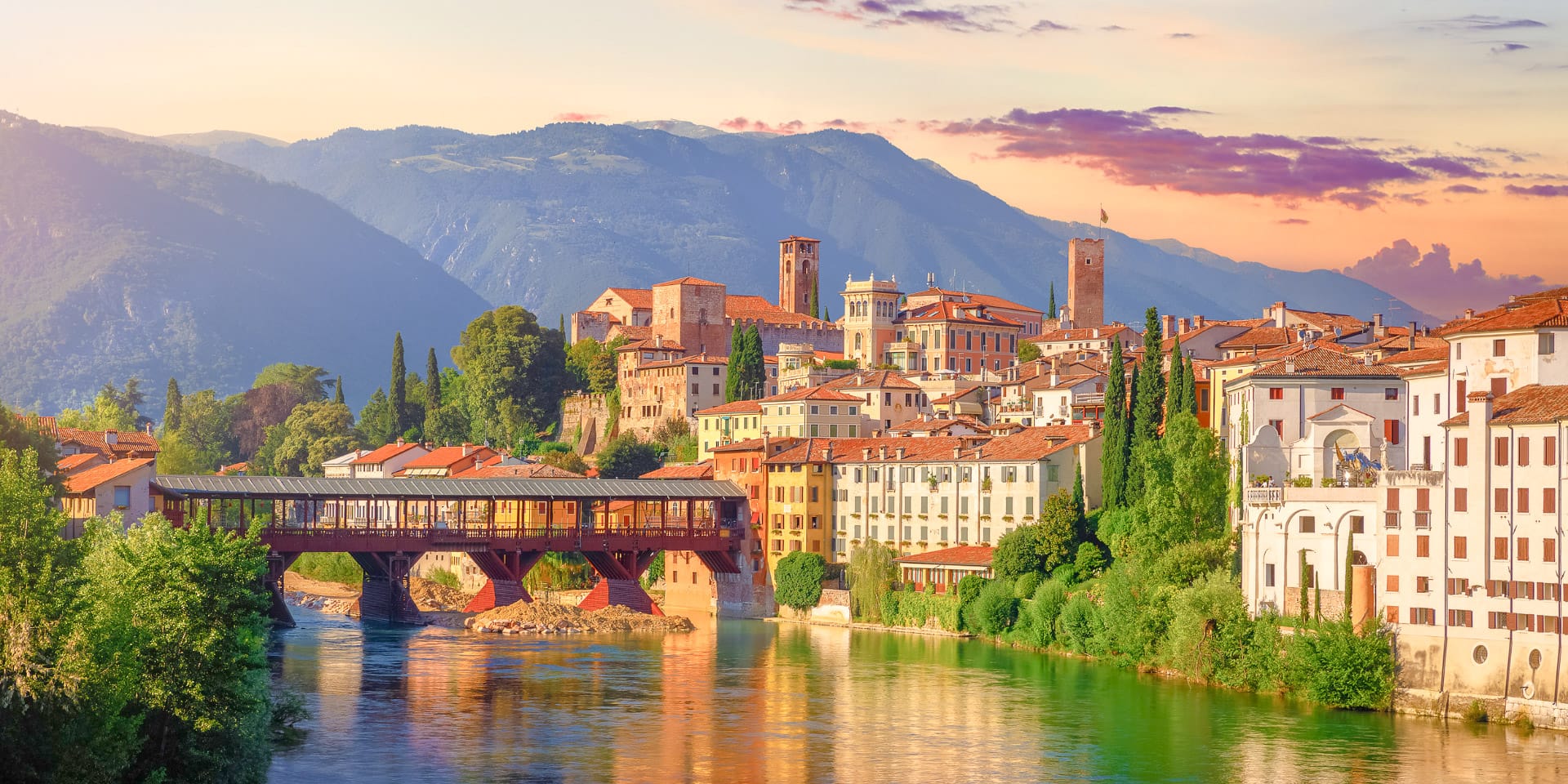
Bassano del Grappa, the western anchor of the region, where the Brenta cuts through the foothills (photo credit: Vagabond Bike)
If Monte Grappa is the main reason for your trip, Bassano del Grappa is a natural choice.
The town sits at the foot of the mountain and provides direct access to several of the classic climbs. It also offers a wider range of restaurants, cafés and evening activities than some of the smaller bases.
Bassano itself is worth exploring. The Ponte degli Alpini, the Nardini distillery and the historic centre all add another dimension to a cycling holiday.
The compromise is that you are slightly further from the Prosecco Hills, although they remain within easy reach.
Places to stay
Options include:
Featured ride: Bike Tour delle Malghe del Grappa
Route summary
| Distance | Elevation | Bike |
| 50 kilometres | 1,660 metres | Gravel, MTB or e-bike |
Route notes
This is the most demanding of the four featured rides.
A demanding and panoramic itinerary on Monte Grappa, designed for those looking for a real mountain experience on the bike. The ride starts in Pederobba and reaches Possagno, at the foot of Canova’s Temple, where the Strada degli Alpini begins: the hardest climb on the massif, with steep pitches and constant echoes of the Great War.
Once you reach Monte Palon, among trenches and open vistas, the rhythm shifts: from the Vedetta area begins the real malghe loop, riding at altitude through pastures, casoni and historical outposts like Malga Domador and the Valle delle Mure.
The descent along the Monfenera closes the loop with a long, enjoyable run through the woods back down to the valley. For those who want to experience the high-altitude part without tackling the full climb, a transfer service is available on request up to the start of the malghe loop.
More information
Visit the Vagabond Bike website for more details on the Bike Tour delle Malghe del Grappa.
Accommodation for cyclists
Accommodation options range from agriturismi and vineyard stays to boutique hotels and larger town-based properties.
Many accommodation providers in the area are accustomed to hosting cyclists, particularly around Valdobbiadene, Asolo, Bassano del Grappa and Monte Grappa. Secure bike storage is increasingly common, and some properties also offer laundry facilities, workshop space or early breakfasts for riders planning longer days in the saddle.
The choice of accommodation often comes down to the type of trip you want. Staying among the vineyards provides immediate access to the Prosecco Hills, while Bassano del Grappa offers a wider choice of restaurants and evening activities. Pederobba sits between several riding areas and works well for cyclists who want maximum flexibility.
If you are visiting during spring, harvest season or major cycling events, booking ahead is advisable as some of the smaller properties have limited availability.
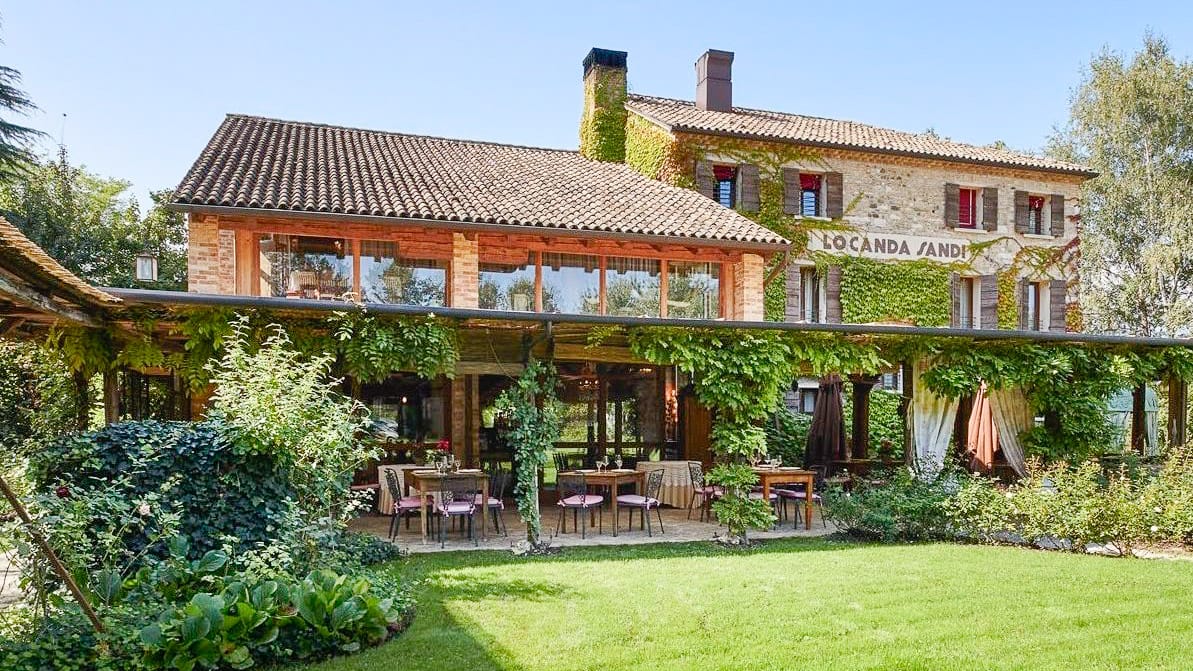
Locanda Sandi, a historic name in Valdobbiadene with elegant rooms and tastings (photo credit: Vagabond Bike)
Sponsor Message
Considering cycling in the Prosecco Hills?
Vagabond has been helping cyclists explore Italy's Prosecco Hills since 2020.
They offer bike hire, self-guided and guided cycling tours, as well as bespoke multi-day cycling trips tailored to your interests and riding style.
Interested? Head to the Vagabond website to find out more, including dates and prices.
Got a question for Massimo Cavalli from Vagabond Bike?
Fill out this form and we will pass it to Vagabond Bike who aim to reply (within 24 hours wherever they can!)
Part 4: Cycling events in the Prosecco Hills
For a region of this size, the cycling calendar is busy. There are road events, gravel rides, bikepacking adventures and social rides throughout the season.
The Giro d’Italia passes through regularly, usually including Monte Grappa when the route visits this part of the Veneto. The area also hosted the 2023 UCI Gravel World Championships. And the historic Granfondo Pinarello, Treviso’s road granfondo run by the bicycle brand of the same name, is currently being reshaped into a new format – worth checking the local calendar nearer your dates.
Summary of events
| Event | Typical timing | Focus |
| Prosecco Cycling | September | Road cycling |
| Nova Eroica Prosecco Hills | September | Gravel and mixed-surface riding |
| Monte Grappa Bike Day | June | Climbing |
| Sportful Dolomiti | June | Road cycling and gravel |
| Veneto Gravel | April | Gravel bikepacking |
| Veneto Trail | June | MTB bikepacking |
Event overview
Veneto Gravel – Sat-Sun 17-18 April 2026
Now in its 10th edition and billed as the world’s biggest gravel bikepacking event – a single-stage unsupported ride across the Veneto, no checkpoints, no fixed stops. Four routes to pick from: Newbie 200 km, Short Lake or Short Beach 400 km, Classic 720 km. You sleep where you stop – agriturismi, B&Bs, the side of the road. Gravel bike, lights, a story to bring home.
Veneto Trail – Friday 19 June 2026
The MTB cousin of Veneto Gravel, now in its 11th edition. An unsupported bikepacking adventure across the Veneto from the Po plain all the way to the Dolomites – ~480 km, 11,000 m of climbing, on singletrack, trail and dirt roads. Mountain bike with luggage. The start is in Cittadella (Padua province), just south-west of us – and the route comes straight through the foothills we ride every day.
Sportful Dolomiti Race – Sunday 21 June 2026
Now in its 31st edition, this is one of the toughest granfondos in Europe – and the local point of pride. Two routes: the Granfondo at 204 km with 4,900 m of climbing, or the Mediofondo at 120 km and 3,200 m. Road bike. Starts and finishes in Feltre, an hour north of Pederobba, on roads that go straight up into the Dolomites. Italians who say “I rode the Sportful” usually mean this one. Numbers are capped and entries open the previous autumn – book early.
Monte Grappa Bike Day – Saturday 27 June 2026
The 12th edition. One day a year the climbing roads of Monte Grappa close to motorised traffic and open to riders. Multiple routes up the mountain, all bikes welcome, festival atmosphere in the valley. Starts from Bassano del Grappa. If you want to climb the Grappa once without sharing the road with cars, this is the day.
Sportful Dolomiti Gravel – Sat-Sun 10-11 July 2026
The gravel cousin of the road granfondo, organised by the same team out of Feltre. Three loops to choose from – 60, 80 or 190 km – taking in the foothills, secondary roads, the shores of Lake Corlo and the Pedavena Brewery park (which is also the finish line, which tells you most of what you need to know about the spirit of the event). Gravel bikes.
Prosecco Cycling – Sunday 27 September 2026
The region’s classic road granfondo, now in its 23rd edition, through the UNESCO Conegliano-Valdobbiadene DOCG hills. ~96 km, 1,550 m of climbing, starting in Piazza Marconi in Valdobbiadene and threading through Tarzo, Refrontolo, San Pietro di Feletto and Conegliano. Road bikes – e-bikes welcome too. Less hardcore than the Sportful, more about riding the postcard.
Nova Eroica Prosecco Hills – late September
The younger sibling of the legendary Eroica in Tuscany, born after the 2019 UNESCO listing of the DOCG hills. Multiple distances, every kind of bike welcome (vintage steel encouraged but not required), festival atmosphere with cellar stops along the white-road route. The best event to come for if you want to ride the Prosecco hills with a crowd that gets it.
Lunedì Gravel – Mondays through the season
This is our one. A social Monday ride we run with friends – not a race, not a tour, just a regular weekly outing for whoever likes pedalling the back roads and stopping at the right places. Different routes each week. If your trip overlaps a Monday, ask us – you’re welcome to come along.
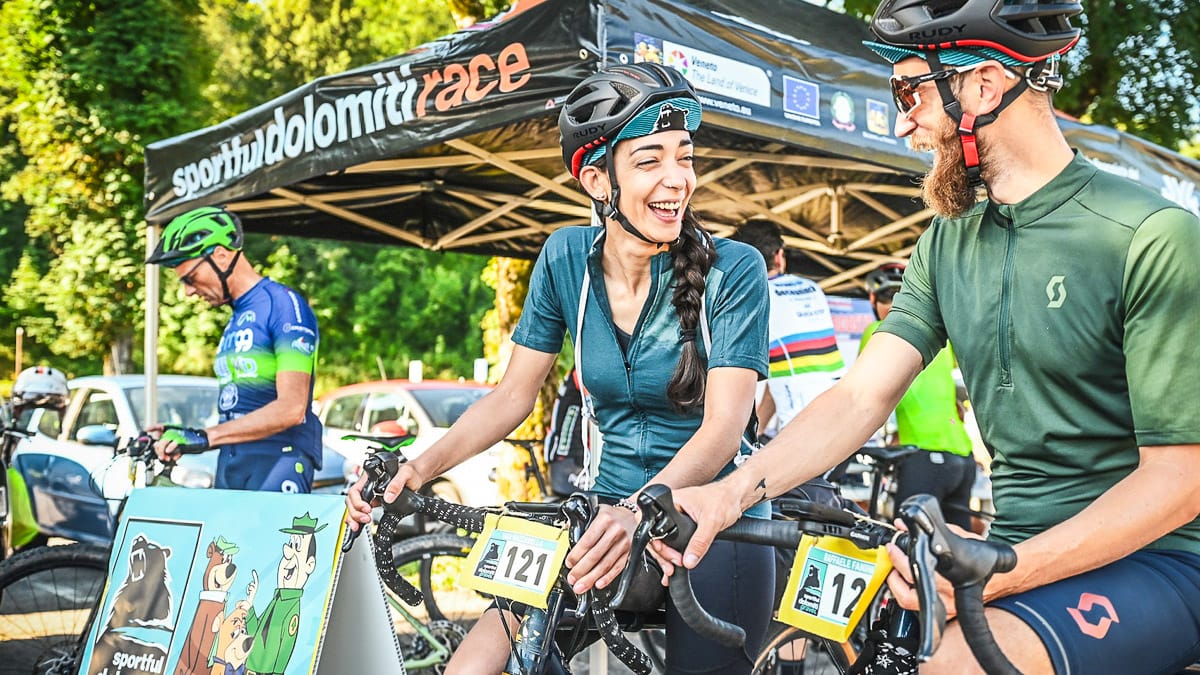
Sportful Dolomiti Gravel, the local July gravel event (photo credit: Vagabond Bike)
Sponsor Message
Considering cycling in the Prosecco Hills?
Vagabond has been helping cyclists explore Italy's Prosecco Hills since 2020.
They offer bike hire, self-guided and guided cycling tours, as well as bespoke multi-day cycling trips tailored to your interests and riding style.
Interested? Head to the Vagabond website to find out more, including dates and prices.
Got a question for Massimo Cavalli from Vagabond Bike?
Fill out this form and we will pass it to Vagabond Bike who aim to reply (within 24 hours wherever they can!)
Part 5: When is the best time for Prosecco cycling?
When is the best time for Prosecco cycling?
Our riding season runs from March to mid-November. Within that period, May and October stand out.
If someone asks me when to visit, those are usually the two months I mention first.
Spring
Spring arrives gradually in our region.
By late March, the orchards along the Piave begin to flower. By early April, fresh green growth starts to appear in the vineyards. Temperatures generally range from around 12°C to 22°C as the season progresses, and the days become noticeably longer.
The Primavera del Prosecco wine exhibitions run throughout spring, while agriturismi and country osterie reopen for the season.
May is one of the highlights of the year. The vineyards are fully green, the days are long and the weather is often settled. It is also the point when more international cyclists begin arriving in the region.
Summer
June and early July bring long days and warmer temperatures.
Daytime temperatures in the foothills are often between 24°C and 30°C. This is also when many of the region’s major cycling events take place, including the Sportful Dolomiti Race, Monte Grappa Bike Day and Sportful Dolomiti Gravel.
By mid-July and August, temperatures can regularly reach 32°C to 35°C in the lower hills and plains.
For many cyclists, this changes the daily routine. Early starts and evening rides become more attractive than riding through the hottest part of the day.
Monte Grappa in summer
Summer is when Monte Grappa comes into its own.
At 1,775 metres, temperatures on the mountain are often noticeably cooler than in the valley below. When Pederobba is experiencing a hot summer afternoon, the higher roads and mountain pastures can feel completely different.
For that reason, many cyclists spend the hottest months riding at altitude.
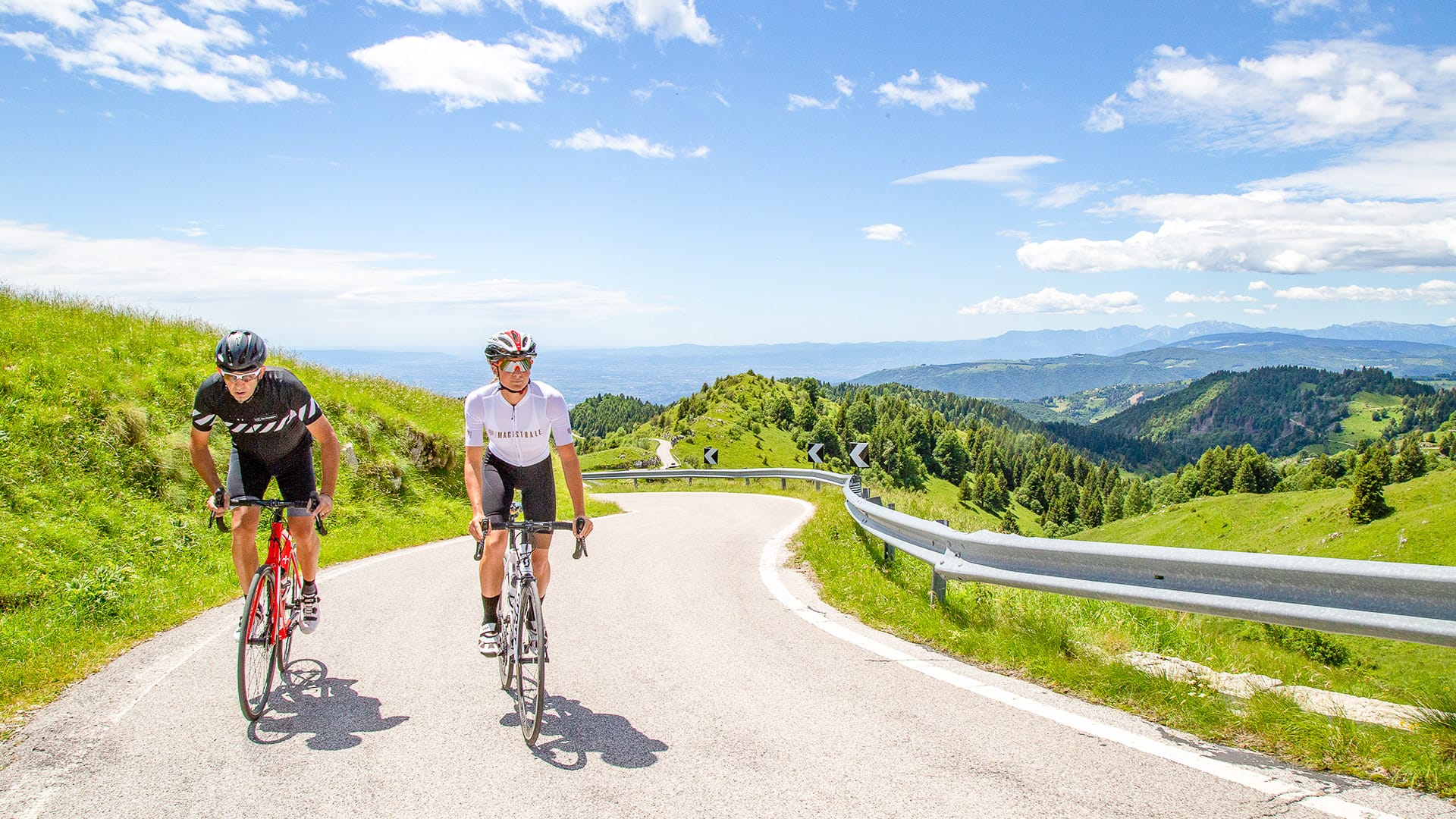
Road cyclists on Monte Grappa (photo credit: Vagabond Bike)
Autumn
Autumn is the other standout season.
September is harvest time in the Prosecco Hills. Vineyards become busy with activity, cellars are in full production and the landscape changes colour week by week.
Temperatures are generally comfortable for riding, often between 18°C and 25°C, while mornings become cooler and fresher.
This is also when major events such as Prosecco Cycling and Nova Eroica Prosecco Hills take place.
October and early November
October is often one of the most enjoyable months for riding.
The vineyards take on their autumn colours, conditions are often excellent and the light changes noticeably. Cooler mornings return, but most days remain ideal for cycling.
In Pederobba, the Mostra dei Marroni del Monfenera takes place throughout October, celebrating the local IGP chestnut and the season’s first vino novello.
Early November can still offer very enjoyable riding. Rain becomes more frequent, but when conditions are good the roads are quieter and the landscape takes on a very different character.
Winter
The region remains rideable through winter, but it is not the period I usually suggest to visitors.
Days are shorter, rainfall is more frequent and roads on Monte Grappa can close because of ice and snow.
Some cyclists enjoy the quieter atmosphere and lower visitor numbers during winter. However, if you have flexibility when planning a trip, March to mid-November generally provides the best conditions.
Part 6: Tips for cycling the Prosecco Hills
The main cycling season runs from March to mid-November. If you are planning to ride Monte Grappa, bear in mind that the Bassano side is open year-round, while the Monte Tomba side closes in winter.
Weather can also affect route choice. Spring and autumn rain can change gravel conditions, while in summer the midday heat can feel particularly hard on the exposed climbs. Booking ahead is always a good idea, mainly because it helps with better organisation and route planning.
Don’t plan routes from a generic map
Google’s “bicycle” layer doesn’t know this region – and the local *tourist maps and the comune leaflets aren’t much better: they’ll mark the “Strada del Prosecco” without telling you which stretches are actually pleasant to ride and which are a main-road grind. Get tracks from someone who’s ridden them.
Choosing the right bike
For most visitors, a gravel bike or e-bike is the most flexible choice. Road bikes are excellent for Monte Grappa and the better asphalt routes. Mountain bikes are better suited to the trail networks on Monte Grappa, the Montello and the Colli Asolani.
| Bike type | Why choose it |
| Gravel bike | Most versatile option for vineyard tracks, woodland sections and quieter roads |
| Road bike | Strong choice for Monte Grappa and classic asphalt routes |
| E-bike | Useful for mixed-ability groups or riders who want to cover more ground |
| MTB | Best for dedicated trail riding on Monte Grappa, the Montello and the Colli Asolani |
Bike hire and bike shops
This is the one section of this guide where we’ll just say it directly: the bike hire and the local cycling support is us.
If you want a full-service experience – quality road bikes, gravel bikes, e-bikes (front-suspension MTB), proper sizing, an itinerary built around your trip, transfers from the airport, mechanical support during the ride – Vagabond Bike is set up to handle the whole thing. Our service van runs every day in season, and our shop in Pederobba is the place where most of what we describe in this guide starts and ends. For full-service cycling in the region, you can ride with us.
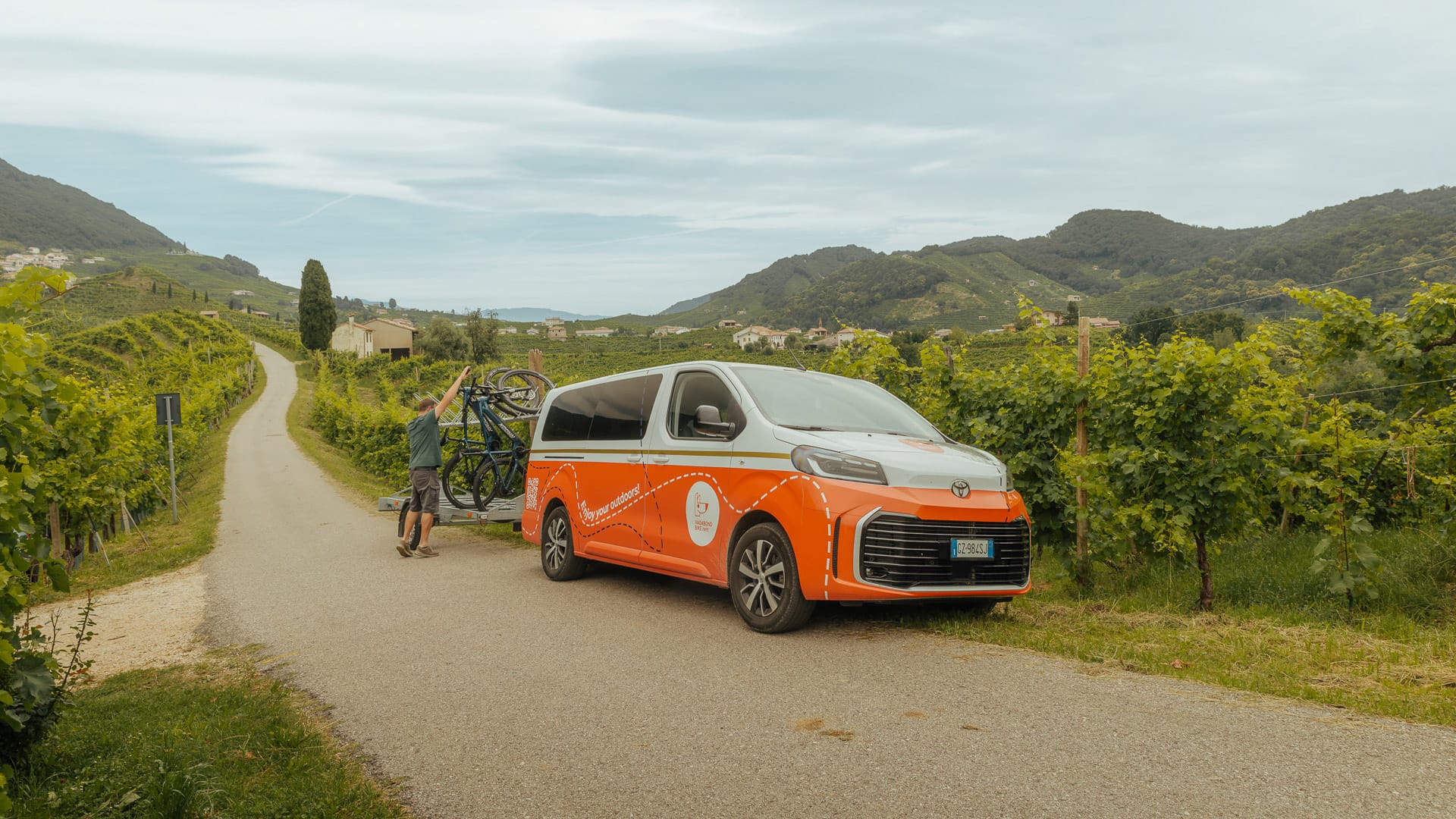
Vagabond support van being loaded with bikes, with the Prosecco Hills in the background (photo credit: Mattia Mionetto via Vagabond Bike)
Winery visits
Small producers here are working farms, not always formal tasting rooms.
If you want to stop for a glass, it is often possible to ride up and ask. If you want a proper visit and tasting, it is better to contact the winery a day or two in advance.
That small bit of planning can make the difference between a quick stop and a much richer experience.
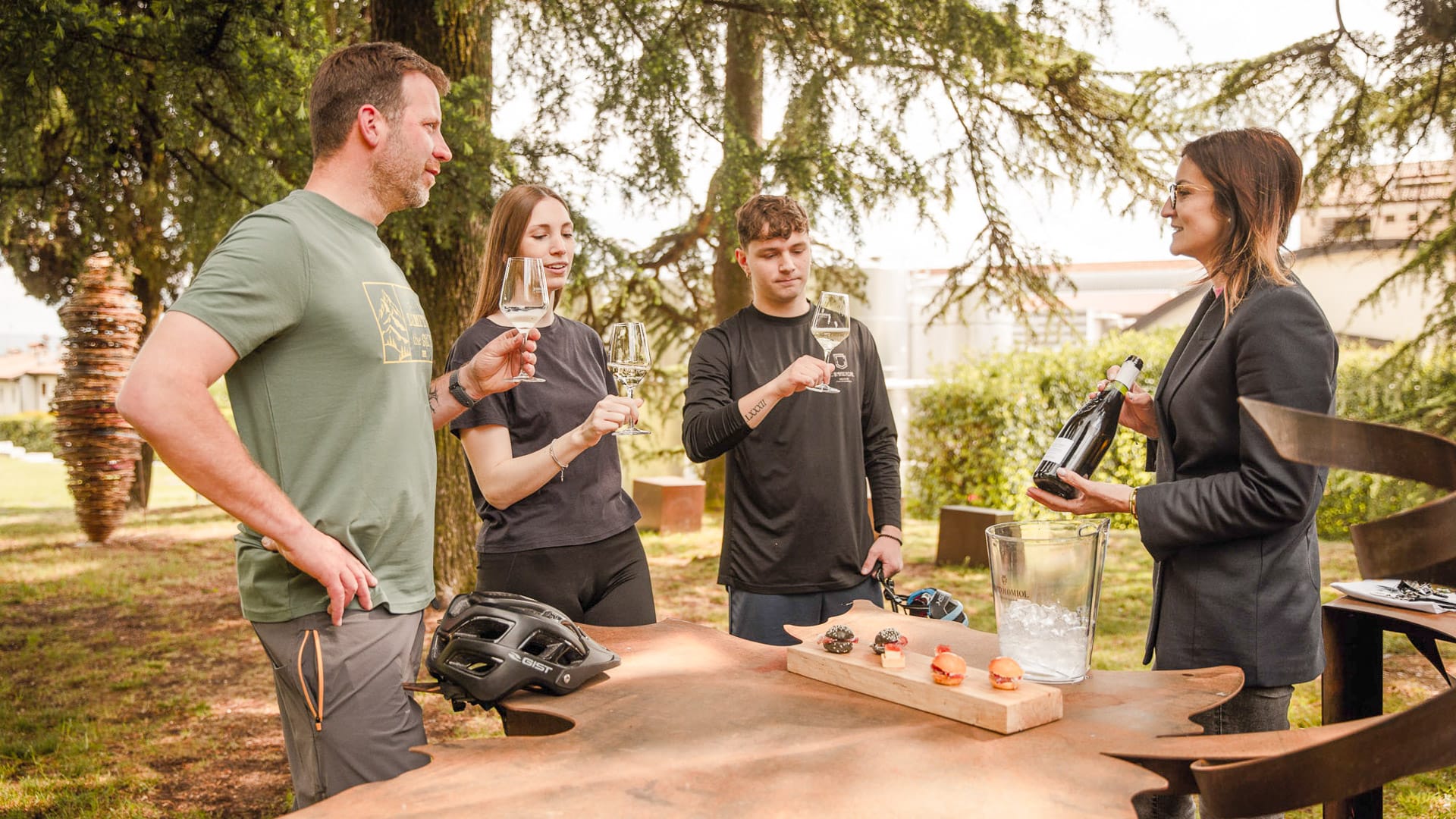
A toast at Parco della Filandetta — the Bortolomiol family’s art-and-wine farm (photo credit: Vagabond Bike)
Weather and clothing
Conditions can change quickly, especially in spring and autumn.
In April, May, September and October, mornings can be cool while afternoons feel warm. A vest, arm warmers, light gloves and a windproof layer are often useful.
Monte Grappa needs particular care. Above 1,500 metres, conditions can feel very different from the valley. Even when the forecast looks good below, it is worth carrying an extra layer for the descent.
Common mistakes visitors make (what not to do!)
The first mistake cyclists often make when cycling the Prosecco Hills is planning too many kilometres!
A 50 kilometre route can easily become a full day once you add a winery stop, lunch, photos and a few unplanned detours.
The second mistake is underestimating the climbs. A short grey line on a map can be a very steep concrete ramp between vineyard terraces.
The third is treating the ride as only a route. Here, the memorable parts often happen in the stops: a cellar, a village bar, a small chapel, a conversation over lunch.
How to get to the Prosecco Hills
Pederobba and the wider Prosecco cycling region are well connected.
Most visitors arrive by air, but the area can also be reached by train or car. The best option depends on where you are travelling from and whether you are bringing your own bike.
Flying to the region
Venice Marco Polo Airport is the main international gateway.
It has long-haul connections and flights from many European cities. From the airport, Pederobba is around 55 minutes by car.
Treviso Airport is smaller but closer, at around 35 minutes by car. It can be a convenient option for riders travelling from the UK and Ireland, particularly on Ryanair routes.
Verona Airport is another useful option. It is around one hour and 30 minutes from Pederobba and can work well if your trip also includes Lake Garda, the Dolomites or other parts of northern Italy.
Travelling by train
The Italian rail network gets you close to the region.
The nearest station to Pederobba is Montebelluna, around ten kilometres away. It sits on the line between Treviso, Feltre and Belluno.
Other useful regional stations include Treviso, Castelfranco Veneto, Conegliano, Bassano del Grappa and Feltre. These can be helpful if you are staying in one of the other cycling bases.
From Venice Marco Polo Airport, one simple route is to take the airport bus to Mestre station and then continue by regional train.
Travelling by car
Driving can be straightforward, especially if you are travelling from northern Europe or combining the Prosecco Hills with other parts of Italy.
From northern Europe, the A22 Brennero motorway is the standard approach. It crosses the Alps from Austria and connects towards the A27 near Belluno, leaving around 30 minutes to reach Pederobba.
From elsewhere in Italy, the A4 Milan-Venice motorway and the A27 Venice-Belluno motorway are the main routes.
Driving from Munich usually takes around five to six hours. From Vienna, allow around six hours. From Milan, it is around three hours.
The Pedemontana Veneta
A useful recent addition is the Pedemontana Veneta, also known as the SPV.
This fast road runs east to west across the foothills, linking the A31 near Vicenza with the A27 in the Treviso area.
It has reduced journey times across the region, particularly for visitors arriving from Vicenza, Verona, Brescia or further west.
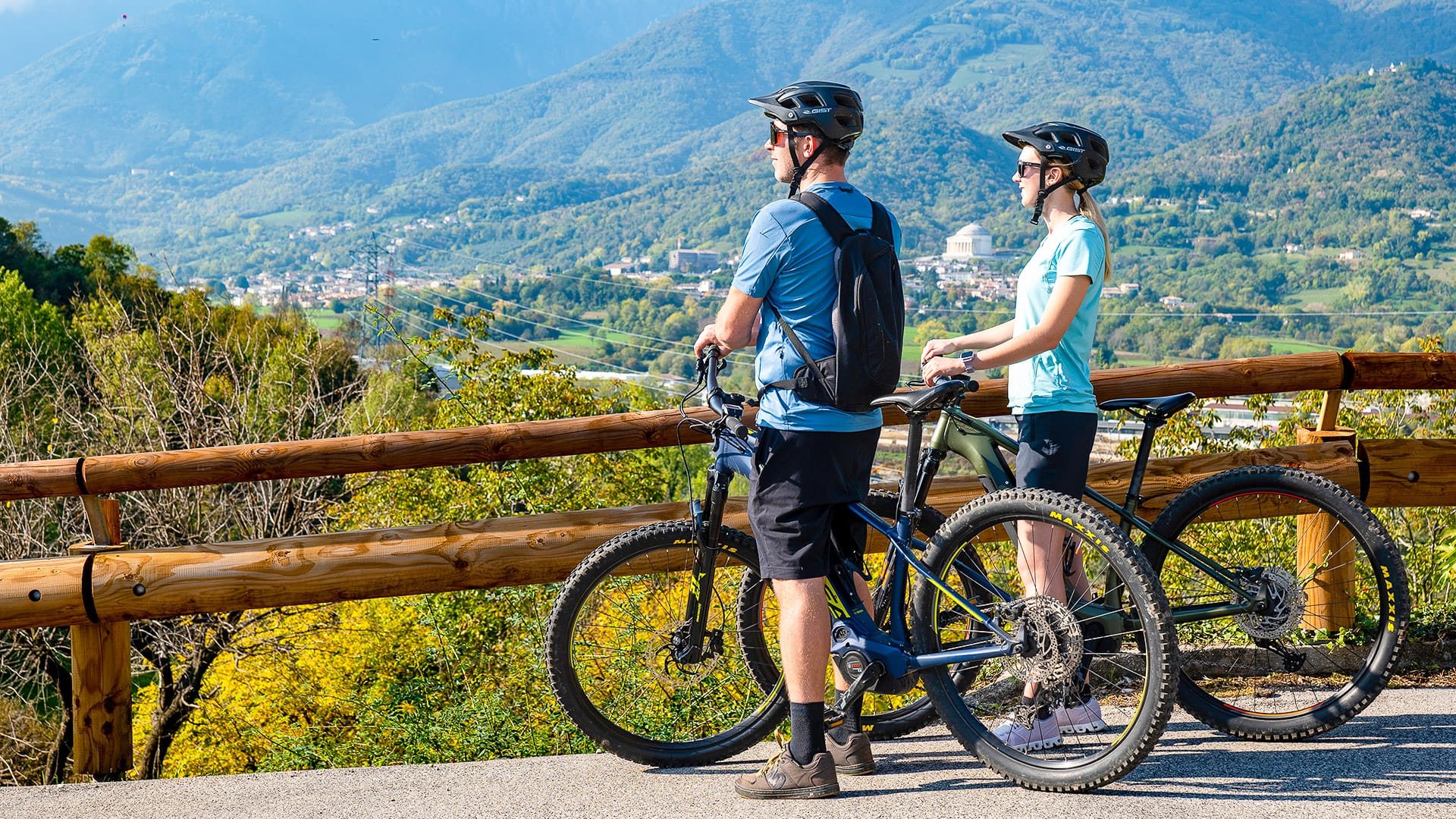
Riding across the Pedemontana Veneta, where the foothills meet the plain (photo credit: Vagabond Bike)
Bike transport and transfers
If you are travelling with your own bike, route planning should include what happens to your bike box.
At Vagabond Bike, we can store bike boxes at our base in Pederobba for the duration of your stay.
We also run transfers from Venice Marco Polo, Treviso and Verona airports, as well as from regional train stations. Our van is fitted with bike racks.
For riders who prefer to travel light, we can also deliver a rental bike to the arrival airport. It will be set up to your size and ready to ride.
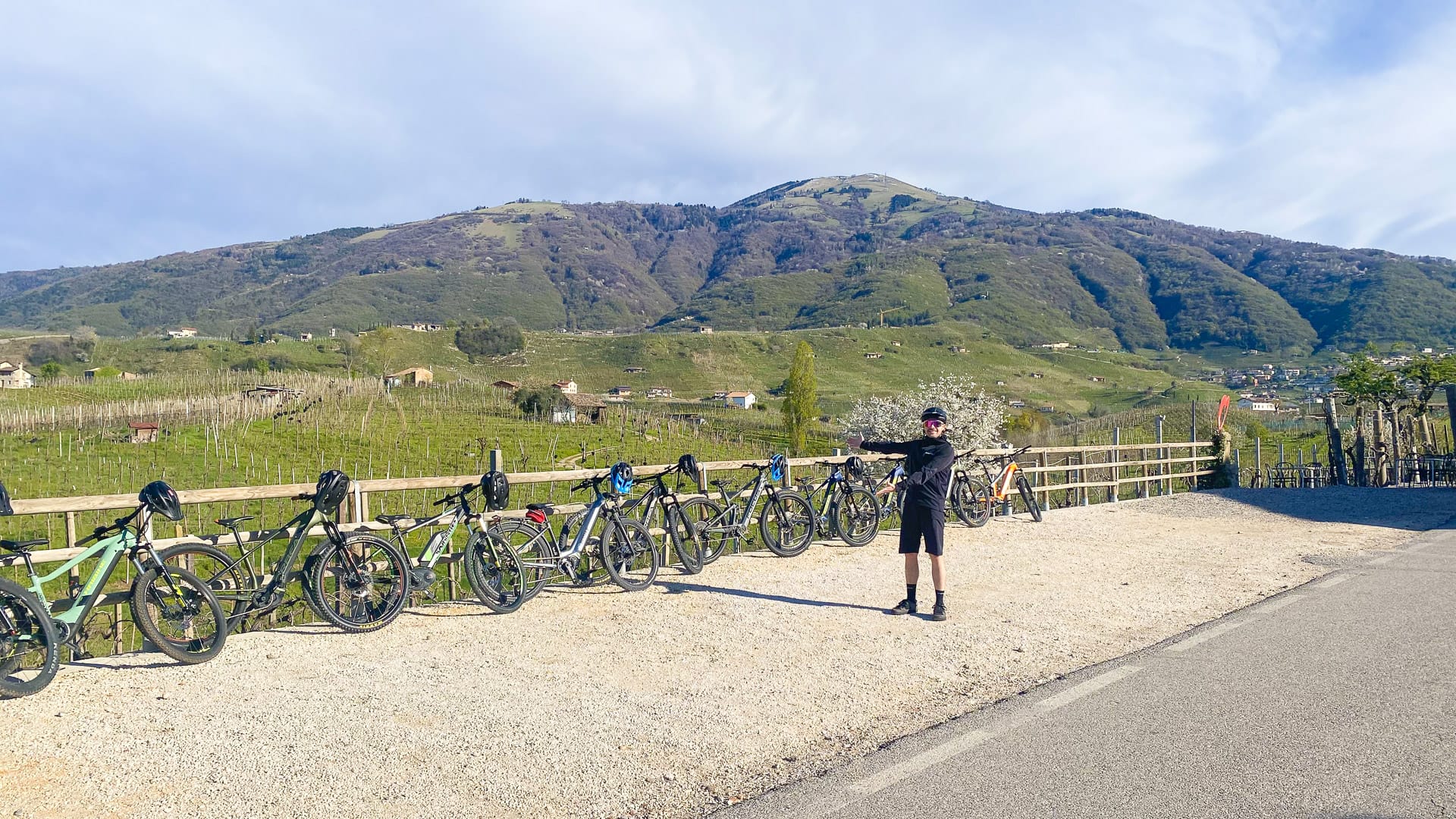
Angelo, our lead guide, delivering bikes to a partner (photo credit: Vagabond Bike)
Travel options at a glance
| Arrival point | Approximate drive time | Notes |
| Treviso Airport | 35 minutes | Closest airport. |
| Venice Marco Polo Airport | 55 minutes | Main international gateway. |
| Verona Airport | One hour and 30 minutes | Useful for wider northern Italy trips. |
| Montebelluna station | Around ten kilometres | Closest station to Pederobba. |
What else is there to do besides cycling?
Cycling is the reason many visitors come here, but the region has plenty to offer when you are off the bike.
That matters if you are planning a rest day, travelling with someone who does not ride, or building a trip that combines cycling with food, wine and culture.
Wine and food
Wine is part of daily life here, not just something for a formal tasting. For cyclists, the wineries that work best are those that are easy to reach on quieter roads, are used to welcoming riders, can be flexible on timing and have somewhere safe for bikes.
Good options include:
- Varaschin, a favourite stop for cyclists on our routes, Varaschin’s Casa Brunoro tasting room in San Pietro di Barbozza is an authentic working winery and one of our bases. Riders are made to feel right at home: it’s the perfect place to pause mid-ride, with your bikes safe and in sight while you enjoy a relaxed tasting.
- Bortolomiol in Valdobbiadene is another good stop. It is a historic house with wine and art at Parco della Filandetta, and is easy to include as part of a ride.
- Locanda Sandi, also in Valdobbiadene, is linked with the Sandi winery and is very used to riders.
- Tenuta Amadio in Monfumo is also a handy stop on a ride, though it is best to give around 30 minutes’ notice.
The best way to understand the Prosecco Hills is to ride through them. Each hill has its own exposure, soil and way of working. Some producers are large family businesses that have grown over generations. Others are small vignaioli where you may find yourself sitting at the family table.
Food follows the same pattern. The local mainstays are sopressa, cheese, polenta, bigoli al ragù, risotto and the working dishes of the Veneto kitchen.
The hills between Cavaso del Tomba, Possagno and Maser are also a small olive oil area. It surprises many visitors because we are so far north.
There are two simple things I think more people should try here: cicchetti and tramezzini. Both come from the Veneto’s bar tradition. They are quick, informal and often much better than visitors expect.
Cyclist-friendly food stops vary depending on where you are riding.
Around Prosecco and Valdobbiadene, some of the best places include:
- Ristoro Fontanazze in Guia
- Trattoria alla Cima
- Osteria Da Maria on Via Follo in Santo Stefano
- Le Tre Noghere in Bigolino
In the Pedemontana and Monfumo area, options include:
- Da Gerry, Al Capitello in Monfumo
- Osteria Al Canton in Nogarè/Crocetta
- Pizzeria Da Lino in Covolo
- Osteria Dall’Armi in Monfumo
Around Asolo, Porchetta a Manetta is a good informal stop. On Montello, Ecosteria Parco Santi Angeli works well, while on Monte Grappa, Da Miet near Cavaso/Monte Tomba and the seasonal Malga Domador are useful names to know. Near the Piave, Locanda Solagna is another strong option.
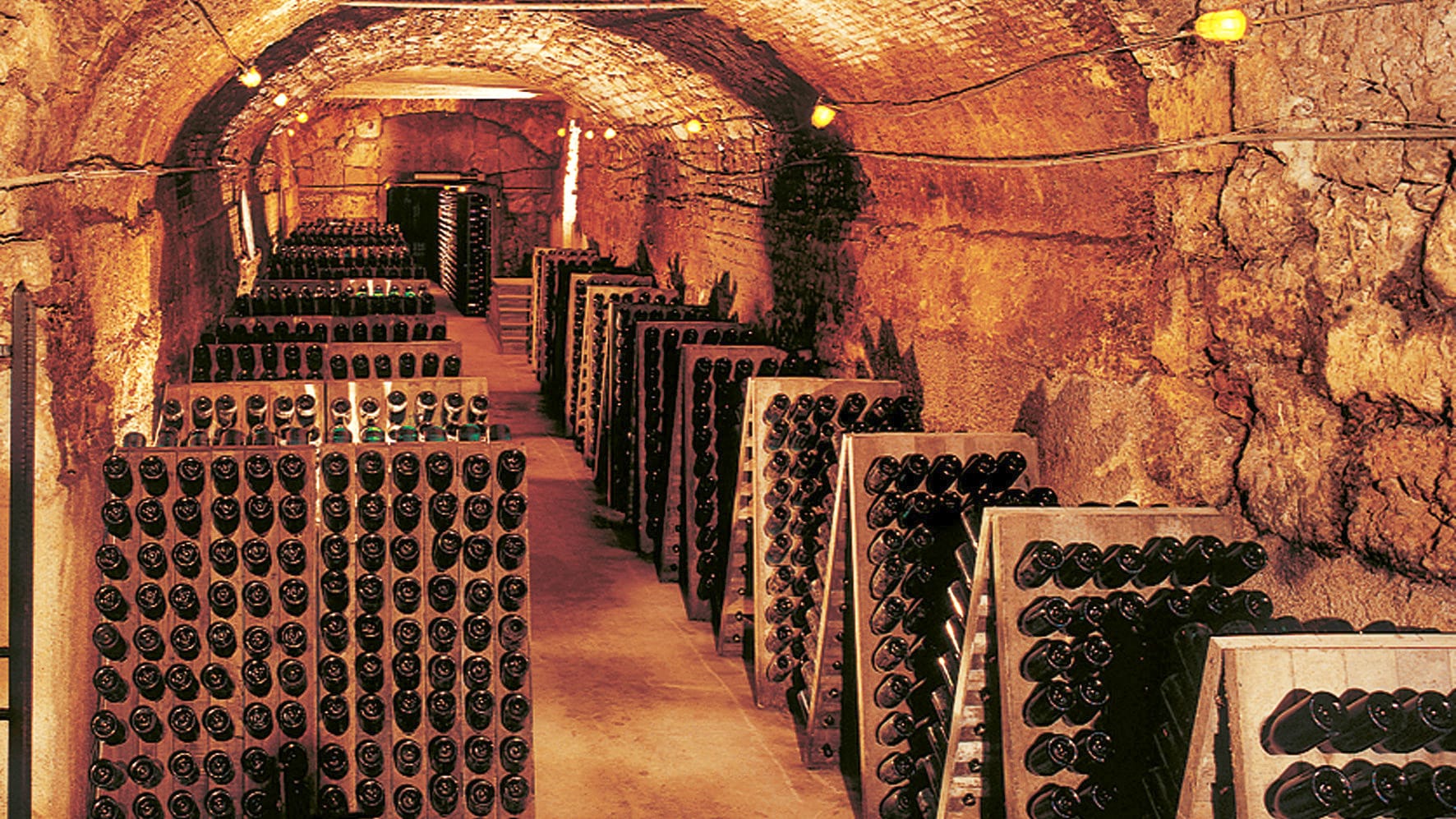
Villa Sandi – the historic Palladian winery (photo credit: Vagabond Bike)
Walks, villages and quieter places
The footpath network on Monte Grappa is one of the great walking areas of the Veneto.
There are open ridges, beech woods and working malghe where you can stop for local cheeses such as Morlacco and Bastardo del Grappa. Both are Slow Food Presidia.
Down in the hills, the Abbazia di Follina has one of the most beautiful Romanesque cloisters in Italy. Nearby, Cison di Valmarino is one of Italy’s Borghi più belli, with its mill stream and the Molinetto della Croda tucked into a small gorge.
There are also smaller places that many cycling visitors miss. Tiny country chapels sit on hilltops. Near Possagno, the Giardino Vegetazionale del Lastego is a good short walk on a rest morning. Along the Piave River, the Oasi delle Fontane Bianche is a quiet wetland of cold-water springs and clear pools.
For families, several local fattorie didattiche open their doors to children. These educational farms offer a simple way to understand how the countryside works, from animals to cheese-making.
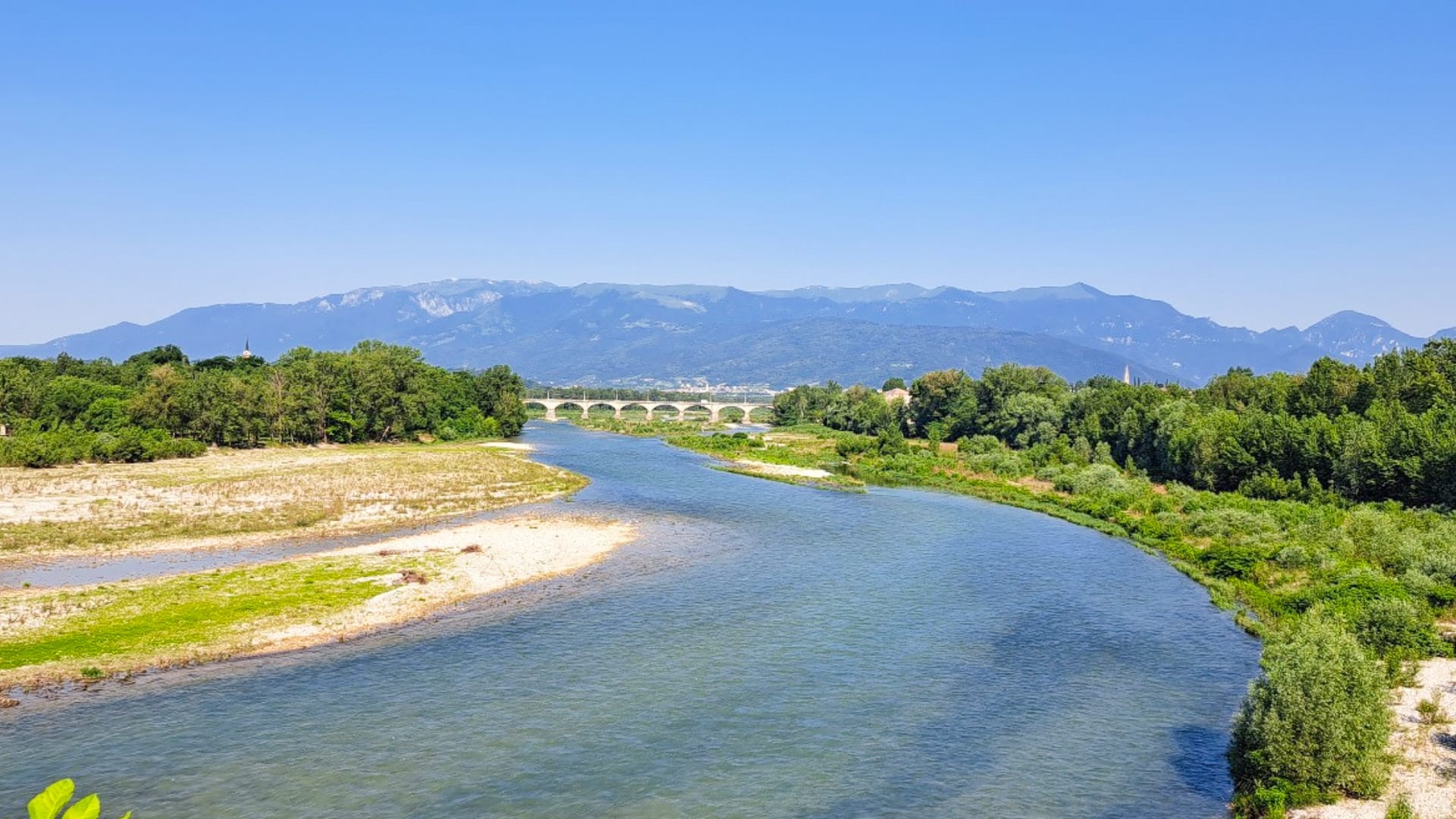
Riding alongside the Piave river – the spine that divides the Prosecco Hills from the Colli Asolani (photo credit: Vagabond Bike)
Day trips from the Prosecco Hills
The region also works well as a base for wider exploring.
The Belluno Dolomites are about half an hour away by car. Lake Santa Croce, the Brent de l’Art canyon and the high passes are all within reach.
Venice and Treviso are straightforward day trips. Padova is roughly an hour away by car.
If you want to leave the ground, Borso del Grappa is widely regarded as one of Italy’s leading paragliding destinations. The area also has several outdoor and sportswear outlets, including La Sportiva, Lotto, Diadora, The North Face, Northwave and Salewa, mostly within about half an hour by car.
Local events and village life
Beyond the larger cycling events, the region has a busy calendar of local food, wine and cultural events.
In spring, the Primavera del Prosecco Superiore runs through the DOCG villages, with wine exhibitions hosted by local Pro Loco associations.
In summer, Bassano del Grappa’s Opera Estate Festival brings dance, theatre, music and other performances to venues across the Pedemontana.
In autumn, Pederobba hosts the Mostra dei Marroni del Monfenera. It is built around the local IGP chestnut, roasted chestnuts, polenta, spiedo and vino novello.
Across the warmer months, there are also sagre almost every weekend. These village food and wine fairs are usually outdoors, with communal tables, grilled food and local wine.
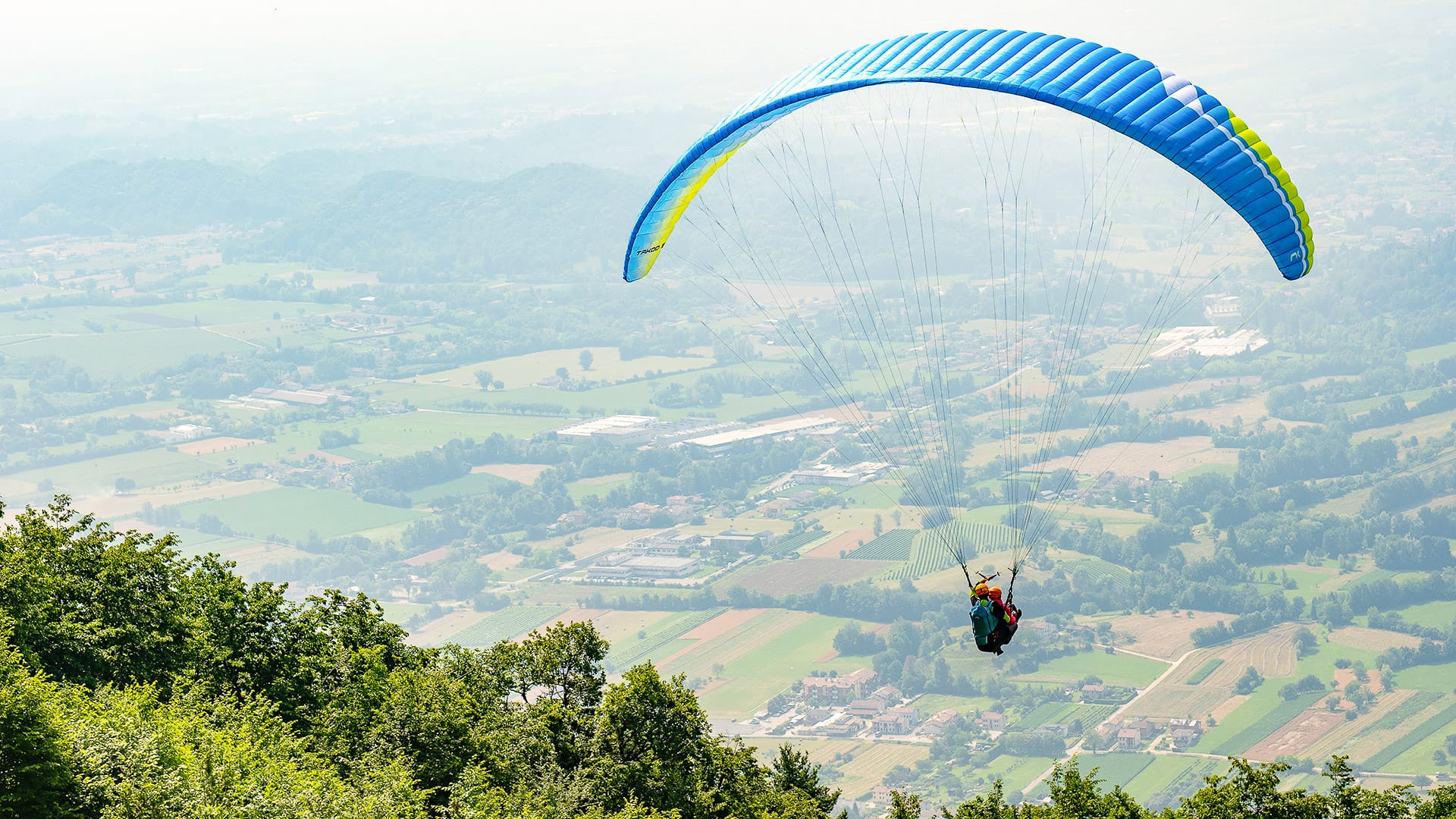
Paragliders launching from Borso del Grappa – Italy’s paragliding capital sits just up the hill from us (photo credit: Vagabond Bike)
Sponsor Message
Considering cycling in the Prosecco Hills?
Vagabond has been helping cyclists explore Italy's Prosecco Hills since 2020.
They offer bike hire, self-guided and guided cycling tours, as well as bespoke multi-day cycling trips tailored to your interests and riding style.
Interested? Head to the Vagabond website to find out more, including dates and prices.
Got a question for Massimo Cavalli from Vagabond Bike?
Fill out this form and we will pass it to Vagabond Bike who aim to reply (within 24 hours wherever they can!)
Part 7: Planning your Prosecco cycling trip with Vagabond Bike
About Vagabond Bike
Vagabond began as a small bike rental business in Pederobba in 2020.
Over time, many visitors also asked for help understanding where to ride, where to stay and how to link the best parts of the region together.
Today, we still keep the company deliberately small. Vagabond Bike is run by a core team of four year-round: me, Massimo Cavalli, founder, plus Elena, Corrado and Riccardo.
- Elena is usually the main point of contact for itinerary planning, including accommodation, lunches, tastings and transfers.
- Corrado keeps the operation moving on the ground.
- Riccardo looks after the website and marketing from Germany.
Our guides join the team seasonally. Angelo is our lead guide, while Paolo guides the MTB enduro groups. Clients deal with us directly, which is important to us. We do not want the business to feel like a big tour company where people are passed from one department to another.
We also purposely run a low number of trips at any one time. At most, we run two multi-day trips in parallel, and no more than four groups are out at the same time. Guided groups are capped at eight riders per guide, because we do not think a guide can properly look after more than that.
This means guests are not passed between departments; the same local team that helps plan the trip is also involved in the practical details on the ground.
Bike hire
Bike hire remains part of what we do.
From our base in Pederobba, we offer road bikes, gravel bikes and front- or full-suspension e-bike rental. Our fleet is made up of reliable bikes we know work well for this terrain, including Wilier road bikes, Commençal gravel and full-suspension trail/enduro bikes, Orbea and Radon front-suspension mountain bikes, and front-suspension e-bikes. We offer all sizes.
Please note that we do not offer non-electric mountain bikes. Our non-electric bike hire is strictly limited to road and gravel models.
Accessories are included, including helmets, locks, e-bike chargers and panniers. Every bike also goes out with a self-repair kit. Pedals are available as flat or SPD, and we can fit your own pedals on request.
We also help with sizing, route choice and practical support during the ride. That practical support includes minor mechanical help and workshop back-up from Corrado, a replacement bike if needed, route advice, WhatsApp or phone support during the ride and emergency collection by van. The exact level of support depends on the product chosen, but the aim is always to get riders help as quickly as possible.
For visitors who want to travel light, we can arrange bike delivery to the arrival airport or another agreed location. We deliver to Venice (VCE), Treviso (TSF) and Verona (VRN) airports, as well as to your accommodation. The cost depends on distance and is quoted on a case-by-case basis. We always propose three options.
Bikes can also be collected from a different agreed location at the end of the trip, which is useful for one-way itineraries.
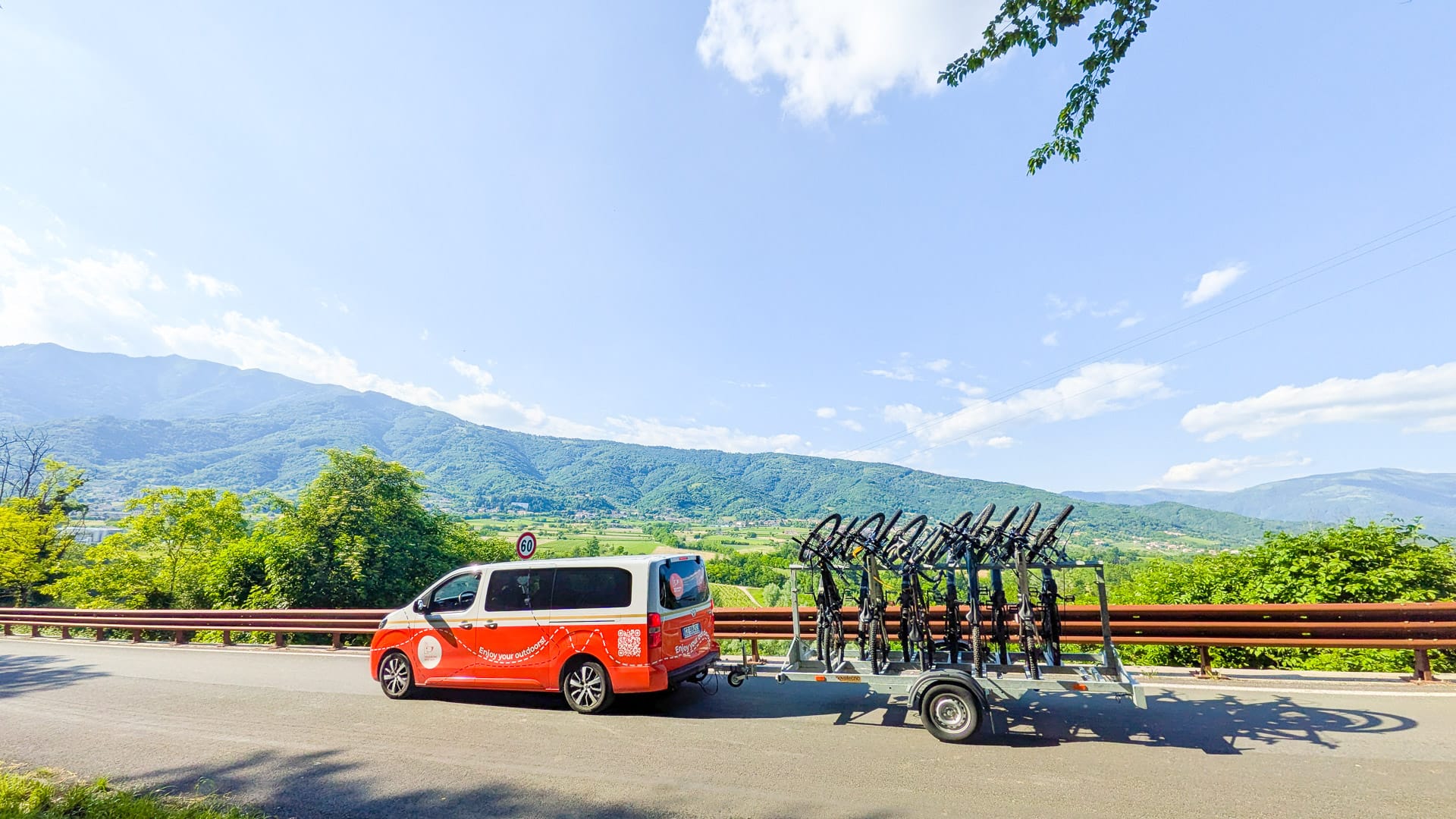
Loaded up and ready to roll – the Electric Proace and the trailer en route across the hills (photo credit: Vagabond Bike)
Self-guided rides
Our most popular format is self-guided riding.
We plan the route, provide GPX files and help organise the details around the ride. Our standard self-guided product includes the route on Komoot, or Ride with GPS where appropriate, plus a Vagabond Route Guide PDF. These routes are chosen from our proven standard routes, with small custom tweaks where needed. We also help plan cellar stops and lunches, and provide phone and WhatsApp support during the ride.
- Riders travel at their own pace, with local support available if needed. That support can include WhatsApp or phone help during the ride, mechanical advice using the self-repair kit and workshop back-up, route changes, restaurant and winery tips, weather-related adjustments, help arranging taxis or transfers, and support with luggage issues.
- Every route we give to clients has been ridden by us. We do not hand out tracks we have not tested ourselves, and this is an important point of pride for Vagabond Bike.
- Alongside the GPX files, riders receive our Vagabond Route Guide. This is a one-page branded guide with the route, key metrics, waypoints and points of interest, suggested stops for coffee, lunch and cellar visits, climbs, water points, hazards, train stations, bail-out or exit options and our support contacts.
- Self-guided rides run on custom dates, so you choose when you come. We do not run fixed self-guided departures. Trips can range from a single day to a weekend or a week-long itinerary.
Self-guided riding works best for riders who are confident enough to ride independently and can tell us their level. We then match the route accordingly, from easier options to more adventurous road, gravel or e-bike rides. If riders would rather not assess their own ability, we usually point them towards a guided ride or an entry-level option.
If a trip also needs accommodation booking, transfers or a fully custom route, we are happy to help and then it becomes a more bespoke product – more details below.
Find out more about self-guided bike trips on this page of Vagabond’s website.
Example: Le Meraviglie del Prosecco – a self-guided day ride
A 40-kilometre loop in the heart of the UNESCO DOCG, starting in Guia di Valdobbiadene: 40.3 km, 880 m of climbing, on gravel and quiet country roads. The route visits the Sanctuary of Collagù, Rolle, Cison di Valmarino and the Abbazia di Follina, and includes a stop at the Osteria senz’oste – the “Inn without an innkeeper”, a Prosecco-hills institution. We hand you the GPX, a route guide, a list of cellars you can drop into along the way, and the number you can call if anything happens. The bike is yours for the day; the ride is yours. Our most popular self-guided day ride.
Guided rides
Guided rides suit cyclists who want company, context and flexibility during the day.
Our lead guide Angelo knows the roads, trails and mountain routes extremely well. A guide can help riders avoid busy roads, adjust the route if conditions change and understand more about the places they are riding through.
- The exact style of guiding depends on the group, but the guide will always lead the ride, keep you away from the busier roads, adapt the route to the conditions, share local and cultural context and help with minor mechanicals.
- Some groups prefer to ride closely together, while others prefer a little more freedom with scheduled meeting points along the way. We decide this together, depending on the riders and the kind of day they want.
- Guided rides can be offered in English, Italian and Spanish. They can be private rides or scheduled group rides, with a maximum of eight riders per guide. We do not think a guide can properly look after more than this.
- Guided tours can cover every area we ride, including the Prosecco Hills, Monte Grappa, Asolo, the Piave and the Montello. This can be particularly useful on Monte Grappa, on gravel routes and for visitors who want to include local stops without spending time planning them in advance.
- Guided rides can also include wine tastings and lunches during the day, which we pre-book in advance.
Find out more about guided bike trips on this page of Vagabond’s website.
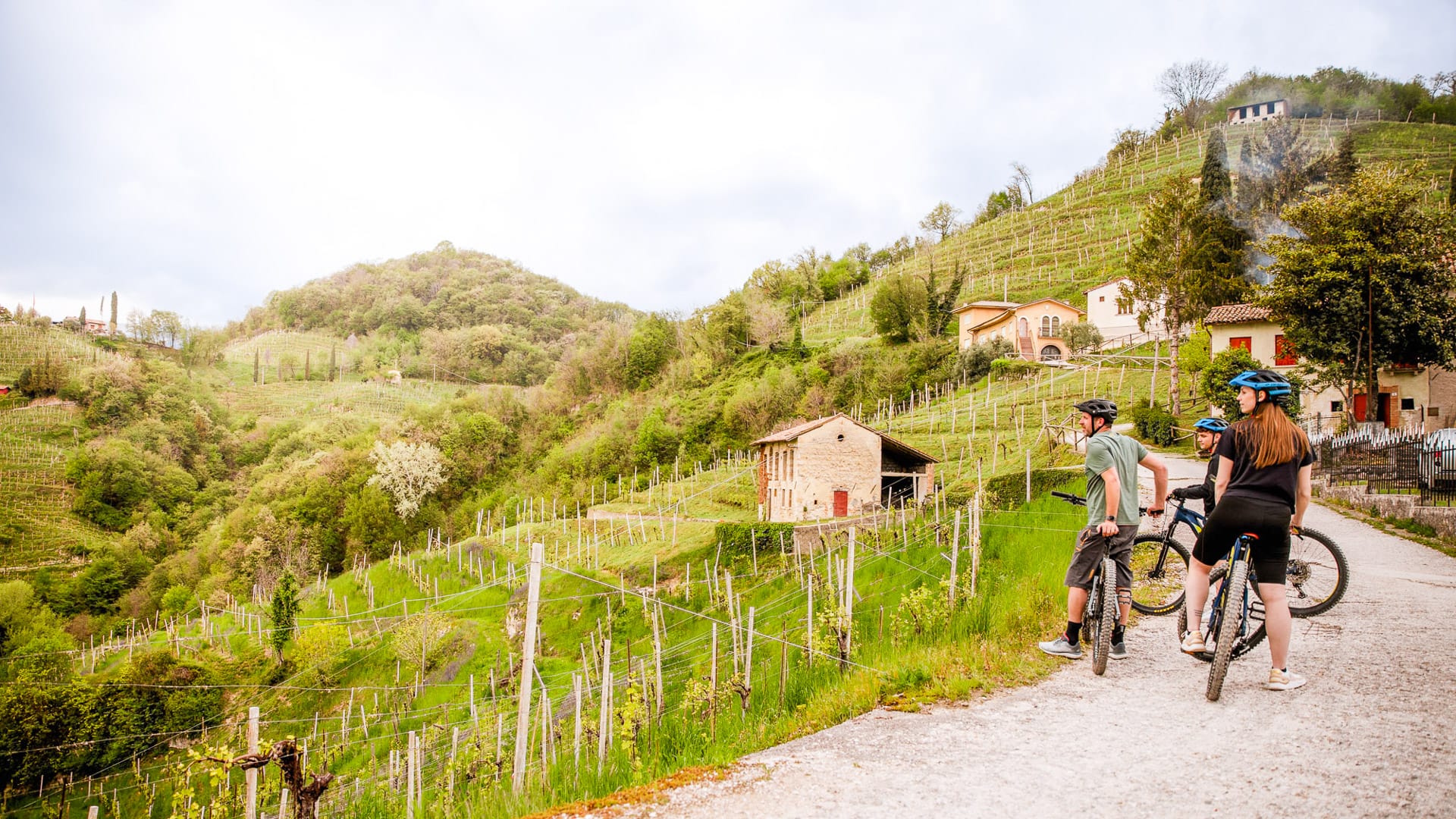
E-bike pause at Collagù (photo credit: Vagabond Bike)
Example: Climbing the Grappa with Angelo – a guided day
A guided day on Monte Grappa with our lead guide Angelo – for riders who want the company of someone who knows every fork, every climb and every rifugio on the mountain. The route varies depending on the group: the Bike Tour delle Malghe del Grappa (50 km, 1,660 m of climbing, starting from Pederobba) is the classic – Strada degli Alpini, Monte Palon, the high malghe loop, the long descent down the Monfenera. Stops at the malghe for cheese, a pause at the Sacrario if the group wants it, and the kind of conversation that comes with riding mountain roads alongside a guide who’s done them a thousand times. For riders who want the high-altitude experience without planning it themselves.
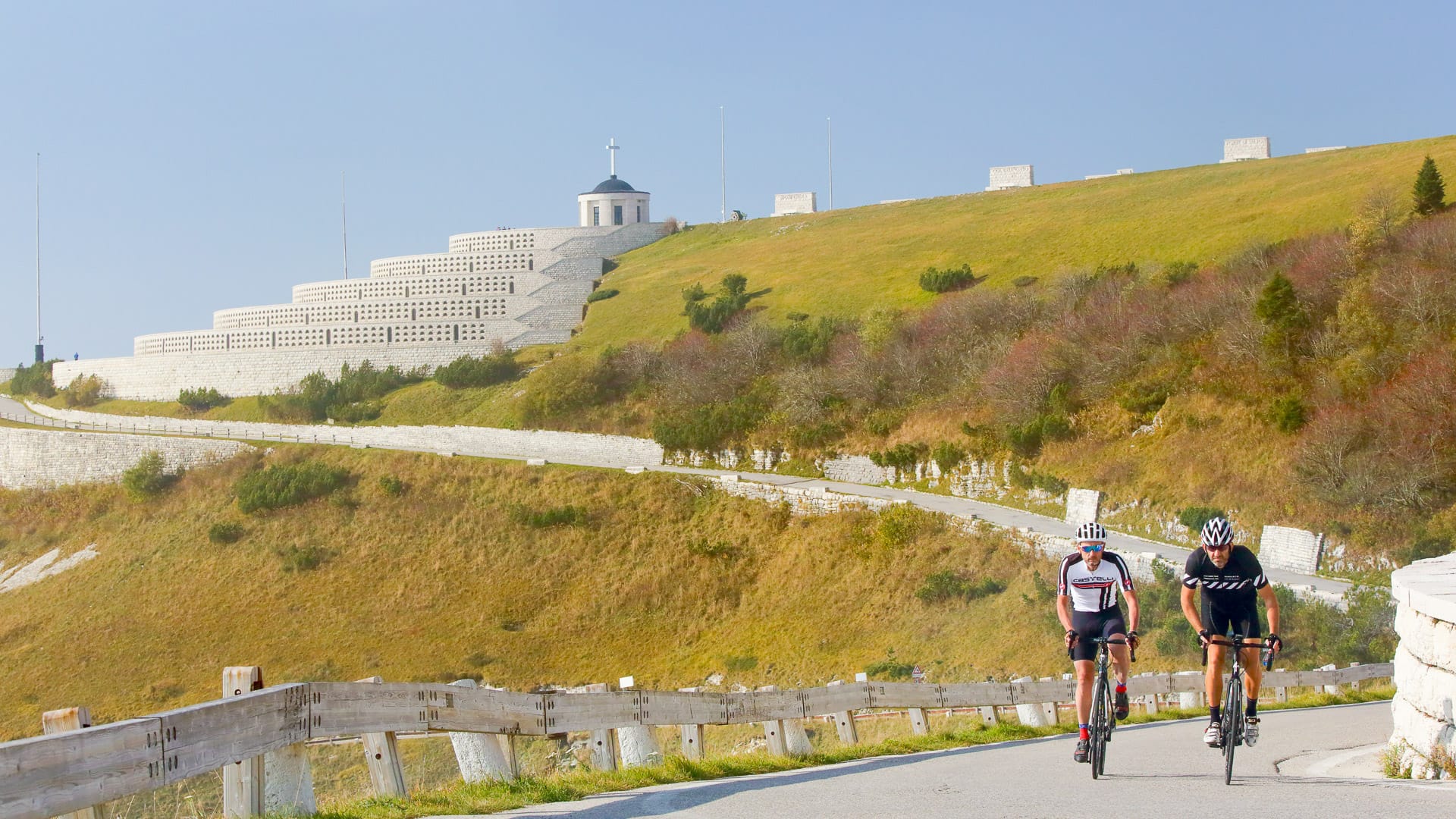
Two road cyclists climbing towards the Sacrario of Monte Grappa, the ossuary visible above (photo credit: Vagabond Bike)
Bespoke multi-day trips
For longer cycling holidays, we build multi-day itineraries around the rider, group or tour operator.
These trips might combine guided and self-guided days, more than one base, different bike types and a mix of riding, food, wine and cultural stops.
For example, we might design a three-day Prosecco Hills trip with easier days, vineyards and tastings; a week-long route linking Prosecco, Asolo, Bassano, the Piave and the Montello, with an optional Monte Grappa bonus; or a gravel-focused itinerary. It always depends on what the rider wants. Adapting is what we are good at.
- Most multi-day trips run from three to seven days, with three days as the usual minimum. Daily distances and elevation can vary a lot. We can plan gentle e-bike days of around 30 to 50 kilometres with little climbing, through to demanding road days of more than 100 kilometres and over 1,500 metres of climbing, including Monte Grappa. The trip can be tailored for leisure cyclists, stronger riders and mixed-ability groups.
- Accommodation is chosen to match the trip. We use a mix of agriturismi, wine estates and boutique hotels, as well as higher-end properties up to five-star Relais & Châteaux or Small Luxury Hotels, depending on the style of the holiday. The key is that each place looks after cyclists well.
- We also book restaurants, wineries and tastings directly through our partners. Tastings are usually paid locally, unless they are already included in the package.
- We can also support non-riding partners and mixed groups, including groups where some riders are on e-bikes, and others are on road or gravel bikes. For non-riders, we can arrange a culture, wine and food programme, as well as transfers.
Find out more about bespoke multi-day bike trips on this page of Vagabond’s website.
Example: Five-day bespoke – built around you
Our most carefully designed product. A five-day trip on the bike – typically with a mix of guided and self-guided days – built around what you tell us: the kind of riding you want, the wine you want to drink, the kitchens you want to sit at, the hotels you want to wake up in. We organise everything from the GPX files to the cellar visits, the lunches, the boutique hotels, the transfers between bases. A different shape for each guest, a different itinerary every time. This is the format we use for high-end international tour operators and for private guests who want a fully built trip.
If you only have one day, we would prioritise the Prosecco Hills. If you have three days, our ideal combination would be one day in the Prosecco Hills, one around Asolo and one on Monte Grappa.
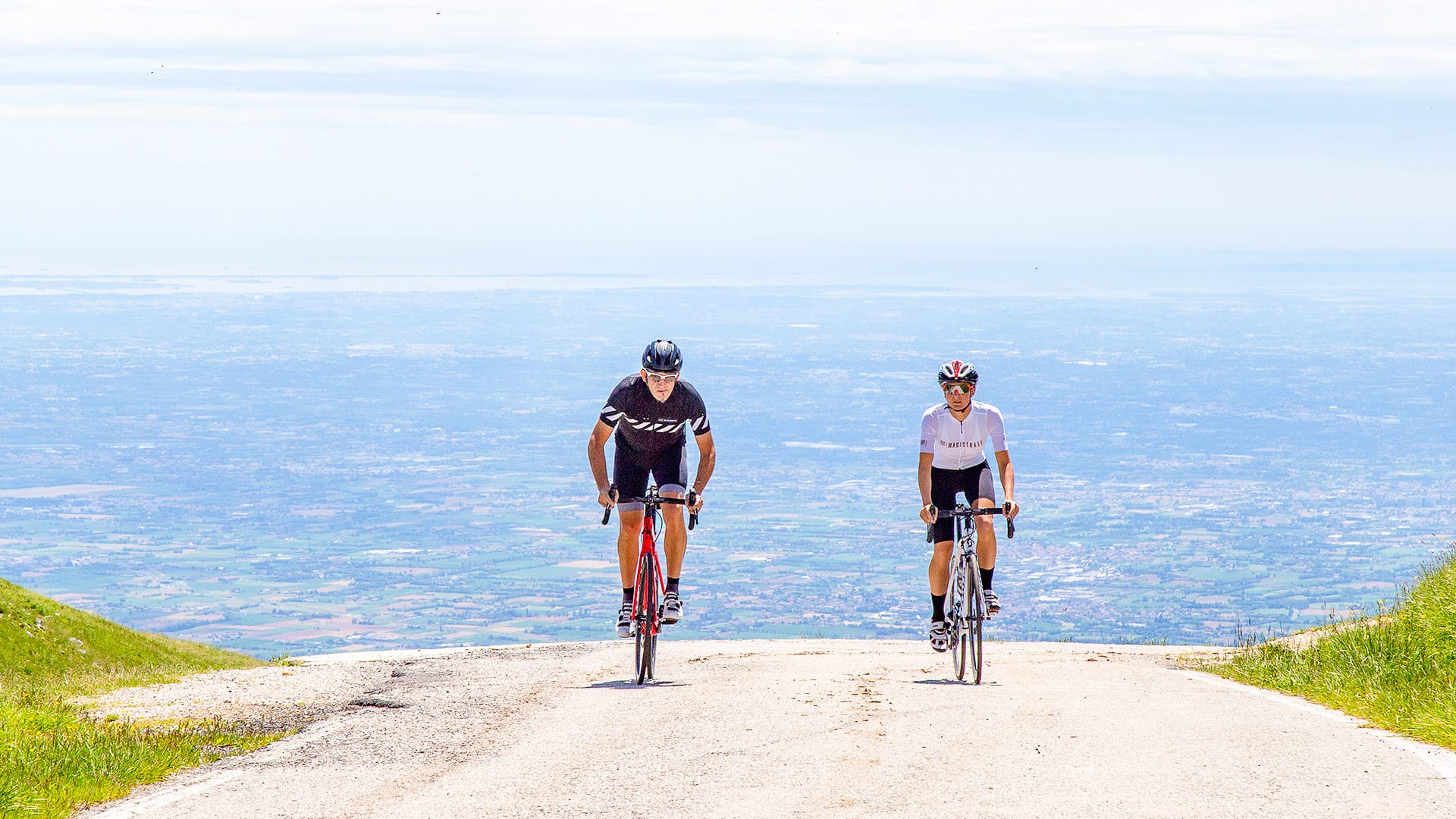
Road cyclists on Monte Grappa (photo credit: Vagabond Bike)
A trip that starts with a conversation
The starting point is always the same.
We ask what kind of trip people want. How much do they want to climb? Do they prefer road, gravel or e-bike riding? Do they want long days, shorter rides, winery stops, good lunches or a mix of everything?
After that first conversation, we send a proposed itinerary. You can then ask for changes, and we refine it from there. Usually, two rounds of revisions are enough, though we can go up to four where needed.
For single-day rides, getting in touch three or four days ahead is usually enough. For multi-day trips, around 15 days is better, and earlier is always advisable in peak season.
When you first contact us, it helps to share your dates, group size, riding level, preferred bike type, preferred daily distance and elevation, accommodation style and how much you want to include wine, food or culture. Once we understand that, the itinerary follows.
For me, that is the most important part of the work. The bike is the tool, but the route, pace and stops need to fit the people riding through the region.
The aim is for riders to spend less time worrying about logistics and more time enjoying the roads, views, food and wine of the Prosecco Hills.
Get in touch
If you are planning a Prosecco cycling trip and want help with bike hire, routes, guided rides or a multi-day itinerary, you can find out more at Vagabond Bike.
Contact Vagabond with your dates, group size and the kind of riding you have in mind, and the team will love to suggest the best way to experience the Prosecco Hills (and beyond!) by bike.
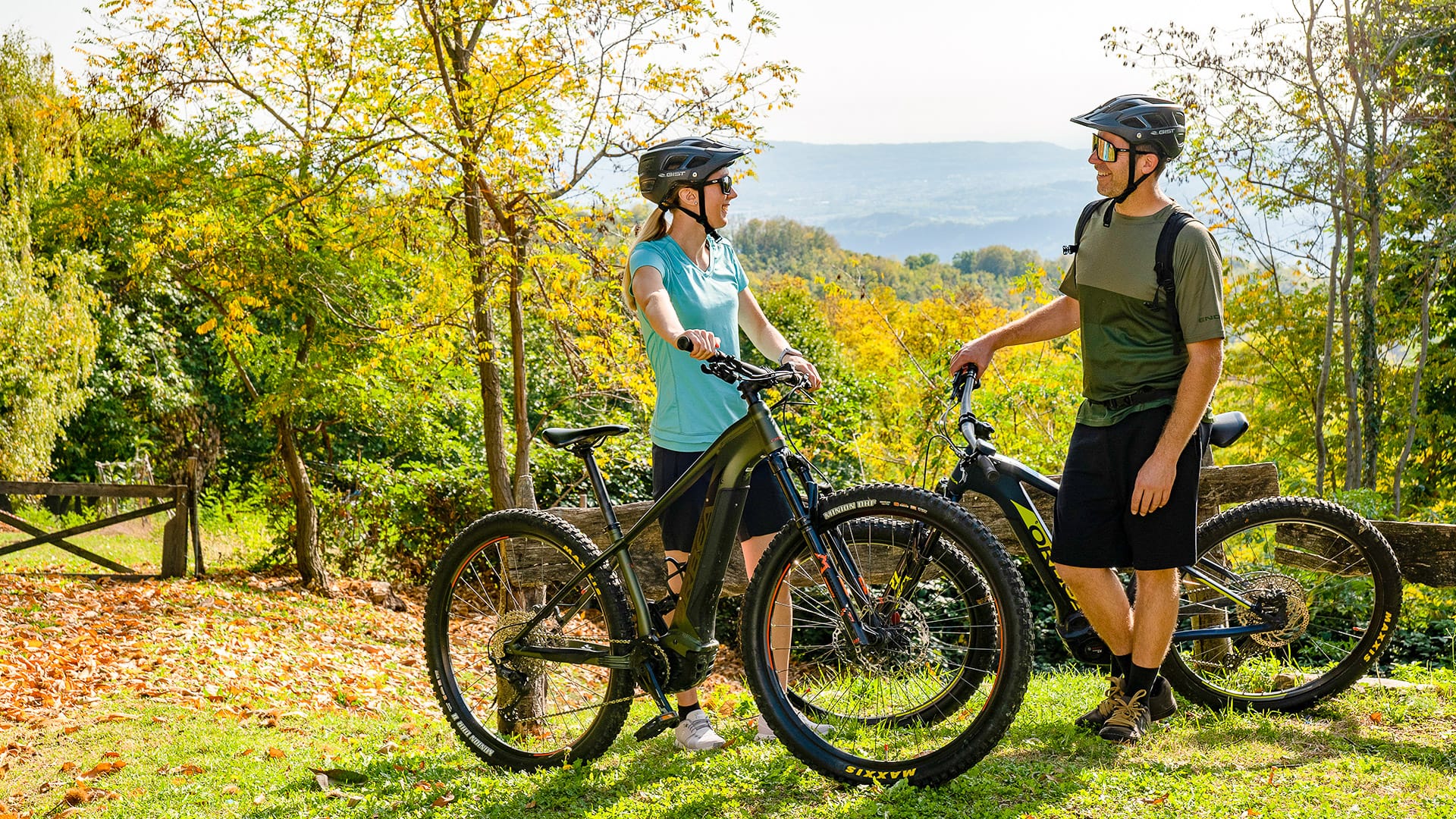
Taking a break (photo credit: Vagabond Bike)
What’s next?
Huge thanks to Massimo Cavalli for sharing these insights into cycling in the Prosecco Hills.
Looking for more exciting content on cycling in Italy? Don’t miss:
- Cycling Italy, our central hub for the country
- Cycling the Italian Lakes: an insider’s guide, for the best bases and routes
- Cycling Tuscany, for cycling highlights and tips
- Cycling Stelvio Pass region, Italian Alps: your ultimate guide, including the easy routes and bike hire tips
- Cycling Verona, for the things you know before cycling in this UNESCO World Heritage city
- Cycling Sardinia, for the best regions and routes in the island
- 3 of the best bike tours in Italy, our pick of the best tours in the country
Got a question for Vagabond Bike?
Fill out this form and we will pass it to Vagabond Bike who aim to reply (within 24 hours wherever they can!)
Got a question for Massimo?
Fill out this form and we will send it to Massimo. We aim to get you an answer within 24 hours where possible!Massimo Cavalli is the founder of Vagabond Bike. Born in Pederobba, between the Prosecco Hills and Monte Grappa, he spent his twenties and thirties in Venice, coaching youth basketball. He came back to Pederobba at 40, having never stopped running in these hills, and started Vagabond in 2020 as a small bike rental business.
Massimo quickly realised that guests had no idea where to ride, and that the back roads, hidden cellars and small trattorie of the region were the real value he could share. From there, Vagabond shifted: today the team designs cycling experiences, from a self-guided day in the Prosecco Hills to fully built five-day trips, for guests from across Europe, North America and beyond. The company is small on purpose, with a deep love for the territory, and works to human rhythms. Massimo says, "I kept stats when I was coaching basketball; on the bike I've never wanted to. Here it's about discovery, not numbers."
Massimo coordinates the company alongside Elena (itineraries), Angelo (lead guide), Corrado (operations) and Riccardo (website and marketing).
Photo credit: Vagabond Bike
First Published: 24 June 2026
This article includes details of products and/or services that we have used ourselves or which we would consider using. Some are paid features or include affiliate links or referral codes which we may earn commission from. As an Amazon Associate we earn from qualifying purchases. Please read our disclosure policy for further information.
The contents of this website are provided for general information purposes only. It is not intended to amount to advice and you should not rely on it. You should carry out your own due diligence and risk assessments and take professional advice. Views expressed by interviewees or other users of this website do not necessarily represent our views. We make no representations, warranties or guarantees, whether express or implied, that the content on our website is accurate, complete or up to date. If you use any information or content on this website, download from, or otherwise obtain content or services through our website, it is entirely at your own discretion and risk. Epic Road Rides Ltd disclaims all liability and responsibility arising from any reliance placed on the information and content on this website. Find out more here.
Sponsor Message
Considering cycling in the Prosecco Hills?
Vagabond has been helping cyclists explore Italy's Prosecco Hills since 2020.
They offer bike hire, self-guided and guided cycling tours, as well as bespoke multi-day cycling trips tailored to your interests and riding style.
Interested? Head to the Vagabond website to find out more, including dates and prices.
Got a question for Massimo Cavalli from Vagabond Bike?
Fill out this form and we will pass it to Vagabond Bike who aim to reply (within 24 hours wherever they can!)